
Exposure of corpses
Human beings, unlike other animals, care for their dead and their corpses. This has been attested since the Palaeolithic. The ways and customs with which the various peoples face the fact of death and treat the bodies are many and varied. No doubt these rites are the result of the bewilderment that death causes in all living beings; people seek immortality but man is confronted with the decomposition of the body. It is therefore necessary to perform rites to avoid the process of decomposition . In Walter Burkert's words, Homo sapiens is a homo sepeliens (from Latin sepelio, to bury), a man who buries his dead.
In our cultural environment we are familiar with the burial, interment, inhumation (from Latin in, in, and humus, earth) and the cremation (from Latin cremationem, burning) or incineration (from Lat. in, into, and cinerem, ash: conversion into ash). Incidentally, cremation or incineration has been growing in Spain for only a few decades. In ancient Greece and Rome both forms coexisted, in Greece cremation began to be practiced after the Mycenaean era; it already existed in the second millennium BC among the Hittites and Hurrians or in Troy VI.
Well, Herodotus, for example, offers an early reflection on the variety of rites and customs according to the peoples, in an anecdote about the Persians, whose empire was composed of diverse peoples. He tells us in his Histories, III, 38:
When Darius was king, he summoned the Greeks who were with him and asked them for what price they would eat their fathers' dead bodies. They answered that there was no price for which they would do it. Then Darius summoned those Indians who are called Callatiae, who eat their parents, and asked them (the Greeks being present and understanding through interpreters what was said) what would make them willing to burn their fathers at death. The Indians cried aloud, that he should not speak of so horrid an act. So firmly rooted are these beliefs; and it is, I think, rightly said in Pindar's poem that custom is lord of all. (translation by A. D. Godley)
And Cicero also provides an interesting text, Disputationes Tusculanae (Tusculan Disputations), I, XLV, 108:
But what occasion is there to animadvert on the opinions of individuals, when we may observe whole nations to fall into all sorts of errors? The Egyptians embalm their dead, and keep them in their houses ; the Persians dress them over with wax, and then bury them, that they may preserve their bodies as long as possible. It is customary with the Magi to bury none of their order, unless they have been first torn by wild beasts. In Hyrcania, the people maintain dogs for the public use ; the nobles have their own — and we know that they have a good breed of dogs ; but every one, according to his ability, provides himself with some, in order to be torn by them ; and they hold that to be the best kind of interment. Chrysippus, who is curious in all kinds of historical facts, has collected many other things of this kind ; but some of them are so offensive as not to admit of being related. (Translated by C. D. Yonge).
Sed quid singulorum opiniones animadvertam, nationum varios errores perspicere cum liceat? Condiunt Aegyptii mortuos et eos servant domi. Persae etiam cera cirumlitos condunt, ut quam maxime permaneant diuturna corpora; Magorum mos est non humare corpora suorum nisi a feris sint ante laniata: inHyrcania plebs públicos alit canes, optimates domesticos: nobile autem genus canum illud esse, sed pro sua quisque facultate parat a quibus lanietur, eamque optimam, illi esse censent sepulturam. Permulta alia colligit Chrysippus, ut est in omni historia curiosus, sed ita taetra sunt quaedam, ut ea fugiat et reformidet oratio.
And Silius Italicus, Punica, XIII, 466-487 says:
And Scipio replied : " Noblest scion of ancient Clausus, no business of my own (and I have heavy tasks to perform) shall take precedence of your request. All over the world the practice is different in this matter, and unlikeness of opinion produces various ways of burying the dead and disposing of their ashes. In the land of Spain, we are told (it is an ancient custom) the bodies of the dead are devoured by loathly vultures. When a king dies in Hyrcania, it is the rule to let dogs have access to the corpse. The Egyptians enclose their dead, standing in an upright position, in a coffin of stone, and worship it ; and they admit a bloodless spectre to their banquets. With the peoples of the Black Sea it is the custom to empty the skull by extracting the brain and to preserve the embalmed body for centuries. The Garamantes, again, dig a hole in the sand and bury the corpse naked, while the Nasamones in Libya commit their dead to the cruel sea for burial. Then the Celts have a horrid practice : they frame the bones of the empty skull in gold, and keep it for a drinking-cup. The Athenians passed a law, that the bodies of all who had fallen in battle in defence of their country should be burnt together on a single pyre. Again, among the Scythians the dead are fastened to tree-trunks and left to rot, and time at last is the burier of their bodies." (Translation by J.D. Duff)
Tunc iuuenis: ‘Gens o ueteris pulcherrima Clausi,
haud ulla ante tuam, quamquam non parua fatigent,
curarum prior extiterit. namque ista per omnis
discrimen seruat populos uariatque iacentum
exequias tumuli et cinerum sententia discors.
tellure, ut perhibent, (is mos anticus) Hibera
exanima obscenus consumit corpora uultur.
regia cum lucem posuerunt membra, probatum est
Hyrcanis adhibere canes. Aegyptia tellus
claudit odorato post funus stantia saxo
corpora et a mensis exanguem haud separat umbram.
exhausto instituit Pontus uacuare cerebro
ora uirum et longum medicata reponit in aeuum.
quid qui reclusa nudos Garamantes harena
infodiunt? quid qui saeuo sepelire profundo
exanimos mandant Libycis Nasamones in oris?
at Celtae uacui capitis circumdare gaudent
ossa, nefas, auro ac mensis ea pocula seruant.
Cecropidae ob patriam Mauortis sorte peremptos
decreuere simul communibus urere flammis.
at gente in Scythica suffixa cadauera truncis
lenta dies sepelit putri liquentia tabo.’
These are interesting reflections for some intransigent people who respect no custom other than that of their own group.
A curious rite, widespread from east to west, which also existed among some peoples of the Iberian Peninsula, is the "exposure of corpses" to carrion birds, so that they would devour the corpses and carry the deceased or his soul to heaven.
Exposing corpses to the carrion birds is attested in Catal Huyuk, an archaeological site in modern Turkey that extends in time from the eighth millennium BC to 5,700 B.C. They buried their dead in their own homes, and the disjointed state in which the skeletons have been found has suggested to researchers that the corpses were exposed to birds and the bones were then collected and buried.
In any case it is a treatment and a rite required by the Persian followers of Zoroaster in Iran, and still practiced today in India by the Parsis, descendants of Persians who emigrated in the seventh century. (Of Parsi origin are, for example, the famous conductor Zubin Mehta and the equally famous actor Freddie Mercury; there must be about 100,000 Parsis today). All this and the new requirements of the times are making this "Parsi" rite gradually die out or adapt, but in any case the rite still makes a deep impression on us.
The corpses are exposed in the so-called "Towers of Silence" to be eaten by vultures and raised to heaven. They consider that burying the dead pollutes the earth, burning them pollutes fire and air, and throwing them into the water pollutes the water.
Herodotus mentions the Persian funeral rite of exposing corpses to scavengers in I, 140.
Apollonius of Rhodes in his poem full of curiosities, “The Voyage of the Argonauts”, Book III (lines 200 ff.), describes a different exposure of corpses because they are not offered to the vultures or scavenger birds :
and at once they passed forth from the ship beyond the reeds and the water to dry land, towards the rising ground of the plain. The plain, I wis, is called Circe's; and here in line grow many willows and osiers, on whose topmost branches hang corpses bound with cords. For even now it is an abomination with the Colchians to burn dead men with fire; nor is it lawful to place them in the earth and raise a mound above, but to wrap them in untanned oxhides and suspend them from trees far from the city. And so earth has an equal portion with air, seeing that they bury the women; for that is the custom of their land. (Translation by Seaton, R.C.)
Interestingly some ancient sources refer to the "exposure of corpses" to the carrion birds in ancient Iberia, Hispania.
Silius Italicus, speaking of the Celtiberian mercenaries in the army of Hannibal, says in Punica, III, 340-343:
The Celts who have added to their name that of
the Hiberi came also. To these men death in battle
is glorious ; and they consider it a crime to burn the
body of such a warrior ; for they believe that the
soul goes up to the gods in heaven, if the body is
devoured on the field by the hungry vulture.
(Translation BY J. D. DUFF)
Venere et Celtae sociati nomen Hiberis.
his pugna cecidisse decus, corpusque cremari
tale nefas: caelo credunt superisque referri,
impastus carpat si membra iacentia uultur.
And soon after, as we have seen before, Silius Italicus: Punica, XIII, 471-472:
In the land of Spain, we are told (it
is an ancient custom) the bodies of the dead are devoured by loathly vultures.(TRANSLATION BY J. D. DUFF)
tellure, ut perhibent, (is mos anticus) Hibera
exanima obscenus consumit corpora uultur.
So they would practice a double ritual. Only the corpses of warriors killed in combat would be exposed, in certain specific places, so that the vultures would carry their spirit to the heavens. Because the vultures have that sacred function of carriers of souls or spirits, they are given the adjective psychopomps (from Greek ψυχοπομπός, from ψυχή, psyche, soul, breath and πομπός, pompos, conductor).
This practice is attested in several fragments of painted pottery of Numantia
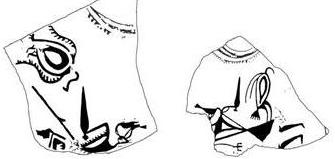
In one fragment a vulture can be seen swooping down on a warrior lying on the ground, pierced by a spear, with a sword in his hand. In the other, a vulture is already devouring the warrior's body.
In Numantia itself, outside the town, some stone circles have been found which one archaeologist considers possible places for exposing corpses in the manner of the "towers of silence" of Iranian Zoroastrians.
The rite clearly informs us about the sense of valor of the warrior and about life understood in an agonistic and competitive way, and about contempt for death. It also reports a hope of reward in the hereafter where brave warriors live with the gods. This indicates the high ethical standards of these people.
There is a text of Aelian in De nat. Anim. X, 22 (FHA, VIII: 330) which extends the rite to the “vaccei” of the Northern Plateau, neighbors of the Cantabrians:
“The “vacei”, a people of Hesperia, burn in the fire those who died of some disease, as having died in an effeminate and cowardly way, to highlight the ignominy of their death; whereas those who met a beautiful death, as brave and strong men adorned with extraordinary valor, they throw to the vultures to be devoured, because they think that these birds are sacred”.
Aelian wrote in Greek but Friedrich Jacobs translated him into Latin in the modern Frommann edition, Jena, 1832 . It reads as follows:
Vaccaei, genus Hesperis, ex aliquo morbo mortuos, ut muliebriter et ignaviter defunctos, ad notandam mortis ignominiam igni cremant; eos vero, qui in bello morte occubuerunt, ut viros bonos et fortes, et eximia virtute ornatos, vulturibus devorandos objiciunt, quod eas aves sacras existiment.
But there are scholars who consider the reading "vaccei" in the texts to be a corrupt reading, which casts great doubt on the validity of the text. Actually the manuscripts of Aelianus say “barkaioi” but not “vacceoi”. The barkaioi are not known in the Iberian Peninsula. Barkaioi would have been corrected by Samuel Bochar (1599-1667) and then followed by other modern philologists and translated into Latin as baccaei and hence vacceoi. Perhaps it said araouacoi, i.e. arevacoi, which some copyist split into ara / ouakoi; ouakoi would give bakoi. That is, the original text also spoke of arevacoi. This interpretation, which is phonetically possible, would be consistent with the meaning of the text, because among the arevacoi of Numantia it is well attested, as we said. The error became largely established thanks to the absolute authority of Schulten for many years in the study of "Sources of ancient Hispania".
In any case there are numerous archaeological remains, paintings, inscriptions and tombstones which seem to attest it in many places of the Iberian Peninsula, to which it perhaps spread from Celtiberia.
Thus among the Vettones and in Cantabria, as evidenced by the Cantabrian stele from Zurita (Renedo de Piélagos), badly damaged, on which a vulture seems to be pecking at the body of a recumbent warrior, and other similar ones from Lara de los Infantes (Burgos), Binefar (Huesca), the Palao (Alcaniz, Teruel).
The rite is attested in various places in Europe among the Celts and Germans.
Pausanias tells us about the invasion of the Gauls in Greece commanded by Brennos in X, 21.6 that they left the corpses of the warriors fallen in the battles to scavenging animals.
After this battle at Thermopylae the Greeks buried their own dead and spoiled the barbarians, but the Gauls sent no herald to ask leave to take up the bodies, and were indifferent whether the earth received them or whether they were devoured by wild beasts or carrion birds. (Translation by W.H.S. Jones, Litt.D., and H.A. Ormerod, M.A.,).
This scene of vultures devouring the bodies of the warriors can be seen, for example, on a Faliscan vase of the fourth century BC.
In the Scandinavian Eddas we find numerous references to these beliefs, so in Edda Mayor, 1986: 33, 78.193-195, 199, 201-202, 212,217,225,246,255,259,297.
We can conclude, therefore, that the rite was practiced throughout the Celtic culture.
A similar ritual is found among some Indian tribes of North America which expose the corpses of their warriors on a sort of raised wooden platform; it sometimes appears in westerns.
The rite is also attested in Tibet where the corpses are exposed in places just outside the villages, where sometimes people help dismember the bodies.
Does this rite, found in such different places, have a common origin? Quite possibly, if we consider that the rite is lost in the mists of time, in prehistoric times, and that the inhabitants of America came from Eurasia in several waves across the Bering Strait at times when it could be crossed on foot.
After this long explanation we are able to understand a text by Longinus in On the Sublime, 3.2 in which he refers to Gorgias of Leontini (483-375) and criticizes him because he grandiloquently calls vultures "living tombs ":
"So Gorgias of Leontini provokes laughter when he writes:" Xerxes ,Zeus of the Persians and vultures, living graves”.
If Gorgias knew the Persian custom, maybe the image is not so grandiloquent. In any case it caught on in history and was used over and over again.
Shakespeare, for example, uses it in Macbeth, Act III, Scene 4, 1359-1361:
Macbeth: If charnel-houses and our graves must send
Those that we bury back, our monuments 1360
Shall be the maws of kites.