Author: admin

  • Urbi et orbi: the city ruling an Empire (III)

    The saying “urbi et orbi” was remarkably successful in referring to a “city” that had a notable success in becoming the capital of the “orb” and also because in itself the phrase contains an attractive word game, apun, consisting of relating Words of different meaning but which differ only in a phoneme or a letter; that is because “urbi and orbi” is a paronomasia.

    Varro, logically, does not resist the temptation to seek an explanation or draw a conclusion, (no matter if it is focused or not,  but it does not appear to be correct), from  the proximity between the two terms: urbem and orbem. He does so it in his De lingua Latina, (On the Latin Language) V, 143:

    Many founded towns in Latium by the Etruscan ritual ; that is, with a team of cattle, a bull and a cow on the inside, they ran a furrow around with a plough (for reasons of religion they did this on an auspicious day), that they might be fortified by a ditch and a wall. The place whence they had ploughed up the earth, they called a fossa ‘ ditch,’ and the earth thrown inside it they called the murus ‘ wall.’ The orbis ‘ circle ‘ which was made back of this, was the beginning of the urbs ‘ city ‘ ; because the circle was post murum ‘ back of the wall,’ it was called a postmoerium  ; it sets the limits for the taking of the auspices for the city. Stone markers of the pomerium stand both around Aricia  and around Rome. Therefore towns also which had earlier had the plough drawn around them, were termed urbes ‘ cities,’ from orbis ‘ circle ‘ and urvum ‘ curved ‘ ; therefore also all our colonies are mentioned as urbes in the old writings, because they had been founded in just the same way as Rome ; therefore also colonies and cities conduntur ‘ are founded,’ because they are placed inside the pomerium. (Translation by Roland G.Kent. Ph.D.)

    Oppida condebant in Latio Etrusco ritu multi, id est, iunctis bobus, tauro et vacca interiore, aratro circumagebant sulcum (hoc faciebant religionis causa die auspicato), ut fossa et muro essent muniti. Terram unde exculpserant, fossam vocabant et introrsum iactam murum. Post ea qui fiebatorbis, urbis principium; qui quod erat post murum, postmoerium dictum, eo usque auspicia urbana finiuntur. Cippi pomeri stant et cirum Ariciam et circum Romam. Quare et oppida quae prius erant circumducta aratro ab orbe et urvo urbes; et ideo coloniae nostrae omnes in litterid antiquis scribunturt urbes, quod ítem conditae ut Roma; et ideo coloniae et urbes condungtur, quod intra pomerium ponuntur.

    I will present some texts that exemplify the use in the Antiquity of this paronomasia.

    Cornelius Nepos (c.100 BC – c. 25 BC) in the Life of Atticus puts in touch both words, urbis and orbis:

    Nepos, Life of Atticus,  20.5

    How strong such  attachment is, he will be easily able to judge, who can understand how much prudence is required to preserve the friendship and favour of those between whom there existed not only emulation in the highest matters, but such a mutual struggle to lessen one another as was sure to happen between Caesar and Antony, when each of them desired to be chief, not merely of the city of Rome, but of the whole world. (Translation by John Selby Watson, MA)

    hoc quale sit, facilius existimabit is, qui iudicare poterit, quantae sit sapientiae eorum retinere usum benivolentiamque, inter quos maximarum rerum non solum aemulatio, sed obtrectatio tanta intercedebat, quantam fuit incidere necesse inter Caesarem atque Antonium, cum se uterque principem non solum urbis Romae, sed orbis terrarum esse cuperet.

    Thus Ovid, in his Ars Amatoria comments that the public shows, that the women attend, are a good opportunity to establish some kind of relationship. In this passage he makes an interesting integration, a paronomasia, between “urbe” and “orbis“: atque ingens orbis in Urbe fuit.

    The Art of love, 1, 171 et seq.

    Caesar would represent a naval fight,
    For his own honour and for Rome’s delight.
    From either sea the youths and maidens come,
    And all the world was then contain’d in Rome!
    (atque ingens ORBIS in URBE fuit)
    In this vast concourse, in this choice of game,
    What Roman heart but felt a foreign flame!
    Once more our prince prepares to make us glad,
    And the remaining east to Rome will add.
    Rejoice, ye Roman soldiers, in your urns,
    Your ensigns from the Parthians shall return,
    And the slain Crassi shall no longer mourn.
    A youth is sent those trophies to demand,
    Ard bears his father’s thunders in his hand;
    Doubt not th’ imperial boy in wars unseen,
    In childhood all of Caesar’s race are men.
    Celestial seeds shoot out before their day,
    Prevent their years, and brook no dull delay.

    (Translated by John Dryden (1631–1700).

    quid, modo cum belli navalis imagine Caesar
       Persidas induxit Cecropiasque rates?
    nempe ab utroque mari iuvenes, ab utroque puellae
       Venere, atque ingens orbis in Urbe fuit.
    quis non invenit turba, quod amaret, in illa?      
       eheu, quam multos advena torsit amor!
    ecce, parat Caesar domito quod defuit orbi
       addere: nunc, oriens ultime, noster eris.
    Parthe, dabis poenas: Crassi gaudete sepulti,
    signaque barbaricas non bene passa manus.      
    ultor adest, primisque ducem profitetur in annis,
       bellaque non puero tractat agenda puer.

    Marcus Velleius Paterculus (c. 19 BC – c. AD 31), Compendium of Roman History, 2,44

    But to resume. It was in Caesar’s consulship that there was formed between himself, Gnaeus Pompeius and Marcus Crassus the partnership in political power which proved so baleful to the city, to the world, and, subsequently at different periods to each of the triumvirs themselves.  Pompey’s motive in the adoption of this policy had been to secure through Caesar as consul the long delayed ratification of his acts in the provinces across the seas, to which, as I have already said, many still raised objections; Caesar agreed to it because he realized that in making this concession to the prestige of Pompey he would increase his own, and that by throwing on Pompey the odium for their joint control he would add to his own power; while Crassus hoped by the influence of Pompey and the power of Caesar he might achieve a place of pre-eminence in the state which he had not been able to reach single-handed.  Furthermore, a tie of marriage was cemented between Caesar and Pompey, in that Pompey now wedded Julia, Caesar’s daughter. (Translated by Frederick W. Shipley)

    Hoc igitur consule inter eum et Cn. Pompeium et M. Crassum inita potentiae societas, quae urbi orbique terrarum nec minus diverso cuique tempore ipsis exitiabilis fuit.  Hoc consilium sequendi Pompeius causam habuerat, ut tandem acta in transmarinis provinciis, quibus, ut praediximus, multi obtrectabant, per Caesarem confirmarentur consulem, Caesar autem, quod animadvertebat se cedendo Pompei gloriae aucturum suam et invidia communis potentiae in illum relegata confirmaturum vires suas, Crassus, ut quem principatum solus adsequi non poterat, auctoritate Pompei, viribus teneret Caesaris,  adfinitas etiam inter Caesarem Pompeiumque contracta nuptiis, quippe Iuliam, filiam C. Caesaris, Cn. Magnus duxit uxorem.

    Tertullian also in his Apologeticum (ca.160-ca.220), 40,1-4 relates the two words:
    quantae clades orbem et urbes ceciderunt!

    On the contrary, faction is a name which belongs to those only who conspire in the hatred of the good and virtuous, and remonstratefull cry for innocent blood, sheltering their malice under this vain pretence, that they are of opinion, forsooth, that the Christians are the occasion of all the mischief in the world. If Tiber overflows, and Nile does not; if heaven stands still and withholds its rain, and the earth quakes ; if famine or pestilence take their marches through the country, the word is, Away with these Christians to the lion ! Bless me ! what, so many people to one lion ! Pray tell me what havoc, what a mighty fall of people has been made in the world and Rome (quantae clades orbem et urbes ceciderunt!)  before the reign of Tiberius, that is, before the advent of Christ ? We read of Hierannape, and Delos, and Rhodes, and Co, islands swept away with many thousands of their inhabitants. … (Translated by Jeremy Collier, A.M.)

    At e contrario illis nomen factionis accommodandum est, qui in odium bonorum et proborum conspirant, qui adversum sanguinem innocentium conclamant, praetexentes sane ad odii defensionem illam quoque vanitatem, quod existiment omnis publicae cladis, omnis popularis incommodi Christianos esse in causa[m].  Si Tiberis ascendit in moenia, si Nilus non ascendit in arva, si caelum stetit, si terra movit, si fames, si lues, statim: “Christianos ad leonem!” acclamatur. Tantos ad unum?
    Oro vos, ante Tiberium, id est ante Christi adventum, quantae clades orbem et urbes ceciderunt! Legimus Hieran, Anaphen et Delon et Rhodon et Co insulas multis cum milibus hominum pessum abisse.

    Sidonius Apollinaris (430-489 AD), bishop of Clermont Ferrand, in Carmina, 7, uses this paronomasia:
    captivus, ut aiunt, orbis in urbe iacet (verse 557)

    Carmen 7 is a panegyric to his father-in-law Avitus on his inauguration as emperor. In a meeting of the gods Rome complains of its decadence; its history is reviewed and Jupiter takes part. Soon Avitus is proclaimed emperor by the Visigothics and Gallicromans.

    Sidonius Apollinaris, Carmina, 7, 550 y ss.

    Now the supreme office calls for thee; in time of peril a realm cannot be ruled by a poltroon. All ambitious rivalry gives place when extremity calls for men of renown. After the losses of Ticinum and Trebia the trembling republic came in haste to Fabius. By the election of Livius the disaster of Cannae, famous for Varro’s rout, was undone; undone too was the Carthaginian, still exulting over the deaths of the Scipios. The world, they say, lies captive in the captive city ; the Emperor has perished, and now the Empire has its head here.

    Ascend the tribunal, we beseech thee, and raise up the fainting; this time of peril asks not that some other should love Rome more. Nor do thou by any chance deem thyself unequal to sovereignty. When Brennus’ host beset the Tarpeian rock, then, thou knowest, Camillus was himself the whole of our state, and he, the destined avenger of his country, covered the smoking embers of the city with the slaughtered enemy. No gold scattered among the people hath secured for thee the verdict of the centuries ; this time no venal tribes bought with plenteous coin rush to give their votes the suffrages of the world no one can buy. Though a poor man, thou art being chosen; rich art thou in thy deserts, and that suffices in itself. Why dost thou hinder the desires of thy country, when she orders thee to give orders to her? This is the judgment of all: ” if thou becomest the master I shall be free.” (Translated by W.B. Anderson).

    nunc iam summa vocant,  dubio sub tempore regnum
    non regit ignavus, postponitur ambitus omnis
    ultima cum claros quaerunt: post damna Ticini
    ac Trebiae trepidans raptim respublica venit
    ad Fabium; Cannas celebres Varrone fugato
    Scipiadumque etiam turgentem funere Poenum
    Livius electus fregit, captivus, ut aiunt,
    orbis in urbe iacet; princeps perit, hic caput omne
    nunc habet imperium, petimus, conscende tribunal, 
    erige collapsos; non hoc modo tempora poscunt,
    ut Romam plus alter amet. nec forte reare
    te regno non esse parem: cum Brennica signa
    Tarpeium premerent, scis, tum respublica nostra
    tota Camillus erat, patriae qui debitus ultor
    texit fumantes hostili strage favillas.
    non tibi centurias aurum populare paravit,
    nec modo venales numerosoque asse redemptae
    concurrunt ad puncta tribus; suffragia mundi
    nullus emit, pauper legeris ; quod sufficit unum,
    es meritis dives, patriae cur vota moraris,
    quae iubet ut iubeas ? haec est sententia cunctis :
    si dominus fis, liber ero.’

    Flavius Cresconius Corippus, who lived approximately from the year 500 to 570 AD was probably the last major Latin author of antiquity, on  time of the Byzantine emperors Iustinian I and Iustin II. His two major works are the epic poem Johannis  and the panegyric In laudem Iustini minoris.

    It is precisely in this last one that in several occasions he uses the formula “urbisorbis“; Precisely it is a feature of his style, the repetition of words and concepts and also the use of paronomasias or words very similar in form although different in the meaning. So

    Verses I, 173 y ss.

    The whole group, prostrate and lying before their feet, while speaking thus, says together: “Have pity, pious,  of those who beg you, holy man, come to help us in adversity. As the day arrives you will see that everything is lost if the people can hear that the throne is empty and the emperor is not there. As much as your affection for your virtuous  father may affect you, let not your  love for your  country  be less than that you have for your father. Your uncle himself, dying, ordered you with his own words to kept the scepter. See how much it was the forecast and request of the old man for our city and the whole world (aspice quanta fuit nostrae simul urbis et orbis). In your behalf God made all that he wanted to happen. Mount your father’s throne, mighty prince,  and rule the world that is submission  to you.

    Talia dicentis pedibus prostrata iacensque
    omnis turba simul “pius es, miserere” perorat
    “supplicibus, vir sancte, tuis: succurre periclis.
    Omnia mox veniente die periisse videbis,
    si vacuam vulgussine príncipe senserit aulam.
    Quantumcumque boni moveat dilectio patris,
    non sit amor patriae patrio minor. Ipse tenere
    sceptra tuus moriens te iussit avunculus ore.
    aspice quanta fuit nostrae simul urbis et orbis
    próvida cura seni. pro te deus omnia fecit,
    quae fieri voluit. solium conscende paternum
    et rege subiectum, prínceps fortissime, mundum

    And again in Verses 244 y ss.

    And not unjustly, I think, would he, in death, be so happy and with a countenance so full of goodness, if his mind, conscious of the good that he makes, would not have abandoned his  tranquil body members, flying towards heaven and would not have ensured the empire by  the confirmation of an heir. When the noble Justin came here, throwing his loving arms around the lifeless body, he said,  sobbing: “Light of the city and  the universe, Father Justinian, are you leaving your beloved court and are you abandoning  your relatives, your servants and so many subjects? Do you despise your lands? Do not you sail for  the exhausted world? Here you have the Avars and the harsh Franks and the Gepids and  the Getas, and so many other nations who, after raising their ensigns, cause war everywhere. With how much  strength will we overcome so many enemies if you, firmness of Rome, are dead? “

    Haud, reor, immerito sic laetus et ore benignus
    Ille foret moriens, nisi mens sibi conscia recti
    in caelum properans securos linqueret artus
    et tutum imperium firmato herede locaret.
    Huc ubi magnanimus sacra cum coniuge venit,
    cara per exanimum circumdans brachia corpus
    cum lacrimis Iustinus ait: “lux urbis et orbis,
    Iustiniane pater, dilectam deseris aulam?
    Cognatos fámulos et tantos linquis alumnos?
    Contemnis terras? Fesso non prospicis orbi?
    En Avares Francique truces Gepidesque Getaeque
    totque aliae gentes commotis undique ignis
    bella movent; qua vi tantos superabimos hostes,
    cum virtus Romana iacet?..
    .

    And again in  verses III, 72 y ss.:

    Organs, plectrums and lyres resounded throughout the city; a thousand kinds of spectacles, a thousand banquets, dances, laughter, conversation, joy and applause were offered. They prayed for long life for the emperors in happy cries. “After its old age,” they say, “the world rejoices its rejuvenation and seeks the principles of its original appearance. The iron age has  now gone, and the  golden age is getting up in your time, Justin, hope of the city and the world, light of the Roman Empire, glory added to all the emperors who preceded you, whose victorious wisdom has gained the highest summit of your father’s kingdom»

    Organa, plectra, lyrae totam insonuere per urbem.
    Mille voluptatum species, convicia mille,
    saltatus, risus, discursus, gaudia, plausus.
    Augustis vitam laetis clamoribus optant.
    post senium dicunt “sese iuvenescere mundus
    gaudet Et antiquae repetit  primordia formae.
    Férrea nunc abeunt aurea saecula surgunt
    temporibus, Iustine, tuis, spes urbis et orbis,
    Romani iubar imperii, decus addite cunctis
    retro principibus, cuius sapientia victrix
    obtinuit patrii fastigia máxima regni.”

    The summary of all this, of the content and the of literary figure, is personified by a happy verse of the fifth century French poet Rutilius Namatianus, from which we retain part of the only poem we know he wrote, entitled “De reditu suo” (On the return ). In it he sings the greatness and ancient splendor of Rome and criticizes Christianity. In the so-called Hymn to Rome, which appears personified, we find the summary verse  which I referred:

                 ‘urbem fecisti quod prius orbis erat’

    “Listen, O fairest queen of thy world, Rome, welcomed amid the starry skies, listen, thou mother of men and mother of gods, thanks to thy temples we are not far from heaven: thee do we chant, and shall, while destiny allows, for ever chant. None can be safe if forgetful of thee. Sooner shall guilty oblivion whelm the sun than the honour due to thee quit my heart; for benefits extend as far as the sun’s rays, where the circling Ocean-flood bounds the world. For thee the very Sun-God who holdeth all together doth revolve: his steeds that rise in thy domains he puts in thy domains to rest. Thee Africa hath not stayed with scorching sands, nor hath the Bear, armed with its native cold, repulsed thee. As far as living nature hath stretched towards the poles, so far hath earth opened a path for thy valour. For nations far apart thou hast made a single fatherland; under thy dominion captivity hath meant profit even for those who knew not justice:and by offering to the vanquished a share in thine own justice, thou hast made a city of what was erstwhile a world.

    “As authors of our race we acknowledge Venus and Mars — mother of the sons of Aeneas, father of the scions of Romulus: clemency in victory tempers armed strength: both names befit thy character: hence thy noble pleasure in war and in mercy: it vanquishes the dreaded foe and cherishes the vanquished. (Translated by  J. Wight Duff and Arnold M. Duff)

    “exaudi, regina tui pulcherrima mundi,
    inter sidereos Roma recepta polos,
    exaudi, genetrix hominum genetrixque deorum,
    non procul a caelo per tua templa sumus:
    te canimus semperque, sinent dum fata, canemus:
    sospes nemo potest immemor esse tui.
    obruerint citius scelerata oblivia solem,
    quam tuus ex nostro corde recedat honos.
    nam solis radiis aequalia munera tendis,
    qua circumfusus fluctuat Oceanus.
    volvitur ipse tibi, qui continet omnia, Phoebus
    eque tuis ortos in tua condit equos.
    te non flammigeris Libye tardavit harenis,
    non armata suo reppulit Ursa gelu:
    quantum vitalis natura tetendit in axes,
    tantum virtuti pervia terrae tuae.
    fecisti patriam diversis gentibus unam:
    profuit iniustis te dominante capi.
    dumque offers victis proprii consortia iuris,
    urbem fecisti quod prius orbis erat.
    “auctores generis Venerem Martemque fatemur,
    Aeneadum matrem Romulidumque patrem:
    mitigat armatas victrix clementia vires,
    convenit in mores nomen utrumque tuos:
    hinc tibi certandi bona parcendique voluptas:
    quos timuit superat, quos superavit amat.

    The Roman Catholic Church is debtor of Ancient Rome almost everything, in  much of its myths, beliefs and dogmas, in its rites, in its artistic expression, in its administrative and juridical structure, and of course in its official language, which is still Latin. This expression is further evidence of this. If the Catholic Pope today can address “the city and the world”, it is precisely because he is “the bishop of Rome,” the city (urbs) that was the capital of the world (orbis)

  • Urbi et orbi: the city ruling an Empire (II)

    The Roman citizen, in his self-assertion and self-satisfaction, confuses the “orbis terrarum” with the “orbis romanus”. There are also innumerable texts and facts that claim to establish in the citizens this idea: that the world, at least interesting, is Roman.

    It is that, for example, we can see in Cicero, Rhetorica Ad Herennium, 4,9,13:

    Our discourse will belong to the Middle type if, as I have said above,'' we have somewhat relaxed our style, and yet have not escended to the most ordinary prose, as follows :

    Men of the jury, you see against whom we are waging war — against allies wlio have been wont to light in our defence, and together with us to preserve our empire by their valour and zeal. Not only must they have known themselves, their resources, and their manpower, but their nearness to us and their alliance with us in all affairs enabled them no less to learn and appraise the power of the Roman people in every sphere. When they had resolved to fight against us, on what, I ask you, did they rely in presuming to undertake the war, since they understood that much the greater part of our allies remained faithful to duty, and since they saw that they had at hand no great supply of soldiers, no competent commanders, and no public money — in short, none of the things needful for carrying on the war ? Even if they were waging war with neighbours on a question of boundaries, even if in their opinion one battle would decide the contest, they would yet come to the task in every way better prepared and equipped than they are now. It is still less credible that with such meagre forces they would attempt to usurp that sovereignty over the whole world which all the civilized peoples, kings, and barbarous nations have accepted, in part compelled by force, in part of their own will, when conquered either by the arms of Rome or by her generosity. Some one will ask :  What of the Fregellans ? Did they not make the attempt on their own initiative ? ' Yes, but these allies would be less ready to make the attempt precisely because they saw how the Fregellans fared." For inexperienced peoples, unable to find in history a precedent for every circumstance, are through imprudence easily led into error; whilst those who know what has befallen others can easily from the fortunes of these others draw profit for their own policies.'' Have they, then, in taking up arms, been impelled by no motive ? Have they relied on no hope ? Who will believe that any one has been so mad as to dare, with no forces to depend on, to challenge the sovereignty of the Roman people ? They must, therefore, have had some motive, and what else can this be but what I say ? "  (Translated by Harry Caplan)

    In mediocri figura versabitur oratio, si haec, ut ante dixi, aliquantum demiserimus neque tamen ad infimum descenderimus, sic:

    «Quibuscum bellum gerimus, iudices, videtis: cum sociis, qui pro nobis pugnare et imperium nostrum nobiscum simul virtute et industria conservare soliti sunt. Ii cum se et opes suas et copiam necessario norunt, tum vero nihilominus propter propinquitatem et omnium rerum societatem, quid omnibus rebus populus Romanus posset, scire <et> existimare poterant. Ii, cum deliberassent nobiscum bellum gerere, quaeso, quae res erat, qua freti bellum suscipere conarentur, cum multo maximam partem sociorum in officio manere intellegerent? Cum sibi non multitudinem militum, non idoneos imperatores, non pecuniam publicam praesto esse viderent? Non denique ullam rem, quae res pertinet ad bellum administrandum? Si cum finitumis de finibus bellum gererent, si totum certamen in uno proelio positum putarent, tamen omnibus rebus instructiores et apparatiores venirent; nedum illi imperium orbis terrae, cui imperio omnes gentes, reges, nationes partim vi, partim voluntate consenserunt, cum aut armis aut liberalitate a populo Romano superati essent, ad se transferre tantulis viribus conarentur. Quaeret aliquis: Quid? Fregellani non sua sponte conati sunt? Eo quidem isti minus facile conarentur, quod illi quemadmodum discessent videbant. Nam rerum inperiti, qui unius cuiusque rei de rebus ante gestis exempla petere non possunt, ii per inprudentiam facillime deducuntur in fraudem: at ii, qui sciunt, quid aliis acciderit, facile ex aliorum eventis suis rationibus possunt providere. Nulla igitur re inducti, nulla spe freti arma sustulerunt? Quis hoc credet, tantam amentiam quemquam tenuisse, ut imperium populi Romani temptare auderet nullis copiis fretus? Ergo aliquid fuisse necessum est. Quid aliud, nisi id, quod dico, potest esse?»

    This is that Ovid says on several occasions. Thus in Fasti, 1, 75 et seq. about the celebrations of January 1 to the god Janus:

    Behold how Aether glows with sacred fire,
    Where incense and odorous nard aspire ;
    How lambent flames all tremulously rolled
    Up to thy dome, reflect from burnished gold.
    Lo! the procession mounts Tarpeia's height;
    The garb and festival are sacred white ;
    New fasces lead the way ; in purple dye
    New consuls in the chairs of ivory.
    The unyoked steers, from the Faliscan plain, 
    Proffer their necks consentant to be slain ;
    And Jupiter from heaven gazing round
    Begardeth nothing else, but Boman ground.
    Salve, auspicious morn! for ever aye
    Return to Romans an auspicious day. 
    Jane biformis, what shall I call thee ?
    Greece, has no corresponding deity.
    Propound the cause, why of Celestials one
    May see behind his back the deed that's done,
    And at the same time view events before. 

    (By Jonh Benson Rose. 1866)

    cernis odoratis ut luceat ignibus aether,              
         et sonet accensis spica Cilissa focis?
    flamma nitore suo templorum verberat aurum,
         et tremulum summa spargit in aede iubar.
    vestibus intactis Tarpeias itur in arces,
         et populus festo concolor ipse suo est,              
    iamque novi praeeunt fasces, nova purpura fulget,
         et nova conspicuum pondera sentit ebur.
    colla rudes operum praebent ferienda iuvenci,
         quos aluit campis herba Falisca suis.
    Iuppiter arce sua totum cum spectet in orbem,              
         nil nisi Romanum quod tueatur habet.
    salve, laeta dies, meliorque revertere semper,
         a populo rerum digna potente coli.
    Quem tamen esse deum te dicam, Iane biformis?
         nam tibi par nullum Graecia numen habet.              
    ede simul causam, cur de caelestibus unus
         sitque quod a tergo sitque quod ante vides.

    And then, a little later:

    The Orbs is Urbs Romana, and our home.

    Romanae spatium est Urbis et orbis idem.

    Fasti 2, 667 y ss.

    What happened when the Capitol was built ?
    When all the gods, yielding to Jove, withdrew,
    Save Terminus, the ancients tell us, who
    Now shares that fane with Jove : therefore its roof
    Is pierced that he may see the stars aloof.
    Since then, Termine, thou art not free 
    To chop and change about in levity :
    Where thou art placed remain, lest so it prove
    Thou giv'st to man what thou deny'st to Jove.
    If plough or harrow hurtle thee, cry out, 
    " This land is mine ; friend, mind what you're about."
    There is a road on the Laurentian plain
    That marked the limits of the Dardan reign ;
    The sixth stone from the city marks the way,
    And there a sheep to Terminus we slay.
    All nations have their termini, save Rome : 
    The Orbs is Urbs Romana, and our home.

    (By Jonh Benson Rose. 1866)

    quid, nova cum fierent Capitolia? nempe deorum
         cuncta Iovi cessit turba locumque dedit;
    Terminus, ut veteres memorant, inventus in aede
         restitit et magno cum Iove templa tenet.              
    nunc quoque, se supra ne quid nisi sidera cernat,
         exiguum templi tecta foramen habent.
    Termine, post illud levitas tibi libera non est:
         qua positus fueris in statione, mane;
    nec tu vicino quicquam concede roganti,              
         ne videare hominem praeposuisse Iovi:
    et seu vomeribus seu tu pulsabere rastris,
         clamato "tuus est hic ager, ille tuus".'
    est via quae populum Laurentes ducit in agros,
         quondam Dardanio regna petita duci:              
    illa lanigeri pecoris tibi, Termine, fibris
         sacra videt fieri sextus ab Urbe lapis.
    gentibus est aliis tellus data limite certo:
         Romanae spatium est Urbis et orbis idem.

    Pompey's triumphs from the East to the West confirm to the Romans  they are the masters of the world. Plutarch presents us the triple triumphal parade of Pompey, in which the whole empire, all the land that he had conquered, participates.

    Plutarch, Pompey 45:

    His triumph had such a magnitude that, although it was distributed over two days, still the time would not suffice, but much of what had been prepared could not find a place in the spectacle, enough to dignify and adorn another triumphal procession. Inscriptions borne in advance of the procession indicated the nations over which he triumphed.  These were: Pontus, Armenia, Cappadocia, Paphlagonia, Media, Colchis, Iberia, Albania, Syria, Cilicia, Mesopotamia, Phoenicia and Palestine, Judaea, Arabia, and all the power of the pirates by sea and land which had been overthrown. Among these peoples no less than a thousand strongholds had been captured, according to the inscriptions, and cities not much under nine hundred in number, besides eight hundred piratical ships, while thirty-nine cities had been founded.  In addition to all this the inscriptions set forth that whereas the public revenues from taxes had been fifty million drachmas, they were receiving from the additions which Pompey had made to the city's power eighty-five million, and that he was bringing into the public treasury in coined money and vessels of gold and silver twenty thousand talents, apart from the money which had been given to his soldiers, of whom the one whose share was the smallest had received fifteen hundred drachmas.  The captives led in triumph, besides the chief pirates, were the son of Tigranes the Armenian with his wife and daughter, Zosime, a wife of King Tigranes himself, Aristobulus, king of the Jews, a sister and five children of Mithridates, Scythian women, and hostages given by the Iberians, by the Albanians, and by the king of Commagene; there were also very many trophies, equal in number to all the battles in which Pompey had been victorious either in person or in the persons of his lieutenants.  But that which most enhanced his glory and had never been the lot of any Roman before, was that he celebrated his third triumph over the third continent. For others before him had celebrated three triumphs; but he celebrated his first over Libya, his second over Europe, and this his last over Asia, so that he seemed in a way to have included the whole world in his three triumphs. (Translated by by Bernadotte Perrin)

    We also have information on the deeds of Pompey in Diodorus Siculus 40, 4

    This is a copy of the inscription that Pompeius set up, recording his achievements in Asia.
    Pompeius Magnus, son of Gnaeus, imperator, freed the coasts of the world and all the islands within the Ocean from the attacks of pirates. He rescued from siege the kingdom of Ariobarzanes, Galatia and the territories and provinces beyond there, Asia and Bithynia. He protected Paphlagonia, Pontus, Armenia and Achaïa, also Iberia, Colchis, Mesopotamia, Sophene and Gordyene. He subjugated Dareius king of the Medes, Artoles king of the Iberians, Aristobulus king of the Jews, and Aretas king of the Nabataean Arabs, also Syria next to Cilicia, Judaea, Arabia, the province of Cyrenaica, the Achaei, Iozygi, Soani and Heniochi, and the other tribes that inhabit the coast between Colchis and Lake Maeotis, together with the kings of these tribes, nine in number, and all the nations that dwell between the Pontic Sea and the Red Sea. He extended the borders of the empire up to the borders of the world. He maintained the revenues of the Romans, and in some cases he increased them. He removed the statues and other images of the gods, and all the other treasure of the enemies, and dedicated to the goddess {Minerva} 12,060 pieces of gold and 307 talents of silve
    r. (Translation by by Francis R. Walton)

    Perhaps he is Pliny the most exaggerated to remind us of the success of Pompey throughout the Roman world:

    "The most glorious, however, of all glories, resulting from these exploits, was, as he himself says, in the speech which he made in public relative to his previous career, that Asia, which he received as the boundary of the empire, he left its centre".

    Let's extend this quote

    Naturalis Historia:  7, 95 et seq. (26) (27) et seq.

    But now, as it belongs fully as much to the glorious renown of the Roman Empire, as to the victorious career of a single individual, I shall proceed on this occasion to make mention of all the triumphs and titles of Pompeius Magnus: the splendour of his exploits having equalled not only that of those of Alexander the Great, but even of Hercules, and perhaps of Father Liber even. After having recovered Sicily, where he first commenced his career as a partizan of Sylla, but in behalf of the republic, after having conquered the whole of Africa, and reduced it to subjection, and after having received for his share of the spoil the title of " Great," he was decreed the honours of a triumph; and he, though only of equestrian rank, a thing that had never occurred before, re-entered the city in the triumphal chariot: immediately after which, he hastened to the west, where he left it inscribed on the trophy which he raised upon the Pyrenees, that he had, by his victories, reduced to subjection eight hundred and seventy-six cities, from the Alps to the borders of Farther Spain; at the same time he most magnanimously said not a word about Sertorius. After having put an end to the civil war, which indeed was the primary cause of all the foreign ones, he, though still of only equestrian rank, again entered Rome in the triumphal chariot, having proved himself a general thus often before having been a soldier. After this, he was dispatched to the shores of all the various seas, and then to the East, whence he brought back to his country the following titles of honour, resembling therein those who conquer at the sacred games—for, be it remembered, it is not they that are crowned, but their respective countries. These honours then did he award to the City, in the temple of Minerva, which he consecrated from the spoils that he had gained: "Cneius Pompeius Magnus, Imperator, having brought to an end a war of thirty years' duration, and having defeated, routed, put to the sword, or received the submission of, twelve millions two hundred and seventy-eight thousand men, having sunk or captured eight hundred and forty-six vessels, having received as allies one thousand five hundred and thirty-eight cities and fortresses, and having conquered all the country from the Mæotis to the Red Sea, dedicates this shrine as a votive offering due to Minerva." Such, in few words, is the sum of his exploits in the East. The following are the introductory words descriptive of the triumph which he obtained, the third day before the calends of October, in the consulship of M. Piso and M. Messala; "After having delivered the sea-coast from the pirates, and restored the seas to the people of Rome, he enjoyed a triumph over Asia, Pontus, Armenia, Paphlagonia, Cappadocia, Cilicia, Syria, the Scythians, Judæa, the Albanians, Iberia, the island of Crete, the Basterni, and, in addition to all these, the kings Mithridates and Tigranes."

    The most glorious, however, of all glories, resulting from these exploits, was, as he himself says, in the speech which he made in public relative to his previous career, that Asia, which he received as the boundary of the empire, he left its centre. If any one should wish, on the other hand, in a similar manner, to pass in review the exploits of Cæsar, who has shown himself greater still than Pompeius, why then he must enumerate all the countries in the world, a task, I may say, without an end.  (Translation by John Bostock, M.D., F.R.S., H.T. Riley, Esq., B.A., Ed. )

    Verum ad decus imperii Romani, non solum ad viri unius, pertinet victoriarum Pompei Magni titulos omnes triumphosque hoc in loco nuncupari, aequato non modo Alexandri Magni rerum fulgore, sed etiam Herculis prope ac Liberi patris.
    igitur Sicilia recuperata, unde primum Sullanus in rei publicae causa exoriens auspicatus est, Africa vero tota subacta et in dicionem redacta Magnique nomine in spolium inde capto, eques Romanus, id quod antea nemo, curru triumphali revectus et statim ad solis occasum transgressus, excitatis in Pyrenaeo tropaeis, oppida DCCCLXXVI ab Alpibus ad fines Hispaniae ulterioris in dicionem redacta victoriae suae adscripsit et maiore animo Sertorium tacuit, belloque civili, quod omnia externa conciebat, extincto iterum triumphales currus eques R. induxit, totiens imperator ante quam miles.
    postea ad tota maria et deinde solis ortus missus hos retulit patriae titulos more sacris certaminibus vincentium — neque enim ipsi coronantur, sed patrias suas coronant —, hos ergo honores urbi tribuit in delubro Minervae, quod ex manubiis dicabat:
    CN·POMPEIVS MAGNVS IMPERATOR BELLO XXX ANNORVM CONFECTO FVSIS FVGATIS OCCISIS IN DEDITIONEM ACCEPTIS HOMINVM CENTIENS VICIENS SEMEL LXXXIII DEPRESSIS AVT CAPTIS NAVIBVS DCCCXLVI OPPIDIS CASTELLIS MDXXXVIII IN FIDEM RECEPTIS TERRIS A MAEOTIS AD RVBRVM MARE SVBACTIS VOTVM MERITO MINERVAE.
    Hoc est breviarium eius ab oriente. triumphi vero, quem duxit a. d. III kal. Oct. M. Pisone M. Messala cos., praefatio haec fuit:
    CVM ORAM MARITIMAM PRAEDONIBVS LIBERASSET ET IMPERIVM MARIS POPVLO ROMANO RESTITVISSET EX ASIA PONTO ARMENIA PAPHLAGONIA CAPPADOCIA CILICIA SYRIA SCYTHIS IVDAEIS ALBANIS HIBERIA INSVLA CRETA BASTERNIS ET SVPER HAEC DE REGE MITHRIDATE ATQVE TIGRANE TRIVMPHAVIT.
    Summa summarum in illa gloria fuit (ut ipse in conditione dixit, cum de rebus suis disseret) Asiam ultimam provinciarum accepisse eandemque mediam patriae reddidisse. si quis e contrario simili modo velit percensere Caesaris res, qui maior ille apparuit, totum profecto terrarum orbem enumeret, quod infinitum esse conveniet.

    In many passages Pliny goes even further and justifies Roman imperialism by its beneficial effects for humanity. In the book 27 of his Natural History tells us about the numerous plants in the world that are collected and transported from anywhere in the world only by effect of the Roman Pax. That is why the Romans are like a second light, as a second sun for humanity, and also as a second nature as he will say in the book 44. I transcribe both passages:

    Pliny, 27, 1 y ss:

    The further I proceed in this work, the more I am impressed with admiration of the ancients; and the greater the number of plants that remain to be described, the more I am induced to venerate the zeal displayed by the men of former times in their researches, and the kindly spirit manifested by them in transmitting to us the results thereof. Indeed their bounteousness in this respect would almost seem to have surpassed the munificent disposition even of Nature herself, if our knowledge of plants had depended solely upon man's spirit of discovery: but as it is, it is evident beyond all doubt that this knowledge has emanated from the gods themselves, or, at all events, has been the result of divine inspiration, even in those cases where man has been instrumental in communicating it to us. In other words, if we must confess the truth—a marvel surpassed by nothing in our daily experience—Nature herself, that common parent of all things, has at once produced them, and has discovered to us their properties.

    Wondrous indeed is it, that a Scythian plant should be brought from the shores of the Palus Mæotis, and the euphorbia from Mount Atlas and the regions beyond the Pillars of Hercules, localities where the operations of Nature have reached their utmost limit! That in another direction, the plant britannica should be conveyed to us from isles of the Ocean situate beyond the confines of the earth! That the æthiopis5 should reach us from a climate scorched by the luminaries of heaven! And then, in addition to all this, that there should be a perpetual interchange going on between all parts of the earth, of productions so instrumental to the welfare of mankind! Results, all of them, ensured to us by the peace that reigns under the majestic sway of the Roman power, a peace which brings in presence of each other, not individuals only, belonging to lands and nations far separate, but mountains even, and heights towering above the clouds, their plants and their various productions! That this great bounteousness of the gods may know no end, is my prayer, a bounteousness which seems to have granted the Roman sway as a second luminary for the benefit of mankind.
    (Translation by John Bostock, M.D., F.R.S. H.T. Riley, Esq., B.A)

    Crescit profecto apud me certe tractatu ipso admiratio antiquitatis, quantoque maior copia herbarum dicenda restat, tanto magis adorare priscorum in inveniendo curam, in tradendo benignitatem subit. nec dubie superata hoc modo posset videri etiam rerum naturae ipsius munificentia, si humani operis esset inventio.
    nunc vero deorum fuisse eam apparet aut certe divinam, etiam cum homo inveniret, eandemque omnium parentem et genuisse haec et ostendisse, nullo vitae miraculo maiore, si verum fateri volumus. Scythicam herbam a Maeotis paludibus et Euphorbeam e monte Atlante ultraque Herculis columnas ex ipso rerum naturae defectu, parte alia Britannicam ex oceani insulis extra terris positis, itemque Aethiopidem ab exusto sideribus axe, alias praeterea aliunde ultro citroque humanae saluti in toto orbe portari, inmensa Romanae pacis maiestate non homines modo diversis inter se terris gentibusque, verum etiam montes et excedentia in nubes iuga partusque eorum et herbas quoque invicem ostentante! aeternum, quaeso, deorum sit munus istud! adeo Romanos velut alteram lucem dedisse rebus humanis videntur.

    Pliny in 37, 77 (200) ss. assimilates Rome to nature itself and Italy is the governor and second mother of the world; the first is, of course, nature itself.

    Having now treated of all the works of Nature, it will be as well to take a sort of comparative view of her several productions, as well as the countries which supply them. Through-out the whole earth, then, and wherever the vault of heaven extends, there is no country so beautiful, or which, for the productions of Nature, merits so high a rank as Italy, that ruler and second parent of the world ; recommended as she is by her men, her women, her generals, her soldiers, her slaves, her superiority in the arts, and the illustrious examples of genius which she has produced. Her situation, too, is equally in her favour ; the salubrity and mildness of her climate ; the easy access which she offers to all nations ; her coasts indented with so many harbours ; the propitious breezes, too, that always prevail on her shores ; advantages, all of them, due to her situation, lying, as she does, midway between the East and the West, and extended in the most favourable of all positions. Add to this, the abundant supply of her waters, the salubrity of her groves, the repeated intersections of her mountain ranges, the comparative innocuousness of her wild animals, the fertility of her soil, and the singular richness of lier pastures.  (Translation by John Bostock, M.D., F.R.S., and H. T. Riley, Esq., B.A.)

    Etenim peractis omnibus naturae operibus discrimen quoddam rerum ipsarum atque terrarum facere conveniet.
    Ergo in toto orbe, quacumque caeli convexitas vergit, pulcherrima omnium est iis rebus, quae merito principatum naturae optinent, Italia, rectrix parensque mundi altera, viris feminis, ducibus militibus, servitiis, artium praestantia, ingeniorum claritatibus, iam situ ac salubritate caeli atque temperie, accessu cunctarum gentium facili, portuosis litoribus, benigno ventorum adflatu. quod contingit positione procurrentis in partem utilissimam et inter ortus occasusque mediam, aquarum copia, nemorum salubritate, montium articulis, ferorum animalium innocentia, soli fertilitate, pabuli ubertate.

    Also Cicero in Catiline Orations: 4, 11 (6) compares  Rome with the lux orbis terrarum.

    Wherefore, if you decide on this you give me a companion in my address, dear and acceptable to the Roman people; or if you prefer to adopt the opinion of Silanus, you will easily defend me and yourselves from the reproach of cruelty, and I will prevail that it shall be much lighter. Although, O conscript fathers, what cruelty can there be in chastising the enormity of such excessive wickedness? For I decide from my own feeling. For so may I be allowed; to enjoy the republic in safety in your company, as I am not moved to be somewhat vehement in this cause by any severity of disposition, (for who is more merciful than I am?) but rather by a singular humanity and mercifulness. For I seem to myself to see this city, the light of the world and the citadel of all nations, falling on a sudden by one conflagration. I see in my mind's eye miserable and unburied heaps of cities in my buried country; the sight of Cethegus and his madness raging amid your slaughter is ever present to my sight. (Translatión by C. D. Yonge, 1856)

    Quam ob rem, sive hoc statueritis, dederitis mihi comitem ad contionem populo carum atque iucundum, sive Silani sententiam sequi malueritis, facile me atque vos a crudelitatis vituperatione populo Romano purgabo atque obtinebo eam multo leniorem fuisse. Quamquam, patres conscripti, quae potest esse in tanti sceleris inmanitate punienda crudelitas? Ego enim de meo sensu iudico. Nam ita mihi salva re publica vobiscum perfrui liceat, ut ego, quod in hac causa vehementior sum, non atrocitate animi moveor (quis enim est me mitior?), sed singulari quadam humanitate et misericordia. Videor enim mihi videre hanc urbem, lucem orbis terrarum atque arcem omnium gentium, subito uno incendio concidentem, cerno animo sepulta in patria miseros atque insepultos acervos civium, versatur mihi ante oculos aspectus Cethegi et furor in vestra caede bacchantis.

    The concentrated and visual expression of the whole empire is represented in the famous "Map of Agrippa".
    Agrippa ordered to build a map of the whole known world that was placed in the Porticus that had the name of his sister Vipsania, in the Field of Mars and near the Pantheon, and whose purpose was to show that Rome was the center of the world. We could therefore consider the map of the Orbis Terrarum or representation of the whole known world. There are those who think that it was simply a list of places with their dimension and the distance between them rather than a representation of the world. And it is that we have only some written fragments of the description of the map and and we can get some idea for later ones. We can imagine the Roman citizen, planning  a journey or by mere curiosity, observing this huge map of countries and roads.

    It is considered that the measures were of great precision, although Pliny observes some error, for example when he speaks of Hispania and of Baetica:

    Pliny, Naturalis Historia, 3, 17(3,2,17)

    At the present day the length of Bætica, from the town of Castulo, on its frontier, to Gades is 250 miles, and from Murci, which lies on the sea-coast, twenty-five miles more. The breadth, measured from the coast of Carteia, is 234 miles. Who is there that can entertain the belief that Agrippa, a man of such extraordinary diligence, and one who bestowed so much care on his subject, when he proposed to place before the eyes of the world a survey of that world, could be guilty of such a mistake as this, and that too when seconded by the late emperor the divine Augustus ? For it was that emperor who completed the Portico which had been begun by his sister, and in which the survey was to be kept, in conformity with the plan and descriptions of M. Agrippa. (Translation by John Bostock, M.D., F.R.S., H.T. Riley, Esq., B.A., Ed.)

    Baeticae longitudo nunc a Castulonis oppidi fine Gadix CCL et a Murgi maritima ora XXV p. amplior, latitudo a Carteia Anam ora CCXXXIIII p. Agrippam quidem in tanta viri diligentia praeterque in hoc opere cura, cum orbem terrarum orbi spectandum propositurus esset, errasse quis credat et cum eo Divum Augustum? is namque conplexam eum porticum ex destinatione et commentariis M. Agrippae a sorore eius inchoatam peregit.

    Vitruvius expresses the same idea from another point of view: there was no better place than Rome to conquer the world:

    Vitruvius, VI,1, 10-11

    But although southern nations have the keenest wits, and are infinitely clever in forming schemes, yet the moment it comes to displaying valour, they succumb because all manliness of spirit is sucked out of them by the sun. On the other hand, men born in cold countries are indeed readier to meet the shock of arms with great courage and without timidity, but their wits are so slow that they will rush to the charge inconsiderately and inexpertly, thus defeating their own devices. Such being nature's arrangement of the universe, and all these nations being allotted temperaments which are lacking in due moderation, the truly perfect territory, situated under the middle of the heaven, and having on each side the entire extent of the world and its countries, is that which is occupied by the Roman people.

    In fact, the races of Italy are the most perfectly constituted in both respects—in bodily form and in mental activity to correspond to their valour. Exactly as the planet Jupiter is itself temperate, its course lying midway between Mars, which is very hot, and Saturn, which is very cold, so Italy, lying between the north and the south, is a combination of what is found on each side, and her preeminence is well regulated and indisputable. And so by her wisdom she breaks the courageous onsets of the barbarians, and by her strength of hand thwarts the devices of the southerners. Hence, it was the divine intelligence that set the city of the Roman people in a peerless and temperate country, in order that it might acquire the right to command the whole world. (Translation by Morris Hicky Morgan, 1914)

    Cum sint autem meridiane nationes animis acutissimis infinitaque sollertia consiliorum, simul ut ad fortitudinem ingrediuntur, ibi succumbunt, quod habent exsuctas ab sole animorum virtutes; qui vero refrigeratis nascuntur regionibus, ad armorum vehementiam paratiores sunt magnis virtutibus sine timore, sed tarditate animi sine considerantia inruentes sine sollertia suis consiliis refragantur. cum ergo haec ita sint ab natura rerum in mundo conlocata et omnes nationes inmoderatis mixtionibus disparatae, veros inter spatium totius orbis terrarum regionesque medio mundi populus Romanus possidet fines.

    Namque temperatissimae ad utramque partem et corporum membris animorumque vigoribus pro fortitudine sunt in Italia gentes. quemadmodum enim Iovis stella inter Martis ferventissimam et Saturni frigidissimam media currens temperatur, eadem ratione Italia inter septentrionalem meridianamque ab utraque parte mixtionibus temperatas et invictas habet laudes. itaque consiliis refringit barbarorum virtutes, forti manu meridianorum cogitationes. ita divina mens civitatem populi Romani egregia temperataque regione conlocavit, uti orbis terrarum imperii potiretur.

    If the "orbis terrarum" is the "orbis romanorum" and Rome is a microcosm, Nero, for example, claims that his Domus Aurea is a microcosm also, a small-scale reproduction of the "Roman empire", including forests, lakes and Masterpieces of the entire empire. Texts of Suetonius or Tacitus and many others confirms it.

    Suetonius, Nero’s Life, (The Lives of the Twelve Caesars), VI,31

    In nothing was he more prodigal than in his buildings. He completed his palace by continuing it from the Palatine to the Esquiline hill, calling the building at first only "The Passage," but after it was burnt down and rebuilt, "The Golden House.1 Of its dimensions and furniture, it may be sufficient to say thus much: the porch was so high that there stood in it a colossal statue of himself a hundred and twenty feet in height; and the space included in it was so ample, that it had triple porticos a mile in length, and a lake like a sea, surrounded with buildings which had the appearance of a city. Within its area were corn fields, vineyards, pastures, and woods, containing a vast number of animals of various kinds, both wild and tame. In other parts it was entirely over-laid with gold, and adorned with jewels and mother of pearl. The supper rooms were vaulted, and compartments of the ceilings, inlaid with ivory, were made to revolve, and scatter flowers; while they contained pipes which shed unguents upon the guests. The chief banqueting room was circular, and revolved perpetually, night and day, in imitation of the motion of the celestial bodies. The baths were supplied with water from the sea and the Albula. Upon the dedication of this magnificent house after it was finished, all he said in approval of it was, "that he had now a dwelling fit for a man." (An English Translation. Publishing Editor. J. Eugene Reed. Alexander Thomson. Philadelphia. Gebbie & Co. 1889.)

    Non in alia re tamen damnosior quam in aedificando domum a Palatio Esquilias usque fecit, quam primo transitoriam, mox incendio absumptam restitutamque auream nominauit. de cuius spatio atque cultu suffecerit haec rettulisse. uestibulum eius fuit, in quo colossus CXX pedum staret ipsius effigie; tanta laxitas, ut porticus triplices miliarias haberet; item stagnum maris instar, circumsaeptum aedificiis ad urbium speciem; rura insuper aruis atque uinetis et pascuis siluisque uaria, cum multitudine omnis generis pecudum ac ferarum.
    in ceteris partibus cuncta auro lita, distincta gemmis unionumque conchis erant; cenationes laqueatae tabulis eburneis uersatilibus, ut flores, fistulatis, ut unguenta desuper spargerentur; praecipua cenationum rotunda, quae perpetuo diebus ac noctibus uice mundi circumageretur; balineae marinis et albulis fluentes aquis. eius modi domum cum absolutam dedicaret, hactenus comprobauit, ut se diceret “quasi hominem tandem habitare coepisse.”

    In a similar way Martial, in his Book "On  the Spectacles", offers us numerous examples of spectacles in Rome with exotic animals, brought from the confines of the empire, of which the Romans  feel themselves owners.

    Martial: De spectaculis (On the Spectacles), 2,

    Here where, rayed with stars, the Colossus  views heaven anear, and in the middle way tall scaffolds rise, hatefully gleamed the palace of a savage king, and but a single house now stood in all the City. Here, where the far-seen Amphitheatre lifts its mass august, was Nero's mere. Here, where we admire the warm-baths., 1 a gift swiftly wrought, a proud domain had robbed their dwellings from the poor.  Where the Claudian Colonnade extends its outspread shade the Palace ended in its furthest part. Rome has been restored to herself, and under thy governance, Caesar, that is now the delight of a people which was once a master's.
    (Translation by Waltr C. A. Ker, M.A.)

    Hic ubi sidereus propius uidet astra colossus
         et crescunt media pegmata celsa uia,
    inuidiosa feri radiabant atria regis
         unaque iam tota stabat in urbe domus;
    hic ubi conspicui uenerabilis Amphitheatri              
         erigitur moles, stagna Neronis erant;
    hic ubi miramur uelocia munera thermas,
         abstulerat miseris tecta superbus ager;
    Claudia diffusas ubi porticus explicat umbras,
        ultima pars aulae deficientis erat.              
    Reddita Roma sibi est et sunt te preside, Caesar,
         deliciae populi, quae fuerant domini.

    So in  De spectaculis, 5

    That Pasiphae was mated to the Dictaean bull, believe : we have seen it, the old-time myth has won its warrant. And let not age-long eld, Caesar, marvel at itself : whatever Fame sings of, that the Arena makes real for thee. (Translation by Waltr C. A. Ker, M.A.)

    Iunctam Pasiphaen Dictaeo credite tauro:
         uidimus, accepit fabula prisca fidem.
    Nec se miretur, Caesar, longaeua uetustas:
         quidquid fama canit, praestat harena tibi.

    And in  6,b

    Ok the lion laid low in Nemea's vasty vale, a deed renowned and worthy of Hercules, Fame used to sing. Dumb be ancient witness ! for after thy shows, O Caesar, we declare that such things are wrought by woman's prowess now. (Translation by Waltr C. A. Ker, M.A.)

    Prostratum uasta Nemees in ualle leonem
         nobile et Herculeum fama canebat opus.
    Prisca fides taceat: nam post tua munera, Caesar,
         hoc iam femineo Marte fatemur agi.

    And in  7

    As, fettered on a Scythian crag, Prometheus fed the untiring fowl with his too prolific heart, so Laureolus,  hanging on no unreal cross, gave up his vitals defenceless to a Caledonian bear. His mangled limbs lived, though the parts dripped gore, and in all his body was nowhere a body's shape. A punishment deserved at length he won he in his guilt had with his sword pierced his parent's or his master's throat, or in his madness robbed a temple of its close-hidden gold, or had laid by stealth his savage torch to thee, O Rome. Accursed, he had outdone the crimes told of by ancient lore ; in him that which had been a show before was punishment. (Translation by Waltr C. A. Ker, M.A.)

    Qualiter in Scythica religatus rupe Prometheus
         adsiduam nimio pectore pauit auem,
    nuda Caledonia sic uiscera praebuit urso
         non falsa pendens in cruce Laureolus.
    Viuebant laceri membris stillantibus artus              
         inque omni nusquam corpore corpus erat.
    Denique supplicium dignum tulit: ille parentis
         uel domini iugulum foderat ense nocens,
    templa uel arcano demens spoliauerat auro,
         subdiderat saeuas uel tibi, Roma, faces.              
    Vicerat antiquae sceleratus crimina famae,
         in quo, quae fuerat fabula, poena fuit.

    And in  8

    Daedalus, now thou art being so mangled by a Lucanian boar, how wouldst thou wish thou hadst now thy wings ! (Translation by Waltr C. A. Ker, M.A.)

    Daedale, Lucano cum sic lacereris ab urso,
         quam cuperes pinnas nunc habuisse tuas!

    And in 9

    Shown along thy Arena's floor, O Caesar, a rhinoceros afforded thee an unpromised fray. Oh, into what dreadful rage fired he with lowered head ! How great was the bull ] to which a bull was as a dummy ! (Translation by Waltr C. A. Ker, M.A.)

    Praestitit exhibitus tota tibi, Caesar, harena
         quae non promisit proelia rhinoceros.
    O quam terribilis exarsit pronus in iras!
         Quantus erat taurus, cui pila taurus erat!

    And in 17

    In that, loyal and suppliant, the elephant adores thee which here but now was so fearful a foe to a bull, this it does unbidden, at the teaching of no master ; believe me, it too feels the presence of our God! (Translation by Waltr C. A. Ker, M.A.)

    Quod pius et supplex elephas te, Caesar, adorat
         hic modo qui tauro tam metuendus erat,
    non facit hoc iussus, nulloque docente magistro,
         crede mihi, nostrum sentit et ille deum.

    Etc. etc.

    Up to this point,  some texts document the divine status that Rome acquired by virtue of the force and energy emanating from it. I could add  many more. This explains why the "city" par excellence, par “antonomasia”, is Rome.

    Note: antonomasia, Greek word, ἀντονομασία, from the verb ἀντονομάζω ("antonomázo"), composed of anti- / ant- / anta-, with the meaning of "instead of", "in exchange for", and the verb ὀνομάζω "onomázo"), that means “to denominate, to name”, derived from ὄνομα "ónoma", name. It designates a rhetorical figure that consists of naming a noun by the adjective that expresses its quality or vice versa, because there it is given that quality in an outstanding way.

    (To be continued…)

  • Urbi et orbi: the city ruling an Empire (I)

    This Latin sentence, which means “for the city (Rome) and for the world”, is applied today in a literal sense exclusively to the blessings that the bishop of Rome, that is, the Pope, imparts to all the faithful Catholics of the World by granting them plenary indulgence and remission of sins. In a broader sense it is used to refer to any type of message addressed in a general way to all the inhabitants of the earth.

    It is its specific and predominant liturgical use that has moved to consider the origin of expression in the blessings of Pope Gregory X in the years 1272 to 1276.

    Well, the expression and its genesis has a long history behind it, because in order to make sense we need a city that is different from the rest and a world or an empire that spoke Latin, and that existed many centuries before Pope Gregory X .

    First, from the point of view of content, of substance,  the expression "urbi et orbi" refers to a special city, Rome, the "city" par excellence because  it is the head or capital of a huge empire, the orb of the Romans. The famous Vitruvius (ca. 80-70 BC-15 BC) perfectly expressed this idea, shared by the Romans since ancient times:

    Vitruvius, De architectura, VI,1,10-11

    Hence, it was the divine intelligence that set the city of the Roman people in a peerless and temperate country, in order that it might acquire the right to command the whole world. (Translation by Morris Hicky Morgan, 1914)

    ita divina mens civitatem populi Romani egregia temperataque regione conlocavit, uti orbis terrarum imperii potiretur.

    From the point of view of linguistic form, the similarity between "urbi" and "orbi" immediately leaps into the ear, they differ only in a phoneme, in this case also in a letter. This is a play on words, a pun. This literary figure is called "paronomasia".

    That Rome is "the city par excellence" is a very old concept, proudly shared by the Romans, as I said above. Let us recall how the general story that Livy (59 BC-17 AD) wrote about Rome is precisely called "Ab urbe condita", "Since the founding of the city", and everyone understands that city  can only be Rome.

    We will then go into this fact and try to explain briefly how a small village with an origin in the 8th or 7th century BC, beside the Tiber, eventually became the capital of the oldest and most important ancient empire of ancient times by its consequences, and how the "orb" of the known land becomes the "Roman orb." The city also ended up being divinized, like its rulers, and receiving cult directed by priests specialized in it.

    Secondly, I will also go a little deeper into the pun, or the literary figure quoted, the paronomasia "urbi et orbi", a figure that we define as "using two or more words, similarly phonetically because only some phoneme is differentiated, but with different meaning ". This paronomasia is also a well-attested literary resource in Roman literature. I will explain some texts later.

    I will deal first with the ascension of the little Rome to "urbs" of the Roman "orb",  which is the same as to say "of the world orb".

    According to historiography and mythology, Rome was founded in the 8th century BC; With more precision in the year 753, and adjusting more on April 21, the day in which the various foundational legends agree.

    Well, with the passage of time it became the capital of a huge empire, to where they led all roads, as the capital city of the world. As a strong and powerful city it is respected and even deified in a long process in which its rulers, the emperors, were also deified.

    In the Persian and Egyptian, and then in the Greek, the divinization of kings, of the powerful, was already a tradition. Greece was conquered by the Romans and declared Roman province in the year 197 b.C., and the victorious Rome became  to be considered a powerful and strong city.

    This divinization, which was elaborated in the East, was consecrated by the Emperor Hadrian in the first half of the second century AD. Moreover, Rome is identified with the Empire itself, which as a powerful god is articulated in different coordinated members.

    On the etymology of the word Rome and Romulus, related to it, not only there is no agreement but diverse proposals, several of them related to the Etruscan world. But for a Greek man, inevitably the word Rome would remind them of their word ῤώμη (rhòme), which means “force”. It would help to deify it as a strong city and inhabited by strong men; strength, force is a property of the gods and assimilated beings; so Rome, which is already strong even in the name, must have something in common with the gods.

    Let us see in a few texts how this idea of Rome and its empire is elaborated as a powerful divinity, benefactor of the human race, from its humble origin.

    Plutarch refers to the name of Rome at the beginning of the biography of Romulus. I use now to reproduce the detailed account of Plutarch to link with the best known legend about Romulus and Remus:

    Plutarch, Parallel Lives, Beginning of the Life of Romulus:

    From whom, and for what reason the great name of Rome, so famous among mankind, was given to that city, writers are not agreed. Some say that the Pelasgians, after wandering over most of the habitable earth and subduing most of mankind, settled down on that site, and that from their strength in war they called their city Rome.  Others say that at the taking of Troy some of its people escaped, found sailing vessels, were driven by storms upon the coast of Tuscany, and came to anchor in the river Tiber; that here, while their women were perplexed and distressed at thought of the sea, one of them, who was held to be of superior birth and the greatest understanding, and whose name was Roma, proposed that they should burn the ships;  that when this was done, the men were angry at first, but afterwards, when they had settled of necessity on the Palatine, seeing themselves in a little while more prosperous than they had hoped, since they found the country good and the neighbours made them welcome, they paid high honours to Roma, and actually named the city after her, since she had been the occasion of their founding it.  And from that time on, they say, it has been customary for the women to salute their kinsmen and husbands with a kiss; for those women, after they had burned the ships, made use of such tender salutations as they supplicated their husbands and sought to appease their wrath.

    Others again say that the Roma who gave her name to the city was a daughter of Italus and Leucaria, or, in another account, of Telephus the son of Heracles; and that she was married to Aeneas, or, in another version, to Ascanius the son of Aeneas. Some tell us that it was Romanus, a son of Odysseus and Circe, who colonized the city; others that it was Romus, who was sent from Troy by Diomedes the son of Emathion; and others still that it was Romis, tyrant of the Latins, after he had driven out the Tuscans, who passed from Thessaly into Lydia, and from Lydia into Italy. Moreover, even those writers who declare, in accordance with the most authentic tradition, that it was Romulus who gave his name to the city, do not agree about his lineage.  For some say that he was a son of Aeneas and Dexithea the daughter of Phorbas, and was brought to Italy in his infancy, along with his brother Romus; that the rest of the vessels were destroyed in the swollen river, but the one in which the boys were was gently directed to a grassy bank, where they were unexpectedly saved, and the place was called Roma from them.  Others say it was Roma, a daughter of the Trojan woman I have mentioned, who was wedded to Latinus the son of Telemachus and bore him Romulus; others that Aemilia, the daughter of Aeneas and Lavinia, bore him to Mars; and others still rehearse what is altogether fabulous concerning his origin. For instance, they say that Tarchetius, king of the Albans, who was most lawless and cruel, was visited with a strange phantom in his house, namely, a phallus rising out of the hearth and remaining there many days.  Now there was an oracle of Tethys in Tuscany, from which there was brought to Tarchetius a response that a virgin must have intercourse with this phantom, and she should bear a son most illustrious for his valour, and of surpassing good fortune and strength. Tarchetius, accordingly, told the prophecy to one of his daughters, and bade her consort with the phantom; but she disdained to do so, and sent a handmaid in to it.  When Tarchetius learned of this, he was wroth, and seized both the maidens, purposing to put them to death. But the goddess Hestia appeared to him in his sleep and forbade him the murder. He therefore imposed upon the maidens the weaving of a certain web in their imprisonment, assuring them that when they had finished the weaving of it, they should then be given in marriage. By day, then, these maidens wove, but by night other maidens, at the command of Tarchetius, unravelled their web. And when the handmaid became the mother of twin children by the phantom, Tarchetius gave them to a certain Teratius with orders to destroy them.  This man, however, carried them to the river-side and laid them down there. Then a she-wolf visited the babes and gave them suck, while all sorts of birds brought morsels of food and put them into their mouths, until a cow-herd spied them, conquered his amazement, ventured to come to them, and took the children home with him. Thus they were saved, and when they were grown up, they set upon Tarchetius and overcame him. At any rate, this is what a certain Promathion says, who compiled a history of Italy.

    But the story which has the widest credence and the greatest number of vouchers was first published among the Greeks, in its principal details, by Diodes of Peparethus, and Fabius Pictor follows him in most points. Here again there are variations in the story, but its general outline is as follows.  The descendants of Aeneas reigned as kings in Alba, and the succession devolved at length upon two brothers, Numitor and Amulius. Amulius divided the whole inheritance into two parts, setting the treasures and the gold which had been brought from Troy over against the kingdom, and Numitor chose the kingdom. Amulius, then, in possession of the treasure, and made more powerful by it than Numitor, easily took the kingdom away from his brother, and fearing lest that brother's daughter should have children, made her a priestess of Vesta, bound to live unwedded and a virgin all her days.  Her name is variously given as Ilia, or Rhea, or Silvia. Not long after this, she was discovered to be with child, contrary to the established law for the Vestals. She did not, however, suffer the capital punishment which was her due, because the king's daughter, Antho, interceded successfully in her behalf, but she was kept in solitary confinement, that she might not be delivered without the knowledge of Amulius. Delivered she was of two boys, and their size and beauty were more than human.  Wherefore Amulius was all the more afraid, and ordered a servant to take the boys and cast them away. This servant's name was Faustulus, according to some, but others give this name to the man who took the boys up. Obeying the king's orders, the servant put the babes into a trough and went down towards the river, purposing to cast them in; but when he saw that the stream was much swollen and violent, he was afraid to go close up to it, and setting his burden down near the bank, went his way.  Then the overflow of the swollen river took and bore up the trough, floating it gently along, and carried it down to a fairly smooth spot which is now called Kermalus, but formerly Germanus, perhaps because brothers are called ‘germani.’ (English Translation by. Bernadotte Perrin. Cambridge, MA. Harvard University Press. London. William Heinemann Ltd. 1914.)

    I stop here the story of Plutarch, which goes on beyond.

    The power, that this small city reached centuries later, generated in the Greek cities a religious answer, granting cult to Rome and considering it divine in itself or in some specific aspect, because they had not known another city with such power. Generally the cult is to the dea Roma, Godess Rome,but also it can be accompanied of the cult to the town, the demos, to the Roman "benefactors", "evergetes", and of course, to the emperor.

    "Evergetes", εὐεργέτης, is a Greek word, from εὐεργετέω, formed by  εύ, eu, ev, meaning "good" and εργετέω, which means "to do" and therefore "to do good" or "to do good works" . It is the title that accompanied some Greek leaders.

    At least once the Dionysiac artists of the Isthmus offer sacrifices to the Romans as common benefactors. It is attested in an inscription of Delphi, the one in Sylloge Inscriptionum Graecarum, number 705

    SIG3 705B.45f  

    They shattered the jurisdiction of he guild of Artists; they gave some of the sacred offices which they held as pledges, they absconded with money, offerings, and sacred crowns, which they have not as yet returned, as they prevented the performance of sacrifices and libations in accordance with the ancient customs of our guild to Dionysos and to the other gods and to the Romans, our common patrons. (The translation is adapted from A.Johnson, P.Coleman-Norton & F.Bourne, "Ancient Roman Statutes", no.49 )

    In the archaeological excavations at Delphi it also appeared an interesting inscription in which a historian named Aristotheos of Troizen (all the scholars locate him  in the middle of the second century BC) publicly read in Delphi part of his History and added his praise of the Romans as benefactors .

    Praise, eulogy, panegyric, funeral speech (oratio funebris), lauds are kinds  of speeches in which the virtues of exceptional people are extolled and, when it corresponds, the greatness of cities and lands. In the schools of Rhetoric,it is logically taught its creation.

    The commemorative inscription of the honors granted to Aristoteos of Troizen says:

    Fouilles De Delphes III 3 no. 124 (Syll.3 702)  FGrH 835 T 1
    Sylloge Inscriptionum Graecarum: 702

    With good fortune, it was resolved by the city of Delphi in full assembly with votes as prescribed by law; since Aristotheos son of Nikotheos of Troizen, the historiographer, when he stayed in the city conducted himself in a way worthy of the temple and of his fatherland, and made public readings {akroaseis} of his writings over several days, and also read in public {paranegnō} acclamations for the Romans, the common benefactors of the Greeks; therefore he and his descendants shall be granted by the city proxeny, priority in access to the oracle, priority in receiving justice, inviolability, freedom from all taxes, privileged seating at all the games that the city holds, and the other privileges that are given to the other proxenoi and benefactors of the city.  (The translation is adapted from R.Zelnick-Abramovitz, in "Between Orality and Literacy: Communication and Adaptation in Antiquity", page 180) Jacoby, Felix (Berlin)

    Note: proxenos (πρόξενος), plural proxenoi or proxeni (πρόξενοι), "instead of or in favor of a foreigner") or proxeinos (πρόξεινος) is the title and function that a state grants to a citizen of another to care for the Citizens of that state; he is a kind of honorary consul.

    We also have Plutarch's account of the wars of Titus Quinctius Flamininus in Greece and the honors paid to him, considering him little less than a god since he is associated with Herakles or with the  Apollo Delfinius himself. Julius Caesar and Augustus would also be worshiped, as we shall see later. Titus Quinctius Flamininus was a politician and military of the Roman Republic. In spite of the opposition of the veterans to whom he had given lands, he was elected consul in 198 b. C. and sent to rule the Macedonian wars against Philippus  V of Macedonia.

    Plutarch: Flamininus, , 16

    But the hardest toils and struggles fell to Titus when he interceded with Manius in behalf of the Chalcidians. They had incurred the consul's wrath because of the marriage which Antiochus had made in their city after the war had already begun, a marriage which was not only unseasonable, but unsuitable for the king's years, since he was an elderly man and had fallen in love with a girl (the girl was a daughter of Cleoptolemus, and is said to have been most beautiful among maidens). This marriage induced the Chalcidians to take the king's side most zealously and allow their city to be his base of operations for the war. Antiochus, therefore, fleeing with all speed after the battle at Thermopylae, came to Chalcis, and taking with him his girl-wife, his treasure, and his friends, sailed back to Asia; but Manius immediately marched against Chalcis in a rage. He was accompanied, however, by Titus, who tried to mollify and intercede with him and at last won him over and calmed him down by entreaties addressed both to him and the other Romans in authority.

    Having been thus saved by Titus, the Chalcidians dedicated to him the largest and most beautiful of the votive offerings in their city, and on them such inscriptions as these are still to be seen: "This gymnasium is dedicated by the people to Titus and Heracles," and again in another place, "This Delphinium is dedicated by the people to Titus and Apollo." Moreover, even down to our own day a priest of Titus is duly elected and appointed, and after sacrifice and libations in his honour, a set hymn of praise to him is sung: it is too long to be quoted entire, and so I will give only the closing words of the song:

    "And the Roman faith we revere
    , which we have solemnly vowed to cherish;
    sing, then, ye maidens, to great Zeus, to Rome, to Titus,
    and to the Roman faith:
    hail, Paean Apollo!
    hail, Titus our saviour!"

    (Translation by. Bernadotte Perrin)

    So, between the deifying tradition of the East and the immense power of the Romans, one arrives at the deification of Rome, the victorious city and its rulers.

    We have numerous epigraphic documents, but few literary ones and for that reason the so-called “himn od Melimnos”  to Rome is very valuable; it  surely must be framed in the celebration of an act of cult to the powerful city of Rome.

    Melimnos is a poetess of Lesbos, whose poem is generally dated at the beginning of the second century a. C. Stobaeus transmits to us this hymn of Melimnos, in which Rome is presented as a warrior  goddess whose destiny is both eternal and unique, in Stobaeus 3.7.12. (or in Diehl, Anthology Lyrica Graeca, II: 315-316):

    Hail, Roma, daughter of Ares,
    Golden-crowned warrior queen
    You who live on earth on holy Olympus,
    For ever indestructible.

    To you alone, most revered one, has Fate
    Granted royal glory of unbreakable dominion,
    So that, with your sovereign power,
    You might lead the way.

    Under your yoke of strong leather straps,
    The chests of earth and grey sea
    Are tightly bound together; with firm hand you govern
    The cities of your peoples

    The longest eternity, which overthrows everything
    And shapes the course of life first in this way, then in that,
    For you alone does not change the wind
    Which fills the sails of empire.

    Indeed, out of all, you alone give birth to
    Strong men, wielders of spears,
    Sending forth a well-aiming crop of men
    Like the fruits of Demeter.

    (Translated by Matthew Dillon and Lynda Garland)

    Note: Ioannes Stobaeus (V – 6th century a. C.), neo-Platonic doxographer of the 5th-6th century, made an anthology of literary texts of about five hundred authors, called Anthology of Extracts, Sayings and Precepts.

    Soon after, and especially in the Empire, it is frequent the creation of temples dedicated to Rome and to the emperor, such as those of Ancyra (present-day Ankara), Pergamon or Lugdunum in the West, dedicated to Rome and Augustus with their corresponding priests.

    Suetonius informs us about  the attitude of Augustus with  the erection of temples and statues in his name:

    Suetonius:  Augustus, 52

    Although he knew that it had been customary to decree temples in honour of the proconsuls, yet he would not permit them to be erected in any of the provinces, unless in the joint names of himself and Rome. Within the limits of the city, he positively refused any honour of that kind. He melted down all the silver statues which had been erected to him, and converted the whole into tripods, which he consecrated to the Palatine Apollo. And when the people importuned him to accept the dictatorship, he bent down on one knee, with his toga thrown over his shoulders, and his breast exposed to view, begging to be excused. ( English Translation, Publishing Editor. J. Eugene Reed. Alexander Thomson. Philadelphia. Gebbie & Co. 1889.)

    Templa, quamuis sciret etiam proconsulibus decerni solere, in nulla tamen prouincia nisi communi suo Romaeque nomine recepit. nam in urbe quidem pertinacissime abstinuit hoc honore; atque etiam argenteas statuas olim sibi positas conflauit omnis exque iis aureas cortinas Apollini Palatino dedicauit. Dictaturam magna ui offerente populo genu nixus deiecta ab umeris toga nudo pectore deprecatus est.
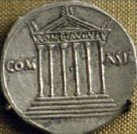
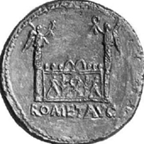
                            

    Temple of Rome and Augustus. Pergamon      Altar of Rome and Augustus – Lugdudum

    Tacitus introduces Tiberius rejecting such honors, unlike Augustus:

    Tacitus, Annales,4,37-38 ;

    About the same time Further Spain sent a deputation to the Senate, with a request to be allowed, after the example of Asia, to erect a temple to Tiberius and his mother. On this occasion, the emperor, who had generally a strong contempt for honours, and now thought it right to reply to the rumour which reproached him with having yielded to vanity, delivered the following speech:
    "I am aware, Senators, that many deplore my want of firmness in not having opposed a similar recent petition from the cities of Asia. I will therefore both explain the grounds of my previous silence and my intentions for the future. Inasmuch as the Divine Augustus did not forbid the founding of a temple at Pergamos to himself and to the city of Rome, I who respect as law all his actions and sayings, have the more readily followed a precedent once approved, seeing that with the worship of myself was linked an expression of reverence towards the Senate. But though it may be par- donable to have allowed this once, it would be a vain and arrogant thing to receive the sacred honour of images representing the divine throughout all the provinces, and the homage paid to Augustus will disappear if it is vulgarised by indiscriminate flattery.

    "For myself, Senators, I am mortal and limited to the functions of humanity, content if I can adequately fill the highest place; of this I solemnly assure you, and would have posterity remember it. They will more than sufficiently honour my memory by believing me to have been worthy of my ancestry, watchful over your interests, courageous in danger, fearless of enmity, when the State required it. These sentiments of your hearts are my temples, these my most glorious and abiding monuments. Those built of stone are despised as mere tombs, if the judgment of posterity passes into hatred. And therefore this is my prayer to our allies, our citizens, and to heaven itself; to the last, that, to my life's close, it grant me a tranquil mind, which can discern alike human and divine claims; to the first, that, when I die, they honour my career and the reputation of my name with praise and kindly remembrance."
    Henceforth Tiberius even in private conversations persisted in showing contempt for such homage to himself. Some attributed this to modesty; many to self-distrust; a few to a mean spirit. "The noblest men," it was said, "have the loftiest aspirations, and so Hercules and Bacchus among the Greeks and Quirinus among us were enrolled in the number of the gods. Augustus, did better, seeing that he had aspired. All other things princes have as a matter of course; one thing they ought insatiably to pursue, that their memory may be glorious. For to despise fame is to despise merit.
    "Translation by Alfred John Church, William Jackson Brodribb)

    Per idem tempus Hispania ulterior missis ad senatum legatis oravit ut exemplo Asiae delubrum Tiberio matrique eius extrueret. qua occasione Caesar, validus alioqui spernendis honoribus et respondendum ratus iis quorum rumore arguebatur in ambitionem flexisse, huiusce modi orationem coepit: 'scio, patres conscripti, constantiam meam a plerisque desideratam quod Asiae civitatibus nuper idem istud petentibus non sim adversatus. ergo et prioris silentii defensionem et quid in futurum statuerim simul aperiam. cum divus Augustus sibi atque urbi Romae templum apud Pergamum sisti non prohibuisset, qui omnia facta dictaque eius vice legis observem, placitum iam exemplum promptius secutus sum quia cultui meo veneratio senatus adiungebatur. ceterum ut semel recepisse veniam habuerit, ita per omnis provincias effigie numinum sacrari ambitiosum, superbum; et vanescet Augusti honor si promiscis adulationibus vulgatur.

    Ego me, patres conscripti, mortalem esse et hominum officia fungi satisque habere si locum principem impleam et vos testor et meminisse posteros volo; qui satis superque memoriae meae tribuent, ut maioribus meis dignum, rerum vestrarum providum, constantem in periculis, offensionum pro utilitate publica non pavidum credant. haec mihi in animis vestris templa, hae pulcherrimae effigies et mansurae. nam quae saxo struuntur, si iudicium posterorum in odium vertit, pro sepulchris spernuntur. proinde socios civis et deos ipsos precor, hos ut mihi ad finem usque vitae quietam et intellegentem humani divinique iuris mentem duint, illos ut, quandoque concessero, cum laude et bonis recordationibus facta atque famam nominis mei prosequantur.' perstititque posthac secretis etiam sermonibus aspernari talem sui cultum. quod alii modestiam, multi, quia diffideret, quidam ut degeneris animi interpretabantur. optumos quippe mortalium altissima cupere: sic Herculem et Liberum apud Graecos, Quirinum apud nos deum numero additos: melius Augustum, qui speraverit. cetera principibus statim adesse: unum insatiabiliter parandum, prosperam sui memoriam; nam contemptu famae contemni virtutes.

    They are significant the speeches  made by some Greek historians and speakers to Rome. Thus Aelius Aristides (Αίλιος Αριστείδης, in Latin, Aelius Aristides, 118-180) was an eminent sophist of the Second Sophist and Greek orator of the second century. His most famous orations was  “Regarding Rome," which he gave in front of the imperial palace in Rome and in which Aristides glorifies "the Empire and the theory behind it, particularly the Pax Romana," and paints an impressive picture of the Roman achievements, which stand out when it is compared to any other empire or city in history. I transcribe only a small part of this important work, which otherwise has been unequally valued by the critics who have dedicated works to it.

    Aelius Aristides: Regarding Rome, 8 and ff.

    It is from this that she gets her name, and strength rome) is the mark of all that is hers. Therefore, if one chose to unfold, as it wvere, and lay flat on the ground the cities which now she carries high in air, and place them side by side, all that part of Italy which intervenes would, I think, be filled and become one continuous city stretching to the Strait of Otranto.
    Though she is so vast as perhaps even now I have not sufficiently shown, but as the eye attests more clearly, it is not possible to say of her as of other cities, There she stands. Again it has been said of the capital cities of the Athenians and the Lacedaemonians -and may no ill omen attend the comparison- that the first would in size appear twice as great as in its intrinsic power, the second far inferior in size to its intrinsic power. But of this city, great in every respect, no one could say that she has not created power in keeping with her magnitude. No, if one looks at the whole empire and reflects how small a fraction rules the whole world, he may be amazed at the city, but when he has beheld the city herself and the boundaries of the city, he can no longer be amazed that the entire civilized world is ruled by one so great.

    Some chronicler, speaking of Asia, asserted that one man ruled as much land as the sun passed, and his  statement was not true because he placed all Africa and Europe outside the limits where the sun rises in the East and sets in the West. It has now however turned out to be true. Your possession is equal to what the sun can pass, and the sun passes over your land. Neither the Chelidonean nor the Cyanean promontories limit your empire, nor does the distance from which a horseman can reach the sea in one day, nor do you reign within fixed boundaries, nor does another dictate to what point your control reaches; but the sea like a girdle lies extended, at once in the middle of the civilized world and your hegemony.

    Around it lie the great continents greatly sloping, ever offering to you in full measure something of their own. Whatever the seasons make grow and whatever countries and rivers and lakes and arts of Hellenes and non-Hellenes produce are brought from every land and sea, so that if one would look at all these things, he must needs behold them either by visiting the entire civilized world or by coming to this city. For whatever is grown and made among each people cannot fail to be here at all times and in abundance. And here the merchant vessels come carrying these many products from all regions in every season and even at every equinox, so that the city appears a kind of common emporium of the world. (Translation by James H. Oliver)

    Note 1: He plays with the already mentioned meaning of the Greek word “rhome”, strength. 2. Again the city and the world orb put in relation.

    This relationship established between "orbis" and "urbis" (the City) is indicating the cultural and political union of a world controlled and appropriate by Rome. Even more,  the greatness of Rome is the greatness of the Empire. Rome is the city and the world; Eeen the world is conceived as a city; both concepts are interchangeable .

    The Latin poets of the time of Augustus are well aware of this role that has been played by them and their city by the design of the gods. Thus, Tibulus, Ovid, Virgil, Horace, etc.

    P.Ovidius Naso:  Amores 2,9

    So many men and maidens without love,
    Hence with great laude thou maiest a triumph move.
    Rome if her strength the huge world had not fild,
    With strawie cabins now her courts should build.
    The weary souldiour hath the conquerd fields,
    His sword layed by, safe, though rude places yeelds.
    The Docke in harbours ships drawne from the flouds,
    Horse freed from service range abroad the woods.
    And time it was for me to live in quiet,
    That have so oft serv'd pretty wenches dyet.
    Yet should I curse a God, if he but said,
    Live without love, so sweete ill is a maide.

    (Translate by Christopher Marlowe, Ed.)

    Tot sine amore viri, tot sunt sine amore puellae! 
         Hinc tibi cum magna laude triumphus eat.
    Roma, nisi inmensum vires promosset in orbem,
         Stramineis esset nunc quoque tecta casis.
    Fessus in acceptos miles deducitur agros;
         Mittitur in saltus carcere liber equus;
    Longaque subductam celant navalia pinum,
         Tutaque deposito poscitur ense rudis.
    Me quoque, qui totiens merui sub amore puellae,
         Defunctum placide vivere tempus erat.
    'Vive' deus 'posito' siquis mihi dicat 'amore!'
         Deprecer — usque adeo dulce puella malum est.

    Tibullus relates directly the future of Rome with his prophetic name: "Fatal, oh Rome, your name will be to the world"

    Tibullus 2.5.39 et seq.

      The Sibyl:

      "High-souled Aeneas, brother of light-winged Love,
      Thy pilgrim ships Troy's fallen worship bear.
      To thee the Latin lands are given of Jove,
      And thy far-wandering gods are welcome there.
      Thou thyself shalt have a shrine
      By Numicus' holy wave;
      Be thou its genius strong to bless and save,
      By power divine!

      O'er thy ship's storm-beaten prow
      Victory her wings will spread,
      And, glorious, rest at last above a Trojan head.
      I see Rutulia flaming round me now.
      O barbarous Turnus, I behold thee dead!
      Laurentum rushes on my sight,
      And proud Lavinium's castled height,
      And Alba Longa for thy royal heir.
      Now I see a priestess fair
      Close in Mars' divine embrace.
      Daughter of Ilium, she fled away
      From Vesta's fires, and from her virgin face
      The fillet dropped, and quite unheeded lay;
      Nor shield nor corslet then her hero wore,
      Keeping their stolen tryst by Tiber's sacred shore!
      Browse, ye bulls, along the seven green hills!
      For yet a little while ye may,
      E'er the vast city shall confront the day!
      O Rome! thy destined glory fills
      A wide world subject to thy sway,–
      Wide as all the regions given
      To fruitful Ceres, as she looks from heaven
      O'er her fields of golden corn,
      From the opening gates of morn
      To where the Sun in Ocean's billowy stream
      Cools at eve his spent and panting team.
      Troy herself at last shall praise
      Thee and thy far-wandering ways.
      My song is truth. Thus only I endure
      The bitter laurel-leaf divine,
      And keep me at Apollo's shrine
      A virgin ever pure."
    So, Phoebus, in thy name the Sibyl sung,
      As o'er her frenzied brow her loosened locks she flung.

    (Done in English verse by Theodore C. Williams. 1908)

    ‘Impiger Aenea, uolitantis frater Amoris,
    Troica qui profugis sacra uehis ratibus,
    iam tibi Laurentes adsignat Iuppiter agros,
    iam uocat errantes hospita terra Lares.
    illic sanctus eris cum te ueneranda Numici
    unda deum caelo miserit indigetem.
    ecce super fessas uolitat Victoria puppes;
    tandem ad Troianos diua superba uenit.
    ecce mihi lucent Rutulis incendia castris:
    iam tibi praedico, barbare Turne, necem.
    ante oculos Laurens castrum murusque Lauini est
    Albaque ab Ascanio condita Longa duce.
    te quoque iam uideo, Marti placitura sacerdos
    Ilia, Vestales deseruisse focos,
    concubitusque tuos furtim uittasque iacentes
    et cupidi ad ripas arma relicta dei.
    carpite nunc, tauri, de septem montibus herbas
    dum licet: hic magnae iam locus urbis erit.
    Roma, tuum nomen terris fatale regendis,
    qua sua de caelo prospicit arua Ceres,
    quaque patent ortus et qua fluitantibus undis
    Solis anhelantes abluit amnis equos.
    Troia quidem tunc se mirabitur et sibi dicet
    uos bene tam longa consuluisse uia.
    uera cano: sic usque sacras innoxia laurus
    uescar, et aeternum sit mihi uirginitas.’
    haec cecinit uates et te sibi, Phoebe, uocauit,

    Virgil expresses in three verses the Roman consciousness of his extraordinary mission in this world. Virgil puts in the mouth of Anchises, the father whom the hero Eneas has gone to look in the Underworld, the hell, the spaces of down,  the extraordinary responsibility of the Romans:

    He tells us in Aeneid, 6, verses 847 et seq.

    Others, I doubt not, shall with softer mould beast out the breathing bronze, coax from the marble features to life, plead cases with greater eloquence and with a pointer trace heaven’s motions and predict the risings of the stars: you, Roman, be sure to rule the world (be these your arts), to crown peace with justice, to spare the vanquished and to crush the proud.” (Translation by H. R. Fairclough)

    Excudent alii spirantia mollius aera,
    credo equidem, vivos ducent de marmore voltus,
    orabunt causas melius, caelique meatus
    describent radio, et surgentia sidera dicent:                            
    tu regere imperio populos, Romane, memento;
    hae tibi erunt artes; pacisque imponere morem,
    parcere subiectis, et debellare superbos.”

    Propertius also puts  urbs with orbi in relation (septem urbs alta iugis, toto quae praesidet orbi) and sings proud of the power of Rome in an elegy in which he presents the confrontation between Augustus and Cleopatra, that is the same as saying the confrontation between Cultures:

    Elegies, 3, 11, 55 and seq.:

    “Rome, with such a Citizen, thou hadst no cause to fear me”. So said even that sot’s tongue, swamped in endless debauch. The tall city on the Seven Hills, who thrones paramont over the whole world, felt the alarms of war and trembled at a woman’s menace. Gods preserve these walls or ours even as gods founded them! While Caesar lives Rome shall scarcely tremble at Jove” (Translated by J.S. Phillimore, M.A.)

    'Non hoc, Roma, fui tanto tibi cive verenda!'
    dixit et assiduo lingua sepulta mero.
    septem urbs alta iugis, toto quae praesidet orbi,
    femineas timuit territa Marte Minas
    (non humana deicienda manu).
    haec di condiderunt, haec di quoque moenia servant:
    vix timeat salvo Caesare Roma Iovem.

    Horace sees in the own fortress of Rome the reason of its own ruin by the continuous civil wars, of which it is horrified. Only Augustus will rescue it from the self destruction implanting the Roman pax. In Epodi 16: 1-14:

    Another age worn out in civil wars,
       And Rome sinks weighed down by her own sheer forces,
    Whom nor the bordering Marsians could destroy;
       Nor Porsena, threatening with Etruscan armies;
    Nor rival Capua. Nor fierce Spartacus,
       Nor Allobroge in all revolts a traitor;
    Nor fierce Germania’s blue-eyed giant sons;
       Nor Hannibal, abhorred by Romans mothers,
    That is the Rome which we, this race, destroy;
       We, impious victims by ourselves devoted,
    And to the wild beast and the wilderness
       Restoring soil which Romans called their country.
    Woe! on the ashes of Imperial Rome
       Shall the barbarian halt his march, a  victor;
    And the wild horseman with a changing hoof
       Trample the site which was the world’s great city,
    And –horrid sight- in scorn to winds and sun
       Scatter the shrouded bones of Rome’s first founder.

    (Translated by Lord Lytton. 1869)

    Altera iam teritur bellis civilibus aetas,
    suis et ipsa Roma viribus ruit.
    quam neque finitimi valuerunt perdere Marsi
    minacis aut Etrusca Porsenae manus,
    aemula nec virtus Capuae nec Spartacus acer
    novisque rebus infidelis Allobrox
    nec fera caerulea domuit Germania pube
    parentibusque abominatus Hannibal:
    inpia perdemus devoti sanguinis aetas
    ferisque rursus occupabitur solum:
    barbarus heu cineres insistet victor et Vrbem
    eques sonante verberabit ungula,
    quaeque carent ventis et solibus ossa Quirini,
    (nefas videre) dissipabit insolens.

    For Cicero it is evident that Rome is the most powerful city and owner of the world.

    Cicero Catiline Orations, 1.4.9.

    O ye immortal gods, where on earth are we? in what city are we living? what constitution is ours? There are here,—here in our body, O conscript fathers, in this the most holy and dignified assembly of the whole world, men who meditate my death, and the death of all of us, and the destruction of this city, and of the whole world. I, the consul see them; I ask them their opinion about the republic, and I do not yet attack, even by words, those who ought to be put to death by the sword. (Translated by C. D. Yonge, B. A)

    O di inmortales! ubinam gentium sumus? in qua urbe vivimus? quam rem publicam habemus? Hic, hic sunt in nostro numero, patres conscripti, in hoc orbis terrae sanctissimo gravissimoque consilio, qui de nostro omnium interitu, qui de huius urbis atque adeo de orbis terrarum exitio cogitent! Hos ego video consul et de re publica sententiam rogo et, quos ferro trucidari oportebat, eos nondum voce volnero!

    Pro Murena 9-10 (21-22)

    But to say no more of this, and to return to the contest of studies and pursuits; how can it be doubted that the glory of military exploits contributes more dignity to aid in the acquisition of the consulship, than renown for skill in civil law? Do you wake before the night is over in order to give answers to those who consult you? He has done so in order to arrive betimes with his army at the place to which he is marching. The cook-crow wakens you, but the sound of the trumpet rouses him: you conduct an action; he is marshaling an army: you take care lest your clients should be convicted; he lest his cities or camp be taken. He occupies posts, and exercises skill to repel the troops of the enemy, you to keep out the rain; he is practised in extending the boundaries of the empire, you in governing the present territories; and in short, for I must say what I think, preeminence in military skill excels all other virtues.

    It is this which has procured its name for the Roman people; it is this which has procured eternal glory for this city; it is this which has compelled the whole world to submit to our dominion; all domestic affairs, all these illustrious pursuits of ours, and our forensic renown, and our industry, are safe under the guardianship and protection of military valour. As soon as the first suspicion of disturbance is heard of, in a moment our arts have not a word to say for themselves. (Translated by C. D. Yonge, B. A.)

    Sed ut hoc omisso ad studiorum atque artium contentionem revertamur, qui potest dubitari quin ad consulatum adipiscendum multo plus adferat dignitatis rei militaris quam iuris civilis gloria? Vigilas tu de nocte ut tuis consultoribus respondeas, ille ut eo quo intendit mature cum exercitu perveniat; te gallorum, illum bucinarum cantus exsuscitat; tu actionem instituis, ille aciem instruit; tu caves ne tui consultores, ille ne urbes aut castra capiantur; ille tenet et scit ut hostium copiae, tu ut aquae pluviae arceantur; ille exercitatus est in propagandis finibus, tuque in regendis. Ac nimirum–dicendum est enim quod sentio–rei militaris virtus praestat ceteris omnibus. Haec nomen populo Romano, haec huic urbi aeternam gloriam peperit, haec orbem terrarum parere huic imperio coegit; omnes urbanae res, omnia haec nostra praeclara studia et haec forensis laus et industria latet in tutela ac praesidio bellicae virtutis. Simul atque increpuit suspicio tumultus, artes ilico nostrae conticiscunt. 

    Ad Familiares. 4.1.2. / 150 (IV 1)

    TO SERVIUS SULPICIUS RUFUS (AT ROME)
    CUMAE, APRIL (TOWARDS THE END)
    You see how the matter stands: the whole world is parcelled out among men in military command, and is ablaze with war: the city, without laws, law courts, justice, or credit, has been abandoned to plunder and fire. Accordingly, nothing occurs to me, I don't say to hope, but scarcely even to venture to wish.
    (Translated by Evelyn S. Shuckburgh)

    Res vides quomodo se habeat: orbem terrarum imperiis distributis ardere bello; urbem sine legibus, sine iudiciis, sine iure, sine fide relictam direptioni et incendiis: itaque mihi venire in mentem nihil potest non modo, quod sperem, sed vix, iam quod audeam optare;

    Paradoxa Stoicorum. 2.18

    Do you threaten me with death, to make me depart from all men, or with exile to make me depart from the wicked? Death is terrible for those  whom everything ends with life; but not to those whose praise cannot perish: exile is terrible to those who have their place of habitation  as circumscribed and limited; not to those who believe the whole world  is one city.

    Mortemne mihi minitaris, ut omnino ab hominibus, an exilium, ut ab inprobis demigrandum sit? Mors terribilis iis, quorum cum vita omnia extinguuntur, non iis, quorum laus emori non potest, exilium autem illis, quibus quasi circumscriptus est habitandi locus, non iis, qui omnem orbem terrarum unam urbem esse ducunt.

    And also for Cornelius Nepos. In  Atticus, 3.3:

    He also conducted himself in such a way, that he appeared familiar with the lowest, though on a level with the highest. Hence it happened that they publicly bestowed upon him all the honours that they could, and offered to make him a citizen of Athens; an offer which he would not accept, because some are of opinion that the citizenship of Rome is forfeited by taking that of another city. As long as he was among them, he prevented any statue from being erected to him; but when absent, he could not hinder it; and they accordingly raised several statues both to him and Phidias,254 in the most sacred places, for, in their whole management of the state, they took him for their agent and adviser. It was the gift of fortune, then, in the first place, that he was born in that city, above all others, in which was the seat of the empire of the world, and had it not only for his native place but for his home; and, in the next, it was a proof of his wisdom, that when he betook himself to a city which excelled all others in antiquity, politeness, and learning, he became individually dear to it beyond other men. (Translated by Rev. John Selby Watson, M)

    Hic autem sic se gerebat, ut communis infimis, par principibus videretur. quo factum est ut huic omnes honores, quos possent, publice haberent civemque facere studerent: quo beneficio ille uti noluit quod nonnulli ita interpretantur, amitti civitatem Romanam alia ascita. quamdiu affuit, ne qua sibi statua poneretur, restitit, absens prohibere non potuit. itaque aliquot ipsi et Phidiae locis sanctissimis posuerunt: hunc enim in omni procuratione rei publicae actorem auctoremque habebant potissimum.  igitur primum illud munus fortunae, quod in ea urbe natus est, in qua domicilium orbis terrarum esset imperii, ut eandem et patriam haberet et domum; hoc specimen prudentiae, quod, cum in eam se civitatem contulisset, quae antiquitate, humanitate doctrinaque praestaret omnes, unus ei fuit carissimus. 

    And also  Livy, who wrote a general history of Rome from its origins, which he entitled "Ab urbe condita" (From the foundation of the city), explains why he dares to take  a work of such magnitude: no doubt the most powerful people have ever been and their emperor, at the time Augustus, deserve it. He tells us in the Preface of his work:

    Whether I am likely to accomplish anything worthy of the labour, if I record the achievements of the Roman people from the foundation of the city, I do not really know, nor if I knew would I dare to avouch it;  perceiving as I do that the theme is not only old but hackneyed, through the constant succession of new historians, who believe either that in their facts they can produce more authentic information, or that in their style they will prove better than the rude attempts of the ancients.  Yet, however this shall be, it will be a satisfaction to have done myself as much as lies in me to commemorate the deeds of the foremost people of the world; and if in so vast a company of writers my own reputation should be obscure, my consolation would be the fame and greatness of those whose renown will throw mine into the shade.  Moreover, my subject involves infinite labour, seeing that it must be traced back above seven hundred years, and that proceeding from slender beginnings it has so increased as now to be burdened by its own magnitude; and at the same time I doubt not that to most readers the earliest origins and the period immediately succeeding them will give little pleasure, for they will be in haste to reach these modern times, in which the might of a people which has long been very powerful is working its own undoing.  I myself, on the contrary, shall seek in this an additional reward for my toil, that I may avert my gaze from the troubles which our age has been witnessing for so many years, so long at least as I am absorbed in the recollection of the brave days of old, free from every care which, even if it could not divert the historian's mind from the truth, might nevertheless cause it anxiety. (English  by Benjamin Oliver Foster, Ph.D., 1919)

    facturusne operae pretium sim, si a primordio urbis res populi Romani perscripserim, nec satis scio nec,  si sciam, dicere ausim, quippe qui cum veterem tum vulgatam esse rem videam, dum novi semper scriptores aut in rebus certius aliquid allaturos se aut scribendi arte rudem vetustatem superaturos credunt. utcumque erit,  iuvabit tamen rerum gestarum memoriae principis terrarum populi pro virili parte et ipsum consuluisse; et si in tanta scriptorum turba mea fama in obscuro sit, nobilitate ac magnitudine eorum me, qui nomini officient meo, consoler.  res est praeterea et inmensi operis, ut quae supra septingentesimum annum repetatur et quae ab exiguis profecta initiis eo creverit, ut iam magnitudine laboret sua; et legentium plerisque haud dubito quin primae origines proximaque originibus minus praebitura voluptatis sint festinantibus ad haec nova, quibus iam pridem praevalentis populi vires se ipsae conficiunt;  ego contra hoc quoque laboris praemium petam, ut me a conspectu malorum, quae nostra tot per annos vidit aetas, tantisper certe, dum prisca illa tota mente repeto, avertam,  omnis expers curae, quae scribentis animum etsi non flectere a vero, sollicitum tamen efficere posset.

    And shortly afterwards he informs us that this was predicted, , when he tells us about the disappearance and predictable rise to the heavens of Romulus, and tells us:

    Livy, 1,16,6-7

    This was Proculus Julius, who, when the people were distracted with the loss of their king and in no friendly mood towards the senate, being, as tradition tells, weighty in council, were the matter never so important, addressed the assembly as follows: “Quirites, the Father of this City, Romulus, descended suddenly from the sky at dawn this morning and appeared to me. Covered with confusion, I stood reverently before him, praying that it might be vouchsafed me to look upon his face without sin. 'Go,' said he, 'and declare to the Romans the will of Heaven that my Rome shall be the capital of the world; so let them cherish the art of war, and let them know and teach their children that no human strength can resist Roman arms.'  So saying,” he concluded, “Romulus departed on high.” It is wonderful what credence the people placed in that man's tale, and how the grief for the loss of Romulus, which the plebeians and the army felt, was quieted by the assurance of his immortality. (Translated by Benjamin Oliver Foster)

    manavit enim haec quoque sed perobscura fama; illam alteram admiratio viri et pavor praesens nobilitavit.  et consilio etiam unius hominis addita rei dicitur fides. namque Proculus Iulius, sollicita civitate desiderio regis et infensa patribus, gravis, ut traditur, quamvis magnae rei auctor, in contionem prodit.  “Romulus” inquit, “Quirites, parens urbis huius, prima hodierna luce caelo repente delapsus se mihi obvium dedit. cum perfusus horrore venerabundus adstitissem, petens precibus ut contra intueri fas esset,  'Abi, nuntia,' inquit 'Romanis caelestes ita velle ut mea Roma caput orbis terrarum sit; proinde rem militarem colant, sciantque et ita posteris tradant nullas opes humanas armis Romanis resistere posse.' haec,” inquit, “locutus sublimis abiit.”  mirum quantum illi viro nuntianti haec fides fuerit, quamque desiderium Romuli  apud plebem exercitumque facta fide inmortalitatis lenitum sit.

    Lucanus, in his Pharsalia, introduces  Caesar speaking to Rome deified, crowned with the crown of towers:

    Lucanus, Pharsalia 1, 183 et seq.

    Caesar has crossed the Alps, his mighty soul
    Great tumults pondering and the coming shock.
    Now on the marge of Rubicon, he saw,
    In face most sorrowful and ghostly guise,
    His trembling country's image; huge it seemed
    Through mists of night obscure; and hoary hair
    Streamed from the lofty front with turrets crowned:
    Torn were her locks and naked were her arms.
    Then thus, with broken sighs the Vision spake:
    What seek ye, men of Rome? and whither hence
    Bear ye my standards? If by right ye come,
    My citizens, stay here; these are the bounds;
    No further dare.' But Caesar's hair was stiff
    With horror as he gazed, and ghastly dread
    Restrained his footsteps on the further bank.
    Then spake he, ' Thunderer, who from the rock
    Tarpeian seest the wall of mighty Rome;
    Gods of my race who watched o'er Troy of old;
    Thou Jove of Alba's height, and Vestal fires,
    And rites of Romulus erst rapt to heaven,
    And God-like Rome; be friendly to my quest.
    Not with offence or hostile arms I come,
    Thy Caesar, conqueror by land and sea,
    Thy soldier here and wheresoe'er thou wilt:
    No other's; his, his only be the guilt
    Whose acts make me thy foe.' 

    (Translated by Sir Edward Ridley)

    iam gelidas Caesar cursu superauerat Alpes
    ingentisque animo motus bellumque futurum
    ceperat. ut uentum est parui Rubiconis ad undas,                 
    ingens uisa duci patriae trepidantis imago
    clara per obscuram uoltu maestissima noctem
    turrigero canos effundens uertice crines
    caesarie lacera nudisque adstare lacertis
    et gemitu permixta loqui: 'quo tenditis ultra?                 
    quo fertis mea signa, uiri? si iure uenitis,
    si ciues, huc usque licet.' tum perculit horror
    membra ducis, riguere comae gressumque coercens
    languor in extrema tenuit uestigia ripa.
    mox ait 'o magnae qui moenia prospicis urbis                 
    Tarpeia de rupe Tonans Phrygiique penates
    gentis Iuleae et rapti secreta Quirini
    et residens celsa Latiaris Iuppiter Alba
    Vestalesque foci summique o numinis instar
    Roma, faue coeptis. non te furialibus armis                 
    persequor: en, adsum uictor terraque marique
    Caesar, ubique tuus (liceat modo, nunc quoque) miles.
    ille erit ille nocens, qui me tibi fecerit hostem.
    '

    And so I could continue to give innumerable examples.
    (To be continued…)
  • Let us quote correctly the Latin phrases, so concise and expressive, and that give so much cultural prestige.

    “Urbi et orbi” is a Latin phrase constituted by two words related to each other by a copulative conjunction, that is united. It turns out that many Latin words, including nouns, have different forms or cases that differ by their termination; “” Casus “after all comes to mean” fall, termination “. In concrete these two words end in -i and for that reason we say that they are in “dative” case.

    All this is elementary Latin grammar and anyone who knows this and nothing else can understand that if we modify the terminations of some words, the nouns between them, we are changing their function, and consequently the meaning.

    Well, the previous phrase "urbi et orbi" means "for the city (that is Rome) and for the world (which is the remaining world)" and that is its meaning because the two end in -i.

    The phrase applies literally to one of the messages issued by the Pope, who is the bishop of Rome and Father of all Catholic Christendom, when he addresses them to the faithful of Rome and the whole world and gives them plenary indulgence for their sins. But in reality the phrase applies by extension to every message issued by anyone and addressed to all men. In a second article I will comment more on the origin of this expression.

    Well, it is very pleasant for those who love and enjoy with the Latin language to meet people who use Latin phrases in all types of writings, comments and conversations. Cervantes called them in Spanish "latinicos" (coloquial Latin) in the Prologue of the first part of his work "Don Quixote” and some call them with a certain contemptuous tone "latinajos", bad Latin.

    Now, in the same proportion, it is profoundly unpleasant to encounter poorly constructed Latin phrases, which make elementary linguistic and grammatical errors, such as not respecting proper termination.

    A few days ago I heard in the mouth of a frequent and abundant tertullian of one of the various television channels in Spain to pronounce with the aplomb of the ignorant "urbi et orbe", thus, finished the last in -e. And the same error in a few days I found it in the pen of a well-known commentator, young promise, of an important Spanish newspaper. (I think foreign authors are more careful when it comes to quoting). But that poorly constructed sentence no longer means what people pretend to use it, if it can mean anything now.

    Of course, the error comes from ignorance, no doubt; facilitated it by the fact that in Spanish there is the noun "orbe" and that leads them to the mistake of these "latinists" little careful.

    If it is not possible to demand that all citizens to know elementary Latin, no matter how desirable it may be, we can demand that those who use prestigious Latin expressions should be minimally advised, that is, they should  look for any of the contrasting instruments which are now available to anyone.

    But since today we go with grammatical conventions I take advantage to warn of other very frequent errors, as shocking as the previous one:

    – – It is said "sensu stricto" and not "sensu strictu":
    – "motu proprio" and not "motu propio": propius, without the -r- means closer
    "in dubio pro reo" and not "in dubium pro reo"
    "veni, vidi, vici" and not "vini, vidi, vinci"
    – "morituri te salutant" and not "morituri te salutan" or "morituri te salutam"
    – "sine nobilitate" (1)  and not "sine nobilitatis"

    (1) I had not yet finished this article when I receive from another lover of Latin, via twitter, the information of another error, new for me so far, which now is perpretated by a government of town, by local government of Guadalupe, city of Spain, , with a public announcement  of a holiday very much rooted in Spain, "Corpus Christi", which the poster has transformed into "Corpus Christis", whose pronunciation would sound rather the name of a famous English auction house, "Christie's", but that can not refer to the belief of The Christians that the "host" of consecrated bread is actually the body of Christ.

    (1). I will say as a curiosity, that precisely from the Latin expression "sine nobilitate" it comes the English term snob, s (ine) nob (ilitate), as Ortega y Gasset explained in "The revolt  of the masses", although dictionaries English, such as Oxford do not admit this origin and they are looking for a more indigenous.

    I reproduce the paragraph of Ortega in which he refers to the term "snob", in which also he uses another Latinism, "idola fori"

    This man-mass is the man previously emptied of his own history, without entrails of the past and, therefore, docile to all disciplines called "international". More than a man, it is only a shell of a man constituted by mere idola fori; It lacks an "inside", an intimacy of its own, inexorable and inalienable, of a self that can not be revoked. Hence he is always available to pretend to be anything. He has only appetites, believes that he has only rights and does not believe that he has obligations: he is the man without the nobility that obliges -sine nobilitate-, snob.

    Note: In England the lists of neighbors indicated next to each name the office and rank of the person. For that reason, next to the name of the simple bourgeois the abbreviation s. nob appeared; that is, “sine nobilitate” “without nobility”. This is the origin of the word snob. (The Revolt of the Masses. “Prologue for the French” III. 1937)

    By the way, "idola fori" is an Latin expression coined by Francis Bacon in his Novum Organum to refer to the imperfect correspondence between the definitions expressed in words in a language and the real thing they define.

    We could extend without end the list of shocking errors if we observe the overflowing imagination of those who, over a well-constructed primitive Latin phrase, create others without regard to the rules of grammatical concordance.

    So on the famous expression “delenda est Carthago", with which the very conservative and nationalist Cato ended  all his speeches, were over, whether or not, there are those who create similar ones of the type "delenda est parliament" (or whatever), when at least he could have said with a little imagination "delendum est parlamentum."

    Or who  on "condicio (or conditio) sine qua non," which is typically juridical, he coins others of any meaning, such as "elements, instruments, circumstances … sine qua non" when the relative "qua" is singular and feminine.

    I take advantage of the previous idea to explain that in Latin "condicio" and "conditio" are two words of different origin, although in late Latin the word "conditio", which in classical Latin means "foundation", acquired the sense of "condition"; since the expression "conditio sine qua non" is characteristic of late Latin, it passed with  that form into modern languages; in reality "conditio sine qua non"  proves to be an anachronism or even hypercultism by converting a word from one  epoch to that of another.

    I can not miss the opportunity to warn of other errors that occur in the accentuation of Latin words, in which inevitably the non-expert in Latin, tends to accentuate as his nationality.  This is aided by the fact that in Latin the graphic  accent is not used; It is not that there is no prosodic or tonic accent (from prosody from πρὸς- (pros = next to), and the root ᾠδή, oide = song), which is put in one syllable or another depending on its quantity or duration (There are long and short syllables) and this, that the ancients differentiated well  in some moments, for us it can  not be significant.

    It should be noted, therefore, that it is said “Cármina Burána” and not  "Carmína Burana", that it  is said "álea iacta est" and not "aléa iacta est", "curriculum vítae" and not "curriculum vitáe", because I refer only to some of the errors that we often hear. The latter of accenting the -a of the diphthong -ae in final position of word is very generalized, violating the rule that in Latin there are no  words with acute accent, that is, with an accent on the last syllable.

    I remember that in my youth there was in Spain an interesting satirical magazine called “La codorniz” (The Quail) and in it a section titled "The paper jail" to which was condemned him  who destroyed the language with their nonsense. There would be at least the violators of Latin grammar, condemning always more bearable than the "lions" of the amphitheater to those who probably would have been sent in the days of some maniacal emperor of language like Claudius, who came to invent three letters to transcribe some Greek sounds, although with little success, because after his death they stopped being used.

    Perhaps I should apologize, on my part, to avoid the annoyance of those who have good and precise knowledge of Latin by correcting such elementary, but not infrequent and unnerving errors. They will certainly know how to apologize me.

  • Prodigies, miracles, wonders, portents, phenomena, monsters (II)

    Among these prodigies, the lightnings, the apparitions of divine beings wrapped in marvelous lights and halos stand out and impress the Romans. The appearance of some goddess to small shepherds is documented already in an Egyptian text of the time of The Middle Kingdom of Egypt (2.000-1800 b.Ch.) to which I dedicate a next article.

    The actions of the images and statues or representations of the divine beings that behave as if they were of flesh and bone and not of stone, wood or metal, also stand out. The statues which speak and send messages to humans, or jump and move from their stand or illuminate the pupil of their eyes with wonderful light, are especially attractive.

    This behavior of the images responds to the diffuse and confused character of these statues that on one hand are mere representations of something that is not in this world and on the other hand they are the materialized divinity itself that lives with us. That is to say, the famous chryso-elephantine statue of Athena Parthenos, Virgin, of Athens is not a mere representation, but the materialized goddess herself.

    And the same is true today with the images of modern saints and virgins, as it is revealed by the popular behavior that venerates them, touches them, invokes them, sings them, pleads with them, in contradiction to what reason says, even theological theory, which in reality does little to inform the people properly.

    Well, these special effects are often used by poets. I will give only two examples of the indisputable Virgil and another of our poet of Hispanic origin Lucan.

    Then I will present a famous text of Pliny the Younger on the appearance of a lady of great stature and prestige and of the ghosts,  which also Tacitus refers  in his Annals.

    I will also quote a passage from The City of God of Saint Augustine, in which he refers and disqualifies these superstitions.

    In this case, it calls powerfully the attention the clairvoyance with which he analyzes the superstitions  of the others and the security with which he accepts the own quack theory. No doubt a reader alien to our culture would not appreciate any difference between the beliefs of pagans and the beliefs of Christians; in fact, historically, the latter feed on the former.

    Today as yesterday the statues of the divine beings continue to cry, illuminating their pupils, jumping from the bases, appearing to the shepherds, sending messages, many times encrypted to the mortals. Read carefully the news of the day and you will find that somewhere in the world someone claims to have met with some similar phenomenon. In that struggle between reason and mystery, the confrontation continues.

    In Greek and Roman epic poetry, the gods are actors in permanent relationship with mortals, in whose disputes they take sides for one or the other.

    I will present first the text of the Hispanic poet Lucanus in which he maximizes the emotion that these prodigies can generate in his credulous readers. The text is a fragment of his poem Bellum Civile, later called "Pharsalia" from  the name of the decisive battle in the civil war between Caesar and Pompey prior to the imposition of a personal and authoritarian regime in Rome, thus ending the long  republican period and giving entrance to the imperial time. In this fragment, among other prodigies, the gods shed tears and the Lares gods sweat.

    Marcus Annaeus Lucanus, Bellum Civile 1.1 lines 544 y ss.

    The jaws of Aetna were agape with flame
    That rose not heavenwards, but headlong fell
    In smoking stream upon th’Italian flank.
    Then black Charybdis, from her boundless depth,
    Threw up a gory sea. In piteous tones
    Howled the wild dogs; the Vestal fire was snatched
    From off the altar; and the flame that crowned
    The Latin festival was split in twain,
    As on the Theban pyre,2 in ancient days;
    Earth tottered on its base: the mighty Alps
    From off their summits shook th' eternal snow.3
    In huge upheaval Ocean raised his waves
    O'er Calpe's rock and Atlas' hoary head.
    The native gods shed tears, and holy sweat
    Dropped from the idols; gifts in temples fell:
    Foul birds defiled the day; beasts left the woods
    And made their lair among the streets of Rome.
    All this we hear; nay more: dumb oxen spake;
    Monsters were brought to birth and mothers shrieked
    At their own offspring; words of dire import
    From Cumae's prophetess were noised abroad.
    Bellona's priests with bleeding arms, and slaves
    Of Cybele's worship, with ensanguined hair,
    Howled chants of havoc and of woe to men.
    Arms clashed; and sounding in the pathless woods
    Were heard strange voices; spirits walked the earth:
    And dead men's ashes muttered from the urn.
    Those who live near the walls desert their homes,
    For lo! with hissing serpents in her hair,
    Waving in downward whirl a blazing pine,
    A fiend patrols the town, like that which erst
    At Thebes urged on Agave,4 or which hurled
    Lycurgus' bolts, or that which as he came
    From Hades seen, at haughty Juno's word,
    Brought terror to the soul of Hercules.
    Trumpets like those that summon armies forth
    Were heard re-echoing in the silent night:
    And from the earth arising Sulla's 5 ghost
    Sang gloomy oracles, and by Anio's wave
    All fled the homesteads, frighted by the shade
    Of Marius waking from his broken tomb.
    In such dismay they summon, as of yore,
    The Tuscan sages to the nation's aid.

    (Translated by Sir Edward Ridley. London. Longmans, Green, and Co. 1905.)

    ora ferox Siculae laxauit Mulciber Aetnae,                  545
    nec tulit in caelum flammas sed uertice prono
    ignis in Hesperium cecidit latus. atra Charybdis
    sanguineum fundo torsit mare; flebile saeui
    latrauere canes. Vestali raptus ab ara
    ignis, et ostendens confectas flamma Latinas  
    scinditur in partes geminoque cacumine surgit 
    Thebanos imitata rogos. tum cardine tellus 
    subsedit, ueteremque iugis nutantibus Alpes 
    discussere niuem. Tethys maioribus undis 
    Hesperiam Calpen summumque inpleuit Atlanta.  
    indigetes fleuisse deos, urbisque laborem 
    testatos sudore Lares, delapsaque templis 
    dona suis, dirasque diem foedasse uolucres 
    accipimus, siluisque feras sub nocte relictis 
    audaces media posuisse cubilia Roma.  
    tum pecudum faciles humana ad murmura linguae, 
    monstrosique hominum partus numeroque modoque 
    membrorum, matremque suus conterruit infans; 
    diraque per populum Cumanae carmina uatis 
    uolgantur. tum, quos sectis Bellona lacertis 
    saeua mouet, cecinere deos, crinemque rotantes 
    sanguineum populis ulularunt tristia Galli. 
    conpositis plenae gemuerunt ossibus urnae.
    tum fragor armorum magnaeque per auia uoces
    auditae nemorum et uenientes comminus umbrae.                
    quique colunt iunctos extremis moenibus agros
    diffugiunt: ingens urbem cingebat Erinys
    excutiens pronam flagranti uertice pinum
    stridentisque comas, Thebanam qualis Agauen
    inpulit aut saeui contorsit tela Lycurgi                 
    Eumenis, aut qualem iussu Iunonis iniquae
    horruit Alcides uiso iam Dite Megaeram.
    insonuere tubae et, quanto clamore cohortes
    miscentur, tantum nox atra silentibus auris
    edidit. e medio uisi consurgere Campo                 
    tristia Sullani cecinere oracula manes,
    tollentemque caput gelidas Anienis ad undas
    agricolae fracto Marium fugere sepulchro.
    haec propter placuit Tuscos de more uetusto
    acciri uates.

    It is very interesting the fragment of the Aeneid of Virgil in which he relates the reaction of the image of Pallas, which had been stolen from his temple by Ulysses and the son of Tydeus. The text can also serve to compare the epic tone, elevated, solemn but far from the dramatic and baroque of Lucanus; but this is another matter.
    Publius Virgilius Maro:

    aeneida, 2, vv. 162 y ss.

    Publius Vergilius Maro, Aeneid 2, v. 162 y ss.

    All the hope of the Danaans and their confidence in beginning the war were ever stayed on the help of Pallas. But from the time that the ungodly son of Tydeus and Ulysses, the contriver of crime, dared to tear the fateful Palladium from its hallowed shrine, slew the guards of the citadelheight, and snatching up the sacred image, ventured with bloody hands to touch the fillets of the maiden goddess — from that time the hopes of the Danaans ebbed and, backward stealing, receded; their strength was broken and the heart of the goddess estranged.

    And with no doubtful portents did Tritonia give signs thereof. Scarcely was the image placed within the camp, when from the upraised eyes there blazed forth flickering flames, salt sweat coursed over the limbs, and thrice, wonderful to relate, the goddess herself flashed forth  from the ground with shield and quivering spear. Straightway Calchas prophesies that the seas must be essayed in flight, and that Pergamus cannot be uptorn by Argive weapons, unless they seek new omens at Argos, and escort back the deity, whom they have taken away overseas in their curved ships. And now that before the wind they are bound for their native Mycenae, it is but to get them forces and attendant gods; then, recrossing the sea, they will be here unlooked for. So Calchas interprets the omens. (Translated by H. Rushton Fairclough)

    Omnis spes Danaum et coepti fiducia belli
    Palladis auxiliis semper stetit. impius ex quo 
    Tydides sed enim scelerumque inuentor Vlixes, 
    fatale adgressi sacrato auellere templo  
    Palladium caesis summae custodibus arcis, 
    corripuere sacram effigiem manibusque cruentis 
    uirgineas ausi diuae contingere uittas, 
    ex illo fluere ac retro sublapsa referri 
    spes Danaum, fractae uires, auersa deae mens. 
    nec dubiis ea signa dedit Tritonia monstris. 
    uix positum castris simulacrum: arsere coruscae 
    luminibus flammae arrectis, salsusque per artus 
    sudor iit, terque ipsa solo (mirabile dictu) 
    emicuit parmamque ferens hastamque trementem. 
    extemplo temptanda fuga canit aequora Calchas, 
    nec posse Argolicis exscindi Pergama telis 
    omina ni repetant Argis numenque reducant 
    quod pelago et curuis secum auexere carinis. 
    et nunc quod patrias uento petiere Mycenas,  
    arma deosque parant comites pelagoque remenso

    It is also interesting the end that Virgil offers us in Book I of his Georgics. It reminds us of the signs that announced the dreadful horrors of the civil war and pray to the gods who protect Rome and guarantee its time of peace and splendor.

    Virgil, Georgics, 1, v.463 et seq.

    Who dare charge the sun
    With leasing? He it is who warneth oft
    Of hidden broils at hand and treachery,
    And secret swelling of the waves of war.
    He too it was, when Caesar's light was quenched,
    For Rome had pity, when his bright head he veiled
    In iron-hued darkness, till a godless age
    Trembled for night eternal; at that time
    Howbeit earth also, and the ocean-plains,
    And dogs obscene, and birds of evil bode
    Gave tokens. Yea, how often have we seen
    Etna, her furnace-walls asunder riven,
    In billowy floods boil o'er the Cyclops' fields,
    And roll down globes of fire and molten rocks!
    A clash of arms through all the heaven was heard
    By Germany; strange heavings shook the Alps.
    Yea, and by many through the breathless groves
    A voice was heard with power, and wondrous-pale
    Phantoms were seen upon the dusk of night,
    And cattle spake, portentous! streams stand still,
    And the earth yawns asunder, ivory weeps
    For sorrow in the shrines, and bronzes sweat.
    Up-twirling forests with his eddying tide,
    Madly he bears them down, that lord of floods,
    Eridanus, till through all the plain are swept
    Beasts and their stalls together. At that time
    In gloomy entrails ceased not to appear
    Dark-threatening fibres, springs to trickle blood,
    And high-built cities night-long to resound
    With the wolves' howling. Never more than then
    From skies all cloudless fell the thunderbolts,
    Nor blazed so oft the comet's fire of bale.
    Therefore a second time Philippi saw
    The Roman hosts with kindred weapons rush
    To battle, nor did the high gods deem it hard
    That twice Emathia and the wide champaign
    Of Haemus should be fattening with our blood.
    Ay, and the time will come when there anigh,
    Heaving the earth up with his curved plough,
    Some swain will light on javelins by foul rust
    Corroded, or with ponderous harrow strike
    On empty helmets, while he gapes to see
    Bones as of giants from the trench untombed.
    Gods of my country, heroes of the soil,
    And Romulus, and Mother Vesta, thou
    Who Tuscan Tiber and Rome's Palatine
    Preservest, this new champion at the least
    Our fallen generation to repair
    Forbid not. To the full and long ago
    Our blood thy Trojan perjuries hath paid,
    Laomedon. Long since the courts of heaven
    Begrudge us thee, our Caesar, and complain
    That thou regard'st the triumphs of mankind,
    Here where the wrong is right, the right is wrong,
    Where wars abound so many, and myriad-faced
    Is crime; where no meet honour hath the plough;
    The fields, their husbandmen led far away,
    Rot in neglect, and curved pruning-hooks
    Into the sword's stiff blade are fused and forged.
    Euphrates here, here Germany new strife
    Is stirring; neighbouring cities are in arms,
    The laws that bound them snapped; and godless war
    Rages through all the universe; as when
    The four-horse chariots from the barriers poured
    Still quicken o'er the course, and, idly now
    Grasping the reins, the driver by his team
    Is onward borne, nor heeds the car his curb.

    (Translation by J. B. Greenough. Boston. Ginn & Co. 1900. )

    …. Solem quis dicere falsum
    audeat. Ille etiam caecos instare tumultus
    saepe monet fraudemque et operta tumescere bella.
    Ille etiam exstincto miseratus Caesare Romam,
    cum caput obscura nitidum ferrugine texit
    inpiaque aeternam timuerunt saecula noctem.
    Tempore quamquam illo tellus quoque et aequora ponti
    obscenaeque canes inportunaeque volucres
    signa dabant. Quotiens Cyclopum effervere in agros
    vidimus undantem ruptis fornacibus Aetnam
    flammarumque globos liquefactaque volvere saxa!
    Armorum sonitum toto Germania caelo
    audiit, insolitis tremuerunt motibus Alpes.
    Vox quoque per lucos volgo exaudita silentis
    ingens et simulacra modis pallentia miris
    visa sub obscurum noctis, pecudesque locutae,
    infandum! sistunt amnes terraeque dehiscunt
    et maestum inlacrimat templis ebur aeraque sudant.
    Proluit insano contorquens vertice silvas
    fluviorum rex Eridanus camposque per omnis
    cum stabulis armenta tulit. Nec tempore eodem
    tristibus aut extis fibrae adparere minaces
    aut puteis manare cruor cessavit et altae
    per noctem resonare lupis ululantibus urbes.
    Non alias caelo ceciderunt plura sereno
    fulgura nec diri totiens arsere cometae.
    ergo inter sese paribus concurrere telis
    Romanas acies iterum videre Philippi;
    nec fuit indignum superis, bis sanguine nostro
    Emathiam et latos Haemi pinguescere campos.
    Scilicet et tempus veniet, cum finibus illis
    agricola incurvo terram molitus aratro
    exesa inveniet scabra robigine pila
    aut gravibus rastris galeas pulsabit inanis
    grandiaque effossis mirabitur ossa sepulchris.
    Di patrii, Indigetes, et Romule Vestaque mater,
    quae Tuscum Tiberim et Romana Palatia servas,
    hunc saltem everso iuvenem succurrere saeclo
    ne prohibete! Satis iam pridem sanguine nostro
    Laomedonteae luimus periuria Troiae;
    iam pridem nobis caeli te regia, Caesar,
    invidet atque hominum queritur curare triumphos;
    quippe ubi fas versum atque nefas: tot bella per orbem,
    tam multae scelerum facies; non ullus aratro
    dignus honos, squalent abductis arva colonis
    et curvae rigidum falces conflantur in ensem.
    Hinc movet Euphrates, illinc Germania bellum;
    vicinae ruptis inter se legibus urbes
    arma ferunt; saevit toto Mars inpius orbe;
    ut cum carceribus sese effudere quadrigae,
    addunt in spatia et frustra retinacula tendens
    fertur equis auriga neque audit currus habenas.

    Other prodigies of great impact among the ancients are, as I said, the apparitions of the divine beings. As I also said, there is evidence of the appearance of an Egyptian goddess to a shepherd in a story that we have incomplete of only 25 lines; In it the pastor tells his companions the encounter with a woman who did not look like mortal .. This prodigy has not stopped repeating itself periodically until our days. In another moment I will dedicate an article to this subject.

    But now I want to refer to another apparition that may remind us of a modern one. Pliny the Younger in a famous letter about the existence or not of the ghosts and the historian Tacitus tell it. I refer to the appearance of "a woman of superhuman stature to Curcius Rufus announcing that he would return to Africa as consul-elect.

    I transcribe the whole letter of Pliny the Younger: Epistula 7,27

     To Sura/,

    The present recess from business we are now enjoying affords you leisure to give, and me to receive, instruction. I am extremely desirous therefore to know whether you believe in the existence of ghosts, and that they have a real form, and are a sort of divinities, or only the visionary impressions of a terrified imagination ? What particularly inclines me to believe in their existence is a story f which I heard of Curtius Rufus. When he was in low circumstances and unknown in the world, he attended the governor of Africa into that province. One evening, as he was walking in the public portico, there appeared to him the figure of a woman, of unusual size and of beauty more than human. And as he stood there, terrified and astonished, she told him she was the tutelary power that presided over Africa, and was come to inform him of the future events of his life : that he should go back to Rome, to enjoy high honours there, and return to that province invested with the proconsular dignity, and there should die. Every circumstance of this prediction actually came to pass. It is said farther that upon his arrival at Carthage, as he was coming out of the ship, the same figure met him upon the shore. It is certain, at least, that being seized with a tit of illness, though there were no symptoms in his case that led those about him to despair, he instantly gave up all hope of recovery; judging, apparently, of the truth of the future part of the prediction by what had already been fulfilled, and of the approaching misfortune from his former prosperity.  Now the following story, which I am going to tell you just as I heard it, is it not more terrible than the former, while quite as wonderful ? There was at Athens  a large and roomv house, which had a bad name, so that no one could live there. In the dead of the night a noise, resembling the clashing of iron was frequently heard, which, if you listened more attentively, sounded like the rattling of chains, distant at first, but approaching nearer by degrees; immediately afterwards a spectre appeared in the form of an old man, of extremely emaciated and squalid appearance, with a long beard and dishevelled hair, rattling the chains on his feet and hands. The distressed occupants meanwhile passed their wakeful nights under the most dreadful terrors imaginable. This, as it broke their rest, ruined their health, and brought on distempers, their terror grew upon them, and death ensued.

    Even in the day time, though the spirit did not appear, yet the impression remained so strong upon their imaginations that it still seemed before their eyes, and kept them in perpetual alarm. Consequently the house was at length deserted, as being deemed absolutely uninhabitable ; so that it was now entirely abandoned to the ghost. However, in hopes that some tenant might be found who was ignorant of this very alarming circumstance, a bill was put up, giving notice that it was either to be let or sold. It happened that Athenodorus  the philosopher came to Athens at this time, and, reading the bill, enquired the price. The extraordinary cheapness raised his suspicion ; nevertheless, when he heard the whole Mory, he was so far from being discouraged that he was more strongly inclined to hire it, and, in short, actually did so. When it grew towards evening, he ordered a couch to be prepared for him in the front part of the house, and, after calling for a light, together with his pencil and tablets, directed all his people to retire. But that his inind might not, for want of employment, be open to the vain terrors of imaginary noises and spirits, he applied himself to writing with the utmost attention. The first part of the night passed in entire silence, as usual ; at length a clanking of iron and rattling of chains was heard : however, he neither lifted up his eyes nor laid down his pen, but in order to keep calm and collected tried to pass the sounds off to himself as something else. The noise increased and advanced nearer, till it seemed at the door, and at, last in the chamber. He looked up, saw, and recognised the ghost exactly as it had been described to him : it stood before him, beckoning with the finger, like a person who calls another, Athenodorus in reply made a sign with his hand that it should wait a little, and threw his eyes again upon his papers ; the ghost then rattled its chains over the head of the philosopher, who looked up upon this, and seeing it beckoning as before, immediately arose, and, light in hand, followed it. The ghost slowly stalked along, as if encumbered with its chains, and, turning into the area of the house, suddenly vanished. Athenodorus, being thus deserted, make a mark with nome grass and leaves on the spot where the spirit left him. The next day he gave information to the magistrates, and advised them to order that spot to be dug up. This was accordingly done, and the skeleton of a man in chains was found there ; for the body, having lain a considerable time in the ground, was putrefied and mouldered away from the fetters. The bones being collected together were publicly buried, and thus after the ghost was appeased by the proper ceremonies, the house was haunted no more This story I believe upon the credit of others ; what I am going to mention, I give you upon my own. I have a freedman named Marcus, who is by no means illiterate. One night, as he and his younger brother were lying together, he  fancied he saw somebody upon his bed, who took out a pair of scissors, and cut off the hair from the top part of  his own head, and in the morning, it appeared his hair  was actually cut, and the clippings lay scattered about the floor. A short time after this, an event of a similar nature contributed to give credit to the former story. A young I lad of my family was sleeping in his apartment with the rest of his companions, when two persons clad in white came in, as he says, through the windows, cut off his hair as he lay, and then returned the same way they entered. The next morning it was found that this boy had been served just as the other, and there was the hair agaiu, spread about the room. Nothing remarkable indeed followed these events, unless perhaps that I escaped a prosecution, in which, if Domitian during whose reign this happened had lived some time longer, I should certainly have been involved. For after the death of that emperor, articles of impeachment against me were found in his scrutore, which had been exhibited by Cams. It may therefore be conjectured, since it is customary for persons under any public accusation to let their hair grow. + this cutting off the hair of my servants was a sign I should escape the imminent danger that threatened mo. Let me desire you then to give this question your mature consideration. The subject deserves your examination ; as, I trust, I am not myself altogether unworthy a participation in the abundance of your superior knowledge. And though you should, as usual, balance between two opinions, yet I hope you will lean more on one side than on the other, lest, whilst I consult you in order to have my doubt settled, you should dismiss me in the same suspense and indecision that occasioned you the present application. Farewell.
    (Translation by William Melmoth,)

    Et mihi discendi et tibi docendi facultatem otium praebet. Igitur perquam velim scire, esse phantasmata et habere propriam figuram numenque aliquod putes an inania et vana ex metu nostro imaginem accipere.  Ego ut esse credam in primis eo ducor, quod audio accidisse Curtio Rufo. Tenuis adhuc et obscurus, obtinenti Africam comes haeserat. Inclinato die spatiabatur in porticu; offertur ei mulieris figura humana grandior pulchriorque. Perterrito Africam se futurorum praenuntiam dixit: iturum enim Romam honoresque gesturum, atque etiam cum summo imperio in eandem provinciam reversurum, ibique moriturum.  Facta sunt omnia. Praeterea accedenti Carthaginem egredientique nave eadem figura in litore occurrisse narratur. Ipse certe implicitus morbo futura praeteritis, adversa secundis auguratus, spem salutis nullo suorum desperante proiecit.  Iam illud nonne et magis terribile et non minus mirum est quod exponam ut accepi?  Erat Athenis spatiosa et capax domus sed infamis et pestilens. Per silentium noctis sonus ferri, et si attenderes acrius, strepitus vinculorum longius primo, deinde e proximo reddebatur: mox apparebat idolon, senex macie et squalore confectus, promissa barba horrenti capillo; cruribus compedes, manibus catenas gerebat quatiebatque.  Inde inhabitantibus tristes diraeque noctes per metum vigilabantur; vigiliam morbus et crescente formidine mors sequebatur. Nam interdiu quoque, quamquam abscesserat imago, memoria imaginis oculis inerrabat, longiorque causis timoris timor erat. Deserta inde et damnata solitudine domus totaque illi monstro relicta; proscribebatur tamen, seu quis emere seu quis conducere ignarus tanti mali vellet.  Venit Athenas philosophus Athenodorus, legit titulum auditoque pretio, quia suspecta vilitas, percunctatus omnia docetur ac nihilo minus, immo tanto magis conducit. Ubi coepit advesperascere, iubet sterni sibi in prima domus parte, poscit pugillares stilum lumen, suos omnes in interiora dimittit; ipse ad scribendum animum oculos manum intendit, ne vacua mens audita simulacra et inanes sibi metus fingeret.  Initio, quale ubique, silentium noctis; dein concuti ferrum, vincula moveri. Ille non tollere oculos, non remittere stilum, sed offirmare animum auribusque praetendere. Tum crebrescere fragor, adventare et iam ut in limine, iam ut intra limen audiri. Respicit, videt agnoscitque narratam sibi effigiem.  Stabat innuebatque digito similis vocanti. Hic contra ut paulum exspectaret manu significat rursusque ceris et stilo incumbit. Illa scribentis capiti catenis insonabat. Respicit rursus idem quod prius innuentem, nec moratus tollit lumen et sequitur.  Ibat illa lento gradu quasi gravis vinculis. Postquam deflexit in aream domus, repente dilapsa deserit comitem. Desertus herbas et folia concerpta signum loco ponit.  Postero die adit magistratus, monet ut illum locum effodi iubeant. Inveniuntur ossa inserta catenis et implicita, quae corpus aevo terraque putrefactum nuda et exesa reliquerat vinculis; collecta publice sepeliuntur. Domus postea rite conditis manibus caruit.  Et haec quidem affirmantibus credo; illud affirmare aliis possum. Est libertus mihi non illitteratus. Cum hoc minor frater eodem lecto quiescebat. Is visus est sibi cernere quendam in toro residentem, admoventemque capiti suo cultros, atque etiam ex ipso vertice amputantem capillos. Ubi illuxit, ipse circa verticem tonsus, capilli iacentes reperiuntur.  Exiguum temporis medium, et rursus simile aliud priori fidem fecit. Puer in paedagogio mixtus pluribus dormiebat. Venerunt per fenestras – ita narrat – in tunicis albis duo cubantemque detonderunt et qua venerant recesserunt. Hunc quoque tonsum sparsosque circa capillos dies ostendit.  Nihil notabile secutum, nisi forte quod non fui reus, futurus, si Domitianus sub quo haec acciderunt diutius vixisset. Nam in scrinio eius datus a Caro de me libellus inventus est; ex quo coniectari potest, quia reis moris est summittere capillum, recisos meorum capillos depulsi quod imminebat periculi signum fuisse.  Proinde rogo, eruditionem tuam intendas. Digna res est quam diu multumque consideres; ne ego quidem indignus, cui copiam scientiae tuae facias.  Licet etiam utramque in partem – ut soles – disputes, ex altera tamen fortius, ne me suspensum incertumque dimittas, cum mihi consulendi causa fuerit, ut dubitare desinerem. Vale.

    Tacitus: Annals: 11, 21.:

    Of the birth of Curtius Rufus, whom some affirm to have been the son of a gladiator, I would not publish a falsehood, while I shrink from telling the truth. On reaching manhood he attached himself to a quæstor to whom Africa had been allotted, and was walking alone at midday in some unfrequented arcade in the town of Adrumetum, when he saw a female figure of more than human stature, and heard a voice, "Thou, Rufus, art the man who will one day come into this province as proconsul." Raised high in hope by such a presage, he returned to Rome, where, through the lavish expenditure of his friends and his own vigorous ability, he obtained the quæstorship, and, subsequently, in competition with well-born candidates, the prætorship, by the vote of the emperor Tiberius, who threw a veil over the discredit of his origin, saying, "Curtius Rufus seems to me to be his own ancestor." Afterwards, throughout a long old age of surly sycophancy to those above him, of arrogance to those beneath him, and of moroseness among his equals, he gained the high office of the consulship, triumphal distinctions, and, at last, the province of Africa. There he died, and so fulfilled the presage of his destiny. (Translation by Alfred John Church, William Jackson Brodribb)

    De origine Curtii Rufi, quem gladiatore genitum quidam prodidere, neque falsa prompserim et vera exequi pudet. postquam adolevit, sectator quaestoris, cui Africa obtigerat, dum in oppido Adrumeto vacuis per medium diei porticibus secretus agitat, oblata ei species muliebris ultra modum humanum et audita est vox 'tu es, Rufe, qui in hanc provinciam pro consule venies.' tali omine in spem sublatus degressusque in urbem largitione amicorum, simul acri ingenio quaesturam et mox nobilis inter candidatos praeturam principis suffragio adsequitur, cum hisce verbis Tiberius dedecus natalium eius velavisset: 'Curtius Rufus videtur mihi ex se natus.' longa post haec senecta, et adversus superiores tristi adulatione, adrogans minoribus, inter pares difficilis, consulare imperium, triumphi insignia ac postremo Africam obtinuit; atque ibi defunctus fatale praesagium implevit.

    St. Augustine, in his City of God, refers  a prodigy well-known in antiquity: the tears shed by the statue of Apollo in Cumae, in Magna Graecia, on the occasion of the war between the Romans and the Greeks, when Publius Crassus died in a battle with Ariston. St. Augustine thinks that these are things of the demons that the poets present to us as true, but from then until today and also much earlier, many statues of gods, virgins and saints have wept frequently, acquiring the errors of men.

    Augustine: De civitate Dei (The City of God), III,11

    Of the statue of Apollo at Cumæ, whose tears are supposed to have portended disaster to the Greeks, whom the god was unable to succour.

    And it is still this weakness of the gods which is confessed in the story of the Cuman Apollo, who is said to have wept for four days during the war with the Achæans and King Aristonicus. And when the augurs were alarmed at the portent, and had determined to cast the statue into the sea, the old men of Cumæ interposed, and related that a similar prodigy had occurred to the same image during the wars against Antiochus and against Perseus, and that by a decree of the senate gifts had been presented to Apollo, because the event had proved favourable to the Romans. Then soothsayers were summoned who were supposed to have greater professional skill, and they pronounced that the weeping of Apollo's image was propitious to the Romans, because Cumæ was a Greek colony, and that Apollo was bewailing (and thereby presaging) the grief and calamity that was about to light upon his own land of Greece, from which he had been brought. Shortly afterwards it was reported that King Aristonicus was defeated and made prisoner,—a defeat certainly opposed to the will of Apollo; and this he indicated by even shedding tears from his marble image. And this shows us that, though the verses of the poets are mythical, they are not altogether devoid of truth, but describe the manners of the demons in a sufficiently fit style. For in Virgil Diana mourned for Camilla, and Hercules wept for Pallas doomed to die. This is perhaps the reason why Numa Pompilius, too, when, enjoying prolonged peace, but without knowing or inquiring from whom he received it, he began in his leisure to consider to what gods he should entrust the safe keeping and conduct of Rome, and not dreaming that the true, almighty, and most high God cares for earthly affairs, but recollecting only that the Trojan gods which Æneas had brought to Italy had been able to preserve neither the Trojan nor Lavinian kingdom founded by Æneas himself, concluded that he must provide other gods as guardians of fugitives and helpers of the weak, and add them to those earlier divinities who had either come over to Rome with Romulus, or when Alba was destroyed. (Translated by the Rev. Marcus Dods, M.A.)

    Neque enim aliunde Apollo ille Cumanus, cum adversus Achivos regemque Aristonicum bellaretur, quatriduo flevisse nuntiatus est ; quo prodigio haruspices territi cum id simulacrum in mare putavissent esse proiciendum, Cumani senes intercesserunt atque rettulerunt tale prodigium et Antiochi et Persis bello in eodem apparuisse figmento, et quia Romanis feliciter provenisset, ex senatus consulto eidem Apollini suo dona missa esse testati sunt. Tunc velut peritiores acciti haruspices responderunt simulacri Apollinis fletum ideo prosperum esse Romanis, quoniam Cumana colonia Graeca esset, suisque terris, unde accitus esset, id est ipsi Graeciae, luctum et cladem Apollinem significasse plorantem. Deinde mox regem Aristonicum victum et captum esse nuntiatum est, quem vinci utique Apollo nolebat et dolebat et hoc sui lapidis etiam lacrimis indicabat. Unde non usquequaque incongrue quamvis fabulosis, tamen veritati similibus mores daemonum describuntur carminibus poetarum. Nam Camillam Diana doluit apud Vergilium et Pallantem moriturum Hercules flevit . Hinc fortassis et Numa Pompilius pace abundans, sed quo donante nesciens nec requirens, cum cogitaret otiosus, quibusnam diis tuendam Romanam salutem regnumque committeret, nec verum illum atque omnipotentem summum Deum curare opinaretur ista terrena, atque recoleret Troianos deos, quos Aeneas advexerat, neque Troianum neque Laviniense ab ipso Aenea conditum regnum diu conservare potuisse: alios providendos existimavit, quos illis prioribus, qui sive cum Romulo iam Romam transierant, sive quandoque Alba eversa fuerant transituri, vel tamquam fugitivis custodes adhiberet vel tamquam invalidis adiutores.

    I could give you many examples.

  • Prodigies, miracles, wonders, portents, phenomena, monsters (I)

    Perhaps some reader has ever wondered where this temptation, so ancient and so modern, comes from believing in marvelous and inexplicable facts, to which the quality of miracles, divine deeds, messages of divinity is given.

    In this article you will find dozens of miracles and marvelous and inexplicable facts that were already produced in Antiquity and which were recorded in texts written more than two thousand years ago. And surely this weakness of a being as rational as man came from a past of thousands of years before, as many as mankind. From this and other weaknesses they are fed all kinds of superstitions and religions.

    But what is a prodigy, a miracle, a wonder, a portent, a phenomenon, a monster of nature?
    First we will use etymology and its significant force to explain the meaning of these terms and some others.

    Prodigy: from the Latin "Prodigium", "Portentum" from the Latin "portentum" and "presage" from the Latin "praesagium" come to mean the same thing in Latin: divine sign.

    The Dictionary of the Royal Spanish Academy defines "prodigy" as "strange event that exceeds the regular limits of nature". And "portentum" as "Thing, action or singular event that by its strangeness or novelty causes admiration or terror"; and “presage”  as: "1. Signal that indicates, prevents and announces an event. 2. Species of divination or knowledge of future things through signs that have been seen or intuitions and sensations".

    The etymology of "prodigium" is not secure; it has been related to "prod- agio," and this to  "aio" which means to speak, to say, and for that reason, perhaps Cicero erroneously links it with "pro-dico"; rather it seems to be related to "ago", "to carry, to push, to lead".

    "Praesagium" is related to "prae-" before, and sagire, infinitive of sagio ", to perceive, to feel, from which sagax derives, which has given " sagacious ". That is why Cicero says in his De divinatione, 1,31,65:

    Now sagire means 'to have a keen perception.' Accordingly certain old women are called sagae,3 because they are assumed to know a great deal, and dogs are said to be 'sagacious.' And so one who has knowledge of a thing before it happens is said to 'presage,' that is, to perceive the future in advance. (Translation. William Armistead Falconer)

    “sagire sentire acute est: ex quo sagae anus, quia multa scire volunt; et sagaces dicti canes. Is igitur, qui ante sagit quam oblata res est, dicitur praesagire, id est futura ante sentiré”

    It seems more certain the etymology  of portentum, from  "pro– (effect of metathesis or change of position of some phoneme) and tendo: to direct, to tend, .., that defines the Royal Spanish Academy as" Thing, action or singular event that by its Strangeness or novelty causes admiration or terror. "

    Marvel (wonder): it is an "extraordinary event or thing that causes admiration". The word comes from the Latin "mirabilia", admirable things, which is the neutral plural of "mirabilis", admirable, which is formed from the root of the verb "mirari", admire, and the adjective "mirus, -a, -um ", marvelous, wonderful, strange, surprising.

    From the same root and words they proceed to admire, and their compounds and also "miracle", from "miraculum".

    The Royal Spanish Academy defines a miracle as: "1. The fact not explainable by natural laws and attributed to supernatural intervention of divine origin. 2. m. Event or rare thing, extraordinary and wonderful. "

    From the same root they come the French "miroir", and the English "mirror".

    Phenomenon is a Greek word φαινόμενον phainómenon, which has come to us through the late Latin  phaenomenon; the Greek verb φαινεῖν, phainein means to shine, to make to shine, to appear; to show, to do see. The Royal Spanish Academy  defines it as: "1. All manifestation that becomes present to the consciousness of a subject and appears as the object of his perception. 2.  Extraordinary and surprising thing. 3.  Colloquial:  Monstrous person or animal. "

    With these terms are also related "oracle", from Latin oraculum and this from orare, to speak, which etymologically means message, communiqué, parliament.

    And also "prophecy", "prediction made by virtue of supernatural gift." Greek word  has come to us  through Latin: prophet, Greek, προφήτης, prophetes, "who says in advance", from προ- (pro -) (before) and φημί, phemí, to speak.

    In any case in the Roman world a "prodigy" is a sign of the gods with which they announce to men a future event, good or bad; it includes therefore omens and auguries.

    Augury, augur, haruspex,  are terms that deserve another extensive article. Let it suffice now to remember that an "augur" is a priest, from Etruscan origin, who observes the sky and the signs of the gods, signs that are called "auguries" .The haruspices, also Etruscan, analyze the entrails of the animals sacrificed to the gods to observe into them the messages of the divinity.

    With a more restricted sense, prodigy refers to any strange incident or marvelous apparition that is supposed that it announces a misfortune and therefore appears in calamitous circumstances for both the collective society and the individual.

    Cicero tells us in De divinitatione, I, 42 (93) and ss. that prodigy is synonymous with ostentum, monstrum and portentum ":

    Indeed, the inherent force of these means of divination, as you like to observe, is clearly shown by the very words so aptly chosen by our ancestors to describe them. Because they 'make manifest' (ostendunt), 'portend ' (portendunt), ' intimate ' (monstrant),'predict ' (praedicunt),they are called ' manifestations,' ' portents,' ' intimations,' and 'prodigies.' (Translation by William Armistead Falconer).

    “Quia enim ostendunt, portendunt, monstrant, praedicunt; ostenta, portenta, monstra, prodigia dicuntur”.

    I widen the quote a bit because it serves as the perfect setting for what we are dealing with. But first I want to refer to the term "monster", which derives from the verb "monstrare", to demonstrate, to teach, to show, it is "nothing but an unexpected and unprecedented being, phenomenon or event that precisely for this reason produces a major commotion in the person who sees or feel it, "that is," indicate, show, warn of something special ". Today in Spanish  the word “monstruo”, "monster" has more often a pejorative meaning, referring to something bad or inadequate, but it is not always so and it also maintains the meaning of something especially positive, as when we say of an artist, each one choose his idol, that he is a "monster of nature"

    Extended text Cicero, De divinatione, I, 42 (93) y ss.

    "Now, for my part, I believe that the character of the country determined the kind of divination which its inhabitants adopted. For  example, the Egyptians and Babylonians, who live on the level surface of open plains, with no hills to obstruct a view of the sky, have devoted their attention wholly to astrology. But the Etruscans, being in their nature of a very ardent religious temperament and accustomed to the frequent sacrifice of victims, have given their chief attention to the study of entrails. And as on account of the density of the atmosphere signs from heaven were common among them, and furthermore since that atmospheric condition caused many phenomena both of earth and sky and also certain prodigies that occur in the conception and birth of men and cattle—for these reasons the Etruscans have become very proficient in the interpretation of portents. Indeed, the inherent force of these means of divination, as you like to observe, is clearly shown by the very words so aptly chosen by our ancestors to describe them. Because they 'make manifest' (ostendunt), 'portend ' (portendunt), ' intimate ' (monstrant),'predict ' (praedicunt),they are called ' manifestations,' ' portents,' ' intimations,' and 'prodigies.'

    But the Arabians, Phrygians, and Cilicians, being chiefly engaged in the rearing of cattle, are constantly wandering over the plains and mountains in winter and summer and, on that account, have found it quite easy to study the songs and flights of birds. The same is true of the Pisidians and of our fellowcountrymen, the Umbrians. While the Carians, and especially the Telmessians, already mentioned, because they live in a country with a very rich and prolific soil, whose fertility produces many abnormal growths, have turned their attention to the study of prodigies.

    "But who fails to observe that auspices and all other kinds of divination flourish best in the best regulated states? And what king or people has there ever been who did not employ divination? I do not mean in time of peace only, but much more even in time of war, when the strife and struggle for safety is hardest. Passing by our own countrymen, who do nothing in war without examining entrails and nothing in peace without taking the auspices, let us look at the practice of foreign nations The Athenians, for instance, in every public assembly always had present certain priestly diviners, whom they call manteis. The Spartans assigned an augur to their kings as a judicial adviser, and they also enacted that an augur should be present in their Council of Elders, which is the name of their Senate. In matters of grave concern they always consulted the oracle at Delphi, or that of Jupiter Hammon or that of Dodona.

    Lycurgus himself, who once governed the Spartan state, established his laws by authority of Apollo's Delphic oracle, and Lysander, who wished to repeal them, was prevented from doing so by the religious scruples of the people. Moreover, the Spartan rulers, not content with their deliberations when awake, used to sleep in a shrine of Pasiphaë which is situated in a field near the city, in order to dream there, because they believed that oracles received in repose were true. (Translation by William Armistead Falconer, 1923)

    Ac mihi quidem videntur e locis quoque ipsis, qui  a quibusque incolebantur, divinationum oportunitates esse ductae. Etenim Aegyptii et Babylonii in camporum patentium aequoribus habitantes, cum ex terra nihil emineret, quod contemplationi caeli officere posset, omnem curam in siderum cognitione posuerunt, Etrusci autem, quod religione inbuti studiosius et crebrius hostias immolabant, extorum cognitioni se maxume dediderunt, quodque propter aëris crassitudinem  de caelo apud eos multa fiebant, et quod ob eandem causam multa invisitata partim e caelo, alia ex terra oriebantur, quaedam etiam ex hominum pecudumve conceptu et satu, ostentorum exercitatissimi interpretes exstiterunt. Quorum quidem vim, ut tu soles dicere, verba ipsa prudenter a maioribus posita declarant. Quia enim ostendunt, portendunt, monstrant, praedicunt, ostenta, portenta, monstra, prodigia dicuntur. Arabes autem et Phryges et Cilices, quod pastu pecudum maxume utuntur campos et montes hieme et aestate peragrantes, propterea facilius cantus avium et volatus notaverunt; eademque et Pisidiae causa fuit  et huic nostrae Umbriae. Tum Caria tota praecipueque Telmesses, quos ante dixi, quod agros uberrumos maximeque fertiles incolunt, in quibus multa propter fecunditatem fingi gignique possunt, in ostentis animadvertendis diligentes fuerunt. 
      Quis vero non videt in optuma quaque re publica plurimum auspicia et reliqua divinandi genera valuisse? Quis rex umquam fuit, quis populus, qui non uteretur praedictione divina? neque solum in pace, sed in bello multo etiam magis, quo maius erat certamen et discrimen salutis. Omitto nostros, qui nihil in bello sine extis agunt, nihil sine auspiciis domi [habent auspicia]; externa videamus: Namque et Athenienses omnibus semper publicis consiliis divinos quosdam sacerdotes, quos μάντεις vocant, adhibuerunt, et Lacedaemonii regibus suis augurem adsessorem dederunt, itemque senibus (sic enim consilium publicum appellant) augurem interesse voluerunt, iidemque de rebus maioribus semper aut Delphis oraclum aut ab Hammone aut a Dodona petebant. Lycurgus quidem, qui Lacedaemoniorum rem publicam temperavit, leges suas auctoritate Apollinis Delphici confirmavit; quas cum vellet Lysander commutare, eadem est prohibitus religione. Atque etiam qui praeerant Lacedaemoniis, non contenti vigilantibus curis in Pasiphaae fano,  quod est in agro propter urbem, somniandi causa excubabant, quia vera quietis oracla ducebant. Ad nostra iam redeo. Quotiens senatus decemviros ad libros ire iussit! quantis in rebus quamque saepe responsis haruspicum paruit! Nam et cum duo visi soles sunt et cum tres lunae et cum faces, et cum sol nocte visus est, et cum e caelo fremitus auditus, et cum caelum discessisse visum est atque in eo animadversi globi, delata etiam ad senatum labe agri Privernatis, cum  ad infinitam altitudinem terra desedisset Apuliaque maximis terrae motibus conquassata esset (quibus portentis magna populo Romano bella perniciosaeque seditiones denuntiabantur; inque his omnibus responsa haruspicum cum Sibyllae versibus congruebant); quid? cum Cumis Apollo sudavit, Capuae Victoria? quid?  ortus androgyni nonne fatale quoddam monstrum fuit? quid? cum fluvius Atratus sanguine fluxit? quid? cum saepe lapidum, sanguinis non numquam, terrae interdum, quondam etiam lactis imber defluxit? quid? cum in Capitolio ictus Centaurus e caelo est, in Aventino portae et homines, Tusculi aedes Castoris et Pollucis Romaeque Pietatis: nonne et haruspices ea responderunt, quae evenerunt, et in Sibyllae libris eaedem repertae praedictiones sunt? 

    Naturally it is believed that the catastrophic announcement can be avoided by the proper offerings and rites that overturn the omen.

    The rites are collected and explained in "books of practices" which are necessary for the purpose. They  are also from Etruscan origin. If the phenomenon is especially serious one has to resort to some soothsayer of recognized prestige, to the Sibylline Books or to the famous oracles like that of Delphi. We will speak of the Sibyls another time.

    The ancients in general and in a special way the Romans were very superstitious, and by that reason all their social, religious and cultural life is plagued of rites and preventions of all type.

    So much these phenomena, today we would say them "paranormal", attracted them, that there exist sacerdotal schools specialized in the interpretation of them; they are the augurs who watch permanently the sky and the flight of the birds and the haruspices who permanently analyze the bowels of the animals that so often are sacrificed  to their gods, as I mentioned before.

    The poet Ovid tells us in his Metamorphoses (otherwise work full of prodigies) how Teages appears, who teaches the Etruscans to reveal the future according to the signs previously mentioned:

    Metamorphoses XV, 547 et seq.

    The grief of others could not ease the woe
    of sad Egeria, and she laid herself
    down at a mountain's foot, dissolved in tears,
    till moved by pity for her faithful sorrow,
    Diana changed her body to a spring,
    her limbs into a clear continual stream.
    This wonderful event surprised the nymphs,
    and filled Hippolytus with wonder, just
    as great as when the Etrurian ploughman saw
    a fate-revealing clod move of its own
    accord among the fields, while not a hand
    was touching it, till finally it took
    a human form, without the quality
    of clodded earth, and opened its new mouth
    and spoke, revealing future destinies.
    The natives called him Tages. He was the first
    who taught Etrurians to foretell events.
    They were astonished even as Romulus,
    when he observed the spear, which once had grown
    high on the Palatine, put out new leaves
    and stand with roots—not with the iron point
    which he had driven in. Not as a spear
    it then stood there, but as a rooted tree
    with limber twigs for many to admire
    while resting under that surprising shade.

    (Translation by Brookes More, 1922)

    Non tamen Egeriae luctus aliena levare
    damna valent, montisque iacens radicibus imis
    liquitur in lacrimas, donec pietate dolentis
    mota soror Phoebi gelidum de corpore fontem
    fecit et aeternas artus tenuavit in undas.
    Et nymphas tetigit nova res, et Amazone natus
    haud aliter stupuit, quam cum Tyrrhenus arator
    fatalem glaebam mediis adspexit in arvis
    sponte sua primum nulloque agitante moveri,
    sumere mox hominis terraeque amittere formam
    oraque venturis aperire recentia fatis
    (indigenae dixere Tagen, qui primus Etruscam
    edocuit gentem casus aperire futuros);
    utve Palatinis haerentem collibus olim
    cum subito vidit frondescere Romulus hastam,
    quae radice nova, non ferro stabat adacto
    et iam non telum, sed lenti viminis arbor
    non exspectatas dabat admirantibus umbras;

    And even they elaborate extensive lists, indexes and books in which these "wonders", the "mirabilia" are collected. They are the paradoxographies. Naturally, the Greeks were the first to do so, and within them the first of whom we have certain news that he writes a specific book on this subject, is Callimachus (310 BC – 240 BC). Its development takes place in Hellenistic time in connection with the creation of the great libraries and centers of investigation like Alexandria and Pergamon.

    Those who are prone to believe in wonders and miracles will find in the Graec-Roman world hundreds of examples of marvelous facts, which according to some people continue to occur in abundance in our scientifically studied world. The knowledge of these "miracles" so old which  so often occur, should at least serve so many credulous people to question the presumed character of these prodigious facts, many of them explainable by scientific knowledge and other simply fantastic creations of man himself; as Spanish painter Goya painted, "the dream of reason produces monsters."

    I will present in several articles some texts of Livy, in whose history there are always present the prodigies, other texts of the poets Lucan and Virgil, and other of St. Augustine and his City of God.

    Livy, a historian who lived in the time of the emperor Augustus, wrote a history of Rome from its  foundation; that is why it is called  "Ab urbe condita", "Since the foundation of the city". His account is full of references to these miracles, portents and monsters; there are dozens of passages in which he refers dozens and even hundreds of "wonderful" facts, omens of all kinds. To this subject some important research articles have been devoted.

    The credulous Livy seems to collect prodigies as the sources offer them without further consideration, but he differs between major and minor prodigies, public and private, in Rome or outside Rome. I will present later an incomplete classification which will give us an idea of the variety of prodigies.

    A moment of special tension and therefore propitious for the appearance of "prodigia" is the time when in the Second Punic War between Romans and Carthaginians, Hannibal comes from Hispania and carries  the confrontation to Italy, traversing the Alps in winter with his elephants; then a great fear and worry spread among the Romans. These circumstances are a good environment for the multiplication of rumors of prodigies of all kinds. Some of them are still produced from time to time nowadays.

    I will cite only two passages from Livy of the possible tens as a sufficient sample and I will also offer a broader relationship with the corresponding textual reference in case the reader would like to extend his readings.

    In the list prodigies we will find rays, meteors and tongues of fire, halos and luminous crowns, multiplication of suns and moons; crevices and sinkings of the earth; strange glows in the sky; rain of blood, stones, earth, milk; rivers that carry bloody water; volcanic eruptions, perspiration of bronze or marble statues; hybrid or monstrous beings, like five-footed horses, man-headed pigs, bicephalous animals; animals or infants who speak, etc., etc.

    As I said, the references to prodigies are innumerable in Livy's work. We will see some examples and in the end I will give an incomplete relationship, with some classification, that will allow us to give an approximate idea of its importance. It is a matter of interest to analyze the extent to which Livy believes in these prodigies and the sources of the prodigies, including the pontifical books and the official Annals in which they are reflected following the Etruscan custom.

    Titus Livius (Livy), Ab urbe condita, The History of Rome, Book 22 1,8

    Men's fears were augmented by the prodigies reported simultaneously from many places: that in Sicily the javelins of several soldiers had taken fire, and that in Sardinia, as a horseman was making the round of the night-watch, the same thing had happened to the truncheon which he held in his hand; that many fires had blazed up on the shore; that two shields had sweated blood; that certain soldiers had been struck with lightning; that the sun's disk had seemed to be contracted;  that glowing stones had fallen from the sky at Praeneste; that at Arpi bucklers had appeared in the sky and the sun had seemed to be fighting with the moon; that at Capena two moons had risen in the daytime;  that the waters of Caere had flowed mixed with blood, and that bloodstains had appeared in the water that trickled from the spring of Hercules itself; that at Antium, when some men were reaping, bloody ears of corn had fallen into their basket; that at Falerii the sky had seemed to be rent as it were with a great fissure; and through the opening a bright light had shone;  and that lots had shrunk and that one had fallen out without being touched, on which was written, “Mavors brandishes his spear;”  that in Rome, about the same time, the statue of Mars on the Appian Way and the images of the wolves had sweated; that at Capua there had been the appearance of a sky on fire and of a moon that fell in the midst of a shower of rain.  Afterwards less memorable prodigies were also given credence: that certain folk had found their goats to have got woolly fleeces; that a hen had changed into a cock and a cock into a hen.

    When the consul had laid these reports before the senate exactly as they had come to him and had introduced into the House the men who vouched for their truth, he consulted the Fathers regarding their religious import.  It was voted that these prodigies should be expiated, in part with greater, in part with lesser victims, and that a supplication should be held for three days at all the couches of the gods;  as for the rest, when the decemvirs should have inspected the Books, such rites were to be observed as they should declare, in accordance with the sacred verses, to be pleasing to the gods. Being so admonished by the decemvirs, they decreed that the first gift should be made to Jupiter, a golden thunderbolt weighing fifty pounds; and that Juno and Minerva should be given offerings of silver;  that Juno Regina on the Aventine and Juno Sospita at Lanuvium should receive a sacrifice of greater victims, and that the matrons, each contributing as much as she could afford, should make up a sum of money and carry it as a gift to Juno Regina on the Aventine and there celebrate a lectisternium ; and that even the very freed-women should contribute money, in proportion to their abilities, for an offering to Feronia. These measures being taken, the decemvirs sacrificed at Ardea in the market-place with the greater victims. Finally-the month was now December —victims were slain at the temple of Saturn in Rome and a lectisternium was ordered-this time senators administered the rite—and  a public feast, and throughout the City for a day and a night “Saturnalia” was cried, and the people were bidden to keep that day as a holiday and observe it in perpetuity. (Translation by Benjamin Oliver Foster)

    augebant metum prodigia ex pluribus simul locis nuntiata: in Sicilia militibus aliquot spicula, in Sardinia autem in muro circumeunti vigilias equiti scipionem quem manu tenuerat arsisse, et litora crebris ignibus fulsisse, et scuta duo sanguine sudasse, et milites quosdam ictos fulminibus,  et solis orbem minui visum, et Praeneste ardentes lapides caelo cecidisse, et Arpis parmas in caelo visas pugnantemque cum luna solem,  et Capenae duas interdiu lunas ortas, et aquas Caeretes sanguine mixtas fluxisse fontemque ipsum Herculis cruentis manasse respersum maculis, et Antii metentibus cruentas in corbem spicas cecidisse,  et Faleriis caelum findi velut magno hiatu visum, quaque patuerit ingens lumen effulsisse; sortes adtenuatas unamque sua  sponte excidisse ita scriptam: “mavors telum suum concutit;”  et per idem tempus Romae signum Martis Appia via ac simulacra luporum sudasse, et Capuae speciem caeli ardentis fuisse lunaeque inter imbrem cadentis.  inde minoribus etiam dictu prodigiis fides habitat: capras lanatas quibusdam factas, et gallinam in marem, gallum in feminam sese vertisse.
    his sicut erant nuntiata expositis auctoribusque in curiam introductis consul de religione patres consuluit. decretum ut ea prodigia partim maioribus hostiis, partim lactentibus procurarentur, et uti supplicatio per triduum ad omnia pulvinaria haberetur; cetera,  cum decemviri libros inspexissent, ut ita fierent quem ad modum cordi esse divis e carminibus praefarentur.  decemvirorum monitu decretum est Iovi primum donum fulmen aureum pondo quinquaginta fieret et Iunoni Minervaeque ex argento dona darentur et Iunoni reginae in Aventino Iunonique Sospitae Lanuvii maioribus hostiis sacrificaretur matronaeque pecunia conlata,  quantum conferre cuique commodum esset, donum Iunoni reginae in Aventinum ferrent lectisterniumque fieret, et ut libertinae et ipsae, unde Feroniae  donum daretur, pecuniam pro facultatibus suis conferrent.
    haec ubi facta, decemviri Ardeae in foro maioribus hostiis sacrificarunt. postremo Decembri iam mense ad aedem Saturni Romae immolatum est lectisterniumque imperatum—eum lectum senatores straverunt—et convivium publicum,  ac per urbem Saturnalia diem ac noctem clamata, populusque eum diem festum habere ac servare in perpetuum iussus.

    Another example of various prodigies:

    Titus Livius (Livy), Ab urbe condita, The History of Rome, Book 24,10, 6

    After enlisting the city legions and raising troops to make up the numbers of the others, the consuls, before they quitted the city, expiated the prodigies which were reported.  Prodigies in large numbers —and the more they were believed by men simple and devout, the more of them used to be reported —were reported that year: that at Lanuvium ravens had made a nest inside the temple of Juno Sospita; that in Apulia a green palm took fire; that at Mantua a lake, the overflow of the river Mincius, appeared bloody;  and at Cales it rained chalk, and at Rome in the Cattle Market blood; and that on the Vicus Insteius an underground spring flowed with such a volume of water that the force of a torrent, as it were, overturned the jars, great and small, that were there and carried them along;  that the Atrium Publicum on the Capitol, the temple of Vulcan in the Campus, that of Vacuna and a public street in the Sabine country, the wall and a gate at Gabii were struck by lightning. Moreover other marvels were widely circulated: that the spear of Mars at Praeneste moved of itself; that an ox in Sicily spoke; that among the Marrucini an infant in its mother's womb shouted “Hail, triumph!”;  that at Spoletium a woman was changed into a man; that at Hadria an altar was seen in the sky, and about it the forms of men in white garments.  In fact at Rome also, actually in the city, directly after the appearance of a swarm of bees in the Forum —a wonder because it is rare —certain men, asserting that they saw armed legions on the Janiculum, aroused the city to arms, whereas those who were on the Janiculum denied that anyone had been seen there except the usual dwellers on that hill.  Atonement was made for these prodigies with full-grown victims on the advice of the soothsayers, and a season of prayer to all the gods who had festal couches at Rome was proclaimed. (Translated by Frank Gardener Moore).

    prodigia eo anno multa nuntiata sunt, quae quo magis credebant simplices ac religiosi homines, eo plura nuntiabantur: Lanuvi in aede intus Sospitae Iunonis corvos nidum fecisse;  in Apulia palmam viridem arsisse; Mantuae stagnum effusum Mincio amni cruentum visum; et Calibus creta et Romae in foro bovario sanguine pluvisse;  et in vico Insteio fontem sub terra tanta vi aquarum fluxisse ut serias doliaque quae in eo loco erant provoluta velut impetus torrentis tulerit;  tacta de caelo atrium publicum in Capitolio, aedem in campo Volcani, Vacunae in Sabinis publicamque viam, murum ac portam Gabiis.  iam alia vulgata miracula erant:  hastam Martis Praeneste sua sponte promotam; bovem in Sicilia locutum; infantem in utero matris in Marrucinis “io triumphe” clamasse; ex muliere Spoleti virum factum; Hadriae aram in caelo speciesque hominum circum eam cum candida veste visas esse.  quin Romae quoque in ipsa urbe, secundum apum examen in foro visum—quod mirabile est, quia rarum—adfirmantes quidam legiones se armatas in Ianiculo videre concitaverunt civitatem ad arma,  cum qui in Ianiculo essent negarent quemquam ibi praeter adsuetos collis eius cultores adparuisse.  haec prodigia hostiis maioribus procurata sunt ex haruspicum responso, et supplicatio omnibus deis quorum pulvinaria Romae essent indicta est.

    List and incomplete classification of the prodigies appeared in the work of  Livy:

    Celestial
         – Sun eclipses: 7,28,7 / 30,38,8 / 37,4,4 / 38,36,4
         – Moon eclipses: 44,37,8-9 / 26,5,9
         – Plurality of suns, moons, etc .: 28,11,3 / 29,14,3 / 41,21,12 / 22,1,9 / 22/1/10 / 30,38,8 / 30,2  , 11-12 / 38,36,4
         – Blood color sun: 25,7,8 / 31,12,5
         – Other celestial prodigies:
         – Sky that burns: 3,9,14 / 3,10,6 / 7,28,7 / 22,1,12 / 30,2,12 / 31,12,5 / 32,9,3 / 39,22 ,3/
         – Huge torch burning: 30,2,12 / 43,13,3 / 45,16,5
         – Figure of ships burning in the sky: 21,62,4 / 42,2,4 /
         – Shields flying through the air: 22,1,9
         – The sun struggling with the moon: 22,1,9 /
         – The torn sky and a great light shining: 22,1,11 /
         – The moon falling in the rain: 22,1,12
         –  A huge stone flying: 23,7,8
         –  Appearance of light at night: 28,11,3 / 29,14,3 / 32,29,2 /
         –  Rainy earth, Stone falling from the sky: 41,9,5 /
    – Seismic movements: 3,10,6 /
         – Storms: 2,62,2 / 26,11,2 / 40,58,6 /
         – Rays: Luterbacher says , collected by Jose Jiménez Delgado in Helmántica, 12, 1961, that 28 rays fell in the temples, 18 in walls, 3 in statues, besides those that fall in men, animals, plants, inanimate beings. Some examples: 1,3,9 (to Rómulo) / 10,31,8 / 22,1,8 / 25,7,8 / 27,7,7 / 27,11,12 / 27,2,2 / 27 / 37.2 / 24,10,9 / 24,44,7 / 27,37,2 / 32,1,10 / 32,9,2 / 36,37,3 / 27,23,3 / 37, 37.2 / 28.11 / 28.11 / 32.1.10 / 32.29.1 / 40.2.4 / 45.16.5 / 21.62.4 / 25.7, 7 / 27,11,2 / 24,10,9 / 42,20,1 / 32,9,2 / 26,23,4 / 33,26,8 / 42,20,1 / 27,4,11 / 30.38,9 / 41,13,1 / 27,37,2 / 22,1,8 / 24,44,8 / 26,223,5 / 27,11,2 / 27,23,3 / 29,14, 3 / 30,38.9 / 35,21,4 / 37,3,2 / 45,16,5 / 25,7,8 / 32,9,2 / 32,29,2 / 36,37,3 / 32.1,12 / 35,9,3 / 45,16,5 / 30,38,9 / 36,37,3 / 42,20,5 /
         –  prodigious rains: earth 10,1,8 / 34,45,6-7 / burning stones 22,1,9 / stones 25,7,7 / 39,22,3 / 37,3,2 / 27,11, 5 / blood 34,45,6-7 / 39,46,5 / 42,20,5 / 24,10,7 / meat 3,10,6 / lime 24,10,7 / Milk 27,11,5 /
        – Others  7, 28/ 10, 31/ 21, 62/ 22, 36/ 23, 31/ 26, 23/ 27, 32/ 29, 10/ 29, 14/ 35, 21/ 37, 3/ 39, 56/  40, 19/ 42, 2/ 43, 15/ 44, 18/ 45, 16.
     Many others less frequent or important

     Terrestrial
         – Blood in sources and rivers: 22,1,10 / 24,10,7 / 24,44,8 / 27,11,3 / 27,23,4 / 27,37,3 / 45,16,5 /
         – Images that are crying or sweating: 22,1,12 / 22,36,7 / 23,31,15 / 27,4,14 / 28,11,4 / 40,19,2 / 43,13,4 /
         – Sacred forests: 27,4,12-14 / 27,37,2 / 41,9,4 /
         – Bee swarm: 21,46,1 / 24,10,11 / 27,23,2 / 35,9,4 /
         – Presence of wolves: 3,29,6-9 / 10,27,8 / 21,46,1 / 21,62,5 / 27,37,3 / 32,29,2 /  
              33,26,9 /
         – Snakes: 1.56,4 / 7.17,3 / 25,16,2 / 26,19,7 / 27,4,13 / 28,11,2 / 41,9,6 / 
             41,21,13 / 43.13
         – Birds of good and bad omen: 10,40,14 / 21,62,4 / 22,1,13 / 24,10,6 / 27,4,12 /
           30,2,9 /
         – Flames and mysterious auras: the head of Servius Tullius burns 1,39,1 / 
           inflamed darts 22,1,8 / inflamed palm 24,10,7 / head on fire 25,39,16 / head 
           of Vulcan 34,45, 7 /
         – Bleeding ears: 22,1,10 / 28,11,2 /
         – Bleeding shields: 25,39,10 /
         – Mice gnawing gold of the temple: 27,23,2

    Monstrosities
         –  Androgynous: 27,11,4 / without sex 27,37,5 / 31,12,6 /
         –  Children without eyes and nose and hands: 35,21,3
         –  Monstrous animals
         –  Goats with wool: 22,113 /
         –  Cow that stops a foal: 23,31,15 /
         –  Pork with two heads: 28,11,3 / pork with human face: 27,4,14 / 32,9,3 /
         –  A lamb is born with an udder full of milk: 27,4,11 /
         –  In Reate a mule gave birth 26,23,5
         –  Lamb male and female at the same time: 28,11,3 /
         –  Lamb with two heads: 32,9,3 /
         –  Colt with five legs: 31,12,7 / 32,1,11 /
          – Three chickens with three legs each: 32,1,11 / one dick with wool,  Goat that stops six kids: 35,21,3 /
          –  Mule that stops: 37,3,3 / Mule with three legs: 40,45,5 / 42,20,5 /
          –  Asses with sturdy legs: 42,20,5
          –  Speaking animals: A talking cow: 3,10,6 / 43,13,3 / 27,11,4 / 28,11,4 / 35,21,4 /
                – Talking children: six months: 21,62,2 / in the womb of his mother: 24,10,10 /
                – Ox that climbs to the third floor and is thrown from it / 21,62,3 / oxen that go up to the roof: 36,37,2 /
               – Fecundated bronze cow: 41,13,2
         –  mysterious voices: huge voice: 1,31,3 / 2,7,2 / more than human: 5,32,6 / 6,33,5 /
         –  Visions, dreams: Hannibal's dream: 21,22,6 /

    If any reader of this blog believed that the miracles were own and exclusive of his own belief, he was very wrong: once again "Nihil novum sub sole".

    The remaining texts announced remain for another article ..

  • May your life be like your speech (talis oratio qualis vita) (II). Are the writings really the evident reflection of the life of the author?

    If we accept absolutely the Stoic principle of the close relationship between life and language and we apply it absolutely to literary creation we will be forced to judge the writer’s life in relation to his writings: if his writings are elevated, his life will be morally high , If his writings are scabrous and scandalous, his life will be equally scandalous.

    This holds the enormous danger of confusing reality with fiction and unfairly valuing people. Considering that literature, the word in general, is a powerful instrument of communication and influence in people, it is easy to understand how on many occasions the dissident has been condemned in various kinds  according to his literary work.

    It often happens now but it also happened in antiquity that some people considered immoral some of Ovid's writings and consequently who judged Ovid as immoral in his life and thus he passed on to posterity as an "immoral poet" for writing a couple of erotic books.  And it did so with Catullus and Martial, and so many others.

    But there are those who, on the contrary, understand that the writer and the speaker (orator) has an enormous capacity to create a fiction, an imagined work that has nothing to do with the existing reality. From this it can be deduced that the moral condition of an author can not be deduced from the moral content of a writing.

    For example, Straton of Sardis was a Greek author of epigrams of whom we do not know with precision the time in which he lived, although generally he is belonged to century II of ours era. His epigrams were all homoerotic, most of them referred to the Greek "pederasty", and they were collected in book XII of the Palatine Anthology, or compilation of Greek poems from the classic to the Byzantine period. The crudity with which he describes homosexual physical love made him considered an "immoral author" and his poems concealed in many manuscripts.

    Well, he clarifies himself in epigram 258 with which closes the mentioned book XII of the Palatine Anthology, that the feelings that he sings are not own, but he makes poems for other peopl, given his facility to compose verses:

    Perchance someone in future years,
    listening to these trifles of mine,
    will think these pains of love
    were all my own.
    No! I ever scribble this
    and that for this
    and that boy-lover,
    since some god gave me this gift.

    (Translated by W.R. Paton)

    I shall now confine myself to presenting only a few examples where "erotic literature," almost always jocular, cheerful, uninhibited, but also critical and bitter, collides with morally rigid behaviors, sometimes evidently hypocritical.

    The matter is most shocking when generally respected authors have allowed themselves to write something of a "higher" tone that was not expected of them. Modern examples of this can be in Spanish literature the theater author Nicolás Fernández de Moratín and his “Arte de las putas”, "Art of the whores", or the fabulist Felix María de Samaniego and his “Jardín de Venus”, "Garden of Venus, or the eschatological Quevedo and his “Gracias y desgracias del ojo del culo”, " Fortunes  and misfortunes of the eye of the ass "; or much more recent the Academician of the Royal Spanish Academy and Nobel Prize for Literature Camilo José Cela and his “La insólita y gloriosa hazaña del cipote de Archidona”. The most belligerent and intransigent reader morally tends to confuse and use as a weapon the identification of what is expressed in the text, which can be an absolute fiction, with the real life of the author.

    Referring to the ancient world, erotic obscenity in Rome is a frequent theme used by Latin satirical writers in their aim to criticize the vices of their society. We saw it in the previous article https://www.antiquitatem.com/en/talis-oratio-qualis-vita

    The Greeks, on the other hand, whom the Roman moral authors attribute much of the guilt, are much more permissive in the critic of the obscene behaviors.

    The obscenity of erotic writings clashes with the "gravitas" and "severitas" or "seriousness" of the ancient "mores maiorum" of the primitive Republic, or moral behavior of the ancestors; it is a source of moral corruption especially for young people and can be interpreted as a sign of immoral life of the writer himself, which is the subject of this article.

    Thus it has passed from the antiquity to our days, as I said. This question of the influence of the obscenity, today we would say pornography, in the formation, education and behavior of the people continues being a matter of absolute topicality.

    Among the examples, I will cite those of the three famous Latin poets mentioned above, who were forced to claim their personal righteousness in the face of the poignant joy of their poems, which some of their readers do not seem to admit.

    The first of the three at the time is Catullus (84 BC-Rome, 57 BC).

    The poem 16 of Catullus is a complex poem, whose interpretation has been dedicated many pages because it reflects some of the characteristics of the sexuality of the Romans to the point of having been considered as an expression of masculine identity in all its strength : The "vir romanus" can be homosexual and receive the "fellatio" only if he is active and domineering and not passive. It also seems that Catullus has been greatly disturbed that he is considered "little man" because he asks thousands of kisses from his beloved (in the condition of the Roman "vir" it  is to take and not to ask an inferior being, as the woman is considered) .

    But I am not interested in analyzing these questions now, but rather the fact that Catullus contrasts literary inventiveness, the poetic person, to the real person, thus denying the Stoic principle of “talis oratio qualis vita” (the discourse has to be in accordance with life), which at least obliges to keep up appearances and how he claims a certain freedom for literature if it is to be attractive.

    Catullus, XVI

    I’ll fuck you and bugger you,
    Aurelius the pathic, and sodomite Furius,
    who thought you knew me from my verses,
    since they’re erotic, not modest enough.
    It suits the poet himself to be dutifully chaste,
    his verses not necessarily so at all:
    which, in short then, have wit and good taste
    even if they’re erotic, not modest enough,
    and as for that can incite to lust,
    I don’t speak to boys, but to hairy ones
    who can’t move their stiff loins.
    You, who read all these thousand kisses,
    you think I’m less of a man?
    I’ll fuck you, and I’ll bugger you.
    (Translated by A. S. Kline, )

    Pedicabo ego vos et irrumabo,
    Aureli pathice et cinaede Furi,
    qui me ex versiculis meis putastis,
    quod sunt molliculi, parum pudicum.
    Nam castum esse decet pium poetam
    ipsum, versiculos nihil necesse est;
    qui tum denique habent salem ac leporem,
    si sunt molliculi ac parum pudici,
    et quod pruriat incitare possunt,
    non dico pueris, sed his pilosis
    qui duros nequeunt movere lumbos.
    Vos, quod milia multa basiorum
    legistis, male me marem putatis?
    Pedicabo ego vos et irrumabo

    Another later example in time is that of Ovid (43 BC-17 AD). Accused of "immoral" in his time and for all posterity with the decisive collaboration of the emperor Augustus who used his famous Art of Love as an excuse to condemn him to exile in the confines of the Empire and with the aid of Christianity that called him "absolutely pagan and immoral poet," he was forced to justify and vindicate again and again the honor of his personal life explaining the difference between literary creation and real life.

    In the elegy addressed to a friend orator, he says in Tristia I, 9,55 et seq:

    It had been best that light had failed my pursuit. And just as you are aided, my eloquent friend, by serious arts, so arts unlike them have injured me. Yet my life is well known to you ; you know that
    with those arts their author's character had no connexion ; you know that this poem I was written long ago, an amusement of my youth, and that those jests, though not deserving praise, were still mere jests.
    (Translation by Arthur Leslie Wheeler. The Loeb Classical Library.)

    at nostrum tenebris utinam latuisset in imis !
    expediit studio lumen abesse meo.
    utque tibi prosunt artes, facunde, severae,
    dissimiles illis sic nocuere mihi.
    vita tamen tibi nota mea est. scis artibus illis
    auctoris mores abstinuisse sui :
    scis vetus hoc iuveni lusum mihi carmen, et istos
    ut non laudandos, sic tamen esse iocos.

    Ovid clarifies things in Tristia II, 345 et seq. :

    This wantonness has caused thee to hate me on account of the arts which thou didst think disturbed unions that all were forbidden to attack. But no brides have learned deceptions through my teaching ; nobody can teach that of which he knows too little. I have composed songs of pleasure and love but in such fashion that no scandal has ever touched my name. No husband exists even amid the common people who doubts his fatherhood through sin of mine. I assure you, my character differs from my verse (my life is moral, my muse is gay), and most of my work, unreal and fictitious, has allowed itself more licence than its author has had. A book is not an evidence of one's soul, but an honourable impulse that presents very many things suited to charm the ear. Else  would Accius be cruel, Terence a reveller, or those would be quarrelsome who sing of fierce war. (Translated by Arthur Leslie Wheeler)

    Haec tibi me inuisum lasciuia fecit, ob Artes,
          Quis ratus es uetitos sollicitare toros.
    Sed neque me nuptae didicerunt furta magistro,
          Quodque parum nouit, nemo docere potest.
    Sic ego delicias et mollia carmina feci,
          Strinxerit ut nomen fabula nulla meum.
    Nec quisquam est adeo media de plebe maritus,
          Vt dubius uitio sit pater ille meo.
    Crede mihi, distant mores a carmine nostro
          (Vita uerecunda est, Musa iocosa mea)
    Magnaque pars mendax operum est et ficta meorum:
          Plus sibi permisit compositore suo.
    Nec liber indicium est animi, sed honesta uoluntas:
          Plurima mulcendis auribus apta feres.
    Accius esset atrox, conuiua Terentius esset,
          Essent pugnaces qui fera bella canunt.

    He insists on the same idea in Tristia II, 303 ff.

    Far from the " Art," written for courtesans
    alone, its first page warns the hands of upright
    women. Any woman who breaks away to a place
    forbidden by a priest, forthwith removes from him
    the sin and becomes herself guilty. Nevertheless
    it is no crime to read tender verse ; the chaste may
    read much that they should not do. Often matrons
    of serious brow behold women nude*, ready for
    every kind of lust. The eyes of Vestals behold the
    bodies of courtesans nor has that been the cause
    of punishment to their owner.
    Yet why is my muse so wanton ? Why does
    my book advise anybody to love ? There is naught
    for me but confession of my error and my obvious
    fault : I repent of my talent and my tastes

    (Translated by Arthur Leslie Wheeler)

    * Note: Because they attended the festivals of Floralia between April 28 and May 3 in which prostitutes were displayed naked, according to the work also of Ovid Fasti V, 159-378.

    et procul a scripta solis meretricibus Arte
    summovet ingenuas pagina prima manus.
    quaecumque erupit, qua non sinit ire sacerdos,
    protinus huic dempti criminis ipsa rea est.
    nec tamen est facinus versus evolvere mollis ;
    multa licet castae non facienda legant.
    saepe supercilii nudas matrona severi
    et veneris stantis ad genus omne videt.
    corpora Vestales oculi meretricia cernunt,
    nec domino poenae res ea causa fuit.
    at cur in nostra nimia est lascivia Musa,
    curve meus cuiquam suadet amare liber ?
    nil nisi peccatum manifestaque culpa fatenda est :
    paenitet ingenii iudiciique mei.

    And in Tristia 3, 2, 5-9

    It avails me not that without real guilt I wrote playful verse, that my Muse was merrier tan my life, but many are the perils by land and sea that I have undergone, and now the Pontus shrivelled with constant frost possesses me. (Translated by Arthur Leslie Wheeler)

    Nec mihi, quod lusi uero sine crimine, prodest,
          Quodque magis uita Musa iocata mea est:
    Plurima sed pelago terraque pericula passum
          Vstus ab assiduo frigore Pontus habet.

    Of Martial (40 AD-104), the Hispanic poet of Bilbilis (Calatayud) who went like many others to Rome, to the City, to the center of the world, we have about 1,550 epigrams;  about 100 of them can be considered obscene applying contemporary moral criteria: they are which  refer or mention the male and female cunnilingus, fellatio and sodomy.

    Martial also must repeat the same clarification and almost with the same words as the previous poets, about the difference between literature and life:

    Martial I,4:

    If perchance, Caesar, you shall come upon my books, lay aside the frown that rules the world. Your triumphs too have been wont to endure jests, and no shame is it to a commander to be matter for wit.  With the air that views Thymele and the mime Latinus, therewith I pray you to read my verses. A censor can permit harmless trifling : wanton is my page ; my life is good. (Translated by Walter C.A.Ker)

    Contigeris nostros, Caesar, si forte libellos,
    Terrarum dominum pone supercilium.
    Consuevere iocos vestri quoque ferre triumphi,
    Materiam dictis nec pudet esse ducem.
    Qua Thymelen spectas derisoremque Latinum,
    Illa fronte precor carmina nostra legas.
    Innocuos censura potest permittere lusus:

    Lasciva est nobis pagina, vita proba.

    Also in the presentation of Book VIII and the first epigram of that book he deals the question of the language of his little poems:

    To the emperor Domitianus, Caesar, Augustus, conqueror of Germany and Dacia, Valerius Martialis sends Greeting.

    OF a truth all my little books, Sire, to which you have given fame, that is, life, are your suppliants, and I think will, for this reason, be read. This one, however, which is marked the eighth of my works, enjoys more frequently the opportunity of showing loyalty. Accordingly I had less occasion for the labour of invention, for which the subject-matter formed a substitute ; that, however, I have here and there attempted to diversify by some intermixture of pleasantry, so that every verse should not heap upon your divine modesty its meed of praise which would more easily weary you than satiate me. And although epigrams have been written in such a style, even by men the most austere and of the highest position, as apparently to have aimed at the verbal licence of mimes, yet I have not allowed these to speak with their usual playfulness. As part of my book and that the greater and better is attached to the Majesty of your sacred name, it should remember that it is unfitting to approach the temple save cleansed by religious purification.  That readers may know I shall regard this obligation, I have determined to make my profession on the very threshold of this little book by a very brief epigram.

    I

    Thou, my book, who art purposed to enter my Master's laurel-wreathed  abode, learn to speak more reverently in modest speech. Undraped Venus, stand back : this little book is not thine ; do thou come to me, thou, Pallas, patron of Caesar. (Translated by Walter C.A.Ker)

    Imperatori Domitiano Caesari Augusto Germanico Dacico Valerius Martialis S.
    Omnes quidem libelli mei, domine, quibus tu fa-
    mam, id est vitam, dedisti, tibi supplicant; et, puto,
    propter hoc legentur. Hic tamen, qui operis nostri octa-
    vus inscribitur, occasione pietatis frequentius fruitur.
    Minus itaque ingenio laborandum fuit, in cuius locum
    materia successerat: quam quidem subinde aliqua ioco-
    rum mixtura variare temptavimus, ne caelesti verecun-
    diae tuae laudes suas, quae facilius te fatigare possint,
    quam nos satiare, omnis versus ingereret. Quamvis
    autem epigrammata a severissimis quoque et summae
    fortunae viris ita scripta sint, ut mimicam verborum
    licentiam adfectasse videantur, ego tamen illis non per-
    misi tam lascive loqui quam solent. Cum pars libri et
    maior et melior ad maiestatem sacri nominis tui alli-
    gata sit, meminerit non nisi religiosa purificatione
    lustratos accedere ad templa debere. Quod ut custo-
    diturum me lecturi sciant, in ipso libelli huius limine
    profiteri brevissimo placuit epigrammate.

    I

    Laurigeros domini, liber, intrature penates
    Disce verecundo sanctius ore loqui.
    Nuda recede Venus; non est tuus iste libellus:
    Tu mihi, tu Pallas Caesariana, veni.

    And in Martial I,35

    That I write verses little squeamish, and not such
    as a schoolmaster would dictate in school, is your
    complaint, Cornelius ; but these poems cannot please,
    any more than husbands can please their wives,
    without amorousness. What if you bade me indite
    a marriage song not in the words of a marriage
    song ? Who brings garments into Flora's festival,
    and permits prostitutes the modesty of the stole ?
    This is the rule assigned to jocular poems, to be
    unable to please unless they are prurient. 2 Where-
    fore lay aside your squeamishness, and spare my
    pleasantries and my jokes, I beg you, and do not
    seek to castrate my poems. Than a Priapus as
    Cybele's priest  nothing is more disgusting.
    (Translated by Walter C.A.Ker)

    Versus scribere me parum severos
    Nec quos praelegat in schola magister,
    Corneli, quereris: sed hi libelli,
    Tamquam coniugibus suis mariti,
    5Non possunt sine mentula placere.
    Quid si me iubeas talassionem
    Verbis dicere non talassionis?
    Quis Floralia vestit et stolatum
    Permittit meretricibus pudorem?
    Lex haec carminibus data est iocosis,
    Ne possint, nisi pruriant, iuvare.
    Quare deposita severitate
    Parcas lusibus et iocis rogamus,
    Nec castrare velis meos libellos.
    Gallo turpius est nihil Priapo.

    The same in 9, 28

    The darling pride of the stage, the glory of the
    games, that Latinus  am I, the favourite of your
    applause,  who could have made a spectator of
    Cato,  who could have dissolved in laughter the
    stern Curii and Fabricii. But nought from Rome's
    theatre did my life assume ; and only through my
    art am I accounted of the stage ;  nor could I have
    been dear to my master had I not character : that
    God looks into the heart within. Call me, if ye
    will, the parasite of laurelled Phoebus,  so Rome
    but know that I am the servant of her Jove.
    (Translated by Walter C.A.Ker)

    Dulce decus scaenae, ludorum fama, Latinus
    Ille ego sum, plausus deliciaeque tuae,
    Qui spectatorem potui fecisse Catonem,
    Solvere qui Curios Fabriciosque graves.
    Sed nihil a nostro sumpsit mea vita theatro,
    Et sola tantum scaenicus arte feror:
    Nec poteram gratus domino sine moribus esse;
    Interius mentes inspicit ille deus.
    Vos me laurigeri parasitum dicite Phoebi,
    Roma sui famulum dum sciat esse Iovis.

    An in book 11, 15

    I have writings that Cato's wife and that grim Sabine dames might read ; I wish this little book to laugh from end to end, and be naughtier than all my little books. Let it be drenched in wine and not ashamed to be stained with rich Cosmian unguents ; let it play with the boys, love the girls, and in no roundabout phrase speak of that where- from we are born, the parent of all, which hallowed Numa  called by its own name. Yet remember that these verses are of the Saturnalia, pollinaris : this little book does not express 3 my own morals. (Translated by Walter C.A.Ker)

    Sunt chartae mihi, quas Catonis uxor
    Et quas horribiles legant Sabinae:
    Hic totus volo rideat libellus
    Et sit nequior omnibus libellis.
    5Qui vino madeat nec erubescat
    Pingui sordidus esse Cosmiano,
    Ludat cum pueris, amet puellas,
    Nec per circuitus loquatur illam,
    Ex qua nascimur, omnium parentem,
    10Quam sanctus Numa mentulam vocabat.
    Versus hos tamen esse tu memento
    Saturnalicios, Apollinaris:
    Mores non habet hic meos libellus.

    Pliny the Younger refers to the use of crude words in the poemes to give them their grace. I reproduce in full Epistula 4, 14:

    TO PATERNUS.

    Perhaps you are asking and looking out for a speech of mine, as you usually do, but I am sending you some wares of another sort, exotic trifles, the fruit of my playtime.  You will receive with this letter some hendecasyllabics of mine with which I pass my leisure hours
    pleasantly when driving, or in the bath, or at dinner.  They contain my jests, my sportive fancies, my loves, sorrows, displeasures and wrath,described sometimes in a humble, sometimes in a lofty strain.  My object has been to please different tastes by this variety of treatment, and I hope that certain pieces will be liked by every one.  Some of them will possibly strike you as being rather wanton, but a man of your scholarship will bear in mind that the very greatest and gravest authors who have handled such subjects have not only dealt with lascivious themes, but have treated them in the plainest language.  I have not done that, not because I have greater austerity than they–by no means, but because I am not quite so daring.  Otherwise, I am aware that Catullus has laid down the best and truest regulations governing this style of poetry in his lines:

      "For it becomes a pious bard to be chaste himself,though there is no need for his verses to be so.  Nay, if they are to have wit and charm, they must be voluptuous and not too modest."

    You may guess from this what store I set on your critical judgment when I say that I prefer you should weigh the whole in the balance rather than pick out a few for your special praise.  Yet pieces, perfect in themselves, cease to appear so the moment they are all on a dead level of perfection.  Besides, a reader of judgment and acumen ought not to compare different pieces with one another, but to weigh each on its own merits and not to think one inferior to another, if it is perfect of its kind.  But why say more?  What more foolish than to excuse or commend mere trifles with a long preface?  Still there is one thing of which I think I should advise you, and it is that I am thinking of calling these trifles "Hendecasyllables," a title which simply refers to the single metre employed.  So, whether you prefer to call them epigrams, or idylls, or eclogues, or little poems, as many do, or any other name,remember that I only offer you "Hendecasyllables."  I appeal to your candour to speak to me frankly about my tiny volume as you would to a third person, and this is no hard request.  For if this trifling work of mind were my chef d'oeuvre, or my one solitary composition, it might perhaps seem harsh to say, "Seek out some other employment for your talent," but it is perfectly gentle and kindly criticism to say, "You have another sphere in which you show to greater advantage."  Farewell. (Translated by John B. Firth

    C. PLINIUS [DECIMO] PATERNO SUO S.
    Tu fortasse orationem, ut soles, et flagitas et exspectas; at ego quasi ex aliqua peregrina delicataque merce lusus meos tibi prodo. Accipies cum hac epistula hendecasyllabos nostros, quibus nos in vehiculo in balineo inter cenam oblectamus otium temporis. His iocamur ludimus amamus dolemus querimur irascimur, describimus aliquid modo pressius modo elatius, atque ipsa varietate temptamus efficere, ut alia aliis quaedam fortasse omnibus placeant. Ex quibus tamen si non nulla tibi petulantiora paulo videbuntur, erit eruditionis tuae cogitare summos illos et gravissimos viros qui talia scripserunt non modo lascivia rerum, sed ne verbis quidem nudis abstinuisse; quae nos refugimus, non quia severiores – unde enim? -, sed quia timidiores sumus. Scimus alioqui huius opusculi illam esse verissimam legem, quam Catullus expressit:
    Nam castum esse decet pium poetam
    ipsum, versiculos nihil necesse est,
    qui tunc denique habent salem et leporem
    si sunt molliculi et parum pudici.
    Ego quanti faciam iudicium tuum, vel ex hoc potes aestimare, quod malui omnia a te pensitari quam electa laudari. Et sane quae sunt commodissima desinunt videri, cum paria esse coeperunt.  Praeterea sapiens subtilisque lector debet non diversis conferre diversa, sed singula expendere, nec deterius alio putare quod est in suo genere perfectum. Sed quid ego plura? Nam longa praefatione vel excusare vel commendare ineptias ineptissimum est. Unum illud praedicendum videtur, cogitare me has meas nugas ita inscribere 'hendecasyllabi', qui titulus sola metri lege constringitur.  Proinde, sive epigrammata sive idyllia sive eclogas sive, ut multi, poematia seu quod aliud vocare malueris, licebit voces; ego tantum hendecasyllabos praesto. A simplicitate tua peto, quod de libello meo dicturus es alii, mihi dicas; neque est difficile quod postulo. Nam si hoc opusculum nostrum aut potissimum esset aut solum, fortasse posset durum videri dicere: 'Quaere quod agas'; molle et humanum est: 'Habes quod agas.' Vale.

    Apuleius also gives us valuable information in his Apology, or discourse on magic, in self-defense.

    Apology, 11:

    Which of us is most to blame? I who am fool enough to speak seriously of such things in a law-court? or you who are slanderous enough to include such charges in your indictment? For sportive effusions in verse are valueless as evidence of a poet's morals. Have you not read Catullus, who replies thus to those who wish him ill:

         _A virtuous poet must be chaste. Agreed.
         But for his verses there is no such need._

    The divine Hadrian, when he honoured the tomb of his friend the poet Voconius with an inscription in verse from his own pen, wrote thus:

         _Thy verse was wanton, but thy soul was chaste_,

    words which he would never have written had he regarded verse of somewhat too lively a wit as proving their author to be a man of immoral life. I remember that I have read not a few poems by the divine Hadrian* himself which were of the same type. Come now, Aemilianus, I dare you to say that that was ill done which was done by an emperor and censor, the divine Hadrian, and once done was recorded for subsequent generations. But, apart from that, do you imagine that Maximus will censure anything that has Plato for its model, Plato whose verses, which I have just read, are all the purer for being frank, all the more modest for being outspoken? For in these matters and the like, dissimulation and concealment is the mark of the sinner, open acknowledgement and publication a sign that the writer is but exercising his wit. For nature has bestowed on innocence a voice wherewith to speak, but to guilt she has given silence to veil its sin. I say nothing of those lofty and divine Platonic doctrines, that are familiar to but few of the elect and wholly unknown to all the uninitiate, such for instance as that which teaches us that Venus is not one goddess, but two**, each being strong in her own type of love and several types of lovers.
    (Translated by H.E.Butler)

    * Aelius Spartianus, in Scriptores historiae Augustae, XIV, affirms that Emperor Hadrian composed several amatory poems: Et de suis dilectis multa versibus composuit, amatoria carmina scripsit.
    ** Plato in his dialogue The Symposium, 180C opposes the Aphrodite Pandemos to the Aphrodite Urania.

    Sed sumne ego ineptus, qui haec etiam in iudicio? an uos potius calumniosi, qui etiam haec in accusatione, quasi ullum specimen morum sit uersibus ludere? Catullum ita respondentem maliuolis non legistis:

    nam castum esse decet pium poetam
    ipsum, uersiculos nihil necesse est?

    Diuus Adrianus cum Voconi amici sui poetae tumulum uorsibus muneraretur, ita scripsit: ‘lasciuus uersu, mente pudicus eras,’ quod nunquam ita dixisset, si forent lepidiora carmina argumentum impudicitiae habenda. ipsius etiam diui Adriani multa id genus legere me memini. aude sis, Aemiliane, dicere male id fieri, quod imperator et censor diuus Adrianus fecit et factum memoriae reliquit. ceterum Maximum quicquam putas culpaturum, quod sciat Platonis exemplo a me factum? cuius uersus quos nunc percensui tanto sanctiores sunt, quanto apertiores, tanto pudicius compositi, quanto simplicius professi; namque haec et id genus omnia dissimulare et occultare peccantis, profiteri et promulgare ludentis est; quippe natura uox innocentiae, silentium maleficio distributa.

    mitto enim dicere alta illa et diuina Platonica, rarissimo cuique piorum ignara, ceterum omnibus profanis incognita:  geminam esse Venerem deam, proprio quamque amore et diuersis amatoribus pollentis;

    earum alteram uulgariam, quae sit percita populari amore, non modo humanis animis, uerum etiam pecuinis et ferinis ad libidinem imperitare ui immodica trucique perculsorum animalium serua corpora complexu uincientem: alteram uero caelitem Venerem, praeditam quae sit optimati amore, solis hominibus et eorum paucis curare, nullis ad turpitudinem stimulis uel illecebris sectatores suos percellentem; quippe amorem eius non amoenum et lasciuum, sed contra incomitum et serium pulchritudine honestatis uirtutes amatoribus suis conciliare, et si quando decora corpora commendet, a contumelia eorum procul absterrere; neque enim quicquam aliud in corporum forma diligendum quam quod ammoneant diuinos animos eius pulchritudinis, quam prius ueram et sinceram inter deos uidere. quapropter, ut semper, eleganter Afranius hoc scriptum relinquat: ‘amabit sapiens, cupient ceteri,’ tamen si uerum uelis, Aemiliane, uel si haec intellegere unquam potes, non tam amat sapiens quam recordatur.

    I will cite, in order to finish this long series of texts, the last part of the  Cento Nuptialis, of Ausonius, poet of Bordeaux, who lived between 310 and 395 and was tutor to the emperor Gratianus in his childhood.

    Ausonius wrote a very famous poem called Cento Nuptialis, that puzzles us with eroticism, pornography perhaps for some, which we would not expect in this poet.

    We must clarify that a Cento is a poem made up of verses drawn from another author that are integrated into a different set in which they acquire a different meaning. Ausonius made a poem about marriage precisely with verses of Virgil, the purest poet, whom people played word games with his name Virgil relating it to "virgine", calling it "virginal".

    At another time, I will dedicate an article to this poem, of which I now only want to cite the last part, Cento Nuptialis, 10, in which he justifies his text, recalling precisely what is said and done by many other authors, among others the mentioned in this same article.

         Be satisfied, friend Paul,
          Paul,with this naughty page;
          Laughter –naught else- I ask.

    But when you have donenreading, stand by me to face those who, as Juvenal says-
    “Put on the airs of Curius and live like Bacchanals,” –  lest percance they picture my life in colours of my poem.

        “My page is naughty, but my life is clean,”

    as Martial says. Bur let them remember, learned as they are, that Pliny, a most honourable man, shows looseness in his scraps of verse, rigour in his private life; that Sulpicia’s Little work is wanton, her Outlook prim; that in morals Apuleius was a philosopher, in his epigrams a lover; that in the precepts of Cicero strictness is prominent, in his letters to Caerellia licence lurks; that Plato’s Symposium contains rhapsodies upon favourites. For what shall I say of the Fescennine verses of Annianus, what of the volumes of the Jeu d’Amour of Laevius, that most ancient poet? What of Evenus, whom Menander has called “the Wise”? What of Menander himself? What of all the comic poets, whose lives were strict for all the broad humour of their subjects? What also of Maro, called Parthenias (the Maidenly) because of his modesty, who in the eighth book of the Aeneid, when desdcribing the intercourse of Venus and Vulcan, has gravely introduced a mixed element of lofty obscenity? And again, in the third book of the Georgics, on cattle-breeding, has he not veiled an indecent meaning under an innocent metaphor? And if the primly-draped propriety of certain folk condemns aught in my playful piece, let them know that it is taken out of Virgbil. So anyone who disapproves of this farce of mine should not read it, or once he has read it, let him forget it, ori f he has not forgotten it, let him pardom it. For, as a matter of fact, it is the story of a wedding, and, like it or dislike it, the rites are exactly as I have described.  (Translated by Hugh G. Evelyn White.)

    Note
    Sulpicia is one of the few Roman female writers of whom we know his name, who quotes Martial in book X, 35 and 38; it seems that she  wrote erotic epigrams addressed to her husband; it could also be a ficitio character created by Martial. Anianus, author of the second century, wrote some Fescennini versi. These are verses with obscene content. The name derives from "fascinum" and its function is related to the avoidance of "evil eye". See https://www.antiquitatem.com/en/fascinating-evil-eye-apotropaic-phallus
    It is said about Virgil in Donatus, Vita Vergilii, 6 (11): It is known that his  life (Virgil) was so honest , both  in his face and in his soul  that he was called in  Naples "Parthenias" (virginal). Cetera sane  vita et ore et animo tam probum fuisse constat ut Neapoli Parthenias appellaretur; The Greek word παρθένος, parthenos, means "virgin" (Remember that the famous Parthenon is the temple to the Virgin Athena, patroness of Athens).

    Contentus esto, Paule mi,
    lasciva, Paule, pagina:
    ridere, nil ultra, expeto.
    Sed cum legeris, adesto mihi adversum eos, qui,
    ut Iuvenalis  ait, ‘Curios simulant et Bacchanalia
    vivunt,’ ne fortasse mores meos spectent de carmine.
    ‘Lasciva est nobis pagina, vita proba,’
    ut Martialis  dicit, meminerint autem, quippe eruditi,
    probissimo viro Plinio in poematiis  lasciviam,
    in moribus constitisse censuram; prurire opusculum
    Sulpiciae, frontem caperare; esse Appuleium in vita
    philosophum, in epigrammatis amatorem; in praeceptis
    Ciceronis extare severitatem, in epistulis ad
    Caerelliam subesse petulantiam; Platonis Symposion
    composita in ephebos epyllia continere, nam quid
    Anniani Fescenninos, quid antiquissimi poetae Laevii
    Erotopaegnion libros loquar? quid Evenum, quem 
    Menander sapientem vocavit? quid ipsum Menandrum?
    quid comicos omnes, quibus severa vita est
    et laeta materia? quid etiam Maronem Parthenien
    dictum causa pudoris, qui in octavo Aeneidos, cum
    describeret coitum Veneris atque Vulcani, atque αἰσχροσεμνίαν
    decenter immiscuit? quid? in tertio Georgicorum
    de summissis in gregem maritis nonne obscenam
    significationem honesta verborum translatione
    velavit? et si quid in nostro ioco aliquorum hominum
    severitas vestita condemnat, de Vergilio arcessitum
    sciat, igitur cui hic ludus noster non placet, ne
    legerit, aut cum legerit, obliviscatur, aut non oblitus
    ignoscat, etenim fabula de nuptiis est et, velit nolit,
    aliter haec sacra non constant.

    The final words of Ausonius can serve as the perfect ending to this article.

    It only remains for me to add that consequently there does not have to be a real and absolute coincidence between what the poet or literary author writes and his way of life; Let's leave a broad field to the author's creativity and imagination. It may even be that the aim of the writer is simply to deceive the reader.

    In this case we must also admit the possibility that authors of writings of high and rigid moral tone lead a personal life that is not edifying. But does it add anything to the dense work of the extreme Christian author to know that he frequently visited the brothels of Madrid or died of alcoholic cirrhosis? Should we fall into those gossip?

    But we will also have to conclude that there are also many cases in which literature is a reflection of the author's real life and in which the literary style itself is directly related to the author's way of being. All this always requires an attentive, informed and critical reading of any literary work.

  • Que tu vida sea como tu discurso (talis oratio qualis vita) (I)

    “El rostro es el espejo del alma”, “Por la forma de expresarte se conoce la forma de ser”, “que tu vida sea como tu discurso” o “piensa lo que dices y di lo que piensas” son expresiones e ideas que venimos utilizando desde la Antigüedad grecorromana en que los pensadores estoicos las generalizaron.

    De similar manera, creemos que el aspecto general y especialmente el vestido de una persona nos revela su forma interior de ser y de pensar. Así un aspecto desaliñado es evidencia de una vida poco organizada.

    Lucio Anneo Sénea emplea en la carta número 114, dirigida a su amigo Lucilio, la expresión “talis hominibus fuit oratio qualis vita”, (para estos hombres, como fue su discurso, así fue su vida) advirtiéndonos además de que esta frase es ya una sentencia o frase hecha acuñada entre los griegos.

    El significado que esta expresión tiene para los estoicos, como lo es Séneca, es que hay una estrecha relación entre lo que se dice en el discurso, oral o escrito, y la vida; dicho de otra manera, que el escritor u orador escribe o habla de acuerdo con su vida. Más todavía, la conveniencia del acuerdo entre “lo que se dice y lo que se piensa” como elemento esencial de toda vida íntegra y moral. Luego profundizaré un poco más en el sentido de estas frases.

    Lo cierto es que la idea de que existe una perfecta relación entre la forma de ser de una persona y la forma de expresarse es muy antigua y extendida en el mundo griego. La encontramos, por ejemplo,  en Platón, en su diálogo sobre la República, III,11.400a y ss. en qué nos habla de la importancia de la música en la educación y de los diversos ritmos, acordes con la expresión de los diversos temas y acordes a su vez con la forma de ser de las personas; puede resultar un poco largo, pero introduce perfectamente la cuestión:

    “…Siguiendo el camino trazado con las armonías, trataremos ahora de los ritmos, no para encontrar en ellos variada complejidad o ritmos de todas clases, sino para comprobar cuáles son los ritmos apropiados a una vida ordenada y valerosa…
    ….porque hay tres formas….también se dan cuatro tonos de los que proceden todas las armonías… No podría señalarte, sin embargo, qué clase de vida se imita con ellos.
    -Examinaremos luego con Damón –añadí- con qué medidas se expresa la vileza, la insolencia, la locura y todos los demás vicios, e igualmente qué ritmos deberán dejarse para las virtudes contrarias a aquellos.

    -Pero la eurritmia y la arritmia se acomodarán a la bella expresión y a su contraria, e igual ocurrirá con lo armónico y lo inarmónico si, de acuerdo con lo que decíamos hace poco, el ritmo y la armonía siguen a la letra, y no ésta a aquellos.
    – No hay duda –replicó- que deberán seguir a la letra.
    -¿Y tanto la expresión como la palabra misma –pregunté- no se verán afectadas por la disposició de ánimo?
    – ¿Cómo no?
    – ¿No sigue todo lo demás a la expresión?
    – Sí.
    – Así, pues, la bella dicción, la armonía, la gracia y la euritmia están en relación directa con la simplicidad de carácter, aunque no por cierto con lo que corrientemente se entiende por estupidez, sino con esa simplicidad que es la propia de un carácter en el que resplandecen la verdad y la belleza.
    – Completamente de acuerdo –dijo.
    -¿y no necesitarán nuestros jóvenes perseguir esas cualidades por todas partes si quieren cumplir con sus deberes?
    – Claro que sí.
    -….. Mas, tanto la falta de gracia como la arritmia y la carencia de armonñia están hermanadas con la fea expresión y las malas costumbres, mientras reflejan e imitan también el carácter opuesto, sensato y bueno.
    – Así es, indubitablemente –dijo.
    – Por tanto, no sólo debemos ejercer vigilancia sobre los poetas, forzándoles a que nos presenten en sus versos hombres de buen carácter o a que dejen de servirse de la poesía, sino que también hemos de vigilar a los demás artistas para impedirles que nos ofrezcan la maldad, el desenfreno, la grosería o la falta de gracia en la representación de seres vivos, en las edificaciones o en cualquier otro género artístico. …
    (Traducción de José Antonio Miguez. Editorial Aguilar)

    En realidad esta es la idea que utiliza Virgilio cuando en su Eglo VI nos índica  la necesidad de adaptar la forma poética de la poesía bucólica a los temas que le son propios:

    Virg. Eglog VI 1-12

    Fue mi musa Talía quien primeramente se dignó componer en verso siracusano y no le causó rubor vivir en los bosques. Cuando yo iba a cantar a los reyes y sus batallas, el dios Cintio (Apolo) me tiró de la oreja y me hizo esta advertencia: “Títiro, lo propio de un pastor es apacentar sus lustrosas ovejas y cantar poemas humildes”.  Por eso ahora yo extraeré de mi débil flauta un poema campestre, pues a ti, Varo, te sobrarán quienes deseen cantar tus alabanzas y describir las tristes guerras. Yo no canto lo que no se me ha ordenado; con todo, si hay alguien que lea esto y lo lee con amor, te cantarán, Varo, nuestros tamarindos y el bosque entero, pues ninguna página es más agradable a Febo que aquella en la que se ha escrito primero el nombre de Varo.

    Prima Syracosio dignata est ludere versu,
    nostra nec erubuit silvas habitare Thalia.
    Cum canerem reges et proelia, Cynthius aurem
    vellit, et admonuit: “Pastorem, Tityre, pinguis
    pascere oportet ovis, deductum dicere carmen.”
    Nunc ego—namque super tibi erunt, qui dicere laudes,
    Vare, tuas cupiant, et tristia condere bella—
    agrestem tenui meditabor arundine Musam.
    Non iniussa cano: si quis tamen haec quoque, si quis
    captus amore leget, te nostrae, Vare, myricae,
    te nemus omne canet; nec Phoebo gratior ulla est,
    quam sibi quae Vari praescripsit pagina nomen.

    Así que hay y debe haber una perfecta relación entre lo que se dice, la forma de decirlo y la vida real de quien lo dice. Es lo que expresa perfectamente también la frase francesa  muy repetida “Le style, c’est l’homme  même”.  La frase está tomada del Discurso de ingreso de Buffon en l’Académie française en 1753 en el que intenta justificar y elogiar la originalidad de los grandes escritores; la frase se volvió contra el propio Buffon al que se le critica su estilo pomposo y ampuloso.

    Otro testimonio, este más breve porque es un fragmento, lo encontramos en el comediógrafo griego Menandro, Fragmento 143K, que se identifica como perteneciente a la Comedia “El atormentador de sí mismo”, nombre que recibe  la adaptación al latín que luego hizo Terencio con su Heautontimourumenos:

    La forma de ser de una persona se conoce por su discurso

    Terencio, autor latino que se sirve del teatro de Menandro para escribir sus comedias en latín, emplea, como decía,  una expresión parecida en una obra de la misma temática a la que llama también Heautontimourumenos,II,4,4  (384/ en otras ediciones 392):

    ESCENA IV
    BAQUIS, ANTÍFILA, CLINIA, SIRO
    (Las dos mujeres entran con su acompañamiento sin ver a los personajes que están en escena.)

    BAQUIS. – Por Pólux, mi querida Antífila, te alabo y te estimo dichosa puesto que has procurado que tus costumbres fueran del todo semejantes a tu hermosura. Y así me amen los dioses como es verdad que no me extraño en absoluto de que cada cual te codicie para sí; pues tu lenguaje me ha revelado tu índole. (Traducción de José Juan Del Col)

    Bacchides.

    Edepol te, mea Antiphila, laudo et fortunatam iudico,
    Id quum studuisti, isti formae ut mores consimiles forent:
    Minimeque, ita me Di ament, miror, si te sibi quisque expetit.
    Nam mihi quale ingenium haberes fuit indicio oratio.

    La idea también la recoge Cicerón en su Brutus, 117

    Y ya que hemos hecho mención de los Estoicos, no omitiré a Quinto Elio Tuberon, hijo de Paulo, que tuvo poco de orador, pero que en lo austero de su vida se ajustó bien con la doctrina que profesaba. Siendo triunviro sentenció, contra el parecer de su tío Escipión el Africano, que los augures no debían tener vacaciones mientras hubiere juicios. Fue así en la vida como en los discursos, duro, hórrido, inculto, y por esto no alcanzó los honores de sus antepasados. Por lo demás, bueno y constante ciudadano, grande adversario de Cayo Graco, como lo da a entender una oración del mismo Graco contra él. También las hay de Tuberon contra Graco. fue mediano en el decir, habilísimo en la disputa.» (Traducción de Marcelino Menéndez Pelayo)

    Et quoniam Stoicorum est facta mentio, Q. Aelius Tubero fuit illo tempore, L. Pauli nepos; nullo in oratorum numero sed vita severus et congruens cum ea disciplina quam colebat, paulo etiam durior; qui quidem in triumviratu iudicaverit contra P. Africani avunculi sui testimonium vacationem augures quo minus iudiciis operam darent non habere; sed ut vita sic oratione durus incultus horridus; itaque honoribus maiorum respondere non potuit. fuit autem constans civis et fortis et in primis Graccho molestus, quod indicat Gracchi in eum oratio; sunt etiam in Gracchum Tuberonis. is fuit mediocris in dicendo, doctissumus in disputando.

    Y el mismo Cicerón en Tusculanae Disputationes, V, 47

    “Sí, pero los estoicos llaman preferibles o ventajosas las mismas cosas que ésos, bienes”. Las llaman aquellos, en verdad, pero niegan que la vida dichosa pueda colmarse con ellas. Éstos, en cambio, juzgan que sin éstas es nula, o, si es dichosa, niegan ciertamnte que sea muy dichosa. Mas nosotros decimos que es muy dichosa y esto nos es confirmado por aquella socrática conclusión; así, en efecto, disertaba aquel príncipe de la filosofía: que cual es la disposición  de cada ánimo, tal es el hombre, y que cual es el hombre mismo, tal es su discurso; pero que los hechos son semejantes al discurso y la vida a los hechos; mas la disposición de ánimo en el buen varón es laudable y, por consiguiente, honesta, porque es laudable: de lo cual se concluye que la vida de los buenos es dichosa. (Traducción de Julio Pimentel Alvarez)

    At enim eadem Stoici “praecipua” vel “producta” dicunt, quae “bona” isti. dicunt illi quidem, sed is vitam beatam compleri negant; hi autem sine is esse nullam putant aut, si sit beata, beatissimam certe negant. nos autem volumus beatissimam, idque nobis Socratica illa conclusione confirmatur. sic enim princeps ille philosophiae disserebat: qualis cuiusque animi adfectus esset, talem esse hominem; qualis autem homo ipse esset, talem eius esse orationem; orationi autem facta similia, factis vitam. adfectus autem animi in bono viro laudabilis; et vita igitur laudabilis boni viri; et honesta ergo, quoniam laudabilis. ex quibus bonorum beatam vitam esse concluditur.

    Y otra vez Cicerón, refiriéndose a Catón el Viejo, nos dice en República, II,1:

    Cuando Escipión vio a todo sus amigos deseosos de escucharle, comenzó a hablar de esta manera:
    ESCIPION: Comenzaré citándoos unas palabras de Catón el Viejo, aquien, como sabéis, siempre he profesado cariño profundo y más profunda admiración; a cuya influencia me entregué por completo desde la juventud, tanto por consejo de mis padres, natural y adoptivo, como pro mi propio gusto, y a quien jamás  me cansé de escuchar. Tanta era su experiencia en los negocios públicos, que había dirigido en paz y en guerra en otro tiempo y con tanta gloria; ¡tan mesurado encontraba su lenguaje, grave y agudo a la vez, tan celoso de instrucción su espíritu y de propagar la instrucción y tan conforme su vida entera con sus palabras.
    (Traducción de Francisco Navarro y Calvo. Ediciones Orbis).

    Cum omnes flagrarent cupiditate audiendi, ingressus est sic loqui Scipio: Catonis hoc senis est, quem, ut scitis, unice dilexi maximeque sum admiratus cuique vel patris utriusque iudicio vel etiam meo studio me totum ab adulescentia dedidi; cuius me numquam satiare potuit oratio; tantus erat in homine usus rei publicae, quam et domi et militiae cum optime, tum etiam diutissime gesserat, et modus in dicendo et gravitate mixtus lepos et summum vel discendi studium vel docendi et orationi vita admodum congruens.

    Plutarco también se sirve de la idea al hablar también de Catón el Viejo 7,1 y 2

    Por este mismo término parece que era también el lenguaje de este hombre singular, porque era gracioso y vehemente, dulce y penetrante, adornado y grave, sentencioso y polémico; al modo que Platón pinta a Sócrates, al parecer hombre vulgar, satírico y acre para los que por primera vez le trataban, pero por dentro lleno de solicitud y pensamientos útiles, que arrancaban lágrimas a los oyentes y convertían su corazón: de manera que no sé en qué pudieron fundarse los que dijeron que el estilo de Catón era parecido al de Lisias; pero de esto juzgarán los que se hallen más en estado de conocer la lengua romana; por lo que a mí hace, me contentaré con referir algunas de sus máximas; estando como estoy en la opinión de que más se ven en ellas, que no en el rostro, las costumbres de cada uno. (Ranz Romanillos)

    Y el mismo Plutarco en sus Vidas, en la Comparación entre Demóstenes y Cicerón, 1, dice:

    Acerca de Demóstenes y Cicerón, lo que dejamos escrito es cuanto ha llegado a nuestro conocimiento que sea digno de memoria, y aunque no es nuestro ánimo entrar en la comparación de la facultad del decir del uno y del otro, nos parece no debe pasarse en silencio que Demóstenes, cuanto talento tuvo, recibido de la naturaleza y acrecentado con el ejercicio, todo lo empleó en la oratoria, llegando a exceder en energía y vehemencia a todos los que compitieron con él en la tribuna y en el foro; en gravedad y decoro, a los que cultivaron el género demostrativo, y en diligencia y arte, a todos los sofistas. Mas Cicerón, hombre muy instruido, y que a fuerza de estudio sobresalió en toda clase de estilos, no sólo nos ha dejado muchos tratados filosóficos al modo de la escuela académica, sino que aun en las oraciones escritas para las causas y las contiendas del foro se ve claro su deseo de ostentar erudición. Pueden también deducirse las costumbres de uno y otro de sus mismas oraciones, pues Demóstenes, aspirando a la vehemencia y a la gravedad, fuera de toda brillantez y lejos de chistes, no olía al aceite, como le motejó Piteas, sino que de lo que daba indicio era de beber mucha agua, de poner sumo trabajo y de austeridad y acrimonia en su conducta; y Cicerón, inclinado a ser gracioso y decidor hasta hacerse juglar, usando muchas veces de ironía en los negocios que pedían diligencia y estudio, y empleando en las causas los chistes, sin atender a otra cosa que a sacar partido de ellos, solía desentenderse del decoro: como en la defensa de Celio, en la que dijo: “no ser extraño que entre tanta opulencia y lujo se entregara a los placeres, porque no participar de lo que se tiene a la mano es una locura, especialmente cuando filósofos muy afamados ponen la felicidad en el placer”. Dícese que acusando Catón a Murena, le defendió Cicerón siendo cónsul, que por mortificar a Catón satirizó largamente la secta estoica, a causa de sus proposiciones sentenciosas, llamadas paradojas, causando esto gran risa en el auditorio y aun en los jueces, y que Catón, sonriéndose, dijo sin alterarse a los circunstantes: “¡Qué ridículo cónsul tenemos, ciudadanos!” Parece que Cicerón era naturalmente formado para las burlas y los chistes, y que su semblante mismo era festivo y risueño; mientras en el de Demóstenes estaba pintada siempre la severidad y la meditación, a las que, entregado una vez, no le fue ya dado mudar; por lo que sus enemigos, como dice él mismo, le llamaban molesto e intratable. (Traducción de Ranz Romanillos).

    Séneca es probablemente el autor que más veces se sirve de esta idea. Como decía al principio, es el autor de la carta en que aparece la frase inicial. En esa carta se limita a establecer de manera muy elocuente una absoluta relación de identidad entre la forma de vida del autor y el tipo de expresión y de construcción lingüística que emplea. Y ejemplifica su tesis con el ejemplo de Mecenas. Reproduzco ahora los primeros párrafos de la carta, en los que aparece la frase citada,  y dejo para el final la reproducción íntegra de la carta a Lucilio 114, digna de ser leída, aunque un tanto larga.

    Me preguntas de dónde procede que en ciertas épocas haya aparecido una especie de habla corrupta y cómo ha venido a suceder que ciertos espíritus se inclinasen a determinados vicios, de tal modo que unas veces vemos de moda, ya la difusión ampulosa, ya la frase quebrada y medida a manera de canto; y cómo es que agradan a un mismo tiempo los sentimientos audaces e inverosímiles, y en otra época las sentencias bruscas o enigmáticas en las cuales es menester entender más allá de lo que se oye; y por qué razón ha habido épocas en que la metáfora se ha usado sin continencia alguna. Es por aquello que se suele oír de boca del pueblo y que entre los griegos convirtióse en proverbio: tal es la vida de los hombres, tal su lenguaje. Así como los actos de cada cual son semejantes a su manera de hablar, la manera de hablar imita en cada época las costumbres públicas: si la moral pública se ha relajado y la gente se ha entregado a los placeres, el lenguaje de los dirigentes deja mucho que desear en sinceridad y hasta en elegancia. La obscenidad del lenguaje es un indicio de inmoralidad pública, si no se presenta en uno o dos individuos solamente, sino que es aplaudida y aceptada. No es posible que el pensamiento nos presente un color y el alma otro. Si el alma es sana, ordenada, ponderada, atemperada, también el pensamiento es moderado y sobrio; si aquélla se vicia, éste resulta al punto contagiado. ¿No ves cómo, cuando languidece el alma, los miembros se entorpecen y los pies se mueven pesadamente; como si aquélla es afeminada, su molicie se manifiesta incluso en el caminar; cómo si es enérgica, áspera, los aires de la persona son más vivos; cómo cuando enloquece o, cosa parecida a la locura, se encoleriza, el cuerpo se mueve desordenadamente, de tal manera que se halla influido por el alma? Por ella es modelado, a ella obedece, de ella torna su ley.

    El tipo de vida que llevaba Mecenas es demasiado conocido para que deba explicarlo, como también su manera de caminar, su refinamiento, su afán de exhibirse, y cómo deseaba que sus vicios no permaneciesen ocultos. Y bien, ¿no es cierto que su estilo es desceñido como sus vestiduras, que sus palabras son tan pretenciosas como su acicalamiento, como su cortejo, como su casa, como su mujer? Habría sido un hombre de gran genio si hubiera procedido con mayor rectitud, si no hubiese gozado no dejándose entender, si sus palabras no hubieran sido superabundantes. En él encontrarás la elocuencia de un hombre ebrio : confusa, llena de divagaciones de licencia.  (Traducción de Jaime Bofill y Ferro. Editorial Iberia).

    Quare quibusdam temporibus provenerit corrupti generis oratio quaeris, et quomodo in quaedam vitia inclinatio ingeniorum facta sit, ut aliquando inflata explicatio vigeret, aliquando infracta et in morem cantici ducta ? Quare alias sensus audaces et fidem egressi placuerint, alias abruptae sententiae et suspiciosae, in quibus plus intellegendum esset quam audiendum ? Quare aliqua aetas fuerit, quae translationis iure uteretur inverecunde ? Hoc quod audire vulgo soles, quod apud Graecos in proverbium cessit: talis hominibus fuit oratio qualis vita.
    Quemadmodum autem uniuscuiusque actio dicenti similis est, sic genus dicendi aliquando imitatur publicos mores, si 1 disciplina civitatis laboravit et se in delicias dedit. Argumentum est luxuriae publicae orationis lascivia, si modo non in uno aut in altero fuit, sed adprobata est et recepta.

    Non potest alius esse ingenio, alius animo color. Si ille sanus est, si compositus, gravis, temperans, ingenium quoque siccum ac sobrium est; illo vitiato hoc quoque adflatur. Non vides, si animus elanguit, trahi membra et pigre moveri pedes ? Si ille effeminatus est, in ipso incessu adparere mollitiam ? Si ille acer est et ferox, concitari gradum ? Si furit aut, quod furori simile est, irascitur, turbatum esse corporis motum nec ire, sed ferri ?

    Quanto hoc magis accidere ingenio putas, quod totum animo permixtum est; ab illo fingitur, illi paret, inde legem petit.

    Quomodo Maecenas vixerit notius est, quam ut narrari nunc debeat, quomodo ambulaverit, quam delicatus fuerit, quam cupierit videri, quam vitia sua latere noluerit. Quid ergo ? Non oratio eius aeque soluta est quam ipse discinctus ? Non tam insignita illius verba sunt quam cultus, quam comitatus, quam domus, quam uxor ? Magni vir ingenii fuerat, si illud egisset via rectiore, si non vitasset intellegi, si non etiam in oratione difflueret. videbis itaque eloquentiam ebrii hominis involutam et errantem et licentiae plenam.

    Luego lo emplea, como decía, en numerosas ocasiones. Así en Cartas, 40, 2

    Dícesme que has oído que, habiendo desembarcado en otro tiempo el filósofo Serapión en la comarca donde te encuentras, pronunciaba grandes discursos, precipitando excesivamente las palabras, porque se agolpaban tantas cosas á su mente, que no podía reproducirlas una voz sola. No apruebo esa manera en un filósofo, cuya palabra debe ser tan reposada como su vida; lo apresurado y precipitado siempre carece de orden. En Homero, la palabra impetuosa que se derrama espesa como la nieve, se atribuye al orador, y al anciano se concede la que es dulce y suave como la miel. (Traducción de Francisco Navarro y Calvo)

    Audisse te scribis Serapionem philosophum, cum istuc adplicuisset: " Solet magno cursu verba convellere, quae non effundit una, sed premit et urguet. Plura enim veniunt quam quibus vox una sufficiat." Hoc non probo in philosopho, cuius pronuntiatio quoque, sicut vita, debet esse conposita; nihil autem ordinatum est, quod praecipitatur et properat. Itaque oratio illa apud Homerum concitata et sine intermissione in morem nivis superveniens iuveniori  oratori data est, lenis et melle dulcior seni profluit.

    Y también en Cartas, 40, 6

    …y así como basta ver una sola vez algunas cosas que se creían imposi-
    bles, basta también oir un solo discurso de estos verbosos oradores. ¿Qué se puede aprenderé imitar? ¿qué se puede juzgar siquiera de esas ersonas que hablan con tanta precipitación y que no pueden contenerse? 
    (Traducción de Francisco Navarro y Calvo)

    Sed ut pleraque, quae fieri posse non crederes, cognovisse satis est, ita istos, qui verba exercuerunt, abunde est semel audisse. Quid enim quis discere, quid imitari velit ? Quid de eorum animo iudicet, quorum oratio perturbata et inmissa est nec potest reprimi ?

    Y en 75, 4:

    No nos propongamos otra cosa que decir lo que pensamos y pensar lo que decimos. Que nuestra vida esté conforme con nuestras palabras. El hombre cumple su promesa si aparece igual cuando se le ve que cuando se le oye… (Traducción de Francisco Navarro y Calvo)

    Haec sit propositi nostri summa: quod sentimus loquamur, quod loquimur sentiamus; concordet sermo cum vita. Ille promissum suum inplevit, qui, et cum videas illum et cum audias, idem est.

    Y en 107, 12:

    Así es como es menester que vivamos, así es como es menester que hablemos: es preciso que el Hado nos encuentre dispuestos y diligentes. He aquí el alma grande que se abandona a él; al contrario, el alma pequeña y degenerada opone resistencia, acusa el orden del Universo y prefiere enmendar a los dioses que enmendarse a sí mismo. Consérvate bueno. (Traudcción de Jaime Bofill y Ferro. Editorial Iberia. 1965)

    Sic vivamus, sic loquamur; paratos nos inveniat atque inpigros fatum. Hic est magnus animus, qui se ei tradidit; at contra ille pusillus et degener, qui obluctatur et de ordine mundi male existimat et emendare mavult deos quam se. Vale.

    Y en 115, 1-2.:

    No querría, Lucilio, que te mostrases demasiado ansioso de las palabras y del estilo: tengo cosas más grandes adonde conducir tu atención. Piensa en lo que tienes que escribir y no en la manera de escribirlo; y aún más que escribir, procura sentir, a fin de aplicártelo especialmente a ti mismo y de imprimir tu sello en las cosas que sientas. De cualquiera que veas un discurso demasiado atildado y elegante, piensa que su alma no se aplica a cosas mucho mayores. El hobre grande no habla de una manera tan cuidada, pero sí más segura; en cualquier cosa que diga encontrarás más aplomo que miramiento. Harto conoces esos jóvenes tan cuidadosamente ataviados , de baba y cabellera relucientes, recien salidos de la caja: no guardes de ellos nada valeroso, nada sólido. El lenguaje es el porte del alma; si es liso, afectado, artificioso en exceso, pone de manifiesto que también el alma anda falta de sinceridad, que esconde algo fingido. El amaneramiento no es un ornato viril.   (Traudcción de Jaime Bofill y Ferro. Editorial Iberia. 1965)

    Nimis anxium esse te circa verba et compositionem, mi Lucili, nolo; habeo maiora, quae cures. Quaere, quid scribas, non quemadmodum; et hoc ipsum, non ut scribas, sed ut sentias, ut illa, quae senseris, magis adplices tibi et velut signes. Cuiuscumque orationem videris sollicitam et politam, scito animum quoque non minus esse pusillis occupatum.

    Magnus ille remissius loquitur et securius; quaecumque dicit, plus habent fiduciae quam curae.
    Nosti comptulos  iuvenes, barba et coma nitidos, de capsula totos; nihil ab illis speraveris forte, nihil solidum. Oratio cultus animi est: si circumtonsa est et  fucata et manu facta, ostendit illum quoque non esse sincerum et habere aliquid fracti. Non est ornamentum virile concinnitas.

    Esta idea y expresión les es de gran utilidad a los poetas satíricos, que  como Horacio, Persio o Juvenal critican con contundencia los vicios de la sociedad romana de su tiempo y establecen una relación entre la decadencia de la sociedad romana con sus nuevos vicios y la decadencia de la literatura; por eso su lengua es renovadora, porque se sienten romanos responsables que han de recuperar la vieja moral, mos maiorum.

    Juvenal en su Sátira IV, 81 y ss. nos habla de Crispo, del que dice que es “un simpático anciano cuyas costumbres estaban a nivel de su elocuencia”. Transcribo el texto completo referido a él:

    Acudió también Crispo, un simpático anciano, cuyas costumbres estaban al nivel de su elocuencia. Era un espíritu gentil. ¿Qué consejero hubiera sido más útil al que gobernaba mares, tierras y pueblos (Vespasiano) si en tiempos de aquella peste, de aquella ruina, hubiera sido lícito dar un consejo honrado y condenar la crueldad? ¿Pero qué hay mas iracundo que el oído de un tirano con quien un amigo no podía hablar de la lluvia, del calor estival o de lo húmeda que resultaba la primavera, sin arriesgar su vida? De modo que Crispo nunca nadó contra corriente, y no era ciudadano capaz de manifestar libremente lo que sentía y de sacrificar la vida a la verdad.  Y asñi vivió muchos inviernos y hasta ochenta solsticios de verano, pues incluso en aquella corte estas armas le protegieron. (Traducción de Manuel Balasch. Editorial Gredos)

    uenit et Crispi iucunda senectus,
    cuius erant mores qualis facundia, mite
    ingenium. maria ac terras populosque regenti
    quis comes utilior, si clade et peste sub illa
    saeuitiam damnare et honestum adferre liceret              
    consilium? sed quid uiolentius aure tyranni,
    cum quo de pluuiis aut aestibus aut nimboso
    uere locuturi fatum pendebat amici?
    ille igitur numquam derexit bracchia contra
    torrentem, nec ciuis erat qui libera posset              
    uerba animi proferre et uitam inpendere uero.
    sic multas hiemes atque octogensima uidit
    solstitia, his armis illa quoque tutus in aula.

    Séneca el Viejo insiste en estas ideas a propósito de la decadencia de la elocuencia. El texto que ofrezco, tal vez demasiado largo, nos sirve también para documentar la existencia,  ya en la Antigüedad, de la llamada “lucha generacional”.

    Séneca el Viejo, en Controversiae, I, Praefatio, 6 y ss.

    En segundo lugar, podréis daros cuenta de cómo escasean cada día más los buenos talentos y de cómo ha ido a menos la elocuencia por no se sabe que desequilibrio de la naturaleza. Todo cuanto tiene la oratoria romana para igualar o aventajar a la altanera Grecia, floreció ya en tiempos de Cicerón; todos los talentos que aportaron brillo a nuestros estudios nacieron entonces. Después, las cosas han ido cada día a peor. Tal vez se deba a los excesos de nuestra época, pues nada hay tan letal para el talento como el lujo; tal vez a que, al tenerse en menos estima esta noble ocupación, toda ocasión de competir se ha convertido en una actividad sórdida que procura gran prestigio y beneficios; o tal vez, en fin, a una cierta fatalidad cuya ley, malvada, eterna y universal, hace que lo que ha llegado a la cima vuelva a caer al fondo mucho más rápidamente de lo que había ascendido.

    Fijaos en lo embotadas que están las mentes de esta juventud perezosa por no dedicar sus desvelos al cultivo de la única actividad honorable. El sueño, la vagancia y, lo que es más vergonzoso aún que el sueño y la vagancia, una constante depravación han invadido su espíritu, apoderándose de estos afeminados una pasión indecente por cantar y bailar. Rizarse el pelo, hablar con un hilito de voz para imitar el encanto femenino, competir con las mujeres en gracilidad corporal y arreglarse de la manera más indecorosa, ése es el modelo que siguen nuestros jóvenes.

    ¿A qué joven de vuestra generación puedo citar que sea, no ya lo bastante inteligente o lo bastante trabajador, sino lo bastante hombre? Endebles y debiles de nacimiento, lo siguen siendo mal que les pese, corrompen la inocencia de otros y echan a perder la suya.  No consientan los dioses la terrible desgracia de que la elocuencia caiga en manos de jóvenes como estos; no tendría yo a la elocuencia en tan alta consideración, si ella no seleccionara las personas a las que se entrega. Os equivocáis, queridos muchachos, al creer que cierto dicho famoso es de Marco Catón y no de un oráculo.

    Porque, ¿qué es un oráculo? Es, indudablemente, la voluntad divina puesta en boca de un hombre. ¿Y pudo la divinidad, no ya para aconsejar al género humano, sino para reprenderlo, hallar un sacerdote más respetable que Marco Catón? ¿Qué es, pues, lo que dijo ese gran hombre? ≪Un orador, Marco, hijo mío, es un hombre de bien, experto en el arte de hablar≫. * Id y buscad oradores entre esos tipos depilados, lustrados, que no son hombres salvo en sus vicios. Es natural que sigan unos modelos acordes a su inteligencia. ¿Hay alguno que se preocupe por el recuerdo que va a dejar? .Hay alguno que sea apreciado, no digo por unas grandes cualidades, sino sencillamente por las que posee? En medio de esta dejadez generalizada, fácilmente pueden hacer pasar por suyas sentencias que pronunciaron los oradores más elocuentes y, de este modo, están continuamente profanando el divino arte de una elocuencia a la que no pueden aspirar.

    * Se trata de la famosa definición de Catón el Censor, citada también  por Quintiliano , y reiterada luego.Instituciones oratoriae XII 1, 1

    Deinde ut possitis aestimare, in quantum cotidie ingenia decrescant et nescio qua iniquitate naturae eloquentia se retro tulerit: quidquid Romana facundia habet quod insolenti Graeciae aut opponat aut praeferat circa Ciceronem effloruit; omnia ingenia quae lucem studiis nostris adtulerunt tunc nata sunt. In deterius deinde cotidie data res est, siue luxu temporum — nihil enim tam mortiferum ingeniis quam luxuria est — siue, cum praemium pulcherrimae rei cecidisset, translatum est omne certamen ad turpia multo honore quaestuque uigentia, siue fato quodam cuius maligna perpetuaque in rebus omnibus lex est, ut ad summum perducta rursus ad infimum, uelocius quidem quam ascenderant, relabantur. Torpent ecce ingenia desidiosae iuuentutis nec in unius honestae rei labore uigilatur: somnus languorque ac somno et languore turpior malarum rerum industria inuasit animos, cantandi saltandique obscena studia effeminatos tenent, et capillum frangere et ad muliebres blanditias extenuare uocem, mollitia corporis certare cum feminis et immundissimis se expolire munditiis nostrorum adolescentium specimen est. Quis aequalium uestrorum, quid dicam satis ingeniosus, satis studiosus, immo quis satis uir est? emolliti eneruesque quod nati sunt inuiti manent, expugnatores alienae pudicitiae, neglegentes suae. In hos ne dii tantum mali ut cadat eloquentia: quam non mirarer, nisi animos in quos se conferret eligeret. erratis, optimi iuuenes, nisi illam uocem non M. Catonis, sed oraculi creditis. Quid enim est oraculum? nempe uoluntas diuina hominis ore enuntiata; et quem tandem antistitem sanctiorem sibi inuenire diuinitas potuit quam M. Catonem, per quem humano generi non praeciperet, sed conuitium faceret? ille ergo uir quid ait? ‘orator est, Marce fili, uir bonus dicendi peritus.’  Ite nunc et in istis uulsis atque expolitis et nusquam nisi in libidine uiris quaerite oratores. Merito talia habent exempla qualia ingenia. Quis est qui memoriae studeat? quis qui, non dico magnis uirtutibus, sed suis placeat? sententias a disertissimis uiris iactatas facile in tanta hominum desidia pro suis dicunt et sic sacerrimam eloquentiam quam praestare non possunt, uiolare non desinunt.

    Persio, en su Sátira I critica la falta de gusto literario de los poetas de su época, que según él no es sino un reflejo de su degradación moral. El estilo es un reflejo de la vida. La Sátira es digna de ser leída, sobre todo por quien se sienta con fuerzas para intentar la creación literaria. Su excesiva longitud me impide reproducirla en este momento, pero la Sátira desarrolla ampliamente la idea que estamos comentando.

    Quintiliano, como no podía ser de otra forma, repite varias veces la idea en su  Institutiones Oratoriae, XI,1,30:

    Porque por lo común la oración manifiesta las costumbres y descubre los secretos del corazón. Y no sin causa los griegos dejaron escrito que cada uno perora también según la vida que tiene. Más despreciables vicios son todavía la vil adulación, la afectada charlatanería, la abominable desvergüenza en las cosas y palabras poco modestas y decentes, y la autoridad iespreciada en todo negocio, los cuales se hallan las más veces en aquellos que quieren ser ó demasiado lisonjeros ó ridículos. (Traducción de Ignacio Rodríguez  y Pedro Sandier)

    profert enim mores plerumque oratio et animi secret detegit. nec sine causa Graeci prodiderunt, ut vivat, quemque etiam dicere. humiliora illa vitia: summissa adulatio, adfectata scurrilitas, in rebus ac verbis parum modestis ac pudicis vilis pudor, in omni negotio neglecta auctoritas; quae fere accidunt iis, qui nimium aut blandi esse aut ridiculi volunt.

    Los vestidos pueden representar un estado mental, como vemos en  Quintiliano VIII, Proemio,20:

    Un adorno moderado , y acompaña do de magnificencia, , como dice un verso griego, da al hombre autoridad: pero si es afeminado, ó con demasía, no adorna el cuerpo, y descubre el poco seso de la persona. A este modo aquel estilo especioso y relumbrante que muchos usan, afemina aquellas ideas, y pensamientos , que están vestidos de semejantes expresiónes. Digo pues, que en  las palabras debe ponerse cuidado;  pero en los pensamientos singular esmero. (Traducción de Ignacio Rodríguez  y Pedro Sandier)

    Et cultus concessus atque magnificus addit hominibus, ut Graeco versu testatum est, auctoritatem; at muliebris et luxuriosus non corpus exornat, sed detegit mentem. similiter illa translucida et versicolor quorundam elocutio res ipsas effeminat, quae illo verborum habitu vestiantur. curam ergo verborum, rerum volo esse sollicitudinem.

    Del mismo modo que el rostro es el reflejo de los pensamientos, frase convertida ya en proverbio o máxima bajo la fórmula “el rostro es el espejo del alma”, que  nos recuerda por ejemplo Cicerón en su  In Pisonem 1:

    ¿No ves, monstruo, no comprendes que todos los hombres se quejan de tu aspecto? Nadie lamenta que un no sé cuál Syro de la nueva grey haya sido hecho cónsul. No nos engañó ni el color de este servil, ni sus velludas mejillas, ni sus podridos dientes; los ojos, las cejas, la frente, todo el rostro, en fin, intérprete mudo de los sentimientos del alma, es lo que inclinó a los hombres en tu favor, lo que ilusionó, sedujo e ipulsó a los que no te conocían. Pocos éramos los enterados de tus sucios vicios; pocos los que sabíamos la obscuridad de tu ingenio, tu estupidez, la torpeza de tu lengua.

    Nunca se había oído tu voz en el foro; no se conocía ningún consejo tuyo en los peligros, ni hecho alguno civil o militar que fuera, no ya ilustre, sino notorio. Has logrado los honores valiéndote del error de los hobres y de la recomendación de esos retratos ahumados, a los cuales te pareces en el color. (Traducción de Juan Bautista Calvo)

    iamne vides, belua, iamne sentis quae sit hominum querela frontis tuae? nemo queritur Syrum nescio quem de grege noviciorum factum esse consulem. non enim nos color iste servilis, non pilosae genae, non dentes putridi deceperunt; oculi, supercilia, frons, voltus denique totus, qui sermo quidam tacitus mentis est, hic in fraudem homines impulit, hic eos quibus erat ignotus decepit, fefellit, induxit. pauci ista tua lutulenta vitia noramus, pauci tarditatem ingeni, stuporem debilitatemque linguae. numquam erat audita vox in foro, numquam periculum factum consili, nullum non modo inlustre sed ne notum quidem factum aut militiae aut domi. obrepsisti ad honores errore hominum, commendatione fumosarum imaginum, quarum simile habes nihil praeter colorem.

    Ahora bien, llevados estos principios a sus últimas consecuencias, ¿quiere esto decir que la obra literaria, toda obra literaria, es un reflejo del pensamiento y del alma del escritor?

    Esto nos exige también profundizar un poco en ello; pero esto parece ya tema de otro artículo.

    ….
    Séneca, Cartas a Lucilio, 114.

    Origen de la corrupción del lenguaje

    Me preguntas de dónde procede que en ciertas épcas haya aparecido una especie de habla corrupta y cómo ha venido a suceder que ciertos espíritus se inclinasen a determinados vicios, de tal modo que unas veces vemos de moda, ya la difusión ampulosa, ya la frase quebrada y medida a manera de canto; y cómo es que agradan a un mismo tiempo los sentimientos audaces e inverosímiles, y en otra época las sentencias bruscas o enigmáticas en las cuales es menester entender más allá de lo que se oye; y por qué razón ha habido épocas en que la metáfora se ha usado sin continencia alguna. Es por aquello que se suele oír de boca del pueblo y que entre los griegos convirtióse en proverbio: tal es la vida de los hombres, tal su lenguaje. Así como los actos de cada cual son semejantes a su manera de hablar, la manera de hablar imita en cada época las costumbres públicas: si la moral pública se ha relajado y la gente se ha entregado a los placeres, el lenguaje de los dirigentes deja mucho que desear en sinceridad y hasta en elegancia. La obscenidad del lenguaje es un indicio de inmoralidad pública, si no se presenta en uno o dos individuos solamente, sino que es aplaudida y aceptada. No es posible que el pensamiento nos presente un color y el alma otro. Si el alma es sana, ordenada, ponderada, atemperada, también el pensamiento es moderado y sobrio; si aquélla se vicia, éste resulta al punto contagiado. ¿No ves cómo, cuando languidece el alma, los miembros se entorpecen y los pies se mueven pesadamente; como si aquélla es afeminada, su molicie se manifiesta incluso en el caminar; cómo si es enérgica, áspera, los aires de la persona son más vivos; cómo cuando enloquece o, cosa parecida a la locura, se encoleriza, el cuerpo se mueve desordenadamente, de tal manera que se halla influido por el alma? Por ella es modelado, a ella obedece, de ella torna su ley.

    El tipo de vida que llevaba Mecenas es demasiado conocido para que deba explicarlo, como también su manera de caminar, su refinamiento, su afán de exhibirse, y cómo deseaba que sus vicios no permaneciesen ocultos. Y bien, ¿no es cierto que su estilo es desceñido como sus vestiduras, que sus palabras son tan pretenciosas como su acicalamiento, como su cortejo, como su casa, como su mujer? Habría sido un hombre de gran genio si hubiera procedido con mayor rectitud, si no hubiese gozado no dejándose entender, si sus palabras no hubieran sido superabundantes. En él encontrarás la elocuencia de un hombre ebrio : confusa, llena de divagaciones de licencia. ¿Qué más insoportable que «un río las riberas del cual están tocadas con bosques? Mira cómo «las barquitas aran su lecho y, siguiendo el curso, abandonan los huertos». ¿Y qué diremos de aquella «mujer de los rizos encrespados y de los labios besuqueadores, que observa suspirando «cómo los tiranos de la selva languidecen, caída la cabeza››? «Facción irremediable, si insinúan con festines, tientan a las familias con botellas, y de la esperanza sacan la muerte.” «Un genio apenas testimonio de su fiesta. Los hilos de una cara adelgazada y un pastel de sal crepitante. La madre o la esposa ciñen el hogar.›› Leyendo estas cosas, ¿no te viene al punto al pensamiento cómo era aquel hombre que caminaba por la ciudad con las túnicas siempre desceñidas -pues hasta cuando suplía los oficios de César ausente, este ir desceñido servía de contraseña- ; aquel que en el tribunal, en la tribuna pública y en toda reunión del pueblo aparecía con la cabeza cubierta por un capuz que le dejaba fuera ambas orejas, de manera semejante a como en los mimos suele aparecer el rico fugitivo; aquel a quien entre el gran fragor de las guerras civiles, cuando la ciudad estaba ansiosa y armada, se le veía públicamente acompañado de sus eunucos, sea como fuere más hombres que él; aquel que se casó mil veces no habiendo tenido más que una mujer? Aquellas palabras tan violentamente construidas, tan negligentemente sueltas, ordenadas tan contra la costumbre, ponen igualmente de manifiesto unas costumbres no menos nuevas, depravadas y excepcionales. Se le tributan grandes elogios por su carácter pacífico; no usó la espada, se abstuvo de verter sangre, y sólo en el desenfreno demostró de lo que era capaz. Pero aquel mérito fue estropeado por las extravagantes delicadezas de su estilo, pues por éstas aparece manifiesto que aquello no fue mansedumbre, sino molicie. Tales dupliciclades en el estilo, tales palabras de sentido alterado, los sentimientos verdaderamente grandes, pero enervados por la expresión que encontramos a menudo, revelan a cualquiera que una felicidad excesiva le habia trastornado el seso. Unos males que unas veces son del hombre y otras de la época. Cuando la prosperidad propaga ampliamente la molicie, al principio se comienza por un cuidado más meticuloso del cuerpo; después, aquella solicitud se aplica a los muebles; más tarde, hasta a las casas, procurando que se ensanchen por la vastedad de los campos, que reluzcan en los muros mármoles traídos de allende el mar, que los techos aparezcan adornados con variedad de oro, y que los artesonados correspondan al brillo de los pavimentos. Después la opulencia es llevada a los festines, donde es buscado el elogio por medio de la novedad y del cambio del orden normal, haciendo que sean presentados primero los platos que acostumbran cerrar el festín y que se den a los que entran los presentes que se daban a los que salían. Cuando el espíritu se ha acostumbrado a desdeñar las cosas acostumbradas, hasta el punto que todo lo usual se convierte en vil, se busca también la novedad en el habla, y ya se sueltan y resucitan palabras antiguas fuera de uso, ya se componen otras muy desconocidas y por lo tanto alteran a capricho el sentido de las frases, ya tienen por cosa culta la metáfora audaz y frecuente, lo cual últimamente ha estado en gran favor. Hay gentes que cortan el sentido de la frase y esperan que les quedaremos agradecidos del favor de dejarla colgada a fin de que el oyente pueda adivinar lo que significa; otros la prolongan y hacen difusa; y no faltan los que no llegan hasta el defecto  -cosa vedada a quien intenta una gran obra -, pero gustan de él. Siempre, pues, que veas que gusta la corrupción del lenguaje, no abrigues duda alguna que las costumbres se han apartado de la rectitud. Así como la opulencia de los banquetes y los vestidos son indicios de que el espíritu público es malsano, también la licencia del lenguaje, si es un hecho general, demuestra la caída de las almas de las cuales brotan aquellas palabras. No debe extrañarte que esta corrupción sea aceptada, no sólo por el auditorio más abyecto, sino por otro público más culto : es por las togas, no por el juicio, por lo que se distinguen. Antes deberías extrñarte que no solamente fuesen alabadas las cosas viciosas, sino los vicios. Pues aquello siempre ha existido : no ha habido genio que por gustar no deba ser tratado con alguna indulgencia. Mencióname el hombre que quieras de gran fama, y te diré lo que hubo de perdonarle su época, lo que hubo de disimularle a sabiendas. Te mencionaré a muchos a quienes los vicios no perjudicaron, y a algunos a quienes fueron beneficiosos. Te digo que te mencionaré a algunos entre los de más fama y tenidos por admirables que si los quisieras corregir los anularías; pues en ellos se hallan mezclados de tal manera los vicios con las virtudes, que no los harías seguir sin ellas. Añade aún que el lenguaje no tiene una regla segura: las costumbres del pueblo, que no se mantienen mucho tiempo en el mismo estado, lo modifican. Muchos van a buscar el lenguaje a otro siglo: usan el idioma de las Doce Tablas. Graco y Craso y Curión les parecen demasiado refinados y modernos y quieren tornar a Apio, y aun a Coruncanio. Otros, al contrario, no queriendo nada que no sea habitual y familiar, caen en ordinariez. Una cosa y otra no son más que corrupción, aunque en sentido diferente, así como, ¡por Hércules !, pretender no usar más que frases brillantes, sonoras, poéticas, evitando las indispensables y de uso corriente. Te diré que igual peca éste que aquél; uno es más atildado de lo que fuera menester; el otro, más descuidado; éste se depila hasta las piernas; aquél, ni siquiera las axilas. Pasemos ahora a la construcción. ¡Cuántos géneros te mencionaré en los cuales se cae en formas viciosas! Unos la recomiendan áspera y quebrada; enturbian a sabiendas todo lo que mana naturalmente; no quieren transición alguna sin sacudida; creen viril y vigoroso cuanto hiere desigualniente el oido. En otros no hay construcción, sino melodía, de tal manera se desliza la palabra lisa y blandainente. ¿Qué te diré de aquel estilo en que ciertas palabras aparecen diferidas y no vienen hasta el final de la cláusula, después de mucho aguardarlas? ¿Y de aquella frase, como la de Cicerón, que se resuelve con tanta lentitud, que fluye, pero es muellernente retardada, que responde mediante reglas fijas a su carácter y medida? En el estilo sentencioso no sólo puede tenerse por defecto que las sentencias sean mezquinas, pueriles o desvergonzadas y más arriesgadas de lo que permite el pudor, sino también cuando son demasiado floridas y en exceso dulces, si resultan varias y no buscan otro efecto que el sonido que hacen llegar a nuestros oídos. Estos defectos pueden ser introducidos por un individuo árbitro de la elocuencia de su tiempo ; los otros le imitan, y el mal va contagiándose. Así, cuando el prestigio era de Salustio, el refinamiento consistía en las sentencias mutiladas, en palabras que aparecían inesperadamente y en una obscura concisión. L. Arruncio, hombre de una rara sobriedad, que escribiera la historia de las Guerras Punicas, fue de la escuela de Salustio e hizo esfuerzos para imitar su estilo. Encontramos en Salustio: «Hizo un ejército con plata». Es decir, lo preparó con dinero. Arruncio comenzó a interesarse por esta manera y la usó en todas sus páginas. En un lugar dice : «Hicieron huir a los nuestros». Y en otro lugar: «Hieron, rey de los siracusanos, hizo la guerra». Y en otro: «Estas nuevas hicieron que los panormitanos se entregasen a la gente romana». Te he querido dar algo para probarlo, pero todo el libro está tejido de cosas semejantes. Aquello que en Salustio era una cosa rara, en Arruncio es frecuente y casi continuo; y no sin causa manifiesta, pues aquél caía en estas cosas, pero éste las buscaba. Ya ves, pues, lo que sucede cuando alguien toma un vicio por ejemplo. Dijo Salustio: «lnvernando las aguas». Arruncio dice en el primer libro de la Guerra Púnica: «De pronto, la tempestad invernó al tiempo». Y en otro lugar, al querer decir que el año había sido frio, dijo: “Todo el año invernó». Y en otro lugar aún: «De allí envió sesenta barcas ligeras, sin contar los soldados y la tripulación necesaria, mientras invernaba el Aquilón». En todo lugar entrometía esta palabra. Dice Salustio en cierto lugar : «Mientras, entre las guerras civiles aspiraba a la fama de justo y bueno». Arruncio no pudo contenerse y al punto hubo de insertar inmediatamente en el primer libro, «que eran muy grandes las famas de Régulo». Este y otros vicios semejantes, que la imitación ha contagiado a alguien, no son indicios de decadencia ni de corrupción de espíritu; es menester que sean propios y nacidos de uno mismo para poder formarse un juicio cabal de sus pasiones; el habla del hombre enfadado es airada, la del hombre apasionado es agitada, la del afeminado es tierna y floja. Tal como aquellos hombres que se depilan la barba, toda o en parte, que se afeitan alrededor de los labios, dejando crecer el resto, que se ponen mantos de colores extravagantes, o togas transparentes, estos hombres que no quieren hacer nada que pase inadvertido a los dernás y que reclaman para si mismos la atención, pasan porque sólo al verlos se les censure; tal es el estilo de Mecenas y de todos los demás que incurren en faltas a sabiendas y queriéndolo. Esto nace de un mal muy grave del alma. Así como en la embriaguez la lengua no balbucea sin que la razón se haya obscurecido, ande enferma o se haya desvanecido por entero, de igual manera este mal del lenguaje, no muy diferente de la embriaguez, no ataca a nadie si antes no ha vacilado su alma. Es ésta, por lo tanto, la que es preciso curar; de ella brotan los sentimientos y las palabras; de ella nos vienen las costumbres, la fisonomía, el porte. Mientras el alma esté sana y vigorosa, el lenguaje es robusto, fuerte y viril; pero si ella enferma, todo el resto sigue a su caída. «Mientras el rey esté vivo, todos tienen un solo pensamiento; muerto él, todo el mundo falta a la palabra.›› Nuestro rey es el alma; en tanto que ésta permanece firine, todo el resto sigue fiel a su deber, todos son obedientes, sumisos; por esto cuando ella pierde su estabilidad vacilan todos; y si se abandona al placer, también sus potencias y sus actos languidecen y todo esfuerzo resulta desfallecido y flojo. Y ya que me he servido de esta imagen, seguiré con ella: nuestra alma unas veces es un rey, otras un tirano. Es un rey cuando atiende a lo honesto, cuando cuida del cuerpo que se le ha encomendado y no le ordena nada bajo ni que envilezca; pero cuando es insolente, codiciosa y afeminada, merece un calificativo odioso y cruel: se convierte en un tirano. Entonces se apoderan de ella y la maltratan pasiones desenfrenadas, que al principio satisfacen, de manera semejante a lo que acontece con el pueblo, que, saciado de momento por las perjudiciales larguezas del Erario público, echa a perder todo lo que puede engullir. Pero cuando la enfermedad ha minado poco a poco todas las fuerzas y las delicias se han infiltrado en la medula y los nervios, el alma sólo halla placer en contemplar aquellas cosas parfa las cuales una golosinería excesiva le ha hecho inútil; en lugar de sus placeres, tiene el espectáculo de los ajenos, proveedora y testimonio de los desenfrenos cuyo abuso le ha privado de llevar a cabo los mismos. Y no le procura tanto gozo la abundancia de las cosas placenteras como tristeza el ver que no puede hacer pasar por su garganta y por su vientre todo aquel cúmulo de delicias y no puede revolcarse en aquella abundancia de mujeres y muchachos, y se siente desencantado al ver que la mayor parte de su felicidad se le escapa por impotencia del cuerpo. ¿No es verdad, querido Lucilio, que es locura que ninguno de nosotros piense en su mortalidad, en que es débil, y, lo que es más aún, que ninguno de nosotros atine en que no es más que uno? Mira nuestras cocinas y nuestros cocineros circulando entre los fuegos : ¿te parece que es para un solo vientre para lo que se prepara la comida con tanto alboroto? Mira nuestras bodegas y nuestros silos llenos de las cosechas de muchos años : ¿te parece que es para un solo vientre para lo que se conservan los vinos de tantos Consulados y de tantos países? Mira en cuántas regiones se remueve la tierra, cuántos miles de colonos la aran y la cavan: ¿te parece que es para un solo vientre para lo que se siembra en Sicilia y en África? Pondremos buen juicio y desearemos cosas moderadas si cada cual cuenta para uno solo y al mismo tiempo mide su cuerpo, si cada uno sabe que no puede alcanzar mucho ni por mucho tiempo. Pero nada te será tan útil para mostrar temperancia en todas las cosas como la frecuente consideración de la brevedad y la incertidumbre de esta vida. En cualquier cosa que hagas, pon tus ojos en la muerte. Consérvate bueno.  (Traducción de Jaime Bofill y Ferro. Editorial Iberia)

    Quare quibusdam temporibus provenerit corrupti generis oratio quaeris, et quomodo in quaedam vitia inclinatio ingeniorum facta sit, ut aliquando inflata explicatio vigeret, aliquando infracta et in morem cantici ducta ? Quare alias sensus audaces et fidem egressi placuerint, alias abruptae sententiae et suspiciosae, in quibus plus intellegendum esset quam audiendum ? Quare aliqua aetas fuerit, quae translationis iure uteretur inverecunde ? Hoc quod audire vulgo soles, quod apud Graecos in proverbium cessit: talis hominibus fuit oratio qualis vita.

    Quemadmodum autem uniuscuiusque actio dicenti similis est, sic genus dicendi aliquando imitatur publicos mores, si 1 disciplina civitatis laboravit et se in delicias dedit. Argumentum est luxuriae publicae orationis lascivia, si modo non in uno aut in altero fuit, sed adprobata est et recepta. Non potest alius esse ingenio, alius animo color. Si ille sanus est, si compositus, gravis, temperans, ingenium quoque siccum ac sobrium est; illo vitiato hoc quoque adflatur. Non vides, si animus elanguit, trahi membra et pigre moveri pedes ? Si ille effeminatus est, in ipso incessu adparere mollitiam ? Si ille acer est et ferox, concitari gradum ? Si furit aut, quod furori simile est, irascitur, turbatum esse corporis motum nec ire, sed ferri ? Quanto hoc magis accidere ingenio putas, quod totum animo permixtum est; ab illo fingitur, illi paret, inde legem petit.

    Quomodo Maecenas vixerit notius est, quam ut narrari nunc debeat, quomodo ambulaverit, quam delicatus fuerit, quam cupierit videri, quam vitia sua latere noluerit. Quid ergo ? Non oratio eius aeque soluta est quam ipse discinctus ? Non tam insignita illius verba sunt quam cultus, quam comitatus, quam domus, quam uxor ? Magni vir ingenii fuerat, si illud egisset via rectiore, si non vitasset intellegi, si non etiam in oratione difflueret. videbis itaque eloquentiam ebrii hominis involutam et errantem et licentiae plenam. Quid turpius " amne silvisque ripa comantibus ? " vide ut " alveum lintribus arent versoque vado  remittant hortos." Quid ? Si quis " feminae cinno crispat et labris columbatur incipitque suspirans, ut cervice lassa fanantur nemoris tyranni." " Inremediabilis factio rimantur epulis lagonaque temptant domos et spe mortem exigunt." " Genium festo vix suo testem. Tenuisve cerei fila et crepacem molam Focum mater aut uxor investiunt."

    Non statim, cum haec legeris, hoc tibi occurret, hunc esse, qui solutis tunicis in urbe semper incesserit ? Nam etiam cum absentis Caesaris partibus fungeretur, signum a discincto petebatur. Hunc esse qui in 1 tribunali, in rostris, in omni publico coetu sic apparuerit, ut pallio velaretur caput exclusis utrimque auribus, non aliter quam in mimo fugitivi divitis solent ? Hunc esse, cui tunc maxime civilibus bellis strepentibus et sollicita urbe et armata comitatus hic fuerit in publico spadones duo, magis tamen viri quam ipse ? Hunc esse, qui uxorem milliens duxi, cum unam habuerit ? Haec verba tam improbe structa, tam neglegenter abiecta, tam contra consuetudinem omnium posita ostendunt mores quoque non minus novos et pravos et singulares fuisse. Maxima laus illi tribuitur mansuetudinis, pepercit gladio, sanguine abstinuit nec ulla alia re, quid posset, quam licentia ostendit; hanc ipsam laudem suam corrupit istis orationis portentosissimae deliciis. Apparet enim mollem fuisse, non mitem. Hoc istae ambages compositionis, hoc verba transversa, hoc sensus miri, 1 magni quidem saepe, sed enervati dum exeunt, cuivis manifestum facient. Motum illi felicitate nimia caput. Quod vitium hominis esse interdum, interdum temporis solet.

    Ubi luxuriam late felicitas fudit, cultus  primum corporum esse diligentior incipit. Deinde supellectili laboratur. Deinde in ipsas domos" inpenditur cura, ut in laxitatem ruris excurrant, ut parietes advectis trans m

  • Male/Female (Qui…Quae…)

    It is a well-established question that women in general in the ancient world, in Greece and in Rome, hardly play any public, social and political role, remaining largely invisible, even in different stays within their own home; so we call “gynoecium”, γυναικεῖον, the rooms of the house for the exclusive use of women; the “andron”, Ἀνδρῶν, is the part of the house reserved for men.

    It is true that any statement about the ancient world needs many more profound qualifications and knowledge. Thus the situation of Greek women is not the same as that of Roman women, and this in the first centuries than  at the end of the Republic or during the Empire, when their social and legal "status" has undergone important modifications.

    It is even striking that while socially her relevant role is  matron of the house, we speak about the free women of the Roman noble families, instead in the Greek-Roman "pantheon" the goddesses, demigoddesses, heroines have an important presence, and if Zeus-Jupiter responds to the paternalistic paradigm of the father-god, the virginal Artemis or Diana represents the autonomous, free and breakthrough woman with the dominant patriarchal system.

    Also in art in general and in funeral epigraphy, for example, women are well present and represented.

    I mean by all this that any statement about the ancient world, which we usually see with the eyes of the present, needs nuances and fine analysis.

    But I do not want to refer to it but to a very current issue, that of sexism in language.

    Both Greek and Latin languages are flexible, very flexible languages; that is to say, the words admit diverse forms, generally different endings to express the diverse "grammatical accidents".

    We say that Spanish, like many other languages today, is derived from Latin. We could also say that these languages are but a Latin evolved over the years subjected to the influence of the substrate of other languages and various factors. This relationship is appreciated by those who are not specialists in languages, especially in the lexicon or set of words, but also in syntactic structures, despite variations. There are some other less obvious and less expected issues.

    Thus for example in Latin there are two grammatical numbers, singular and plural and two there are also in Spanish; (in fact, there remains in Latin a remnant of a third number called dual which is applied to beings or objects that generally appear in pairs, such as two hands, two eyes, two ears, etc.).

    In Latin there are three genders, masculine, feminine and neutral. In Spanish the neutral has disappeared, there is only one rest in the article "lo", in the pronoun "ello (it)", etc. So  the masculine and the feminine are only operative.

    However, the use of grammatical genders in Spanish has generated, in addition to purely linguistic questions, others of a social and even political kin when "grammatical gender" is identified with "physical sex".

    It turns out that language, like other human activities, operates with an invisible "media economy" principle and thus generally it uses substantive or "masculine" adjectives to refer to both men and women. So when we affirm "man is a being endowed with intelligence", we naturally refer to "man and woman", without excluding the latter. In more linguistic terms, we would say that Spanish language "marks" the feminine term, but not the masculine one, which, because it is not "marked", can be used to refer to both genders.

    In that has naturally influenced the very historical formation of society, aptly defined as "patriarchal" given the preponderant role played in civilian and social life by the "pater", the father, and not the mother, relegated generally and for many years to the interior of the home and her functions.

    But the roles of men and women in society have changed markedly in a process of equalization that has certainly not ended. This process thas not been kind, but has provoked great controversy among "patriarchal", "sexist" people in popular terminology, and "feminists".

    This process of equalization has spread to all sectors of society. Thus in democratic countries equality has been achieved in laws, which no longer cover discrimination in the enjoyment of rights based on the gender or sex of individuals. Real equalization in society has obviously not yet been achieved and there is still a great way to go. For example, laws regulating labor and labor relations are not discriminatory, but in our country it is a sad reality that women often charge a lower wage than men, even when they do the same work.

    Well, some people consider that language, in which some masculine gender terms are used to refer to masculine and feminine beings together, is discriminatory and "sexist", that is, it exalts gender or masculine sex for the detriment of feminine. Thus language is also a field of confrontation between those who cling to traditional uses and those who demand a renewal that does not hide the reality that approximately half of the human beings which  inhabit the planet earth are women.

    The solutions that have been proposed are diverse and their general acceptance is nothing short of impossible. Thus it is proposed to replace the terms of specific gender with others of more abstract meaning, for example using "humanity" instead of "men", or use indistinct or alternatively one or the other, so we would sometimes say "men" and other "women"; "The boys" and "the girls"; or simultaneously use the two, thus "men and women",  "boys and girls", etc.

    This question of sexist language is not definitively resolved, despite the normative efforts of some institutions. Moreover, the issue sometimes provokes controversies, such as recently emerged between two academics of  Royal Spanish Academy that has resulted in several articles of replicas and counter-replies loaded with ad hominem arguments.

    At this point in the article, more than one reader will ask the story or reason of all this exhibition in a blog dedicated to the ancient Greek-Roman world?

    Well, I can not say that this question of the "sexist" use of language arose in the ancient world, but there is evidence as old as the Greek Iliad in which the male and the female term are simultaneously specified and used simultaneously. It was precisely a recent rereading of the Iliad that caused me to stumble with verse 350 of Book XV and that motivated this article with such a long introduction.

    Homer says in Illiad, XV, 346-351

    And Hector shouted aloud, and called to the Trojans:“Speed ye against the ships, and let be the blood-stained spoils. Whomsoever I shall mark holding aloof from the ships on the further side, on the very spot shall I devise his death, nor shall his  kinsmen and kinswomen give him his due meed of fire in death, but the dogs shall rend him in front of our city.”  (English Translation by A.T. Murray, Ph.D.Cambridge, MA., Harvard University Press; London, William Heinemann, Ltd. 19)

    In this occasion I will also cite the text in Greek so that it can be verified by the reader that the use of " male and female relatives, kinsmen and kinswomen" is not merely an effect of translation, but it is seen in the original: γνωτοί and γνωταί are the masculine form and female of the same word:

    Ἕκτωρ δὲ Τρώεσσιν ἐκέκλετο μακρὸν ἀΰσας
    νηυσὶν ἐπισσεύεσθαι, ἐᾶν δ' ἔναρα βροτόεντα·
    ὃν δ' ἂν ἐγὼν ἀπάνευθε νεῶν ἑτέρωθι νοήσω,
    αὐτοῦ οἱ θάνατον μητίσομαι, οὐδέ νυ τόν γε
    γνωτοί τε γνωταί τε πυρὸς λελάχωσι θανόντα,   
    ἀλλὰ κύνες ἐρύουσι πρὸ ἄστεος ἡμετέροιο.

    Let us now turn to this other example of Pausanias (eight hundred years separate it from the previous text), which in his Description of Greece, when speaking about Delphi, referring to Homer and Pindarus and to the source Casotide, says in 10: 24,2:

    So these men wrote what I have said, and you can see a bronze statue of Homer on a slab, and read the oracle that they say Homer received:
    —“Blessed and unhappy, for to be both wast thou born.
    Thou seekest thy father-land; but no father-land hast thou, only a mother-land.
    The island of Ios is the father-land of thy mother, which will receive thee
    When thou hast died; but be on thy guard against the riddle of the young children.”

    The inhabitants of Ios point to Homer's tomb in the island, and in another part to that of Clymene, who was, they say, the mother of Homer.
    But the Cyprians, who also claim Homer as their own, say that Themisto, one of their native women, was the mother of Homer, and that Euclus foretold the birth of Homer in the following verses:
    —“And then in sea-girt Cyprus there will be a mighty singer,
    Whom Themisto, lady fair, shall bear in the fields, A man of renown, far from rich Salamis.
    Leaving Cyprus, tossed and wetted by the waves,
    The first and only poet to sing of the woes of spacious Greece,
    For ever shall he be deathless and ageless.”

    These things I have heard, and I have read the oracles, but express no private opinion about either the age or date of Homer. (Translation by W.H.S. Jones, Litt.D., and H.A. Ormerod, M.A., Cambridge, MA, Harvard University Press; London, William Heinemann Ltd. 1918).

    I have already mentioned something about this issue in https://www.antiquitatem.com/en/eucation-of-the-greek-girl-plato

    But now I want to highlight a curious and significant fact.

    In a special and repeated way the masculine / feminine doublet was sometimes used in the Roman legislative world. There are times when the legislator wants to make it clear linguistically that he refers to "men and women" in a non-discriminatory way. The Roman jurist has opted  the solution of using together the masculine terms and the corresponding feminine in resemblance to some current uses.

    I have also found it in a recent visit to the National Archaeological Museum of Madrid, in the known as the "Lex Salpensana", which regulates the citizenship of the town of Salpensa, now Facialcázar, city close to Utrera, in the Hispanic Bética of the time Imperial of Domitian.

    It is known that the "Roman Law" is the set of laws that exclusively regulate the life of the "Roman citizen". However, not all inhabitants of the Roman Empire are "citizens" (cives), some of them are related but not Roman citizens, like the "latini", others are foreign friends, but not citizens, "peregrini", pilgrims, whose relations with the Romans is determined by ius gentium; many of them are slaves, that is, men without rights. Each group has its own rights, until in 212 with the so-called Constitutio Antoniniana the Emperor Caracalla considers Roman citizens all free inhabitants of the empire, including those of Hispania, of course.

    In a similar way, the Romans  assimilate the territories and cities that they  conquer  and are creating many others with different legal entities, such as "colonies" or "municipia",  "municipalities." Moreover, the different legal qualifications are applied in terms of the quality of their citizens and their assimilation to Rome.

    The emperor Titus Flavius Domitianus (51 – 96) assimilated since the year 73 the Hispanic cities to the condition of "Latin cities"; thus he promulgated and granted between the years 81 and 84  the municipality of Salpensa a law with which he granted the "ius Latii", the law of Lazio, the Latin Law, of inferior category and less beneficial than the "ius romanum". Of this law we have only 9 chapters of a plate of the several of which it should have, according to other similar laws, like the Lex Flavia Malacitana, and the Lex Irnitana.

    On these laws and their meaning I must write an article at the time, but today I will confine myself to the verification of that linguistic precision which differentiates between the beings of gender and the masculine and feminine sex in the written language, in this case of a law . Of course he does not do it because it considers that the generalist formula is sexist, but for reasons of juridical precision; but who would tell us that this formula that has served and serves as a confrontation when not as exercises of dubious humor, who would tell us that he had already settled in a text two thousand years ago?

    National Archaeological Museum of Madrid

    I reproduce only the five rubrics in which these uses appear in Latin and in their translation, leaving for another occasion the comment and meaning, not without difficulty.  I use the meritorious  translation of  E. G.  Hardy, in his work Three Spanish Charters and other documents. The Lawbook Exchange Ltd. Clark. New Jersey)

    Note: The word "rubric" is derived from the Latin ruber, rubra, rubrum, meaning "red". According The dictionary of the Spanish Royal Academy, in its first two meanings, it means:

    1. Trait or set of traits, always performed in the same way, which usually are put on the signature after the name and that sometimes replaces it. 2. Label, mark, epigraph

    In the fifth, which alreadyit warns that it is in disuse, it means:

    5.  Sign in red or red sign.

    And it is precisely this fifth that explains the meaning of the previous ones. In the ancient texts, especially legal, the beginning or title of the paragraph was colored "red", and hence derived their meanings.

    Note: the English language is less flexible and less often marks the difference between masculine and feminine grammatical genders, which makes it less obvious the masculine-feminine linguistic differentiation in relation to physical sexual differentiation. In any case the differentiation appears: grand-sons/granddaughters, male/ female, freedmen/ freedwomen, free man / free woman,


    Rubric 21 

    R. MAGISTRATES TO OBTAIN THE ROMAN CITIZENSHIP.
    XXI. All persons created duoviri, aediles, or quaestors in accordance with this law shall be Roman citizens, on laying  down the magistracy at the end of the year, together with their parents and wives, and children born in lawful wedlock, and subject to the patria potestas, and in like manner grand-sons and granddaughters being the children of a son, and  subject to the patria potestas, always provided that no more  Roman citizens be created than the number of magistrates proper to be elected in accordance with this law.

    R. Ut magistratus civitatem Romanam consequantur. [XXI. . . Qui llvir aedilis quaestor ex hac lege factus erit cives Romani sunto cum post annum magistratu] | abierint cum parentibus coniugibusque {h}ac liberi(s) qui legitumis nuptis quae l siti in potestatem parentium fuerunt item nepotibus ac neptibus filio I nat{al}is [natabus] qui quaeque in potestate parentium fuerint dum ne plures c(ives) R(omani) I  sint qua(m) quod ex h(ac) l(ege) magistratus creare oportet.

    Rubric 22

    R. PERSONS OBTAINING THE ROMAN CITIZENSHIP TO REMAIN IN THE LEGAL DOMINION', MARITAL CONTROL, AND PARENTAL POWER OF THE SAME PERSONS AS BEFORE.
    All persons, male or female, obtaining the Roman citizenship, in accordance with this law, or having obtained it in accordance with an edict of the imperator Caesar Augustus Vespasianus, or the imperator Titus Caesar Augustus, or the imperator Caesar Augustus Domitianus, father of his country, shall be in the parental power or marital control o legal dominion of that person, having been made a Roman citizen by this law, to whom such dependence would be proper, if the said persons had not been transferred into the Roman citizenship; and the said persons shall have the same right of choosing a legal guardian, which they would have, if they had been born of Roman citizen, and had not exchanged their citizenship.

    R. Ut qui civitat(em) Roman(am) consequantur, maneant in eorundem m(ancipio) m(anu) potestate.
    XXII. Qui quaeque ex h(ac) l(ege) exve edicto imp(eratoris) Caesaris Aug(usti) Vespasiani, imp(eratoris)ve Titi Caesaris Aug(usti), aut imp(eratoris) Caesaris Aug(usti) Domitiani, p(atris) p(atriae), civitatem Roman(am) consecutus consecuta erit. Is ea in eius, qui c(ivis) R(omanus) h(ac) l(ege) factus erit, potestate manu mancipio, cuius esse deberet, si civitate Romana mutatus mutata non esset, esto idque ius tutoris optandi habeto, quod haberet si a cive Romano ortus orta neq(ue) civitate mutatus mutata esset.

    Rubric 23

    R. PERSONS OBTAINING THE ROMAN CITIZENSHIP TO RETAIN RIGHTS OVER FREEDMEN.
    XXIII. In the case of all persons, male female, obtaining  the Roman citizenship in accordance with this law, or having obtained it in accordance with an edict of the imperator  Caesar Vespasianus Augustus or the imperator Titus Caesar Vespasianus Augustus or the imperator Caesar Domitianus Augustus, there shall be the same rights and the same conditions in respect to freedmen or freedwomen, whether their own or their fathers', such freedmen and freedwomen not having come into the Roman citizenship, and likewise in respect to the goods of the said freedmen and freedwomen, and to the services imposed in consideration of their freedoms as would have existed, if the said persons had not exchanged their citizenship.

    .R. Ut qui c(ivitatem) R(omanam) consequentur, iura Iiberatorum retineant.
    XXIII. Qui quaeve [ex] h(ac) l(ege) exve edicto imp(eratoris) Caes(aris) Vesp(asiani) Aug(usti), imp(eratoris)ve Titi Caes(aris) Vespasian(i) Au(gusti) I aut imp(eratoris) Caes(aris) Domítiani Aug(usti) c(ivitatem) R(omanam) consecutus consecuta erit: is in | libertos libertasve suos suas paternos paternas, qui quae in c(vitatem) R(omanam) non | venerit, deque bonis eorum earum et is, quae libertatis causa inposita | sunt, idem ius eademque condicio esto, quae esset, si cìvitate mutatus I mutata non esset
    .

    Rubric 28.

    R. CONCERNING THE MANUMISSION OF SLAVES BEFORE  A DUOVIR.
    XXVIII. In the case of any citizen of the municipium Flavium Salpensanum, being possessed of Latin rights, manumitting one of his slaves, male or female, from servitude to liberty  and ordering the said slave to be free man or  free woman at the court of the duovirs  charged with the  highest jurisdiction in the said municipium, always provided that no ward in law and no unmarried woman and no widow  shall manumit such person or order such person to he free man or free woman unless represented by a gnardian, then  the person so manumitted and so ordered to be free shall be a free man or a free woman, possessed of the best rights whereby Latin freedmen are  shall be free persons, provided that a person less than twenty years of age shall only manumit when that number of the decuriones by which decrees may lawfully be made shall have approved just cause of manumission.

    R. De servis aput IIvir(um) manumittendis. XXVIII. Si quis municeps munici Flavi Salpensani, qui Latinus erit, aput Ilvir(os), | qui iure dicundo praeerunt eius municipi, servom suom servamve suam | ex servitute in libertate[m] manumiserit, liberum liberamve esse iusserit, | dum ne quis pupillus neve quae virgo mulierve sine tutore auctore | quem quamve manumittat, liberum liberamve esse iubeat: qui ita | manumissus liberve esse iussus erit, liber esto, quaeque ita manumissa | liberave [esse] iussa erit, libera esto, uti qui optum[o] iure Latini libertiní li Iberi sunt erunt; dum is qui minor XX annorum erit ita manumittat, | si causam manumittendi iusta[m] esse is numerus decuríonum, per quem | decreta h(ac) l(ege) facta rata sunt, censuerit. 

    Rubric 29

    R. CONCERNING THE ASSIGNMENT OF A LEGAL GUARDIAN.
    XXIX. As respecting persons, male or female, being citizens of the mllnicipium Flavium Salpensanum, and not being wards in law, who have no legal guardian or one whose legal  existence is uncertains if the said persons shall bave made demand  of the duovirs, charged with the highest juriSdiction in the said municipium, that they shall assign a guardian, at the same time specifying the person whom they desire to be  so assigned, then the magistrate, of whom such demand is made, shall take cognizance of the case, acting on the views  of all his colleagues, whether one or more than one, who are at the time present in the said municipium or within  the boundaries thereof, and, if they shall approve, shall assign the guardian so specified. But if the person, male  37 female, in whose name such demand is made, is a ward in law, or if the magistrate, from whom such demand is made,  shall have no colleague, or no colleague within the boundaries of the said municipium,u then the said magistrate, from whom  such demand shall have been made, shall within the ten days  next following take cognizance of the case, and acting on a  decree of the decuriones, passed in the presence of not less than two-thirds of the said decuriones, shall assign the person  specified by the applicant as his legal guardian,45 provided tha.t thereby the right of tutelage be not withdrawn from  a legally constituted guardian6 The guardian so granted by this law to the said person, provided that thereby the right of tutelage be not withdrawn from a legally constituted guardian, shall be as lawfully appointed as though he were a Roman citizen, and as though the nearest agnate, being a Roman citizen, had been made guardian.

    Cui tutor non erit incertusve erit, si is eave municeps municipi Flavi Salpensani erit, et pupilli pupillaeve non erunt, et ab IIviris, qui iure dicundo praeerunt eius municipi, postulaverit, uti sibi tutorem det, et eum, quem dare volet, nominaverit: tum is, a quo postulatum erit, sive unum sive plures collegas habebit, de omnium collegarum sententia, qui tum in eo municipio intrave fines municipi eius erunt, causa cognita, si ei videbitur, eum qui nominatus erit tutorem dato. Sive is eave, cuius nomine ita postulatum erit, pupillus pupillave erit, sive is, a quo postulatum erit, non habebit collegam, collegave eius in eo municipio intrave fines eius municipi nemo erit: tum is, a quo ita postulatum erit, causa cognita in diebus X proximis, ex decreto decurionum, quod cum duae partes decurionum non minus adfuerint, factum erit, eum, qui nominatus erit, quo ne ab iusto tutore tutela abeat, ei tutorem dato. Qui tutor hac lege datus erit, is ei, cui datus erit, quo ne ab iusto tutore tutela abeat, tam iustus tutor esto, quam si is civis Romanus et ei adgnatus proximus civis Romanus tutor esset.

    Similar expressions appear in the other laws with content also similar and that is because  I avoid repeating them.

  • The white blackbird and the black swan are a rare avis (rara avis)

    “Rara avis”, “white blackbird”, “white crow”, “black swan” are ancient expressions that serve to express the rarity and scarce or exceptional existence of a being, person, animal, object and even idea and thought. We can affirm the antiquity of the expression “rare avis” (rare bird, strange bird) by the antiquity of its language, Latin, but also “blackbird” and “black swan” and even “white crow” are used from the Greco-Roman antiquity to our days.

    From the point of view of "Stylistics" we can speak of examples of the rhetorical figure called adýnaton or impossibile, in the plural adýnata or impossibilia, with which we refer to impossible beings or facts because they contradict the laws of Nature.

    Note: ἀδυνατον (adynaton, "an impossibility"), from α- (a-, "without") + δύναμαι (dynamai, "I am powerful, I am able")

    The Greeks already used as proverbial expression "to see a white crow", λευκὸν ἰδεῖν κόρακα, (leukòn ideîn kóraka) as something impossible or adýnaton; This is attested by Palatine Anthology11 (11, 417).

    Anonymous
    On an Elderly Woman annoying a Young Man-
    Shake the acorns off another oak, Menesthion; for I do not accept wrinkled apples past their season, but have ever desired fruit in its prime like myself; so why try to see a white crow? 
    English Translation by. W. R. Paton. London. William Heinemann Ltd. 1926. 4.)

    Note; i.e. it is as difficult to get hold of me as to meet with a white crow.

    Note: The Palatine Anthology is a compilation of epigrams of all types (funerary, votive, amorous, etc.) by unknown author, written around 980 A. C. It receives the name from the Palatine Library of Heidelberg, where it went to stop at the end of century XVI.

    We find references about "white blackbird"  already among the Greeks; We can suppose that it was already used with a proverbial sense. Aristotle (384 BC-322) was not only a philosopher, profession for which he is best identified by current readers, but a varied scientist who touched all the issues of his time and who has had a huge influence on culture Western to modern times. Among the numerous treatises of science he wrote, (many are not preserved) some are on "biology." One of these has as title "History of  animals", in its Latin version "Historia animalium". Aristotle described more than 500 living beings. Without going into considerations about  the real or not of Aristotle's authorship of some parts of this work, the truth is that in book IX, 617a (19) it is  told about the "blackbirds" and he says:

    There are two kinds of owsels; the one is black, and is found everywhere, the other is quite white, about the same size as the other, and with the same pipe. This latter is found on Cyllene in Arcadia, and is found nowhere else. The laius, or blue-thrush, is like the black owsel, only a little smaller; it lives on cliffs or on tile roofings; it has not a red beak as the black owsel has. (translated by D’Arcy Wentworth Thompson. The University of Adelaide Library)

    Note: Cyllene is the second highest mountain of the Peloponnese in Greece, border between the regions of Arcadia and Achaia, which reaches 2,374 meters of altitude.

    The Pseudo-Aristotle, tells us in " On Marvellous Things Heard ", in Latin "De  Mirabilibus Auscultationibus, 15, 831b 14":

    They say that in Cyllene in Arcadia the blackbirds are white, but not in any other place, and that they have harmonious voices and come out into the moonshine; and that if one were to try by day, they are very hard to catch. (On Marvellous Things Heard as published in the Loeb Classical Library Cambridge (Mass.) and London, 1936)

    Note: On Marvellous Things Heard is a collection of anecdotes traditionally attributed to Aristotle. The material mainly deals with the natural world (e.g., plants, animals, minerals, weather, geography). This  work is an example of the paradoxography literary genre. Paradoxography is a genre of  literature which deals with the occurrence of abnormal or inexplicable phenomena. 

    Pliny the Elder (23 AD – 79 AD), the naturalist who died during the eruption of Vesuvius, collects this peculiarity of some blackbirds in his work Natural History (Naturalis Historia) X, 87:

    The blackbird is found in the vicinity of Cyllene, in Arcadia, with White plumaje; a thing that is the cause nowhere else. The ibis, in the neigbourhood of Pelusium only is black, while in all other places it is white.
    (Translated by John Bostock & Henry Thomas Riley. London 1855)

    merulae circa Cyllenen Arcadiae, nec usque aliubi, candidae nascuntur. ibis circa Pelusium tantum nigra est, ceteris omnibus locis candida.

    Note: White blackbirds is a paradox.

    Pausanias, the Greek traveler in Hadrian's imperial age who bequeathed us a genuine Greek tourist guide, entitled "Description of Greece", also speaks of this. I was just browsing this guide to prepare a recent trip to Greece when I came across the reference to the "white blackbirds" which suggested to me by this article.

    The reference is made in Book VIII when he describes  the Arcadia, abrupt and hard landscape that has nothing to do with the idealized, topical and idyllic vision built by Virgil, a thousand times repeated later, especially in the Renaissance.

    Well, Pausanias says in Description of Greece, VIII, 17,3-4:

    Cyllene can show also the following marvel. On it the blackbirds are entirely white. The birds so called by the Boeotians are a somewhat different breed, which does not sing. Eagles called swan-eagles, very like to swans for whiteness, I am acquainted with, as I have seen them on Mount Sipylus round the lake called the Lake of Tantalus. White wild boars and Thracian white bears have been known to be acquired by private individuals. White hares are bred in Libya, and white deer I have seen in Rome to my great astonishment, though it never occurred to me to ask from what continent or island they had been brought. I have made these few remarks concerning the blackbirds in Cyllene that nobody may disbelieve what has been said about their color.
    ( English Translation by W.H.S. Jones, Litt.D., and H.A. Ormerod, M.A.,Cambridge, MA, Harvard University Press; London, William Heinemann Ltd. 1918. )

    Claudius Aelianus or Aelian (in Greek: Κλαύδιος Αἰλιανός), Praeneste, ca. 175 – ca. 235) was a rhetorician and Roman writer who spoke Greek perfectly and wrote his works in Greek. In his "History of  Animals," V, 27, tells us:

    Here are further examples of the peculiar and Peculiarities diverse natures of animals. Theopompus reports that in the country of the Bisaltae the Hares have a double liver. According to Ister the Guinea-fowls of Leros are never injured by any bird of prey. Aristotle says that among the Neuri the Oxen have their horns on their shoulders, and Agatharcides says that in Ethiopia the Swine have horns. Sostratus asserts that all Blackbirds on Cyllene are white. Alexander of Myndus says that in Pontus the Flocks grow fat upon the bitterest wormwood. He states also that Goats born on Mimas do not drink for six months ; all they do is to look towards the sea with their mouths open and to drink in the breezes from that quarter. I learn that the Goats of Illyria have a solid, not a cloven hoof. And Theophrastus has the most amazing statement that in Babylonia the fish frequently come out of the river and pasture on dry land. (Aelian On the characteristics of animals. Translated by A.F.Scholfield. Cambridge.London. William Heineman/ Cambridge Massachusets. Harvard University Press. 1948.

    Note how in the information or disinformation of Aelian they are white and to all the blackbirds of Cyllene, without space or any opportunity for the black ones. This is what usually happens in the careless transmission of messages: in each transmission the initial message is modified and deformed more and more.

    I never had chance to see a white "blackbird", because everyone I met has been black with the orange beak. I doubted and still doubt that there are white blackbirds. Serious science tells us that it is a bird about 25 centimeters, that the male is entirely black with the orange beak and the female is dark brown; That it is able to learn and repeat sounds. No serious reference is made to the existence of white "blackbirds", other than as a consequence of some genetic anomaly.

    Cicero uses in one of his letters the expression "avis alba", with the same meaning, replacing the concrete "blackbird" with the generic "bird", “avis”. It seems a strange mixture or contamination of the Greek original expression "white blackbird" with the more Latin "rara avis" that I will comment next.

    Cicero uses it in a letter of the year 45 or 46 BC, that is to say in 707 or 708 from the founding of the City (Rome), in a letter to Curius, who has decided to go to Greece to dedicate himself to business. He takes advantage once again, given his high self-esteem, to self-consider a "white bird", that is, a scarce citizen of good judgment and opinion.

    Given the non-excessive length of the letter, I allow myself to reproduce it completely, taking advantage of the opportunity to read by whomever wishes one of the more than eight hundred letters that we keep from Cicero.

    Cicero, Epistulade ad Familiares, VII, 28 .

    TO MANIUS CURIUS (IN ACHAIA) ROME (AUGUST)
    I remember the time when I thought you foolish for associating with your friends over there rather than with us: for a residence in this city-while it was still a city at all-was much better suited to your culture and refinement than all the Peloponnesus put together, to say nothing of Patrae. Now, however, on the contrary you seem to me to have been long-sighted for having settled in Greece when things here were in a desperate condition, and at the present crisis not only to be wise for being abroad, but happy as well. And yet what man of any discernment can be happy at present? But what you, who could do so, have secured by the use of your feet-removal to a place "Where of the Pelopidae"  (you know the rest)-I am getting by a different method. For, after giving myself up to the reception of my friends which is more crowded than it used to be, precisely because they imagine that in a citizen of honest sentiments they see a rare bird of good omen, I bury myself in my library. Accordingly, I am completing works of an importance which you will perhaps appreciate. For in a certain talk I had with you at your house, when you were finding fault with my gloom and despair, I understood you to say, that you could not recognize the old high spirit in my books.  But, by Hercules, at that time I was mourning for the Republic—which by its services to me, and no less by mine to it, was dearer to me than my life. And even now, though not only is reason (which ought to be more powerful than anything) consoling me, but also time which cures even fools, yet I am nevertheless grieving that the general interests are in such a state of collapse, that no hope even is left of any future improvement. Not that in the present instance the fault is his, in whose power everything is—unless by any chance that very fact is not as it should be—but some things by accident and others by my own fault also have so fallen out, that complaint on my part for the past is barred. Hope for the future I see none. Therefore I return to what I said at first: you have left all this wisely, if you did so by design; luckily, if by accident. (
    translated by Evelyn Shuckburgh 1900)
    Cicero, Epistulade ad Familiares, VII, 28 .

    Scr. Romae in. m. Sext. a. 708 (46) M. CICERO S. D. CVRIO. 7.28

    memini cum mihi desipere videbare, quod cum istis potius viveres quam nobiscum. erat enim multo domicilium huius urbis, cum quidem haec urbs, aptius humanitati et suavitati tuae quam tota Peloponnesus, nedum Patrae. nunc contra et vidisse mihi multum videris, cum prope desperatis his rebus te in Graeciam contulisti, et hoc tempore non solum sapiens, qui hinc absis, sed etiam beatus. quamquam quis, qui aliquid sapiat, nunc esse beatus potest?
    sed quod tu cui licebat, pedibus es consecutus ut ibi esses, 'ubi nec Pelopidarum' (nosti cetera), nos idem prope modum consequimur alia ratione. Cum enim salutationi nos dedimus amicorum, quae fit hoc etiam frequentius quam solebat, quod quasi avem albam videntur bene sentientem civem videre, abdo me in bibliothecam. itaque opera efficio tanta quanta fortasse tu senties; intellexi enim ex tuo sermone quodam, cum meam maestitiam et desperationem accusares domi tuae, discere te ex meis libris animum meum desiderare.

    sed me hercule et tum rem publicam lugebam, quae non solum suis erga me sed etiam meis erga se beneficiis erat mihi vita mea carior, et hoc tempore, quamquam me non ratio solum consolatur, quae plurimum debet valere, sed etiam dies, quae stultis quoque mederi solet, tamen doleo ita rem communem esse dilapsam ut ne spes quidem melius aliquando fore relinquatur. nec vero nunc quidem culpa in eo est in cuius potestate omnia sunt (nisi forte id ipsum esse non debuit), sed alia casu, alia etiam nostra culpa sic acciderunt ut de praeteritis non sit querendum. reliquam spem nullam video. qua re ad prima redeo: sapienter haec reliquisti, si consilio, feliciter. si casu.

    The expression, then, only serves to refer to a rare thing, and this from the antiquity and in several languages as also happens in French, where for example exists, with the same meaning, the expression "merle blanc". In Italian they seem to prefer "mosca bianca", white fly, perhaps related to the Ciceronian "avis alba", which I mentioned earlier. In German they use an expression similar to "white blackbird", "ein weisser Rabe", a white crow.
    In English I do not know  own expression, and it has been generalized among the educated citizen the expression "rara avis", which I comment on below.

    "Rara avis" is a well-known Latin expression as a proverb, which Horace (65 BC-8 BC) uses in his Satire II, 2, in which he extols the sober life and frugality that in eating comes to extravagance in the food driven by fashion and vanity. In this Satire the old peasant Ofelus, with his popular wisdom, is the one who exposes the advantages of frugality over the  senseless luxury.

    Certainly, Horace does not use the phrase in the same sense that we are commenting here, but he uses the phrase "rara avis" as such.

    Horace says in Satires, II, 2, 23 and ss:

    Yet after all you’ll hardly deign, I, fear,
    To dine on pullet when a peacock’s near;
    By vain caprice or empty show cajoled;
    Because forshooth the scarce bird fells for gold,
    And strutting forth elate with beauty frail
    Expands the gaudy glories of his tail.
    But do you eat that plumage you adore?
    Or is he, cook’d, as beauteous as before?

    (Translate by Francis Howes, M.A. London. William Pickering. 1845)

    vix tamen eripiam, posito pavone velis quin
    hoc potius quam gallina tergere palatum,
    corruptus vanis rerum, quia veneat auro      
    rara avis et picta pandat spectacula cauda:
    tamquam ad rem attineat quidquam. num vesceris ista,
    quam laudas, pluma? cocto num adest honor idem?

    With the sense mentioned here it is often quoted as the first Latin text written one of Juvenal, which I will immediately comment, but Juvenal was born precisely when Persius died and this one already uses in one of his satires the expression “rare bird",  "rara avis”

    Perrsius (Aulus Persius Flacus, AD 34 – Rome, AD 62) is a Latin satirist poet who died very young when he was just 28 years old. Of stoical and rigid moral, he criticizes the vices of the society of Nero. He wrote six Satire; In the first he criticizes the literature of the time, for example  the contemporary poets who pretend to please the public with hollow high-sounding poetry empty of content. In this context, in a fictitious dialogue in which a poet recognizes that something worthy of consideration sometimes comes out, Persius says in Satire I, v. 43 et seq.

    “Whoever you are, my imaginary opponent, I am not the man, if in writing I chance to hatch anything good –for that is a Phoenix indeed- but if I doo  hatch anything good, I am not the man to shrink from praise –no- my heartstrings are not of horn. (Translated by John Conington. Oxford, at The Clarendon Press. 1872)

    Quisquis es, o modo quem ex adverso dicere feci,
    Non ego cum scribo, si forte quid aptius exit,
    (Quando haec rara avis est) si quid tamen aptius exit,
    Laudari metuam: neque enim mihi cornea fibra est.

    There we have the first written Latin testimony of the expression "rara avis", which will immediately employ the other great Latin satirist, Juvenal, in his Satire VI. This time he refers to an fellow  who intends to marry and takes the opportunity to criticize the vices of the ladies and gentlemen in relation to their marriage; He says about the chaste woman:

    Juvenal (60-128 d.C.), Satires, VI, 162 y ss.:

    "Do you say no worthy wife is to be found among all these crowds?" Well, let her be handsome, charming, rich and fertile; let her have ancient ancestors ranged about her halls; let her be more chaste than the dishevelled Sabine maidens who stopped the war—-a prodigy as rare upon the earth as a black swan! yet who could endure a wife that possessed all perfections? (Translated by G. G. Ramsay)

    ‘Nullane de tantis gregibus tibi digna videtur? ’
    sit formosa decens dives fecunda, vetustos
    porticibus disponat avos, intactior omni
    crinibus effusis bellum dirimente Sabina,
    rara avis in terris nigroque simillima cycno:
    quis feret uxorem cui constant omnia?

    The same Juvenal, in Satire VII, 189 et seq. also uses the expression "white crow", similar to the one of "white blackbird", with which I initiated this article. Will be the same bird the blackbird and the crow? Note that the ancient precision in the naming and classification of living beings, in this case birds, is far from modern scientific taxonomy. The text of Juvenal says in this passage, when speaking about fortune:

    Pass by cases of rare good fortune: the lucky man  is both beautiful and brave, he is wise and noble and high-born; he sews on to his black shoe the crescent of the Senator. He is a great orator too, a good javelin-man, and if he chance to have caught a cold, he sings divinely. For it makes all the difference by what stars you are welcomed when you utter your first cry, and are still red from your mother's womb. If Fortune so choose, you will become a Consul from being a rhetor; if again she so wills, you will become a rhetor from being a Consul.

    What of Ventidius  and Tullius? What made their fortunes but the stars and the wondrous potency of secret Fate? The Fates will give kingdoms to a slave, and triumphs to a captive! Nevertheless that fortunate man is rare—-rarer than a white crow. (Translated by G. G. Ramsay)

    Note: Ventidius, a prisoner of war with Pompey, came to  consul. Tullius is the king Servius Tullius, from  humble origin.

    exempla novorum
    fatorum transi: felix et pulcer et acer,
    felix et sapiens et nobilis et generosus
    adpositam nigrae lunam subtexit alutae;
    felix orator quoque maximus et iaculator,
    et si perfrixit, cantat bene. distat enim quae
    sidera te excipiant modo primos incipientem
    edere vagitus et adhuc a matre rubentem.
    si Fortuna volet, fies11 de rhetore consul;
    si volet haec eadem, fiet de consule rhetor.
    Ventidius quid enim? quid Tullius? anne aliud quam
    sidus et occulti miranda potentia fati?
    servis regna dabunt, captivis fata triumphum.
    felix ille tamen corvo quoque rarior albo.

    Juvenal joined in the first text here reproduced the expression “rara avis”, "rare bird", to another of similar meaning, "black swan", used from the antiquity with the same meaning.

    Obviously, in Antiquity it was taken for granted that all swans were to be white and that therefore no black swans existed. It seems as if the expression were the result of the conversion in proverb of the subject that the scientist Lucretius poses in book II of his "De rerum natura", v. 817 et seq. about the colors:

         Besides,
    Since special shapes have not a special colour,
    And all formations of the primal germs
    Can be of any sheen thou wilt, why, then,
    Are not those objects which are of them made
    Suffused, each kind with colours of every kind?
    For then 'twere meet that ravens, as they fly,
    Should dartle from white pinions a white sheen,
    Or swans turn black from seed of black, or be
    Of any single varied dye thou wilt.

    (Traslated by William Ellery Leonard. E. P. Dutton. 1916.)

    Praeterea quoniam non certis certa figuris
    est natura coloris et omnia principioru
    formamenta queunt in quovis ese nitore,
    cur ea quae constant ex illis non pariter sunt
    omne genus perfusa coloribus in genere omni?
    conveniebat enim corvos quoque saepe volantis
    ex albis álbum pinnis iactare colorem
    et nigros fieri nigro de semine cycnos
    aut alio quovis uno varioque colore.

    Ovid in a letter addressed to Fabius Maximus, collected in Ponticae III, 3, 95 et seq. makes a reference to the black swan:

    Were I to doubt your favor for these words,
    Maximus, I should believe that swans are the
    color of Memnon. But milk is not changed to
    black pitch nor does shining ivory become terebinth. 
    (Translated by Arthur Leslie Wheeler)

    Si dubitem, faveas quin his, o Maxime, dictis,
      Memnonio cycnos esse colore putem.
    Sed neque mutatur nigra pice lacteus humor,
      nec, quod erat candens, fit terebinthus ebur.

    Note: Memnon was king of the Ethiopians and therefore of black color. The terebinth wood is dark in color, according to Pliny as black as ebony.

    It is not surprising that many years later a father of the church, as misogynous as Jerome (340-420) picks up Juvenal's expression and his opinion on the chastity of women; It is certainly plausible that Jerome knew Juvenal and his famous VI Satire. Jerome uses the proverbial expression with some frequency; So he does it in De perpetua virginitate B. Mariae Liber, 20 (Adversus Helvidium) and in Dialogus adversus Pelagianos.Lib. II, 11; But it is in the reference that he makes of Theophrastus and his book De nuptiis in his Adversus Iovianum, LIb. I, 47 where he employs it in the same sense as Juvenal. He says there:

    But if she herself is poorly, we must fall sick with her and never leave her bedside. Or if she be a good and agreeable wife (how rare a bird she is!), we have to share 384her groans in childbirth, and suffer torture when she is in danger. A wise man can never be alone. (Translated by W.H. Fremantle, Against Jovinianus in NPNF2, vol. 6 (New York, 1893))

    Quod si ipsa languerit,coegrotandum est, et numquam ab eius lectulo recedendum. Aut si bona fuerit et suavis uxor (quae tamen rara avis est), cum parturiente gemimus, cumpericlitante torquemur. Sapiens autem numquam solus esse potest.

    Since then, these proverbial expressions have not ceased to be used.

    But it happened that in 1697 the English brought black swans (cygnus atratus) from Australia to England, and this fact produced a notable commotion in English and European society, accustomed to seeing only white swans, and which now had to admit the existence of "Black swans". If the phrase had hitherto been used to refer to a person or a particularly rare or impossible event, it could now serve to refer to the need for explanation of a fact whose possibility of existence was not previously contemplated because the facts did not make it predictable.

    Anyway, in any case it is striking the fact that these phrases turned into proverb support very well the passage of time and even from one language to another with the necessary adaptations.