Author: admin

  • The citizens of Capua were consulted

    As it is well known, the Athenians invented back in the fifth century BC. the democracy or political system in which the citizens, the people, the “demos”, chose their rulers. This grandiose fact, whose most advanced development only exists in a few present Western countries, does not allow us to ignore the great limitation of that original democracy: only the citizens, a minority among the inhabitants of Athens, had these rights; Nor women, nor slaves, nor foreigners could vote.

    Neither should we ignore the ease with which the people were “manipulated”, impressed, to make damaging agreements even against democracy itself, when there emerge the “demagogues” who even impose “tyrants”.

    Let us remember something as well known as the etymology of democracy, demagogy, tyranny:

    Democracy: from the Greek nouns δῆμος, (demos = village, people) and κράτος (krátos = power): government of the people.

    Demagogy: from Greek δῆμος –dēmos-, village, people and ἄγω –ago-, to run, to direct. According to the RAE (Real Academia Española, Royal Spanish Academy) Dictionary:

    Political practice consisting in winning with praise the popular favor and also Degeneration of the democracy, in which politicians, by means of concessions and compliments to the elementary feelings of the citizens, try to obtain or to maintain the power.

    Tyranny: from the Greek τύραννος (tyrannos) meaning  "master"; it appears to be a non-Indo-European, but  Lydian term; it has also been related to the Etruscan term "turan", which means “dama, lady”  applied to Venus. According to the RAE:

    "person who obtains against the law the government of a State, especially if he governs it without justice and in accordance with his will"; And also: "a person who abuses his power, superiority or strength in any concept or matter, and also simply who imposes that power and superiority to an extraordinary degree."

    See https://www.antiquitatem.com/en/tyranny-democracy-thucydides-dictator

    Well, I'm going to tell an episode that occurred in Italy where Hannibal moved himself during the Second Punic War, defeating and annihilating the Latin armies and occupying one after another numerous cities, generating a sense of panic and total fear among all the Romans.

    Specifically it occurs in Capua, capital of Campania about thirty kilometers from Naples, southern Italy, one of the most prosperous and wealthy and even more luxurious cities than the famous Sybaris and Crotona, according to the testimony of Polybius The Histories, VII, 1, y III, 91,6; Cicero, De Lege Agraria, II,95 ; or Strabo V,4,3. Capua  was communicated with Rome by the famous Via Apia from 312 BC.

    We have tried sometimes about Sybaris or Crotona in this same blog.

    https://www.antiquitatem.com/en/bed-of-roses-princess-and-pea-andersen

    https://www.antiquitatem.com/en/zeuxis-virgins-of-crotone-imitation

    In this episode we will observe the ease with which the malleable "mass" of citizens is handled by a skillful individual and what can happen when the people as a whole and each of its members are confronted with their own responsibility.

    The citizens of Capua "hated" their senators who acted haughtily without consideration or even kept in touch with them, but when they had occasion to break up with them, they were unable to agree and propose substitutes for those whom they wished to make disappear . I reproduce a beginning text perhaps too long, but necessary to situate the facts in context.

    Titus Livius, (Livy) , from his History of Rome from, Ab Urbe Condita Libri , book 23, chapters 1-4.

    After the battle of Cannae and the capture and plunder of the camps, Hannibal had moved at once out of Apulia into Samnium, being invited into the land of the Hirpini by Statius Trebius, who promised that he would turn over Compsa to him. Trebius was a Compsan of high rank among his people, but opposed by the party of the Mopsii, a family made powerful by the favour of the Romans.  After the news of the battle of Cannae, and when the coming of Hannibal had been made known by utterances of Trebius, since the Mopsii had left the city, it was handed over to the Carthaginians without resistance and a garrison admitted. There Hannibal left all his booty and the baggage, divided his army, and ordered Mago either to take over such cities of that region as were deserting the Romans or to compel them to desert in case they refused. He himself made his way through the Campanian region to the Lower Se, intending to attack Neapolis, that he might have a seaport. On entering the territory of the Neapolitans, he stationed some of the Numidians in ambush, wherever he conveniently could (and most of the roads are deep-cut and the turnings concealed). Other Numidians he ordered to ride up to the gates, making a display of the booty they were driving along before them from the farms. Against these men, because they seemed to be few in number and disorganized, a troop of cavalry made a sally, but being drawn into the ambush by the enemy's purposely retreating, it was overpowered.  And not a: man would have escaped if the proximity of the sea and the sight of vessels, chiefly of fishermen, not far from the shore had not given those who could swim a way of escape.  However a number of young nobles were captured or slain in that battle, among them, Hegeas, a cavalry commander, who fell as he rashly pursued the retreating. From besieging the city the Carthaginian was deterred by the sight of walls such as by no means invited an attacker.

    Hannibal then directed his march to Capua, which was pampered by its long-continued prosperity and the favour of fortune, but, along with the general corruption, especially from the licence of the common people, who enjoyed an unlimited freedom. As for the senate, Pacuvius Calavius, a noble who was at the same time of the people's party, but had gained his influence by base arts, had made it subservient both to himself and to the common people. He, being in their highest office, as is happened, in the year of the defeat at Lake Trasumennus, thought that the commons, long hostile to the senate, would use the opportunity of a revolution and dare to commit a great crime, namely, if Hannibal should come into the region with his victorious army, they would slay the senators and hand over Capua to the Carthaginians.  A bad man, but not utterly abandoned, he preferred to dominate a state still intact rather than one that had been wrecked, yet believed that none was intact if deprived of its deliberative body. He accordingly entered upon a scheme to save the senate and at the same time to make it submissive to himself and to the commons. Summoning the senate he began by saying that, unless it should prove necessary, a plan to revolt from the Romans would by no means have his approval, since he had  children by a daughter of Appius Claudius and had given a daughter in marriage to Marcus Livius at Rome. But, he went on to say, something much more serious and more to be dreaded was impending; for the common people were not aiming to rid the state of the senate by a revolt, but by the massacre of the senate wished to hand over the republic, left helpless, to Hannibal and the Carthaginians. From that danger he could free them if they should leave it to him, and, forgetting civil conflicts, trust him. When, overcome by fear, they unanimously left matters to him, “I will shut you up,” he said, “in the Senate House and, just as if I were myself a sharer in the crime intended, by approving plans which it would be vain for me to oppose, I will find a way to save you. For this accept a pledge, as you yourselves desire.” Having given the pledge he went out, ordered the Senate House to be closed and left a guard before the entrance, that no one might be able to enter the Senate House or leave it without his order.
    Then calling the people to an assembly he said: “You have often desired, Campanians, to have the power to exact punishment from a base and odious senate. That power you have, not by riotously storming, with great danger to yourselves, the houses of individuals who defend them with garrisons of clients and slaves, but you have the power secure and unrestricted. As they are shut up there, every man of them, in the Senate House, seize them, left alone, unarmed! And do nothing in haste or at haphazard. I will give you the right to decide their fate in each separate case, so that each shall pay the penalty he has deserved.  But above all things you should vent your wrath with due regard to the conviction that your safety and advantage are worth more than wrath. For it is these senators that you hate, I think; it is not your wish to have no senate at all. In fact you must either have a king —save the mark! —or else a senate, the only deliberative body in a free state. And so you have two things to do at the same time —to do away with the old senate, and to choose a new one. I will order the senators to be called one by one and will consult you as to their fate. Whatever is your opinion in each case shall be done, but before punishment is inflicted on the guilty one you will choose in his place a brave and active man as a new senator.”He then sat down, and after the names had been placed in the urn, he ordered the first name drawn by lot to be called and the man himself to be led out of the Senate House. On hearing the name every man shouted his loudest, that he was a bad man and base and deserved punishment.  Upon that Pacuvius said: “I see what your verdict is in this man's case; therefore in place of a bad man and base nominate a good and just senator.” At first there was silence from their inability to suggest a better man. Then when someone, overcoming his timidity, named a man, at once there was a much louder outcry, some saying they did not know him, others taunting him, now with shameful conduct, now with low rank and sordid poverty and the disreputable nature of his trade or business. All the more was this done in the case of the second and third senator called. So it was clear that people were dissatisfied with the man himself, but had no one to put in his place. For nothing was gained by once more naming the same men, who had been named only to be reviled. And the rest were much lower in rank and less known than those who first came to mind. Accordingly men slipped away, saying that the most familiar evil is the most endurable, and bidding Pacuvius release the senate from confinement.

    In this way Pacuvius, having made the senate much more subservient to himself than to the common people by saving their lives, ruled without arms, as all now gave way to him. Thereafter the senators, forgetting their rank and freedom, flattered the common people, greeted them, invited them graciously, entertained them at well appointed feasts;  invariably undertook cases, appeared as counsel, or as jurors gave a verdict, only for that side which was the more popular and better suited to win favour with the populace.  Moreover, nothing was done in the senate otherwise than if a meeting of the common people was being held there. The state had always been inclined to luxury, not only from defects in character, but also from the abundant opportunity for indulgences and the beguilement of all the charms of sea and land. But at that time, thanks to the servility of the leading men and the licence of the common people, they were so unrestrained that no limit was set to passion or to expense.  To their contempt for laws, the magistrates, the senate, there was now added, after the defeat at Cannae, their disparagement of the Roman power also, for which there used to be some respect. All that held them back from at once revolting was that the long-established right of intermarriage had united many distinguished and powerful families with the Romans, and that, although a considerable number were serving on the Roman side, the strongest bond was the three hundred horsemen, noblest of the Campanians, who had been chosen to garrison Sicilian cities by the Romans and sent thither.
    (Translated by Frank Gardener Moore)

    Hannibal post Cannensem pugnam castraque capta ac direpta confestim ex Apulia in Samnium moverat, accitus in Hirpinos a Statio Trebio pollicente se Compsam traditurum. compsanus erat Trebius nobilis inter suos; sed premebat eum Mopsiorum factio, familiae per gratiam Romanorum potentis.  post famam Cannensis pugnae volgatumque Trebi sermonibus adventum Hannibalis cum Mopsiani urbe excessissent, sine certamine tradita urbs Poeno praesidiumque acceptum est. ibi praeda omni atque impedimentis relictis, exercitu partito Magonem regionis eius urbes aut deficientis ab Romanis accipere aut detractantis cogere ad defectionem iubet, ipse per agrum Campanum mare inferum petit, oppugnaturus Neapolim, ut urbem maritimam haberet. ubi fines Neapolitanorum intravit, Numidas partim in insidiis—et pleraeque cavae sunt viae sinusque occulti—quacumque apte poterat disposuit, alios prae se actam praedam ex agris ostentantis obequitare portis iussit.  in quos, quia nec multi et incompositi videbantur, cum turma equitum erupisset, ab cedentibus consulto tracta in insidias circumventa est;  nec evasisset quisquam, ni mare propinquum et haud procul litore naves, piscatoriae pleraeque, conspectae peritis nandi dedissent effugium.  aliquot tamen eo proelio nobiles iuvenes capti caesique, inter quos et Hegeas, praefectus equitum, intemperantius cedentes secutus cecidit.  ab urbe oppugnanda Poenum absterruere conspecta moenia haudquaquam prompta oppugnanti.
    inde Capuam flectit iter luxuriantem longa felicitate atque indulgentia fortunae, maxime tamen inter corrupta omnia licentia plebis sine modo libertatem exercentis.  senatum et sibi et plebi obnoxium Pacuvius Calavius fecerat, nobilis idem ac popularis homo, ceterum malis artibus nanctus opes. is cum eo forte anno quo res male gesta ad Trasumennum est in summo magistratu esset, iam diu infestam senatui plebem ratus per occasionem novandi res magnum ausuram facinus ut, si in ea loca Hannibal cum victore exercitu venisset, trucidato senatu traderet  Capuam Poenis, inprobus homo sed non ad extremum perditus, cum mallet incolumi quam eversa re publica dominari, nullam autem incolumem esse orbatam publico consilio crederet, rationem iniit qua et senatum servaret et obnoxium sibi ac plebi faceret. vocato senatu cum sibi defectionis ab Romanis consilium placiturum nullo modo, nisi necessarium fuisset,  praefatus esset, quippe qui liberos ex Appii Claudii filia haberet filiamque Romam nuptum M. Livio dedisset; ceterum maiorem multo rem magisque timendam instare; non enim per defectionem ad tollendum ex civitate senatum plebem spectare, sed per caedem senatus vacuam rem publicam tradere Hannibali ac Poenis velle; eo se periculo posse liberare eos, si permittant sibi et certaminum in re publica obliti credant,—cum omnes victi metu permitterent,  “claudam” inquit “in curia vos et, tamquam et ipse cogitati facinoris particeps, adprobando consilia quibus nequiquam adversarer, viam saluti vestrae inveniam. in hoc , fidem, quam voltis ipsi, accipite.” fide data egressus claudi curiam iubet, praesidiumque in vestibulo relinquit, ne quis adire curiam iniussu suo neve inde egredi possit.
    tum vocato ad contionem populo “quod saepe” inquit “optastis, Campani, ut supplicii sumendi vobis ex improbo ac detestabili senatu potestas esset, eam non per tumultum expugnantes domos singulorum, quas praesidiis clientium servorumque tuentur, cum summo vestro periculo; sed tutam habetis ac liberam; clausos omnis in curia accipite, solos, inermis. nec quicquam raptim aut forte temere egeritis; de singulorum capite vobis ius sententiae dicendae faciam, ut quas quisque meritus est poenas pendat; sed ante omnia ita vos irae indulgere oportet, ut potiorem ira salutem atque utilitatem vestram habeatis. etenim hos, ut opinor, odistis senatores, non senatum omnino habere non voltis; quippe aut rex, quod abominandum, aut, quod unum liberae civitatis consilium est, senatus habendus est. itaque duae res simul agendae vobis sunt, ut et veterem senatum tollatis et novum cooptetis.  citari singulos senatores iubebo de quorum capite vos consulam; quod de quoque censueritis fiet; sed prius in eius locum virum fortem ac strenuum novum senatorem cooptabitis quam de noxio supplicium sumatur.”  inde consedit et nominibus in urnam coniectis citari quod primum sorte nomen excidit ipsumque e curia produci iussit ubi auditum est nomen, malum et inprobum pro se quisque clamare et supplicio dignum.  tum Pacuvius “video quae de hoc sententia sit; date igitur pro malo atque inprobo bonum senatorem et iustum.” primo silentium erat inopia potioris subiciundi; deinde cum aliquis omissa verecundia quempiam nominasset, multo maior extemplo clamor oriebatur, cum alii negarent nosse, alii nunc probra nunc humilitatem sordidamque inopiam et pudendae artis aut quaestus genus obicerent. hoc multo magis in secundo ac tertio citato senatore est factum, ut ipsius paenitere homines appareret, quem autem in eius substituerent locum deesse, quia nec eosdem nominari attinebat, nihil aliud quam ad audienda probra nominatos, et multo humiliores obscurioresque ceteri erant eis qui primi memoriae occurrerant. ita dilabi homines, notissimum quodque malum maxime tolerabile dicentes esse iubentesque senatum ex custodia dimitti.

    hoc modo Pacuvius cum obnoxium vitae beneficio senatum multo sibi magis quam plebi fecisset, sine armis iam omnibus concedentibus dominabatur.  hinc senatores omissa dignitatis libertatisque memoria plebem 'adulari; salutare, benigne invitare, apparatis accipere epulis,  eas causas suscipere, ei semper parti adesse, secundum eam litem iudices dare quae magis popularis aptiorque in volgus favori conciliando esset;  iam vero nihil in senatu agi aliter quam si plebis ibi esset concilium. prona semper civitas in luxuriam non ingeniorum modo vitio sed afluenti copia voluptatium et inlecebris omnis amoenitatis maritimae terrestrisque,  tum vero  ita obsequio principum et licentia plebei lascivire ut nec libidini nec sumptibus modus esset. ad contemptum legum, magistratuum, senatus accessit tum, post Cannensem cladem, ut, cuius aliqua verecundia erat, Romanum quoque spernerent imperium.  id modo erat in mora ne extemplo deficerent, quod conubium vetustum multas familias claras ac potentis Romanis miscuerat,  et cum militarent aliquot apud Romanos, maximum vinculum erant trecenti equites, nobilissimus quisque Campanorum, in praesidia Sicularum urbium delecti ab Romanis ac missi.

    In short, Capua fell into the hands of Hannibal, who set the camp there during the winter, but the luxury and comfort of life in this luxurious city so weakened his army and relaxed its discipline that as soon the cold passed, he removed it immediately to restore the spirit of sacrifice that must accompany every good soldier.

    Cicero reminds it in the text whose reference I quoted earlier, De Lege Agraria, II, 95:

    The Campanians were always proud from the excellence of their soil, and the magnitude of their crops, and the healthiness, and position, and beauty of their city. From that abundance, and from this affluence in all things, in the first place, originated those qualities; arrogance, which demanded of our ancestors that one of the consuls should be chosen from Capua: and in the second place, that luxury which conquered Hannibal himself by pleasure, who up to that time had proved invincible in arms. (Translated by C. D. Yonge)

    DE LEGE AGRARIA ORATIO SECVUNDA CONTRA P. SERVILIVM RVLLVM TR. PLEB. IN SENATV
    Cicero Leg. Agr. II. 95 Campani semper superbi bonitate agrorum et fructuum magnitudine, urbis salubritate, descriptione, pulchritudine. Ex hac copia atque omnium rerum adfluentia primum illa nata est adrogantia qua a maioribus nostris alterum Capua consulem postularunt, deinde ea luxuries quae ipsum Hannibalem armis etiam tum invictum voluptate vicit.

    But this is another matter.

    In any case, the anecdote of the citizens who mistreated their senators may perhaps move to some reflection current populist leaders willing to consult the people whenever they assume it coincident with their objectives. In our current societies democracy is representative, that is, the citizens elect their representatives in them they delegate their right to participate in political life in some aspects. Only on rare occasions of special importance it is resorted to referendum or consultation of all citizens entitled to participate.

    Note: "referendum" is a verbal form called "gerundive" that means "obligation of …" from the verb re-fero, re-ferre, composed of re- (back, again) and fero, to carry. Consequently it means "to be consulted".

    In the political context, therefore, it refers to the procedure by which a question or matter "must be taken or returned … to the people", that is to say, “it must to be consulted” with all the citizens who hold the sovereignty for ratification .

    The RAE (Real Academia Española, Royal Spanish Academy) Dictionary , with its plausible concision, defines it as:

    "Procedure by which popular laws or decisions are submitted to the popular vote with a decision-making or consultative character".

    Plebiscite is a synonymous word with an absolutely Latin flavor. It is formed of plebis, genitive of plebs, which means plebs, people (remember the initial division of Roman citizens between "patricians", with all the rights and "plebeian"  who  would have to achieve them with a long struggle for equality, and "scitum", from the verb scio, scire, to know, and its inchoative compound  "sciscere", which initially means to inform, to try to know, and secondarily to deliberate, to vote, to decree, to solve.

    Thus Cicero says  in Philippics I, 10,26

    "Consules iure populum rogaverunt, populusque iure scivit",

    that  translated says:

    "the consuls according to law consulted the people and the people resolved according to law."

    The Dictionary of the RAE (Real Academia Española; Royal Spanish Academy) defines it with all clarity and precision as follows:

    From Latin  Plebiscītum .
    1. Resolution taken by an entire town by majority vote
    2. Enquiry that the public powers submit to the direct popular vote to approve or reject a certain proposal on a political or legal issue.
    3. . In ancient Rome, a law which the plebs established at the suggestion of their tribune, separately from the upper classes of the republic, and which at first forced only the plebeians, but later all the people.

    I avoid the pettifogger, never better denominated, discussion of the technical difference between plebiscite and referendum, which has produced not a few articles.
  • Ancient myths try to explain the various kinds of sexual relationships between men and women

    Phaedrus explains in a fable why homoeroticisme or homosexuality exists, both male and female; Ovid also does it with his account of Iphis and Ianthe. Plato also did it in his dialogue The Banquet, as I said in this blog. Even without understanding it very well, they tried to explain transsexuality and transgender.

    The ancients do not question heterosexuality, that is, social order and social morality, but they recognize the natural reality that some women can feel and want to live as men and some men as women.

    Two thousand years later, there are countries of advanced legislation with this recognition of a natural reality, in front of others that even punish very hard these facts not so much of female homosexuality as of transgender or transsexuality.

    Female homosexuality, that a woman loves as a woman to another of the same sex, is hardly understood as possible and very little visible in the ancient world, although not nonexistent.

    There is certainly, although virtually invisible also, the homosexuality of a woman who assumes the role of a man to relate her to another woman, that is, the masculinization of her behavior. It is the so-called tribade or tribas, a woman with homoerotic behavior, who seeks sexual intercourse with another woman, or more specifically, a woman who in the female homoerotic relationship assumes the dominant role, the masculinized role;  it comes from the Greek τριβάς, tribas, derived from the verb τριβηιν, tribein, which means to rub, scrub or masturbate.

    This female homosexual or homoerotic practice is generally rejected socially because it implies a violation of the practice considered normal, the heterosexual, but in any case, in the old world its existence is recognized recognizing the complexity and diversity of the social relation between humans; moreover, not only it does not hide itself but its explanation is approached with some naturalness, even if it is by recourse to myth.

    This is that  Plato made, as I said  in https://www.antiquitatem.com/en/homosexuality-lesbian-gay-andorogynous

    This is that  Phaedrus does also for example in his fable IV, 16, eliminated along with the previous 15 of numerous editions, and Ovid in Book IX of the Metamorphoses when he narrates the history of Iphis and Ianthe.

    Both texts have been widely studied and commented by researchers interested in the knowledge of sexual behavior in antiquity; I only now intend to give an account of the existence of these texts for the knowledge of the interested reader.

    Phaedrus 4.16 (Perry 515)

    Someone asked Aesop why lesbians and fairies had been created, and old Aesop explained, 'The answer lies once again with Prometheus, the original creator of our common clay (which shatters as soon as it hits a bit of bad luck). All day long, Prometheus had been separately shaping those natural members which shame conceals beneath our clothes, and when he was about to apply these private parts to the appropriate bodies Bacchus unexpectedly invited him to dinner. Prometheus came home late, unsteady on his feet and with a good deal of heavenly nectar flowing through his veins. With his wits half asleep in a drunken haze he stuck the female genitalia on male bodies and male members on the ladies. This is why modern lust revels in perverted pleasures.' (Translated by Laura Gibbs (2002))

    Note: According to Pseud-Apollodorus, in his Mythological Library, 1,7,1 Prometheus was the creator of men, making them of water and earth, and for this he was punished by Zeus; in other versions Prometheus is only the benefactor, but not the creator of mankind:

    Prometheus moulded men out of water and earth1 and gave them also fire, which, unknown to Zeus, he had hidden in a stalk of fennel.2 But when Zeus learned of it, he ordered Hephaestus to nail his body to Mount Caucasus, which is a Scythian mountain. On it Prometheus was nailed and kept bound for many years. Every day an eagle swooped on him and devoured the lobes of his liver, which grew by night. That was the penalty that Prometheus paid for the theft of fire until Hercules afterwards released him, as we shall show in dealing with Hercules. (English Translation by Sir James George Frazer,)

    Phaedrus  IV, 16

    Rogavit alter, tribadas et molles mares
    Quae ratio procreasset? Exposuit senex:

    «Idem Prometheus, auctor vulgi fictilis
    Qui simul offendit ad fortunam frangitur,
    Naturae partis veste quas celat pudor,
    Cum separatim toto finxisset die,
    Aptare mox ut posset corporibus suis,
    Ad cenam est invitatus subito a Libero.
    Ubi irrigatus multo venas nectare
    Sero domum est reversus titubanti pede.
    Tum semisomno corde et errore ebrio
    Applicuit virginale generi masculo
    Et masculina membra applicuit feminis.
    Ita nunc libido pravo fruitur gaudio».

    Note: from the fable it follows that homosexuality, both male and female, is the result of an error and therefore it  is at odds with normal behavior, that  is heterosexuality, but the error is of the creator himself of the "human  Race "and therefore it is" natural " and permanent, not a "disease " that can be healed, and so it is intended to be explained with myth.

    Ovid on the  his hand narrates in his most important work, The Metamorphoses, various myths referred to the sexual behavior of men and women. The myth of Iphis and Ianthe  addresses the reality of some people whose feelings and psychological behavior do not match their physical sex.

    Ovid describes the reality of a girl, a woman physically, who feels like a man and falls in love with another woman. The reality observed certainly poses a problem in the old society in which a marriage between women is not conceived. The main purpose of marriage was to procreate children for the family and for society. The solution, according to the prevailing social norm, is to turn the girl  into a boy, even if that conversion is due to the powerful goddess  Isis and not to the human art of modern surgery.

    Ovid, after narrating the impossible love of Biblis with his brother Caunus, tells the story of Iphis and Ianthe.

      Metamorphosis IX, 666-798  The Fable of Iphis and Ianthe

    The fame of this, perhaps, thro' Crete had flown:
    But Crete had newer wonders of her own,
    In Iphis chang'd; for, near the Gnossian bounds
    (As loud report the miracle resounds),
    At Phaestus dwelt a man of honest blood,
    But meanly born, and not so rich as good;
    Esteem'd, and lov'd by all the neighbourhood;
    Who to his wife, before the time assign'd
    For child-birth came, thus bluntly spoke his mind.
    If Heav'n, said Lygdus, will vouchsafe to hear,
    I have but two petitions to prefer;
    Short pains for thee, for me a son and heir.
    Girls cost as many throes in bringing forth;
    Beside, when born, the titts are little worth;
    Weak puling things, unable to sustain
    Their share of labour, and their bread to gain.
    If, therefore, thou a creature shalt produce,
    Of so great charges, and so little use
    (Bear witness, Heav'n, with what reluctancy),
    Her hapless innocence I doom to die.
    He said, and common tears the common grief display,
    Of him who bad, and her who must obey.

    Yet Telethusa still persists, to find
    Fit arguments to move a father's mind;
    T' extend his wishes to a larger scope,
    And in one vessel not confine his hope.
    Lygdus continues hard: her time drew near,
    And she her heavy load could scarcely bear;
    When slumbring, in the latter shades of night,
    Before th' approaches of returning light,
    She saw, or thought she saw, before her bed,
    A glorious train, and Isis at their head:
    Her moony horns were on her forehead plac'd,
    And yellow shelves her shining temples grac'd:
    A mitre, for a crown, she wore on high;
    The dog, and dappl'd bull were waiting by;
    Osyris, sought along the banks of Nile;
    The silent God: the sacred crocodile;
    And, last, a long procession moving on,
    With timbrels, that assist the lab'ring moon.
    Her slumbers seem'd dispell'd, and, broad awake,
    She heard a voice, that thus distinctly spake.
    My votary, thy babe from death defend,
    Nor fear to save whate'er the Gods will send.
    Delude with art thy husband's dire decree:
    When danger calls, repose thy trust on me:
    And know thou hast not serv'd a thankless deity.
    This promise made, with night the Goddess fled;
    With joy the woman wakes, and leaves her bed;
    Devoutly lifts her spotless hands on high,
    And prays the Pow'rs their gift to ratifie.

    Now grinding pains proceed to bearing throes,
    'Till its own weight the burden did disclose.
    'Twas of the beauteous kind, and brought to light
    With secrecy, to shun the father's sight.
    Th' indulgent mother did her care employ,
    And past it on her husband for a boy.
    The nurse was conscious of the fact alone;
    The father paid his vows as for a son;
    And call'd him Iphis, by a common name,
    Which either sex with equal right may claim.
    Iphis his grandsire was; the wife was pleas'd,
    Of half the fraud by Fortune's favour eas'd:
    The doubtful name was us'd without deceit,
    And truth was cover'd with a pious cheat.
    The habit show'd a boy, the beauteous face
    With manly fierceness mingled female grace.

    Now thirteen years of age were swiftly run,
    When the fond father thought the time drew on
    Of settling in the world his only son.
    Ianthe was his choice; so wondrous fair,
    Her form alone with Iphis cou'd compare;
    A neighbour's daughter of his own degree,
    And not more bless'd with Fortune's goods than he.

    They soon espous'd; for they with ease were join'd,
    Who were before contracted in the mind.
    Their age the same, their inclinations too;
    And bred together, in one school they grew.
    Thus, fatally dispos'd to mutual fires,
    They felt, before they knew, the same desires.
    Equal their flame, unequal was their care;
    One lov'd with hope, one languish'd in despair.
    The maid accus'd the lingring day alone:
    For whom she thought a man, she thought her own.
    But Iphis bends beneath a greater grief;
    As fiercely burns, but hopes for no relief.
    Ev'n her despair adds fuel to her fire;
    A maid with madness does a maid desire.
    And, scarce refraining tears, Alas, said she,
    What issue of my love remains for me!
    How wild a passion works within my breast,
    With what prodigious flames am I possest!
    Could I the care of Providence deserve,
    Heav'n must destroy me, if it would preserve.
    And that's my fate, or sure it would have sent
    Some usual evil for my punishment:
    Not this unkindly curse; to rage, and burn,
    Where Nature shews no prospect of return.
    Nor cows for cows consume with fruitless fire;
    Nor mares, when hot, their fellow-mares desire:
    The father of the fold supplies his ewes;
    The stag through secret woods his hind pursues;
    And birds for mates the males of their own species chuse.
    Her females Nature guards from female flame,
    And joins two sexes to preserve the game:
    Wou'd I were nothing, or not what I am!
    Crete, fam'd for monsters, wanted of her store,
    'Till my new love produc'd one monster more.
    The daughter of the sun a bull desir'd,
    And yet ev'n then a male a female fir'd:
    Her passion was extravagantly new,
    But mine is much the madder of the two.
    To things impossible she was not bent,
    But found the means to compass her intent.
    To cheat his eyes she took a different shape;
    Yet still she gain'd a lover, and a leap.
    Shou'd all the wit of all the world conspire,
    Shou'd Daedalus assist my wild desire,
    What art can make me able to enjoy,
    Or what can change Ianthe to a boy?
    Extinguish then thy passion, hopeless maid,
    And recollect thy reason for thy aid.
    Know what thou art, and love as maidens ought,
    And drive these golden wishes from thy thought.
    Thou canst not hope thy fond desires to gain;
    Where hope is wanting, wishes are in vain.

    And yet no guards against our joys conspire;
    No jealous husband hinders our desire;
    My parents are propitious to my wish,
    And she herself consenting to the bliss.
    All things concur to prosper our design;
    All things to prosper any love but mine.
    And yet I never can enjoy the fair;
    'Tis past the pow'r of Heav'n to grant my pray'r.
    Heav'n has been kind, as far as Heav'n can be;
    Our parents with our own desires agree;
    But Nature, stronger than the Gods above,
    Refuses her assistance to my love;
    She sets the bar that causes all my pain;
    One gift refus'd, makes all their bounty vain.
    And now the happy day is just at hand,
    To bind our hearts in Hymen's holy band:
    Our hearts, but not our bodies: thus accurs'd,
    In midst of water I complain of thirst.
    Why com'st thou, Juno, to these barren rites,
    To bless a bed defrauded of delights?
    But why shou'd Hymen lift his torch on high,
    To see two brides in cold embraces lye?

    Thus love-sick Iphis her vain passion mourns;
    With equal ardour fair Ianthe burns,
    Invoking Hymen's name, and Juno's pow'r,
    To speed the work, and haste the happy hour.

    She hopes, while Telethusa fears the day,
    And strives to interpose some new delay:
    Now feigns a sickness, now is in a fright
    For this bad omen, or that boding sight.
    But having done whate'er she could devise,
    And empty'd all her magazine of lies,
    The time approach'd; the next ensuing day
    The fatal secret must to light betray.
    Then Telethusa had recourse to pray'r,
    She, and her daughter with dishevel'd hair;
    Trembling with fear, great Isis they ador'd,
    Embrac'd her altar, and her aid implor'd.

    Fair queen, who dost on fruitful Egypt smile,
    Who sway'st the sceptre of the Pharian isle,
    And sev'n-fold falls of disemboguing Nile,
    Relieve, in this our last distress, she said,
    A suppliant mother, and a mournful maid.
    Thou, Goddess, thou wert present to my sight;
    Reveal'd I saw thee by thy own fair light:
    I saw thee in my dream, as now I see,
    With all thy marks of awful majesty:
    The glorious train that compass'd thee around;
    And heard the hollow timbrels holy sound.
    Thy words I noted, which I still retain;
    Let not thy sacred oracles be vain.
    That Iphis lives, that I myself am free
    From shame, and punishment, I owe to thee.
    On thy protection all our hopes depend.
    Thy counsel sav'd us, let thy pow'r defend.

    Her tears pursu'd her words; and while she spoke,
    The Goddess nodded, and her altar shook:
    The temple doors, as with a blast of wind,
    Were heard to clap; the lunar horns that bind
    The brows of Isis cast a blaze around;
    The trembling timbrel made a murm'ring sound.

    Some hopes these happy omens did impart;
    Forth went the mother with a beating heart:
    Not much in fear, nor fully satisfy'd;
    But Iphis follow'd with a larger stride:
    The whiteness of her skin forsook her face;
    Her looks embolden'd with an awful grace;
    Her features, and her strength together grew,
    And her long hair to curling locks withdrew.
    Her sparkling eyes with manly vigour shone,
    Big was her voice, audacious was her tone.
    The latent parts, at length reveal'd, began
    To shoot, and spread, and burnish into man.
    The maid becomes a youth; no more delay
    Your vows, but look, and confidently pay.
    Their gifts the parents to the temple bear:
    The votive tables this inscription wear;
    Iphis the man, has to the Goddess paid
    The vows, that Iphis offer'd when a maid.

    Now when the star of day had shewn his face,
    Venus and Juno with their presence grace
    The nuptial rites, and Hymen from above
    Descending to compleat their happy love;
    The Gods of marriage lend their mutual aid;
    And the warm youth enjoys the lovely maid.

    (Translated by Sir Samuel Garth, John Dryden, et al)
    By Mr. DRYDEN.

    Fama noui centum Cretaeas forsitan urbes
    Inplesset monstri, si non miracula nuper
    Iphide mutata Crete propiora tulisset.
    Proxima Gnosiaco nam quondam Phaestia regno
    Progenuit tellus ignotum nomine Ligdum,
    Ingenua de plebe uirum; nec census in illo
    Nobilitate sua maior, sed uita fidesque
    Inculpata fuit. grauidae qui coniugis aures
    Vocibus his monuit, cum iam prope partus adesset:
    "Quae uoueam, duo sunt: minimo ut releuere dolore,
    Vtque marem parias. onerosior altera sors est,
    Et uires fortuna negat: quod abominor, ergo,
    Edita forte tuo fuerit si femina partu,
    (Inuitus mando: pietas, ignosce) necetur."
    Dixerat, et lacrimis uultum lauere profusis
    Tam qui mandabat, quam cui mandata dabantur;
    Sed tamen usque suum uanis Telethusa maritum
    Sollicitat precibus, ne spem sibi ponat in arto;
    Certa sua est Ligdo sententia. iamque ferendo
    Vix erat illa grauem maturo pondere uentrem,
    Cum medio noctis spatio sub imagine somni
    Inachis ante torum pompa comitata sacrorum
    Aut stetit aut uisa est: inerant lunaria fronti
    Cornua cum spicis nitido flauentibus auro
    Et regale decus; cum qua latrator Anubis
    Sanctaque Bubastis uariusque coloribus Apis,
    Quique premit uocem digitoque silentia suadet;
    Sistraque erant, numquamque satis quaesitus Osiris
    Plenaque somniferis serpens peregrina uenenis.
    Tum uelut excussam somno et manifesta uidentem
    Sic adfata dea est: "pars o Telethusa mearum,
    Pone graues curas mandataque falle mariti;
    Nec dubita, cum te partu Lucina leuarit,
    Tollere, quidquid erit. dea sum auxiliaris opemque
    Exorata fero, nec te coluisse quereris
    Ingratum numen." monuit thalamoque recessit.
    Laeta toro surgit purasque ad sidera supplex
    Cressa manus tollens, rata sint sua uisa, precatur.
    Vt dolor increuit seque ipsum pondus in auras
    Expulit et nata est ignaro femina patre,
    Iussit ali mater puerum mentita; fidemque
    Res habuit, neque erat ficti nisi conscia nutrix.
    Vota pater soluit nomenque inponit auitum:
    Iphis auus fuerat, gauisa est nomine mater,
    Quod commune foret nec quemquam falleret illo.
    Inde incepta pia mendacia fraude latebant:
    Cultus erat pueri, facies, quam siue puellae
    Siue dares puero, fieret formosus uterque.
    Tertius interea decimo successerat annus,
    Cum pater, Iphi, tibi flauam despondit Ianthen,
    Inter Phaestiadas quae laudatissima formae
    Dote fuit uirgo, Dictaeo nata Teleste.
    Par aetas, par forma fuit, primasque magistris
    Accepere artes, elementa aetatis, ab isdem;
    Hinc amor ambarum tetigit rude pectus et aequum
    Vulnus utrique dedit, sed erat fiducia dispar:
    Coniugium pactaeque exspectat tempora taedae,
    Quamque uirum putat esse, uirum fore credit Ianthe;
    Iphis amat, qua posse frui desperat, et auget
    Hoc ipsum flammas ardetque in uirgine uirgo,
    Vixque tenens lacrimas "quis me manet exitus" inquit,
    "Cognita quam nulli, quam prodigiosa nouaeque
    Cura tenet Veneris? si di mihi parcere uellent,
    Parcere debuerant; si non, et perdere uellent,
    Naturale malum saltem et de more dedissent!
    Nec uaccam uaccae, nec equas amor urit equarum;
    Vrit oues aries, sequitur sua femina ceruum;
    Sic et aues coeunt, interque animalia cuncta
    Femina femineo correpta cupidine nulla est.
    Vellem nulla forem! ne non tamen omnia Crete
    Monstra ferat, taurum dilexit filia Solis,
    Femina nempe marem: meus est furiosior illo,
    Si uerum profitemur, amor; tamen illa secuta est
    Spem Veneris, tamen illa dolis et imagine uaccae
    Passa bouem est, et erat, qui deciperetur, adulter.
    Huc licet e toto sollertia confluat orbe,
    Ipse licet reuolet ceratis Daedalus alis,
    Quid faciet? num me puerum de uirgine doctis
    Artibus efficiet? num te mutabit, Ianthe?
    Quin animum firmas teque ipsa reconligis, Iphi,
    Consiliique inopes et stultos excutis ignes?
    Quid sis nata, uide, nisi te quoque decipis ipsam,
    Et pete, quod fas est, et ama, quod femina debes.
    Spes est, quae capiat, spes est, quae pascit amorem;
    Hanc tibi res adimit: non te custodia caro
    Arcet ab amplexu nec cauti cura mariti,
    Non patris asperitas, non se negat ipsa roganti;
    Nec tamen est potiunda tibi, nec, ut omnia fiant,
    Esse potes felix, ut dique hominesque laborent.
    Nunc quoque uotorum nulla est pars uana meorum,
    Dique mihi faciles, quidquid ualuere, dederunt,
    Quodque ego, uult genitor, uult ipsa socerque futurus;
    At non uult natura, potentior omnibus istis,
    Quae mihi sola nocet. uenit ecce optabile tempus,
    Luxque iugalis adest, et iam mea fiet Ianthe –
    Nec mihi continget: mediis sitiemus in undis.
    Pronuba quid Iuno, quid ad haec, Hymenaee, uenitis
    Sacra, quibus qui ducat abest, ubi nubimus ambae?"
    Pressit ab his uocem, nec lenius altera uirgo
    Aestuat, utque celer uenias, Hymenaee, precatur.
    Quod petit haec, Telethusa timens modo tempora differt,
    Nunc ficto languore moram trahit, omina saepe
    Visaque causatur; sed iam consumpserat omnem
    Materiam ficti, dilataque tempora taedae
    Institerant, unusque dies restabat: at illa
    Crinalem capiti uittam nataeque sibique
    Detrahit et passis aram complexa capillis
    "Isi, Paraetonium Mareoticaque arua Pharonque
    Quae colis et septem digestum in cornua Nilum,
    Fer, precor", inquit "opem nostroque medere timori!
    Te, dea, te quondam tuaque haec insignia uidi
    Cunctaque cognoui, sonitum comitesque facesque…
    Sistrorum memorique animo tua iussa notaui.
    Quod uidet haec lucem, quod non ego punior, ecce
    Consilium munusque tuum est: miserere duarum
    Auxilioque iuua." lacrimae sunt uerba secutae.
    Visa dea est mouisse suas (et mouerat) aras,
    Et templi tremuere fores imitataque lunam
    Cornua fulserunt crepuitque sonabile sistrum.
    Non secura quidem, fausto tamen omine laeta
    Mater abit templo, sequitur comes Iphis euntem,
    Quam solita est, maiore gradu; nec candor in ore
    Permanet, et uires augentur, et acrior ipse est
    Vultus et incomptis breuior mensura capillis,
    Plusque uigoris adest, habuit quam femina. nam quae
    Femina nuper eras, puer es. date munera templis,
    Nec timida gaudete fide! dant munera templis,
    Addunt et titulum, titulus breue carmen habebat:
    "Dona puer solvit quae fémina voverat Iphis."
    Postera lux radiis latum patefecerat orbem,
    Cum Venus et Iuno sociusque Hymenaeus ad ignes
    Conueniunt, potiturque sua puer Iphis Ianthe.

  • Lesbian love

    Lesbian Visibility Day is celebrated on 26 Aprilo to demand equal rights for lesbians in many parts of the world. Without entering into moral, the text that is mentioned here, one of the Dialogues of the Heterae or Courtesans that Lucian of Samosata wrote, is a document that I consider interesting

    Recently, some countries, such as Spain and many others, increasingly have advanced legislation very respectful of the reality of gender and sex of people, including transsexuals and transgenders.

    Sadly, these issues generate intolerant attitudes with this reality in sectors of the western society very attached to the tradition, being the western society and culture the most permissive, in front of others like the openly belligerent Islamist. There are  many countries in which homosexuality and other behaviors other than the heterosexual norm are the cause of serious penalties and persecutions.

    Well, there are certainly people who situate this reality exclusively in modern times without knowing the historical reality.

    It is known how in antiquity, especially in Greece but also in the Roman Republic and in the Imperium, it is enjoyed  sex in general with a more playful and uninhibited attitude than in later times, in which among others components, a Judeo-Christian moral is imposed for which "sex" and its enjoyment is an element of sin and uncontrolled life.

    The ancient Greek and Roman, in general, joyfully enjoys sex as an element of the natural life, without adjudging any sinful connotation. This allows them to have a much more open and tolerant attitude towards the various modalities in which humans relate carnally.

    Thus it is known that the ancient Grec-Roman world accepted male homosexuality with great ease in certain circumstances that did not question the established social order. It is the case of the so-called Greek " Pederasty”  in which an adult welcomes a young man for his “civic” education  as citizen  until he finishes his adolescence or better, until it leaves in his body the "manly or pubic  hair".

    Or the ease with which the Roman admits the active homosexuality of the citizen in front of the passive that is rejected as improper and immoral. The Roman sees in the sexual practice an instrument of domination and therefore perfectly admissible in the case in which the citizen submits sodomization to a slave and in general to a non-citizen.

    On the other hand, female homosexuality, which is inexplicable and virtually invisible in a strongly paternalistic society, is not socially admissible; this  does not mean that it does not exist. Moreover, on occasions when it becomes visible, as in some writings of satirical authors such as Juvenal or Martial, the sexual behavior of one of the women is masculinized, trying to make this behavior understandable and not to question the established moral order.

    All these are today widely studied questions that need a more extensive and deep treatment that I can not do on this occasion.

    I now only want to reflect in a couple of articles (this is the first) the much more open, understanding and intelligent attitude of the ancients, who naturally observe the complex reality of sexuality and the behavior of human beings, which once admitted by reality, they try to explain and understand.

    Some time ago I published in this respect an article entitled “Men, women, androgynous”: https://www.antiquitatem.com/en/homosexuality-lesbian-gay-andorogynous

    Also some time ago I published something about the poetess Sappho, who can help us and report on these issues: https://www.antiquitatem.com/en/sappho-sapphic-lesbian-love-alcaeus

    I would now like to comment on a text by Lucian of Samosata, of his Dialogue of the Hetairae, in which he clearly reveals the reality not only of female homosexuality or lesbianism, almost invisible in the ancient world and also in the modern world, but also the reality of a person whose experience of gender does not coincide with their sexual physical reality. The story deserves also a broad study that I will try in another moment. Today is enough with its reading.

    Lucian of  Samosata (125-181) is a Syrian humorist who writes in Greek, or rather, a Greek born in Syria. The reading of his work, large and diverse, will surprise more than one reader today.

    The text may be scandalous and inadequate for some people, but this is the historical reality and just as it does not seem appropriate to ignore or deny the reality of a diverse and complex human sexuality, it does not seem appropriate either to ignore the texts which, from ancient times, reflected and accepted this natural reality with a better willingness.

    There are several editions in different languages in which the most striking and shocking dialogues with the morale of the moment, as this "fifth" which I now transcribe, was modestly removed from the edition.

    In fact this translation I offer corresponds to the first complete version that was made in that language of the Dialogues of the Courtesans, a private translation of 250 copies made expressly in 1895 for the Athenian Society ( Athenian Society); it was made from the text edited by C. Jacobitz.

    Perhaps we can think now that if the ancients tackled these issues with obvious naturalness, permissiveness and joviality, why should there be in our time intolerant, aggressive and even violent attitudes with the person considered different?

    Although, to be more exact, we should also take into account that not all ancient authors have such a calm acceptance of female homosexuality as we can deduce from Lucian's text. Roman satirical writers such as Juvenal or Martial, for example, relate the decay of the ancient Roman fortress to the depravity of customs and the loss of the "mos maiorum", the morality of the ancients, produced since the victory in the Punic Wars, the conquest of Greece and the Orient and the arrival of great wealth to Rome. In the depravity of customs, they criticize with all hardness the sexual behaviors that question the established order in a society so patriarchal as Roman, and within that behavior they reject the passive homosexuality of the Roman citizen and the feminine homosexuality or feminine homoerotismus in a special way; In the case of Juvenal, is a fact to take into account its evident and declared misogyny.

    Note: misogyny,  μισογυνία,  'hatred of women' or contempt to women;  from Greek μισόγυνος, misogynos,  and this from μισέω (miseo), "hate" , and γυνή (Gyne), "woman."

    In reality, these satirical writers only express the social rejection of sexual behavior outside the heterosexual, which in no case reaches the qualification of the first Christian parents, for those who practice female homosexuality have to suffer eternal punishment in hell. The text presented below, participating in the background of this rejection, does not hide its reality; In the articles quoted it is even tried to explain the origin and its reality. That is what we can value positively the vision of the ancients: that even if they reject socially and morally these practices outside the normal, they do not hide it and even seek its explanation, even if it is mythical; We already know that one of the functions of the "myth" is to consolidate the existing social and cultural situation.

    Lucian of Samosata: Dialogues of the Courtesans, V

    CLONARIUM and LEAENA.

    CLONARIUM. People are saying curious things about you, Leaena: that Megilla, the wealthy Lesbian, treats you like a man, and that you lie in bed doing I don’t like to say what. Don’t blush, but tell me if it is true.

    LEAENA. Well, there is something in it; but I’m rather ashamed, for it’s very strange.

    CLONARIUM. By the mother of Bacchus! What is it, then? What does the woman mean? What do you do when you’re in bed together? If you love me, tell me.

    LEAENA. I do love you better tan anyone else. Well, if you must know, she is wonderfully like a man.

    CLONARIUM. I suppose you mean she is one of those women who don’t care about men, but enjoy having women, as if they were men themselves, like the women of Lesbos?

    LEAENA. That’s about it.

    CLONARIUM. Well, but –tell me how she first tempted you, how she gained your consent, and what followed.

    LEAENA. She arranged a drinking-bout with Demonassa the Corinthian, a wealthy woman of the same tastes as herself, and took me to sing and play to them. When I had finished singing, it was late, and time go to bed. Then, the ladies being heated with wine, Megilla said: “come, Leaena, it is time to go to bed; you shall sleep between us”.

    CLONARIUM. What next? Did you sleep with them?

    LEAENA. At firs they kissed me like men, not just putting their lips to mine, but panting with half-open mouths. Then they embraced me and began to play with me, put their hands on my titties, and Demonassa was so hot that she even bit me; I couldn’t make out what it meant, till at length Megilla, who was getting very warm, pulled off her false hair, which fitted tightly to her head. When you looked closely, you could see her skin was clean-shaven like a lusty athlete’s. This frightened me, but she said: “Did you ever see such a fine Young fellow, Leaena?” –“Where, Megilla?” said I. –“Don’t call me a woman,” she said. “My name is Megillus, and there is my wife” (pointing to Demonassa). –I laughed at this and said: “So, then, Mr. Megillus, you were a mana ll the time, and we didn’t know it, just like Achilles concealed amongst the maidens. And have you got a weapon like his? Can you do with Demonassa the same as a man? –“No,” she said. “But I don’t want one; if you like to try, you will find I have a much nicer way of my own.” –“Well,” said I, “perhaps you are a Hermaphrodite, and are doubly provided”; for you see, Clonarium, I didn’t understand as yet, -“No,” she answered: “I am a man altogether.” –“I once Heard Ismenodora, a Boeotian flute-player, say that there was a famous prophet of Thebes named Tiresias (I think), who had once been a woman: has anything like that happened to you?” –“Not at all; my parts are like other women’s, but my feelings and passions are those of a man.” –“Are you hot enough?” I asked. –“Just try me,” she said, “if you don’t believe me, and you’ll find I am just as good as a man; I have got something quite as nice as a man’s member. Come, try for yourself.” –At last I consented. Then she embraced me as if she had been a man, and kissed me and panted, and accomplished her desires and enjoyed herself greatly, and before I went away, she made me a present of a splendid bracelet and some beautiful chemises.

    CLONARIUM. But how did she do it? That’s what I should like to know.

    LEAENA. Now you want to know too much; it was rather disgusting.  No, by Venus”  I won’t tell you any more.
    (Literally and completely translated for the first time from the Greek text of C.Jacobitz. Athens: Privately printed for the Athenian Society: MDCCCXCV)

  • Ovid in the Prado Museum-Madrid (Ovid V)

    The most famous Latin poets of the three of the time of Augustus, Virgil, Horace and Ovid, undoubtedly the most influential of them all in Western culture has been Ovid, although not the best valued by literary criticism. The influence of Ovid has been felt since antiquity itself, during the Middle Ages and the Renaissance to the present day in all arts, in literature of course, but also especially in painting and even in music. This is a subject very attended by the scholars and to which perhaps I should on my part dedicate some ample comment at some time. Something of this I have said in some of the articles that I have published in the thread of the celebration of the bimillenary of the poet’s death.

    I will briefly refer, however, to his influence on the painting of the Prado Museum, Museo del Prado in Madrid. Ovid is present in all the important museums of the world: Louvre Museum of Paris and the National Gallery of London and the Alte Pinakothek of Munich and the Hermitage of St. Petersburg, etc. etc.,  through its influence on painters, especially of the Renaissance and Baroque (Rubens, Velázquez, Tiziano ...) but also contemporaries, as Picasso himself.

    The influence is mostly that of his book of mythology The Metamorphosis or transformation of some beings into others, usually humans or gods in animals, trees or stars. The Metamorphosis are a true treatise on mythology.

    I will refer exclusively and briefly to his presence at the Prado Museum, Museo del Prado, in Madrid. In fact it is absolutely advisable to anyone who visits this important museum, one of the most important Pinacothecas, "art galleries", in the world, to do so after a previous reading of the work of Ovid, the Metamorphosis, or some of the guides and publications that exist on the subject, or a visit to the museum's own website.

    https://www.museodelprado.es/coleccion/obras-de-arte?search=metamorfosis&ordenarPor=pm:relevance

    Note: the word "pinacotheca" has come to us through the Latin "pinacotheca, but in fact it is from  Greek origin: πινακοθήκη, pinakotheke, word itself composed of πινακος, pinakos, genitive of πίναξ, pinax, meaning " picture" and θήκη, theke," box, wardrobe, shelf,  and by extension collection of things and objects deposited therein.

    The consultation to this link at the time of the publication of this article offers the immediate reference of 158 works, some of them of the most famous of which the Museum houses. It is true that not all of them are indebted exclusively to Ovid, but the vast majority.

    I will confine myself to presenting only three of the corresponding Ovid texts and to cite some of the others to encourage the reader to search for the correspondences of himself, an experience that can be extended to any other museum, such as the Louvre Museum or the National Gallery of London) or the Alte Pinakothek of Munich or the Hermitage of St. Petersburg, etc. etc.

    The reader can find ample information in numerous books and published articles on this, of general form in the work of Amalia Fernández: Diosesy mitos. Una aproximación literaria a la pintura mitológica del Museo del Prado, Madrid, 1998) (Gods and myths. A literary approach to the mythological painting of the Museo del Prado); Or Rosa López Torrijos: Mitología e Historia en las obras maestras del Prado, Madrid, 1998 (Mythology and History in the masterpieces of the Prado,) or more concretely in Mª. Cruz García Fuentes: Mitos de las Metamorfosis de Ovidio en la Iconografía del Museo del Prado, Madrid, Edit. C. E. R. S. A., 2013. ( Myths of the Metamorphoses of Ovid in the Iconography of the Prado Museum).

    I will limit myself to relate, as I said, by way of example, three or four great works of the Museum, of the hundred and fifty exposed, with the corresponding text of the Metamorphoses of Ovid. I hope that this is enough incentive for the reader to locate and atmosphere the visit to the Museum with the reading of Ovid.

    The painter Peter Paul Rubens (1577-1640) is widely represented in the Museo del Prado with paintings of mythological subject, whose commission received from King Felipe IV to decorate the "Torre de la parada” (Tower of the Parada). Most of the mythological scenes of the passions of the gods were inspired by Ovid's description in the Metamorphoses.

    For example:

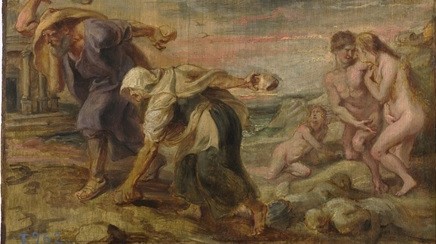
    Deucalión and Pyrrha. (1636-1637. Oil on wood, 26.4 x 41.7 cm.)

    In Greco-Roman mythology there is also a deluge with which Jupiter punishes the evil of the human race, which must perish. Only Deucalion, son of Prometheus, and his wife Pyrrha are saved from punishment in their  ark, which was stranded on Mount Parnassus in the Greek Peloponnese. This pair will give rise to a new race of men.

    Although Rubens's picture refers only to the creation of the new men, I will return to the story since the appearance of Deucalion in the poem of Ovid.

    Ovid tells us the episode of the deluge and the survival of Deucalion and Pyrrh a in Metamorphosis, I, 309-430:

    Now hills, and vales no more distinction know;
    And levell'd Nature lies oppress'd below.
    The most of mortals perish in the flood:
    The small remainder dies for want of food.

    A mountain of stupendous height there stands
    Betwixt th' Athenian and Boeotian lands,
    The bound of fruitful fields, while fields they were,
    But then a field of waters did appear:
    Parnassus is its name; whose forky rise
    Mounts thro' the clouds, and mates the lofty skies.
    High on the summit of this dubious cliff,
    Deucalion wafting, moor'd his little skiff.
    He with his wife were only left behind
    Of perish'd Man; they two were human kind.
    The mountain nymphs, and Themis they adore,
    And from her oracles relief implore.
    The most upright of mortal men was he;
    The most sincere, and holy woman, she.

    When Jupiter, surveying Earth from high,
    Beheld it in a lake of water lie,
    That where so many millions lately liv'd,
    But two, the best of either sex, surviv'd;
    He loos'd the northern wind; fierce Boreas flies
    To puff away the clouds, and purge the skies:
    Serenely, while he blows, the vapours driv'n,
    Discover Heav'n to Earth, and Earth to Heav'n.
    The billows fall, while Neptune lays his mace
    On the rough sea, and smooths its furrow'd face.
    Already Triton, at his call, appears
    Above the waves; a Tyrian robe he wears;
    And in his hand a crooked trumpet bears.
    The soveraign bids him peaceful sounds inspire,
    And give the waves the signal to retire.
    His writhen shell he takes; whose narrow vent
    Grows by degrees into a large extent,
    Then gives it breath; the blast with doubling sound,
    Runs the wide circuit of the world around:
    The sun first heard it, in his early east,
    And met the rattling ecchos in the west.
    The waters, listning to the trumpet's roar,
    Obey the summons, and forsake the shore.

    A thin circumference of land appears;
    And Earth, but not at once, her visage rears,
    And peeps upon the seas from upper grounds;
    The streams, but just contain'd within their bounds,
    By slow degrees into their channels crawl;
    And Earth increases, as the waters fall.
    In longer time the tops of trees appear,
    Which mud on their dishonour'd branches bear.

    At length the world was all restor'd to view;
    But desolate, and of a sickly hue:
    Nature beheld her self, and stood aghast,
    A dismal desart, and a silent waste.

    Which when Deucalion, with a piteous look
    Beheld, he wept, and thus to Pyrrha spoke:
    Oh wife, oh sister, oh of all thy kind
    The best, and only creature left behind,
    By kindred, love, and now by dangers joyn'd;
    Of multitudes, who breath'd the common air,
    We two remain; a species in a pair:
    The rest the seas have swallow'd; nor have we
    Ev'n of this wretched life a certainty.
    The clouds are still above; and, while I speak,
    A second deluge o'er our heads may break.
    Shou'd I be snatcht from hence, and thou remain,
    Without relief, or partner of thy pain,
    How cou'dst thou such a wretched life sustain?
    Shou'd I be left, and thou be lost, the sea
    That bury'd her I lov'd, shou'd bury me.
    Oh cou'd our father his old arts inspire,
    And make me heir of his informing fire,
    That so I might abolisht Man retrieve,
    And perisht people in new souls might live.
    But Heav'n is pleas'd, nor ought we to complain,
    That we, th' examples of mankind, remain.
    He said; the careful couple joyn their tears:
    And then invoke the Gods, with pious prayers.
    Thus, in devotion having eas'd their grief,
    From sacred oracles they seek relief;
    And to Cephysus' brook their way pursue:
    The stream was troubled, but the ford they knew;
    With living waters, in the fountain bred,
    They sprinkle first their garments, and their head,
    Then took the way, which to the temple led.
    The roofs were all defil'd with moss, and mire,
    The desart altars void of solemn fire.
    Before the gradual, prostrate they ador'd;
    The pavement kiss'd; and thus the saint implor'd.

    O righteous Themis, if the Pow'rs above
    By pray'rs are bent to pity, and to love;
    If humane miseries can move their mind;
    If yet they can forgive, and yet be kind;
    Tell how we may restore, by second birth,
    Mankind, and people desolated Earth.
    Then thus the gracious Goddess, nodding, said;
    Depart, and with your vestments veil your head:
    And stooping lowly down, with losen'd zones,
    Throw each behind your backs, your mighty mother's bones.
    Amaz'd the pair, and mute with wonder stand,
    'Till Pyrrha first refus'd the dire command.
    Forbid it Heav'n, said she, that I shou'd tear
    Those holy reliques from the sepulcher.
    They ponder'd the mysterious words again,
    For some new sense; and long they sought in vain:
    At length Deucalion clear'd his cloudy brow,
    And said, the dark Aenigma will allow
    A meaning, which, if well I understand,
    From sacrilege will free the God's command:
    This Earth our mighty mother is, the stones
    In her capacious body, are her bones:
    These we must cast behind. With hope, and fear,
    The woman did the new solution hear:
    The man diffides in his own augury,
    And doubts the Gods; yet both resolve to try.
    Descending from the mount, they first unbind
    Their vests, and veil'd, they cast the stones behind:
    The stones (a miracle to mortal view,
    But long tradition makes it pass for true)
    Did first the rigour of their kind expel,
    And suppled into softness, as they fell;
    Then swell'd, and swelling, by degrees grew warm;
    And took the rudiments of human form.
    Imperfect shapes: in marble such are seen,
    When the rude chizzel does the man begin;
    While yet the roughness of the stone remains,
    Without the rising muscles, and the veins.
    The sappy parts, and next resembling juice,
    Were turn'd to moisture, for the body's use:
    Supplying humours, blood, and nourishment;
    The rest, too solid to receive a bent,
    Converts to bones; and what was once a vein,
    Its former name and Nature did retain.
    By help of pow'r divine, in little space,
    What the man threw, assum'd a manly face;
    And what the wife, renew'd the female race.
    Hence we derive our nature; born to bear
    Laborious life; and harden'd into care.

    The rest of animals, from teeming Earth
    Produc'd, in various forms receiv'd their birth.
    The native moisture, in its close retreat,
    Digested by the sun's aetherial heat,
    As in a kindly womb, began to breed:
    Then swell'd, and quicken'd by the vital seed.
    And some in less, and some in longer space,
    Were ripen'd into form, and took a sev'ral face.
    Thus when the Nile from Pharian fields is fled,
    And seeks, with ebbing tides, his ancient bed,
    The fat manure with heav'nly fire is warm'd;
    And crusted creatures, as in wombs, are form'd;
    These, when they turn the glebe, the peasants find;
    Some rude, and yet unfinish'd in their kind:
    Short of their limbs, a lame imperfect birth:
    One half alive; and one of lifeless earth.

    (Translated by Sir Samuel Garth, John Dryden, et al (1717))

    Note: because some texts are somewhat extensive, I will reproduce the Latin texts at the end of the article.

    The Rape of Europa

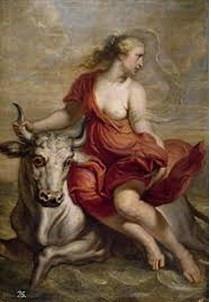
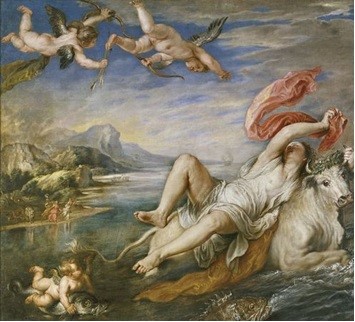
    According to the mythical account, Europa was daughter of Agenor, the king of Tiro; The god Zeus fell in love with her, who ordered Hermes to bring the king's cows to the river; Zeus was transformed into a white bull to gain the confidence of Europa, that was mounted in its loins; At that moment the bull started speeding, entered the Mediterranean Sea and reached Crete. There the god appeared in his divinity and seduced the young woman.

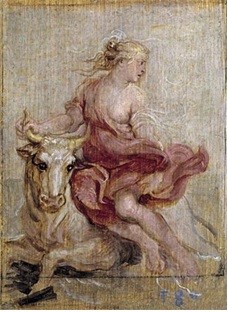
    This is one of the myths most represented since ancient times; we have representations since the 6th century BC. Tiziano painted between 1559 and 1562 an oil on this myth that is exposed in the Museum of the Prado. Peter Paul Rubens copied this painting in 1628-1629. Then the same Rubens repeated the theme again for the “Torre de la Parada”,Tower of the Parade, but in a very different way (the sketch is preserved in the same museum) and in turn shortly afterwards Jan Erasmus Quelinus painted on this sketch the painting which is also preserved in the Prado Museum.

    Peter Paul Rubens.  (Copy of Tiziano, Vecellio di Gregorio)


    The Rape of Europa. Sketch by Peter Paul Rubens 1636 – 1637. Oil painting, 18.9 x 13.7 cm. And Jan Erasmus Quelinus oil.

    Ovid tells us in Metamorphoses II, 833-875:

    Europa's Rape

    When now the God his fury had allay'd,
    And taken vengeance of the stubborn maid,
    From where the bright Athenian turrets rise
    He mounts aloft, and re-ascends the skies.
    Jove saw him enter the sublime abodes,
    And, as he mix'd among the crowd of Gods,
    Beckon'd him out, and drew him from the rest,
    And in soft whispers thus his will exprest.

    "My trusty Hermes, by whose ready aid
    Thy sire's commands are through the world convey'd.
    Resume thy wings, exert their utmost force,
    And to the walls of Sidon speed thy course;
    There find a herd of heifers wand'ring o'er
    The neighb'ring hill, and drive 'em to the shore."

    Thus spoke the God, concealing his intent.
    The trusty Hermes, on his message went,
    And found the herd of heifers wand'ring o'er
    A neighb'ring hill, and drove 'em to the shore;
    Where the king's daughter, with a lovely train
    Of fellow-nymphs, was sporting on the plain.

    The dignity of empire laid aside,
    (For love but ill agrees with kingly pride)
    The ruler of the skies, the thund'ring God,
    Who shakes the world's foundations with a nod,
    Among a herd of lowing heifers ran,
    Frisk'd in a bull, and bellow'd o'er the plain.
    Large rowles of fat about his shoulders clung,
    And from his neck the double dewlap hung.
    His skin was whiter than the snow that lies
    Unsully'd by the breath of southern skies;
    Small shining horns on his curl'd forehead stand,
    As turn'd and polish'd by the work-man's hand;
    His eye-balls rowl'd, not formidably bright,
    But gaz'd and languish'd with a gentle light.
    His ev'ry look was peaceful, and exprest
    The softness of the lover in the beast.

    Agenor's royal daughter, as she plaid
    Among the fields, the milk-white bull survey'd,
    And view'd his spotless body with delight,
    And at a distance kept him in her sight.
    At length she pluck'd the rising flow'rs, and fed
    The gentle beast, and fondly stroak'd his head.
    He stood well-pleas'd to touch the charming fair,
    But hardly could confine his pleasure there.
    And now he wantons o'er the neighb'ring strand,
    Now rowls his body on the yellow sand;
    And, now perceiving all her fears decay'd,
    Comes tossing forward to the royal maid;
    Gives her his breast to stroke, and downward turns
    His grizly brow, and gently stoops his horns.
    In flow'ry wreaths the royal virgin drest
    His bending horns, and kindly clapt his breast.
    'Till now grown wanton and devoid of fear,
    Not knowing that she prest the Thunderer,
    She plac'd her self upon his back, and rode
    O'er fields and meadows, seated on the God.

    He gently march'd along, and by degrees
    Left the dry meadow, and approach'd the seas;
    Where now he dips his hoofs and wets his thighs,
    Now plunges in, and carries off the prize.
    The frighted nymph looks backward on the shoar,
    And hears the tumbling billows round her roar;
    But still she holds him fast: one hand is born
    Upon his back; the other grasps a horn:
    Her train of ruffling garments flies behind,
    Swells in the air, and hovers in the wind.

    Through storms and tempests he the virgin bore,
    And lands her safe on the Dictean shore;
    Where now, in his divinest form array'd,
    In his true shape he captivates the maid;
    Who gazes on him, and with wond'ring eyes
    Beholds the new majestick figure rise,
    His glowing features, and celestial light,
    And all the God discover'd to her sight.

    Translated by Sir Samuel Garth, John Dryden, et al (1717)

    Orpheus and Eurydice

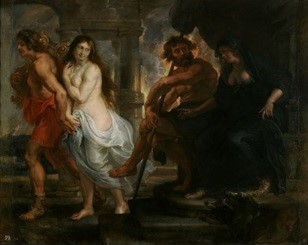
    The theme of the mythical pair Orpheus and Eurydice is that of the descent into the lower world, to hell, to the world of the dead, to the world where Pluto and Proserpine reign; In Greek this descent is called καταβᾴσεις, katabaseis, or κάθοδοι, kathodoi, and are adjudged to Hercules, Ulysses, Aeneas, Theseus, Pyrithus and especially to Orpheus, who goes in search of his wife, deceased by the venom of a snake, and whose end I do not anticipate for not to diminish the interest in the reading of Ovid's text, which undoubtedly inspired the many pictorial representations of the myth. I present it in a painting also by Peter Paul  Rubens.

    Orpheus and Eurydice. 1636 – 1638. Oil on canvas, 196.5 x 247.5 cm.

    Virgil tells us also  the myth in his little Culex and then in his famous Georgics. Ovid had to know this Virgilian version and it is Ovid's account that we find at the beginning of Book X of his Metamorphoses, verses 1 to 77. which I now transcribe:

    The Story of Orpheus and Eurydice

    Thence, in his saffron robe, for distant Thrace,
    Hymen departs, thro' air's unmeasur'd space;
    By Orpheus call'd, the nuptial Pow'r attends,
    But with ill-omen'd augury descends;
    Nor chearful look'd the God, nor prosp'rous spoke,
    Nor blaz'd his torch, but wept in hissing smoke.
    In vain they whirl it round, in vain they shake,
    No rapid motion can its flames awake.
    With dread these inauspicious signs were view'd,
    And soon a more disastrous end ensu'd;
    For as the bride, amid the Naiad train,
    Ran joyful, sporting o'er the flow'ry plain,
    A venom'd viper bit her as she pass'd;
    Instant she fell, and sudden breath'd her last.

    When long his loss the Thracian had deplor'd,
    Not by superior Pow'rs to be restor'd;
    Inflam'd by love, and urg'd by deep despair,
    He leaves the realms of light, and upper air;
    Daring to tread the dark Tenarian road,
    And tempt the shades in their obscure abode;
    Thro' gliding spectres of th' interr'd to go,
    And phantom people of the world below:
    Persephone he seeks, and him who reigns
    O'er ghosts, and Hell's uncomfortable plains.
    Arriv'd, he, tuning to his voice his strings,
    Thus to the king and queen of shadows sings.

    Ye Pow'rs, who under Earth your realms extend,
    To whom all mortals must one day descend;
    If here 'tis granted sacred truth to tell:
    I come not curious to explore your Hell;
    Nor come to boast (by vain ambition fir'd)
    How Cerberus at my approach retir'd.
    My wife alone I seek; for her lov'd sake
    These terrors I support, this journey take.
    She, luckless wandring, or by fate mis-led,
    Chanc'd on a lurking viper's crest to tread;
    The vengeful beast, enflam'd with fury, starts,
    And thro' her heel his deathful venom darts.
    Thus was she snatch'd untimely to her tomb;
    Her growing years cut short, and springing bloom.
    Long I my loss endeavour'd to sustain,
    And strongly strove, but strove, alas, in vain:
    At length I yielded, won by mighty love;
    Well known is that omnipotence above!
    But here, I doubt, his unfelt influence fails;
    And yet a hope within my heart prevails.
    That here, ev'n here, he has been known of old;
    At least if truth be by tradition told;
    If fame of former rapes belief may find,
    You both by love, and love alone, were join'd.
    Now, by the horrors which these realms surround;
    By the vast chaos of these depths profound;
    By the sad silence which eternal reigns
    O'er all the waste of these wide-stretching plains;
    Let me again Eurydice receive,
    Let Fate her quick-spun thread of life re-weave.
    All our possessions are but loans from you,
    And soon, or late, you must be paid your due;
    Hither we haste to human-kind's last seat,
    Your endless empire, and our sure retreat.
    She too, when ripen'd years she shall attain,
    Must, of avoidless right, be yours again:
    I but the transient use of that require,
    Which soon, too soon, I must resign entire.
    But if the destinies refuse my vow,
    And no remission of her doom allow;
    Know, I'm determin'd to return no more;
    So both retain, or both to life restore.

    Thus, while the bard melodiously complains,
    And to his lyre accords his vocal strains,
    The very bloodless shades attention keep,
    And silent, seem compassionate to weep;
    Ev'n Tantalus his flood unthirsty views,
    Nor flies the stream, nor he the stream pursues;
    Ixion's wond'ring wheel its whirl suspends,
    And the voracious vulture, charm'd, attends;
    No more the Belides their toil bemoan,
    And Sisiphus reclin'd, sits list'ning on his stone.

    Then first ('tis said) by sacred verse subdu'd,
    The Furies felt their cheeks with tears bedew'd:
    Nor could the rigid king, or queen of Hell,
    Th' impulse of pity in their hearts repell.

    Now, from a troop of shades that last arriv'd,
    Eurydice was call'd, and stood reviv'd:
    Slow she advanc'd, and halting seem to feel
    The fatal wound, yet painful in her heel.
    Thus he obtains the suit so much desir'd,
    On strict observance of the terms requir'd:
    For if, before he reach the realms of air,
    He backward cast his eyes to view the fair,
    The forfeit grant, that instant, void is made,
    And she for ever left a lifeless shade.

    Now thro' the noiseless throng their way they bend,
    And both with pain the rugged road ascend;
    Dark was the path, and difficult, and steep,
    And thick with vapours from the smoaky deep.
    They well-nigh now had pass'd the bounds of night,
    And just approach'd the margin of the light,
    When he, mistrusting lest her steps might stray,
    And gladsome of the glympse of dawning day,
    His longing eyes, impatient, backward cast
    To catch a lover's look, but look'd his last;
    For, instant dying, she again descends,
    While he to empty air his arms extends.
    Again she dy'd, nor yet her lord reprov'd;
    What could she say, but that too well he lov'd?
    One last farewell she spoke, which scarce he heard;
    So soon she drop'd, so sudden disappear'd.

    All stunn'd he stood, when thus his wife he view'd
    By second Fate, and double death subdu'd:
    Not more amazement by that wretch was shown,
    Whom Cerberus beholding, turn'd to stone;
    Nor Olenus cou'd more astonish'd look,
    When on himself Lethaea's fault he took,
    His beauteous wife, who too secure had dar'd
    Her face to vye with Goddesses compar'd:
    Once join'd by love, they stand united still,
    Turn'd to contiguous rocks on Ida's hill.

    Now to repass the Styx in vain he tries,
    Charon averse, his pressing suit denies.
    Sev'n days entire, along th' infernal shores,
    Disconsolate, the bard Eurydice deplores;
    Defil'd with filth his robe, with tears his cheeks,
    No sustenance but grief, and cares, he seeks:
    Of rigid Fate incessant he complains,
    And Hell's inexorable Gods arraigns.
    This ended, to high Rhodope he hastes,
    And Haemus' mountain, bleak with northern blasts.

    (Translated by Sir Samuel Garth, John Dryden, et al (1717))

    Atalanta and Hippomenes

    Hippomenes and Atalanta 1618 – 1619. Oil on canvas, 206 x 297 cm. Reni, Guido, baroque Bolognese painter

    Some time ago I wrote  the story of the famous race of Atalanta and Hippomenes in this same blog adapting directly the text of Ovid. The myth tells the story of Atalanta, the daughter of the king of Arcadia, who offered to marry anyone who could beat her in the race; Those who were defeated would be punished with death. The handsome Hippomenes won the race by using the help of the goddess Venus, who suggested a stratagem.

    I refer to https://www.antiquitatem.com/en/atalanta-mythologie-palace-of-the-infant

    to get a wider commentary on the story, but I nonetheless offer the text, now in view of one of the pictures of the Prado , The one corresponding to Guido Reni.

    Whoever wants a full reading of Ovid's text must go to Metamorphoses, VIII, 281 et seq. for the episode of Meleager and the boar hunt of Calidon and to Metamorphosis X, 560-704 for the race with Hippomenes.

    When Atalanta was born, her father, the king of Arcadia, enraged because he only wanted a son, abandoned her all godliness lacking at the top of a mountain so that she could die of hunger or devoured by the ferocious beasts. The goddess Artemis, who casually hunted in those places, took pity on the helpless child and sent her a huge bear that, docilely, suckled her with her milk.
    Sometime later, and adopted as a daughter by the goddess, she became an accurate huntress and the fastest woman in the world and emulating her patroness she promised that she would never marry either.

    When being a famous huntress she received as a trophy the skin of the wild boar ravaging the kingdom of Calydon, whose hunting she had participated in, she reconciled with her father, who again and again insisted her on the need to get married and provide him a future heir for his throne.

    The elusive Atalanta consulted the oracle of the gods on her husband and heard these confusing words:

    – For anything you need a husband, Atalanta; avoid having a husband. And yet you will not escape from marriage and still alive you will see yourself private of yourself.

    Frightened by these words, hard to be understood, she tries to remain single living in the woods, away from her many suitors, who she wants to scare and avoid with a strange proposal:

    – Only will possess me the one of you who beats me in a quick race, that one will be my husband. Instead the loser will have to die in punishment for his pretensions. This is my final proposal.

    Such is the beauty of the fast Atalanta that many were the unsuspecting youth who dared to compete with the fastest woman in the world, so they lost the race moaning and crying and, with it, they lost the priceless life.

    So the young Hippomenes, who had only heard to talk about the beautiful Atalanta, considered excessive the risk he would have to face in order to get her as his wife. But as soon as he saw the splendid body of the young girl who had removed the veil from her face, he fell in love and was immediately seduced.

    – I’ll also try my luck; the prize is worth risking death. Gods always help those who are brave- he says inflamed. And madly in love, he continues:

    – Beautiful Atalanta, you have beaten easily and effortlessly those poor boys, but now measure yourself with me, that I'm the son of Megareus. If I beat you, it won´t be a dishonorable defeat for you and if you win the race, you would have beaten Hippomenes, the great-grandson of Neptune, god of the waters.

    Atalanta raising her beautiful bright eyes up looks at him tenderly.

    – Why do you, foolish boy, want to risk your precious life, you who are still a child? You are beautiful and brave, because death does not scare you. So much you love and want me that you are willing to die…? Run away while you can, young handsome boy; many other pretty girls will be pleased and happy to marry you.

    And perhaps touched by the sweet feeling of love for the very first time, the inexperienced and unfriendly Atalanta softens her relentless decision and thinks in the inner part of her heart:

    – Why has this unhappy boy to die undeservedly as a reward for his love? I wish you, unhappy boy, had not ever seen me. If virginity was not my eternal destiny, you'd be the only one with whom I would share my wedding bed. I wish you, fool, were faster than me.
    But Hippomenes already urges the race, but not before entrusting himself to the goddess of love and asking for her divine help:

    – You, goddess, who has inspired my blind passion, help my fearlessness.

    Venus answered the call wrapped in a white cloud, visible only to Hippomenes, and gave him three yellow apples, as bright as the sun, that he should use in the race in a certain way.

    The trumpets gave the departure signal. There the two contenders go, so fast that they seem to fly. Atalanta, refusing to pass and leave the boy behind, places herself on par and, rapt, she stares at his virginal face. Hippomenes then throws one of the three bright apples, which immediately attracts the eye and interest of Atalanta. She restrains then her speed and while she´s collecting the golden fruit from the ground with curiosity, she is passed by Hippomenes. The fast Atalanta recovers the lost space and again she surpasses the young man easily. The young man throws a second fruit and once again entertains the girl, who soon also recovers the lost time. All that remains is the last stretch before the finish line. Now the young man throws strongly the third apple out of the way. Atalanta hesitates, but trusting in her swift feet, she goes to collect the golden fruit which is placed in the distance. But she miscalculated her speed or maybe the burgeoning love restrained her progress, because now she loses the race. Meanwhile Hipomenes has reached the finish line and, this way, he has reached his desired and deserved prize too, the marriage with the young virgin.

    Incomprehensibly, the young Hippomenes forgot Venus and failed to thank her help. This way, the goddess felt neglected and offended by it.

    One day as they were passing by the temple of Cybele, Mother of gods, they decided to rest because they were very tired due to the long trip. Hipomenes was taken by a sudden and overwhelming desire to lie with Atalanta, sparked no doubt by the vengeful Venus. Right there, in the sacred cave, in front of the divine images, they desecrate the sanctuary with their obscene love.

    Mother Cybele punished their lustfulness with her divine severity: long and fierce manes cover their human necks, hands become claws, a long tail emerges from their backs, fierce they raise up their proud lion heads and their jaws make roaring noises which intimidate the rest part of the animals.

    Later the goddess takes pity on them, so she ties the pair of lions with strong flex leather straps to her majestic carriage, which they´ll have to pull tireless for the whole eternity.

    These are three or four examples of how Ovid can facilitate the visit to Museums such as the Prado and facilitate the understanding of dozens of works exposed there.

    Latin texts

    Deucalion and Pyrrha, Metamorphosis, I, 309-430:

    Obruerat tumulos inmensa licentia ponti,
    Pulsabantque noui montana cacumina fluctus.
    Maxima pars unda rapitur: quibus unda pepercit,
    Illos longa domant inopi ieiunia uictu.
    Separat Aonios Oetaeis Phocis ab aruis, 
    Terra ferax, dum terra fuit, sed tempore in illo
    Pars maris et latus subitarum campus aquarum;
    Mons ibi uerticibus petit arduus astra duobus,
    Nomine Parnasus, superantque cacumina nubes:
    Hic ubi Deucalion (nam cetera texerat aequor)
    Cum consorte tori parua rate uectus adhaesit,
    Corycidas nymphas et numina montis adorant
    Fatidicamque Themin, quae tunc oracla tenebat:
    Non illo melior quisquam nec amantior aequi
    Vir fuit aut illa metuentior ulla deorum.
    Iuppiter ut liquidis stagnare paludibus orbem
    Et superesse uirum de tot modo milibus unum
    Et superesse uidet de tot modo milibus unam,
    Innocuos ambo, cultores numinis ambo,
    Nubila disiecit nimbisque aquilone remotis
    Et caelo terras ostendit et aethera terris.
    Nec maris ira manet, positoque tricuspide telo
    Mulcet aquas rector pelagi supraque profundum
    Exstantem atque umeros innato murice tectum
    Caeruleum Tritona uocat conchaeque sonanti
    Inspirare iubet fluctusque et flumina signo
    Iam reuocare dato: caua bucina sumitur illi,
    Tortilis, in latum quae turbine crescit ab imo,
    Bucina, quae medio concepit ubi aera ponto,
    Litora uoce replet sub utroque iacentia Phoebo.
    Tunc quoque, ut ora dei madida rorantia barba
    Contigit et cecinit iussos inflata receptus,
    Omnibus audita est telluris et aequoris undis
    Et, quibus est undis audita, coercuit omnes.
    Iam mare litus habet, plenos capit alueus amnes,
    Flumina subsidunt collesque exire uidentur,
    Surgit humus, crescunt loca decrescentibus undis,
    Postque diem longam nudata cacumina siluae
    Ostendunt limumque tenent in fronde relictum.
    Redditus orbis erat; quem postquam uidit inanem
    Et desolatas agere alta silentia terras,
    Deucalion lacrimis ita Pyrrham adfatur obortis:
    "O soror, o coniunx, o femina sola superstes,
    Quam commune mihi genus et patruelis origo,
    Deinde torus iunxit, nunc ipsa pericula iungunt,
    Terrarum, quascumque uident occasus et ortus,
    Nos duo turba sumus: possedit cetera pontus.
    Haec quoque adhuc uitae non est fiducia nostrae
    Certa satis; terrent etiam nunc nubila mentem.
    Quis tibi, si sine me fatis erepta fuisses,
    Nunc animus, miseranda, foret? quo sola timorem
    Ferre modo posses? quo consolante doleres?
    Namque ego, crede mihi, si te quoque pontus haberet,
    Te sequerer, coniunx, et me quoque pontus haberet.
    O utinam possim populos reparare paternis
    Artibus atque animas formatae infundere terrae!
    Nunc genus in nobis restat mortale duobus
    (Sic uisum superis) hominumque exempla manemus."
    Dixerat, et flebant; placuit caeleste precari
    Numen et auxilium per sacras quaerere sortes.
    Nulla mora est: adeunt pariter Cephisidas undas,
    Vt nondum liquidas, sic iam uada nota secantes.
    Inde ubi libatos inrorauere liquores
    Vestibus et capiti, flectunt uestigia sanctae
    Ad delubra deae, quorum fastigia turpi
    Pallebant musco stabantque sine ignibus arae.
    Vt templi tetigere gradus, procumbit uterque
    Pronus humi gelidoque pauens dedit oscula saxo,
    Atque ita "si precibus" dixerunt "numina iustis
    Victa remollescunt, si flectitur ira deorum,
    Dic, Themi, qua generis damnum reparabile nostri
    Arte sit, et mersis fer opem, mitissima, rebus."
    Mota dea est sortemque dedit: "discedite templo
    Et uelate caput cinctasque resoluite uestes
    Ossaque post tergum magnae iactate parentis."
    Obstipuere diu, rumpitque silentia uoce
    Pyrrha prior iussisque deae parere recusat,
    Detque sibi ueniam, pauido rogat ore pauetque
    Laedere iactatis maternas ossibus umbras.
    Interea repetunt caecis obscura latebris
    Verba datae sortis secum inter seque uolutant.
    Inde Promethides placidis Epimethida dictis
    Mulcet et "aut fallax" ait "est sollertia nobis,
    Aut (pia sunt nullumque nefas oracula suadent)
    Magna parens terra est: lapides in corpore terrae
    Ossa reor dici; iacere hos post terga iubemur."
    Coniugis augurio quamquam Titania mota est,
    Spes tamen in dubio est: adeo caelestibus ambo
    Diffidunt monitis. sed quid temptare nocebit?
    Discedunt uelantque caput tunicasque recingunt
    Et iussos lapides sua post uestigia mittunt.
    Saxa (quis hoc credat, nisi sit pro teste uetustas?)
    Ponere duritiem coepere suumque rigorem
    Mollirique mora mollitaque ducere formam.
    Mox ubi creuerunt naturaque mitior illis
    Contigit, ut quaedam, sic non manifesta uideri
    Forma potest hominis, sed, uti de marmore coepta,
    Non exacta satis rudibusque simillima signis.
    Quae tamen ex illis aliquo pars umida suco
    Et terrena fuit, uersa est in corporis usum;
    Quod solidum est flectique nequit, mutatur in ossa;
    Quae modo uena fuit, sub eodem nomine mansit;
    Inque breui spatio superorum numine saxa
    Missa uiri manibus faciem traxere uirorum,
    Et de femineo reparata est femina iactu.
    Inde genus durum sumus experiensque laborum
    Et documenta damus, qua simus origine nati.
    Cetera diuersis tellus animalia formis
    Sponte sua peperit, postquam uetus umor ab igne
    Percaluit solis caenumque udaeque paludes
    Intumuere aestu fecundaque semina rerum
    Viuaci nutrita solo ceu matris in aluo
    Creuerunt faciemque aliquam cepere morando.
    Sic, ubi deseruit madidos septemfluus agros
    Nilus et antiquo sua flumina reddidit alueo
    Aetherioque recens exarsit sidere limus,
    Plurima cultores uersis animalia glaebis
    Inueniunt et in his quaedam modo coepta per ipsum
    Nascendi spatium, quaedam inperfecta suisque
    Trunca uident numeris, et eodem in corpore saepe
    Altera pars uiuit, rudis est pars altera tellus.

                 …………………
    The rape of Europa. Metamorphoses II, 833-875:

    Has ubi uerborum poenas mentisque profanae
    Cepit Atlantiades, dictas a Pallade terras
    Linquit et ingreditur iactatis aethera pennis.
    Seuocat hinc genitor nec causam fassus amoris:
    "Fide minister" ait "iussorum, nate, meorum,
    Pelle moram solitoque celer delabere cursu
    Quaeque tuam matrem tellus a parte sinistra
    Suspicit (indigenae Sidonida nomine dicunt),
    Hanc pete, quodque procul montano gramine pasci
    Armentum regale uides, ad litora uerte".
    Dixit et expulsi iamdudum monte iuuenci
    Litora iussa petunt, ubi magni filia regis
    Ludere uirginibus Tyriis comitata solebat.
    Non bene conueniunt nec in una sede morantur
    Maiestas et amor; sceptri grauitate relicta,
    Ille pater rectorque deum, cui dextra trisulcis
    Ignibus armata est, qui nutu concutit orbem,
    Induitur faciem tauri mixtusque iuuencis
    Mugit et in teneris formosus obambulat herbis.
    Quippe color niuis est, quam nec uestigia duri
    Calcauere pedis nec soluit aquaticus Auster.
    Colla toris exstant, armis palearia pendent;
    Cornua parua quidem, sed quae contendere possis
    Facta manu puraque magis perlucida gemma.
    Nullae in fronte minae nec formidabile lumen;
    Pacem uultus habet. miratur Agenore nata
    Quod tam formosus, quod proelia nulla minetur;
    Sed quamuis mitem, metuit contingere primo.
    Mox adit et flores ad candida porrigit ora.
    Gaudet amans et, dum ueniat sperata uoluptas,
    Oscula dat manibus; uix iam, uix cetera differt.
    Et nunc alludit uiridique exsultat in herba
    Nunc latus in fuluis niueum deponit harenis;
    Paulatimque metu dempto, modo pectora praebet
    Virginea plaudenda manu, modo cornua sertis
    Impedienda nouis. ausa est quoque regia uirgo,
    Nescia quem premeret, tergo considere tauri,
    Cum deus a terra siccoque a litore sensim
    Falsa pedum primo uestigia ponit in undis,
    Inde abit ulterius mediique per aequora ponti
    Fert praedam. pauet haec litusque ablata relictum
    Respicit et dextra cornum tenet, altera dorso
    Imposita est; tremulae sinuantur flamine uestes.

       ………..
    Orpheus and Eurydice

    Inde per immensum croceo uelatus amictu
    Aethera digreditur Ciconumque Hymenaeus ad oras
    Tendit et Orphea nequiquam uoce uocatur.
    Adfuit ille quidem, sed nec sollemnia uerba
    Nec laetos uultus nec felix attulit omen;
    Fax quoque, quam tenuit, lacrimoso stridula fumo
    Vsque fuit nullosque inuenit motibus ignes.
    Exitus auspicio grauior. nam nupta per herbas
    Dum noua naiadum turba comitata uagatur,
    Occidit in talum serpentis dente recepto.
    Quam satis ad superas postquam Rhodopeius auras
    Defleuit uates, ne non temptaret et umbras,
    Ad Styga Taenaria est ausus descendere porta
    Perque leues populos simulacraque functa sepulcro
    Persephonen adiit inamoenaque regna tenentem
    Vmbrarum dominum pulsisque ad carmina neruis
    Sic ait: "o positi sub terra numina mundi,
    In quem reccidimus, quidquid mortale creamur,
    Si licet et falsi positis ambagibus oris
    Vera loqui sinitis, non huc, ut opaca uiderem
    Tartara, descendi, nec uti uillosa colubris
    Terna Medusaei uincirem guttura monstri;
    Causa uiae est coniunx, in quam calcata uenenum
    Vipera diffudit crescentesque abstulit annos.
    Posse pati uolui nec me temptasse negabo:
    Vicit Amor. supera deus hic bene notus in ora est;
    An sit et hic, dubito. sed et hic tamen auguror esse,
    Famaque si ueteris non est mentita rapinae,
    Vos quoque iunxit Amor. per ego haec loca plena timoris,
    Per Chaos hoc ingens uastique silentia regni,
    Eurydices, oro, properata retexite fata!
    Omnia debentur uobis paulumque morati
    Serius aut citius sedem properamus ad unam.
    Tendimus huc omnes, haec est domus ultima, uosque
    Humani generis longissima regna tenetis.
    Haec quoque, cum iustos matura peregerit annos,
    Iuris erit uestri: pro munere poscimus usum.
    Quod si fata negant ueniam pro coniuge, certum est
    Nolle redire mihi: leto gaudete duorum."
    Talia dicentem neruosque ad uerba mouentem
    Exsangues flebant animae: nec Tantalus undam
    Captauit refugam stupuitque Ixionis orbis,
    Nec carpsere iecur uolucres, urnisque uacarunt
    Belides, inque tuo sedisti, Sisyphe, saxo.
    Tunc primum lacrimis uictarum carmine fama est
    Eumenidum maduisse genas, nec regia coniunx
    Sustinet oranti nec, qui regit ima, negare
    Eurydicenque uocant. umbras erat illa recentes
    Inter et incessit passu de uulnere tardo.
    Hanc simul et legem Rhodopeius accipit Orpheus,
    Ne flectat retro sua lumina, donec Auernas
    Exierit ualles; aut irrita dona futura.
    Carpitur adcliuis per muta silentia trames,
    Arduus, obscurus, caligine densus opaca.
    Nec procul abfuerant telluris margine summae:
    Hic, ne deficeret, metuens auidusque uidendi
    Flexit amans oculos: et protinus illa relapsa est
    Bracchiaque intendens prendique et prendere certans
    Nil nisi cedentes infelix adripit auras.
    Iamque iterum moriens non est de coniuge quicquam
    Questa suo (quid enim nisi se quereretur amatam?)
    Supremumque "uale", quod iam uix auribus ille
    Acciperet, dixit reuolutaque rursus eodem est.
    Non aliter stupuit gemina nece coniugis Orpheus,
    Quam tria qui timidus, medio portante catenas,
    Colla canis uidit; quem non pauor ante reliquit,
    Quam natura prior, saxo per corpus oborto;
    Quique in se crimen traxit uoluitque uideri
    Olenos esse nocens, tuque, o confisa figurae,
    Infelix Lethaea, tuae, iunctissima quondam
    Pectora, nunc lapides, quos umida sustinet Ide.
    Orantem frustraque iterum transire uolentem
    Portitor arcuerat; septem tamen ille diebus
    Squalidus in ripa Cereris sine munere sedit:
    Cura dolorque animi lacrimaeque alimenta fuere.
    Esse deos Erebi crudeles questus in altam
    Se recipit Rhodopen pulsumque aquilonibus Haemum.

  • Was the Ovid’s exile real or mere fiction? (Ovid IV)

    Was the exile that fueled part of Ovid’s poetry real or was it only a poetic fiction with which the creative poet has deceived us two thousand years?

    The question may seem a modern exaggeration, characteristic of scholars who seek notoriety at any price. But it is not so and it is worthwhile to devote some time to this topic that was already raised at the beginning of the 20th century, and to which since then serious reflections and studies have been dedicated.

    In the eighth year after Ch. Ovid was banished, fulminantly, by Augustus to Tomis, the present Constance, in Romania, on the coasts of the Euxine Pontus, the Black Sea. He wrote three works from exile: his famous Tristia, Epistulae ex Ponto (Letters from Pontus or Pontics) and Ibis, an invective against an enemy of his who harms him in Rome. In them they are some of the poet's most famous poems. See previous articles dedicated to the poet in this blog.

    The mere possibility that the exile that motivates these works is a fiction produces at least a certain restlessness and sentimental shock in which young people feel the emotional charge of some of the poems that the poet wrote in exile.

    At the beginning of twentieth century, in 1923, J.J. Hartman questioned the reality of Ovid's exile and asserted that all his references to exile in Tomis were but an exercise in imaginative humorous fiction; That the "I" of the poem has nothing to do with the real "I" of the poet.

    The issue was debated in the following decades with some insistence, until in 1985  Fitton Brown published an article in the Liverpool Classical Monthly, 10.2 (1985), 18-22 entitled " The unreality of Ovid's Tomitan exile", which gained the consideration and attention of numerous scholars. Periodically there are studies and articles positioned in one direction or another.

    In Spain, recently, in 2008, Professor E. Berchez Castro made his doctoral thesis at the University of Barcelona on the topic: Realidad y ficción del destierro de Ovidio en Tomis (Reality and fiction of Ovid's exile in Tomis). Based on it, he has published the book ”Ovid’s exile in Tomis: reality and fiction”.

    The arguments that Fitton Brown and later Berchez in a more detailed and exhaustive way wield to deny or at least seriously doubt the reality of the poet's exile we can basically group them into six or seven groups:

    1. The information we have about Ovid's exile is basically what the poet himself gives us in his poems and it is full of gaps, inaccuracies and contradictions. See his autobiography in the article https://www.antiquitatem.com/en/ovid-bimillenary-of-death-of-ovid   and his description of the exile in https://www.antiquitatem.com/en/ovid-bimillenary-exile-euxine-pontus

    Until the fourth century no mention of this exile appears, except for one of Pliny the Elder, which is doubtful, and another of Statius (lived in 45-96).

    From Pliny's quotation, the only thing that can be safely deduced is that he knew the work of Ovid and that he had been in Pontus for the last few years, but he does not make any further comment about it.

    Naturalis Historia XXXII 152  (LIV):

    To the above enumeration we will add some names given in the poem of Ovid, which are not to be found in any other writer: species, howevr, whicn are probably peculiar to the Euxine, on the shores of which he commenced that work towards the close of his life. The fishes thus mentioned by him are the sea-ox, the cercyrus, that dwells among the rocks… (Translated by John Bostock and H.T. Riley. 1857)

    his adiciemus ab Ovidio posita animalia, quae apud neminem alium reperiuntur, sed fortassis in Ponto nascentia, ubi id volumen supremis suis temporibus inchoavit : bovem, cercyrum in scopulis vivente

    Statius for his part wrote in Silvae I 2, 254-255

    Bring songs that are worthy of the marriage feast. Philetas himself with Cos to applaud him and old Callimachus and Propertius in his Umbrian grot Would fain have praised this day, and Naso too right gladly e'en in Tomi, And Tibullus by the glowing hearth that  was his wealth. (Translated by J.H.MOZLEY,M.A. London. 1928. THE LOEB CLASSICAL LIBRARY)

    …  date carmina festis
    digna toris, hunc ipse Coo plaudente Philetas
    Callimachusque senex Umbroque Propertius antro
    ambissent laudare diem, nec tristis in ipsis
    Naso Tomis divesque foco lucente Tibullus.

    But it can not be inferred from this that he had been exiled to Tomis.

       Especially striking is that neither Suetonius, who so many things and gossip tells us about Augustus, nor Tacitus refer to the matter, when they report in detail the punishments of other writers at the same time.

    In the fourth century, Aurelius Victor (c.320 – c.390) and  Jerome (340-420) in his “Chronicon 2033” informed us of the year of his death, as we saw in the previous article in this series on the Bimillennial of Ovid’s death:

    Ovid the poet died in exile, and is interred near the town of Tomi.

    Ovidius poeta in exilio diem obiit et iuxta oppidum Tomos sepelitur

    And also briefly in Epitome of Caesaribus, I, 24:

    So (Augustus) punished with exile the poet Ovid, also known as Naso, because he wrote three books on the "art of loving".

    "Nam [Augustus] poetam Ovidium, qui et Naso, pro eo, quod tres libellos amatoriae artis conscripsit, exilio damnavit").

    These appointments are obviously very late already.

    2. The causes of his exile are unknown to us, in spite of the numerous references to them that the poet himself makes and the infinite efforts by  the numerous students since then. I mentioned something about it in the previous article https://www.antiquitatem.com/en/ovid-bimillenary-exile-euxine-pontus.

    It is also unknown and unexplained why this destination was chosen: Tomis in the Euxine Pontus.
    In various passages he attributes his sentence to "error" and an "indiscretion". For example very clearly in Tristia II, 207 et seq .:

    Though two crimes, a poem  and a blunder, have brought me ruin, of my fault in the one I must keep silent, for my worth is not such that I may reopen thy wounds, O Caesar ; 'tis more than enough that thou shouldst have been pained once. The other remains : the charge that by an obscene poem I have taught foul adultery. (Translation by Arthur Leslie Wheeler. The Loeb Classical Library.)

    perdiderint cum me duo crimina, carmen et error,
    alterius facti culpa silenda mihi :
    nam non sum tanti, renovem ut tua vulnera, Caesar,
    quem nimio plus est indoluisse semel.
    altera pars superest, qua turpi carmine factus
    arguor obsceni doctor adulterii.

    Thus in his time, as Ovid himself reports, he is known as "teacher of impudent adultery," and this was directly in line with the program of morality of Augustus and the Leges Iuliae of 18 BC. To 9 d.C. which sought to defend the family and the ancient traditions, punishing adultery with exile and fineing those who had no children. These are in particular the lex Iulia de adulteriis coercendis, the lex Iulia de maritandis ordinibus and the lex Papia Poppaea.

    It is clear that his mistake was to write the "Art of loving" (Ars amandi), as already he makes clear in the poem that serves as a presentation to his Tristia: I, 1, 67-68 and then on multiple occasions:

    Examine the title. I am not the teacher of love; that work has already paid its deserved penalty. (Translation by Arthur Leslie Wheeler. The Loeb Classical Library.)

    'inspice' dic 'titulum. non sum praeceptor amoris;
    quas meruit, poenas iam dedit illud opus'.

    But he defends himself by affirming the difference between literature and life, that it is one thing to write and another to maintain certain behavior. In the elegy addressed to a friend orator, he says in Tristia I, 9,55 et seq:

    It had been best that light had failed my pursuit. And just as you are aided, my eloquent friend, by serious arts, so arts unlike them have injured me. Yet my life is well known to you ; you know that with those arts their author's character had no connexion ; you know that this poem I was written long ago, an amusement of my youth, and that those jests, though not deserving praise, were still mere jests. (Translation by Arthur Leslie Wheeler. The Loeb Classical Library.)

    at nostrum tenebris utinam latuisset in imis !
    expediit studio lumen abesse meo.
    utque tibi prosunt artes, facunde, severae,
    dissimiles illis sic nocuere mihi.
    vita tamen tibi nota mea est. scis artibus illis
    auctoris mores abstinuisse sui :
    scis vetus hoc iuveni lusum mihi carmen, et istos
    ut non laudandos, sic tamen esse iocos.

    He repeats this idea that it was an error and not a crime, the fault he committed,  at least six or seven times in addition to that quoted: Tristia I, 1,51-52; II, 109; III 1,7-8; III, 14,5-6; III, 7,29-30; IV, 1,24; IV, 10, 99 et seq .; In Pontics II, 2,15-16; II, 3,91-94; III, 3,71-72

    As Catullus had to defend himself as forced to  defend himself with his poems before, and then Martial with some of his epigrams, and so many other writers since then, Ovid sets the record straight  in Tristia, on Book II, 345 ff. :

    This wantonness has caused thee to hate me on account of the arts which thou didst think disturbed unions that all were forbidden to attack. But no brides have learned deceptions through my teaching ; nobody can teach that of which he knows too little. I have composed songs of pleasure and love but in such fashion that no scandal has ever touched my name. No husband exists even amid the common people who doubts his fatherhood through sin of mine. I assure you, my character differs from my verse (my life is moral, my muse is gay), and most of my work, unreal and fictitious, has allowed itself more licence than its author has had. A book is not an evidence of one's soul, but an honourable impulse that presents very many things suited to charm the ear. Else  would Accius be cruel, Terence a reveller, or those would be quarrelsome who sing of fierce war.  (Translation by Arthur Leslie Wheeler. The Loeb Classical Library.)

    haec tibi me invisum lascivia fecit, ob artes,
    quis ratus es vetitos sollicitare toros.
    sed neque me nuptae didicerunt furta magistro,
    quodque parum novit, nemo docere potest.
    sic ego delicias et mollia carmina feci,
    strinxerit ut nomen fabula nulla meum.
    nec quisquam est adeo media de plebe maritus,
    ut dubius vitio sit pater ille meo.
    crede mihi, distant mores a carmine nostro
    -vita verecunda est, Musa iocosa mea-
    magnaque pars mendax operum est et ficta meorum :
    plus sibi permisit compositore suo.
    nec liber indicium est animi, sed honesta voluntas
    plurima mulcendis auribus apta ferens.
    Accius esset atrox, conviva Terentius esset,
    essent pugnaces qui fera bella canunt.

    In this book Tristia II, 237 et seq. he tells Emperor Augustus, engaged in the important tasks of governing such a great empire, that he is not responsible for the misuse of his poems:

    Can I wonder, then, that under this weight of great affairs thou hast never unrolled the volume of my jests ? Yet if, as I could wish, thou hadst chanced to have the leisure, thou wouldst have read no crimes in my " Art." That poem, I admit, has no serious mien, it is not worthy to be read by so great a prince ; but not for that reason is it opposed to the commandments of the law, nor does it offer teaching to the daughters of Rome. And that thou may'st not doubt for whom I write, one of the three books contains these four verses* :  " Far from me ! ye narrow fillets, badge of modesty ! and thou, long ruffle  covering half the feet** ! I shall sing of naught but what is lawful, of loves which men allow. There shall be in my song no sin." Have I not strictly excluded from this " Art " all women whom the assumption of the robe and fillet of wedlock protect ?

    But, thou mayst say, the matron can use arts intended for others and draw therefrom instruction, though she be not herself the pupil. Let the matron read nothing then, for from every song she can gain wisdom for sin. From whatever she touches, be she inclined to wrongdoing, she will equip her character for vice. Let her take up the Annals  -naught is ruder than they- she will surely read by whom Ilia*** became a mother. So soon as she takes up the " Aeneadum genetrix," she will ask by whom fostering Venus became the mother of the Aeneadae****. I will show later, if only I may present it in order, that it is possible for the soul to be injured by every kind of poem. (Translation by Arthur Leslie Wheeler. The Loeb Classical Library.)

    Notes:
    * The verses are in Ars Amandi, I 31-34, Art of loving, Remedia amoris 285-86
    ** The ribbons are the ties with which the free Roman women are tied and the purple steering wheel is worn by the matrons in the stole, which is their characteristic dress. The poet is telling us that his work is not for free Roman girls or midwives, but for slaves and professionals of love.
    *** Ilia or Rea Silvia was a vestal priestess, therefore with a vow of chastity, who became pregnant with the god Mars and gave birth to the most famous Roman twins, Romulus and Remus.
    **** The goddess Venus or Aphrodite, the wife of Hephaistos or Vulcan, fell in love with the mortal Anchises, she was presented to him like the daughter of Otreus, king of Phrygia and Aeneas was born from him.

    mirer in hoc igitur tantarum pondere rerum
    te numquam nostros evoluisse iocos ?
    at si, quod mallem, vacuum tibi forte fuisset,
    nullum legisses crimen in Arte mea.
    illa quidem fateor frontis non esse severae
    scripta, nec a tanto principe digna legi :
    non tamen idcirco legum contraria iussis
    sunt ea Romanas erudiuntque nurus.
    neve, quibus scribam, possis dubitare, libellos,
    quattuor hos versus e tribus unus habet :
    " este procul, vittae tenues, insigne pudoris,
    quaeque tegis medios instita longa pedes !
    nil nisi legitimum concessaque furta canemus,
    inque meo nullum carmine crimen erit."
    ecquid ab hac omnes rigide summovimus Arte,
    quas stola contingi vittaque sumpta vetat ?
    " at matrona potest alienis artibus uti,
    quodque trahat, quamvis non doceatur, habet."
    nil igitur matrona legat, quia carmine ab omni
    ad delinquendum doctior esse potest.
    quodcumque attigerit, siqua est studiosa sinistri,
    ad vitium mores instruet inde suos.
    sumpserit Annales -nihil est hirsutius illis-
    facta sit unde parens Ilia, nempe leget.
    sumpserit Aeneadum genetrix ubi prima, requiret,
    Aeneadum genetrix unde sit alma Venus,
    persequar inferius, modo si licet ordine ferri,
    posse nocere animis carminis omne genus.

    And he does itso extensively, reviewing in many verses the most scurrilous episodes of Greco-Latin mythology, before which the advice of his “Art of love” may pale.

    It is the idea that he also reiterates in Pontics III, 3, 49 et seq. speaking imaginatively with Eros who has appeared to him in dreams:

    Yet thou knowest, and thou couldst swear it with a clear conscience, that I have not disturbed lawful wedlock. This I wrote for those who have no modest locks to be touched with the fillet nor a long stole descending to their feet. 3 Speak, I beg thee hast thou at any time learned to deceive brides, rendering descent uncertain by my precepts ? Or has not every wo nan been strictly excluded from these books whom the law protects from stealthy paramours ? Yet of what avail is this if men believe that I have composed directions for that adultery which is forbidden by stern laws ?  (Translation by Arthur Leslie Wheeler. The Loeb Classical Library.)

    scis tamen, et liquido iuratus dicere possis,
    non me legitimos sollicitasse toros.
    scripsimus haec illis, quarum nee vitta pudicos
    contingit crines nee stola longa pedes.
    die, precor, ecquando didicisti fallere nuptas,
    et facere incertum per mea iussa genus ?
    an sit ab his omnis rigide summota libellis,
    quam lex furtivos arcet habere viros ?
    quid tamen hoc prodest, vetiti si lege severa
    credor adulterii composuisse notas ?

    He insists on the same idea soon after, Tristia II, 303 ff.

    Far from the " Art," written for courtesans alone, its first page warns the hands of upright women. Any woman who breaks away to a place forbidden by a priest, forthwith removes from him the sin and becomes herself guilty. Nevertheless it is no crime to read tender verse ; the chaste may read much that they should not do. Often matrons of serious brow behold women nude, ready for every kind of lust. The eyes of Vestals behold the bodies of courtesans* nor has that been the cause of punishment to their owner. Yet why is my muse so wanton ? Why does my book advise anybody to love ? There is naught for me but confession of my error and my obvious fault : I repent of my talent and my tastes. (Translation by Arthur Leslie Wheeler. The Loeb Classical Library.)

    Note:
    * Because they attended the Floralia festivities between April 28 and May 3, when prostitutes were exhibited naked according to the work of Ovid Fasti V, 159-378.

    et procul a scripta solis meretricibus Arte
    summovet ingenuas pagina prima manus.
    quaecumque erupit, qua non sinit ire sacerdos,
    protinus huic dempti criminis ipsa rea est.
    nec tamen est facinus versus evolvere mollis ;
    multa licet castae non facienda legant.
    saepe supercilii nudas matrona severi
    et veneris stantis ad genus omne videt.
    corpora Vestales oculi meretricia cernunt,
    nec domino poenae res ea causa fuit.
    at cur in nostra nimia est lascivia Musa,
    curve meus cuiquam suadet amare liber ?
    nil nisi peccatum manifestaque culpa fatenda est :
    paenitet ingenii iudiciique mei.

    The whole book II is really a defense of his poetry, which in no way pretends to be a stimulus for the immorality of the Roman matrons, because it is not addressed to them. On the other hand, their alleged immoralities do not clash in the Greco-Roman cultural, religious and social context, in the context of their mythology, plagued by scabrous episodes, and their way of life.

    Already at the beginning of this book II, verse 1 and ss. tells us:
    What have I to do with you, ye books, illstarred object of my toil, -I, ruined and wretched through my own talent ? Why do I seek once again the Muses so recently condemned, the causes of my guilt ? Or is one well-earned penalty not enough ? Verse gave men and women a desire to know me, but 'twas no good omen for me ; verse caused Caesar to brand me and my ways by commanding that my " Art” be forthwith taken away. Take away from me my pursuit and you will take away from my life also the charges against it.
    (Translation by Arthur Leslie Wheeler. The Loeb Classical Library.)

    Quid mihi vobiscum est, infelix cura, libelli,
    ingenio perii qui miser ipse meo ?
    cur modo damnatas repeto, mea crimina, Musas ?
    an semel est poenam commeruisse parum ?
    carmina fecerunt, ut me cognoscere vellet
    omine non fausto femina virque meo :
    carmina fecerunt, ut me moresque notaret
    iam demi iussa Caesar ab Arte mea.
    deme mihi studium, vitae quoque crimina demes ;

    But despite the problems that his poems have caused him, the poetry is a passion that he can not renounce. That passion is what made him no listening the advice of his father. See the article in this blog where I quote the famous verse what ever I tried to write was verse." "quod temptabam dicere versus erat” https://www.antiquitatem.com/en/poetry-is-a-godsend-horace-ovid-virgil

    In an expressive and heartfelt way he explains why he resorts to poetry in his exile. He says in Tristia, IV, 1, 19 and ss.:

    Me also the Muse comforted while on my way to the appointed lands of Pontus ; she only was the steadfast companion of my flight the -only one who fears neither treachery, nor the brand of the Sintian soldier, nor sea nor winds nor the world of the barbarians.
    …………..
    Well could I wish, since they were destined to work me harm, that I had ne'er set hand to the holy service of the Pierian ones. But now, what am I to do ? The very power of that holy service grips me ; madman that I am, though song has injured me, 'tis still song that I love.
    (Translation by Arthur Leslie Wheeler. The Loeb Classical Library.)

    me quoque Musa levat Ponti loca iussa petentem :
    sola comes nostrae perstitit ilia fugae ;
    sola nee insidias, Sinti nec  militis ensem,
    nec mare nec ventos barbariamque timet.
    …………….
    non equidem vellem, quoniam nocitura fuerunt,
    Pieridum sacris inposuisse manum.
    sed nunc quid faciam ? vis me tenet ipsa sacrorum,
    et carmen demens carmine laesus amo.

    Could be the cause of exile this book, Ars Amandi, Ars amatoria, which had been circulating in Rome for more than eight years? The poet himself is surprised that the punishment has come so late. He tells us in Tristia. II, 539-546:

    I too sinned in that style of composition thus a fault not new is suffering a new penalty and I had published verse when thou wert censuring our sins and I passed thee so many times, a knight uncriticized. Thus the writings which in my youth all thoughtless I supposed would harm me not, have harmed me now that I am old. Late and overfull is the vengeance for that early book, distant is the penalty from the time of the sin.  (Translation by Arthur Leslie Wheeler. The Loeb Classical Library.)

    nos quoque iam pridem scripto peccavimus isto:
    supplicium patitur non nova culpa novum;
    carminaque edideram, cum te delicta notantem
    praeteriit totiens inreprehensus eques.
    ergo quae iuvenis mihi non nocitura putavi
    scripta parum prudens, nunc nocuere seni.
    sera redundavit veteris vindicta libelli,
    distat et a meriti tempore poena sui.

    The truth is that the poet was not so young: he was 42 years old.

    It does not seem, therefore, that the real cause was to have written the Ars Amandi (Ars Amatoria), but another one of more substance and gravity, as the poet himself reflects when he makes Eros himself, whom he recurs to justify his poetry, to say in Epistulae ex Ponto , III, 3, 65 et seq.

    Thus methought I spoke to the winged boy, in these words methought he answered me, " By my weapons, the torch and arrows, by my mother I swear, and by Caesar's head, that I have learned naught but what is lawful from thy mastership, that there resides no crime in thine ‘ Art.' As I defend thee on this score, would I could on the rest! Thou knowest there is another thing that has injured thee more. Whatever this is (for neither should the painful tale itself be repeated nor canst thou say that thou art free from guilt), though thou dost veil thy crime under the guise of ' error ' the wrath of the judge was not too severe. (Translation by Arthur Leslie Wheeler. The Loeb Classical Library.)

    haec ego visus eram puero dixisse volucri,
    hos visus nobis ille dedisse sonos :
    " per mea tela, faces, et per mea tela, sagittas,
    per inatrem iuro Caesareumque caput,
    nil nisi concessum nos te didicisse magistro,
    Artibus et nullum crimen inesse tuis.
    utque hoc, sic utinam defendere cetera possem !
    scis aliud, quod te laeserit, esse, magis.
    quicquid id est (neque enim debet dolor ipse referri,
    nee potes a culpa dicere abesse tua)
    tu licet erroris sub imagine crimen obumbres,
    non gravior merito iudicis ira fuit.

    There was something more serious, an indiscretion that had to do directly with Augustus, to which he refers clearly in Book II, 103 et seq .:

    why did I see anything ? Why did I make my eyes guilty ? Why was I so thoughtless as to
    harbour the knowledge of a fault ? Unwitting was Actaeon when he beheld Diana unclothed ; none the less he became the prey of his own hounds. Clearly, among the gods, even ill-fortune must be atoned for, nor is mischance an excuse when a deity is wronged. On that day when my ruinous mistake ravished me away, my house, humble but stainless, was destroyed humble indeed.
    (Translation by Arthur Leslie Wheeler. The Loeb Classical Library.)

    Cur aliquid uidi? cur noxia lumina feci?
          Cur imprudenti cognita culpa mihi?
    Inscius Actaeon uidit sine ueste Dianam:
          Praeda fuit canibus non minus ille suis.
    Scilicet in superis etiam fortuna luenda est,
          Nec ueniam laeso numine casus habet.
    Illa nostra die, qua me malus abstulit error,
          Parua quidem periit, sed sine labe domus:

    The allusion to the myth of Acteon, who saw  naked Diana or Artemis, the virgin goddess of the hunt and was transformed into deer devoured by their own dogs, unleashed the speculations and made several think that Ovid saw something that offended to the emperor, such as Livia, his wife; Or perhaps he saw some ceremony of the  Goddess or Isis cults, forbidden to men.

    He insists on the guilty fact of having seen something that was not due in Tristia, III, 5, 45 et seq .:

    I never sought to wreck everything by assailing the life of Caesar, which is the life of the world. I have said nothing, divulged nothing in speech, let slip no impious words by reason of too much wine : because my unwitting eyes beheld a crime, I am punished, and 'tis my sin that I possessed eyes. I cannot indeed exculpate my fault entirely, but part of it consists in error. (Translation by Arthur Leslie Wheeler. The Loeb Classical Library.)

    Non mihi quaerenti pessumdare cuncta petitum
          Caesareum caput est, quod caput orbis erat:
    Non aliquid dixiue, elataue lingua loquendo est,
          Lapsaque sunt nimio uerba profana mero:
    Inscia quod crimen uiderunt lumina, plector,
          Peccatumque oculos est habuisse meum.
    Non equidem totam possum defendere culpam:
          Sed partem nostri criminis error habet.

    And again in Tristia III, 6, 27 ff.

    Tis not a brief tale or safe to say what chance made my eyes witness a baleful evil. My mind shrinks in dread from that time, as 'twere from its own wounds, and the very thought of it
    renews my shame ; whatever can bring such sense of shame should be covered and hidden in the darkness of night. Nothing then will I say except that I have sinned, but by that sin sought no reward ; folly is the proper name for my crime, if you wish to give the true title to the deed.
    (Translation by Arthur Leslie Wheeler. The Loeb Classical Library.)

    Nec breue nec tutum, quo sint mea, dicere, casu
          Lumina funesti conscia facta mali:
    Mensque reformidat, ueluti sua uulnera, tempus
          Illud, et admonitu fit nouus ipse pudor:
    Sed quaecumque adeo possunt afferre pudorem,
          Illa tegi caeca condita nocte decet.
    Nil igitur referam nisi me peccasse, sed illo
          Praemia peccato nulla petita mihi,
    Stultitiamque meum crimen debere uocari,
          Nomina si facto reddere uera uelis.

    Seen and read this whole story, apparently so detailed and so often repeated, it seems only an attempt to leave everything in the most absolute nebula and ambiguity, and consequently we are not really aware of the lack.

    As I mentioned in the previous article quoted, several explanations or solutions have been proposed to the enigma of what Ovidio saw, what was his indiscretion, which evidently had to do directly with Augustus. It has been thought that perhaps Ovid was a connoisseur or participant in some scabrous episode of the imperial family, in particular of his daughter Iulia, who had been from  Scribonia, or her granddaughter, Iulia also daughter of the same Scribonia and Agrippa, or even that the own Augustus had committed incest with them (remember that in the same year that the poet the Young Iulia was banished to a remote island probably by adultery); Or at some point saw  the wife of Augustus naked, perhaps in the bathroom; Or saw something forbidden to men at festivals in honor of Isis or the Good Goddess; Or that he even had some love affair with the emperor's daughter; Or was a connoisseur and participant in some meeting of some group that was not a supporter of Augustus, or participated in the conspiracy of Fabius Maximus in favor of the succession of Agrippa Postumus, grandson of Augustus, and supporters of Germanicus and not of Tiberius in succession in the context of the rivalries between the "Iulii" and the "Claudii". This last hypothesis has been raised by numerous and recognized scholars. All these are unsupported hypotheses, which in any case have not been confirmed.

    There is even a somewhat absurd assumption that would not deserve to be quoted unless it was the work of an expert and famous person in the study of Roman History, Jerome Carcopino (1881-1970), member of the French Academy among many other titles.

    According to the imaginative proposal of this author, Ovid would actively belong to a kind of secret Neopythagorean sect that celebrates meetings where using the magic power of the numbers they conspire or they try to harm Augustus; It should be noted that Augustus had also prohibited certain divinatory practices.

    3. Their participation in a plot against the emperor and the characteristics of the sentence is not well agreed. As Ovid himself tells us on several occasions, he was not exiled but relegated or confined (relegatus) without confiscation of property or loss of other rights.

    Although his works were removed from the libraries and his reading was forbidden, Ovid did not suffer a "damnatio memoriae" or elimination of any reference that kept his memory, because his works have almost reached us in their totality; And all this is also somewhat contradictory to the stubbornness of Augustus and then Tiberius not to grant him forgiveness, not even to bring his destiny closer to Italy or Rome:

    Tristia, II, 121 and ff.

    Fallen then is my house, though pleasing to the Muses, beneath one charge albeit no small one -yet so fallen that it can rise again, if only time shall mellow the wrath of injured Caesar whose leniency in the penalty that has befallen is such that the penalty is milder than I feared. Life was granted me ; thy wrath halted ere it achieved my death : O sire, with what restraint hast thou used thy power ! Then too there is added for thou takest it not away my inherited wealth, as if life were too small a gift. Thou didst not condemn my deeds through a decree of the senate nor was my exile ordered by a special court. With words of stern invective -worthy of a prince- thou didst thyself, as is fitting, avenge thine own injury. And thy command, though severe and threatening, was yet mild in naming my punishment, for it calls me relegatus, not exile, and thou dost use therein language especially adapted to my fate.  (Translation by Arthur Leslie Wheeler. The Loeb Classical Library.)

    Corruit haec igitur Musis accepta, sub uno
          Sed non exiguo crimine lapsa domus:
    Atque ea sic lapsa est, ut surgere, si modo laesi
          Ematuruerit Caesaris ira, queat.
    Cuius in euentu poenae clementia tanta est,
          Venerit ut nostro lenior illa metu.
    Vita data est, citraque necem tua constitit ira,
          O princeps parce uiribus use tuis!
    Insuper accedunt, te non adimente, paternae,
          Tamquam uita parum muneris esset, opes.
    Nec mea decreto damnasti facta senatus,
          Nec mea selecto iudice iussa fuga est.
    Tristibus inuectus uerbis (ita principe dignum)
          Vltus es offensas, ut decet, ipse tuas.
    Adde quod edictum, quamuis immite minaxque,
          Attamen in poenae nomine lene fuit:
    Quippe relegatus, non exul, dicor in illo,
          Priuaque fortunae sunt ibi uerba meae.

    He reiterates the same idea that he was not declared exul, ie "exiled" with loss of rights, but relegatus (relegated, expelled from the country maintaining fundamental rights)  and almost in the same terms in Book V, 2bis, 11 et seq .; I avoid what would be a mere redundancy.

    Recall how at the beginning of Tristia II, in verse 8, cited above he tells us that his works have been taken off:

    ; verse caused Caesar to brand me and my ways by commanding that my " Art” be forthwith taken away.

    carmina fecerunt, ut me moresque notaret
    iam demi iussa Caesar ab Arte mea.

    In Tristia III, 1, 65 ff. he exposes the very fact of the exclusion of his books from public libraries in Rome. It is the book itself, that goes to Rome and has arrived at the temple of Apollo in which the books are exposed, the one who speaks and tells us:

    I was seeking my brothers, save those indeed whom their father would he had never begot, and as I sought to no purpose, from that abode the guard who presides over the holy place commanded me to depart. A second temple I approached, one close to a theatre : this too might not be visited by my feet. Nor did Liberty allow me to touch her halls, the first that were opened to learned books.

    The fate of our unfortunate sire overflows upon his offspring, and we suffer at our birth the exile which he has borne. Perhaps sometime both to us and to him Caesar conquered by long years will be less severe. O gods, or rather (for it is not meet that I should pray to a throng), Caesar, mightiest of gods, hearken to my prayer ! .  (Translation by Arthur Leslie Wheeler. The Loeb Classical Library.)

    quaerebam fratres, exceptis scilicet illis,
    quos suus optaret non genuisse pater,
    quaerentem frustra custos e sedibus illis
    praepositus sancto iussit abire loco,
    altera templa peto, vicino iuncta theatro :
    haec quoque erant pedibus non adeunda meis.
    nec me, quae doctis patuerunt prima libellis,
    atria Libertas tangere passa sua est.
    in genus auctoris miseri fortuna redundat,
    et patimur nati, quam tulit ipse, fugam.
    forsitan et nobis olim minus asper et illi
    evictus longo tempore Caesar erit.
    di, precor, atque adeo neque enim mihi turba roganda est-
    Caesar, ades voto, maxime dive, meo !

    And something similar in Epistulae ex Ponto, I, 1,1 and ss .:

    Naso, no recent dweller now in the land of Tomis, sends to you this work from the Getic shore. If you have leisure, entertain and harbour, Brutus, these poems from a foreign land ; hide them away where you will, yet somewhere. They venture not to enter a public memorial for fear their master has closed for them this way. Ah, how often have I said, " Surely you give no base instruction ! Go ! Clean verse may freely enter that place ! " Yet these verses go not thither, but as you see they deem it safer to lie in the seclusion of a private household. (Translation by Arthur Leslie Wheeler. The Loeb Classical Library.)

    Naso Tomitanae iam non novus incola terrae
    hoc tibi de Getico litore mittit opus,
    si vacat, hospitio peregrinos, Brute, libellos
    excipe, dumque aliquo, quolibet abde loco.
    publica non audent intra monimenta venire,
    ne suus hoc illis clauserit auctor iter.
    a ! quotiens dixi " certe nil turpe docetis :
    ite, patet castis versibus ille locus ! "
    non tamen accedunt, sed, ut aspicis ipse, latere
    sub Lare privato tutius esse putant.

    4. There is also a whole series of data that the poet contributes that we can consider as incompatible with reality, such as the last night in Rome and his farewell, the description of the trip, the starting point, the storm at sea, the route followed. Everything seems riddled with rhetorical elements and literary topics (that of the storm especially significant and with long tradition in epic poetry), and consequently everything seems exaggerated, distorted, false, hardly credible to the reader.

    We do not know all the data about the trip that we could consider objective: we do not know the exact point in which it embarked: Ostia, Brindisi, another port more on  the north? The route does not seem adequate for a Roman merchant ship; The duration seems excessively long.

    5. The supporters of the hypothesis of the non-reality of exile find many arguments that we can consider as objectives in the geographical description of Tomis and its location, its port, the arid landscape, its always wintry climate according to the poet in a locus horribilis and does not coincide with what the modern paleoclimatic studies of the Istria or Danube and its waters indicate,  the wrong location of the Polar Star that he says  it is on the head of its inhabitants and that would place  much more to the north. The place on the other hand had been visited from many hundreds of years before by Greek merchants and then by Romans.

    The description of such a horrible place is made especially in Tristia III, 10, a poem dedicated precisely to this description, which all critics consider exaggerated and topical. Even the poet himself must have noticed his exaggerations when in verses 35 et seq. he warns us:

    I may scarce hope for credence, but since there is no reward for a falsehood, the witness ought to be believed. (Translation by Arthur Leslie Wheeler. The Loeb Classical Library.)

    vix equidem credar, sed, cum sint praemia falsi
    nulla, ratam debet testis habere fidem :

    For the rest, scholars have pointed out how this description is absolutely indebted to Virgil's description of Scythia and its climate in Georgics, III, 349-366. I will avoid reproducing the texts so as not to lengthen an already excessive article.

    Curiously Ovid himself also makes a quick reference to frozen Scythian at the beginning of his Metamorphosis I, 61 et seq.

    At His command
    to far Aurora, Eurus took his way,
    to Nabath, Persia, and that mountain range
    first gilded by the dawn; and Zephyr's flight
    was towards the evening star and peaceful shores,
    warm with the setting sun; and Boreas
    invaded Scythia and the northern snows;
    and Auster wafted to the distant south
    where clouds and rain encompass his abode.

    (Traslated by Brookes More, 1922)

    Eurus ad Auroram Nabataeaque regna recessit
    Persidaque et radiis iuga subdita matutinis;
    vesper et occiduo quae litora sole tepescunt,
    proxima sunt Zephyro: Scythiam septemque triones
    horrifer invasit Boreas: contraria tellus
    nubibus adsiduis pluviaque madescit ab Austro.

    The Boreas is the frigid north wind and the Seven Trions (seven oxen) is the constellation of the Great Bear or the Wagon.

    According to these authors, as Berchez, in the choice of destiny, so distant, so inhospitable, so inexplicable, the poet seeks to increase the feeling of mourning in the reader.

    6. It also disconcerts the description of its inhabitants, exaggeratedly ferocious and semi-savage, the poor differentiation of the various ethnic groups, and above all the affirmation that there was no one to speak with in Latin or Greek and had to do so only in the languge of the Getae  or in Sarmatian, languages in which he tells us that he got to compose poems. Certainly there would be some Greek merchant or some Roman official there

    In any case, if we are to believe in the reality of the exile, Ovid was fully devoted to his poetic passion in this very adverse environment; There wrote his Tristia, Epistulae ex Ponto, Ibis, Nux, Halieutica and it is possible that he continued with the writing of the Fasti, which he had only completed for the first six months of the year. All these works were sent to Rome. Of course the poet presents his task as a way to forget and make bearable his misfortune. He tells us in several passages as Tristia IV 10, 111-132, or in Tristia V, 7, 39 et seq. which I reproduce:

    I busy my mind with studies beguiling my grief, trying to cheat my cares. What else am I to do, all alone on this forsaken shore, what other resources for my sorrows should I try to seek? If I look upon the country, 'tis devoid of charm, nothing in the whole world can be more cheerless ; if I look upon the men, they are scarce men worthy the name ; they have more of cruel savagery than wolves. They fear not laws ; right gives way to force, and justice lies conquered beneath the aggressive sword. With skins and loose breeches they keep off the evils of the cold ; their shaggy faces are protected with long locks. A few retain traces of the Greek tongue, but even this is rendered barbarous by a Getic twang. There is not a single man among these people who perchance might express in Latin any common words
    whatsoever. I, the Roman bard -pardon, ye Muses ! -am forced to utter most things in Sarmatian fashion. Lo ! I am ashamed to confess it ; now from long disuse Latin words with difficulty occur even to me ! And I doubt not there are even in this book not a few barbarisms, not the fault of the man but of the place. Yet for fear of losing the use of the Ausonian tongue and lest my own voice grow dumb in its native sound, I talk to myself, dealing again with disused words and seeking again the ill-omened currency of my art.

    Thus do I drag out my life and my time, thus do I withdraw myself from the contemplation of my woes. Through song I seek oblivion from my wretchedness. If such be the rewards I win by my pursuit, 'tis enough. (Translation by Arthur Leslie Wheeler. The Loeb Classical Library.)

    detineo studiis animum falloque dolores,
    experior curis et dare verba meis.
    quid potius faciam desertis solus in oris,
    quamve mails aliam quaerere coner  opem ?
    sive locum specto, locus est inamabilis, et quo
    esse nihil toto tristius orbe potest,
    sive homines, vix sunt homines hoc nomine digni,
    quamque lupi, saevae plus feritatis habent.
    non metuunt leges, sed cedit viribus aequum,
    victaque pugnaci iura sub ense iacent.
    pellibus et laxis arcent mala frigora bracis,
    oraque sunt longis horrida tecta comis.
    in paucis remanent Graecae vestigia linguae,
    haec quoque iam Getico barbara facta sono.
    unus in hoc nemo est populo,  qui forte Latine
    quaelibet e medio reddere verba queat.
    ille ego Romanus vates ignoscite, Musae !
    Sarmatico cogor plurima more loqui.
    en pudet et fateor, iam desuetudine longa
    vix subeunt ipsi verba Latina mihi.
    nee dubito quin sint et in hoc non pauca libello
    barbara : non hominis culpa, sed ista loci,
    ne tamen Ausoniae perdam commercia linguae,
    et fiat patrio vox mea muta sono,
    ipse loquor mecum desuetaque verba retracto,
    et studii repeto signa sinistra mei.
    sic animum tempusque traho, sic meque reduco
    a contemplatu summoveoque mali.
    carminibus quaero miserarum oblivia rerum :
    praemia si studio consequar ista, sat est.

    It does not seem, therefore, that the place was as "horribilis" as the poet repeatedly draws it.

    7. The authors who question the reality of the exile add other important ones that they deduce from the literary study of the texts themselves to all these reasons. Thus the information about the Pontus has been obtained from various literary sources. As I have commented, the influence of Virgil and the description of Scythia and its climate in Georgics III, 349 et seq. is evident.

    Other purely literary reasons are the  disposition and structure itself of the Tristia I, as if it were a piece of speech, the forms  and reiterations used.

    It is also argued that the amorous elegy had reached its exhaustion after the works of Catullus, Propertius, Tibulus, and Ovid himself, who now uses his capacity to create works of fiction, as he had done in his Heroids or imaginary letters of mythical heroines

    In this creative work he also finds that there are many literary possibilities offered by the rhetorical resources he handles so well, such as the oppositions present / past, friends / loneliness, civilization and Roman security / barbarism, etc. With all this he creates a new poetry very attractive, the poetry of exile, which sometimes mixes and confuses fiction with reality and was inspired and served as a model later to the present day.

    The scholars  deduce from all this that there was no exile of Ovid or at least it is not proven to exist. But a study  also critical of all these reasons would force us to conclude that they are neither definitive nor conclusive, and all can be denied from the perspective of the historical truth of exile. We can also ask ourselves why if the exile was not real, nobody made it see, no one denounced it, nobody noted that it was a fiction?

    To be more exact, all except the argument that we can call “ex silentio”, that is, the really striking fact that neither the poets of his time and later until the fourth century nor the historians, especially Suetonius and Tacitus, make reference to this exile and punishment when instead they reflect the convictions of several other authors. This is probably the strongest argument in favor of the possible non-reality of exile.

    In any case it is difficult to forget the sown doubt and a new reading of these poems from the perspective of their unreality is very suggestive and disturb. The wide selection of texts offered is certainly enough to leave open the question.

    We can note as a curiosity that the exile of Ovid has ever been fictionalized in modern times. Sometimes this is a good way to get closer to the reality of the story. I will cite only three:

    God was born in exile (1960) (Dieu est né en exil),  by Vintila Horia, who received the Goncourt Prize in 1960 and also provoked the controversy and reaction of the cultural left captained by Sartre.

    The Austrian Christoph Ransmayr wrote The Last World (1989)

    The Spanish Pablo Montoy, wrote  Far from Rome (2008, reissued in 2016) (Lejos de Roma)

    In any case and to end this series on the two-thousandth anniversary of the death of Ovid I will reproduce what is considered to be the epitaph that the poet himself left written for himself and commissioned his wife in Tristia, III, 3, 73-76; It may be a joke more, the result of his powerful imagination, but this will not prevent us, travelers through his works two thousand years later, wherever he is, we want him to "rest peacefully in peace."

    I, WHO LIE HERE, WITH TENDER LOVES ONCE PLAYED,
    NASO, THE BARD, WHOSE LIFE HIS WIT BETRAYED.
    GRUDGE NOT, O LOVER, AS THOU PASSEST BY,
    A PRAYER I " SOFT MAY THE BONES OF NASO LIE !

    HIC EGO QUI IACEO TENERORVM LVSOR AMORUM
    INGENIO PERII NASO POETA MEO
    AT TIBI QVI TRANSIS NE SIT GRAVE QVISQVIS AMASTI
    DICERE NASONIS MOLLITER OSSA CVBENT

  • Some Roman public service contractors were fraudsters

    In ancient Rome, and from Republican era, it is leased to private the exploitation of land and resources of the state, which were all conquered by the roman legions, and even strong companies of investors were established for it. This activity generated a space where it was easy to confuse the private with the public and produced some episodes of corruption which to some extent remind current events.

    I will refer to an episode of the Second Punic War, also peppered with a story of corruption, which explains how this system was generated. All wars, before and now are always time and opportunity for big business, to which no matter  whether or not the benefits are stained with innocent blood.

    Livy tells us the episode in his  The History of Rome from its origin (Ab urbe condita), on the book XXV, 3 et seq.

    Rome is definitely facing up to Carthage because  its expansion in the Mediterranean and because it considers that  the Punics or Carthaginians are threat to their survival. This war began developing in Hispania, where the Carthaginians are already well established; It is then developed in the Italian territory itself, where Hannibal is gone from Hispania through the passes of the Alps in winter, and finally it will end years after with the destruction of Carthage. Hannibal`s  victorious campaigns in Italy (Ticino, Trebia, Trasimene, Cannas …) widespread panic among Romans.

    It is precisely the situation of need of the Scipios in Hispania which forces  them to send a letter in 215 to the Senate of Rome for help. The expenses for war are such than the State does not have enough money to cope with them and therefore it resorted to the collaboration of the capitalists or  "publicans" who have been benefiting by the contracts of the State. These "publicani" or citizens with economic resources form three companies to supply the army. Given the circumstances of insecurity of time and distances that have to be transported some resources, it is included in the contract a clause according the which  the risk of shipwreck  must be borne by the State. We can imagine widespread panic situation by the presence of Hannibal  in Italy itself and the successive victories with which he is crushing the Roman armies.

    In that context there were two individuals, two “publicani" who not enough happy with the lawful profits simulated accidental sinking of ships loaded with waste material and little valuable  to collect them as well.

    From the foregoing we will draw important consequences about the constitution of these societies, but the episode has a second part very revealing. When fraudsters are discovered and reported to the Senate, it does not act immediately against them, given the affinity and convergence of interests in many cases between the class and families of the senators with the "publicans".  It must to be the people through their special representatives, the tribunes of the plebs (today we would say “the popular action”), which  demanded responsibilities and initiated legal proceedings.

    While meeting the people's congress, it was interrupted by the violent action of the publicans, willing to avoid the conviction of one of their powerful members. Given the evidence of the charges and the danger of the situation, the Senate had no choice but to intervene more decisively.

    I would conclude that it is equally as scandalous that contractors defraud the State that the State itself has no interest in punishing the fraudsters.

    We leave for super specialists whether these tenants were really from the class or ordo of the "publicans" and on the historicity of supply contracts for the army, because this appears to be an isolated case in the historical context of late III century BC.

    In any case, it does not take much imagination to set the resemblance to actual situations in which large powerful criminals avoid the action of justice, managed largely by people related to their social group. It is true that the ancient and modern situations do not are exactly alike and we should not exaggerate the resemblance, but once again we reaffirm the motto of this blog, "Nihil novum sub sole" "Nothing new under the sun".

    As it is demanded for this blog, what is said, it must to be found in existing texts and there nothing is better than to reproduce the writings of Livy. In a later article I will explain how far  the interests of individuals and companies are confused with the public and state.

    Livy,  The History of Rome (Ab urbe condita), book XXV, 3 et seq:

    Quintus Fulvius Flaccus and Appius Claudius entered upon their consulship, the former for the third time. And the praetors received by lot the following assignments: Publius Cornelius Sulla, the duties of praetor urbanus and praetor peregrinus, previously two separate offices;  Gnaeus Fulvius Flaccus, Apulia, Gaius Claudius Nero, Suessula, Marcus Junius Silanus, Etruria.  To the consuls were assigned by decree the war with Hannibal and two legions each. The one was to take over his troops from Quintus Fabius, consul in the previous year, the other from Fulvius Centumalus. Of the praetors, Fulvius Flaccus was to have the legions which had been at Luceria under the praetor Aemilius, Nero Claudius the one which had been in the Picene district under Gaius Terentius. They were themselves to enlist more recruits for the same. To Marcus Junius the city legions of the previous year were given for Etruria.  For Tiberius Sempronius Gracchus and Publius Sempronius Tuditanus their commands and provinces, Lucania and Gaul, with their armies, were continued.  And the same was done for Publius Lentulus, within the limits of the old province in Sicily, and for Marcellus, whose province was Syracuse and up to the former boundaries of Hiero's kingdom. The fleet was assigned to Titus Otacilius, Greece to Marcus Valerius, Sardinia to Quintus Mucius Scaevola, the Spanish provinces to Publius and Gnaeus Cornelius. In addition to the old armies two city legions were enrolled by the consuls, and the total that year amounted to twenty-three legions.

    The consular levy was hampered by the conduct of Marcus Postumius of Pyrgi, which almost occasioned a serious insurrection. Postumius was a tax-farmer, who in many years had had no equal in dishonesty and avarice in the state, except Titus Pomponius Veientanus, whom the Carthaginians under Hanno's command had captured in the preceding year, while he was rashly ravaging the country in Lucania. These men, since the state assumed the risk from violent storms in the case of shipments to the armies, had falsely reported imaginary shipwrecks, and even those which they had correctly reported had been brought about by their own trickery, not by accident. They would put small cargoes of little value on old, battered vessels, sink them at sea, after taking off the crews in small boats that were in readiness, and then falsely declare that the shipments were far more valuable.  This dishonesty had been reported in the previous year to Marcus Aemilius, the praetor, and by him brought before the senate, but it was not branded by any decree of the senate, because the senators were unwilling to offend the tax-farmers as a class at such a crisis.

    The people proved a more unsparing avenger of dishonesty; namely, two tribunes of the plebs, Spurius and Lucius Carvilius, were at length aroused, and seeing that the affair was unpopular and notorious, imposed a fine of two hundred thousand asses upon Marcus Postumius. When the day for his protest against this fine arrived, the assembly of the commons was so large that the open space on the Capitol could scarcely contain the crowd. After the arguments were concluded, there seemed to be but one hope, namely, if Gaius Servilius Casca, a tribune of the plebs who was a blood-relative of Postumius, should interpose his veto before the tribes should be called to vote. The tribunes provided witnesses,cleared the people away, and the urn was brought, that they might determine by lot in which tribe the Latins should vote. Meantime the tax-farmers pressed Casca to adjourn that day's hearing before the assembly. The people protested; and it so happened that the first seat at the end of the platform was occupied by Casca, whose mind was swayed at once by fear and shame. Finding in him no sufficient protection, the publicans, in order to prevent action, rushed in a wedge through the space cleared by removal of the crowd, while at the sametime they reviled the people and the tribunes. And it had almost come to a battle when Fulvius, the consul, said to the tribunes, “Do you not see that you are reduced to the ranks, and that this means an insurrection if you do not promptly dismiss the popular assembly?” it was said, a man whose exile would have been followed by the ruin of the city, had allowed himself to be condemned by the angry citizens;  that before his time the decemvirs, under whose laws they were then still living, and later many leading men in the state, had submitted to the judgment of the people in their cases; that Postumius of Pyrgi had wrested the vote from the Roman people, had brought to naught an assembly of the plebs, reduced the tribunes to the ranks, drawn up a battle-line against the Roman people, had taken his position, to separate the tribunes from the people and to prevent the tribes from being summoned to vote. Nothing had restrained men from slaughter and battle but the forbearance of the magistrates in yielding for the moment to the mad audacity of a few men, and in allowing themselves and the Roman people to be worsted, also in that, as regards the voting, which the defendant would have prevented by force of arms, they had of their own accord suspended it, to avoid giving excuse to those eager for the fray.  These words were interpreted by all the best citizens as deserved by an outrageous occurrence, and the senate declared that this violence had been employed against the state, setting a dangerous precedent. Thereupon the Carvilii, tribunes of the people, in place of the procedure to fix the amount of the fine, at once named a day for Postumius' appearance on a capital charge, and ordered that if he did not furnish sureties he should be seized by an attendant and taken to prison. Postumius furnished sureties, but did not appear. The tribunes put the question to the plebs and the plebs ordained that, if Marcus Postumius should not appear before the first of May, and on being summoned on that day should not reply nor be excused, it should be understood that he was in exile, and be decided that his property should be sold and himself refused water and fire. The tribunes then began to name a day for the appearance on a capital charge of each of those who had been instigators of riot and sedition, and to demand sureties from them.  At first they threw into prison those who did not give security, and then even those who were able to do so. Avoiding this danger many went into exile.   (Translation by Frank Gardener Moore. Cambridge, Mass., Harvard University Press; London, William Heinemann, Ltd. 1940.)

    Q. Fulvius Flaccus tertium Appius Claudius consulatum ineunt.  et praetores provincias sortiti sunt, P. Cornelius Sulla urbanam et peregrinam, quae duorum ante sors fuerat, Cn. Fulvius Flaccus Apuliam, C. Claudius Nero Suessulam, M. Iunius Silanus Tuscos. consulibus bellum cum Hannibale et binae legiones decretae; alter a Q. Fabio superioris anni consule, alter a Fulvio Centumalo acciperet;  praetorum Fulvi Flacci quae Luceriae sub Aemilio praetore, Neronis Claudi quae in Piceno sub C. Terentio fuissent legiones essent; supplementum in eas ipsi scriberent sibi. M. Iunio in Tuscos legiones urbanae prioris anni datae. Ti. Sempronio Graccho et P. Sempronio Tuditano imperium provinciaeque Lucani et Gallia cum suis exercitibus prorogatae;  item P. Lentulo qua vetus provincia in Sicilia esset, M. Marcello Syracusae et qua Hieronis regnum fuisset; T. Otacilio classis, Graecia M. Valerio, Sardinia Q. Mucio Scaevolae, Hispaniae. et Cn. Corneliis. ad veteres exercitus duae urbanae legiones a consulibus scriptae, summaque trium et viginti legionum eo anno effecta est. dilectum consulum M. Postumii Pyrgensis cum magno prope motu rerum factum impediit. publicanus erat Postumius, qui multis annis parem fraude avaritiaque neminem in civitate habuerat praeter T. Pomponium Veientanum, quem populantem temere agros in Lucanis ductu Hannonis priore anno ceperant Carthaginienses. hi, quia publicum periculum erat a vi tempestatis in iis quae portarentur ad exercitus et ementiti erant falsa naufragia et ea ipsa quae vera renuntiaverant fraude ipsorum facta erant, non casu. in veteres quassasque naves paucis et parvi pretii rebus impositis, cum mersissent eas in alto exceptis in praeparatas scaphas nautis, multiplices fuisse merces ementiebantur. ea fraus indicata M. Aemilio praetori priore anno fuerat ac per eum ad senatum delata nec tamen ullo senatus  consulto notata, quia patres ordinem publicanorum in tali tempore offensum nolebant. populus severior vindex fraudis erat, excitatique tandem duo tribuni plebis, Spurius et L. Carvilii, cum rem invisam infamemque cernerent, ducentum milium aeris multam M. Postumio dixerunt. cui certandae cum dies advenisset, conciliumque tam frequens plebis adesset ut multitudinem area Capitolii vix caperet, perorata causa una spes videbatur esse si C. Servilius Casca tribunus plebis, qui propinquus cognatusque Postumio erat, priusquam ad suffragium tribus vocarentur, intercessisset.  testibus datis tribuni populum summoverunt, sitellaque lata est, ut sortirentur ubi Latini suffragium ferrent.  interim publicani Cascae instare ut concilio diem eximeret; populus reclamare; et forte in cornu primus sedebat Casca, cui simul metus pudorque animum versabat. cum in eo parum praesidii esset, turbandae rei causa publicani per vacuum summoto locum cuneo inruperunt iurgantes simul cum populo tribunisque.,  nec procul dimicatione res erat cum Fulvius consul tribunis “nonne videtis” inquit “vos in ordinem coactos esse et rem ad seditionem spectare, ni propere dimittitis plebis concilium?”. plebe dimissa senatus vocatur et consules referunt de concilio plebis turbato vi atque audacia publicanorum:  M. Furium Camillum, cuius exilium ruina urbis secutura fuerit, damnari se ab iratis civibus passum esse;  decemviros ante eum, quorum legibus ad eam diem viverent, multos postea principes civitatis iudicium de se populi passos:  Postumium Pyrgensem suffragium populo Romano extorsisse, concilium plebis sustulisse, tribunos in ordinem coegisse, contra populum Romanum aciem instruxisse, locum occupasse, ut tribunos a plebe intercluderet, tribus in suffragium vocari prohiberet. nihil aliud a caede ac dimicatione continuisse homines nisi patientiam magistratuum, quod cesserint inpraesentia furori atque audaciae paucorum vincique se ac populum Romanum passi sint et comitia,  quae reus vi atque armis prohibiturus erat, ne causa quaerentibus dimicationem daretur, voluntate ipsi sua sustulerint. haec cum ab optimo quoque pro atrocitate rei accepta essent, vimque eam contra rem publicam et pernicioso exemplo factam senatus decresset,  confestim Carvilii tribuni plebis omissa multae certatione rei capitalis diem Postumio dixerunt ac, ni vades daret, prendi a viatore atque in carcerem duci iusserunt.  Postumius vadibus datis non adfuit.  tribuni plebem rogaverunt plebesque ita scivit, si M. Postumius ante kal. maias non prodisset citatusque eo die non respondisset neque excusatus esset, videri eum in exilio esse bonaque eius venire, ipsi aqua et igni placere interdici.  singulis deinde eorum qui turbae ac tumultus concitatores fuerant, rei capitalis diem dicere ac vades poscere coeperunt.  primo non dantis, deinde etiam eos qui dare possent in—carcerem coiciebant; cuius rei periculum vitantes plerique in exilium abierunt.  hunc fraus publicanorum, deinde fraudem audacia protegens exitum habuit.  comitia inde pontifici maximo creando sunt habita; ea comitia novus pontifex M. Cornelius Cethegus habuit.

  • Ovid among the barbarians of the Euxine Pontus. (Ovid III)

    In the eighth year of our era, the cheerful and worldly Latin poet Ovid was in Elba island in the company of his friend Maximus whose full name was Marcus Aurelius Cotta Máximus, son of Marcus Valerius Messala Corvinus, the protector of some literates. There Ovid received from the emperor Augustus a letter with the charge of serious crimes and the order to appear quickly in Rome, where he received the immediate condemnation of exile to the frontiers of the Empire.

    Before the end of the year, he must to leave Rome and Italy to the coasts of the Euxine Pontus, to the city of Tomis, present Constanza in Romania, on the border of the Getae and Sarmatians. A soldier accompanied him only on the outward journey. He was born on February 20, 43 BC, the next year after the murder of Julius Caesar; He was 52 years old. There he died 9 years later, in 17, sad and melancholy because he never got the forgiveness of Augustus nor of Tiberius to return to Rome or to leave at least  that destiny so inhospitable.

    In a letter to his friend Cotta Máximus, years later, collected in Pontic, II, 3.83-90, he reminds us of the day he received the unfortunate news:

    Aethalian Ilva last saw us together and received the tears as they fell from our sorrowing cheeks. Then at your question whether the news was true which the ill repute of my sin had brought, I wavered between dubious confession and dubious denial, fear telling the tale of my timidity, and like the snow which rainy Auster melts tears of dismay welled up and coursed along my cheeks.
    (Translation by Arthur Leslie Wheeler. The Loeb Classical Library.)

    ultima me tecum vidit maestisque cadentes
    excepit lacrimas Aethalis Ilva  genis :
    cum tibi quaerenti, num verus nuntius esset,
    attulerat culpae quem mala fama meae,
    inter confessum dubie dubieque negantem
    haerebam, pavidas dante timore notas,
    exemploque nivis, quam mollit aquaticus Auster,
    gutta per attonitas ibat oborta genas.

    As I said in an earlier article, https://www.antiquitatem.com/en/ovid-bimillenary-of-death-of-ovid  we do not know precisely the exact day of his death, which should have been in winter, and the year we know from the information that  Jerome includes in his book  Eusebius Chronicles, Chronicon 2033, which he makes  corresponding with the year 18 of Christ, with the Olympics 199th, with the 4th of the reign of Herod and with the 4th also of Tiberius. Interestingly in that same year Livy also died, but in his homeland Patavium, the Padova of today. As a result, two thousand years of his death are now fulfilled.

    Jerome says in Chronicon 2033:

    Ovid the poet died in exile, and is interred near the town of Tomi.

    Ovidius poeta in exsilio perit, et juxta oppidum Tomos sepelitur”

    Ovid wrote there one of the most famous poems in Latin literature: one in which he remembers his last day in Rome, which has also been a subject of study and exercise for every student of Latin for centuries; I refer to the Elegy 3th of the book I of his Tristia. At the end of the article I will reproduce the whole poem, because it is not too long, only 102 verses, to be exact.

    Ovid was not devoted to the forum or rhetoric, as his father intended, but to the poetry for which he was especially gifted. In Rome he led the life of the members of a wealthy society, carefree and ready to live in leisure and permanent fun.

    In consonance with this kind of life, he first wrote love or rather erotic poems or elegies, since they refer to physical and carnal love and not to the idealized and romantic. Amores, The Art of Love (Ars amandi or Ars Amatoria), "The Cure for Love" (Remedia amoris) and Women's Facial Cosmetics" (Medicamina Faciei Femineae) are the works of this period and this theme, and he will then tackle other themes of more substance such as The Metamorphoses, and Fasti, a work not without irony.  I have spoken briefly about that in the previous article.

    Well, the works of erotic-love content undoubtedly impacted Roman society and clashed with the imperial policy of moralizing public life and marriage that Augustus intended to develop, according to the “mos maiorum” or customs of the ancestors. These books soon earned him the reputation of "immorality", which has not abandoned him to this day. The Christianity, that was becoming a religion of the Empire, contributed decisively to this severed judgment.

    But was Ovid really an "immoral"? Time and again he tells us that his life was blameless. But then, what crime had he committed to suffer the harsh punishment? The poet himself gives us some clues in his own works and from the antiquity to the present day we continue searching in the texts to find the cause, which we do not really know. In fact, the most valuable information is the one that the poet himself brings in his Tristia (Sadnesses) and his Pontics (Letters from the Pontus) and it is in them where it is searched again and again.

    He repeats in these works to the satiety and monotony three ideas: the description of his painful situation, inmany dangers and lacking any comfort to produce in his family and friends the feeling of absolute abandonment; The confession of which he was guilty, but only of an error and stupidity that not of a crime or malicious behavior; And the praise of the majesty and benevolence of the emperor and his family to await forgiveness.

    The poet himself is aware and knows the criticism he has for repeating over and over again the same: his request for forgiveness od the emperor. Thus he says in Ex Ponto III, 9, 39-45:

    Because these compositions of mine contain the same thought, Brutus, you report that somebody is carping at my verse : nothing (he says) but petitioning that I may enjoy a land nearer home, and talk of the throng of enemies encircling me. Ah, how the critic seizes on but one of many shortcomings ! If this is the only blemish of my Muse, 'tis well.  (Translation by Arthur Leslie Wheeler. The Loeb Classical Library.)

    Quod sit in his eadem sententia, Brute, libellis,
          Carmina nescio quem carpere nostra refers:
    Nil nisi me terra fruar ut propiore rogare,
          Et quam sim denso cinctus ab hoste loqui.
    O, quam de multis uitium reprehenditur unum!
    Hoc peccat solum si mea Musa, bene est.

    On several occasions he describes his plight in exile. It is sufficiently expressive the reference in Tristia V, 7,11-24, that some editions titrate precisely "Ovid among the barbarians." He says there in a letter of uncertain date and also addressed to a person not known by us:

    " AMONG THE GOTHS "

    The letter which you are reading has come to you from that land where the broad Hister adds his waters to the sea. If you are blessed with life and the sweetness of safety, bright is still one spot in my life. Doubtless you are asking, as ever, dearest one, how I fare, though this you can know even if I speak not. I am wretched -this is the brief sum of my woes- and so will all be who live subject to Caesar's wrath. What the people of the land of Tomis are like, amid what customs I live, are you interested to know ? Though upon this coast there is a mixture of Greeks and Getae, it derives more from the scarce pacified Getae. Greater hordes of Sarmatae and Getae go and come upon their horses along the roads. Among them there is not one who does not bear quiver and bow, and darts yellow with viper's gall. Harsh voices, grim countenances, veritable pictures of Mars, neither hair nor beard trimmed by any hand, right hands not slow to stab and wound with the knife which every barbarian wears fastened to his side. Among such men, alas ! your bard is living, forgetful of the loves with which he played : such men he sees, such men he hears, my friend. Would he might not live, but die among them, and yet so that his shade might leave this hated place ! (Translation by Arthur Leslie Wheeler. The Loeb Classical Library.)

    Quam legis, ex ilia tibi venit epistula terra,
    latus ubi aequoreis additur Hister aquis.
    si tibi contingit cum dulci vita salute,
    candida fortunae pars manet una meae,
    scilicet, ut semper, quid agam, carissime, quaeris,
    quamvis hoc vel me scire tacente potes.
    sum miser; haec brevisest nostrorum summa malorum,
    quisquis et offenso Caesare vivit ? erit.
    turba Tomitanae quae sit regionis et inter
    quos habitem mores, discere cura tibi est ?
    mixta sit haec quamvis inter Graecosque Getasque,
    a male pacatis plus trahit ora Getis.
    Sarmaticae maior Geticaeque frequentia gentis
    per medias in equis itque reditque vias.
    in quibus est nemo, qui non coryton et arcum
    telaque vipereo lurida felle gerat.
    vox fera, trux vultus, verissima Martis imago,
    non coma, non ulla barba resecta manu,
    dextera non segnis fixo dare vulnera cultro,
    quem iunctum lateri barbarus omnis habet.
    vivit in his heu nunc, lusorum oblitus amorum,
    hos videt, hos vates audit, amice, tuus :
    atque utinam vivat non et moriatur in illis,
    absit ab invisis et tamen umbra locis.

    And then in Ponticae I, 3, 57-60 he completes the description of the unfortunate situation, although he certainly seems to be exaggerating reality because the shores of the Black Sea are a summer destination appealing to many people in neighboring countries:

    " But," I suppose, " though I am separated from the land of my birth, I have yet had the good fortune to be in a place where men dwell ! " At the edge of the world I lie abandoned on the strand, where the buried earth supports constant snows. No fields here produce fruit, nor sweet grapes, no willows are green upon the bank, nor oaks upon the hill. Nor can you praise the sea more than the land, for the sunless waters ever heave beneath the madness of the winds. Wherever you gaze, lie plains with no tillers, vast steppes which no man claims. Close at hand on the right and left is a dreaded enemy terrifying us with imminent fear on both sides. One side is on the eve of feeling the Bistonian spears, the other the darts sped by the hand of the Sarmatian. (Translation by Arthur Leslie Wheeler. The Loeb Classical Library.)

    at, puto, qua genitus fueram, tellure carenti
    in tamen humano contigit esse loco,
    orbis in extremi iaceo desertus harenis,
    fert ubi perpetuas obruta terra nives.
    non ager hic pomum, non dulces educat uvas, 
    non salices ripa, robora monte virent.
    neve fretum laudes terra magis, aequora semper
    ventorum rabie solibus orba tument.
    quocumque aspicies,  campi cultore carentes
    vastaque, quae nemo vindicat, arva iacent.
    hostis adest dextra laevaque a parte timendus,
    vicinoque metu terret utrumque latus.
    altera Bistonias pars est sensura sarisas,
    altera Sarmatica spicula missa manu.

    In various passages he attributes his sentence to  an "error" and an indiscretion. For example, in Tristia II, 207 et seq.

    Though two crimes, a poem  and a blunder, have brought me ruin, of my fault in the one I
    must keep silent, for my worth is not such that I may reopen thy wounds, O Caesar ; 'tis more than enough that thou shouldst have been pained once. The other remains : the charge that by an obscene poem I have taught foul adultery
    . (Translation by Arthur Leslie Wheeler. The Loeb Classical Library.)

    perdiderint cum me duo crimina, carmen et error,
    alterius facti culpa silenda mihi :
    nam non sum tanti, renovem ut tua vulnera, Caesar,
    quem nimio plus est indoluisse semel.
    altera pars superest, qua turpi carmine factus
    arguor obsceni doctor adulterii.

    Thus in his time, as Ovid himself reports, he is known as "teacher of impudent adultery," and this was directly in conflict with the program of morality of Augustus and the Leges Iuliae which  sought to defend the family and ancient traditions, punishing adultery with exile and fining those who had no children. But he defends himself by affirming the difference between literature and life, that it is one thing to write and another to maintain certain behavior. In the elegy addressed to a friend orator, he says in Tristia I, 9,55 and ss:

    It had been best that light had failed my pursuit. And just as you are aided, my eloquent friend, by serious arts, so arts unlike them have injured me. Yet my life is well known to you ; you know that with those arts their author's character had no connexion ; you know that this poem I was written long ago, an amusement of my youth, and that those jests, though not deserving praise, were still mere jests. (Translation by Arthur Leslie Wheeler. The Loeb Classical Library.)

    at nostrum tenebris utinam latuisset in imis !
    expediit studio lumen abesse meo.
    utque tibi prosunt artes, facunde, severae,
    dissimiles illis sic nocuere mihi.
    vita tamen tibi nota mea est. scis artibus illis
    auctoris mores abstinuisse sui :
    scis vetus hoc iuveni lusum mihi carmen, et istos
    ut non laudandos, sic tamen esse iocos.

    Could it then be the cause of exile this book, Ars Amandi, which also had already more than eight years circulating in Rome?

    Rather it seems an added excuse to another motive of more substance, to the indiscretion to which shortly after, in the same book II, 103 and ss the poet makes reference:

    why did I see anything ? Why did I make my eyes guilty ? Why was I so thoughtless as to harbour the knowledge of a fault ? Unwitting was Actaeon when he beheld Diana unclothed ; none the less he became the prey of his own hounds. Clearly, among the gods, even ill-fortune must be atoned for, nor is mischance an excuse when a deity is wronged. On that day when my ruinous mistake ravished me away, my house, humble but stainless, was destroyed humble indeed, (Translation by Arthur Leslie Wheeler. The Loeb Classical Library.)

    Cur aliquid uidi? cur noxia lumina feci?
          Cur imprudenti cognita culpa mihi?
    Inscius Actaeon uidit sine ueste Dianam:
          Praeda fuit canibus non minus ille suis.
    Scilicet in superis etiam fortuna luenda est,
          Nec ueniam laeso numine casus habet.
    Illa nostra die, qua me malus abstulit error,
          Parua quidem periit, sed sine labe domus:

    The allusion to the myth of Acteon, who saw Diana or Artemis naked, the virgin goddess of the hunt and was transformed into deer devoured by their own dogs, unleashed the speculations and made several think that Ovide saw something that offended to the emperor, such as Livia, his wife; Or perhaps he saw some ceremony of the Good Goddess or Isis cults, forbidden to men.

    Several other explanations or solutions have also been proposed to the riddle of what Ovid saw, what his indiscretion was. It has been thought that Ovid might have been acquainted with, or participated in, some scurrilous episode in the imperial family, in particular of his daughter, or granddaughter, or of the emperor himself; Or at some point he saw  the wife of Augustus naked; Or that he even had some love affair with the emperor's daughter; Or that he was a connoisseur and participant in some meeting of some group not in favor of Augustus, or of supporters of Germanicus and not of Tiberius in succession in the context of the rivalries between the Julians and the Claudians. All these are unsupported hypotheses, which in any case have not been confirmed.

    There is even a somewhat absurd assumption that would not deserve to be quoted unless it was the work of an expert and famous person in the study of Roman history, Jerome Carcopino (1881-1970), member of the French Academy with many other titles.

    According to the imaginative proposal of this author, Ovid would actively belong to a kind of secret Neopythagorean sect that celebrates meetings where using the magic power of the numbers conspire or try to harm Augustus.

    I do not want to go any further into this question, because I leave for another article the analysis of possible causes and a really striking proposal that appeared at the beginning of the twentieth century and which has resurfaced more recently with some force: I am referring to the possible non-existence of exile so famous, that it would have been but a fiction more of a creative poet that so many things fictioned or imagined, as the Heroides or letters of mythological women to their lovers.

    Thus, in various passages he insists on the guilty fact of having seen something he should not have seen, but never clarifies it and we remain unknowingly despite the efforts that scholars have made since then to this day.  And so we remained without knowing the fault.

    The poet himself also explains the conditions of his sentence, in Tristia, II, 121 et seq.

    Fallen then is my house, though pleasing to the Muses, beneath one charge albeit no small one -yet so fallen that it can rise again, if only time shall mellow the wrath of injured Caesar whose leniency in the penalty that has befallen is such that the penalty is milder than I feared. Life was granted me ; thy wrath halted ere it achieved my death : O sire, with what restraint hast thou used thy power ! Then too there is added for thou takest it not away my inherited wealth, as if life were too small a gift. Thou didst not condemn my deeds through a decree of the senate nor was my exile ordered by a special court. With words of stern invective -worthy of a prince- thou didst thyself, as is fitting, avenge thine own injury. And thy command, though severe and threatening, was yet mild in naming my punishment, for it calls me relegatus, not exile, and thou dost use therein language especially adapted to my fate. (Translation by Arthur Leslie Wheeler. The Loeb Classical Library.)

    Corruit haec igitur Musis accepta, sub uno
          Sed non exiguo crimine lapsa domus:
    Atque ea sic lapsa est, ut surgere, si modo laesi
          Ematuruerit Caesaris ira, queat.
    Cuius in euentu poenae clementia tanta est,
          Venerit ut nostro lenior illa metu.
    Vita data est, citraque necem tua constitit ira,
          O princeps parce uiribus use tuis!
    Insuper accedunt, te non adimente, paternae,
          Tamquam uita parum muneris esset, opes.
    Nec mea decreto damnasti facta senatus,
          Nec mea selecto iudice iussa fuga est.
    Tristibus inuectus uerbis (ita principe dignum)
          Vltus es offensas, ut decet, ipse tuas.
    Adde quod edictum, quamuis immite minaxque,
          Attamen in poenae nomine lene fuit:
    Quippe relegatus, non exul, dicor in illo,
          Priuaque fortunae sunt ibi uerba meae.

    He reiterates in almost the same terms the same idea that he was not declared exul, ie "exiled" with loss of rights, but relegatus (relegated, expelled from the country maintaining fundamental rights) in Book V, 2bis, 11 And ss .; I avoid what would be a mere redundancy.

    So the poet, without any process, was not actually exiled but confined to Tomis, without confiscation of property or loss of any other right.

    As I said above, on the road to exile and in his own exile he continued to write poems and finding in it the only consolation. In that village, far from Rome, in a harsh and inhospitable climate inhabited by Getae and Sarmatians, who speak a language unintelligible by a Roman or Greek, Ovid wrote his famous poems  "Tristia" ; His Letters from Pontus or Pontics (Ex Ponto) addressed to his wife and friends in Rome and also to some enemy, and in them some of the most exciting verses of Latin literature. There he also wrote a harsh invective, Ibis, against an individual who harmed his situation in exile.

    Some literary critics, excessively cruel, consider these works as a mere exercise of empty rhetoric and servile petition for clemency. But they are absolutely unjust, because in these elegies is one of the most beautiful and exciting poems of Latin poetry, which can not tarnish some cooler and more formal literary and rhetorical resources.

    I refer in particular to the third poem of the first book of his "Tristia",  in which he reminds us of his last night in his house in Rome and his departure for exile. There are many other passages in which he shows a sense of love and gratitude to his wife, who has remained in Rome for not to suffer the hardships of a hostile land and take care of the family home; Or the consolation that poetry gives him, that he must declaim in the wind alone, in order not to forget Latin, his tongue, because no one speaks it there. He even learned the language of those barbarians and wrote some poem in it. Or the little consolation that gives him  the fact that your parents have died and have not seen the misfortune of your child.

    Passages and moments of interest are many. I will reproduce, fulfilling the objective of this blog, the aforementioned third complete elegy, in which the poet remembers the last night that happened in Rome and the sad moment of the departure. This elegy has excited thousands of students of Latin who had to translate and comment as a school exercise. To paraphrase the poet, I will also say that "when I remember those years in which I had to translate this poem, I still feel the emotion of that moment". May this elegy encourage the reader to a complete reading of the works of Ovid.

    Tristia I, 3  THE NIGHT OF EXILE

    When steals upon me the gloomy memory of that night which marked my latest hours in the
    City – when  I recall that night on which I left so many things dear to me, even now from my eyes the teardrops fall.

    Already the morning was close at hand on which Caesar had bidden me to depart from Ausonia's furthest bounds. No time had there been or spirit to get ready what might suit best ; my heart had become numb with the long delay. I took no thought to select my slaves or my companions or the clothing and outfit suited to an exile. I was as dazed as one who, smitten by the fire of Jove, still lives and knows not that he lives. But when my very pain drove away the cloud upon my mind and at length my senses revived, I addressed for the last time as I was about to depart my sorrowing friends of whom, just now so many, but one or two remained. My loving wife was in my arms as I wept, herself weeping more bitterly, tears raining constantly over her innocent cheeks. My daughter was far separated from us on the shores of Libya, and we could not inform her of my fate. Wherever you had looked was the sound of mourning and lamentation, and within the house was the semblance of a funeral with its loud outcries. Men and women, children too, grieved at this funeral of mine ; in my home every corner had its tears. If one may use in a lowly case a lofty example, such was the appearance of Troy in the hour of her capture.

    Now the voices of men and dogs were hushed and the moon aloft was guiding her steeds through the night. Gazing up at her, and by her light at the Capitol, which, all in vain, adjoined my home, I prayed : "Ye deities that dwell near by and ye temples never henceforth to be seen by my eyes, ye gods of this lofty city of Quirinus, whom I must leave, receive from me this my salutation for all time ! And although too late I take up the shield when wounded, yet disburden of hatreds this banishment of mine ; tell to that man divine what error beguiled me, that he may not think a fault to be a crime and that what you know he too, the author of my punishment, may feel. If the god be appeased I cannot be wretched."

    With such prayer as this I appealed to the gods, my wife with many more, the sobs interrupting her cries half uttered. She even cast herself with flowing hair before the Lares, touching the cold hearth with quivering lips and pouring forth to the Penates before her many words not destined to avail the spouse she mourned.

    Now night hurrying to her close refused me time for lingering, and the Parrhasian bear had
    wheeled about her axis. What was I to do ? The enthralling love of country held me, yet that was the last night before the exile that had been decreed. Alas ! how many times did I say, as somebody hastened by, " Why do you hurry me ? Consider whither you are hastening or whence ! " Alas ! how many times did I falsely say that I had a definite hour suited to my intended journey. Thrice I touched the threshold, thrice did something call me back, and my very feet moved slowly to gratify my inclination. Oft when I had said farewell once again I uttered many words, and as if I were in the act of setting forth I gave the final kisses. Oft I gave the same parting directions, thus beguiling myself, with backward look at the objects of my love. At last I said, " Why hasten ? Tis Scythia whither I am going, 'tis Rome that I must leave. Both are good reasons for delay. My wife lives and 1 live, but she is being denied me forever and my home and the sweet inmates of that faithful home, and the comrades I have loved with a brother's love, O hearts knit to me with Theseus' faith ! Whilst I may I will embrace you. Never more perhaps shall I have the chance. The hour granted me is so much gain."

    No longer delaying I left my words unfinished and embraced each object dearest to my heart.
    During my talk and our weeping, bright in the lofty sky Lucifer had arisen, to me a baneful star.
    I was torn asunder as if I were leaving my limbs behind a very half seemed broken from the body to which it belonged. Such was the anguish of Mettus when the steeds were driven apart, punishing his treachery. Then in truth arose the cries and laments of my people ; sorrowing hands beat upon naked breasts. Then in truth my wife, as she hung upon my breast at parting, mingled these sad words with my tears, " I cannot suffer you to be torn away. Together, together we will go ; I will follow you and be an exile's exiled wife. For me too the journey has been commanded, for me too there is room in the faraway land. My entrance will add but a small freight to your exile ship. You are commanded to flee your country by Caesar's wrath, I by my loyal love. This love shall be for me a Caesar."

    Such was her attempt, as it had been before, and with difficulty did she surrender her resolve
    for my profit.  I set forth if it was not rather being carried forth to burial without a funeral
    unkempt, my hair falling over my unshaven cheeks. She, frenzied by grief, was overcome, they say, by a cloud of darkness, and fell half dead in the midst of our home. And when she rose, her tresses fouled with unsightly dust, raising her body from the cold ground, she lamented now her deserted self, now the deserted Penates, and often called the name of her ravished husband, groaning as if she had seen the bodies of her daughter and myself resting on the high-built pyre; she wished to die, in death to lay aside all feeling, yet from regard for me she did not die. May she live ! and when I am far away -since thus the fates have willed -so live as by her aid to bring constant relief.
    (Translated by Arthur Leslie Wheeler. CAMBRIDGE, MASSACHUSETTS. HARVARD UNIVERSITY PRESS. LONDON WILLIAM HEINEMANN LTD .MCM XXXIX)

    Cum subit illius tristissima noctis imago,
          Qua mihi supremum tempus in urbe fuit,
    Cum repeto noctem, qua tot mihi cara reliqui,
          Labitur ex oculis nunc quoque gutta meis.
    Iam prope lux aderat, qua me discedere Caesar
          Finibus extremae iusserat Ausoniae.
    Nec spatium nec mens fuerat satis apta parandi:
          Torquerant longa pectora nostra mora.
    Non mihi seruorum, comites non cura legendi,
          Non aptae profugo uestis opisue fuit.
    Non aliter stupui, quam qui Iouis ignibus ictus
          Viuit et est uitae nescius ipse suae.
    Vt tamen hanc animi nubem dolor ipse remouit,
          Et tandem sensus conualuere mei,
    Alloquor extremum maestos abiturus amicos,
          Qui modo de multis unus et alter erat.
    Vxor amans flentem flens acrius ipsa tenebat,
          Imbre per indignas usque cadente genas.
    Nata procul Libycis aberat diuersa sub oris,
          Nec poterat fati certior esse mei.
    Quocumque aspiceres, luctus gemitusque sonabant,
          Formaque non taciti funeris intus erat.
    Femina uirque meo, pueri quoque funere maerent,
          Inque domo lacrimas angulus omnis habet.
    Si licet exemplis in paruis grandibus uti,
          Haec facies Troiae, cum caperetur, erat.
    Iamque quiescebant uoces hominumque canumque,
          Lunaque nocturnos alta regebat equos.
    Hanc ego suspiciens et ad hanc Capitolia cernens,
          Quae nostro frustra iuncta fuere Lari,
    "Numina uicinis habitantia sedibus," inquam,
          "Iamque oculis numquam templa uidenda meis,
    Dique relinquendi, quos urbs habet alta Quirini,
          Este salutati tempus in omne mihi.
    Et quamquam sero clipeum post uulnera sumo,
          Attamen hanc odiis exonerate fugam,
    Caelestique uiro, quis me deceperit error,
          Dicite, pro culpa ne scelus esse putet.
    Vt quod uos scitis, poenae quoque sentiat auctor,
         Placato possum non miser esse deo."
    Hac prece adoraui superos ego: pluribus uxor,
          Singultu medios impediente sonos.
    Illa etiam ante lares passis astrata capillis
          Contigit exstinctos ore tremente focos,
    Multaque in aduersos effudit uerba Penates
          Pro deplorato non ualitura uiro.
    Iamque morae spatium nox praecipitata negabat,
          Versaque ab axe suo Parrhasis Arctos erat.
    Quid facerem? blando patriae retinebar amore:
          Vltima sed iussae nox erat illa fugae.
    A! quotiens aliquo dixi properante "quid urges?
          Vel quo festinas ire, uel unde, uide."
    A! quotiens certam me sum mentitus habere
          Horam, propositae quae foret apta uiae.
    Ter limen tetigi, ter sum reuocatus, et ipse
          Indulgens animo pes mihi tardus erat.
    Saepe "uale" dicto rursus sum multa locutus,
          Et quasi discedens oscula summa dedi.
    Saepe eadem mandata dedi meque ipse fefelli,
          Respiciens oculis pignora cara meis.
    Denique "quid propero? Scythia est, quo mittimur," inquam
          "Roma relinquenda est. utraque iusta mora est.
    Vxor in aeternum uiuo mihi uiua negatur,
          Et domus et fidae dulcia membra domus,
    Quosque ego dilexi fraterno more sodales,
          O mihi Thesea pectora iuncta fide!
    Dum licet, amplectar: numquam fortasse licebit
          Amplius. in lucro est quae datur hora mihi."
    Nec mora, sermonis uerba imperfecta relinquo.
          Complectens animo proxima quaeque meo.
    Dum loquor et flemus, caelo nitidissimus alto,
          Stella grauis nobis, Lucifer ortus erat.
    Diuidor haud aliter, quam si mea membra relinquam,
          Et pars abrumpi corpore uisa suo est.
    Sic doluit Mettus tunc cum in contraria uersos
          Vltores habuit proditionis equos.
    Tum uero exoritur clamor gemitusque meorum,
          Et feriunt maestae pectora nuda manus.
    Tum uero coniunx umeris abeuntis inhaerens
          Miscuit haec lacrimis tristia uerba meis:
    "Non potes auelli. simul hinc, simul ibimus:" inquit,
          "Te sequar et coniunx exulis exul ero.
    Et mihi facta uia est, et me capit ultima tellus:
          Accedam profugae sarcina parua rati.
    Te iubet e patria discedere Caesaris ira,
          Me pietas. pietas haec mihi Caesar erit."
    Talia temptabat, sicut temptauerat ante,
          Vixque dedit uictas utilitate manus.
    Egredior, siue illud erat sine funere ferri,
          Squalidus immissis hirta per ora comis.
    Illa dolore amens tenebris narratur obortis
          Semianimis media procubuisse domo:
    Vtque resurrexit foedatis puluere turpi
          Crinibus et gelida membra leuauit humo,
    Se modo, desertos modo complorasse Penates.
          Nomen et erepti saepe uocasse uiri,
    Nec gemuisse minus, quam si nataeque uirique
          Vidisset structos corpus habere rogos,
    Et uoluisse mori, moriendo ponere sensus,
          Respectuque tamen non periisse mei.
    Viuat, et absentem, quoniam sic fata tulerunt.
          Viuat ut auxilio subleuet usque suo.

  • Bimillenary of Ovid’s death, Autobiography (Ovide II)

    The Latin poet Publius Ovidius Naso, desperate and sick, died in exile in 17 AD in Tomis, the present Constanza, in Romania, by the Black Sea, then called Pontus Euxinus, the Euxine Sea (favorable sea). He was born on March 20, 43 BC, the year after the assassination of Julius Caesar, in the city of Sulmona, in the center of Italy, east of Rome and about 130 km from the Urbe, the City, from an old and rich family; He was 60 years old when he died, much less than his father who died at 90 years old.

    As it is fitting for the life of a forgotten exile, we do not know precisely the exact day of his death, which probably occurred in the winter. They have passed since the day he marched to Hades 2,000 years, according to the information that St. Jerome includes in his book  “Chronicles of Eusebius”, in Chronicon 2033, which he makes it  correspond with the year eighteenth year (18) of Christ, with the  hundred and ninety-ninth Olympiad (199), with the fourth (4) of the reign of Herod and with the fourth (4) also of Tiberius.

    Curiously the historian Titus Livius  died also in the same year, but in his homeland Patavium, the Padua of today.  Jerome says in Chronicon 2033, in accordance with http://www.documentacatholicaomnia.eu/04z/z_0347-0420__Hieronymus__Chronicun__MLT.pdf.html

    Ovid the poet died in exile, and is interred near the town of Tomi.

    Ovidius poeta in exsilio perit, et iuxta oppidum Tomos sepelitur”

    Ovid, together with Virgil and Horace, they are the three great poets of the time of Augustus who triumphed under cover of great protectors like Caius Clinius Maecenas, whose name has come to call all protector of the arts, and Marcus Valerius Messala Corvinus.

    All three, although distinct, they are the highest figures of classical poetry and have played a decisive role in the configuration of Western culture. Perhaps the most read, imitated and influential in all the arts and not only in literature, is Ovid, although this is the least valued literarily.

    Undoubtedly with excessive rigor and judging him with criteria of modern taste, J. Bayet says about Ovid in his Littérature Latine:

    Reading his poems in succession, they are found monotonous”

    a lire ses poemes de suite, on les trouve monotones” .

    And Paladini and Castorina in his “Storia della letteratura latina”:

    "Ovid, in short, appears as a great versifier but a mediocre poet, if we except some elegies of" Amores "and" Tristia "and some parts of the" Metamorphosis. "

    (Ovidio, in definitiva, appare un gran verseggiatore e un mediocre poeta, ove si eccettuino alcune elegie degli "Amores" e dei "Tristia", più qualche parte delle "Metamorfosi").

    With less severe criteria, his ease of versification and the abundance of formal resources, the poet's exhaustive knowledge of mythology, of literary tradition and its topics, his playful and ironic  spirit, his sincere personal sentiment must be in some of his poems positively valued.

    Well, we have scattered biographical data  of Ovid in his works and above all an "autobiography", which without being complete and exhaustive, does offer us numerous data of interest that the poet wants to transcribe in his exile at the end of his life. I will reproduce it below entirety.

    We have also two important Ovid’s anecdotes: one happy, which is the ease with which he composed verses, about which I wrote an article in this blog, to which I refer: https://www.antiquitatem.com/en/poetry-is-a-godsend-horace-ovid-virgil

    The other one is more than an anecdote: in the year 8 of our era the Emperor Augustus, irritated we do not know exactly why, banished the poet without remission and forced him to leave the city, Rome, forever; accompanied by a soldier he undertook the journey before the end of the year to Tomis, at the Euxine Pontus, on the border of the Empire, on the border with barbarian peoples, and he died there sadly.

    Infinite efforts have been devoted for centuries for find the concrete cause of the cruel decision of a dictator, who on the other hand seems to have had a good sense of humor. In another article I will deal with this question a little more extensively.

    It will suffice on this occasion to say that from exile he sent to Rome, to his wife and to his friends, numerous letters that we keep under the title of Pontics or Epistulae ex Ponto, and wrote five books of elegies, some really exciting, tthe tradition gave them the name of "Tristia" (Sadness, sad things, sad poems, as you prefer to interpret them).

    It is precisely in book IV that he includes the aforementioned autobiography which I will reproduce below in English and in Latin. But first I want to relate his works and make a small reference to his importance in the culture of the West.

    The first, Amores (a set of 50 poems, written in "elegiac couplet" or set of two verses (δίστιχον , di-stichon, =two lines), a hexameter and a pentameter, was written and recited by Ovid  at age 18. He sings the imagined loves, with his dear Corinna and they are a reflection about the social and loving life of the Romans in the time of Augustus.

    (Art of loving) The poet proposes in the first two books of the Art of loving (Ars amandi or Ars amatoria) teach men to conquer loved women and in the third to teach women how to get their beloved. We would say today that it is a kind of "manual to flirt". It is also a portrait of Roman society. It seems that this work served Augustus as a pretext to condemn the poet to exile, although it was circulating for several years before Rome.

    Remedia amoris pretends just the opposite of Ars amandi, that is, to liberate and heal the sick of love. Perhaps he wrote it to please those who were especially annoyed by the audacity of the previous felt.

    "Women's Facial Cosmetics" (Medicamina faciei feminae) is a small rarity of which only 100 verses are preserved, dedicated to offering recipes and remedies to preserve the good, also spiritual, tone of women in love. It seems as if Ovid already suspected the extraordinary importance that the cosmetics industry would have later.

    These works are those that gave him the unjust reputation of poet and dissolute man. It is true that when the poet speaks of "love," he does not refer to the Platonic and romantic, but to the physical and carnal; But his jocular, brash tone does not justify the moral judgment that Christianity, which later imposed itself, has dictated from him as an "obscene" poet, even though his influence in the "Christian" Middle Ages and Renaissance was enormous .

    The Heroides are a collection of 21 love letters of women protagonists of the mythology
    that the poet makes come out of his mouth, stylus or calamus. Ovid proclaims himself an inventor of this curious literary genre, from which, naturally, there was a precedent, such as the letter of Aretusa to her husband Lycotas, which Propertius offers in his Elegy IV, 6.

    As a curiosity I will comment that one of the letters is of the poetess Sappho, unique non-mythological character and three are replies of the men loved. Many critics think that these letters are monotonous, despite the efforts of the poet's imagination.

    Medea is a tragedy that is not preserved, highly valued by Ovid himself and by ancient authors such as Quintilianus or Tacitus. The tragic story of this woman, priestess, magician, madly in love with Jason, who once abandoned is capable of killing the fruit of that love, impressed Euripides, Seneca and countless authors ever since.

    They have also been lost a Gigantomachy  or epic poem about  the struggle of the giants and an abbreviated translation of the Phaenomena of Aratus, that also had translated Cicero and later Germanicus.

    The Metamorphoses (Metamorphoseis, from the Greek μεταμόρφωσις, 'transformation'), is undoubtedly his great creation and one of the masterpieces of Latin literature, whose reading can fascinate the reader. He versifies in 11.991 hexameters the transformations in stars, plants, animals of 250 Greco-Roman myths that follow a chronological order from the creation of the world until Augustus. He leaves in this work the love elegy and its characteristics and he  mixes  characteristics of the epic, other lyrics, bucolic or tragic. In this book, converted into a manual of mythology, painters like Velázquez, Tiziano and Rubens were inspired and current artists continue to be inspired.

    The Fasti had to be written before the exile, although they were published about the year 12 AD. In the six books that he wrote, there are commented  every day the festivities and myths of the first six months of the year, having planned to complete the year. The Latin word "fasti", in plural, designates lists of religious events or persons based on the chronological order of the calendar.  Paulus Festus, 78.4-5 L, defines them when he says:

    They are called books of Fasts  to those in which a description of the whole year is made. The festive days are therefore the holidays

    Fastorum libri appellantur, in quibus totius anni fit descriptio, fasti enim dies festi sunt

    This first part was published in the year 8, the year of the exile and he did not feel strong enough or sufficient enough to complete the work, which is of exceptional historical and documentary interest. From a literary point of view he tries in some sense to emulate Virgil's Aeneid and to serve the greater glory and honor of the emperor Augustus, from whom in any case neither obtained the pardon nor permission to leave Tomis, nor did he succeed it from Tiberius.

    The three book, that I comment below, correspond to his time in the exile:

    Ibis is an invective or elegiac poem of 644 verses, written during exile, in which, using mythical stories, he curses and attacks an individual who is hurting him and whom he desires the terrible punishment of myths.

    I have already referred to the poems “Tristia” and Letters from Pontus or Pontics (Epistulae ex Ponto) at the beginning of the article. They are works consisting of letters to his relatives and friends in which he asks that they intercede with  the emperor to obtain the pardon and also describes his life between Scythians and Sarmatians and Getae, nomadic people related to the Dacians and Thracians.

    The “Tristia”, the name is expressive enough,  are five books that revolve around the sadness that produced the exile and the insistent request to the emperor to forgive him. Some of the passages, like that of the last night in Rome, are the best known and valued of the poet.

    The Letters from Pontus (the Black Sea) are epistles to his wife and friends in Rome, in which the themes of the Tristia and the request for clemency are repeated. The poetic form of these letters and their own content is what keeps him alive in a hostile and dangerous land, harsh nature in which he lacks all the comforts that he loved, including any person to speak with in Latin or Greek.

    There are also preserved a few works that were attributed to Ovid and are now considered spurious:  Consolation to Livia (Consolatio ad Liviam),On fishing (Halieutica), The Walnut Tree (Nux), The Dream (Somnium).

    I must advise the reading of this immense production that for two millennia has interested and influenced  the whole western culture. He influenced Latin authors who followed him as Seneca, Lucan, Statius … although he weighed on him the moral judgment of his erotic works and he is the pagan poet par excellence for Christians. The Middle Ages, since the Carolingian era venerated  Ovid, especially the Metamorphoses and their erotic books, until  the twelfth century was called "Ovidian Aetas. At this time the poets considered him the great master of love to imitate, like the Chrétien de Troyes in about 1160. But also they use of Ovid to express the rejection to the sexuality, the amorous reprobation (reprobatio amoris), from his Remedia amoris.

    He was, therefore, indispensable in the Middle Ages and in the Renaissance, although it was not only necessary to purge him of some elements but also to find clear references to the Christian religion. So the famous L ' Ovide moralisé, Christianized adaptation in French of the Metamorphoses in 72,000 octosyllabic verses was created in the beginning of the 14th century.

    Boccaccio, Dante, Tasso, Cervantes, Lope de Vega, Calderón, Camoens were attracted by the works of Ovid, which have continued to remain present until our days.

    Perhaps the poet himself foresaw the importance of his work and its perennial influence when he tells us at the end of the Metamorphoses, in book XV, 871-879:

    And now, I have completed a great work, which not Jove's anger, and not fire nor steel, nor fast-consuming time can sweep away. Whenever it will, let the day come, which has dominion only over this mortal frame, and end for me the uncertain course of life. Yet in my better part I shall be borne immortal, far above the stars on high, and mine shall be a name indelible. Wherever Roman power extends her sway over the conquered lands, I shall be read by lips of men. If Poets' prophecies have any truth, through all the coming years of future ages, I shall live in fame.
    (Ovid. Metamorphoses. Brookes More. Boston. Cornhill Publishing Co. 1922.)

    Iamque opus exegi, quod nec Iovis ira nec ignis
    nec poterit ferrum nec edax abolere vetustas.
    Cum volet, illa dies, quae nil nisi corporis huius
    ius habet, incerti spatium mihi finiat aevi :
    parte tamen meliore mei super alta perennis
    astra ferar, nomenque erit indelebile nosgtrum,
    quaque patet domitis Romana potentia terris.
    Ore legar populi perque omnia saecula fama,
    siquid habent veri vatum presagia, vivam

    Moreover the sadness and melancholy of his writings from Tomis have inspired many other authors who have also suffered exile, such as Cesare Pavese (1908-1950) with his Land of Exile (Terra d'esilio, 1936) from his residence in Brancaleone, in Calabria where he was confined by anti-fascist activities, and Ossip Mandelstam (1891-1938), deported by Stalin to Gulag, died in Vladivostock, who wrote precisely a work entitled "Tristia" in 1922.

    The Elegy 10th of the book IV of the Tristia is an autobiography that in little more than 130 verses makes a journey from his  childhood to his old age. It is, of course, the best source of data to know the life of the poet. This is a very peculiar work of Ovid, in elegiac couplet s (a hexameter plus a pentameter), similar in structure to a rhetorical piece, written from exile, almost at the end of his life, of which there is no precedent in history of Latin Literature.

    In the first part he gives a description of his family: his parents, his brother, his wives, his daughter, his stepdaughter, his relatives, his literary friends, his political-administrative activity or "cursus honorum" that he soon abandoned. Then, until the end, he refers again and again to the committed "mistake", (error)  that caused  the exile and his stay in Tomis.

    The excess of rhetorical elements, typical of Ovid's style, which sometimes make him somewhat obscure, his monotony and his general tone of worldly poet preoccupied only with a comfortable life and dock, have often earned him negative criticism, as I said at the beginning of this article; But he also has poems of a deep feeling and lyricism, like the third Elegy of the book I of the Tristia, that I will comment in a later article.

    Tristia, IV, 10. The  poet’s autobiogrphy. 

    That thou mayst know who I was, I that playful poet of tender love whom thou readest, hear my words, thou of the after time. Sulmo is my native place, a land rich in ice-cold streams, thrice thirty miles from the city. There first I saw the light, and if thou wouldst know the date, 'twas when both consuls fell under stress of like fate. I was heir to rank (if rank is aught) that came from forefathers of olden time-no knight fresh made by fortune's gift. I was not the first born, for my birth befell after that of a brother, thrice four months my senior. The same day-star beheld the birth of us both : one birthday was celebrated by the offering of our two cakes -that day among the five sacred to armed Minerva which is wont to be the first stained by the blood of combat.  While still of tender age we began our training, and through our father's care we came to attend upon men of the city distinguished in the liberal arts. My brother's bent even in the green of years was oratory : he was born for the stout weapons of the wordy forum. But to me even as a boy service of the divine gave delight and stealthily the Muse was ever drawing me aside to do her work. Often my father said, " Why do you try a profitless pursuit ? Even the Maeonian left no wealth." I was influenced by what he said and wholly forsaking Helicon I tried to write words freed from rhythm, yet all unbidden song would come upon befitting numbers and whatever I tried to write was verse.

    Meanwhile as the silent-pacing years slipped past we brothers assumed the toga of a freer life and our shoulders put on the broad stripe of purple while still our pursuits remained as before. And now my brother had seen but twice ten years of life when he passed away, and thenceforth I was bereft of half myself. I advanced so far as to receive the first office granted to tender youth, for in those days I was one third of the board of three.  The senate house awaited me, but I narrowed my purple stripe: that was a burden too great for my powers. I had neither a body to endure the toil nor a mind suited to it ; by nature I shunned the worries of an ambitious life and the Aonian sisters  were ever urging me to seek the security of a retirement I had ever chosen and loved.

    The poets of that time I fondly reverenced : all bards I thought so many present gods. Ofttimes Macer, already advanced in years, read to me of the birds he loved, of noxious snakes and healing plants. Ofttimes Propertius would declaim his flaming verse by right of the comradeship that joined him to me. Ponticus famed in epic, Bassus also, famed in iambics, were pleasant members of that friendly circle. And Horace of the many rhythms held in thrall our ears while he attuned his fine-wrought songs to the Ausonian lyre. Vergil I only saw, and to Tibullus greedy fate gave no time for friendship with me.  Tibullus was thy successor, Gallus, and Propertius his ; after them came I, fourth in order of time. And as I reverenced older poets so was I reverenced by the younger, for my Thalia was not slow to become renowned. When first I read my youthful songs in public, my beard had been cut but once or twice. My genius had been stirred by her who was sung throughout the city, whom I called, not by a real name, Corinna. Much did I write, but what I thought defective I gave in person to the flames for their revision. Even when I was setting forth into exile I burned certain verse that would have found favour, for I was angry with my calling and with my songs.

    My heart was ever soft, no stronghold against Cupid's darts a heart moved by the slightest impulse. And yet, though such my nature, though I was set aflame by the littlest spark, no scandal became affixed to my name. When I was scarce more than a boy a wife unworthy and unprofitable became mine -mine for but a short space. Into her place came one, blameless, but not destined to remain my bride. And last is she who remained with me till the twilight of my declining years, who has endured to be the mate of an exile husband. My daughter, twice
    fertile, but not of one husband, in her early youth made me grandsire. And already had my father completed his allotted span adding to nine lustra a second nine. For him I wept no otherwise tan he would have wept for me had I been taken. Next for my mother I made the offerings to death. Happy both ! and laid to rest in good season! since they passed away before the day of my punishment. Happy too am I that my misery falls not in their lifetime and that for me they felt no grief. Yet if for those whose light is quenched something besides a name abides, if a slender shade escapes the highheaped pyre, if, O spirits of my parents, report of me has reached you and the charges against me live in the Stygian court, know, I beg you -and you 'tis impious for me to deceive- that the cause of the exile decreed me is an error, and no crime. Be these my words to the shades. To you, fond hearts, that would know the events of my life, once more I turn.

    Already had white hairs come upon me driving away my better years and mottling my ageing locks ; ten times since my birth had the victorious rider, garlanded with Pisan olive, borne away the prize, when the wrath of an injured prince ordered me to Tomis on the left of the Euxine sea. The cause of my ruin, but too well known to all, must not be revealed by evidence of mine. Why tell of the disloyalty of comrades, of the petted slaves who injured me ? Much did I bear not lighter than exile itself. Yet my soul,disdaining to give way to misfortune, proved itself unconquerable, relying on its own powers. Forgetting myself and a life passed in ease I seized with unaccustomed hand the arms that the time supplied : on sea and land I bore misfortunes as many as are the stars that lie between the hidden and the visible pole. Driven through long wanderings at length I reached the shore that unites the Sarmatians with the quiver-bearing Getae. Here, though close around me I hear the din of arms, I lighten my sad fate with what song I may ; though there be none to hear it, yet in this wise do I employ and beguile the day. So then this living of mine, this stand against the hardness of my sufferings, this bare will to view the daylight's woes, I owe, my Muse, to thee ! For thou dost lend me comfort, thou dost come as rest, as balm, to my sorrow. Thou art both guide and comrade : thou leadest me fur from Hister and grantest me a place in Helicon's midst ; thou hast given me while yet alive (how rare the boon !) a lofty name -the name which renown is wont to give only after death. Nor has jealousy,that detractor of the present, attacked with malignant tooth any work of mine. For although this age of ours has brought forth mighty poets, fame has not been grudging to my genius, and though I place many before myself, report calls me not their inferior and throughout the world I am most read of all. If then there be truth in poets' prophecies, even though I die forthwith, I shall not, O earth, be thine. But whether through favour or by very poetry I have gained this fame, 'tis right, kind reader, that I render thanks to thee. (Translated by Arthur Leslie Wheeler.  The Loeb Classical Library. CAMBRIDGE, MASSACHUSETPS. HARVARD UNIVERSITY PRESS. LONDON. WILLIAM HEINEMANN LTD. MCM XXXIX)

    Tristia, IV, 10

    Ille ego qui fuerim, tenerorum lusor amorum,
    quem legis, ut noris, accipe posteritas.
    Sulmo mihi patria est, gelidis uberrimus undis,
    milia qui novies distat ab urbe decem.
    editus hic ego sum, nec non, ut tempora noris,
    cum cecidit fato consul uterque pari
    si quid id est, usque a proavis  vetus ordinis heres
    non modo fortunae munere factus eques,
    nec stirps prima fui; genito sum fratre creatus,
    qui tribus ante quater mensibus ortus erat.
    Lucifer amborum natalibus affuit idem:
    una celebrata est per duo liba dies;
    haec est armiferae  festis de quinque Minervae,
    quae fieri pugna prima cruenta solet.
    protinus excolimur teneri curaque parentis
    imus ad insignes urbis ab arte viros.
    frater ad eloquium viridi tendebat ab aevo,
    fortia verbosi natus ad arma fori,
    at mihi iam puero caelestia sacra placebant,
    inque suum furtim Musa trahebat opus.
    saepe pater dixit ‘studium quid inutile temptas :
    Maeonides nullas ipse reliquit opes.’
    motus eram dictis, totoque Helicone relicto
    scribere temptabam  verba soluta modis.
    sponte sua carmen numeros veniebat ad aptos,
    et quod temptabam scribere  versus erat.
    interea tacito passu labentibus annis
    liberior fratri sumpta mihique toga est,
    induiturque umeris  cum lato purpura clavo,
    et studium nobis, quod fuit ante, manet.
    iamque decem vitae frater geminaverat annos,
    cum perit, et coepi parte carere mei.
    cepimus et tenerae primos aetatis honores,
    eque  viris quondam pars tribus una fui.
    curia restabat . clavi mensura coacta est,
    maius erat nostris viribus illud onus.
    nec patiens corpus, nec mens fuit apta labori,
    sollicitaeque fugax ambitionis eram,
    et petere Aoniae suadebant tuta sorores
    otia, iudicio semper amata meo.
    temporis illius colui fovique poëtas,
    quotque aderant vates, rebar adesse deos.
    saepe suas volucres legit mihi grandior aevo,
    quaeque nocet  serpens, quae iuvat  herba. Macer.
    saepe suos solitus recitare Propertius ignes,
    iure sodalicii, quo  mihi iunctus erat.
    Ponticus heroo, Bassus quoque clarus iambis
    dulcia convictus membra fuere mei.
    et tenuit nostras numerosus Horatius aures;
    dum ferit Ausonia carmina culta lyra.
    Vergilium vidi tantum : nec avara Tibullo
    tempus amicitiae fata dedere meae.
    successor fuit hic tibi, Galle, Propertius illi;
    quartus ab his sene temporis ipse fui.
    utque ego maiores, sic me coluere minores,
    notaque non tarde facta Thalia mea est.
    carmina cum primum populo iuvenalia legi,
    barba resecta mihi bisve semelve fuit.
    moverat ingenium totam cantata per urbem
    nomine non vero dicta Corinna mihi.
    multa quidem scripsi, sed, quae vitiosa putavi,
    emendaturis ignibus ipse dedi.
    tunc quoque, cum fugerem, quaedam placitura cremavi,
    iratus studio carminibusque meis.
    molle Cupidineis nec inexpugnabile telis
    cor mihi, quodque levis causa moveret, erat.
    cum tamen hic essem minimoque accenderer igni,
    nomine sub nostro fabula nulla fuit.
    paene mihi puero nec digna nec utilis uxor
    est data, quae tempus per breve nupta fuit.
    illi successit, quamvis sine crimine coniunx,
    non tamen in nostro firma futura toro.
    ultima, quae mecum seros permansit in annos;
    sustinuit coniunx exulis esse viri.
    filia me mea bis prima fecunda iuventa,
    sed non ex uno coniuge, fecit avum.
    et iam complerat genitor sua fata novemque
    addiderat lustris altera lustra novem.
    non aliter flevi, quam me fleturus ademptum
    ille fuit. Matri  proxima busta tuli.
    felices ambo tempestiveque sepulti,
    ante diem poenae quod periere
    meae! me quoque felicem, quod non viventibus illis
    sum miser, et de me quod doluere nihil!
    si tamen extinctis aliquid nisi nomina restat, 
    et gracilis structas effugit umbra rogos,
    fama, parentales, si vos mea contigit, umbrae,
    et sunt in Stygio crimina nostra foro,
    scite, precor, causam (nec vos mihi fallere fas est)
    errorem iussae, non scelus, esse fugae.
    Manibus hoc satis est: ad vos, studiosa, revertor,
    pectora, quae vitae quaeritis acta meae.
    iam mihi canities pulsis melioribus annis
    venerat, antiquas miscueratque comas,
    postque meos ortus Pisaea vinctus oliva
    abstulerat deciens praemia victor eques,
    cum maris Euxini positos ad laeva Tomitas
    quaerere me laesi principis ira iubet.
    causa meae cunctis nimium quoque nota ruinae
    indicio non est testificanda meo.
    quid referam comitumque nefas famulosque nocentes?
    Ipsa  multa tuli non leviora fuga.
    indignata malis mens est succumbere seque
    praestitit invictam viribus usa suis;
    oblitusque mei ductaeque per otia vitae
    insolita cepi temporis arma manu;
    totque tuli terra casus pelagoque quot inter
    occultum stellae conspicuumque polum.
    tacta mihi tandem longis erroribus acto
    iuncta pharetratis Sarmatis ora Getis.
    hic ego, finitimis quamvis circumsoner armis,
    tristia, quo possum, carmine fata levo.
    quod quamvis nemo est, cuius referatur ad aures,
    sic tamen absumo decipioque diem.
    ergo quod vivo duosque laboribus obsto,
    nec me sollicitae taedia lucis habent,
    gratia. Musa, tibi: nam tu solacia praebes,
    tu curae requies, tu medicina venis.
    tu dux et comes es, tu nos abducis ab Histro,
    in medioque mihi das Helicone locum;
    tu mihi, quod rarum est, vivo sublime dedisti
    nomen, ab exequiis quod dare fama solet,
    nec, qui detractat praesentia, Livor iniquo
    ullum de nostris dente momordit opus.
    nam tulerint magnos cum saecula nostra poetas,
    non fuit ingenio fama maligna meo,
    cumque ego praeponam multos mihi, non minor illis
    dicor et in toto plurimus orbe legor.
    si quid habent igitur vatum praesagia veri,
    protinus ut moriar, non ero, terra, tuus.
    sive favore tuli, sive hanc ego carmine famam,
    iure tibi grates, candide lector, ago.

  • Poetry is soul medicine. (Ovid I)

    The 21st of March of each year it is celebrated the World Poetry Day . It is a day to sing the excellences of the poetic work. In this blog they are numerous times that I have talked about poetry.

    I will remember just a couple of articles:

    https://www.antiquitatem.com/en/poetry-is-a-godsend-horace-ovid-virgil

    https://www.antiquitatem.com/en/aut-insanit-homo-aut-versus-facit-horace

    Well, in this year 2017 it is commemorated  the bimillenary of the death of the Latin poet Ovid in his exile in Tomis, on the shores of the Euxine Pontus, then the Black Sea.  He was expelled there by a severe emperor Augustus, displeased with the poet.

    I will also say as a curious detail that Ovid was born on March 20, 43 BC, the year before the assassination of Julius Caesar, the day before that than later, in 1999, the UNESCO set the day to celebrate the poets of the world and their creative ability.

    Again and again Ovid tells us in his poems that he wrote in the exile, in his Tristia and Epistulae ex Ponto, (Letters from the Black Sea), that one of the causes of his sentence was to have written a booklet of erotic poetry , his celebrated Ars Amatoria  or Ars amandi ("The Art of Love"). The other, undoubtedly more serious cause was a certain indiscretion or vision of something prohibited that he does not clarify.

    In that exile among half-savage barbarian peoples where he lacks all the comforts of his life in Rome, he has only the consolation of poetry, as he himself confesses. So if poetry was the cause of his ruin, it was also his comfort in difficult times. As the popular saying goes: "the one who sings his evils scares", also collected by Cervantes in his Don Quixote, I, 22.

    "What are gurapas?" asked Don Quixote.
    "Gurapas are galleys," answered the galley slave, who was a young man of about four-and-twenty, and said he was a native of Piedrahita.
    Don Quixote asked the same question of the second, who made no reply, so downcast and melancholy was he; but the first answered for him, and said, "He, sir, goes as a canary, I mean as a musician and a singer."
    "What!" said Don Quixote, "for being musicians and singers are people sent to the galleys too?"
    "Yes, sir," answered the galley slave, "for there is nothing worse than singing under suffering."
    "On the contrary, I have heard say," said Don Quixote, "that he who sings scares away his woes."
    "Here it is the reverse," said the galley slave; "for he who sings once weeps all his life."
    "I do not understand it," said Don Quixote; but one of the guards said to him, "Sir, to sing under suffering means with the non sancta fraternity to confess under torture; they put this sinner to the torture and he confessed his crime.
    ((DON QUIXOTE, by Miguel de Cervantes. Translated by John Ormsby (1829-1895))

    El cual era un mozo de hasta edad de veinte y cuatro años, y dijo que era natural de Piedrahíta. Lo mesmo preguntó don Quijote al segundo, el cual no respondió palabra, según iba de triste y malencónico; mas respondió por él el primero, y dijo:
    –éste, señor, va por canario; digo, por músico y cantor.
    –Sí, señor –respondió el galeote–, que no hay peor cosa que cantar en el ansia.
    –Antes, he yo oído decir –dijo don Quijote– que quien canta sus males espanta.
    –Acá es al revés –dijo el galeote–, que quien canta una vez llora toda la vida.
    –No lo entiendo –dijo don Quijote.
    Mas una de las guardas le dijo:
    –Señor caballero, cantar en el ansia se dice, entre esta gente non santa, confesar en el tormento.

    The poet reiterates this idea again and again in his poems, but he has a poem  especially focused on this question, the first elegy of Book IV of his Tristia (Sorrows). As much of Ovid's poetry, this elegy is somewhat rhetorical, plagued in addition to references to Greco-Latin mythology, which can make its reading somewhat difficult and heavy in modern times. But it seems a good way to commemorate in this year 2017 the World Poetry Day, celebrating also the bimillenary  of the death of Ovid.

    I transcribe, therefore, in full the elegy Tristia, IV, 1 ,with enough notes to clarify the meaning even at the risk of destroying the poem.

    BOOK IV I. A PLEA FOR INDULGENCE

    Whatever faults you may find -and you will find Them- in my books, hold them absolved, reader, because of the time of their writing. I am an exile ; solace, not fame, has been my object that my mind dwell not constantly on its own woes. This is why even the ditcher, shackled though he be, resorts to song, lightening with untutored rhythm his heavy work. He also sings who bends forward over the slimy sand, towing against the stream the slow-moving barge, or he who pulls to his breast in unison the pliant oars, timing  his arms with measured strokes upon the water. The weary shepherd leaning upon his staff or seated upon a rock soothes his sheep with the drone of his reeds. At once singing, at once spinning her allotted task, the slave girl beguiles and whiles away her toil. They say too that when the maid  of Lyrnesus was taken from him, sad Achilles relieved his sorrow with the Haemonian lyre(1). While Orpheus was drawing to him the forests and the hard rocks by his singing, he was sorrowing for the wife  twice lost to him(2).

    Me also the Muse comforted while on my way to the appointed lands of Pontus ; she only was the steadfast companion of my flight -the only one who fears neither treachery, nor the brand of the Sintian(3) soldier, nor sea nor winds nor the world of the barbarians. She knows also what mistake led me astray at the time of my ruin, -that there is fault in my deed, but no crime. Doubtless for this very reason is she fair to me now because she injured me before, when she was indicted with me for a joint crime. Well could I wish, since they were destined to work me harm, that I had ne'er set hand to the holy service of the Pierian ones(4). But now, what am I to do ? The very power of that holy service grips me ; madman that I am, though song has injured me, 'tis still song that I love. So the strange lotos tasted by Dulichian palates gave pleasure through the very savour which wrought harm(5). The lover is oft aware of his own ruin yet clings to it, pursuing that which sustains his own fault. I also find pleasure in my books though they have injured me, and I love the very weapon that made my wounds.

    Perchance this passion may seem madness, but this madness has a certain profit : it forbids the mind to be ever gazing at its woes, rendering it forgetful of present mischance. As the stricken Bacchante feels not her wound while in ecstasy she shrieks to the accompaniment of Idaean(6) measures, so when my heart feels the inspiring glow of the green thyrsus, that mood is too exalted for human woe ; it realizes neither exile nor the shores of the Scythian sea nor the anger of the gods, and just as if I were drinking slumber-bringing Lethe's draughts(7), I lose the sense of evil days.

    ‘Tis right then for me to revere the goddesses who lighten my misfortunes, who came from Helicon(8) to share my anxious flight, who now by sea, now by land, deigned to follow my route on ship or afoot. May they at least, I pray, be propitious to me ! For the rest of the gods take sides with mighty Caesar, heaping upon me as many ills as the sands of the shore, the fishes of the sea, or the eggs of the fish. Sooner will you count the flowers of spring, the grain-ears of summer, the fruits of autumn, or the snowflakes in time of cold(9) than the ills which I suffered driven all over the world seeking in wretchedness the shores to the left l of the Euxine. Yet no lighter since my coming is the lot of my misfortunes ; to this place also fate has followed my path. Here also I recognize the threads of my nativity, threads twisted for me from a black fleece. To say naught of ambushes or of dangers to my life -true they are, yet too heavy for belief in truth- how pitiable a thing is living among Bessi and Getae(10) for him who was ever on the people's lips ! How pitiable to guard life by gate and wall, and scarce to be safe-guarded by the strength of one's own position ! The rough contests of military service I shunned even as a youth and touched arms only with a hand intending to play ; but now that I am growing old I fit a sword to my side, a shield to my left arm, and I place a helmet upon my gray head. For when the guard from the lookout has given the signal of a raid, forthwith I don my armour with shaking hands.

    The foe with his bows and with arrows dipped in poison fiercely circles the walls upon his panting steed, and as the sheep which has not found shelter in the fold is carried and dragged through field,through forest by the ravening wolf, so 'tis with him whom the barbarian finds not yet sheltered within the hedge of the gates, but in the fields : that man either follows into captivity and submits to the bonds cast about his throat or he dies by an envenomed missile. This is the place in which, a new colonist in an abode of anxiety, I lie secluded -alas ! too long is the period of my fate !

    Nevertheless my Muse has the heart to return to rhythm, to her old-time rites, a friendly guest amid these great misfortunes. But there is none to whom I may read my verses, none whose ears can comprehend Latin words. I write for myself -what else can I do ?- and I read to myself, and my writing is secure in its own criticism. Yet have I often said, " For whom this careful toil ? Will the Sauromatae and the Getae read my writings ? " Often too my tears have flowed as I wrote, my writing has been moistened by my weeping, my heart feels the old wounds as if they were fresh, and sorrow's rain glides down upon my breast.

    Again when I bethink me what, through change of fortune, I am and what I was, when it comes over me whither fate has borne me and whence, often my mad hand, in anger with my efforts and with itself, has hurled my verses to blaze upon the hearth. And since of the many not many survive, see thou readest them with indulgence, whoever thou mayst be ! Thou too take in good part verse that is not better than my lot, O Rome forbidden to me ! (Translated by Arthur Leslie Wheeler. (The Loeb Classical Library. Cambridge, Massachussets Harvard University Press/London William Heibemann LTD.  MCM XXXIX

    Notes:
    1.  Briseis was the daughter of Brises, a priest of the city of Lyrnessus. Slave and spoil of Achilles, she was taken away by Agamemnon; Achilles, angry, abandoned the fight in the siege of Troy. It is called "Haemonian"  the lyre because Haemonia was a province of Thrace and it was the gift of Hermes to the Thracian Orpheus.
    2. Orpheus is the musician and singer par excellence, who with his lyre and zither attracted the beasts and plants and rocks leaned in his path. He went down to the hells in search of his beloved Eurydice, killed by the sting of a snake when he fled Aristeo's harassment. Hades and Persephone agree to give him his wife on the condition that Orpheus should go ahead on his way out of hell and not look back to see her until the arrival to earth; But Orpheus doubts whether his wife follows him and turns to see her. At that moment Eurydice dies again, returns to Hell and Orpheus can no longer recover her.
    3. The "Sintians" are inhabitants of Macedonia and by extension the name also designates the Thracians.
    4. The Muses

    5. It is allusions to the episode of Odyssey IX, 82 et seq. in which Ulysses or Odysseus and his companions stop in the country of the lotophages, or lotus eaters, plant that makes you forget. Dulichian  was an island neighboring Ithaca and that's because Ulysses and his companions are  called so.

    6. By the relationship of the Phrygian hill Ida with the rites of the cult to Cibeles.

    7. The Lethe  (from which derives "lethal") is a river of the Hells, whose waters made  forget to the dead his  previous life.

    8. It is the sacred mountain where the Muses live.

    9. They are examples of "adynata" or impossible facts (from the Greek ἀδυνατον, "impossible thing"), of α- (a- "without") + δύναμαι (dynamai, "power, to be powerful"). They are rhetorical resources to which the poet is so fond of.

    10.  They are two of the barbarian peoples of Pontus.

    Tristia IV, 1

    Siqua meis fuerint, ut erunt, vitiosa libellis,
    excusata suo tempore, lector, habe.
    exul eram, requiesque mihi, non fama petita est,
    mens intenta suis ne foret usque malis.
    hoc est cur cantet vinctus quoque compede fossor,
    indocili numero cum grave mollit opus.
    cantat et innitens limosae pronus harenae,
    adverso tardam qui trahit amne ratem;
    quique refert pariter lentos ad pectora remos,
    in numerum pulsa brachia pulsat aqua.
    fessus ubi incubuit baculo saxove resedit
    pastor, harundineo carmine mulcet oves.
    cantantis pariter, pariter data pensa trahentis,
    fallitur ancillae decipiturque labor.
    fertur et abducta Lyrneside tristis Achilles
    Haemonia curas attenuasse lyra.
    cum traheret silvas Orpheus et dura canendo
    saxa, bis amissa coniuge maestus erat.
    me quoque Musa levat Ponti loca iussa petentem.
    sola comes nostrae perstitit illa fugae;
    sola nec insidias, Sinti nec  militis ensem,
    nec mare nec ventos barbariamque timet.
    scit quoque, cum perii, quis me deceperit error,
    et culpam in facto, non scelus, esse meo,
    scilicet hoc ipso nunc aequa, quod obfuit ante,
    cum mecum iuncti criminis acta rea est.
    non equidem vellem, quoniam nocitura fuerunt,
    Pieridum sacris inposuisse manum,
    sed nunc quid faciam? vis me tenet ipsa sacrorum,
    et carmen demens carmine laesus amo.
    sic nova Dulichio lotos gustata palato
    illo, quo nocuit, grata sapore fuit.
    sentit amans sua damna fere, tamen haeret in illis,
    materiam culpae persequiturque suae.
    nos quoque delectant, quamvis nocuere, libelli,
    quodque mihi telum vulnera fecit, amo.
    forsitan hoc studium possit furor esse videri,
    sed quiddam furor hic utilitatis habet,
    semper in obtutu mentem vetat esse malorum,
    praesentis casus inmemoremque facit,
    utque suum Bacche non sentit saucia vulnus,
    dum stupet Idaeis exululata modis,
    sic ubi mota calent viridi mea pectora thyrso,
    altior humano spiritus ille malo est.
    ille nec exilium, Scythici nec litora ponti,
    ille nec iratos sentit habere deos.
    utque soporiferae biberem si pocula Lethes,
    temporis adversi sic mihi sensus abest. 
    iure deas igitur veneror mala nostra levantes,
    sollicitae  comites ex Helicone fugae,
    et partim pelago partim vestigia terra
    vel rate dignatas vel pede nostra sequi,
    sint, precor, haec saltem faciles mihi! namque deorum
    cetera cum magno Caesare turba facit,
    meque tot adversis cumulant, quot litus harenas,
    quotque fretum pisces, ovaque piscis habet,
    vere prius flores, aestu numerabis aristas,
    poma per autumnum frigoribusque nives,
    quam mala, quae toto patior iactatus in orbe,
    dum miser Euxini litora laeva peto.
    nec tamen, ut veni, levior fortuna malorum est :
    huc quoque sunt nostras fata secuta vias.
    hic quoque cognosco natalis stamina nostri,
    stamina de nigro vellere facta mihi.
    utque neque insidias capitisque pericula narrem,
    vera quidem, veri  sed graviora fide,
    vivere quam miserum est inter Bessosque Getasque
    illum, qui populi semper in ore ruit .
    quam miserum est, porta vitam muroque tueri,
    vixque sui tutum viribus esse loci!
    aspera militiae iuvenis certamina fugi,
    nec nisi lusura movimus arma manu;
    nunc senior gladioque latus scutoque sinistram,
    canitiem galeae subicioque meam.
    nam dedit e specula custos ubi signa tumultus,
    induimus trepida protinus arma manu.
    hostis, habens arcus imbutaque tela venenis, 
    saevus anhelanti moenia lustrat equo,
    utque rapax pecudem, quae se non texit ovili,
    per sata, per silvas fertque trahitque lupus,
    sic, siquem nondum portarum saepe  receptum
    barbarus in campis repperit hostis, habet:
    aut sequitur captus coniectaque vincula collo
    accipit, aut telo virus habente perit.
    hic ego sollicitae lateo novus incola sedis .
    heu nimium fati tempora longa  mei!
    et tamen ad numeros antiquaque sacra reverti
    sustinet in tantis hospita Musa malis,
    sed neque cui recitem quisquam est mea carmina, nec qui
    auribus accipiat verba Latina suis.
    ipse mihi—quid enim faciam?—scriboque legoque,
    tutaque iudicio littera nostra suo est.
    saepe tamen dixi cui nunc haec cura laborat?
    an mea Sauromatae scripta Getaeque legent?
    saepe etiam lacrimae me sunt scribente profusae,
    umidaque est fletu littera facta meo,
    corque vetusta meum, tamquam nova, vulnera novit,
    inque sinum maestae labitur imber aquae,
    cum vice mutata, qui sim fuerimque, recordor,
    et, tulerit quo me casus et unde, subit,
    saepe manus demens, studiis irata sibique,
    misit in arsuros carmina nostra focos,
    atque ita  de multis quoniam non multa supersunt,
    cum venia facito, quisquis es, ista legas.
    tu quoque non melius, quam sunt mea tempora, carmen,
    interdicta mihi, consule. Roma, boni.

  • At the gates of the Roman Empire / At the gates of Europe

    The History does not repeat itself but sometimes some events occur at different times and the have some similarity. See article https://www.antiquitatem.com/en/cervantes-world-book-day.

    In these present times they appear occasionally comparisons of the fall of the Roman Empire with the present time of tensions between East and West. More specifically similarities are seen between the events of the year 378 which end with the defeat of the Romans at Adrianople, present-day Edirne in Turkey at the current borders of Greece and Bulgaria and the death of Emperor Valens in battle and the wars in Iraq and Syria, which move millions of displaced fugitives from one place to another.

    I do not intend to take the comparison to the extent that some "ideologues",  certainly interested, intended  saying that so as the admission of the "barbarians" ended with the Roman Empire, just so  the admission of many fugitives and immigrants, almost all Muslims, will  end with the "Western civilization". Is this an exaggerated conclusion, in many cases xenophobic, rejecting the different. I do not will follow this path, without ignoring therefore the serious problems  that a little thoughtful intervention by the West in the East, intervention, in the background selfish and imperialistic, has caused.

    I will just transcribe some texts of the History of Ammianus, covering the years cited, in which the erratic and selfish policy of the Roman emperors concerning the admission of immigrants and fugitives from the war, produces effects that remind us with all clarity to some current events.

    The borders of the Empire are on the Danube, the called Ister, that from the center of Europe flows to the Black Sea. On the other side they inhabit several Goths peoples  and further east unknown tribes, of which unlimited cruelties and ways of life far removed from Western civilization are counted. One of these tribes is the  Alans  and another  the Huns;  all kinds of rumors about his savagery and cruelty are narrated.

    Well, the Huns are allied with the Alans, no less rough and wild, and push the Goths, more civilized and Christianized even (arrians), to the border of the Danube, river of enormous flow that  difficult to cross.

    The Goths ask the emperor that allows them to enter the Empire and settle them in this privileged area of peace and wealth.

    It would be easy to translate all of this into modern language: the Huns and their cruelty are the ISIS or DAESH and its vileness, the Goths are the immigrants or refugees fleeing from the war, the Roman Empire is the European Union, the indecisive, contradictory and selfish policy of the emperor is this of the Brussels and other European countries, some specific details, such as transport, claims control runaways and corruption in the management of aid, are so similar to current than they produce certainly astonishment.

    It matters little that these events occur a little further north than the current ones, in Thrace, in a territory that is now part correspond to Turkey and part to Bulgaria. Now they occur a little further south and east, between Syria and Turkey and the nearby Greek islands like Lesbos.

    I leave it to the reader's consideration the draw any conclusion, if it is to be drawn, but history should serve to avoid making the same mistakes in similar situations and to better understand some facts and their causes.

    Ancient Thrace projected on the current political map. The red blue corresponds to the Danube and red point to the situation of Adrianople, in modern Turkey, point very close to the Greek and Bulgarian borders, ie at the gates of Europe; the green point Greek is the  island of Lesbos

    Who  best tells it us is Ammianus, Greek writer who was born about 330, although he writes in Latin, in his “The Roman history”, Res Gestae (Rerum gestarum Libri XXXI), Book 31

    The book begins with a paragraph that lightened of Roman fondness for omens, is certainly prescient:

    31.1.1: Meanwhile Fortune's rapid wheel, which is always interchanging adversity and prosperity, armed Bellona in the company of her attendant Furies, and transferred to the Orient melancholy events, the coming of which was foreshadowed by the clear testimony of omens and portents.

    31.2.1 'However, the seed and origin of all the ruin and various disasters that the wrath of Mars aroused, putting in turmoil all places with unwonted fires, we have found to be this. The people of the Huns, but little known from ancient records, dwelling beyond the Maeotic Sea near the ice-bound ocean, exceed every degree of savagery.

    Ammianus, collecting the popular opinion, paints the Huns with the most terrifying features:

    31.2.3 But although they have the form of men, however ugly, they are so hardy in their mode of life that they have no need of fire nor of savory food, but eat the roots of wild plants and the half-raw flesh of any kind of animal whatever, which they put between their thighs and the backs of their horses, and thus warm it a little.
    ….

    31.2.5 They dress in linen cloth or in the skins of field-mice sewn together, and they wear the same clothing indoors and out. ..

    He also describes them as extraordinary horsemen and hardened warriors without fear for their own life and naturally, faithless, fickle, irrational and without respect for the gods:

    31.2.11 In truces they are faithless and unreliable, strongly inclined to sway to the motion of every breeze of new hope that presents itself, and sacrificing every feeling to the mad impulse of the moment. Like unreasoning beasts, they are utterly ignorant of the difference between right and wrong; they are deceitful and ambiguous in speech, never bound by any reverence for religion or for superstition. …

    31.2.12 This race of untamed men, without encumbrances, aflame with an inhuman desire for plundering others' property, made their violent way amid the rapine and slaughter of the neighbouring peoples as far as the Halani, once known as the Massagetae.

    He describes  below  the many peoples who live across the Ister, especially the Alans, who extend  to eastward and "they are divided into large and populous nations" wandering from place to place with their cattle and wagons, without a fixed place to stand them.

    The following paragraph can give us an idea  of  the fierceness of the "Alans" in war:

    31.2.22 …. and there is nothing in which they take more pride than in killing any man whatever: as glorious spoils of the slain they tear off their heads, then strip off their skins 1 and hang them upon their war-horses as trappings.

    Well, according to Ammianus, it occurs an alliance of the Huns with the Alans and they attack the Goths and expel them from their territory.  These people cause mass movements of Goths (who already maintained relations with the Romans and even some of them had been Christianized) to the Roman frontiers:

    31.3.8 …  But while this well-planned work was being pushed on, the Huns swiftly fell upon him, and would have crushed him at once on their arrival had they not been so loaded down with booty that they gave up the attempt.

    And now it begins the story of the terrible exodus which has many similarities with today:
    Most of the Goths known as Tervingi, expelled from their lands, are driven by the Romans to Thrace with the consent of the emperor Valens after they  promise to deliver rewards  and military aid. The Gretungs  Goths also secretly cross the Ister with their ships.

    31.4.1 Therefore, under the lead of Alavivus, they took possession of the banks of the Danube, and sending envoys to Valens, with humble entreaty begged to be received, promising that they would not only lead a peaceful life but would also furnish auxiliaries, if circumstances required.

    31.4.2 While this was happening in foreign parts, terrifying rumours spread abroad that the peoples of the north were stirring up new and uncommonly great commotions: that throughout the entire region which extends from the Marcomanni and the Quadi to the Pontus, a savage horde of unknown peoples, driven from their abodes by sudden violence, were roving about the river Hister in scattered [p. 403] bands with their families.

    31.4.3. In the very beginning this news was viewed with contempt by our people, because wars in those districts were not ordinarily heard of by those living at a distance until they were ended or at least quieted for a time.

    31.4.4 But when the belief in what had taken place gained strength, and was confirmed by the coming of the foreign envoys, who begged with prayers and protestations that an exiled race might be received on our side of the river, the affair caused more joy than fear; and experienced flatterers immoderately praised the good fortune of the prince, which unexpectedly brought him so many young recruits from the ends of the earth, that by the union of his own and foreign forces he would have an invincible army; also that instead of the levy of soldiers which was contributed annually by each province, there would accrue to the treasuries  a vast amount of gold.

    31.4.5. In this expectation various officials were sent with vehicles to transport the savage horde, and diligent care was taken that no future destroyer of the Roman state should be left behind, even if he were smitten with a fatal disease. Accordingly, having by the emperor's permission obtained the privilege of crossing the Danube and settling in parts of Thrace, they were ferried over for some nights and days embarked by companies in boats, on rafts, and in hollowed tree-trunks  ; and because the river is by far the most dangerous of all and was then swollen by frequent rains, some who, because of the great crowd, struggled against the force of the waves and tried to swim were drowned; and they were a good many.

    31.4.6 With such stormy eagerness on the part of insistent men was the ruin of the Roman world brought in. This at any rate is neither obscure nor uncertain, that the ill-omened officials who ferried the barbarian hordes often tried to reckon their number, but gave up their vain attempt; as the most distinguished of poets says:

    Who wishes to know this would wish to know
    How many grains of sand on Libyan plain By Zephyrus are swept. (
    Virg., Georg. II, 106 ff.)

    31.4.7 Well then, let the old tales revive of bringing the Medic hordes to Greece; for while they describe the bridging of the Hellespont, the quest of a sea at the foot of Mount Athos by a kind of mechanical severing, * and the numbering of the armies by squadrons at Doriscus, 2 later times have unanimously regarded all this as fabulous reading.

    * I.e., cutting a canal through the isthmus of the peninsula on which the mountain stands.

    31.4.8 For after the countless swarms of nations were poured through the provinces, spreading over a great extent of plain and filling all regions and every mountain height, by this new evidence the trustworthiness also of old stories was confirmed. First Fritigern and Alavivus were received, and the emperor gave orders that they should be given food for their present needs and fields to cultivate.

    31.4.9 During this time, when the barriers of our frontier were unlocked and the realm of savagery was spreading far and wide columns of armed  men like glowing ashes from Aetna, when our difficulties and imminent dangers called for military reformers who were most distinguished for the fame of their exploits: then it was, as if at the choice of some adverse deity, that men were gathered together and given command of armies who bore stained reputations. At their head were two rivals in recklessness: one was Lupicinus, commanding general in Thrace, the other Maximus, a pernicious leader.

    31.4.10 Their treacherous greed was the source of all our evils. I say nothing of other crimes which these two men, or at least others with their permission, with the worst of motives committed against the foreign new-comers, who were as yet blameless; but one melancholy and unheard-of act shall be mentioned, of which, even if they were their own judges  of their own case, they could not be acquitted by any excuse.

    31.4.11 When the barbarians after their crossing were harassed by lack of food, those most hateful generals devised a disgraceful traffic; they exchanged every dog that their insatiability could gather from far and wide for one slave each, and among these were carried off also sons of the chieftains.

    31.4.12 During these days also Vithericus, king of the Greuthungi, accompanied by Alatheus and Saphrax, by whose will he was ruled, and also by Farnobius, coming near to the banks of the Danube, hastily sent envoys and besought the emperor that he might be received with like kindness.

    31.4.13 ….. When these envoys were rejected, as the interests of the state seemed to demand, and were in doubt what course to take, ….

    Tervingi, driven by hunger, insecurity and ill-treatment, and commanded by Alavivus and Frigiternus, rebel against Valents  and join to Lupicinus.

    31.5.1. But now the Theruingi, who had long since been permitted to cross, were still roaming about near the banks of the river, detained by a twofold obstacle, both because, through the ruinous negligence  of the generals, they were not supplied with the necessaries of life, and also because they were purposely held back by an abominable kind of traffic.

    31.5.2 When this became clear to them, they muttered that they were being forced to disloyalty as a remedy for the evils that threatened them, and Lupicinus, fearing that they might soon revolt, sent soldiers and compelled them to move out  more quickly.

    31.5.3 The Greuthungi took advantage of this favourable opportunity, and when they saw that our soldiers were busy elsewhere, and that the boats that usually went up and down the river and prevented them from crossing were inactive, they passed over the stream in badly made craft and pitched their camp at a long distance from Fritigern.

    31.5.4 But he with his natural cleverness in foresight protecting himself against anything that might happen, in order to obey the emperor's commands and at the same time join with the powerful Gothic kings, advanced slowly and in leisurely marches arrived late at Marcianopolis. There another, and more atrocious, thing was done, which kindled the frightful torches that were to burn for the destruction of the state.

    31.5.5. Having invited Alavivus and Fritigern to a dinner-party, Lupicinus posted soldiers against the main body of the barbarians and kept them at a distance from the walls of the town; and when they asked with continual entreaties that they might, as friendly people submissive to our rule, be allowed to enter and obtain what they needed for food, great wrangling arose between the inhabitants and those who were shut out, which finally reached a point where fighting was inevitable. Whereupon the barbarians, becoming wildly excited when they perceived that some of their kindred were being carried off by force, killed and despoiled a great troop of soldiers.

    Well, Ammianus continues to describe the situation of misery and despair that causes riots and clashes.

    31.5.8 When report, that spiteful nurse of rumours, spread abroad what had happened, the whole nation of the Theruingi was fired with ardour for battle, and amid many fearful scenes, portentous of extreme dangers, after the standards had been raised according to their custom and the doleful sound of the trumpets had been heard, predatory bands were already rushing about, pillaging and burning the country-houses and making whatever places they could find a confusion of awful devastation.

    Ammianus tells how the Goths, who had been taken earlier, rebel, kill the inhabitants of Adrianople, join Frigitern and rush to plunder Thrace. In the looting they are joining them all who had a bad situation:

    31.6.5.  They approved the counsel of the king, who they knew would be an active participator in the plan, and advancing cautiously they spread over every quarter of Thrace, while their prisoners or those who surrendered to them pointed out the rich villages, especially those in which it was said that abundant supplies of food were to be found. Besides their native self-confidence, they were encouraged especially by this help, that day by day great numbers of their countrymen flocked to them, including those who had been sold some time before by the traders, as well as many other persons, whom those who were half-dead with hunger when they first crossed into the country had bartered for a drink of bad wine or bits of the poorest of bread.

    31.6.7. With such guides nothing that was not [p. 425] inaccessible and out of the way remained untouched. For without distinction of age or sex all places were ablaze with slaughter and great fires, sucklings were torn from the very breasts of their mothers and slain, matrons and widows whose husbands had been killed before their eyes were carried off, boys of tender or adult age were dragged away over the dead bodies of their parents.

    31.6.8. Finally many aged men, crying that they had lived long enough after losing their possessions and their beautiful women, were led into exile with their arms pinioned behind their backs, and weeping over the glowing ashes of their ancestral homes.

    Ammianus tells us yet colorful the atrocities of the war and how mercilessly and indiscriminately hits  people and their families:

    31.8.7. Then there were to be seen and to lament acts most frightful to see and to describe: women driven along by cracking whips, and stupified with fear, still heavy with their unborn children, which before coming into the world endured many horrors; little children too 1 clinging to their mothers. Then could be heard the laments of high-born boys and maidens, whose hands were fettered incruel captivity.

    31.8.8. Behind these were led last of all grown-up girls and chaste wives, weeping and with downcast faces, longing even by a death of torment to forestall the imminent violation of their modesty. Among these was a freeborn man, not long ago rich and independent, dragged along like some wild beast and railing at thee, Fortune, as merciless and blind, since thou hadst in a brief moment deprived him of his possessions, and of the sweet society of his dear ones; had driven him from his home, which he saw fallen to ashes and ruins, and sacrificed him to a bloodthirsty victor, either to be torn limb from limb or amid blows and tortures to serve as a slave.

    I think that nothing detracts the story of Ammianus from the chronic and visual reports that reporters today offer us about episodes of the war in Syria.

    I invite the reader to complete reading the rest of the book 31 of the History of Ammianus, where wars and battles of enormous cruelty are reported in this and other areas of borders, until the end with the account of the episode more serious and echo in antiquity:

    There comes a time when he is the emperor himself, Augustus Valens, who is directly involved in the fight and precipitates the battle of Adrianople to not share the victory with his nephew Gratian, who victorious comes to aid. Valens  loses the battle and dies burned refuged in a cabin. For many historians this is the evidence of the beginning of the inexorable "fall of the Empire."

    We can read how tells how the death of Valens on 9 August 378:

    31.13.11 To these ever irreparable losses, so costly to the Roman state, a night without the bright light of the moon put an end.

    31.13.12 At the first coming of darkness the emperor, amid the common soldiers as was supposed (for no one asserted that he had seen him or been with him), fell mortally wounded by an arrow, and presently breathed his last breath; and he was never afterwards found anywhere. For since a few of the foe were active for long in the neighbourhood for the purpose of robbing the dead, no one of the fugitives or of the natives ventured to approach the spot.

    31.13.14 Others say that Valens did not give up the ghost at once, but with his bodyguard  and a few eunuchs was taken to a peasant's cottage near by, well fortified in its second storey; and while he was being treated by unskilful hands, he was surrounded by the enemy, who did not know who he was, but was saved from the shame of captivity.

    31.13.15 For while the pursuers were trying to break open the bolted doors, they were assailed with arrows from a balcony of the house; and fearing through the inevitable delay to lose the opportunity for pillage, they piled bundles of straw and firewood about the house, set fire to them, and burned it men and all.

    (An English Translation. John C. Rolfe, Ph.D., Litt.D. Cambridge. Cambridge, Mass., Harvard University Press; London, William Heinemann, Ltd. 1935)

    The consequences were that in the year 382, four years after the Battle of Adrianople, Theodosius signed a treaty guaranteeing the Goths to enjoy autonomy within the Empire, and yet in 395 they attacked Constantinople; between 395 and 397 they invaded Greece, Thessaly, Macedonia; between 401 and 402 they invade Italy and sack Rome in 410. In the year 456 they entered Hispania, at the western end of the Empire. In the year 475 Romulus Augustulus (Little Augustus, he was only 15 years old) was deposed by Odoacer king of the Heruli and with him just the Western Empire ends.

    Latin text

    31.1.1: Inter haec  Fortunae volucris rota, adversa prosperis  semper alternans, Bellonam furiis in societatem adscitis, armabat, maestosque transtulit ad Orientem eventus, quos adventare praesagiorum fides clara monebat, et portentorum.

    31.2.1 Totius autem sementem exitii et cladum originem diversarum, quas Martius furor incendio insolito 1 miscendo cuncta concivit, hanc comperimus causam. Hunorum gens monumentis veteribus leviter nota, ultra paludes Maeoticas glacialem oceanum accolens, omnem modum feritatis excedit.

    31.2.3 In hominum autem figura, licet insuavi, ita victu  sunt asperi, ut neque igni neque saporatis indigeant cibis, sed radicibus herbarum agrestium, et semicruda cuiusvis pecoris carne vescantur, quam inter femora sua equorumque  terga subsertam, fotu calefaciunt brevi.
    ….
    31.2.5 Indumentis operiuntur linteis vel ex pellibus silvestrium murum consarcinatis; nec alia illis domestica vestis est, alia forensis.

    31.2.11 Per indutias infidi et inconstantes, ad omnem auram incidentis spei novae perquam mobiles, totum furori incitatissimo tribuentes. Inconsultorum animalium ritu, quid honestum inhonestumve sit, penitus ignorantes, flexiloqui et obscuri, nullius religionis vel superstitionis reverentia aliquando districti, …

    31.2.12 Hoc expeditum indomitumque hominum genus, externa praedandi aviditate flagrans immani, per rapinas finitimorum grassatum et caedes, ad usque Halanos pervenit, veteres Massagetas, …

    31.2.22 …nec quicquam est quod elatius iactent, quam homine quolibet occiso, proque exuviis gloriosis interfectorum, avulsis capitibus, detractas pelles pro phaleris iumentis accommodant bellatoriis.

    31.3.8 …  Fama tamen late serpente per Gothorum reliquas gentes, quod invisitatum  antehac hominum genus, modo, nivium ut turbo montibus celsis, ex abdito sinu coortum apposita quaeque convellit et corrumpit: populi pars maior, quae Athanaricum attenuata necessariorum penuria deseruerat, quaeritabat domicilium remotum ab omni notitia barbarorum, diuque deliberans, quas eligeret sedes, cogitavit Thraciae receptaculum gemina ratione sibi conveniens, quod et caespitis est feracissimi, et amplitudine fluentorum Histri distinguitur ab arvis patentibus iam peregrini fulminibus Martis: hoc quoque idem residui velut mente cogitavere communi.

    31.4.1 Itaque duce Alavivo ripas occupavere Danubii, missisque oratoribus ad Valentem, suscipi se humili prece poscebant, et quiete victuros se pollicentes, et daturos (si res flagitasset) auxilia.

    31.4.2 Dum aguntur haec in externis, novos maioresque solitis casus versare gentes arctoas, rumores terribiles diffuderunt: per omne quicquid ad Pontum a Marcomannis praetenditur et  Quadis, multitudinem barbaram abditarum nationum, vi subita sedibus pulsam, circa flumen Histrum, vagari cum caritatibus suis disseminantes.

    31.4.3. Quae res aspernanter a nostris inter initia ipsa accepta est, hanc ob causam, quod illis tractibus non nisi peracta aut sopita audiri procul agentibus consueverant bella.

    31.4.4 Verum pubescente fide gestorum, cui robur adventus gentilium addiderat legatorum, precibus et obtestatione petentium, citra flumen suscipi plebem extorrem: negotium laetitiae fuit potius quam timori, eruditis adulatoribus in maius fortunam principis extollentibus, quae  ex ultimis terris tot tirocinia trahens, ei nec opinanti offerret, ut collatis in unum suis et alienigenis viribus, invictum haberet exercitum, et pro militari supplemento, quod provinciatim annuum pendebatur, thesauris accederet auri cumulus magnus.

    31.4.5. Hacque spe mittuntur diversi, qui cum vehiculis plebem transferant truculentam. Et navabatur opera diligens, nequi Romanam rem eversurus relinqueretur, vel quassatus morbo letali. Proinde permissu imperatoris transeundi Danubium copiam, colendique adepti Thraciae partes, transfretabantur in dies et noctes, navibus ratibusque et cavatis arborum alveis agminatim impositi, atque per amnem longe omnium difficillimum, imbriumque crebritate tunc auctum, ob densitatem nimiam contra ictus aquarum nitentes quidam, et natare conati, hausti sunt plures.

    31.4.6 Ita turbido instantium studio orbis Romani pernicies ducebatur. Illud sane neque obscurum est neque incertum, infaustos transvehendi barbaram plebem ministros, numerum eius comprehendere calculo saepe temptantes, conquievisse frustratos, ut eminentissimus memorat vates,

    ‘Quem qui scire velit, Libyci velit aequoris idem
    Discere, quam multae zephyro truduntur 2 harenae. (Virg., Georg. II, 106 ff.)

    31.4.7 Resipiscant tandem memoriae veteres, Medicas acies ductantes ad Graeciam: quae dum Hellespontiacos pontes, et discidio quodam fabrili, mare sub imo Athonis pede quaesitum exponunt et turmatim apud Doriscum exercitus recensitos, concordante omni posteritate, ut fabulosae sunt lectae.

    31.4.8 Nam postquam innumerae gentium multitudines, per provincias circumfusae, pandentesque se in spatia ampla camporum, regiones omnes et cuncta opplevere montium iuga, fides quoque vetustatis recenti documento firmata est. Et primus cum Alavivo suscipitur Fritigernus, quibus et alimenta pro tempore, et subigendos agros tribui statuerat imperator.

    31.4.9 Per id tempus nostri limitis reseratis obicibus, atque (ut Aetnaeas favillas armatorum agmina diffundente barbaria), cum difficiles necessitatum articuli correctores rei militaris poscerent aliquos claritudine gestarum rerum notissimos: quasi laevo quodam numine deligente, in unum quaesiti potestatibus praefuere castrensibus homines maculosi: quibus Lupicinus antistabat et Maximus, alter per Thracias comes, dux alter exitiosus, aemulae ambo  temeritatis.

    31.4.10 Quorum insidiatrix aviditas materia malorum omnium fuit. Nam (ut alia omittamus, quae memorati vel certe, sinentibus eisdem, alii perditis rationibus in commeantes peregrinos adhuc innoxios deliquerunt) illud dicetur, quod nec apud sui periculi iudices absolvere ulla poterat venia, triste et inauditum.

    31.4.11 Cum traducti barbari victus inopia vexarentur, turpe commercium duces invisissimi cogitarunt, et quantos undique insatiabilitas colligere potuit canes, pro singulis dederunt  mancipiis, inter quae et filii  ducti sunt optimatum.

    31.4.12 Per hos dies interea etiam Vithericus Greuthungorum rex cum Alatheo et Saphrace, quorum arbitrio regebatur, itemque Farnobio, propinquans Histri marginibus, ut simili susciperetur humanitate, obsecravit imperatorem legatis propere missis.

    31.4.13 …..Quibus (ut communi rei conducere videbatur) repudiatis, et quid capesserent anxiis, …

    31.5.1. At vero Theruingi, iam dudum transire permissi, prope ripas etiam tum vagabantur, duplici impedimento adstricti, quod ducum dissimulatione perniciosa, nec victui congruis sunt adiuti, et tenebantur consulto nefandis nundinandi commerciis.

    31.5.2 Quo intellecto, ad perfidiam instantium malorum subsidium verti mussabant, et Lupicinus ne iam deficerent pertimescens, eos admotis militibus adigebat ocius proficisci.

    31.5.3 Id tempus opportunum nancti Greuthungi, cum alibi militibus occupatis, navigia ultro citroque discurrere solita, transgressum eorum prohibentia, quiescere perspexissent, ratibus transiere male contextis, castraque a Fritigerno locavere longissime.

    31.5.4 At ille genuina praevidendi sollertia, venturos muniens casus, ut et imperiis oboediret, et regibus validis iungeretur, incedens segnius, Marcianopolim tarde pervenit itineribus lentis. Ubi aliud accessit atrocius, quod arsuras in commune exitium faces furiales accendit.

    31.5.5. Alavivo et Fritigerno ad convivium corrogatis, Lupicinus ab oppidi moenibus barbaram plebem, opposito milite, procul arcebat, introire ad comparanda victui necessaria, ut dicioni nostrae obnoxiam et concordem, per preces assidue postulantem, ortisque maioribus iurgiis inter habitatores et vetitos, ad usque necessitatem pugnandi est ventum. Efferatique acrius barbari, cum necessitudines hostiliter rapi sentirent, spoliarunt interfectam militum magnam manum.

    31.5.8 Haec ubi fama rumorum nutrix maligna dispersit, urebatur dimicandi studio Theruingorum natio omnis, et inter metuenda multa periculorumque praevia maximorum, vexillis de more sublatis, auditisque triste sonantibus classicis, iam turmae praedatoriae concursabant, pilando villas et incendendo, vastisque cladibus quicquid inveniri poterat permiscentes.

    31.6.5. Laudato regis consilio, quem cogitatorum norant fore socium efficacem, per Thraciarum latus omne dispersi caute gradiebantur, dediticiis vel captivis vices uberes ostendentibus, eos praecipue, ubi alimentorum reperiri satias dicebatur, eo maxime adiumento, praeter genuinam erecti fiduciam, quod confluebat ad eos in dies ex eadem gente multitude, dudum a mercatoribus venundati, adiectis plurimis quos primo transgressu necati inedia vino exili vel panis frustis mutavere vilissimis.

    31.6.7. Nec quicquam nisi inaccessum et devium praeeuntibus eisdem mansit intactum. Sine distantia enim aetatis vel sexus, caedibus incendiorumque magnitudine cuncta flagrabant, abstractisque ab ipso uberum suctu parvulis et necatis, raptae sunt matres et viduatae maritis coniuges ante oculos caesis, et puberes adultique pueri per parentum cadavera tracti sunt.

    31.6.8. Senes denique multi, ad satietatem vixisse clamantes, post amissas opes cum speciosis feminis, manibus post terga contortis, defletisque gentilium favillis aedium ducebantur extorres.

    31.8.7. tunc erat spectare cum gemitu facta dictu visuque praedira, attonitas metu feminas flagris concrepantibus agitari, fetibus gravidas adhuc immaturis, antequam prodirent in lucem, impia tolerantibus multa, implicatos alios matribus parvulos, et puberum audire lamenta, puellarumque nobilium, quarum stringebat fera captivitas manus.

    31.8.8. Post quae  adulta virginitas, castitasque nuptarum, ore abiecto, flens ultima ducebatur, mox profanandum pudorem optans morte (licet cruciabili) praevenire. Inter quae cum beluae ritu traheretur ingenuus paulo ante dives et liber, de te, Fortuna, ut inclementi querebatur et caeca, quae eum puncto temporis brevi opibus exutum et dulcedine caritatum, domoque extorrem, quam concidisse vidit in cinerem et ruinas, aut lacerandum membratim, aut serviturum sub verberibus et tormentis crudo devovisti victori.

    31.13.11  … Diremit haec numquam pensabilia damna, quae magno rebus stetere Romanis, nullo splendore lunari nox fulgens.

    31.13.12 Primaque caligine tenebrarum, inter gregarios imperator, ut opinari dabatur (neque enim vidisse se quisquam vel praesto fuisse adseveravit), sagitta perniciose saucius ruit, spirituque mox consumpto decessit, nec postea repertus est usquam. Hostium enim paucis spoliandi gratia mortuos per ea loca diu versatis, nullus fugatorum vel accolarum illuc adire est ausus.

    31.13.14 Alii dicunt Valentem animam non exhalasse confestim, sed cum candidatis et spadonibus paucis, prope ad agrestem casam relatum, secunda contignatione fabre munitam, dum fovetur manibus imperitis, circumsessum ab hostibus, qui esset ignorantibus, dedecore captivitatis exemptum.

    31.13.15 Cum enim oppessulatas ianuas perrumpere conati qui secuti sunt, a parte pensili domus sagittis incesserentur, ne per moras inexpedibiles populandi amitterent copiam, congestis stipulae fascibus et lignorum, flammaque supposita, aedificium cum hominibus torruerunt.