Author: admin

  • Calligramme, technopaegnia τεχνοπαíγνια, Carmina figurata, Pattern Poetry, figure poem, visual Poetry, concrete Poetry, creative writing .

    We name “calligramme” or pattern poem or visual poem it that with the arrangement of its verses and words written in the text draws the shape that the content of the poem refers to extend the emotional content. It is therefore a beautiful visual poem; that’s what “calligramme” means.

    Calligramme is a modern word, derived from the French Calligramme, created by the poet GuillaumeApollinaire in his work entitled  "Calligrammes. Poèmes de la Paix et de la Guerre 1913-1916 ". The word is composition of the Greek adjective καλός, kalós, which means beautiful, good and substantive γράμμα, gramma, meaning letter. writing. So properly it means "beautiful letter, beautiful written."

    Ausonius was the the first used “technopaegnia” in his work  XII, 1 to refer to a poem in hexameters in which each verse ends with the monosyllable with which  the next begins. It is a Greek word composed of τέχνη, techne, art, and παἱγνιον, paígnion, game, thus meaning "art game", referring to the special ability of the poet, but it doesn’t  had the meaning we ascribe now.

    On Latin it is called carmina figurata and naturally they are numerous by the Roman tendency to imitate everything Greek.

    Poem-figure Pattern Poetry are  a good names.

    Visual poetry and concrete poetry are two modern terms to refer to a kind  of poetry in which the visual and space work with rhyme and rhythm to the objective representation (objectualization) of abstract ideas.

    Such poems are somehow put in value in modern times by Guillaume Apollinair  (1880-1918), and by the Chilean poet Vicente Huidobro (1893-1948), to the point that there will be many people who consider the creators without knowing who already the Greeks as Simias of Rhodes, author of the fourth century BC, lived about 300 BC , famous because he was the first of whom we preserved  some in our Western tradition, and Theocritus, the poet of Idylls, wrote them. In our modern pride we should not ignore that in the Arab world poems also are drawn taking advantage of the graphical beauty of the signs that the Arabs used in their writing.

    The ancient Greek technopaegnia or poems-figure are six: of  Simmias of Rhodes we retain three  that have darken wowing since ancient times, which are titled Wings, Axe and Egg. Of Theocritus we have the poem called the Syrinx. Of Dosiadas, a contemporary of the previous we preserve, "The Doric altar," and of a Besantinus, who was identified with the Latin lexicographer of II century A.D., Lucius Julius Vestinus, contemporary of Hadrian, the poem "The Ionic altar." Besantinus" would be a corruption of the name" Vestinus" through "Bestinus". But all these authorships have been questioned at some point; of these authors only Theocritus is well known for us.

    Naturally, there were similar poems in Latin in Roman times. So Levius, in the first century, used them in its Pterygium Phoenicis (the Wings of Phoenix), and in the IV century the poet Publilius Porfirius Optacianus writes  poems entitled also Syrinx, the Altar and Water Organ, proof that he knew the Greeks. Venantius Fortunatus, in the sixth century and later Rabanus Maurus, in time of Charlemagne, wrote some poems-figure.

    Since the Renaissance they had a great development throughout Europe; actually in Spain it was lower because its Humanism had less knowledge of Greek.

    Modern and currently its development is enormous, given the importance that all visual and designs of the things have in our culture, given to know by effective mass media

    Generally the six Greeks have been preserved in manuscripts attached to the end of the work of Theocritus since Antiquity and in the tenth century they were included by the Byzantine compiler in the Greek Anthology as book number XV. But these are scholars details that do not interest us at the moment.

    On the origin of these poetic forms it has been thought, perhaps without much foundation, they were poems to be inscribed in the object they describe, because there are certainly many objects with allusive inscriptions. Thus the "Axe" would be enrolled in an "axe", the "wings" on the wings of a statue of Eros, etc ..

    With less ground although its origin should be  in magic formulas. Probably its origin is in the mannerism of the educated Hellenistic poets interested in their eruditeness about  ancient inscriptions when poetry is no longer oral and does not fulfill a social function being sung or recited on certain occasions, to become a purely bookish creation oriented to mere reading.

    It should be taken into account that that the manuscripts often present us  two settings of the lines: the setting that makes up the figure to the terms and the setting of the verses in the order in which they are to be read. In the latter case, not all scholars are agree with that the manuscripts transmit;  generally they respected the order of Wings, Syrinx and the two Altars, but not with the Egg or the Axe.

    Another question to consider is that both the Greek metric as the Latin and its various types of verses are based on the amount or duration of syllables and not in number, so they have an added difficulty to performing the visual forms. The solve it using and mixing different types of lines to adjust its visual form.

    I offer the printing these poems as it appears in the edition of Jean Crispin 1570, forming the corresponding figures and its Latin version in case  of The Axe, The Wings, The Egg, and The Syringx or Pipe:

    Theokritou Syrakoisiou Eidyllia kai epigrammata sozomena. Simmiou Rodiou, Moschou Syrakosiou, Bionos Smyrnaiou = Theocriti, Simmiae, Moschi, & Bionis Eidyllia & Epigrammata quae supersunt, cum Musaei poemario, omnia graecolatina & exposita. Genevae : apud J(ean) Crispinum.1570:

    Simias: The Axe

    Epeus devoted to the goddess Athena the axe with which he built the famous Trojan horse


    Note: in the Loeb Classical Library edition, The Greek Antohology, vol V, translation by W.R. Paton. London. 1918 it appears with this form for easy reading. But the reading would form a spiral from the outer verses 1-2 left towards 11-12 interiors, according to proposal by P.E. Legrand. The double axe, called on Greek labrys λάβρυς is itself already of Cretan culture; then the Greeks called the ax of double edge pelekys (πέλεκυς) and the Romans bipennis, word which has passed as a historical and archaeological technical term.

    THE AXE OF SIMIAS

    Phocian Epeius, in gratitude for her strong device, gave to the virile goddess Athena the axe with which of old he laid in ruin the high, god-built towers, then when he burnt to ashes with fire-breathing doom the holy city of the Dardanidae and dashed down from their seats the gilded kings, a man who was not reckoned among the chieftains of the Achaeans, but one of low degree who carried water from the pure fountains. But now he has entered on the path of Homer, thanks to thee, holy Pallas of many counsels. Thrice blessed he whom with a gracious mind thou watchest over. This blessedness ever lives and breathes.  ( Loeb Classical Library, The Greek Antohology, vol V, translated by W.R.Paton. London. 1918)

    Simias: the Wings

    Note: it is supposed that it was engraved on the wings of a statue of Eros. The poem presents  a young and old Eros at the same time. Eros is the god of love and sexual attraction, but also he is the cosmological god who emerged from the egg laid by Night after the original Chaos and brings order to the Cosmos.

    Behold the ruler of the deep-bosomed Earth, the turner upside-down of the Son of Acmon, and have no fear that so little a person should have so plentiful a crop of beard to his chin. For I was born when Necessity bare rule, and all creatures, moved they in Air or in Chaos, were kept though her dismal governance far apart. Swift-flying son of Cypris and war-lord Ares – I am not that at all; for by no force came I into rule, but by gentle-willed persuasion, and yet all alike, Earth, deep Sea, and brazen Heaven, bowed to my behest, and I took to myself their old sceptre and made me a judge among gods. (The Greek Bucolic Poets. Translated by Edmonds, J M. Loeb Classical Library Volume 28. Cambridge, MA. Harvard Univserity Press. 1912.)

    Simias: the Egg

    Lo here a new weft of a twittering mother, a Dorian nightingale; receive it with a right good will, for pure was the mother whose shrilly throes did labour for it. The loud-voiced herald of the gods took it up from beneath its dear mother’s wings, and cast it among the tribes of men and bade it increase its number onward more and more – that number keeping the while due order of rhythms – from a one-footed measure even unto a full ten measures: and quickly he made fat from above the swiftly-slanting slope of its vagrant feet, striking, as he went on, a motley strain indeed but a right concordant cry of the Pierians, and making exchange of limbs with the nimble fawns the swift children of the foot-stirring stag. – Now these fawns through immortal desire of their dear dam do rush apace after the beloved teat, all passing with far-hasting feet over the hilltops in the track of that friendly nurse, and with a bleat they go by the mountain pastures of the thousand feeding sheep and the caves of the slender-ankled Nymphs, till all at once some cruel-hearted beast, receiving their echoing cry in the dense fold of his den, leaps speedily forth of the bed of his rocky lair with intent to catch one of the wandering progeny of that dappled mother, and then swiftly following the sound of their cry straightway darteth through the shaggy dell of the snow-clad hills. – Of feet as swift as their urged that renowned god the labour, as he sped the manifold measures of the song. (The Greek Bucolic Poets. Translated by Edmonds, J M. Loeb Classical Library Volume 28. Cambridge, MA. Harvard Univserity Press. 1912.)

    Note: It is a difficult to translate and difficult to read poem, whose reading should be made from the first verse to the last, from the second to the penultimate and so until to the center; but Legrand proposes another reading from the center to the periphery. It is made a comparison with an egg of nightingale, which grows with the rhythm that  the god Hermes set with his foot. The increasing rate is then compared with a fawn running around looking for his mother. It seems that the poet is referring to the fact of poetic creation itself: the poet is a nightingale, frequent identification in antiquity, and therefore he makes a poem as would the bird egg. But there he is who gives a more transcendent and cosmological interpretation, relating it to the poem of the wings of Eros and by referring to the cosmic egg.

    Theocritus: The syrinx

    Note: Theocritus offers a syrinx or pipe  the god Pan. With it he will play sweetly to Echo, his beloved nymph. Curiously, the poem draws a syrinx or shepherd's flute in which the reeds are decreasing, when the figure we have of it from pictures or reliefs is of all same reeds, which were covered with wax at different distances for different sound.

    THE PIPE OF THEOCRITUS

    The bed-fellow of nobody and mother of the far-fighter gave birth to the swift director of the nurse of him whose place a stone took, not Cerastas, whom the child of the bull once reared, but him whose heart once was burnt by the edge of a shield lacking a Pi, whole by name, a double animal who felt desire for the Meropian girl born of a voice and like to the wind, who put together for the violet-crowned Muse a shrill wound, the monument of fiery love ; he who quenched the bravery that had the same name as the slayer of his grandfather and freed the Tyrian maiden from it ; he to whom Paris Simichidas offered this beloved possession of the blind-bearers ; rejoicing in thy soul at which, O treader of flocks, tormentor of the Saettian woman, son of a thief, without a father, box-footed, mayst thou sweetly play to the mute girl. Calliope the invisible. (Loeb Classical Library, The Greek Antohology, vol V, translated by W.R.Paton. London. 1918)

    Notes:
    “The bed-fellow” is Penelope; “of nobody” is Odysseus“the far-fighter” is Telemachus; “a stone”  is Juppiter; “Cerastas” is long-horned = Comatas, long-haired; “child of the bull” is the bees, because it was believed that bees are born from the bowels of the bulls;
    "Edge shield" because if we add a “p” to “itys” (shield) we have “pitys”, which means “pine tree”  and Pine is also the name of a nymph loved by the god Pan, word which means ”all”; “double animal” because is goat-legged; “girl born of a voice” is Echo; “a shrill wound” because  Syrinx also = fistula; “monument of fiery love” for Syrinx; “the bravery” for the Persian at Marathon; “the slayer of his grandfather” is Perseus, word that sounds similar to Persian; “freed the Tyrian maiden” because Europa (Euroep) was daughter of a Phoenician; “the blind-bearers”  because the pastors  carry satchel, which in Greek is called “pera” and it sounds similar to  “perós”, " which means "crippled" and the blind are disabled; “treader of flocks” because Pan walks on  rocks  and "laos”, the" people, sounds like "laas", the stone,  and Deucalion made men  throwing stones over his shoulder; “Saettian woman”  is Omphalè; “son of a thief” ,  son of Hermes; “box-footed”, Pan has hooves and the Greek word for hoof khele reminds khelos, box,  which is synonymous with larnax and because it  Pan is Larnakógulos; “the mute girl” is Echo, who cannot speak of herself; “Calliope” means “of beautiful voice”.

    It is a difficult text to read without the notes to clarify many puns in Greek. The scholiasts or ancient commentators devoted good efforts to this task. This poem is full, like following Doric Altar, of guessing or "griphos" that is necessary to be solved in order to understand.

    Dosiadas:  The Doric Altar

    The poem presents itself as inscribed on the altar, which Jason made; Philoctetes is bitten by a snake when contemplates and suffers terrible pain until  Odysseus and Diomedes go to look him to conquer Troy.

    DOSIADAS. THE ALTAR

    The husband of the woman clothed in male attire, a man who was twice young, made me ; not he who lay on the fire, the son of the Empusa, whose death was due to the Trojan cowherd, offspring of a dog, but the friend of Chryse, when the cook of men struck the brazen-limbed watchman whom the faithless husband of two wives, he who was cast away by his mother, toiled to fashion. And when he had looked on my structure, the slayer of Theocritus, the burner of him of the three nights, called out . . . for it afflicted him with its poison, the belly-creeper that had put off old age. And him … in the sea-girt place, the husband of Pan's mother, the thief with two lives and the son of the man-devourer, for the sake of the shafts that destroyed Ilion, brought to the Teucrian city thrice sacked.
    (Loeb Classical Library, The Greek Antohology, vol V, translated by W.R.Paton. London. 1918)

    Notes: the poem is also  unintelligible without the explanatory notes, because it is also plagued, like Syrinx, of "guessing" or "griphos". “The woman clothed in male attire” is Medea fleeing from Athens disguised as a man; The poet  names the husband, Jason, saying  he was not Achilles, who was born from Thetis who changed shape often like the ghost Empusa: who lay on the fire, because his mother got him into the fire except for the heel, which was vulnerable;  “the Trojan cowherd”, is Paris; offspring of a dog because his mother Hecuba became dog after the fall of Troy; Chryse  is a goddess of the northern Aegean; the cook of men" is Medea who cooked  Pelias with the false promise of restoring youth;  "the brazen-limbed watchman " is the Talos automaton, built by Hephaestus; the faithless husband of two wives because  was born only of Hera, "the two wives" for Aglaia and Aphrodite; he who was cast away by his mother because the sky threw his mother;  the slayer of Theocritus, is Philoctetes ; Theocritus is Paris, who  prepared the pyre of Heracles, who is" the man of three nights "because Zeus begetting him lasted up night to three times its normal length; the belly-creeper that had put off old age is the snake which crawls and take the old skin; the husband of Pan's mother, the  mother is Penelope, whose husband is Odysseus (see the Siringa ); the "Thief" because he had stolen the Palladium or image of Pallas that protected Troy. “with two lives" because he came under the Hades and returned alive;  the man-devourer  is Diomedes, son of Tydeus who had eaten the head of Melanippus.

    Besantinus, ( Iulius Vestinus):  Ionic Altar

    Note: It is not a normal altar, stained by the blood of the victims, but the altar of the Muses where the poets can come  to make their offerings without snakes, like the altar of Jason.

    BESANTINUS. THE ALTAR

    The black cloud of victims does not, like purple, dye me with its reddening stream, and the knives sharpened on the Naxian stone spare the flocks of Pan ; the sweet-scented juice of the Arabian trees does not blacken me with its curling smoke. Thou seest in me an altar not composed of golden bricks or the clods of Alybe, nor let that altar be like to me which the two gods born in Cynthus built, taking the horns of the goats that feed about the smooth ridges of Cynthus. For together with the children of Heaven did the earth-born Nine rear me, the Muses to whose art the King of the gods granted immortality. And mayest thou, who drinkest of the spring that the Gorgon's son opened with a blow of his hoof, sacrifice and pour on me libations in abundance sweeter than the honey of Hymettus'bees. Come to meet me with a confident heart, for I am pure of the venomous monsters which lay hid on that altar in Neae of Thrace that the thief of the purple ram dedicated to thee. Trito-born, hard by Myrina.  (Loeb Classical Library, The Greek Antohology, vol V, translated by W.R.Paton. London. 1918)

    Note: the initials of each verse in Greek, read vertically, makes  an acrostic  phrase that can be translated as “I hope you can, Olympic, sacrificing many times”. "Olympic" was one of the titles of Hadrian, and so it seems that the author is his contemporary. the children of Heaven  are the Graces. the earth-born Nine  are the Muses.  the Gorgon's  son  is  Pegasus. Trito-born is an epithet of Athena.

    These examples and explanations may serve to illustrate and imagine the eruditeness, mannerism and aestheticism reached by the Greeks of the Hellenistic period. Again, everything, almost everything, were found or invented by the Greeks.

    I indicated how this Mannerist and erudite practice continued at the end of the Roman era, during the Middle Ages and the Renaissance, when they are edited  profusely and in modern times.

    One example of the  Renaissance by Michel de Montaigne in his Essays,

    CHAPTER LIVOF VAIN SUBTLETIES

    There are a sort of little knacks and frivolous subtleties from which men sometimes expect to derive reputation and applause: as poets, who compose whole poems with every line beginning with the same letter; we see the shapes of eggs, globes, wings, and hatchets cut out by the ancient Greeks by the measure of their verses, making them longer or shorter, to represent such or such a figure.  Of this nature was his employment who made it his business to compute into how many several orders the letters of the alphabet might be transposed, and found out that incredible number mentioned in Plutarch. (ESSAYS OF MICHEL DE MONTAIGNE. Translated by Charles Cotton. Edited by William Carew Hazilitt 1877)

    Des Vaines Subtilitez
    Il est de ces subtilitez frivoles et vaines, par le moyen desquelles les hommes cherchent quelquesfois de la recommandation: comme les poetes qui font des ouvrages entiers de vers commençans par une mesme lettre: nous voyons des oeufs, des boules, des aisles, des haches façonnées anciennement par les Grecs avec la mesure de leurs vers, en les alongeant ou accoursissant, en maniere qu'ils viennent à représenter telle ou telle figure. Telle estoit la science de celuy qui s'amusa à conter en combien de sortes se pouvoient renger les lettres de l'alphabet, et y en trouva ce nombre incroiable qui se void dans Plutarque.

    The modern examples are countless and  the imagination of artists is exuberant. I will offer only this one of Apollinair, this representing the Eiffel Tower:

    Salut monde dont je suis la langue èloquente que sa bouche o Paris tire et tirera toujours aux allemands.

    Hello world, of which I am the eloquent tongue which your mouth, O Paris, and will always  stick out at the Germans.

    Or this poem Wrectched Wars of Miguel Hernandez,  to celebrate the first century birth in 2010.

    Wretched wars

    Wretched wars
    if not fought for love.

    Wretched. Wretched.

    Wretched weapons
    if they are not words.

    Wretched. Wretched.

    Wretched men
    if they do not die of love.

    Wretched. Wretched.

    https://sites.google.com/site/nightingalesthatsing/40-poemas/tristes-guerras

    Tristes guerras
    si no es amor la empresa.
    Tristes, tristes.

    Tristes armas
    si no son las palabras.
    Tristes, tristes.

    Tristes hombres
    si no mueren de amores.
    Tristes, tristes.

  • Wine, sex and baths ruin our bodies, but… (Balnea vina Venus corrumpunt corpora, sed…)

    According to the moralist scheme of Roman historians and educators, the ancient inhabitants of Rome were austere farmers, who then became addicted to the pleasures and they were corrupted influenced by Greek and Asian luxury after the Punic Wars and the conquest of Greece and East.

    Among the many pleasures to which they became accustomed certainly they include bathrooms, good food and love, ie the pleasures of the flesh. Of them by some extent, the word "bath" or "hot springs" (thermae) is almost synonymous with "Roman culture" because it is no city or urban or private group of some importance that does not have  good bathrooms supplied by spectacular aqueducts.

    Numerous literary texts that sing these three pleasures as humans, to praise them or to criticize  their practice and amoral abuse, because it is very different from the "mores" or ancient customs. But the topic of "baths, wine and Venus, (ie, love or sex or women in a common sexist language today unacceptable and criticized), to which is sometimes added "the food ", spread to all social classes to become this popular, a popular version of the famous "carpe diem" of Horace. See: https://www.antiquitatem.com/en/carpe-diem-horace-poetry-epicureism

    In the case of "pleasure of drinking," vina", remember the famous phrase "felices hispani,quibus vivere est bibere", which I already devoted an article. See: https://www.antiquitatem.com/en/felices-hispani-quibus-vivere-est-bibere

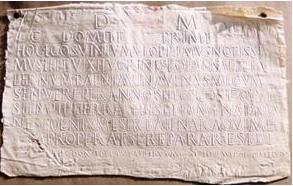
    It is well known and cited one couplet of an epitaph appeared in Roma, referenced in the Corpus Inscriptionum Latinarum (CIL) with the number 15258, or in Carmina Latina Epigraphica (CLE) with the number 1499, or in Inscriptiones Latinae Selectae (ILS) 8157 = CLE 1499, that synthesizes this "hedonistic" proposal.

    Note. Hedonism, from the Greek ἡδονισμός (hedonismos) from ἡδονή (hedone), pleasure, and the suffix -ισμός (-ismos) quality, doctrine, system.

    This is an example of what some anthologies and literary precepts called "serpentine verse", in which the end of the verse or couplet is the same as the first, as the snake biting its own tail, like this one of Juvenal , 14, 139:

    Crescit amor nummi quantum ipsa pecunia crevit.

    "As money increases, so does love of money."

    Some also speak in these compositions  as "chiasmus" or composition in "X", from the Greek χιασμός (chiasmos), the Greek name of the χ letter X, pronounced "chi, qui,".

    The inscription above corresponds to a tombstone or epitaph appeared in first-century in Rome that  Merope dedicates to his partner Tiberius Claudius Secundus, who lived the not inconsiderable amount of 52 years, with the next really beautiful couplet:

    “bathing, wine, sex ruin our bodies,
    but bathing, wine and love make life worth living”.

    “balnea vina Venus corrumpunt corpora nostra
    Sed vitam faciunt b(alnea) v(ina) V(enus)

    The full epitaph reads:

    “He lived 52 years.
    To the spirits
    of the departed Tibrius Claudius Secundus.
    Here he has everything with him.
    “bathing, wine, sex ruin our bodies,
      but bathing, wine and love
    make life worth living”.
    Merope, freedwoman of Caesar
    made this for her dear companion,
    herself and their family and their descendents.”

    V(ixit) an(nos) LII
    d(is) M(anibus)
    Ti(beri) Claudi Secundi
    hic secum habet omnia
    balnea vina Venus
    corrumpunt corpora
    nostra se<d=T> vitam faciunt
    b(alnea) v(ina) V(enus)
    karo contubernal(i)
    fec(it) Merope Caes(aris)
    et sibi et suis p(osterisque) e(orum)

    Photograph of the text as appear in the Corpus Inscriptionum Latinarum.

    It is certainly a well popular maxim in the ancient world. For example it also appears in a bilingual inscription of Gallipoli, now Turkey, on a spoon with the same hexameter: Carmina Latina Epigraphica (CLE) 1923; (CIL III 12274c); (In the edition of Carmina Latina Epigraphica, post Editam collectionem Buechelerianam in lucem prolate Conlegit Einar Engstrom, 1912 p.42, No. 148..):

    “Baths, wine and sex make fate come faster”

    balnea vina Venus faciunt properantia fata.

    Another epitaph of the third century A.D., of Ostia, also includes the couplet with some variation that expresses self-satisfaction or perhaps complacency and boasting of whom has had a good life. Consider the fact that the deceased is often in the first person, who addresses the still alive, adds a sarcastic tone if not black humor.

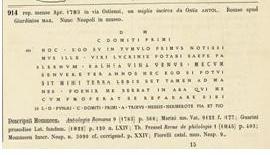
    The epitaph is the corresponding CIL XIV, 914 (or 01318 CLE)

    “To the spirit of the departed C.Domitius Primus. I, the well-known Primus, am in this tomb.  I lived on Lucrine oysters; I often drank Falernian wine. Baths, wine, and  love aged with me through the years. If I managed this, may the earth be light on me. Yet among the spirits, the phoenix, which hastens to renew itself along with me, saves me on the altar. Space granted  for the burial of C.Domitius Primus by the three Messii –Hermeros, Pia y Pius.”

    D(is) M(anibus)
    C(aius) Domiti Primi
    hoc ego su(m) in tumulo Primus notissi
    mus ille vixi Lucrinis pota<v=B>i saepe Fa
    lernum baln<e=I>a vina Venus mecum
    senuere per annos hec(!) ego si potui
    sit mihi terra lebis(!) et tamen ad Ma
    nes foenix(!) me serbat(!) in ara qui me
    cum properat se reparare sibi
    l(ocus) d(atus) funeri C(ai) Domiti Primi a tribus Messis Hermerote Pia et Pio

    Transcription of the text and photo in the CIL

    A note: J.M. Stowasser suggests judiciously several emendations reading  some words for better understanding of the epitaph: "illex" for "ille", "tenuere" for "senuere", "seposui" for "si posui", and "arca" for "ara", in "Über ein paar anapästische lateinische Inschriften," in Dreißigster Jahresbericht über das k. k. Franz Joseph-Gymnasium in Wien, Schuljahr 1903/1904 (Wien: Selbstverlag des Gymnasiums, 1904),

    Robert L. quotes  in  "Aphrodisias," Hellenica 13 (1965): 189) other text with a similar sentiment:

    “The flower is dear to travelers: bathe, drink, eat, fuck, for you bring none of these below (to Hades)”

    The fact that this maxim appears in epitaphs gives added value because we can interpret it as an objective statement of a bon viveur or epicurean, not without black humor.

    These latest inscriptions added to the pleasures of bathing, drinking and enjoying the love of eating, some way implicit in that of "drinking". There are also many examples where the pleasure of eating and general invitation to the good life is highlighted. All this is certainly prolonged and increased during the Middle Ages and then by the rigidity of Christianity, which seeks to impose fasting and abstinence. The popular, skeptical, epicurean or hedonistic answer is "let us eat and drink, for tomorrow we come to die." But this requires a separate article, which at some point I will, because the examples of inscriptions referred to it are numerous.

    Actually this maxim and similar are rooted in the anonymous Greek epigram of the Anthologia Palatina, 10,112 (collection of Greek poems, usually brief, from classical times to the Byzantine).

    Wine and baths and venerean indulgence make the road to Hades more precipitous

    Note: the word "anthology" derives from the Greek ἄνθος, anthos, 'flower' and λέγω 'to select',  and it means  "flower selection" just like the Latin "florilegium", posy.

    As I said, the sentence continues in the Middle Ages to the present day. Interestingly, it seems that since the Middle Ages has diminished if not disappeared fondness for baths and  hygiene in general; this pleasure  does not seem to recover well to contemporary times with the proliferation of SPAs. See:

    But if it disappears reference to the baths, numerous variations, which in many cases show a clear condemnation and a moralizing proposal,  usually are present. I will cite just one example in Spanish of a compendium of the eighteenth century:

    FLORILEGIUM LATINUM, SÍVE HORTUS PROVERBIORUM, Phrasium, et Syntaxeosque Chrysolitus amoenissimus. NON MODO LATINITATIS PERFECTAE Intelligentiae candidatis perutile, & accommodátum , verum etiam quám maxime necessarium.
    PER D. JOANNEM DE LAMA, QUARTA IMPRESSION. Con las Licencias necesarias .
    En Madrid : En la Imprenta de Miguel Escribano.  Año de 1769.

    In the section EEGANTIAE SIVE  CATONIANA carmina memoria perpetuo tenenda, which begins on page 320, there are since page 329 entitled In peccatorem (for the sinner). Well, at p. 330 he devotes a few couplets to the sins of love and wine; among others:

    The bathrooms, wine, Venus (sex) are the true poisons of virtue.
    To that virtue this strong, flee wine and Venus

    Balnea , vina , Venus virtütis vera venena:
    Ut virtus vigeat : vadite , vina Venus.

    Or

    The bathroom, wine, Venus, corrupt our bodies:
    But our bodies are healed by the bathroom, wine, Venus

    Balnea , vina , Venus , corrumpunt corpora nostra:
    corpora noftra sanant balnea , vina , Venus.

    But eliminated the component bathing or hygiene by water, the conjunction of “vina” and Venus, wine and love (wine and women in their most popular and sexist version) has potent remained until today, since the frequency of occurrence in numerous operas, to use less artistic in folk songs.

    I will cite just the famous toast of the Traviata:


    Toast (Let's Drink From The Joyful Chalices)

    [Alfredo]

    Let's drink, drink from the joyful chalices
    since the beautiness is blossoming.
    And might the fleeting hour get inebriated at will
    Let's drink among (those) sweet quivers
    that Love makes arise,
    since that eye goes to (his) almighty heart.
    Let's drink, (my) love, (so that) love among the chalices
    will get hotter kisses

    [Chorus] Ah! Let's drink, (so that) love, among the chalices, will get hotter kisses

    [Violetta]

    With you, with you, I'll be able to share
    my cheerful time;
    Everything is crazy, crazy in the world
    what is not pleasure
    Let's enjoy (the pleasures), fleeting and fast
    is the joy in love,
    it's a flower that blossoms and dies,
    neither it can be enjoyed longer
    Let's enjoy, it's calling us, it's calling us an ardent
    flattering accent
    .

    [Chorus]

    Let's enjoy, the cup* and the canticle,
    the lovely night and the smiles;

    might the new day find them (still) in this paradise

    [Violetta] Life is in (its) jubilation

    [Alfredo] When (people) aren't in love yet...

    [Violetta] Don't say it to those who don't know it,

    [Alfredo] So it's my destiny

    [Tutti]

    Let's enjoy, the cup* and the canticle,
    the lovely night and the smiles;
    might the new day find them (still) in this paradise.

    (Translated by http://lyricstranslate.com/es/brindisi-libiamo-ne039lieti-calici-toast-lets-drink-joyful-chalices.html#ixzz44ma62HlW)

    Alfredo
    Libiamo, libiamo ne’lieti calici
    Che la belleza inflora.
    E la fuggevol, fuggevol ora
    S’inebri a voluttà.
    Libiami ne’dolce fremiti
    Che suscita l’amore,
    Poiché quell’occhio
    Al core omnipotente va.
    Libiamo,amore,
    Amor fra i calici
    Piu caldi baci avrá.
    Coro
    Ah! Libiam,amor,
    Fra’calici
    Piu caldi baci avrà.
    Violetta
    Tra voi, tra voi
    Saprò dividere
    Il tempo mio giocondo;
    Tutto è follia, follia nel mondo
    Ciò che non è piacer
    Godiam, fugace e rapido è il Gaudio dell’amore,
    È un flor che nasce e muore,
    Ne più si può goder
    Godiamo, c’invita.
    C’invit un férvido accento lusinghier.
    Coro
    Godamo, la tazza,
    La tazza e il cantico,
    La notte abella e il riso;
    In questo, in questo paradiso
    ne scopra il nuovo di.
    Violetta
    La vita è nel tripudio
    Alfredo
    Quando non s’ami ancora
    Violetta
    Nol dite a chil’ignora.
    Alfredo
    È il mio destin così…
    Tutti
    Godiamo, la tazza,
    La tazza e il cantico,
    La notte abbella e il riso;
    In questo, in questo
    Paradiso ne scopra il nuovo di.

    I will also reference, by contrast, the very sexist and insufferable Spanish pasodoble of Manolo Escobar,  of remarkable success in Spain at the time, entitled "Women and Wine", whose chorus, related to the content of the article, I would play (I find it impossible to quote the rest of the lyrics of this pasodoble, even to reject it as absurd and of infamous literary quality.):

    Note: "infamous" is a word derived from Greek φημί, (to talk), in-femi (ie, no-talking), which therefore means etymologically "unspeakable, unpronounceable, unworthy to be said,", because  the noble sentiments, such as patriotism, must be proclaimed but in the right way and in the right context, because if not their dignity is undermined.

    Women and Wine

    Long live wine and women!
    and the roses that heat our sun!
    Long live wine and women
    for they are the gifts of the Lord!
    And long live every corner of my homeland.
    Long may they live together as one!
    Forming our flag
    and the armour of my Spain.

    (Translated by http://lyricstranslate.com/es/mujeres-y-vino-women-and-wine.html#ixzz44mZRzQM7)

    Viva el vino y las mujeres
    y las rosas que calienta nuestro sol.
    Viva el vino y las mujeres,
    que por algo son regalo del Señor.
    Y vivan
    los cuatro puntos
    cardinales de mi patria.
    Que vivan los cuatro juntos,
    que forman nuestra bandera
    y el escudo de mi España.

  • privative alpha, ἀ-, -ἀν; a- , -an

    privative a, ἀ- , privative alpha, is a Greek prefix (originated in Indoeuropean) that expresses negation or absence of the concept meaning by the term to which it is attached.From Greek it came to Latin and from it to Spanish and other romance languages.

    The Spanish language is spoken today by more than 560 million people, the largest number, more than 120 million, in Mexico. It is the second most spoken language by native speakers after Mandarin Chinese.

    In three quarters, ie approximately 75%, it is formed from the Latin language, the language of the Romans, who introduced it in  their empire, at least in the western part.

    But in the formation of Spanish they have intervened and involved many components: the indigenous languages,  which  were the substrate on which was introduced the new, the Basque, the Germanic (which left few remains because the Visigoths and spoke Latin when they reach Hispania) , Arabic (with very strong presence), Hebrew, French, English, Italian, American languages, etc.etc.

    The Greek is also a very important language in shaping of the Spanish. First because many Latin form words actually are originally Greek words. We should remember how Greek culture permeates the entire Roman life. See:https://www.antiquitatem.com/en/graecia-capta-greek-culture-quignard 

    Secondly because the Greek, also Latin, have been, and continue to be, very productive in creating new words, especially in science and educated field.

    All these are basic things that everyone knows, as no doubt also knows what I'll summarize below. I want to show how a simple understanding of the meaning of prepositions and some preverbs (part of a word that appears at the beginning and clarifies the meaning) Greek more used allows us to know easily, or help us to do so, the meaning of technicalities and words apparently of learned abstruse meaning.

    So I'll do a little relationship, not intended to be exhaustive, of course, but by relating the most common and some techniques that serve as an example.

    In this case, gradually we will complete  the series, give the beginning with a-, Greek. ἀ- a-, or -an, gr. ἀν- (if the term that it joins begins with vocal), the so-called privative alpha (first letter of the Greek alphabet). It is not properly a preposition, but both in Greek and Latin and several modern languages it serves to deny or indicate the lack or deprivation of the term that comes joined. I relate only Greek words, not Latin, nor others involved in the composition of the a-, but not the alpha privative. It will be time for other listings.

    Abiogenesis: ἀ- (a-) (no, without, non, un-) βιο- (bio-) (life) – γένεσις (genesis) (origin, principle or process of formation): spontaneous generation from nonliving matter.

    abyss and abyssal: ἄ- (a -) (no, without, non, un-) -βυθός (Byzas) background: bottomless: belonging to the abyss; wildlife that lives in the deep sea.

    Aboulia, Abulia: ἀ- βουλία ,a-boulia, from βουλὴ (boule) (the will) and this from  βούλομαι (boulomai) (to will, to want): no will; indolent, selflessness, without interest. See  apathy.

    Acephaly, Acephalus ἀ -κεφαλῇ (a-kefale)(head), ἀ-κέφαλος (aképhalos): headless.

    Akinesia: ἀκινησία (akinesia); from κίνησις (kinesis), movement, and this from  κiνέο, kineo, to move: immobility, without movement, paralysis.

    acracy: ἀκρατία (akrata) (intemperance) from ἀ-κράτος (a-kratos) (power, authority): Doctrine which advocates  the abolition of all authority;  pertaining or relative to the acracia. Partisan of the acracia. Lawlessness.  See anarchy

    Achromia and Achromaticity: χρῶμα, -ατος (chroma, -atos) (color): colorless.

    Aphasia: ἀφασία (aphasia) from  ἀ- φημί (femi, femi) (speaking): inability to speak, loss of speech.

    Aphonia, aphonic, aphonous: ἀφωνία (Aphonia) from φωνή (phone) (sound)Loss of voice. Voicelessness; without voice.

    Agenesisfrom  ἀγενησία, from  α- γένος (a-genos) (origin, birth, race, training): quality of uncreated; inability to beget. Any imperfect development of the body, or any anomaly of organization.

    Agerasia: ἀγηρασία (agērasía) from  a-γῆρας (a-geras) (old age): Old age exempt from infirmities of this age. An outward appearance more youthful than one's true age.

    Agnosis, agnosy, agnosia, agnostic and agnosticism: αγνῶσις (agnosis) from α-γνῶσις. Αγνωμαζει,  (agnōstikós) from αγνωστικός (relative to knowledge) from  γιγνώσκω (ginnosko) (know). Inability to recognize objects through the senses. Philosophical attitude that declares inaccessible to human understanding all knowledge of the divine and what transcends experience or senses.

    Alexia: ἀ- and λέξις (lexis) (speech, diction) from λέγω (lego) (to say, express, read): The inability, due to a cerebral disorder, to comprehend or understand writing.

    Amazon: Αμαζών (amazon). Its etymology is not absolutely clear, but it has been made  popularly derived from α (a-) and μαζός (breast), because it was said that these warriors were amputated from right breast or burned to better draw the bow. But scientifically it has been proposed that the name derives from the name of an Iranian tribe called * ha-mazan, the warriors.

    Marcus Junianus Justinus or Justinus Frontinus  includes the their fantastic version in his "Historiae Phillippicae ex Trogo Pompeio", Liber II, 4:

    "They exercised the virgins on weapon-wielding, horse-riding and hunting, and burned the children's right breasts, so that arrow-throwing wouldn't be impeded; and for such reason, they were called Amazons."

    "Virgines (…) armis, equis, venationibus exercebant, inustis infantum dexterioribus mammis, ne sagittarum iactus impediantur; unde dictae Amazones."

    Ambrosia: ἀμβροσία ambrosia, from α- αν-  αμ-   ἄμ-βροτος ám-brotos,  immortal , not human, divine. Drink constituted among other things by honey, proper to the gods because it gave the immortality. Ragweed.

    Amenorrhea: ἀ- a-, μήν, μηνός men, menos, (month) and -ρροια –rroia from ῥέω  rheo, to run, to flow. Absence of menstrual flow.

    Analphabet:: ἀναλφάβητος analphábētos from  ἀν-ἄλφα βέτα alpha, beta (first letters of the Greek alphabet): Illiterate. Who can’t read or write.

    Analgesia, analgesic: ἀναλγησία Analgesia, ἂν-ἄλγος  an- without algos, pain. Absence or reduction of painful sensations; insensitivity.

    Anarchy, anarchism, anarchist: ἀναρχία anarchy, ἂν-,  ἄρχω an-archo, to order, ἀρχὴ, arché, origin, control, power: absence of government or authority. Doctrine which advocates the abolition of the state and the elimination of all power or authority which  constrains individual freedom.

    Anemia, anaemia: ἀναιμία anaimia from  ἂν-, an, αἷμα, aima, blood blood deficiency, low blood count.

    Anerosia: ἂν-, an-, ἔρως, eros, love,: absence of love.

    Anesthesia and anesthetic: ἀναισθησία anaisthēsía, ἀν-, an-, αἰσθήσεις, theseis, sensation, perception, from αἰσθάνομαι, aisthanomai, receive: insensitivity, without sensitivity.

    Anhydrous: ἄνυδρος ánydros, from ἀν-, an, ὕδωρ, hydor, water: that has no water.

    Anhydride: ἄνυδρος ánydros from ἀν- a, ὕδωρ, hydro, water, εἶδος, eidos, aspect: corps  resulted from the combination of oxygen and a nonmetallic element that reacts with water and gives an acid.

    Anhidrosis: ἀνίδρωσις anídrōsis from  ἀν-, an-, ἱδρόω, hidroo, to sweat  ἱδρώς, hydros, sweating: no sweating. The reduced ability or inability to sweat.

    Anhipnia: ἀν-, an, ὕπνος, hipnos, sleep,: absence of sleep.

    Anodyneἀνωδυνία anōdynía, ἀνώδυνος, anodyne, from  ἀν-ὀδύνη, odyne,  pain;, from  ὀδυνἀω, odynao, causing pain. : Absence of pain, free from pain.        

    Anomaly: ἀνωμαλία anomaly, from ἀν-ὁμαλὸς, an-homalos, even, same, Deviation or discrepancy of a rule or use, irregular, uneven, strange.

    Anomie: ἀνομία. from ἀ-νόμος, nomos, usage, custom: Absence of law.

    Anonymous: Anonymos ἀνώνυμος from ἀν-ὄνομα, onoma, name: without name

    Anopsia and anopia: ἀνοψίη anopsíē  from  ἀν- (an-) and ὄψις (opsis) "sight" blindness, sightless, A defect in vision. State or condition of sightlessness, often due to medical reasons.

    Anorexia: ἀνορεξία anorexia, from ἀν-ὄρεξίς, orexis, appetite, from ὀρέγω, orego, to desire, to tender: inappetence, absence of appetite, without appetite.

    Anuriaἀν- οὖρον, ouron, urine, from ουρώ, ouro, to urinate: complete cessation of urinary secretion. A condition in which the kidneys do not produce urine.

    Aorist: ἀόριστος aoristos from  a- ὁριστός, determined, defined, from ὁρίζω, oriso, to limit,: undefined, not done, not completed.

    Apathy, apathic and apathetic: from ἀ-πάθος, pathos, passion, incident”, “emotion”, “passion, feeling: impassive mind, without passions, indolence, impassibility”, “insensibility”, “freedom from emotion, absence of vigor or energy.

    Apnea: from  ἄπνοια ápnoia, ἀ-απνοια, pnoia, breathing, from πνέω, pneo, to breath : cessation of breathing. Drowning.

    Apteran, apterous: ἄπτερος wingless, from  ἄ-πτερὸν, pteron, wing, feather: Wingless insect; In a building, especially a classical temple without columns in its side walls.

    Arrhythmia: ἀρρυθμία arrythmia, from  ἀ-ῥυθμός, Rythmos, rhythm.: regularly Irregularity and inequality in the heart's contractions. An irregular heartbeat.

    asepsis and aseptic: ἀ-σῆψίς from sepsis, putrefaction, from σήπω, to rot: Absence of septage,  free from sepsis, infection-free status; set of scientific procedures designed to preserve the body of infectious germs, mainly applied to sterilization of surgical material.

    Asphyxia: ἀσφυξία asphyxia, from ἄσφυκτος ásphyktos, from σφύξεις, pulsation, palpitation: Suspension or difficulty in breathing. Stopping of the pulse.

    Asymmetry and asymmetric: ἀσυμμετρία asymmetría from  ἀ-συν without, with, μέτρον, metron, measure: without measure; absence of symmetry.

    Asyndeton: ἀσύνδετον asyndeton; from ἀ-συν without, with, δέω, deo, to tye, συνδέω, to unite,link: detached itself; this grammatical figure is to remove conjunctions. Without conjunctions. Omission of conjunctions in a text to give vividness and energy to what is expressed, as in the famous phrase of Caesar "I came, I saw, I conquered," Veni, vidi, vici.

    Note: the famous phrase is referred by Plutarch in Caesar, 50.3 and in Moralia, 206e and by Suetonius in Life of Julius Caesar, 37. 

    Asymptomatic: ἀ-σύμ-πτωμα sýmptōma from ἀ- (no, without) – σύν-, with, πίπτειν, to fall, to influence: no coincidence; without symptom, ie, without revealing manifestation of a disease or no signal or indication of something it is happening or will happen.

    Asymptote: [γραμμή] ἀσύμπτωτος [Gramme] asýmptōtos, from  ἀ- (no, without) – σύν-, with, πίπτειν, or πίπτω, pipto, falling, influence, impact: [line] that does not coincide. In geometry, straight line, indefinitely prolonged, continuous approaching a curve, without ever finding it.

    astatine: ἄστατον astaton, from  α'- στα- from τι'θημι, to put, to place: unstable; radioactive chemical element, atomic number 85, obtained artificially, with chemical properties similar to those of iodine and whose isotopes are unstable.

    Asthenia: ἀσθένεια astheneia from  ἀ-σθένος, strength,: without strength, weakness, loss of strength.

    Astigmatism: ἀ-στίγμα, -ατος stigma, -atos, mark, point,  and -ism: defect of the vision due to an irregular curvature of the surface of the cornea and lens. In optical, defect of an optical system that reproduces a point as a small fuzzy area.

    Athanasy, athanasia: ἀθανασία athanasia from  ἀ-θάνατος, death, without death, immortality. An absence of death or the condition of everlasting life.  Proper name.

    Ataraxia: ἀταραξία ataraxia, from  ἀ- ταράσσω, tarasso, agitate, trouble, disturb:  imperturbability, serenity, tranquility of mind; absence of mental disturbance

    Ataxia: ἀταξία from  ἀ- ταξις, taxis, order,: In medicine, disorder, irregularity, disturbance of the nervous system functions; inability to govern orderly locomotion.

    Atheism, atheist: from θεος, from ἄ-theos, θεὸς, theos, god: denial of the existence of any god.

    Athermal: ἄ- θέρμη, therme, heat,: without heat; that does not involve either heat or a change in temperature.

    Atypical: τύπος, from ἀ- τύπος, types, figure, model, image: That by its characters deviates from the representative models or known types.

    atom atomic: ἄτομον atomon from  ἄ-τομος – atoms, from τομὴ, tome,  cutting which can not be cut, indivisible.

    Atony, atonal: ἀτονία, atonia, from τόνος, tones, rope, tension, stress, from τείνειν, teinein ,‎ to stretch, extend: languor, absence of energy, vigor or strength. Languid. Absence of tone and vigor, or weakness of organic tissues, particularly the contractile.

    Atrophy: ἀτροφία atrophia τροφὴ, nutrition: malnutrition, absence  of development of an organ.

  • Should the painting be imitation of nature, or creation of the intellect?

    The art of painting was very important in Antiquity, although hardly we have a rest from it by the nature of the support on it is usually done.

    We get some paint on a wall of buildings, especially in Pompeii, but also in other isolated area, some exceptionally well-preserved table in the warm climate of the Egyptian desert and little else. Certainly they are preserved many mosaics that reproduce many paintings or try to imitate them.

    And we have also numerous texts which refer to this art. Among them, for example, a treatise of Lucianus of Samosata and especially the book XXXV of Pliny, who in his encyclopedic Natural History wrote almost about everything.

    Well, in Natural History, XXXV, chap. 36 (60). he tells us, even briefly, an in Antiquity well known anecdote and reproduced ad nauseam since the Renaissance, about the method for painting from a natural model.

    The story is told in more detail and otherwise set by Cicero in one of his minor works on rhetoric, in his De Inventione rhetorica, On the rhetorical invention, II, 1: 1-4

    The story has had a special importance in the history of later art. It raises the question of the pursuit of beauty from a natural model and the matter is linked to the Platonic doctrine of general ideas, because when a painter draws the face of a man or of a woman or of any other being, what really does he express on the canvas or on the table, the face he is  watching or the ideal representation of the beautiful face he has created in his mind, that is, the general idea?

    We will read these two texts and we will make make three further references to the anecdote, one from the humanist Leon Battista Alberti, another one of the painter Raphael Sanzio and the third one of Francisco Pacheco (1564-1644), teacher and father in law of Velazquez, who naturally could not escape his appointment.

    Cicero (106a.C.-43a.C.) wrote his manual entitled De Inventione, On rhetoric invention, being very young, around the year 86, 20 years old. We retain only two of the four books that this work  should have. As a work of youth, the mature orator Cicero was not very proud of it, as he tells us in his De Oratore, (Lib.I. 5) and also Quintilian (Institutio Oratoria, III. 1, 20)

    Well Marcus Tullius Cicero tells us in "On invention", Book II, 1.1-4:

    Some men of Crotona, when they were rich in all kinds of resources, and when they were considered among the most prosperous people in Italy, were desirous to enrich the temple of Juno, which they regarded with the most religious veneration, with splendid pictures. Therefore they hired Zeuxis of Heraclea at a vast price, who was at that time considered to be far superior to all other painters, and employed him in that business. He painted many other pictures, of which some portion, on account of the great respect in which the temple is held, has remained to within our recollection; and in order that one of his mute representations might contain the preeminent beauty of the female form, he said that he wished to paint a likeness of Helen. And the men of Crotona, who had frequently heard that he exceeded all other men in painting women, were very glad to hear this; for they thought that if he took the greatest pains in that class of work in which he had the greatest skill, he would leave them a most noble work in that temple.

    Nor were they deceived in that expectation: for Zeuxis immediately asked of them what beautiful virgins they had; and they immediately led him into the palaestra, and there showed him numbers of boys of the highest birth and of the greatest beauty. For indeed, there was a time when the people of Crotona were far superior to all other cities in the strength and beauty of their persons; and they brought home the most honourable victories from the gymnastic contests, with the greatest credit. While, therefore, he was admiring the figures of the boys and their personal perfection very greatly; "The sisters," say they, "of these boys are virgins in our city, so that how great their beauty is you may infer from these boys." "Give me, then," said he, "I beg you, the most beautiful of these virgins, while I paint the picture which I promised you, so that the reality may be transferred from the breathing model to the mute likeness." Then the citizens of Crotona, in accordance with a public vote, collected the virgins into one place, and gave the painter the opportunity of selecting whom he chose. But he selected five, whose names many poets have handed down to tradition, because they had been approved by the judgment of the man who was bound to have the most accurate judgment respecting beauty. For he did not think that he could find all the component parts of perfect beauty in one person, because nature has made nothing of any class absolutely perfect in every part. Therefore, as if nature would not have enough to give to everybody if it had given everything to one, it balances one advantage bestowed upon a person by another disadvantage.

    But since the inclination has arisen in my mind to write a treatise on the art of speaking, we have not put forth any single model of which every portion was necessarily to be copied by us, of whatever sort they might be; but, having collected together all the writers on the subject into one place, we have selected what each appears to have recommended which may be most serviceable, and we have thus culled the flower from various geniuses. For of those who are worthy of fame or recollection, there is no one who appears either to have said nothing well, or everything admirably. So that it seemed folly either to forsake the sensible maxims brought forward by any one, merely because we are offended at some other blunder of his, or, on the other hand, to embrace his faults because we have been tempted by some sensible precept which he has also delivered.
    (Translation by C. D. Yonge (1853))

    Crotoniatae quondam, cum florerent omnibus copiis et in Italia cum primis beati numerarentur, templum Iunonis, quod religiosissime colebant, egregiis picturis locupletare voluerunt. itaque Heracleoten Zeuxin, qui tum longe ceteris excellere pictoribus existimabatur, magno pretio conductum adhibuerunt. is et ceteras conplures tabulas pinxit, quarum nonnulla pars usque ad nostram memoriam propter fani religionem remansit, et, ut excellentem muliebris formae pulchritudinem muta in se imago contineret, Helenae pingere simulacrum velle dixit; quod Crotoniatae, qui eum muliebri in corpore pingendo plurimum aliis praestare saepe accepissent, libenter audierunt. putaverunt enim, si, quo in genere plurimum posset, in eo magno opere elaborasset, egregium sibi opus illo in fano relicturum.

    [2] neque tum eos illa opinio fefellit. nam Zeuxis ilico quaesivit ab iis, quasnam virgines formosas haberent. illi autem statim hominem deduxerunt in palaestram atque ei pueros ostenderunt multos, magna praeditos dignitate. etenim quodam tempore Crotoniatae multum omnibus corporum viribus et dignitatibus antisteterunt atque honestissimas ex gymnico certamine victorias domum cum laude maxima rettulerunt. cum puerorum igitur formas et corpora magno hic opere miraretur: ‘Horum,’ inquiunt illi, ‘sorores sunt apud nos virgines. quare, qua sint illae dignitate, potes ex his suspicari.’ ‘Praebete igitur mihi, quaeso,’ inquit, ‘ex istis virginibus formonsissimas, dum pingo id, quod pollicitus sum vobis,  ut mutum in simulacrum ex animali exemplo veritas transferatur.’ tum Crotoniatae publico de con- silio virgines unum in locum conduxerunt et pictori quam vellet eligendi potestatem dederunt. ille autem quinque delegit; quarum nomina multi poetae memoriae prodiderunt, quod eius essent iudicio probatae, qui pulchritudinis habere verissimum iudicium de- buisset. neque enim putavit omnia, quae quaereret ad venustatem, uno se in corpore reperire posse ideo, quod nihil simplici in genere omnibus ex partibus per- fectum natura expolivit. itaque, tamquam ceteris non sit habitura quod largiatur, si uni cuncta concesserit, aliud alii commodi aliquo adiuncto incommodo muneratur.

    [4] Quod quoniam nobis quoque voluntatis accidit, ut artem dicendi perscriberemus, non unum aliquod proposuimus exemplum, cuius omnes partes, quocumque essent in genere, exprimendae nobis necessarie vi- derentur; sed omnibus unum in locum coactis scriptoribus, quod quisque commodissime praecipere videbatur, excerpsimus et ex variis ingeniis excellentissima quaeque libavimus. ex iis enim, qui nomine et memoria digni sunt, nec nihil optime nec omnia prae- clarissime quisquam dicere nobis videbatur. quapropter stultitia visa est aut a bene inventis alicuius recedere, si quo in vitio eius offenderemur, aut ad vitia eius quoque accedere, cuius aliquo bene praecepto duceremur.

    Moreover, the reader will easily understand how the matter was to be frequent theme in painting from the Renaissance and of course in the Baroque and neoclassicism, as lovers of classic themes. I also will reproduce a couple of illustrations on the content of the texts; which it comes next seems the representation of a modern casting selection of candidates for representation, as I comment at  the bottom of it.

    Work of neoclassical painter François-André Vincent (Paris, 1746-1816), "Zeuxis et les filles de Crotone", "Zeuxis and daughters of Crotona" (3.23 m. X 4.15 m.), Painted in 1789 . Louvre Museum.

    In the picture, like it were a modern "casting", we can appreciate the beauty of each girl, the shame of some because  remaining  naked, the content of the selected, the nerves on edge of waiting, the anger of rejected … well, like a "casting" is involved.

    I extend a little more the corresponding text of Pliny, which refers to a statue of the goddess Juno, to include another famous anecdote referring to the rivalry between Zeuxis and Parrasius, which I have already referred in https://www.antiquitatem.com/en/zeuxis-parraxius-classical-art-painting 

    In these two stories it is illustrated with examples the discussion between aesthetic theory of exact imitation of nature to fool the eye, from  the concept of "trompe l'oeil" , "trap for the eye",  comes and the perfect imitation, and transcending the inherent beauty of nature.

    Pliniy, Naturalis Historia, XXXV, 36 (60)

     Aetists who painted with the pencil.

    In the ninetieth Olympiad lived Aglaophon, Cephisodorus, Erillus, and Evenor, the father of Parrhasius, one of the greatest of painters, and of whom we shall hare to speak when we come to the period at which he flourished. All these were artists of note, but not sufficiently so to detain us by any further details, in our haste to arrive at the luminaries of the art ; first among whom shone Apollodorus of Athens, in the ninety-third Olympiad. He was the first to paint objects as they really appeared ; the first too, we may justly say, to confer glory  by the aid of the pencil." Of this artist there is a Priest in Adoration, and an Ajax struck by Lightning, a work to be seen at Pergamus at the present day : before him, there is no painting of any artist now to be seen which has the power of rivetting the eye.

    The gates of art being now thrown open by Apollodorus,- Zeuxis of Heraclea entered upon the scene, in the fourth year of the ninety-fifth Olympiad, destined to lead the pencil — for
    it is of the pencil that we are still speaking — a pencil for which there was nothing too arduous, to a very high pitch of glory. By some writers he is erroneously placed in the eighty-ninth Olympiad, a date that must of necessity be reserved for Demophilus of Himera and Neseus of Thasos, of one of whom, it is uncertain which, Zeuxis was the pupil. It was in reference to him that Apollodorus, above-mentioned, wrote a verse to the effect, that Zeuxis had stolen the art from others and had taken it all to himself.' Zeuxis also acquired such a vast amount of wealth, that, in a spirit of ostentation, he went so far as to parade himself at Olympia with his name embroidered on the checked pattern of his garments in letters of gold. At a later period, he came to the determination to give away his works, there being no price high enough to pay for them, he said. Thus, for instance, he gave an Alcmena to the people of Agrigentum, and a Pan to Archelaus. He also painted a Penelope, in which the peculiar character of that matron appears to he delineated to the very life ; and a figure of an athlete, with which he was so highly pleased, that he wrote beneath it the line which has since become so famous, to the effect that it would be easier to find fault with him than to imitate him. His Jupiter seated on the throne, with the other Deities standing around him, is a magnificent production : the same, too, with his Infant Hercules strangling the Dragons, in presence of Amphitryon and his mother Alcmena, who is struck with horror.

    Still, however, Zeuxis is generally censured for making the heads and articulations of his figures out of proportion. And yet, so scrupulously careful was he, that on one occasion, when he was about to execute a painting for the people of Agrigentum, to be consecrated in the Temple of the Lacinian Juno there, he had the young maidens of the place stripped for examination, and selected five of them, in order to adopt in his picture the most commendable points in the form of each. He also painted some monochromes in white.

    The contemporaries and rivals of Zeuxis were Timanthes, Androcydes, Eupompus, and Parrhasius.  This last, it is said, entered into a pictorial contest with Zeuxis, who represented some grapes, painted so naturally that the birds flew towards the spot where the picture was exhibited. Parrhasius, on the other hand, exhibited a curtain, drawn with such singular truthfulness, that Zeuxis, elated with the judgment which had been passed upon his work by the birds, haughtily demanded that the curtain should be drawn aside to let the picture be seen. Upon finding his mistake, with a great degree of ingenuous candour he admitted that he had been surpassed, for that whereas he himself had only deceived the birds, Parrhasius had deceived him, an artist. There is a story, too, that at a later period, Zeuxis having painted a child carrying grapes, the hirds canae to peck at them ; upon which, with a similar degree of candour, he expressed himself vexed with his work, and exclaimed — '' I have surely painted the grapes better than the child, for if I had fully succeeded in the last, the birds would have been in fear of it." Zeuxis executed some figures also in clay," the only works of art that were left behind at Ambracia, when Fulvius jS'obilior'® transported the Muses from that city to Rome. There is at Ptome a Helena by Zeuxis, in the Porticos of Philippus,  and a Marsyas Bound, in the Temple of Concordia there.  (Translated by John Bostock,M.D.,F.R.S., and H.T.. Riley,Cambridge)

    LXXXX autem olympiade fuere Aglaophon, Cephisodorus, Erillus, Euenor, pater Parrhasii et praeceptor maximi pictoris, de quo suis annis dicemus, omnes iam inlustres, non tamen in quibus haerere expositio debeat festinans ad lumina artis, in quibus primus refulsit Apollodorus Atheniensis LXXXXIII olympiade. hic primus species exprimere instituit primusque gloriam penicillo iure contulit. eius est sacerdos adorans et Aiax fulmine incensus, quae Pergami spectatur hodie. neque ante eum tabula ullius ostenditur, quae teneat oculos.
    Ab hoc artis fores apertas Zeuxis Heracleotes intravit olympiadis LXXXXV anno quarto, audentemque iam aliquid penicillum — de hoc enim adhuc loquamur — ad magnam gloriam perduxit, a quibusdam falso in LXXXVIIII olympiade positus, cum fuisse necesse est Demophilum Himeraeum et Nesea Thasium, quoniam utrius eorum discipulus fuerit ambigitur.
    in eum Apollodorus supra scriptus versum fecit, artem ipsis ablatam Zeuxim ferre secum. opes quoque tantas adquisivit, ut in ostentatione earum Olympiae aureis litteris in palliorum tesseris intextum nomen suum ostentaret. postea donare opera sua instituit, quod nullo pretio satis digno permutari posse diceret, sicuti Alcmenam Agragantinis, Pana Archelao.

    fecit et Penelopen, in qua pinxisse mores videtur, et athletam adeoque in illo sibi placuit, ut versum subscriberet celebrem ex eo, invisurum aliquem facilius quam imitaturum. magnificus est et Iuppiter eius in throno adstantibus diis et Hercules infans dracones II strangulans Alcmena matre coram pavente et Amphitryone.

    reprehenditur tamen ceu grandior in capitibus articulisque, alioqui tantus diligentia, ut Agragantinis facturus tabulam, quam in templo Iunonis Laciniae publice dicarent, inspexerit virgines eorum nudas et quinque elegerit, ut quod in quaque laudatissimum esset pictura redderet. pinxit et monochromata ex albo. aequales eius et aemuli fuere Timanthes, Androcydes, Eupompus, Parrhasius.

    descendisse hic in certamen cum Zeuxide traditur et, cum ille detulisset uvas pictas tanto successu, ut in scaenam aves advolarent, ipse detulisse linteum pictum ita veritate repraesentata, ut Zeuxis alitum iudicio tumens flagitaret tandem remoto linteo ostendi picturam atque intellecto errore concederet palmam ingenuo pudore, quoniam ipse volucres fefellisset, Parrhasius autem se artificem.

    fertur et postea Zeuxis pinxisse puerum uvas ferentem, ad quas cum advolassent aves, eadem ingenuitate processit iratus operi et dixit: uvas melius pinxi quam puerum, nam si et hoc consumassem, aves timere debuerant. fecit et figlina opera, quae sola in Ambracia relicta sunt, cum inde Musas Fulvius Nobilior Romam transferret. Zeuxidis manu Romae Helena est in Philippi porticibus, et in Concordiae delubro Marsyas religatus.

    As I said above, the anecdote, well known since Antiquity itself is remembered, for example, by the great humanist Leon Battista Alberti (1404-1472), who devoted himself as a good humanist all the arts and knowledge of the most varied disciplines and was the first theorist of art. He wrote the treatise De pictura, On painting, first in Latin and then he translated it into Italian. I also offer in Spanish what he says in Book III, chapter 56 about the story of Zeuxis and the question of imitating or not to paint nature.

    In order not to waste his study and care the painter should avoid the custom of some simpletons. Presumptuous of their own intellect and without any example from nature to follow with their eyes or minds, they study by themselves to acquire fame in painting. They do not learn how to paint well, but become accustomed to their own errors. This idea of beauty, [8] which the well trained barely discern, flees from the intellect of the inexpert.
    In order to make a painting which the citizens placed in the temple of Lucina near Croton, Zeuxis, the most excellent most skilled painter of all, did not rely rashly on his own skills as every painter does today. He thought that he would not be able to find so much beauty as he was looking for in a single body, since it was not given to a single one by nature. He chose, therefore, the five most beautiful young girls from the youth of that land in order to draw from them whatever beauty is praised in a woman.

    [9] He was a wise painter. Frequently when there is no example from nature which they can follow, painters attempt to acquire by their own skill a reputation for beauty. Here it easily happens that the beauty which they search is never found even with much work. But they do acquire bad practices which, even when they wish, they will never be able to leave. [10] He who dares take everything he fashions from nature will make his hand so skilled that whatever he does will always appear to be drawn from nature.

    The following demonstrates what the painter should seek out in nature. Where the face of some well known and worthy man is put in the istoria –even though there are other figures of a much more perfect art and more pleasing than this one– [p. 93] that well known face will draw to itself first of all the eyes of one who looks at theistoria . So great is the force of anything drawn from nature. For this reason always take from nature that which you wish to paint, and always choose the most beautiful.  (http://www.noteaccess.com/Texts/Alberti/Intro1.htm  Alberti, Leon Battista. On Painting. [First appeared 1435-36] Translated with Introduction and Notes by John R. Spencer. New Haven: Yale University Press. 1970 [First printed 1956]).

    56. Sed quo sit studium non futile et cassum, fugienda est illa consuetudo nonnullorum qui suopte ingenio ad picturae laudem contendunt, nullam naturalem faciem eius rei oculis aut mente coram sequentes. Hi enim non recte pingere discount sed erroribus assuefiunt. Fugit enim imperitos ea pulchritudinis idea quam peritissimi vix discernunt. Zeuxis, praestantissimus et omnium doctissimus et peritissimus pictor, facturus tabulam quam in tempio Lucinae apud Crotoniates publice dicaret, non suo confisus ingenio temere, ut fere omnes hac aetate pictores, ad pingendum accessit, sed quod putabat omnia quae ad venustatem quaereret, ea non modo proprio ingenio non posse, sed ne a natura quidem petita uno posse in corpore reperiri, idcirco ex omni eius urbis iuventute delegit virgines quinque forma praestantiores, ut quod in quaque esset formae muliebris laudatissimum, id in pictura referret. Prudenter is quidem, nam pictoribus nullo proposito exemplari quod imitentur, ubi ingenio tantum pulchritudinis laudes captare enituntur, facile evenit ut eo labore non quam debent aut quaerunt pulchritudinem assequantur, sed plane in malos, quos vel volentes vix possunt dimittere, pingendi usus dilabantur. Qui vero ab ipsa natura omnia suscipere consueverit, is manum ita exercitatam reddet ut semper quicquid conetur naturam ipsam sapiat.  Quae res in picturis quam sit optanda videmus, nam in historia si adsit facies cogniti alicuius hominis, tametsi aliae nonnullae praestantioris artificii emineant, cognitus tamen vultus omnium spectantium oculos ad se rapit, tantam in se, quod sit a natura sumptum, et gratiam et vim habet. Ergo semper quae picturi sumus, ea a natura sumamus, semperque ex his quaeque pulcherrima et dignissima deligamus.

    III, 56. Ma per non perdere studio e fatica si vuole fuggire quella consuetudine d'alcuni sciocchi, i quali presuntuosi di suo ingegno, senza avere essemplo alcuno dalla natura quale con occhi o mente seguano, studiano da sé a sé acquistare lode di dipignere. Questi non imparano ipignere bene, ma assuefanno sé a' suoi errori. Fugge gl'ingegni non periti quella idea delle bellezze, quale i bene essercitatissimi appena discernono. Zeusis, prestantissimo e fra gli altri essercitatissimo pittore, per fare una tavola qual pubblico pose nel tempio di Lucina appresso de' Crotoniati, non fidandosi pazzamente, quanto oggi ciascuno pittore, del suo ingegno, ma perché pensava non potere in uno solo corpo trovare quante bellezze egli ricercava, perché dalla natura non erano ad uno solo date, pertanto di tutta la gioventù di quella terra elesse cinque fanciulle le più belle, per torre da queste qualunque bellezza lodata in una femmina. Savio pittore, se conobbe che ad i pittori, ove loro sia niuno essemplo della natura quale elli seguitino, ma pure vogliono con suoi ingegni giugnere le lode della bellezza, ivi facile loro avverrà che non quale cercano bellezza con tanta fática troveranno, ma certo piglieranno sue pratiche non buone, quali poi ben volendo mai potranno lassare. Ma chi da essa natura s'auserà prendere qualunque facci cosa, costui renderà sua mano sì essercitata che sempre qualunque cosa farà parrà tratta dal naturale. Qual cosa quanto sia dal pittore a ricercarla si può intendere, ove poi che in una storia sarà uno viso di qualche conosciuto e degno uomo, bene che ivi sieno altre figure di arte molto più che questa perfette e grate, pure quel viso conosciuto a sé imprima trarrà tutti gli occhi di chi la storia raguardi: tanto si vede in sé tiene forza ciò che sia ritratto dalla natura. Per questo sempre ciò che vorremo dipignere piglieremo dalla natura, e sempre torremo le cose più belle.

    Little later the great Raphael (1483 -1520), also known as Raphael Sanzio or Raphael of Urbino, says in a letter to Baldassare Castiglione, who feels admired by painting "Triumph of Galatea":

    IV. Letter to Castiglione

    On the Galatea, I think a great teacher if I did half the things so great that Your Lordship writes me. But I recognize in your  words your love for me and I tell you that to paint a beautiful one, I should need to see many beautiful ones, with this condition, that Your Lordship will be with me to choose the best. But as there is a shortage of good judges and of lovely ladies, I use a certain idea that which comes into my mind. Wheter  it has in it self any excellent art, I do not know. But I do strive to it have it. To which send Your Lordship. From Rome ".

    IV. Lettera al Castiglione

    Signor conte….Della Galatea mi terrei un gran maestro se vi fossero la metà delle tante cose che V.S. mi scrive. Ma nelle sue parole riconosco l´amore che mi porta: et le dico che per dipingere una bella mi bisogneria veder più belle, con questa conditione, che V.S. si trovasse meco a far scelta del meglio», Ma, essendo carestia e di buoni giudici e di belle donne, io mi servo di certa idea che mi viene nella mente. Se questa ha in sé alcuna eccellenza d'arte, io non so; ben m'affatico di averla. Vostra Signoria mi comandi. Di Roma.

    Francisco Pacheco knows this opinion of Raphael Sanzio. Pacheco is the teacher and father in law of Velazquez, and he says in his “Arte de la pintura”, (The art of painting), book I, chap 12:

    And if this should fail, or it is not caught with the beauty that should, or by discomfort of place or of time, it is admirably take advantage from  the beautiful ideas that the brave architect has acquired. As Raphael of Urbino gave to understand writing to Baltasar Conde Castellon, who urged much the figure of Galatea which he had frescoed. Saying this way:  Ma essendo carestia, e de buoni giudecij et de belle dome, io mi servo di certa iddea, che mi viene nellamente ; si questa ha in se alcuna escellenza d'arte, io non so : ben me affatico di haberla. It means: But as there is a shortage of good judges and of lovely ladies, I use a certain idea that which comes into my mind. Wheter  it has in it self any excellent art, I do not know. But I do strive to it have it, so that perfection is to move from ideas to nature, and from nature to the ideas: always looking for the best and safest and perfect. So Leonardo de Vinci, a man of very subtle wit,  teacher of Raphael,  did it so, tending to follow the ancients; who, before putting himself first to invent any story, investigated  all proper and natural effects of any figure, according to his idea. And made then many scratches, then went where people, similar whom he would paint, were gathered; and watched the way of their faces and clothes and body movements and when he found things that please him, according to his attempt, he drew on the libretto he always carried (we will see below his words under this attempt) and thus he ended his works beautifully. This is finally what should be done in this last stage, with the example of the old Zeusis, who for the beautiful Helena whom the people of Agrigentum offered him to paint, he chose five beautiful maidens and from each of them he was choosing the most perfect to make an equally ended figure, outstripping the art to nature: because  he painted in a fellow  the beauty that just was in many.

    Y cuando esto faltare , ó no se hallare con la belleza que conviene, ó por incomodidad de lugar ó de tiempo, viene admirablemente el valerse de las hermosas ideas que tiene adquiridas el valiente artífice. Como lo dió á entender Rafael de Urbino escribiendo al Conde Baltasar Castellón, que le encareció mucho la figura de la Galatea que había pintado al fresco. Diciendo de esta manera : Ma essendo carestia, e de buoni giudecij et de belle dome, io mi servo di certa iddea, che mi viene nellamente ; si questa ha in se alcuna escellenza d'arte, io non so : ben me affatico di haberla. Quiere decir : « Mas careciendo de buen juicio y de hermosas mujeres , yo me sirvo de cierta idea que se me ofrece á la imaginación ; si esta tiene alguna excelencia en el arte , no lo sé ; pero bien me fatigo para alcanzarla, de manera que la perfección consiste en pasar de las ideas á lo natural , y de lo natural á las ideas : buscando siempre lo mejor y más seguro y perfecto. Así lo hacía también su maestro del mismo Rafael, Leonardo de Vinci, varón de sutilísimo ingenio , atendiendo á seguir los antiguos ; el cual primero que se pusiese á inventar cualquier historia, investigaba todos los efectos propios y naturales de cualquier figura , conforme á su idea. Y hacia luego diversos rasguños, después se iba donde sabia que se juntaban personas de la suerte que las había de pintar y observaba el modo de sus semblantes y vestidos y movimientos del cuerpo ; y hallando cosa que le agradase , conforme á su intento, lo dibujaba en el libreto que siempre llevaba consigo (veremos adelante sus palabras conforme a este intento ) y de esta manera acababa sus obras maravillosamente. Esto es finalmente lo que conviene hacer en este último grado, con el ejemplo del antiguo Zéusis , que para la bellísima Helena que se le ofreció pintar al pueblo de Agrigento, eligió cinco hermosas doncellas , y de cada una de ellas fue escogiendo lo más perfecto para hacer una figura igualmente acabadísima, aventajando la arte á la misma naturaleza: pues pintó en un sugeto la hermosura que apenas se hallaba en muchos.  (Arte de la pintura, book I, chap. 12, Arte de la pintura, page 216-218. Edit. 1866 by Manuel Galiano) 

    Concerning the numerous pictorial representations of the story, in addition to the one presented above, I show another one, which is an illustration of a manuscript of the Roman de la Rose, edited in the year 1525 in Rouen, preserved in New York, The Pierpont Morgan Library, MS M.0948, page 159.

  • Bees, divine animals (Petronius, 56)

    Wheat, oil, wine, milk (often in the form of cheese) and honey are certainly the most characteristic foods in the Mediterranean world. Honey is used by man from the farthest prehistory

    Who does not have engraved on his retina scene gathering honey in the Cave of  the Spider, in  Bicorp (Valencia, Spain) from  the years 8000-6000 B.C.?

    The truth is that bees and their hives have always been an issue that has amazed men. I present another picture of an astonishing gem of ancient Crete in which two bees are foraging pollen from a flower.

    Jewel from the necropolis of Krissolakkos, Mailla (Crete).

    They are numerous Greek and then Roman authors who refer to honey by two different reasons: think first that the ancients did not know the sugar and therefore honey is the sweetener used and second the observation of the organization and industriousness of the bees in the hive induce them to establish fruitful comparisons with the society of men. Is a recurring topic well that the hive is a perfect society worthy of imitation and so men learned many things from them.

    It appears already mentioned in Homer and Hesiod and its activity regulated by the  laws of Solon. Then there are countless poets and philosophers who focus their attention on bees and honey. But besides being bee an animal whose activity can be channeled and economically exploit their product, they are also many technical and scientific authors who write general agriculture beekeeping or more specific treaties.

    Aristotle dedicates the book V, chapters 18 and 19 to bees and several references in Book IX of his Animalium History. Pseudo-Aristotle also addresses the issue in his Mirabilium Auscultationes (Περὶ θαυμασίων ἀκουσμάτων). Theophrastus, Democritus, Aristomachus of Solos, Nicander of Colophon, Philiscus of Tasus wrote apiculture treaties,.

    In the Carthaginian world, Mago wrote a general treatise on Agriculture frequently cited by Greek and Latin authors, which  also refers to the bees.

    In the Latin world, Virgil, in addition to referring it frequently in his Bucolic, dedicated the book IV of his Georgics to the world of bees; Pliny in his Naturalis Historia devotes several chapters of book XI and numerous references in his work, for example in the book XX dedicated to  remedies of  garden plants, and  in the XXI dedicated to flowers; Varro  with his De re rustica; Columela with his De re rustica; Ovid in his  Metamorphoses; Elianus in Natura Animalium; Iginus and Celsus in his medical treatises; Petronius in the Satyricon; Martial in his epigrams, Apicius in his  De re coqinaria, Cook book. Etc etc.

    Petronius called them "divine animals":

    Satyricon, 56

    Then there's the bee: in my opinion, they're divine insects because they puke honey, though there are folks that claim that they bring it from Jupiter, and that's the reason they sting, too, for wherever you find a sweet, you'll find a bitter too."  (Translation by W. C. Firebaugh)

    Apes enim ego divinas bestias puto, quae mel vomunt, etiam si diuntur illud a Iove afferrre. Ideo autem pungunt, quia ubicunque dulce est, ibi et acidum invenies.

    Honey is used in ancient times in religious ceremonies because it is related to numerous gods and goddesses and appears in numerous myths; and especially in food to make cakes and delicious dishes; wine is sweetened with it to produce the famous "mulsum" or sweet wort and the "mead" or honey water was manufactured with it. But it was also used in medicine and pharmacology  and perfumery and jewelry to clean up the jewels  give a special texture to tissues.

    If today the most famous honey in the world, at least in Spain, is the "honey of the Alcarria",  in Antiquity the most valued was the "honey of Attica", but it was produced in many parts of the Empire, from Germany to Africa and around it an important industry and economic activity was generated. All this deserves a special article.

    Marcus Terentius Varro (116-27 BC), who is considered "the wisest of the Romans," wrote many works on the most diverse subjects; but we retain only the title of 55 of them and only a complete, precisely on "agriculture". His "De re rustica" or "Rerum rusticarum libri III", that is "On Agriculture". The greater part of  his work "De lingua latina", On Latin language, is preserved and only some fragments of other works remain. In his work on agriculture he devotes part of Book III to treat bees.

    Well, there is very harmful to bees mite, Varroa, which produces the disease called "varroasis" which finishes with hives. A.C. Oudemans described in 1904 the mite that Edward Jacobson had discovered in Java in Indonesia. When putting the scientific name, indicating the genus and species, he called "varroa iacobsoni". Jacobson named the species but for the genre Oudemans remembered Varro and his treatise on agriculture and he took  from him the name "varroa".

    I will transcribe the entire chapter 16 of the third book of his work, dedicated to bees, but devotes only disease … I leave for another time the texts of other authors cited above also relate to the world of bees:

    Marcus Terentius Varro
    On Agriculture

    16 1    ”Well,” remarked Appius, “the third act of the husbandry of the steading is left — fishponds.” “Why third?” inquired Axius. “Or, just because you were accustomed in your youth not to drink honey-wine at home for the sake of thrift, are we to overlook honey?” “It is the truth he is telling,” Appius said to us. 2 “For I was left in straitened circumstances, together with two brothers and two sisters, and gave one of them to Lucullus without a dowry; it was only after he relinquished a legacy in my favour that I, for the very first time, began to drink honey-wine at home myself, though meantime mead was none the less commonly served at banquets almost daily to all guests. 3 And furthermore, it was my right and not yours to know these winged creatures, to whether nature has given so much talent and art. And so, that you may realize that I know bees better than you do, hear of the incredible art that nature has given them. Our well-versed Merula, as he has done in other cases, will tell you of the practice followed by bee-keepers.

    4 “In the first place, bees are produced partly from bees, and partly from the rotted carcass of a bullock. And so Archelaus, in an epigram, says that they are ‘the roaming children of a dead cow’; and the same writer says: ‘While wasps spring from horses, bees come from calves.’ Bees are not of a solitary nature, as eagles are, but are like human beings. Even if jackdaws in this respect are the same, still it is not the same case; for in one there is a fellowship in toil and in building which does not obtain in the other; in the one case there is reason and skill — it is from these that men learn to toil, to build, to store up food. 5 They have three tasks: food, dwelling, toil; and the food is not the same as the wax, nor the honey, nor the dwelling. Does not the chamber in the comb have six angles, the same number as the bee has feet? The geometricians prove that this hexagon inscribed in a circular figure encloses the greatest amount of space. They forage abroad, and within the hive they produce a substance which, because it is the sweetest of all, is acceptable to gods and men alike; for the comb comes to the altar and the honey is served at the beginning of the feast and for the second table. 6 Their commonwealth is like the states of men, for here are king, government, and fellowship. They seek only the pure; and hence no bee alights on a place which is befouled or one which has an evil odour, or even one which smells of sweet perfume. So one who approaches them smelling of perfume they sting, and do not, as flies do, lick him; and one never sees bees, as he does flies, on flesh or blood or fat — so truly do they alight only on objects which have a sweet savour. 7 The bee is not in the least harmful, as it injures no man’s work by pulling it apart; yet it is not so cowardly as not to fight anyone who attempts to break up its own work; but still it is well aware of its own weakness. They are with good reason called ‘the winged attendants of the Muses,’ because if at any time they are scattered they are quickly brought into one place by the beating of cymbals or the clapping of hands; and as man has assigned to those divinities Helicon and Olympus, so nature has assigned to the bees the flowering untilled mountains. 8 They follow their own king where he goes, assist him when weary, and if he is unable to fly they bear him upon their backs, in their eagerness to serve him. They are themselves not idle, and detest the lazy; and so they attack and drive out from them the drones, as these give no help and eat the honey, and even a few bees chase larger numbers of drones in spite of their cries. On the outside of the entrance to the hive they seal up the apertures through which the air comes between the combs with a substance which the Greeks call erithace. They all live as if in an army, sleeping and working regularly in turn, and send out as it were colonies, and their leaders give certain orders with the voice, as it were in imitation of the trumpet, as happens when they have signals of peace and war with one another. But, my dear Merula, that our friend Axius may not waste away while hearing this essay on natural history, in which I have made no mention of gain, I hand over to you the torch in the race.”

    10 Whereupon Merula: “As to the gain I have this to say, which will perchance be enough for you, Axius, and I have as my authorities not only Seius, who has his apiaries let out for an annual rental of 5,000 pounds of honey, but also our friend Varro here. I have heard the latter tell the story that he had two soldiers under him in Spain, brothers named Veianius, from the district near Falerii. They were well-off, because, though their father had left only a small villa and a bit of land certainly not larger than one iugerum, they had built an apiary entirely around the villa, and kept a garden; and all the rest of the land had been planted in thyme, snail-clover, and balm — a plant which some call honey-leaf, others bee-leaf, and some call bee-herb. 11 These men never received less than 10,000 sesterces from their honey, on a conservative estimate, as they said they preferred to wait until they could bring in the buyer at the time they wanted rather than to rush into market at an unfavourable time.” “Tell me, then,” said he, “where I ought to build an apiary and of what sort, so as to get a large profit.” 12 “The following,” said Merula, “is the proper method for building apiaries, which are variously called melitrophia and mellaria: first, they should be situated preferably near the villa, but where echoes do not resound (for this sound is thought to be a signal for flight in their case); where the air is temperate, not too hot in summer, and not without sun in winter; that it preferably face the winter sunrise, and have near by a place which has a good supply of food and clear water. 13 If there is no natural food, the owner should sow crops which are most attractive to bees. Such crops are: the rose, wild thyme, balm, poppy, bean, lentil, pea, clover, rush, alfalfa, and especially snail-clover, which is extremely wholesome for them when they are ailing. It begins flowering at the vernal equinox and continues until the second equinox. 14 But while this is most beneficial to the health of bees, thyme is best suited to honey-making; and the reason that Sicilian honey bears off the palm is that good thyme is common there. For this reason some bruise thyme in a mortar and soak it in lukewarm water, and with this sprinkle all the plots planted for the bees. 15 So far as the situation is concerned, one should preferably be chosen close to the villa — and some people place the apiary actually in the portico of the villa, so that it may be better protected. Some build round hives of withes for the bees to stay in, others of wood and bark, others of a hollow tree, others build of earthenware, and still others fashion them of fennel stalks, building them square, about three feet long and one foot deep, but making them narrower when there are not enough bees to fill them, so that they will not lose heart in a large empty space. All such hives are called alvi, ‘bellies,’ because of the nourishment (alimonium), honey, which they contain; and it seems that the reason they are made with a very narrow middle is that they may imitate the shape of the bees. 16 Those that are made of withes are smeared, inside and out, with cow-dung, so that the bees may not be driven off by any roughness; and these hives are so placed on brackets attached to the walls that they will not be shaken nor touch one another when they are arranged in a row. In this method, a second and a third row are placed below it at an interval, and it is said that it is better to reduce the number than to add a fourth. At the middle of the hive small openings are made on the right and left, by which the bees may enter; 17 and on the back, covers are placed through which the keepers can remove the comb. The best hives are those made of bark, and the worst those made of earthenware, because the latter are most severely affected by cold in winter and by heat in summer. During the spring and summer the bee-keeper should examine them about thrice a month, smoking them lightly, and clear the hive of filth and sweep out vermin. 18 He should further see to it that several chiefs do not arise, for they become nuisances because of their dissensions. Some authorities state also that, as there are three kinds of leaders among bees — the black, the red, and the striped — or as Menecrates states, two — the black and the striped — the latter is so much better that it is good practice for the keeper, when both occur in the same hive, to kill the black; for when he is with the other king he is mutinous and ruins the hive, because he either drives him out or is driven out and takes the swarm with him. 19 Of ordinary bees, the best is the small round striped one. The one called by some the thief, and by others the drone, is black, with a broad belly. The wasp, though it has the appearance of a bee, is not a partner in its work, and frequently injures it by its sting, and so the bees keep it away. Bees differ from one another in being wild or tame; by wild, I mean those which feed in wooded places, and by tame those which feed in cultivated ground. The former are smaller in size, and hairy, but are better workers.
    “In purchasing, the buyer should see whether they are well or sick. 20 The signs of health are their being thick in the swarm, sleek, and building uniformly smooth comb. When they are not so well, the signs are that they are hairy and shaggy, as if dusted over — unless it is the working season which is pressing them; for at this time, because of the work, they get tough and thin. 21 If they are to be transferred to another place, it should be done carefully, and the proper time should be observed for doing it, and a suitable place be provided to which to move them. As to the time, it should be in spring rather than in winter, as in winter it is difficult for them to form the habit of staying where they have been moved, and so they generally fly away. If you move them from a good situation to one where there is no suitable pasturage, they become runaways. And even if you move them from one hive into another at the same place, the operation should not be carried out carelessly, 22 but the hive into which the bees are going should be smeared with balm, which has a strong attraction for them, and combs full of honey should be placed inside not far from the entrance, for fear that, when they notice either a lack of food. . . . He says that when bees are sickly, because of their feeding in the early spring on the blossoms of the almond and the cornel, it is diarrhoea that affects them, and they are cured by drinking urine. 23 Propolis is the name given to a substance with which they build a protectum (‘gable’) over the entrance opening in front of the hive, especially in summer. This substance is used, and under the same name, by physicians in making poultices,c and for this reason it brings even a higher price than honey on the Via Sacra. Erithace is the name given a substance with which they fasten together the ends of the comb (it is a different substance than either honey or propolis) and it is in it that the force of the attraction lies. So they smear with this substance, mixed with balm, the bough or other object on which they want the swarm to settle. 24 The comb is the structure which they fashion in a series of cells of wax, each separate cell having six sides, the same number as that of the feet given to each bee by nature. It is said that they do not gather wholly from the same sources the materials which they bring in for making the four substances, propolis, erithace, comb, and honey. Sometimes what they gather is of one kind, since from the pomegranate and the asparagus they gather only food, from the olive tree wax, from the fig honey, but of a poor quality. 25 Sometimes a double service is rendered, as both wax and food from the bean, the balm, the gourd, and the cabbage; and similarly a double service of food and honey from the apple and wild pear, and still another double service in combination, since they get wax and honey from the poppy. A threefold service, too, is rendered, as food, honey, and wax from the almond and the charlock. From other blossoms they gather in such a way that they take some materials for just one of the substances, other materials for more than one; 26 they also follow another principle of selection in their gathering (or rather the principle follows the bees); as in the case of honey, they make watery honey from one flower, for instance the sisera, thick honey from another, for instance from rosemary; and so from still another they make an insipid honey, as from the fig, good honey from snail-clover, and the best honey from thyme. 27 As drink is a component of food, and as this, in the case of bees, is clear water, they should have a place from which to drink, and this close by; it should flow past their hives, or run into a pool in such a way that it will not rise higher than •two or three fingers, and in this water there should lie tiles or small stones in such a way that they project a little from the water, so that the bees can settle on them and drink. In this matter great care should be taken to keep the water pure, as this is an extremely important point in making good honey. 28 As it is not every kind of weather that allows them to go far afield for feeding, food should be provided for them, so that they will not have to live on the honey alone at such times, or leave the hives when it is exhausted. So about ten pounds of ripe figs are boiled in six congii of water, and after they are boiled they are rolled into lumps and placed near the hives. Other apiarists have water sweetened with honey placed near the hives in vessels, and drop clean pieces of wool into it through which they can suck, for the double purpose of keeping them from surfeiting themselves with the drink and from falling into the water. A vessel is placed near each hive and is kept filled. Others pound raisins and figs together, soak them in boiled wine, and put pellets made of this mixture in a place where they can come out to feed even in winter.
    29 “The time when the bees are ready to swarm, which generally occurs when the well hatched new brood is over large and they wish to send out their young as it were a colony (just as the Sabines used to do frequently on account of the number of their children), you may know from two signs which usually precede it: first, that on preceding days, and especially in the evenings, numbers of them hang to one another in front of the entrance, 30 massed like a bunch of grapes; and secondly, that when they are getting ready to fly out or even have begun the flight, they make a loud humming sound exactly as soldiers do when they are breaking camp. Those which have gone out first fly around in sight, looking back for the others, which have not yet gathered, to swarm. When the keeper observes that they have acted so, he frightens them by throwing dust on them and by beating brass around them; 31 and the place to which he wishes to carry them, and which is not far away, is smeared with bee-bread and balm and other things by which they are attracted. When they have settled, a hive, smeared on the inside with the same enticing substances, is brought up and placed near by; and then by means of a light smoke blown around them they are induced to enter. When they have moved into the new colony, they remain so willingly that even if you place near by the hive from which they came, still they are content rather with their new home.

    32 “As I have given my views on the subject of feeding, I shall now speak of the thing on account of which all this care is exercised — the profit. The signal for removing the comb is given by the following occurrences . . . if the bees make a humming noise inside, if they flutter when going in and out, and if, when you remove the covers of the hives, the openings of the combs are seen to be covered with a membrane, the combs being filled with honey. 33 Some authorities hold that in taking off honey nine-tenths should be removed and one-tenth left; for if you take all, the bees will quit the hive. Others leave more than the amount stated. Just as in tilling, those who let the ground lie fallow reap more grain from interrupted harvests, so in the matter of hives if you do not take off honey every year, or not the same amount, you will by this method have bees which are busier and more profitable. 34 It is thought that the first season for removing the comb is at the time of the rising of the Pleiades, the second at the end of summer, before Arcturus is wholly above the horizon, and the third after the setting of the Pleiades. But in this case, if the hive is well filled no more than one-third of the honey should be removed, the remainder being left for the wintering; but if the hive is not well filled no honey should be taken out. When the amount removed is large, it should not all be taken at one time or openly, for fear the bees may lose heart. If some of the comb removed contains no honey or honey that is dirty, it should be cut off with a knife. 35 Care should be taken that the weaker bees be not imposed upon by the stronger, for in this case their output is lessened; and so the weaker are separated and placed under another king. Those which often fight one another should be sprinkled with honey-water. When this is done they not only stop fighting, but swarm over one another, licking the water; and even more so if they are sprinkled with mead, in which case the odour causes them to attach themselves more greedily, and they drink until they are stupefied. 36 If they leave the hive in smaller numbers and a part of the swarm remains idle, light smoke should be applied, and there should be placed near by some sweet-smelling herbs, especially balm and thyme. 37 The greatest possible care should be taken to prevent them from dying from heat or from cold. If at any time they are knocked down by a sudden rain while harvesting, or overtaken by a sudden chill before they have foreseen that this would happen (though it is rarely that they are caught napping), and if, struck by the heavy rain-drops, they lie prostrate as if dead, they should be collected into a vessel and placed under cover in a warm spot; the next day, when the weather is at its best, they should be dusted with ashes made of fig wood, and heated a little more than warm. Then they should be shaken together gently in the vessel, without being touched with the hand, and placed in the sun. 38 Bees which have be warmed in this way recover and revive, just as happens when flies which have been killed by water are treated in the same way. This should be carried out near the hives, so that those which have been revived may return each to his own work and home.”
    (The English translation is by W. D. Hooper and H. B. Ash. published in the Loeb Classical Library, 1934)

    16  Appius, Igitur relinquitur, inquit, de pastione villatica tertius actus de piscinis. Quid tertius? inquit Axius. An quia tu solitus es in adulescentia tua domi mulsum non bibere propter parsimoniam, nos mel neclegemus? Appius nobis, Verum dicit, inquit. 2 Nam cum pauper cum duobus fratribus et duabus sororibus essem relictus, quarum alteram sine dote dedi Lucullo, a quo hereditate me cessa primum et primus mulsum domi meae bibere coepi ipse, cum interea nihilo minus paene cotidie in convivio omnibus daretur  mulsum. 3 Praeterea meum erat, non tuum, eas novisse volucres, quibus plurimum natura ingeni atque artis tribuit. Itaque eas melius me nosse quam te ut scias, de incredibili earum arte naturali audi. Merula, ut cetera fecit, historicos quae sequi melitturgoe soleant demonstrabit.

    4 Primum apes nascuntur partim ex apibus, partim ex bubulo corpore putrefacto. Itaque Archelaus in epigrammate ait eas esse
    βοὸς φθιμένης πεπλανημένα τέκνα,
    idem
    ἵππων μὲν σφῆκες γενεά, μόσχων δὲ μέλισσαι.

    Apes non sunt solitaria natura, ut aquilae, sed ut homines. Quod si in hoc faciunt etiam graculi, at non idem, quod hic societas operis et aedificiorum, quod illic non est, hic ratio atque ars, ab his opus facere discunt, ab his aedificare, ab his cibaria condere. 5 Tria enim harum: cibus, domus, opus, neque idem quod cera cibus, nec quod mel, nec quod domus. Non in favo sex angulis cella, totidem quot habet ipsa pedes? Quod geometrae hexagonon fieri in orbi rutundo ostendunt, ut plurimum loci includatur. Foris pascuntur, intus opus faciunt, quod dulcissimum quod est, et deis et hominibus est acceptum, quod favus venit in altaria et mel ad principia convivi et in secundam mensam administratur. 6 Haec ut hominum civitates, quod hic est et rex et imperium et societas. Secuntur omnia pura. Itaque nulla harum adsidit in loco inquinato aut eo qui male oleat, neque etiam in eo qui bona olet unguenta. Itaque iis unctus qui accessit, pungunt, non, ut muscae, ligurriunt, quod nemo has videt, ut illas, in carne aut sanguine aut adipe. Ideo modo considunt in eis quorum sapor dulcis. 7 Minime malefica, quod nullius opus vellicans facit deterius, neque ignava, ut non, qui eius conetur disturbare, resistat; neque tamen nescia suae imbecillitatis. Quae cum causa Musarum esse dicuntur volucres, quod et, si quando displicatae sunt, cymbalis et plausibus numero redducunt in locum unum; et ut his dis Helicona atque Olympon adtribuerunt homines, sic his floridos et incultos natura adtribuit montes. 8 Regem suum secuntur, quocumque it, et fessum sublevant, et si nequit volare, succollant, quod eum servare volunt. Neque ipsae sunt inficientes nec non oderunt inertes. Itaque insectantes ab se eiciunt fucos, quod hi neque adiuvant et mel consumunt, quos vocificantes plures persecuntur etiam paucae. Extra ostium alvi opturant omnia, qua venit inter favos spiritus, quam erithacen appellant Graeci. 9 Omnes ut in exercitu vivunt atque alternis dormiunt et opus faciunt pariter et ut colonias mittunt, iique duces conficiunt quaedam ad vocem ut imitatione tubae. Tum id faciunt, cum inter se signa pacis ac belli habeant. Sed, O Merula, Axius noster ne, dum haec audit physica, macescat, quod de fructu nihil dixi, nunc cursu lampada tibe trado.

    10 Merula, De fructu, inquit, hoc dico, quod fortasse an tibi satis sit, Axi, in quo auctorem habeo non solum Seium, qui alvaria sua locata habet quotannis quinis milibus pondo mellis, sed etiam hunc Varronem nostrum, quem audivi dicentem duo milites se habuisse in Hispania fratres Veianios ex agro Falisco locupletis, quibus cum a patre relicta esset parva villa et agellus non sane maior iugero uno, hos circum villam totam alvaria fecisse et hortum habuisse ac relicum thymo et cytiso opsevisse et apiastro, quod alii meliphyllon, alii melissophyllon, quidam melittaenam appellant. 11 Hos numquam minus, ut peraeque ducerent, dena milia sestertia ex melle recipere esse solitos, cum dicerent velle expectare, ut suo potius tempore mercatorem admitterent, quam celerius alieno. Dic igitur, inquit, ubi et cuius modi me facere oporteat alvarium, ut magnos capiam fructus. 12 Ille, melittonas ita facere oportet, quos alii melitrophia appellant, eandem rem quidam mellaria. Primum secundum villam potissimum, ubi non resonent imagines (hic enim sonus harum fugae existimatur esse protelum), esse oportet aere temperato, neque aestate fervido neque hieme non aprico, ut spectet potissimum ad hibernos ortus, qui prope se loca habeat ea, ubi pabulum sit frequens et aqua pura. 13 Si pabulum naturale non est, ea oportet dominum serere, quae maxime secuntur apes. Ea sunt rosa, serpyllon, apiastrum, papaver, faba, lens, pisum, ocimum, cyperum, medice, maxime cytisum, quod minus valentibus utilissimum est. Etenim ab aequinoctio verno florere incipit et permanet ad alterum aequinoctium. 14 Sed ut hoc aptissimum ad sanitatem apium, sic ad mellificium thymum. Propter hoc Siculum mel fert palmam, quod ibi thymum bonum frequens est. Itaque quidam thymum contundunt in pila et diluunt in aqua tepida; eo conspergunt omnia seminaria consita apium causa. 15 Quod ad locum pertinet, hoc genus potissimum eligendum iuxta villam, non quo non in villae porticu quoque quidam, quo tutius esset, alvarium collocarint. Ubi sint, alii faciunt ex viminibus rutundas, alii e ligno ac corticibus, alii ex arbore cava, alii fictiles, alii etiam ex ferulis quadratas longas pedes circiter ternos, latas pedem, sed ita, ubi parum sunt quae compleant, ut eas conangustent, in vasto loco inani ne despondeant animum. Haec omnia vocant a mellis alimonio alvos, quas ideo videntur medias facere angustissimas, ut figuram imitentur earum. 16 Vitiles fimo bubulo oblinunt intus et extra, ne asperitate absterreantur, easque alvos ita collocant in mutulis parietis, ut ne agitentur neve inter se contingant, cum in ordinem sint positae. Sic intervallo interposito alterum et tertium ordinem infra faciunt et aiunt potius hinc demi oportere, quam addi quartum. Media alvo, qua introeant apes, faciunt foramina parva dextra ac sinistra. 17 Ad extremam, qua mellarii favum eximere possint, opercula imponunt. Alvi optimae fiunt corticeae, deterrimae fictiles, quod et frigore hieme et aestate calore vehementissime haec commoventur. Verno tempore et aestivo fere ter in mense mellarius inspicere debet fumigans leniter eas et ab spurcitiis purgare alvum et vermiculos eicere. 18 Praeterea ut animadvertat ne reguli plures existant; inutiles enim fiunt propter seditiones. Et quidam dicunt, tria genera cum sint ducum in apibus, niger ruber varius, ut Menecrates scribit, duo, niger et varius, qui ita melior, ut expediat mellario, cum duo sint in eadem alvo, interficere nigrum, cum sit cum altero rege, esse seditiosum et corrumpere alvom, quod fuget aut cum multitudine fugetur. 19 De reliquis apibus optima est parva varia rutunda. Fur qui vocabitur, ab aliis fucus, est ater et lato ventre. Vespa, quae similitudinem habet apis, neque socia est operis et nocere solet morsu, quam apes a se secernunt. Hae differunt inter se, quod ferae et cicures sunt. Nunc feras dico, quae in silvestribus locis pascitant, cicures, quae in cultis. Silvestres minores sunt magnitudine et pilosae, sed opifices magis.

    In emendo emptorem videre oportet, valeant an sint aegrae. 20 Sanitatis signa, si sunt frequentes in examine et si nitidae et si opus quod faciunt est aequabile ac leve. Minus valentium signa, si sunt pilosae et horridae, ut pulverulentae, nisi opificii eas urget tempus; tum enim propter laborem asperantur ac marcescunt. 21 Si transferendae sunt in alium locum, id facere diligenter oportet et tempora, quibus id potissimum facias, animadvertendum et loca, quo transferas, idonea providendum: tempora, ut verno potius quam hiberno, quod hieme difficulter consuescunt quo translatae manere, itaque fugiunt plerumque. Si e bono loco transtuleris eo, ubi idonea pabulatio non sit, fugitivae fiunt. Nec, si ex alvo in alvum in eodem loco traicias, neglegenter faciendum, 22 sed et in quam transiturae sint apes, ea apiastro perfricanda, quod inlicium hoc illis, et favi melliti intus ponendi a faucibus non longe, ne, cum animadverterint aut inopiam esse . . . habuisse dicit. Is ait, cum sint apes morbidae propter primoris vernos pastus, qui ex floribus nucis graecae et cornus fiunt, coeliacas fieri atque urina pota reficiendas. 23 Propolim vocant, e quo faciunt ad foramen introitus protectum ante alvum maxime aestate. Quam rem etiam nomine eodem medici utuntur in emplastris, propter quam rem etiam carius in sacra via quam mel venit. Erithacen vocant, quo favos extremos inter se conglutinant, quod est aliut melle et propoli; itaque in hoc vim esse illiciendi. Quocirca examen ubi volunt considere, eum ramum aliamve quam rem oblinunt hoc admixto apiastro. 24 Favus est, quem fingunt multicavatum e cera, cum singula cava sena latera habeant, quot singulis pedes dedit natura. Neque quae afferunt ad quattuor res faciendas, propolim, erithacen, favum, mel, ex iisdem omnibus rebus carpere dicunt. Simplex, quod e malo punico et asparago cibum carpant solum, ex olea arbore ceram, e fico mel, sed non bonum. 25 Duplex ministerium praeberi, ut e faba, apiastro, cucurbita, brassica ceram et cibum; nec non aliter duplex quod fit e malo et piris silvestribus, cibum et mel; item aliter duplex quod e papavere, ceram et mel. Triplex ministerium quoque fieri, ut ex nuce Graeca et e lapsano cibum, mel, ceram. Item ex aliis floribus ita carpere, ut alia ad singulas res sumant, alia ad plures, 26 nec non etiam aliut discrimen sequantur in carptura aut eas sequatur, ut in melle, quod ex alia re faciant liquidum mel, ut e siserae flore, ex alia contra spissum, ut e rore marino; sic ex alia re, ut e fico mel insuave, e cytiso bonum, e thymo optimum. 27 Cibi pars quod potio et ea iis aqua liquida, unde bibant esse oportet, eamque propinquam, quae praeterfluat aut in aliquem lacum influat, ita ut ne altitudine escendat duo aut tres digitos; in qua aqua iaceant testae aut lapilli, ita ut extent paulum, ubi adsidere et bibere possint. In quo diligenter habenda cura ut aqua sit pura, quod ad mellificium bonum vehementer prodest. 28 Quod non omnis tempestas ad pastum prodire longius patitur, praeparandus his cibus, ne tum melle cogantur solo vivere aut relinquere exinanitas alvos. Igitur ficorum pinguium circiter decem pondo decoquont in aquae congiis sex, quas coctas in offas prope apponunt. Alii aquam mulsam in vasculis prope ut sit curant, in quae addunt lanam puram, per quam sugant, uno tempore ne potu nimium impleantur aut ne incidant in aquam. Singula vasa ponunt ad alvos, haec supplentur. Alii uvam passam et ficum cum pisierunt, affundunt sapam atque ex eo factas offas apponunt ibi, quo foras hieme in pabulum procedere tamen possint.

    29 Cum examen exiturum est, quod fieri solet, cum adnatae prospere sunt multae ac progeniem ut coloniam emittere volunt, ut olim crebro Sabini factitaverunt propter multitudinem liberorum, huius quod duo solent praeire signa, scitur: unum, quod superioribus diebus, maxime vespertinis, multae ante foramen 30 ut uvae aliae ex aliis pendent conglobatae; alterum, quod, cum iam evolaturae sunt aut etiam inceperunt, consonant vehementer, proinde ut milites faciunt, cum castra movent. Quae primum exierunt, in conspectu volitant reliquas, quae nondum congregatae sunt, respectantes, dum conveniant. A mellario cum id fecisse sunt animadversae, iaciundo in eas pulvere et circumtinniendo aere perterritae, 31 quo volunt perducere, non longe inde oblinunt erithace atque apiastro ceterisque rebus, quibus delectantur. Ubi consederunt, afferunt alvum eisdem inliciis litam intus et prope apposita fumo leni circumdato cogunt eas intrare. Quae in novam coloniam cum introierunt, permanent adeo libenter, ut etiam si proximam posueris illam alvum, unde exierunt, tamen novo domicilio potius sint contentae.

    32 Quod ad pastiones pertinere sum ratus quoniam dixi, nunc iam, quoius causa adhibetur ea cura, de fructu dicam. Eximendorum favorum signum sumunt ex ipsis † uiris alvos habeat nem congerminarit † coniecturam capiunt, si intus faciunt bombum et, cum intro eunt ac foras, trepidant et si, opercula alvorum cum remoris, favorum foramina obducta videntur membranis, cum sint repleti melle. 33 In eximendo quidam dicunt oportere ita ut novem partes tollere, decumam relinquere; quod si omne eximas, fore ut discedant. Alii hoc plus relincunt, quam dixi. Ut in aratis qui faciunt restibiles segetes, plus tollunt frumenti ex intervallis, sic in alvis, si non quotannis eximas aut non aeque multum, et magis his assiduas habeas apes et magis fructuosas. 34 Eximendorum favorum primum putant esse tempus vergiliarum exortu, secundum aestate acta, antequam totus exoriatur arcturus, tertium post vergiliarum occasum, et ita, si fecunda sit alvos, ut ne plus tertia pars eximatur mellis, reliquum ut hiemationi relinquatur; sin alvus non sit fertilis, ne quid eximatur. Exemptio cum est maior, neque universam neque palam facere oportet, ne deficiant animum. Favi qui eximuntur, siqua pars nihil habet aut habet incunatum, cultello praesicatur. 35 Providendum ne infirmiores a valentioribus opprimantur, eo enim minuitur fructus; itaque imbecilliores secretas subiciunt sub alterum regem. Quae crebrius inter se pugnabunt, aspargi eas oportet aqua mulsa. Quo facto non modo desistunt pugna, sed etiam conferciunt se lingentes, eo magis, si mulso sunt asparsae, quo propter odorem avidius applicant se atque obstupescunt potantes. 36 Si ex alvo minus frequentes evadunt ac subsidit aliqua pars, subfumigandum et prope apponendum bene olentium herbam maxime apiastrum et thymum. 37 Providendum vehementer ne propter aestum aut propter frigus dispereant. Si quando subito imbri in pastu sunt oppressae aut frigore subito, antequam ipsae providerint id fore, quod accidit raro ut decipiantur, et imbris guttis uberibus offensae iacent prostratae, ut efflictae, colligendum eas in vas aliquod et reponendum in tecto loco ac tepido, proximo die quam maxime tempestate bona cinere facto e ficulneis lignis infriandum paulo plus caldo quam tepidiore. Deinde concutiendum leviter ipso vaso, ut manu non tangas, et ponendae in sole. 38 Quae enim sic concaluerunt, restituunt se ac revivescunt, ut solet similiter fieri in muscis aqua necatis. Hoc faciendum secundum alvos, ut reconciliatae ad suum quaeque opus et domicilium redeant.

  • Crowned with laurel

    Laurel leaves crown the best poets and the most seasoned soldiers. It is true that “weapons and the letters” quite frequently go together, but it is curious that the same decorative and symbolic element that rewards intelligence and art also serve as recognition of the value and military courage. The bay also has other values that should know, but why?


    Trees, plants in general, play an important role in the symbolic and religious life of all the peoples. In many cases and places they are sacred elements; and there are sacred forests where the genius or sacred power of divinity hide and sacred trees, inhabited by the gods, consecrated or identified with them. Each species is related to a deity and to a specific function. Its elements, such as leaves or , are used as symbols or simply as decorative elements. Thus, for example, crowns of various kinds are used according to their meaning.

    We know how Athena, the Minerva of the Romans, gave Athens her name and tree, the olive tree. The tree of Dionysus or Bacchus, god of wine, of course must be the vine and ivy. Myrtle is this of the Venus, goddess of love.

    Virgil clearly expressed it, for example, in their Bucolics,VII, 61-64:

    CORYDON

    “The poplar doth Alcides hold most dear,
    the vine Iacchus, Phoebus his own bays,
    and Venus fair the myrtle: therewithal
    Phyllis doth hazels love, and while she loves,
    myrtle nor bay the hazel shall out-vie.”

    (J. B. Greenough. Boston. Ginn & Co. 1895.)

    Populus Alcidae gratissima, uitis Iaccho,
    Formosae myrtus Veneri, sua laurea Phoebo;
    Phylis amat corylos; illas dum Phyllis amabit,
    Nec myrtus uincet corylos, nec laurea Phoebi.

    The laurel is the tree of Phoebus or Apollo, the sun god, the god of wisdom, of artistic creation, of poetry, music and divination. The laurel is the tree in which the virgin nymph Daphne, pursued by Apollo, to escape the god, was transformed.

    The laurel, always green, is a tree that is therefore associated with the fire of the sun and the prophecy.

    Apollo issued oracles * to men who request it. In his famous sanctuary of Delphi, forced destination for the Greek, to know the future, he issued them by a priestess or a medium, the Pithia, the Pythoness **.

    * From Latin oraculum and this from orare, speak, etymologically it means message, parliament.

    ** At Delphi Apollo killed the  Python snake; hence the term also applies to a powerful and feared constrictor snake that kills its victims by suffocation curling environment.

    It seems that the oracle was obtained from the fire, throwing bay leaves to it;  if the leaves frizzle and crackle,  this was good signal and if they did not frizzle, the signal was bad. Who obtained a good oracle, they returned home crowned with laurel. In addition laurel caused premonitory dreams.

    In the Renaissance, Alciatus reminds us in his Book of Emblems,  CCX  (aliter CCXI)  the laurel knows the future and placed near produces precognitive dreams:

    The laurel tree

    Knowing what is to come, the laurel tree bears signs of safety: placed under a pillow, it creates dreams that come true.

    Praescia venturae laurus fert signa salutis:
    Subdita pulvillo somnia vera facit

    In the same Book of emblems reminds us an appointment of Tibullus on the same issue:

    Tibullus, Book II, 5, v. 79 et seq.

    Such was the olden time. O Phoebus, now
    Of mild, benignant brow,
    Let those portents buried be
    In the wild, unfathomed sea!
    Now let thy laurel loudly flame
    On altars to thy gracious name,
    And give good omen of a fruitful year
    Crackling laurel if the rustic hear,
    He knows his granary shall bursting be,
    And sweet new wine flow free,

      …. (Translated by Theodore C.Williams. Boston and New York Houghton Mifflin Company. The Riverside Press. Cambridge,1908)

    Haec fuerant olim; sed tu iam mitis, Apollo,
    prodigia indomitis merge sub aequoribu.
    Et succensa sacris creepitet bene laurea flammis
    Omine quo felix et sacer annus erit.
    Laurus ubi bona signa dedit, gaudete coloni:
    Distendet spicis horrea plena Ceres…

    And another of Propertius Book. II, 28, 35

    Now cease the wheels whirled to the magic chant, the altar fire is dead and the laurel lies in ashes. (Translated by H.E. Butler,M.A. The Loeb Classical Library)

    The chanting of magic, the whirling bullroarers cease, and the laurel lies scorched in the quenched fires.  (Translated by A. S. Kline)

    Deficiunt mágico torti sub carmine rhombi,
    Et iacet extincto laurus adusta foco

    And Lucretius  in his De Rerum Natura, VI, 154-155

    Nor is there aught that in the crackling flame
    Consumes with sound more terrible to man
    Than Delphic laurel of Apollo lord.

    (Transated by William Ellery Leonard, Ed.)

    Nec res ulla magis quam Phoebi Delphica laurus
    Terribili sonitu flamma crepitante crematur

    The laurel is a symbol of glory; the palm is symbol of victory and the olive branch of peace. The leaves of various plants are used to crown the winners.

    A corona is a circular leaf ornament or tree branches, flowers or herbs metal ornament that is placed around the head in recognition or memory of the special value of a person's intelligence, his art or his military merits.

    In ancient Greece they will likely be used initially as a decorative element and later used in the world of athletic games (ex. Olympics) as a reward for the winners and also of poetic games. Recall that with athletic games,  poetic and literary competitions are also held.

    From the world of competitive sport certainly it went  to the world of the war (from which incidentally athletic games come ) and from Greece came to Rome. Although today what really is estimated is  actually prize money,  the Crown or similar tool as a symbol of victory is still used.

    As I said above, probably it came into use as merely ornamental element and soon served to crown the victors in the poetic or literary games that were developed in parallel with athletic games, of which the Olympics are the best example, but also "Pythian" in honor of Apollo and the "Isthmian" in honor of Neptune. We may even think that in the case of the Pythian games at first only artistic competitions are held, as befits the god Apollo, and eventually athletic competitions would be added as  in Olympia in honor of Zeus. And again in Olympia art competitions would be introduced, like the "Pythian".

    In relation to the Pythian games and laurel we can quote a few lines from Ovid, I century before and after Christ, so far from their origin, but they are illustrative. Ovid in his poem recalls the victory of Apollo over the serpent Python.

    Ovid, Metamorphoses I, 445-ff.

    Lest in a dark oblivion time should hide
    the fame of this achievement, sacred sports
    he instituted, from the Python called
    “The Pythian Games.” In these the happy youth
    who proved victorious in the chariot race,
    running and boxing, with an honoured crown
    of oak leaves was enwreathed. The laurel then
    was not created, wherefore Phoebus, bright
    and godlike, beauteous with his flowing hair,
    was wont to wreathe his brows with various leaves.

    (Translated by Brookes More. Boston. Cornhill Publishing Co. 1922.)

    Neve operis famam posset delere vetustas,
    instituit sacros celebri certamine ludos,
    Pythia perdomitae serpentis nomine dictos.
    Hic iuvenum quicumque manu pedibusve rotave
    vicerat, aesculeae capiebat frondis honorem:
    nondum laurus erat, longoque decentia crine
    tempora cingebat de qualibet arbore Phoebus.

    So soon they also meant the triumph of the great athletes, who conferred so much honor to their hometowns. Since the athletic games, in turn, are clearly related to the military tasks of the early Greek warrior aristocrats, it could easily bee moved the meaning of laurel to the military world and thus prove the military glory.

    This meaning is especially developed among the Romans, who were almost always at war throughout his history. With laurel the undefeated generals and emperors are crowned, and the victorious weapons are adorned with laurel, such as spears, bows of ships or letters and tablets which brought news of victory. So Roman generals at the ceremony of victory, who also in their hands carry a branch of laurel, and the lictors and soldiers parading in the procession.

    Even a small digression, I will comment that the Romans greatly developed the typology of the crowns as symbols of very specific functions; on another occasion I will comment in more detail. Suffice now a hasty catalog of crowns: obsidionalis (for breaking the siege of a city), civica (for saving the life of a Roman citizen), navalis (for being the first in the collision or by a naval victory) muralis ( for being the first to climb a wall), castrensis (for going into the enemy camp), triumphalis (the triumph is the greatest reward the General winner), etc. There are also the convivalis (of the banquet), the funebris (it needs no explanation), the nuptialis (for wedding), the natalitia (for birth: of olive if a boy, of wool if a girl), etc.

    Going back to early Greece, Pindar (518? -438 BC), for example, tells us how the winner is crowned with olive leaf crowns on the occasion of the chariot race of the year 452 B.C. . In Olympic IV, 11ff, dedicated to his friend Psaumis of Camarina:

    For the procession comes in honor of Psaumis' chariot; Psaumis, who, crowned with the olive of Pisa, hurries to rouse glory for Camarina. (Translated by Diane Arnson Svarlien. 1990.)

    And Pliny, who described the various types of laurel reminds us how properly the laurel is the decorative element, in Natural History, XV, 39 (127):

    The laurel is especially consecrated to triumphs, is remarkably ornamental to houses, and guards the portals of our emperors and our pontiffs: there suspended alone, it graces the palace, and is ever on guard before the threshold. Cato speaks of two varieties of this tree, the Delphic and the Cyprian. Pompeius Lenæus has added another, to which he has given the name of "mustax," from the circumstance of its being used for putting under the cake known by the name of "mustaceum." He says that this variety has a very large leaf, flaccid, and of a whitish hue; that the Delphic laurel is of one uniform colour, greener than the other, with berries of very large size, and of a red tint approaching to green. He says, too, that it is with this laurel that the victors at Delphi are crowned, and warriors who enjoy the honours of a triumph at Rome. The Cyprian laurel, he says, has a short leaf, is of a blackish colour, with an imbricated edge, and crisped. (John Bostock, M.D., F.R.S., H.T. Riley, Esq., B.A., Ed)

    Laurus triumphis proprie dicatur, vel gratissima domibus, ianitrix Caesarum pontificumque. sola et domos exornat et ante limina excubat .  duo eius genera tradidit Cato, Delphicam et Cypriam. Pompeius Lenaeus adiecit quam mustacem appellavit, quoniam mustaceis subiceretur: hanc esse folio maximo flaccidoque et albicante; Delphicam aequali colore viridiorem, maximis bacis atque e viridi rubentibus ac victores Delphis coronare ut triumphantes Romae; Cypriam esse folio brevi, nigro, per margines imbricato crispam.

    Virgil remembers how the sailors placed wreaths of flowers  (and laurel in the prows of boats in victory and peace, in his Georgics, I, 303-304:

    As laden keels, when now the port they touch,
    And happy sailors crown the sterns with flowers.

    (Translated by J. B. Greenough. Boston. Ginn & Co. 1900.)

    Ceu pressae cum iam portum tetigere carinae,
    Puppibus et laeti nautae imposuere coronas

    Pliny also reminds us it in  Natural History XV, 40 (133):

    This tree is emblematical of peace: when a branch of it is extended, it is to denote a truce between enemies in arms. For the Romans more particulary it is the messenger of joyful tidings, and of victory: it accompanies the despatches of the general, and it decorates the lances and javelins of the soldiers and the fasces which precede their chief.  (Translated by John Bostock, M.D.,F.R.S. and H.T. Riley, Esq. B.A. 1855)

    Ipsa pacifera, ut quam praetendi etiam inter armatos hostes quietis sit indicium. Romanis praecipue laetitiae victoriarumque nuntia additur litteris et militum lanceis pilisque, fasces imperatorum decorat.

    Saint Isidore also considered the laurel as a symbol of glory and victory. In his Etymologies XVII, 7.2 he derives its name from the word laus (praise), and explains why it crowns the head of the winners:

    "Laurel" (Laurus) is so called from the word laudis (praise). The heads of the victors were crowned with praise with this tree.  Among the ancients it was called laudea; then the letter D was abolished and replaced by R and it was called laurus, just like auriculis (ears) which was at first pronounced audiculae and medidies (midday) which is now pronounced meridies. The Greeks call this tree  δάφνη (Dafne) δαφνην  because it never loses its verdure; and for this reason the winners are crowned with him. The common people believe that this is the only tree that can not be struck by lightning.

    Laurus a verbo laudis dicta; hac enim cum laudibus victorum capita coronabantur. Apud antiquos autem laudea nominabatur; postea D littera sublata et subrogata R dicta est laurus; ut in auriculis, quae initio audiculae dictae sunt, et medidies, quae nunc meridies dicitur. Hanc arborem Graeci  δάφνην (dafnen)  vocant, quod numquam deponat viriditatem; inde illa potius victores coronantur. Sola quoque haec arbor vulgo fulminari minime creditur.

    Apollo, whose tree is the laurel, is the patron god of poetry, of music and of the arts in general. Its perennial verdure is the best symbol of the enduring value of poetry and art. A greater specialization seems to require the laurel for epic poetry which sings  the victorious heroes and the myrtle for lyric  and pastoral poetry:

    Virgil, Bucolic: VIII 11-13:

    Take thou these songs that owe their birth to thee,
    and deign around thy temples to let creep
    this ivy-chaplet 'twixt the conquering bays.

    (Translated by J. B. Greenough. Boston. Ginn & Co. 1895.)

    …accipe iussis
    Carmina coepta tuis, atque hanc sine tempora circum
    Inter uictrices hederam tibi serpere laurus.

    This symbolic value of the literary glory survived in the Middle Ages, it gained new importance in the Renaissance and endures today.

    Mostly it has been used, appropriated, translated, recreated the famous fable or myth of Apollo and Daphne. Daphne δάφνη is precisely the Greek name for the laurel. The myth was divulged by Ovid in his Metamorphoses, I, 452 et ff.:

    Apollo, proud of their victory over the serpent Python, mocked Cupid, who being  a child used arms of an adult; Cupid took revenge wounding him with a golden arrow and inflaming his heart with an irresistible love for the nymph Daphne while he  wounded her with an arrow of lead, which generated disgust and rejection.The supplications  of Apollo were useless , and they did not soften the heart of the nymph; Apollo, desperate chases her through the woods and he is about to reach her  when Dafne implores the help of his father, Peneus River, who turns her into laurel; Apollo desperate and tearful embraces the tree, which made its emblem and its tree. And the laurel is also the symbol of unrequited and unhappy love.

    Well, no Medieval or Renaissance literary or Baroque author who does not remember, imitate or reproduce this myth.

    I will comment on a curious question. Often in the literature, with an epic or lyrical character appears a comic element that downplays the grandeur of earlier. Thiat happens with laurel: given its culinary value to flavor stews and cooked, it is not uncommon in the Baroque Literature of contrasts appear burlesque versions of the value of laurel.

    An example is the famous Spanish playwright and poet Lope de Vega, who under the name of his heterónimo Tomé Burguillos, is the author of this great sonnet which ridicules the desire of poets to receive laurels and awards. I offer only Spanish text without translation to avoid damaging the poem:

    Llevóme Febo a su Parnaso un día,
    y vi por el cristal de unos canceles
    a Homero y a Virgilio con doseles,
    leyendo filosófica poesía
    Vi luego la importuna infantería
    de poetas fantásticos noveles,
    pidiendo por principios más laureles
    que anima Dafne y que Apolo cría.
    Pedile yo también por estudiante,
    y díjome un bedel: “Burguillos, quedo:
    que no sois digno de laurel triunfante”
    “¿Por qué?”, le dije; y respondió sin miedo:
    “Porque los lleva todos un tratante
    para hacer escabeches en Laredo.”

    This comic contrast between the two functions of laurel, the sublime to crown the head of the poets and this of the prosaic culinary seasoning, remains a continuing reflection today. For example, the writer, journalist and Spanish writer Manuel Vicent reminds us in his article in the newspaper El País of 22 July 2001 "Glory":

    .. So they you want you, dedicated to the verses in the horatian village, between chickens and lettuce, you contemplating the twilight and they filling the sack. The laurel  has two destinations: the head of the hero or the stew. Maybe one day you were a rebel: it was that day when you were willing to die for no bend yourself. That is the moment of glory that belongs to you.

    But Laurel does not exhaust its virtuality in this symbolic work; its branches also serve as a shield against lightning, which increases the idea of symbol of immortality. Pliny tells us how Tiberius crowned himself with bay when there was a storm:

    Naturalis Historia, book XV,  40 (134-135):

    Another reason, too, may be the fact, that of all the shrubs that are planted and received in our houses, this is the only one that is never struck by lightning…. It is said that when it thundered, the Emperor Tiberius was in the habit of putting on a wreath of laurel to allay his apprehensions of disastrous effects from the lightning.

    et quia manu satarum receptarumque in domos fulmine sola non icitur. ..Ti. principem tonante caelo coronari ea solitum ferunt contra fulminum metus.

    Saint Isidore picked up the belief in his Etymologies (XVII, 7, 1), as we saw above:

    The common people believe that this is the only tree that can’t  be struck by lightning.

    Sola quoque haec arbor vulgo fulminari minime creditur.

    Even today in some towns, they are placed on the balconies branches of laurel to ward off the danger of lightning.

    Petrarch (Francesco Petrarca) had very easy to pun on the name of his immortal beloved, Laura, "Laurel" in many poems of his Songbook; so, Song XXIX:

    She is a star on earth, and she keeps
    her chastity as laurel stays green,
    so no lightning strikes her, no shameful breeze
    can ever force her.

    (Translated by: A.S.Kline)

    ch'è stella in terra, et come in lauro foglia
    conserva verde il pregio d'onestade,
    ove non spira folgore, né indegno
    vento mai che l'aggrave.

    and in song CXXIX

    where the breeze is fragrant
    with fresh and perfumed laurel
    .
    (Translated by: A.S.Kline)

    ove l'aura si sente
    d'un fresco et odorifero laureto
    .

    Also the laurel is a common element in the ideals gardens (locus amoenus) ideal scene, despite the redundancy, for love. So  Petronius does it in his Satyricon , chap. CXXXI,8,

    Shorn of its top, the swaying pine here casts a
    summer shade
    And quivering cypress, and the stately plane
    And berry-laden laurel. A brook's wimpling waters strayed
    Lashed into foam, but dancing on again
    And rolling pebbles in their chattering flow.
    It was Love's own nook,

    (Translation by W. C. Firebaugh)

    Mobilis aestiuas platanus diffuderat umbras
    et bacis redimita Daphne tremulaeque cupressus
    et circum tonsae trepidanti uertice pinus.
    Has inter ludebat aquis errantibus amnis
    spumeus, et querulo uexabat rore lapillos.
    Dignus amore locus …

    And even occasionally it may appear in funeral environments, recalling the perennial glory of the deceased.

    Finally, only the olive tree can compete in the ancient world in symbolic value with laurel.

    So the meaning of laurel as a symbol of artistic and military triumph was preserved throughout the Middle Ages and of course in the Renaissance, where it can also be a symbol of triumph in love, given the similarities with these the poets present the two battles, war and love, and in Baroque periods and so to this day. Appointments are innumerable. And even a piece remains of its  magic value in the custom of placing branches on the balconies, custom now generally Christianized by putting olive branches in Palm Sunday.

    I will transcribe as an example of the emblem of Alciato cited above aimed at Charles V for his campaign in Tunisia and two quotes from Cervantes in Don Quixote with evident ironic tone:

    Alciato's Book of Emblems
    Emblem 211

    The laurel tree is owed to Charles for his victory over the Poeni:
    may such garlands adorn victorious heads.

    Debetur Carolo superatis Laurea Poenis:
      Victrices ornent talia serta comas.

    Don Quixote (II, 18):  

    When Don Lorenzo had finished reciting his gloss, Don Quixote stood up, and in a loud voice, almost a shout, exclaimed as he grasped Don Lorenzo's right hand in his, "By the highest heavens, noble youth, but you are the best poet on earth, and deserve to be crowned with laurel, not by Cyprus or by Gaeta—as a certain poet, God forgive him, said—but by the Academies of Athens, if they still flourished, and by those that flourish now, Paris, Bologna, Salamanca. Heaven grant that the judges who rob you of the first prize—that Phoebus may pierce them with his arrows, and the Muses never cross the thresholds of their doors. Repeat me some of your long-measure verses, senor, if you will be so good, for I want thoroughly to feel the pulse of your rare genius." (Translated by John Ormsby)

    Don Quixote (II, 55):

    (aimed for his donkey)

    ! O comrade and friend, how ill have I repaid thy faithful services! Forgive me, and entreat Fortune, as well as thou canst, to deliver us out of this miserable strait we are both in; and I promise to put a crown of laurel on thy head, and make thee look like a poet laureate, and give thee double feeds."

    Etymological note: “laureate”, of course,  means crowned with laurel. Who perform  secondary education are the laureates with the bacca, which according to the dictionary of the Royal Academy is the fruit or berry laurel; they  are bacca laureati, ie "bachelors" (word derived from "Baccalaureatus").

    I then offer a long quotation from Pliny, at the end of Book XV on the bay, their classes, their symbolism and wonders. This gives us an idea of the importance that the laurel was in the ancient world and detail with which it is studied.

    Pliny, Natural History, 39-40
    39. (30.)—The laurel; thirteen varieties of it.

    The laurel is especially consecrated to triumphs, is remarkably ornamental to houses, and guards the portals of our emperors and our pontiffs: there suspended alone, it graces the palace, and is ever on guard before the threshold. Cato speaks of two varieties of this tree, the Delphic and the Cyprian. Pompeius Lenæus has added another, to which he has given the name of "mustax," from the circumstance of its being used for putting under the cake known by the name of "mustaceum." He says that this variety has a very large leaf, flaccid, and of a whitish hue; that the Delphic laurel is of one uniform colour, greener than the other, with berries of very large size, and of a red tint approaching to green. He says, too, that it is with this laurel that the victors at Delphi are crowned, and warriors who enjoy the honours of a triumph at Rome. The Cyprian laurel, he says, has a short leaf, is of a blackish colour, with an imbricated edge, and crisped.
    Since his time, however, the varieties have considerably augmented. There is the tinus for instance, by some considered as a species of wild laurel, while others, again, regard it as a tree of a separate class; indeed, it does differ from the laurel as to the colour, the berry being of an azure blue. The royal laurel, too, has since been added, which has of late begun to be known as the "Augustan:" both the tree, as well as the leaf, are of remarkable size, and the berries have not the usual rough taste. Some say, however, that the royal laurel and the Augustan are not the same tree, and make out the former to be a peculiar kind, with a leaf both longer and broader than that of the Augustan. The same authors, also, make a peculiar species of the bacalia the commonest laurel of all, and the one that bears the greatest number of berries. With them, too, the barren laurel is the laurel of the triumphs, and they say that this is the one that is used by warriors when enjoying a triumph—a thing that surprises me very much; unless, indeed, the use of it was first introduced by the late Emperor Augustus, and it is to be considered as the progeny of that laurel, which, as we shall just now have occasion to mention, was sent to him from heaven; it being the smallest of them all, with a crisped short leaf; and very rarely to be met with.
    In ornamental gardening we also find the taxa employed, with a small leaf sprouting from the middle of the leaf, and forming a fringe, as it were, hanging from it; the spadonia, too, without this fringe, a tree that thrives remarkably well in the shade: indeed, however dense the shade may be, it will soon cover the spot with its shoots. There is the chamædaphne, also, a shrub that grows wild; the Alexandrian laurel, by some known as the Idean, by others as the "hypoglottion," by others as the "carpophyllon," and by others, again, as the "hypelates." From the root it throws out branches three quarters of a foot in length; it is much used in ornamental gardening, and for making wreaths, and it has a more pointed leaf than that of the myrtle, and superior to it in softness, whiteness, and size: the seed, which lies between the leaves, is red. This last kind grows in great abundance on Mount Ida and in the vicinity of Heraclea in Pontus: it is only found, however, in mountainous districts.
    The laurel, too, known as the daphnoides, is a variety that has received many different names: by some it is called the Pelasgian laurel, by others the euthalon, and by others the stephanon Alexandri. This is also a branchy shrub, with a thicker and softer leaf than that of the ordinary laurel: if tasted, it leaves a burning sensation in the mouth and throat: the berries are red, inclining to black. The ancient writers have remarked, that in their time there was no species of laurel in the island of Corsica. Since then, however, it has been planted there, and has thrived well.

    40.—Historical anecdotes connected with the laurel.

    This tree is emblematical of peace: when a branch of it is extended, it is to denote a truce between enemies in arms. For the Romans more particularly it is the messenger of joyful tidings, and of victory: it accompanies the despatches of the general, and it decorates the lances and javelins of the soldiers and the fasces which precede their chief. It is of this tree that branches are deposited on the lap of Jupiter All-good and All-great, so often as some new victory has imparted uni- versal gladness. This is done, not because it is always green, nor yet because it is an emblem of peace—for in both of those respects the olive would take the precedence of it—but because it is the most beauteous tree on Mount Parnassus, and was pleasing for its gracefulness to Apollo even; a deity to whom the kings of Rome sent offerings at an early period, as we learn from the case of L. Brutus. Perhaps, too, honour is more particularly paid to this tree because it was there that Brutus earned the glory of asserting his country's liberties, when, by the direction of the oracle, he kissed that laurel-bearing soil. *

    (Note *: He alludes to the circumstance of the priestess being asked who should reign at Rome after Tarquin; upon which she answered, "He who first kisses his mother;" on which Brutus, the supposed idiot, stumbled to the ground, and kissed the earth, the mother of all.)

    Another reason, too, may be the fact, that of all the shrubs that are planted and received in our houses, this is the only one that is never struck by lightning. It is for these reasons, in my opinion, that the post of honour has been awarded to the laurel more particularly in triumphs, and not, as Massurius says, because it was used for the purposes of fumigation and purification from the blood of the enemy.

    In addition to the above particulars, it is not permitted to defile the laurel and the olive by applying them to profane uses; so much so, indeed, that, not even for the propitiation of the divinities, should a fire be lighted with them at either altar or shrine. Indeed, it is very evident that the laurel protests against such usage by crackling as it does in the fire, thus, in a manner, giving expresssion to its abhorrence of such treatment. The wood of this tree when eaten is good as a specific for internal maladies and affections of the sinews.
    It is said that when it thundered, the Emperor Tiberius was in the habit of putting on a wreath of laurel to allay his apprehensions of disastrous effects from the lightning. There are also some remarkable facts connected with the laurel in the history of the late Emperor Augustus: once while Livia Drusilla, who afterwards on her marriage with the Emperor assumed the name of Augusta, at the time that she was affianced to him, was seated, there fell into her lap a hen of remarkable whiteness, which an eagle let fall from aloft without its receiving the slightest injury: on Livia viewing it without any symptoms of alarm, it was discovered that miracle was added to miracle, and that it held in its beak a branch of laurel covered with berries. The aruspices gave orders that the hen and her progeny should be carefully preserved, and the branch planted and tended with religious care. This was accordingly done at the country-house belonging to the Cæsars, on the Flaminian Way, near the banks of the Tiber, eight miles from the City; from which circumstance that road has since received the title "Ad gallinas." From the branch there has now arisen, wondrous to relate, quite a grove: and Augustus Cæsar afterwards, when celebrating a triumph, held a branch of it in his hand and wore a wreath of this laurel on his head; since which time all the succeeding emperors have followed his example. Hence, too, has originated the custom of planting the branches which they have held on these occasions, and we thus see groves of laurel still existing which owe their respective names to this circumstance. It was on the above occasion, too, that not improbably a change was effected in the usual laurel of the triumph. The laurel is the only one among the trees that in the Latin language has given an appellation to a man, and it is the only one the leaf of which has a distinct name of its own,—it being known by the name of "laurea." The name of this tree is still retained by one place in the city of Rome, for we find a spot on the Aventine Mount still known by the name of "Loretum," where formerly a laurel-grove existed. The laurel is employed in purifications, and we may here mention, incidentally, that it will grow from slips—though Democritus and Theophrastus have expressed their doubts as to that fact.We shall now proceed to speak of the forest trees.
      (Translated by  John Bostock, M.D., F.R.S. H.T. Riley, Esq., B.A. London. Taylor and Francis, Red Lion Court, Fleet Street. 1855).

    Naturalis Historia, XV, 39-40

    Laurus triumphis proprie dicatur, vel gratissima domibus, ianitrix Caesarum pontificumque. sola et domos exornat et ante limina excubat. duo eius genera tradidit Cato, Delphicam et Cypriam. Pompeius Lenaeus adiecit quam mustacem appellavit, quoniam mustaceis subiceretur: hanc esse folio maximo flaccidoque et albicante; Delphicam aequali colore viridiorem, maximis bacis atque e viridi rubentibus ac victores Delphis coronare ut triumphantes Romae; Cypriam esse folio brevi, nigro, per margines imbricato crispam.  postea accessere genera: tinus — hanc silvestrem laurum aliqui intellegunt, nonnulli sui generis arborem — differt colore; est enim caerulea baca. accessit et regia, quae coepit Augusta appellari, amplissima et arbore et folio, bacis gustatu quoque non asperis. aliqui negant eandem esse et suum genus regiae faciunt longioribus foliis latioribusque.

    iidem in alio genere bacaliam appellant hanc quae vulgatissima est bacarumque fertilissima, sterilem vero earum, quod maxime miror, triumphalem eaque dicunt triumphantes uti, nisi id a Divo Augusto coepit, ut docebimus, ex ea lauru quae ei missa e caelo est, minima altitudine, folio crispo, brevi, inventu rara. accedit in topiario opere Thasia, excrescente in medio folio parvola veluti lacinia folii, et sine ea spadonina, mira opacitatis patientia, itaque quantalibeat sub umbra solum implet.  est et chamaedaphne silvestris frutex et Alexandrina, quam aliqui Idaeam, alii hypoglottion, alii danaen, alii carpophyllon, alii hypelaten vocant. ramos spargit a radice dodrantales, coronarii operis, folio acutiore quam myrti ac molliore et candidiore, maiore, semine inter folia rubro, plurima in Ida et circa Heracleam Ponti, nec nisi in montuosis. id quoque quod daphnoides vocatur genus in nominum ambitu est; alii enim Pelasgum, alii eupetalon, alii stephanon Alexandri vocant. et hic frutex est ramosus, crassiore ac molliore quam laurus folio, cuius gustatu accendatur os, bacis e nigro rufis. notatum antiquis, nullum genus laurus in Corsica fuisse, quod nunc satum et ibi provenit.

    40
    Ipsa pacifera, ut quam praetendi etiam inter armatos hostes quietis sit indicium. Romanis praecipue laetitiae victoriarumque nuntia additur litteris et militum lanceis pilisque, fasces imperatorum decorat.  ex iis in gremio Iovis optimi maximique deponitur, quotiens laetitiam nova victoria adtulit, idque non quia perpetuo viret nec quia pacifera est, praeferenda ei utroque olea, sed quia spectatissima in monte Parnaso ideoque etiam grata Apollini visa, adsuetis eo dona mittere, oracula inde repetere iam et regibus Romanis teste L. Bruto, fortassis etiam in argumentum, quoniam ibi libertatem publicam is meruisset lauriferam tellurem illam osculatus ex responso et quia manu satarum receptarumque in domos fulmine sola non icitur.  ob has causas equidem crediderim honorem ei habitum in triumphis potius quam quia suffimentum sit caedis hostium et purgatio, ut tradit Masurius, adeoque in profanis usibus pollui laurum et oleam fas non est, ut ne propitiandis quidem numinibus accendi ex iis altaria araeve debeant. laurus quidem manifesto abdicat ignes crepitu et quadam detestatione, interna eorum etiam vitia et nervorum ligno torquente. Ti. principem tonante caelo coronari ea solitum ferunt contra fulminum metus.

    Sunt et circa Divum Augustum eventa eius digna memoratu. namque Liviae Drusillae, quae postea Augusta matrimonii nomen accepit, cum pacta esset illa Caesari, gallinam conspicui candoris sedenti aquila ex alto abiecit in gremium inlaesam, intrepideque miranti accessit miraculum. quoniam teneret in rostro laureum ramum onustum suis bacis, conservari alitem et subolem iussere haruspices ramumque eum seri ac rite custodiri: quod factum est in villa Caesarum fluvio Tiberi inposita iuxta nonum lapidem Flaminiae viae, quae ob id vocatur Ad Gallinas, mireque silva provenit. ex ea triumphans postea Caesar laurum in manu tenuit coronamque capite gessit, ac deinde imperatores Caesares cuncti. traditusque mos est ramos quos tenuerunt serendi, et durant silvae nominibus suis discretae, fortassis ideo mutatis triumphalibus.  unius arborum Latina lingua nomen inponitur viris, unius folia distinguntur appellatione; lauream enim vocamus. durat et in urbe inpositum loco, quando Loretum in Aventino vocatur ubi silva laurus fuit. eadem purificationibus adhibetur, testatumque sit obiter et ramo eam seri, quoniam dubitavere Democritus atque Theophrastus.

    Nunc dicemus silvestrium naturas.

  • Pyramus and Thisbe: an old story of tragic love, like Romeo and Juliet

    It is difficult to escape the celebration of “Valentine’s Day, the lovers day.” A powerful tradition that has its roots in antiquity and in the Middle Ages and is currently anchored by the commercial interests of powerful corporations and business organizations, seems to prevail unchecked.

    The matter is not without interest but I have to leave for another time to dig a little on the origin of the holiday, in the absence of the martyr Saint Valentine or of powerful arguments to doubt his existence, in the Christianization of a party of most important pagan holidays of February, the Lupercalia.

    All this is of great interest, but I prefer to postpone its study. I want to limit myself now to tell one of the most beautiful love stories of antiquity that  Ovid tells in his Metamorphoses, the tragic love story of Pyramus and Thisbe, two dead lovers by a tragic error.

    The story, the tale, well known since Antiquity, was so successful since the Renaissance that it is but one from which seems to emerge the most famous tragedy of Shakespeare, Romeo and Juliet, who also used it on A Midsummer Night's Dream.

    It is true that Hyginus, contemporary although a little older than Ovid, (64 BC -. 17) makes a simple reference to the story of Pyramus and Thisbe in his Fables Hyginus is a writer from Valencia, (Spain)  according to Luis Vives,  although others scholars doubt the place of his birth.

    (See https://www.antiquitatem.com/en/moon-sun-eclipse-antikythera-mechanism )

    He says in Fables, CCXLII:

    …..Pyramus in Babylonia ob amorem Thisbes ipse se occidit…
                    Pyramus in Babylonia out of love for Thisbe killed himself.

    CCXLII Qui se ipsi interfecerunt

    CCXLIII    Thisbe Babylonia propter Pyramum quod ipse se interfecerat.
                   Thisbe of Babylon killed herself because Pyramus had killed himself.

    CCXLIII Quae se ipsae interfecerunt

    But he is the poet Ovid who tells this story in Book IV of his work Metamorphoses. We know of no author who told in advance and there are few who do later, some with some variation.

    The story is certainly of oriental origin, as evidenced its location in Babylon. Certainly since Ovid  the story  had remarkable success and was well known; before it seems  that it was not known,  judging by the words of Ovid: "vulgaris fabula non est" "it is not a popular story." In Late Antiquity there is a slightly different version of Nonnus, Latin author of the late IV or early of V century, in his Dyonisiaca XII, 84 et seq. He places it in Cilicia, not in Babylon.

    Augustine presents us as one of the common themes that students have to develop as an exercise in studying rhetoric, which means that the issue was already well known. So he says, referring to the wall interposed between Pyramus and Thisbe in his On Order, De ordine, 1,3,8:

    I tell you, that I irritate myself when I see you singing and suffering with these verses of all kinds that stand between you and the truth a wall thicker than this one they strove to raise between your lovers; but they were connected by a hairline crack. He tried then to sing Pyramus).

    Irritor, inquam, abs te versus istos tuos omni metrorum genere cantando et ululando insectari, qui inter te atque veritatem immaniorem murum quam inter amantes tuos conantur  erigere”. ; nam in se illi vel inolita rimula respirabant. Pyramum enim ille tum canere instituerat.

    And then in the same De Ordine, 1,5,12

    I tell you: so be it that  you call me an irritating busybody;  for surely I can not but be irritating  if I have attack you when you talked with Pyramus and Thisbe …

    Cui ego licet, inquam, me odiosum percontatorem voces; vix enim possum non esse,qui  expugnavi me cum Pyramo et Thisbe coloqueris

    In the Middle Ages it is commonplace as reference to "unhappy love". The myth appears in all medieval European literature: in Spain and appears in The Fazienda overseas, probably in the year 1153. In France there are numerous examples; it is sufficient the Chretien de Troyes in his Conte of Charrette. Chaucer in England told the story in his The Legend of Good Women. In Italy, Boccaccio summarizes the fable in his De claris mulieribus, although the names of Pyramus and Thisbe not appear.

    In Spain it has a minor presence in the Middle Ages by the general lack of Ovid, but it seems that the Marquis de Santillana and Gomez Manrique had a translation of the Metamorphoses. But since the Renaissance there are dozens poets and literary authors who replicate the legend, of which are also numerous fictional romances that were sung in Spain and Portugal. Numerous editions and translations of Ovid from the Renaissance facilitated the direct relationship between authors and this legend.

    I want to emphasize only two of Spanish authors without going into the matter, because my interest at the moment is to provide readers with direct text of Ovide; so they can enjoy an exciting literary narrative. These two authors are Cervantes, who in his Don Quixote makes three references to the unhappy love affair: the story of Cardenio and Lucinda in First Part (I, 23-24), and in the Second the sonnet of Lorenzo Miranda, son of The Knight of the Green Gaban, (II, 16-18) and the episode of the Wedding of Camacho (II, 19,20 and 21) with the comic inversion of the fatal love.

    I offer the Miranda’s Lorenzo sonnet, because it is shorter:

    The lovely maid, she pierces now the wall;
      Heart-pierced by her young Pyramus doth lie;
      And Love spreads wing from Cyprus isle to fly,
    A chink to view so wondrous great and small.
    There silence speaketh, for no voice at all
      Can pass so strait a strait; but love will ply
      Where to all other power 'twere vain to try;
    For love will find a way whate'er befall.
    Impatient of delay, with reckless pace
      The rash maid wins the fatal spot where she
    Sinks not in lover's arms but death's embrace.
      So runs the strange tale, how the lovers twain
    One sword, one sepulchre, one memory,
      Slays, and entombs, and brings to life again.

    (Translated by John Ormsby)

    El muro rompe la doncella hermosa
    que de Píramo abrió el gallardo pecho;
    parte el Amor de Chipre y va derecho
    a ver la quiebra estrecha y prodigiosa.

    Habla el silencio allí, porque no osa
    La voz entrar por tan estrecho estrecho;
    las almas sí, que amor suele de hecho
    facilitar la más difícil cosa

    Saltó el deseo de compás y el paso
    de la imprudente virgen solicita
    por su gusto su muerte. Ved qué historia;

    Que a entrambos en un punto, ¡oh extraño caso!,
    los mata, los encubre y resucita
    una espada, un sepulcro, una memoria.

    The other is Gongora, who wrote the story, albeit humorous, or to be more precise, difficult to interpret, that is now known as the Enlightenment and Defense of the Fable of Pyramus and Thisbe (1618). Gongora had previously alluded to the theme of Pyramus and Thisbe in one of the Letrillas (a brief poem) in which the popular refrain 'let me go warm and the people may laugh” is repeated.

    Because love is so cruel
    that thalamus makes a sword
    of Pyamus and his love,
    where he and she together are,
    let be my Tisbe a cake
    and let be the sword my tooth
    and the people may laugh

    Pues amor es tan cruel
    que de Píramo y su amada
    hace tálamo una espada,
    do se junten ella y él,
    sea mi Tisbe un pastel
    ya la espada sea mi diente
    y ríase la gente.

    Shakespeare, meanwhile, recalls the story in the famous tragedy Romeo and Juliet and with an ironic tone in "A Midsummer Night's Dream", though specialists say that the English author does not was directly influenced by the work of Ovid, but the influence came indirectly from  Italian authors  from the poem by Arthur Brooke the Tragical Historye of Romeus and Juliet and from translation of William Painter "Rhomeo and Julietta"; these authors made use of a French version of Pierre Boaiastou which was based on Romeo and Giuletta of Mateo Bandello and a Giulietta e Romeo of Luigi da Porto.

    But Shakespeare would have no difficulty in knowing such a popular topic in Europe: Golding  had had translated the Metamorphoses in 1567.

    Of course the issue was relevant to other artists in addition to the letters, as painters and musicians, from ancient times to the present day.

    I offer only four examples of paintings on the theme: A first-century Pompeii, one from a twelfth-century Romanesque capital in Basel, one of the XVIII-XIX and one absolutely contemporary.

    Pyramus and Thisbe represented in a fresco of the House of Octavius Cuartio (Pompeii). S. I d.C.

    Cloister of the Cathedral of Basel, late twelfth century,  (with a Christian moralizing interpretation)

    Pierre-Claude Gautherot, (1769-1825),

    Gabriel Alonso, painting published by the digital publishing One and Zero (http://unoyceroediciones.com/)

    Examples of music go from opera A Midsummer Night's Dream,  by Benjamin Britten based on A Midsummer Night's Dream or West Side Story based on Romeo and Juliet to the adaptation of the Beatles, in which Paul McCartney was Pyramus, Thisbe was John Lennon, George Harrison was the Moon and Ringo Starr was the lion.

    But enough of much scholarly considerations and inconsequential curiosities and let us allow the poet Ovid to relate in detail the unfortunate history.

    Metamorphoses, IV, 42…..54;  55-166

    it pleased her sisters, and they ordered her
    to tell the story that she loved the most.
    So, as she counted in her well-stored mind
    the many tales she knew, first doubted she
    whether to tell the tale of Derceto,—
    that Babylonian, who, aver the tribes
    of Palestine, in limpid ponds yet lives,—
    her body changed, and scales upon her limbs;
    …..
    or of that tree
    which sometime bore white fruit, but now is changed
    and darkened by the blood that stained its roots.—
    Pleased with the novelty of this, at once
    she tells the tale of Pyramus and Thisbe;—
    and swiftly as she told it unto them,
    the fleecy wool was twisted into threads.
    PYRAMUS AND THISBE
    When Pyramus and Thisbe, who were known
    the one most handsome of all youthful men,
    the other loveliest of all eastern girls,—
    lived in adjoining houses, near the walls
    that Queen Semiramis had built of brick
    around her famous city, they grew fond,
    and loved each other—meeting often there—
    and as the days went by their love increased.
    They wished to join in marriage, but that joy
    their fathers had forbidden them to hope;
    and yet the passion that with equal strength
    inflamed their minds no parents could forbid.
    No relatives had guessed their secret love,
    for all their converse was by nods and signs;
    and as a smoldering fire may gather heat,
    the more 'tis smothered, so their love increased.
    Now, it so happened, a partition built
    between their houses, many years ago,
    was made defective with a little chink;
    a small defect observed by none, although
    for ages there; but what is hid from love?
    Our lovers found the secret opening,
    and used its passage to convey the sounds
    of gentle, murmured words, whose tuneful note
    passed oft in safety through that hidden way.
    There, many a time, they stood on either side,
    thisbe on one and Pyramus the other,
    and when their warm breath touched from lip to lip,
    their sighs were such as this: “Thou envious wall
    why art thou standing in the way of those
    who die for love? What harm could happen thee
    shouldst thou permit us to enjoy our love?
    But if we ask too much, let us persuade
    that thou wilt open while we kiss but once:
    for, we are not ungrateful; unto thee
    we own our debt; here thou hast left a way
    that breathed words may enter loving ears.,”
    so vainly whispered they, and when the night
    began to darken they exchanged farewells;
    made presence that they kissed a fond farewell
    vain kisses that to love might none avail.
    When dawn removed the glimmering lamps of night,
    and the bright sun had dried the dewy grass
    again they met where they had told their love;
    and now complaining of their hapless fate,
    in murmurs gentle, they at last resolved,
    away to slip upon the quiet night,
    elude their parents, and, as soon as free,
    quit the great builded city and their homes.
    Fearful to wander in the pathless fields,
    they chose a trysting place, the tomb of Ninus,
    where safely they might hide unseen, beneath
    the shadow of a tall mulberry tree,
    covered with snow-white fruit, close by a spring.
    All is arranged according to their hopes:
    and now the daylight, seeming slowly moved,
    sinks in the deep waves, and the tardy night
    arises from the spot where day declines.
    Quickly, the clever Thisbe having first
    deceived her parents, opened the closed door.
    She flitted in the silent night away;
    and, having veiled her face, reached the great tomb,
    and sat beneath the tree; love made her bold.
    There, as she waited, a great lioness
    approached the nearby spring to quench her thirst:
    her frothing jaws incarnadined with blood
    of slaughtered oxen. As the moon was bright,
    Thisbe could see her, and affrighted fled
    with trembling footstep to a gloomy cave;
    and as she ran she slipped and dropped her veil,
    which fluttered to the ground. She did not dare
    to save it. Wherefore, when the savage beast
    had taken a great draft and slaked her thirst,
    and thence had turned to seek her forest lair,
    she found it on her way, and full of rage,
    tore it and stained it with her bloody jaws:
    but Thisbe, fortunate, escaped unseen.
    Now Pyramus had not gone out so soon
    as Thisbe to the tryst; and, when he saw
    the certain traces of that savage beast,
    imprinted in the yielding dust, his face
    went white with fear; but when he found the veil
    covered with blood, he cried; “Alas, one night
    has caused the ruin of two lovers! Thou
    wert most deserving of completed days,
    but as for me, my heart is guilty! I
    destroyed thee! O my love! I bade thee come
    out in the dark night to a lonely haunt,
    and failed to go before. Oh! whatever lurks
    beneath this rock, though ravenous lion, tear
    my guilty flesh, and with most cruel jaws
    devour my cursed entrails! What? Not so;
    it is a craven's part to wish for death!”
    So he stopped briefly; and took up the veil;
    went straightway to the shadow of the tree;
    and as his tears bedewed the well-known veil,
    he kissed it oft and sighing said, “Kisses
    and tears are thine, receive my blood as well.”
    And he imbrued the steel, girt at his side,
    deep in his bowels; and plucked it from the wound,
    a-faint with death. As he fell back to earth,
    his spurting blood shot upward in the air;
    so, when decay has rift a leaden pipe
    a hissing jet of water spurts on high.—
    By that dark tide the berries on the tree
    assumed a deeper tint, for as the roots
    soaked up the blood the pendent mulberries
    were dyed a purple tint.
    Thisbe returned,
    though trembling still with fright, for now she thought
    her lover must await her at the tree,
    and she should haste before he feared for her.
    Longing to tell him of her great escape
    she sadly looked for him with faithful eyes;
    but when she saw the spot and the changed tree,
    she doubted could they be the same, for so
    the colour of the hanging fruit deceived.
    While doubt dismayed her, on the ground she saw
    the wounded body covered with its blood;—
    she started backward, and her face grew pale
    and ashen; and she shuddered like the sea,
    which trembles when its face is lightly skimmed
    by the chill breezes;—and she paused a space;—
    but when she knew it was the one she loved,
    she struck her tender breast and tore her hair.
    Then wreathing in her arms his loved form,
    she bathed the wound with tears, mingling her grief
    in his unquenched blood; and as she kissed
    his death-cold features wailed; “Ah Pyramus,
    what cruel fate has taken thy life away?
    Pyramus! Pyramus! awake! awake!
    It is thy dearest Thisbe calls thee! Lift
    thy drooping head! Alas,”—At Thisbe's name
    he raised his eyes, though languorous in death,
    and darkness gathered round him as he gazed.
    And then she saw her veil; and near it lay
    his ivory sheath—but not the trusty sword
    and once again she wailed; “Thy own right hand,
    and thy great passion have destroyed thee!—
    And I? my hand shall be as bold as thine—
    my love shall nerve me to the fatal deed—
    thee, I will follow to eternity—
    though I be censured for the wretched cause,
    so surely I shall share thy wretched fate:—
    alas, whom death could me alone bereave,
    thou shalt not from my love be reft by death!
    And, O ye wretched parents, mine and his,
    let our misfortunes and our pleadings melt
    your hearts, that ye no more deny to those
    whom constant love and lasting death unite—
    entomb us in a single sepulchre.
    “And, O thou tree of many-branching boughs,
    spreading dark shadows on the corpse of one,
    destined to cover twain, take thou our fate
    upon thy head; mourn our untimely deaths;
    let thy fruit darken for a memory,
    an emblem of our blood.” No more she said;
    and having fixed the point below her breast,
    she fell on the keen sword, still warm with his red blood.
    But though her death was out of Nature's law
    her prayer was answered, for it moved the Gods
    and moved their parents. Now the Gods have changed
    the ripened fruit which darkens on the branch:
    and from the funeral pile their parents sealed
    their gathered ashes in a single urn.
    So ended she; at once Leuconoe
    took the narrator's thread; and as she spoke
    her sisters all were silent.

    (Translation from Ovid,  Metamorphoses. Brookes More. Boston. Cornhill Publishing Co. 1922).

    Dicta probant primamque iubent narrare sorores.
    Illa, quid e multis referat (nam plurima norat),
    cogitat et dubia est, de te, Babylonia, narret,
    Derceti, quam versa squamis velantibus artus
    stagna Palaestini credunt motasse figura;
    ……
    an, quae poma alba ferebat,
    ut nunc nigra ferat contactu sanguinis arbor.
    Hoc placet, hanc, quoniam vulgaris fabula non est,
    talibus orsa modis, lana sua fila sequente:
    …..
    55-168
    Pyramus et Thisbe.
    “Pyramus et Thisbe, iuvenum pulcherrimus alter,
    altera, quas oriens habuit, praelata puellis,
    contiguas tenuere domos, ubi dicitur altam
    coctilibus muris cinxisse Semiramis urbem.
    Notitiam primosque gradus vicinia fecit:
    tempore crevit amor. Taedae quoque iure coissent:
    sed vetuere patres. Quod non potuere vetare,
    ex aequo captis ardebant mentibus ambo.
    Conscius omnis abest: nutu signisque loquuntur,
    quoque magis tegitur, tectus magis aestuat ignis.
    Fissus erat tenui rima, quam duxerat olim,
    cum fieret paries domui communis utrique.
    Id vitium nulli per saecula longa notatum
    (quid non sentit amor?) primi vidistis amantes,
    et vocis fecistis iter; tutaeque per illud
    murmure blanditiae minimo transire solebant.
    Saepe, ubi constiterant hinc Thisbe, Pyramus illinc,
    inque vices fuerat captatus anhelitus oris,
    “invide” dicebant “paries, quid amantibus obstas?
    quantum erat, ut sineres toto nos corpore iungi,
    aut hoc si nimium est, vel ad oscula danda pateres?
    Nec sumus ingrati: tibi nos debere fatemur,
    quod datus est verbis ad amicas transitus aures.”
    Talia diversa nequiquam sede locuti
    sub noctem dixere ”vale” partique dedere
    oscula quisque suae non pervenientia contra.
    Postera nocturnos aurora removerat ignes,
    solque pruinosas radiis siccaverat herbas:
    ad solitum coiere locum. Tum murmure parvo
    multa prius questi, statuunt, ut nocte silenti
    fallere custodes foribusque excedere temptent,
    cumque domo exierint, urbis quoque tecta relinquant;
    neve sit errandum lato spatiantibus arvo,
    conveniant ad busta Nini lateantque sub umbra
    arboris. Arbor ibi, niveis uberrima pomis
    ardua morus, erat, gelido contermina fonti.
    Pacta placent. Et lux, tarde discedere visa,
    praecipitatur aquis, et aquis nox exit ab isdem.
    Callida per tenebras versato cardine Thisbe
    egreditur fallitque suos, adopertaque vultum
    pervenit ad tumulum, dictaque sub arbore sedit.
    Audacem faciebat amor. Venit ecce recenti
    caede leaena boum spumantes oblita rictus,
    depositura sitim vicini fontis in unda.
    Quam procul ad lunae radios Babylonia Thisbe
    vidit et obscurum timido pede fugit in antrum,
    dumque fugit, tergo velamina lapsa reliquit.
    Ut lea saeva sitim multa conpescuit unda,
    dum redit in silvas, inventos forte sine ipsa
    ore cruentato tenues laniavit amictus.
    Serius egressus vestigia vidit in alto
    pulvere certa ferae totoque expalluit ore
    Pyramus: ut vero vestem quoque sanguine tinctam
    repperit, “una duos” inquit “nox perdet amantes.
    E quibus illa fuit longa dignissima vita,
    nostra nocens anima est: ego te, miseranda, peremi,
    in loca plena metus qui iussi nocte venires,
    nec prior huc veni. Nostrum divellite corpus,
    et scelerata fero consumite viscera morsu,
    o quicumque sub hac habitatis rupe, leones.
    Sed timidi est optare necem.” Velamina Thisbes
    tollit et ad pactae secum fert arboris umbram;
    utque dedit notae lacrimas, dedit oscula vesti,
    “accipe nunc” inquit “nostri quoque sanguinis haustus!”
    quoque erat accinctus, demisit in ilia ferrum,
    nec mora, ferventi moriens e vulnere traxit.
    Ut iacuit resupinus humo: cruor emicat alte,
    non aliter quam cum vitiato fistula plumbo
    scinditur et tenui stridente foramine longas
    eiaculatur aquas atque ictibus aera rumpit.
    Arborei fetus adspergine caedis in atram
    vertuntur faciem, madefactaque sanguine radix
    purpureo tingit pendentia mora colore.
    Ecce metu nondum posito, ne fallat amantem,
    illa redit iuvenemque oculis animoque requirit,
    quantaque vitarit narrare pericula gestit.
    Utque locum et visa cognoscit in arbore formam,
    sic facit incertam pomi color: haeret, an haec sit.
    Dum dubitat, tremebunda videt pulsare cruentum
    membra solum, retroque pedem tulit, oraque buxo
    pallidiora gerens exhorruit aequoris instar,
    quod tremit, exigua cum summum stringitur aura.
    Sed postquam remorata suos cognovit amores,
    percutit indignos claro plangore lacertos,
    et laniata comas amplexaque corpus amatum
    vulnera supplevit lacrimis fletumque cruori
    miscuit et gelidis in vultibus oscula figens
    “Pyrame” clamavit “quis te mihi casus ademit?
    Pyrame, responde: tua te carissima Thisbe
    nominat: exaudi vultusque attolle iacentes!”
    Ad nomen Thisbes oculos iam morte gravatos
    Pyramus erexit, visaque recondidit illa.
    Quae postquam vestemque suam cognovit et ense
    vidit ebur vacuum, “tua te manus” inquit “amorque
    perdidit, infelix. Est et mihi fortis in unum
    hoc manus, est et amor: dabit hic in vulnera vires.
    Persequar exstinctum letique miserrima dicar
    causa comesque tui; quique a me morte revelli
    heu sola poteras, poteris nec morte revelli.
    Hoc tamen amborum verbis estote rogati,
    o multum miseri meus illiusque parentes,
    ut quos certus amor, quos hora novissima iunxit,
    conponi tumulo non invideatis eodem.
    At tu quae ramis arbor miserabile corpus
    nunc tegis unius, mox es tectura duorum,
    signa tene caedis pullosque et luctibus aptos
    semper habe fetus, gemini monimenta cruoris.”
    Dixit, et aptato pectus mucrone sub imum
    incubuit ferro, quod adhuc a caede tepebat.
    Vota tamen tetigere deos, tetigere parentes:
    nam color in pomo est, ubi permaturuit, ater,
    quodque rogis superest, una requiescit in urna.”
    Desierat, mediumque fuit breve tempus, et orsa est
    dicere Leuconoe: vocem tenuere sorores.

  • Treasury, treasure, chest, purse, money box (piggy bank) (II)

    Treasury, ark or safe box, piggy bank, are three instruments designed to save wealth. They are very old and still exist. This allows us some historical and linguistic comments.

    The money box, (piggy bank) is a small box, usually of clay, to keep coins, that must be broken to recover them. Well, the old Romans give away their piggy banks to children or adults at a new year. Up to this point the culture and way of life of a few Romans ,who won all a huge empire, even in the smallest details permeated us. Because this custom of giving children piggy banks continues, although certainly in decline today. This intended to motivate into children the virtue of saving.

    The Romans called the piggy bank loculus, locellus, loculamentum, ie little place, little box, bag, and aulula. These are generic terms which are applied accordingly to  many small objects, sometimes divided into several compartments. Actually these words designate the compartments of a box or chest and by extension the box itself.

    These objects are easily transportable, unlike the heavier "ark", also Latin word (arca) with which sometimes it seems to correspond, but a text of Juvenal in his Satires I, 81 ff. distinguishes perfectly the money box or bag (luculus) from a  "safe" or chest or strongbox.

    From the day when the rain-clouds lifted up the waters, and Deucalion climbed that mountain in his ship to seek an oracle—-that day when stones grew soft and warm with life, and Pyrrha showed maidens in nature's garb to men—-all the doings of mankind, their vows, their fears, their angers and their pleasures, their joys and goings to and fro, shall form the motley subject of my page. For when was Vice more rampant? When did the maw of Avarice gape wider? When was gambling so reckless? Men come not now with purses to the hazard of the gaming table, but with a treasure-chest beside them. What battles will you there see waged with a steward for armour-bearer! Is it a simple form of madness to lose a hundred thousand sesterces, and not have a shirt to give to a shivering slave? (Translated by G. G. Ramsay)

    Ex quo Deucalion nimbis tollentibus aequor
    navigio montem ascendit sortesque poposcit,
    paulatimque anima caluerunt mollia saxa
    et maribus nudas ostendit Pyrrha puellas,
    85quidquid agunt homines, votum timor ira voluptas
    gaudia discursus, nostri farrago libelli est.
    et quando uberior vitiorum copia? quando
    maior avaritiae patuit sinus? alea quando
    hos animos? neque enim loculis comitantibus itur
    90ad casum tabulae, posita sed luditur arca.
    proelia quanta illic dispensatore videbis
    armigero! simplexne furor sestertia centum
    perdere et horrenti tunicam non reddere servo?

    Chest of  Turiaso (probably from the first century. Zaragoza Museum. (Spain).

    These sympathetic boxes, piggy banks, have appeared with some frequency in the excavations, usually of clay, so it must be broken to remove the coins. They are in various kinds, the most common probably being a cylinder finish in a cone with a slot for coins, although there are also in other kinds, square, round, oval ..

    Here is a copy of the II-III century AD purchased in Rome or Naples in 1906-9, currently at Johns Hopkins Archaeological Museum in Baltimore, Maryland.


    It is decorated with the figure of Mercury, holding caduceus or staff, with winged hat and a bag of money; there is also a lamb. At the back it is marked by Potter manufacturer BASAUGU,  perhaps Bassienus Augurinus.

    It is  curious this figure reminiscent in form to those of primitive tholoi, although reduced to a thumbnail.

    They have about twenty of this type appeared. They are usually decorated with figures of Mercury, Venus, Fortune and  chariot.

    Here is another of unknown origin, collected by Caylus in his Recueil d'antiquités Egyptiennes, Etruscan, Roman grecques et, Paris 1752-1757, T. IV, p. 270, tav. 82, 3.

    Or this one taken from Graeven, H. 1901. Die tönerne Sparbüchse im Altertum, fig. 5.

    Or this one taken from W. HABEREY, Kornspeicher und M Jnzspartopf. Bonner Jb. 159

    Or they found in Apulum (Romania), more similar to current.

    The prestigious Dictionnaire des Antiquités et Romaines Grecques of Daremberg et Saglio tells us in the the term "loculus" p. 1293:

    "One of the most interesting discoveries of this kind is the one that was made in 1812 in the Baths of Titus: they found a round piggy bank, red clay, decorated with figures of three deities, yet full of coins that was introduced; it contained 251 denier in fact, the oldest being of the Republic, the most recent of the reign of Trajan. Fea, by whom  we know this discovery, do not leave us the design of this small monument now lost "

    “Une des découvertes les plus intéressantes en ce genre est cele qui fut faite en 1812 aux thermes de Titus: on y trouva une tirelire ronde, en terre cuite rouge, ornée des figures de trois divinités, pleine encoré des pièces qu’on y avait introduites; elle contenait en effet 251 deniers, les plus anciens étant de la République, les plus recents du commencement du règne de Trajan. Fea, qui nous fait connaitre cette découverte, ne nous a pas laissé le dessin de ce petit monument aujourd’hui perdu”

    Anyway, these friendly tools can assist in developing the vice of greed, although they are rather well suited to develop the virtue of saving and the value of money that most mortals will find it extremely difficult to achieve.

    Sometimes in them they are accumulated significant amounts, making true the words of Tertullian, in a passage in which he criticizes the pursuit of riches and exaggerated luxury  in some women, in De Cultu Feminarum, 1,91,19:

    From the smallest caskets is produced an ample patrimony

    De brevissimis loculis patrimonium  grande profertur

    I reproduce the text to know  the criticism that some stoic and Christians moralists  do the immoderate luxury, so outrageous then as today:

    On the Apparel of Women De cultu feminarum
    Chapter IX. —-God's Distribution Must Regulate Our Desires, Otherwise We Become the Prey of Ambition and Its Attendant Evils.

    For, as some particular things distributed by God over certain individual lands, and some one particular tract of sea, are mutually foreign one to the other, they are reciprocally either neglected or desired: (desired) among foreigners, as being rarities; neglected (rightly), if anywhere, among their own compatriots, because in them there is no such fervid longing for a glory which, among its own home-folk, is frigid. But, however, the rareness and outlandishness which arise out of that distribution of possessions which God has ordered as He willed, ever finding favour in the eyes of strangers, excites, from the simple fact of not having what God has made native to other places, the concupiscence of having it.  Hence is educed another vice—-that of immoderate having; because although, perhaps, having may be permissible, still a limit  is bound (to be observed). This (second vice) will be ambition; and hence, too, its name is to be interpreted, in that from concupiscence ambient in the mind it is born, with a view to the desire of glory,—-a grand desire, forsooth, which (as we have said) is recommended neither by nature nor by truth, but by a vicious passion of the mind,—-(namely, ) concupiscence. And there are other vices connected with ambition and glory. Thus they have withal enhanced the cost of things, in order that (thereby) they might add fuel to themselves also; for concupiscence becomes proportionably greater as it has set a higher value upon the thing which it has eagerly desired. From the smallest caskets is produced an ample patrimony. On a single thread is suspended a million of sesterces. One delicate neck carries about it forests and islands. The slender lobes of t. he ears exhaust a fortune; and the left hand, with its every finger, sports with a several money-bag. Such is the strength of ambition—-(equal) to bearing on one small body, and that a woman's, the product of so copious wealth. (Translated by the Rev. S. Thelwall. http://www.tertullian.org/)

    Nam ut quaeque rerum per singulas quasque terras et unamquamque regionem maris a Deo distributa sunt, inuicem sibi peregrina, apud exteros mutuo rara, apud suos iure si utique uel negleguntur uel appetuntur, quia non tantus est in illis gloriae feruor inter domesticos frigidae. Sed enim ex possessionum distributione quam Deus ut uoluit ordinauit, raritas et peregrinitas apud extraneos semper gratiam inueniens de simplici causa non habendi quae Deus alibi collocauit concupiscentiam concitat habendi. Ex hac uitium aliud extenditur, immoderate habendi, quod, etsi forte habendum sit, modus tamen debetur: haec erit ambitio. Vnde et nomen eius interpretandum est quod concupiscentia apud animum ambiente nascatur ad gloriae uotum, grande scilicet uotum quod, ut diximus, non natura nec ueritas sed uitiosa animi passio, concupiscentia, commendauit. Et alta uitia ambitionis et gloriae. Sic et pretia rebus inflammauit ut se quoque accenderet. Nam tanto maior fit concupiscentia quanto magno fecit quod concupiit. De breuissimis loculis patrimonium grande profertur; uno lino decies sestertium inseritur; saltus et insulas tenera ceruix circumfert; graciles aurium cutes kalendarium expendunt et sinistra per singulos digitos de saccis singulis ludit. Hae sunt uires ambitionis tantarum usurarum substantiam uno et muliebri corpusculo baiulari.

    There are other similar things, but they have a small door to remove the coins, so we should not call them piggy banks.

    There are also various other objects in the form of tree trunk or wood box intended for example to collect donations from the faithful in the temples, similar to the existing today in churches, the collection box. In this regard Josephus tells us this existence in the Jewish temple in Jerusalem for one made of a wooden trunk.

    Josephus, Jewish Antiquities, IX, 8, 2.

    Now Jehoash, king of Jerusalem, had an inclination to repair the temple of God; so he called Jehoiada, and bid him send the Levites and priests through all the country, to require half a shekel of silver for every head, towards the rebuilding and repairing of the temple, which was brought to decay by Jehoram, and Athaliah and her sons. But the high priest did not do this, as concluding that no one would willingly pay that money; but in the twenty-third year of Jehoash's reign, when the king sent for him and the Levites, and complained that they had not obeyed what he enjoined them, and still commanded them to take care of the rebuilding the temple, he used this stratagem for collecting the money, with which the multitude was pleased. He made a wooden chest, and closed it up fast on all sides, but opened one hole in it; he then set it in the temple beside the altar, and desired every one to cast into it, through the hole, what he pleased, for the repair of the temple. This contrivance was acceptable to the people, and they strove one with another, and brought in jointly large quantities of silver and gold; and when the scribe and the priest that were over the treasuries had emptied the chest, and counted the money in the king's presence, they then set it in its former place, and thus did they every day. But when the multitude appeared to have cast in as much as was wanted, the high priest Jehoiada, and king Joash, sent to hire masons and carpenters, and to buy large pieces of timber, and of the most curious sort; and when they had repaired the temple, they made use of the remaining gold and silver, which was not a little, for bowls, and basons, and cups, and other vessels, and they went on to make the altar every day fat with sacrifices of great value. And these things were taken suitable care of as long as Jehoiada lived.(Flavius Josephus. The Works of Flavius Josephus. Translated by. William Whiston, A.M. Auburn and Buffalo. John E. Beardsley. 1895.)

    Martial references these boxes or piggy banks in his poems 12 and 13 of book  Epigrams, XIV, 1 (entitled Apophoreta or Gifts):

    12. Ivory Money-boxes

    To fill these money-boxes with anything but yellow money is unfitting: let cheap wood carry silver. . (Translation by Walter C.A. Ker. The Loeb Classical Library)

    Loculi eborei
    Hos nisi de flava loculos implere moneta
    Non decet: argentum vilia ligna ferant.

    13. Wooden Money-boxes

    If anything still remain at the bottom of me, a Little Money-box, it shall be a gift. Is there nothing? The little box itself shall be the gift. (Translation by Walter C.A. Ker. The Loeb Classical Library)

    Loculi lignei

    Si quid adhuc superest in nostri faece locelli,
    Munus erit. Nihil est: ipse locellus erit.

    Word "aulula" is obviously in relation to the word "Aulularia" which is the title of a comedy by Plautus in which the money is hidden in a small pot or ceramic case. An old miser, Euclión,  finds a "small pot" full of money and he lives permanently scared thinking it's going to take.

    Otherwise they called also loculus the boxes to store drugs, similar to our pillboxes today. They are often made of ivory, But there are similar things made of bronze.

    Drawing from Le Dictionnaire des Antiquités et Romaines Grecques of Daremberg et Saglio, p. 1294 in which Asclepius and Hygeia ( his daugther, the health) appear (name from which incidentally derives "hygiene"), with their attributes. First preserved as a relic in the church of Sainte Valerie, it is in the museum of Sion in Valais.

    Ovid refers to these boxes: Fasti, VI, 749:

    From ivory box,  herbs he selected part,
    The which the shade of Glaucus had yproved
    The benefit:-for Aesculapius roved
    Searching for simples once, and killed a snake,
    And saw its fellowherbs remedial take
    And him resuscitate.
    (Translation by John Benson Rose).

    Gramina continuo loculis depromit eburnis:
      Profuerant Glauci Manibus illa prius:
    Tunc, quum observatas augur descendit in herbas,
      Usus et auxilio est anguis ab angue dato.

    They are also called so the boxes with surgical instruments

    There are also numerous kinds of toilette boxes, which in Greek are called  pyxis (πυξίς, plural pyxides) ceramic boxes with images of female life in the Gynoecium, spinning, wedding … As this pyxis of the called Painter of the Wedding (470 BC) from the Louvre Museum.

    Some of really imaginative form, as these taken from the Daremberg-Saglio Dictionary as a dove or foot-shaped with compartments for blushes, eye drops or rouge. They are found in Praeneste.

    There are also loculi or boxes to store jewelry, keys, clothes, papers. Like this to rings to which Martial  refers in the book  XI, poem 59, and which he calls "dactiloteca" from Greek δάκτυλος,  dactylos, finger.

    Martial, Epigrammata, book XI, 59

    Six rings Charinus wears on each of his fingers, and he does not take off at night nor when he bathes. Do you ask the reason? He has not got a ring-case.
    (Translation by Walter C.A. Ker, M.A.. The  Loeb Classical Library)

    Senos Charinus omnibus digitis gerit,
    Nec nocte ponit anulos,
    Nec cum lavatur. Causa quae sit, quaeritis?
    Dactyliothecam non habet.

    Or this of wood, bone and bronze from the first century of the Naples National Archaeological Museum.

    Or this one of Mers-les-Bains (80); Paris, Cabinet des Médailles de la BnF.; dim. 125 x 46mm

    Loculus are also the Loculus Archimedius, the columbarium niches, the cells in a hive, the compartments of a burial, the coffin, the place of a warehouse or cell or cave to put the barrels,  ballot box to vote,  the library shelf , manger  for horses, divided pools into compartments piscinae loculatae, small boxes for dried figs … Even it is called as well the bag or folder of school.

    As I said, anyway "arcae loculatae" are the paint boxes  with compartments to house the paintings without mixing with them Varro sets a curious comparison in De Re Rustica III, 17.4:

    On Agriculture

    For just as Pausias and the other painters of the same school have large boxes with compartments for keeping their pigments of different colours, so these people have ponds with compartments for keeping the varieties of fish separate, as if they were holy and more inviolate than those in Lydia about which, Varro, you used to say that while you were sacrificing, they would come up in schools, at the sound of a flute, to the edge of the shore and the altar, because no one dared catch them (the same time as that at which you saw the dancing islands of the Lydians); just so no cook dares 'haul these fish over the coals.'
    Translation  by W. D. Hooper and H. B. Ash, LOEB Classical Library)

    Nam ut Pausias et ceteri pictores eiusdem generis loculatas magnas habent arculas, ubi discolores sint cerae, sic hi loculatas habent piscinas, ubi dispares disclusos habeant pisces, quos, proinde ut sacri sint ac sanctiores quam illi in Lydia, quos sacrificanti tibi, Varro, ad tibicinem gregatim venisse dicebas ad extremum litus atque aram, quod eos capere auderet nemo, cum eodem tempore insulas Lydorum ibi χορευούσας vidisses, sic hos piscis nemo cocus in ius vocare audet.

  • Treasury, treasure, chest, purse, money box (piggy bank): money (I)

    For many millennia man uses all his energy to replenish the energy spent foraging and food. He was able to accumulate wealth when he was able to cultivate the land and control the domesticating animals using their multiplication. He must to keep the accumulated wealth safe from various enemies; so kings and states created the called “treasures”. Some smaller or personal amounts were kept in protected “arks” or “safe boxes”. Even smaller and easier to transport amounts were kept in smaller boxes also, in bags or “piggy banks”.

    Treasury, ark or safe box, piggy bank, are three instruments designed to save wealth. They are very old and still exist. This allows us some historical and linguistic comments.

    Treasury: θησαυρός is a Greek word, thesaurus in Latin, from  unknown source, perhaps an Egyptian or Semitic loan, as some think. There is who relates it to the Greek verb τίθημι, tithemi, to place, to put, (from which derived also theme or thesis), but it did not seem overly justified. Its meaning can be very general: depot, warehouse (in Egyptian papyri frequently it refers to deposits of wheat), chest, box, bag, treasure.

    So especially the term designates a room in which they are stored and saved all kinds of goodies, jewelry, food…and  by metonymy from the continent it pass to refer to content: money, precious objects, metal …. Then it can even refer generically to persons or things considered of great value. Even dictionaries or anthologies (Thesaurus) that contain words and texts of value to the language. Or even a whole set of coins, jewelry or valuables hidden things, especially in the "treasure islands" which endlessly feed the dreams of many visionaries.

    In the Antiquity in private homes it is a generally underground vaulted chamber similar to our warehouses. They are named that too, Treasury,  the treasure houses which in historic times every Greek state maintained within the sacred precincts of a Panhellenic sanctuary as Olimpia or Delphi, in which the offerings of citizens to their gods were stored.  It is a curious survival of these offerings to the gods in their temples. Also this "treasure house" could be located in the agora or public square of the city.

    Treasury are also called, perhaps with some impropriety, the underground tombs in the form of tholos or beehive, characteristic of the remote Greek antiquity. The Greek word tholos, θόλος means vault, roundabout, round chamber. Probably the most famous of these “tholos” or tombs is  the so-called "Treasury of Atreus" at Mycenae, which is dated more or less close to the famous Trojan War times. Part of doorpost, as various elements of the Parthenon, have ended up in the British Museum, an issue that periodically generates an interesting controversy, as the reader knows well. There is no agreement among researchers whether these buildings were actually "treasure houses", ie, the hosted wealth, metals, weapons, jewelry, etc. or they were simply graves.


    In Rome the public treasury and therefore the public money is called Aerarium. After missing the monarchy, the Temple of Saturn was used to save public money until the final days of the Empire. It is  explained by Festus Sextus Pompeius, in his De significatione verborum, I, "aerarii tribuni":

    Tribunes of the Treasury (aerarii Tribuni). They are named from "aes" (the as, copper coin) and "tribuere" (giving, delivering, attribute). The Romans kept his treasure in the temple of Saturn.

    Aerarii Tribuni a tribuendo aere fiunt. Aerarium populus Romanus in aede Saturni habuit.

    In this temple they are stored other objects, such as standards of the legions, such as it is certified by Livy in III, 69; IV, VII 22 and 23. I offer some texts:

    Livy,III,69:

    We are told that all these measures were carried out so promptly that the standards were fetched from the treasury by the quaestors that very day, and being carried to the Campus Martius, headed the line of march from the mustering ground at ten o'clock in the morning; (Translation. Cambridge, Mass., Harvard University Press; London, William Heinemann, Ltd. 1922

    haec omnia adeo mature perfecta accepimus ut signa, eo ipso die a quaestoribus ex aerario prompta delataque in campum, quarta diei hora mota ex campo sint, exercitusque nouus, paucis cohortibus ueterum militum uoluntate sequentibus, manserit ad decimum lapidem.

    And in Livy, IV, 22:

    The standards were taken out of the treasury and brought to the dictator. (Translation. Cambridge, Mass., Harvard University Press; London, William Heinemann, Ltd. 1922).

    signa ex aerario prompta feruntur ad dictatorem.

    The laws engraved on bronze are also saved , as Suetonius says in  Caesar 28:

    but soon afterwards, when the law was inscribed on brass, and deposited in the treasury,… (Publishing Editor. J. Eugene Reed. Alexander Thomson. Philadelphia. Gebbie & Co. 1889.)

    ac mox lege iam in aes incisa et in aerarium condita   

    And the decrees of the Senate recorded in books, while the originals are kept in the temple of Ceres in the custody of the councilors (aediles): Josephus Antiquities of the Jews, XIV 9:

    Now after Caius was slain, when Marcus Antonius and Publius Dolabella were consuls, they both assembled the senate, and introduced Hyrcanus's ambassadors into it, and discoursed of what they desired, and made a league of friendship with them. The senate also decreed to grant them all they desired. I add the decree itself, that those who read the present work may have ready by them a demonstration of the truth of what we say. The decree was this:
    "The decree of the senate, copied out of the treasury, from the public tables belonging to the quaestors, when Quintus Rutilius and Caius Cornelius were quaestors, and taken out of the second table of the first class, on the third day before the Ides of April, in the temple of Concord.
    (Translated by William Whiston, A.M. Auburn and Buffalo. John E. Beardsley. 1895.)

    From Plutarch, in Cato Minor 16-17 it is followed  that the  documents are kept in the Treasury as if it was a  public "notary"  or public registry. And Cicero in De legibus, III, 4 the obligatoriness for the presidents of the assemblies displaying them publish the decisions in the Treasury:

    Let those who act observe the auspices; obey the pubic augur; and carry into effect  all proclamations, taking care that they are exhibited in the treasury, and generally known. (Translated , chiefly by Editor, C.D.Yonge,B.A. London, MDCCCLIII)

    Qui agent auspicia servanto, auguri publico parento,promulgata proposita in aerario cognita agunto.

    And Tacitus reports that the Decrees of the Senate do not move to the Treasury before the tenth day, ie after nine days. In Annales III, 51.

    Only one of the ex-consuls, Rubellius Blandusm supported Lepidus.The rest voted with Agrippa. Priscus was dragged off to prison and instantly put to death. Of this Tiberius complained to the Senate with his usual ambiguity, extolling their loyalty in so sharply avenging the very slightest insultus to the sovereign, though he deprecated such hasty punishment of mere word, praising Lepidus and not censuring Agrippa. .So the Senate passed a resolution that their decrees should not be registered in the treasury till nine days had expired, and so much respite was to be given to condemned persons. Still the Senate had not liberty to alter their purpose, and lapse of time never softened Tiberius. (Taciitus. Alfred John Church. William Jackson Brodribb. Sara Bryant. edited for Perseus. New York. : Random House, Inc. Random House, Inc. reprinted 1942.)

    Solus Lepido Rubellius Blandus e consularibus adsensit: ceteri sententiam Agrippae secuti, ductusque in carcerem Priscus ac statim exanimatus. id Tiberius solitis sibi ambagibus apud senatum incusavit, cum extolleret pietatem quamvis modicas principis iniurias acriter ulciscentium, deprecaretur tam praecipitis verborum poenas, laudaret Lepidum neque Agrippam argueret. igitur factum senatus consultum ne decreta patrum ante diem decimum ad aerarium deferrentur idque vitae spatium damnatis prorogaretur. sed non senatui libertas ad paenitendum erat neque Tiberius interiectu temporis mitigabatur.

    In the Treasury, aerarium, other public documents, reports and general offices, of the governors of provinces, the names of the foreign ambassadors were also guarded.

    During the Republic the aerarium was divided into two parts: the common treasury where regular rates (tributum; vectigalia) were kept, from where money for the ordinary functioning of the state was extracted and the Sacred Treasury (aerarium sanctum or sanctius) which  is only taken if extraordinary danger. They report it Livy, XXVII, 10; Julius Caesar in his De Bello Civili, I, 14; Florus IV, 2; Cicero Ad Att.VII, 21.2). I offer some texts:

    Livy, XXVII,10;

    While the consuls were endeavouring to provide everything else needed for the war, it was voted that the gold yielded by the five per cent tax on manumissions, and kept in the more sacred treasury to meet extreme emergencies, should be brought out.    About four thousand pounds of gold were brought out. ( Cambridge. Cambridge, Mass., Harvard University Press; London, William Heinemann, Ltd. 1943)

    cetera expedientibus quae ad bellum opus erant, consulibus aurum vicensimarium, quod in sanctiore aerario ad ultimos casus servabatur, promi placuit. prompta ad quattuor milia pondo auri.

    Julius Caesar in his De Bello Civili, I, 14:

    Intelligence of this being brought to Rome, so great a panic spread on a sudden that when Lentulus, the consul, came to open the treasury, to deliver money to Pompey by the senate's decree, immediately on opening the hallowed door he fled from the city. (Translated by W. A. McDevitte and W. S. Bohn)

    Quibus rebús Romam nuntiatis, tantum repente terror invaist, ut, cum Lentulus consul ad aperiendum aerarium venisset ad pecuniamque Pompeio ex senates cojsulto proferendam, protinus aperto sanctiore aerario ex urbe profugeret.

    And Cicero Ad Att.VII,21,2

    On the 7th of February the tribune C.Cassius came with an order from him to the consuls that they should go to Rome, remove the Money from the reserve treasury, and immediately quit the town. (Translated by Evelyn S. Shuckburgh. London George Bell and sons. 1905)

    vii Idus Febr. Capuam C. Cassius tribunus pl. venit, adtulit mandata ad consules ut Romam venirent, pecuniam de sanctiore aerario auferrent, statim exirent.

    This sacred Treasury also formed with some of the immense wealth that the Romans won with his conquests, is also formed, according to Manlia Act, the year 357 BC, ratified by the Senate, with 5% (vicesima) of value of the freed slave, what is called "aurum vicesimarium" or "Vicesima Libertatis". Titus Livius in VII, 16, 7:

    The other consul accomplished nothing worth recording, except that without precedent he got a law passed in his camp before Sutrium —the men voting by tribes —which levied a tax of one-twentieth on manumissions. The Fathers ratified this law, since it brought in no small revenue to the empty treasury; but the tribunes of the plebs, troubled less by the law than by the precedent established, had it made a capital offence for anyone thereafter to summon the people to the comitia away from Rome.  If this should be permitted, there was nothing, they argued, however baneful to the people, which could not be carried through by the votes of soldiers sworn to obey their consul. (An English Translation. Cambridge. Cambridge, Mass., Harvard University Press; London, William Heinemann, Ltd. 1924: no copyright notice.)

    ab altero consule nihil memorabile gestum,   nisi quod legem novo exemplo ad Sutrium in castris tributim de vicesima eorum, qui manu mitterentur, tulit. patres, quia ea lege haud parvum vectigal inopi aerario additum esset, auctores fuerunt; [8] ceterum tribuni plebis non tam lege quam exemplo moti, ne quis postea populum sevocaret, capite sanxerunt; nihil enim non per milites iuratos in consulis verba quamvis perniciosum populo, si id liceret, ferri posse.

    It is a curious similarity to various measures that sometimes  the various governments still make  in special circumstances. Then in the Empire, after the division of Augustus of provinces between senatorial and imperial provinces, the contribution of the imperial, administered by the emperor, was called Fiscus, Treasury.

    The Treasury received the rates of senatorial provinces, many of the existing taxes  in Italy such income of all public lands, tax of manumission, customs duties, water ratges for the use of water from the aqueduct, the sewer rates …

    In addition to aerarium and Fiscus, Augustus created another third treasury for military expenses, called aerarium militare to meet the expenses of the army, including the retirement of the legionaries. Augustus, when he created it, contributed a large sum and promised to do every year.

    The Monumentum Ancyranum (Monument of Ankara), also known as Res Gestae Divi Augusti (Acts of the Divine Augustus) is the Temple of Augustus and Rome in which he appeared an inscription in Latin and Greek that is the best copy we have of bronze inscription  in front of  the Mausoleum of Augustus in Rome that included the works and miracles of Augustus. In paragraph 17.2 it is said:

    And in the consulship of Marcus Lepidus and Lucius Arruntius I contributed one hundred and seventy million sesterces out of my own patrimony to the military treasury, which was established on my advice that from it gratuities might be paid to soldiers who had seen twenty or more years of service. (English translation by Frederick W. Shipley, The Loeb Classical Library, Velleius Paterculus and Res Gestae Divi Augusti, first published in 1924.)

    Et M.Lepido et L.Arruntio consulibus in aerarium militare quod ex consilio meo constitutum est, ex quo praemia darentur militibus qui vicena aut plura stipendia emeruissent, HS (sestertium) milliens et septuagentiens ex patrimonio meo detuli.

    There is also news of the creation of Augustus in Dio, IV, 23,24,25,32 and Suetonius, Life of Augustus 49. I offer this last reference:

    For the purpose of providing a fund always ready to meet their pay and pensions, he instituted a military exchequer, and appropriated new taxes to that object. (Translation: Publishing Editor. J. Eugene Reed. Alexander Thomson. Philadelphia. Gebbie & Co. 1889)

    utque perpetuo ac sine difficultate sumptus ad tuendos eos prosequendosque suppeteret, aerarium militare cum uectigalibus nouis constituit.

    The most important was the vicesima hereditatum et legatorum, ie five percent of inheritances and legacies, with some exceptions depending on the degree of kinship or the amount bequeathed. They give us news Dio Casius LV, 25; LVI 18, LXXVII, 9; LXXVIII, 129; Iulius Capitolinus in Marco Antonio, 11, Pliny the Younger, who specifies the existing exemptions to the degree of kinship, in his Panegyricus of Trajan, 37-40, whose I offer part:

    The burdens of empire have forced to institute many taxes  as useful to the community as a burden for individuals. For it was invented the “vicesima” (5%  of value), tolerable and slight tribute only to heirs who are not from home, but burdensome for them. So it was imposed on those and forgave these .
    … So his father sets it: that  children who inherited the property from his mother or the mother from  her children, but to get citizenship, they did not obtain the rights of consanguinity, they not taxed twentieth (the vicesima). And that same exemption was attributed to the child on parental property, if he  was under parental authority …

    Onera imperii pleraque vectigalia institui, ut pro utilitate communi, ita singulorum iniuriis coegerunt. His Vicesima reperta est, tributum tolerabile et facile heredibus dumtaxat extraneis, domesticis grave. Itaque illis irrogatum est, his remissum:….
    Igitur pater tuus sanxit, ut, quod ex matris ad liberos, ex liberorum bonis pervenisset ad matrem, etiamsi cognationum iura non recepissent, quum civitatem adipiscerentur, eius Vicesimam ne darent. Eandem immunitatem in paternis bonis filio tribuit, si modo reductus esset in patris potestatem: …..

    Sometimes even it vanishes completely, as it is stated in Codex Iustinianus, 6, tit.33, s.3.
    Variations were constant throughout the history of the emperors. As the administration was concentrated in the hands of the emperor, the Treasury also fell under their control and disappeared the difference between aerarium and fiscus. Suffice it to these examples. All this is very complex and interesting and reveals the complexity of managing such a large empire. Suffice it for now to what was said. Anyone interested in these issues will find abundant literature on the web.

    These tax rates are actually very small compared to those of modern states. We have to remember the animosity with which the Romans saw the payment of taxes to the state, because they  knew themselves the owners of the world and they  were the losers who must to pay taxes. So they are instituted these kinds of fees.

    All these words and actions of Roman administration have continued until the present day: treasure, treasury, taxes, etc …

    But the Romans also permanently handle smaller amounts of money, and for this they have small boxes, such as piggy banks. But we'll see it in another article

  • Annum novum faustum felicem A good, happy, prosperous and fortunate New Year

    The ancient Romans celebrated the beginning of a new year with very special holidays, as it couldn’t be otherwise: not for nothing is very important in the ancient classical world is a mistaken idea of cyclical time just constantly reborn. See https://www.antiquitatem.com/en/what-is-century

    In the months of December and January they were held in Rome several feasts  (the annual calendar was full of them), the Saturnalia, New Year, … that have come together and made their mark on our celebrations of Christmas and New Year. See article  https://www.antiquitatem.com/en/christmas-birth-of-jesus-mithras

    This survival  certainly helps us to better understand these ancient rites, despite the differences; Consider that in this way we celebrate the arrival of a new year over two thousand years.

    As today, these festivals  had a public and official dimension (inauguration of the new consuls, expressing loyalty to the emperor by asking for it and making him gifts that are called "STRENA" (I will later comment on them); today's  they are the message of king or political leader, new budgets, public horseback riding, etc.);  and a private party (visits to the homes of relatives and friends, mutual congratulations, exchanging hugs, kisses, gifts and good wishes votes, all with some ritual value …).

    In three days of rites, official and private acts and practices of purification and augural, the Romans lived closed the year and opened a new era under the protection of Iuppiter Optimus Maximus, bifrons Ianus and the Lares (household gods).

    As I said, it is essential to start things right: the good start is a good premonition of further development and therefore the first name pronounced in a solemn celebration should be a good omen, the name of the first recruited soldier should express happiness, the name of the persons who led the victim to the slaughter should also mean happiness, etc. Therefore any action usually begins with the formula "quod bonum, faustum, felix, fortunatumque esset", "may it be good, fortunate, happy and prosperous."

    The first day of the year, full of force, of a special "Virtus" also should be happy as a determinant premonition of a year full of goods and then  at that time gifts were made and wises of a happy new year with the formula "annum novum faustum felicem (tibi, vobis precor, adprecor, … etc.), sometimes with "annum novum faustum  felicem fortunatum”,  similar to the general formula, which are nothing but rites and magic acts aimed at ensuring a favorable future ..

    We have certainty of this formula in at least two letters and on numerous objects, some of which are precisely the  gifts which were exchanged at this time, especially chandeliers or lamps (lucerna), about  which I will speak immediately.

    In addition to an explicit reference in Pliny, the formula appears repeatedly in imperial coins and medals and in dedication of some monuments. We can conclude from all this that the formula "annum novum faustum felicem" was so prevalent at this time as our "happy new year".

    The Vindolanda tablets are a wooden tablets the size of a postcard with texts written in ink, of the first and second centuries that appeared at the foot of the famous Hadrian's Wall that separates the warring tribes of northern Britain from dominated part by legions. They appeared in the fort  Vindolanda and military and  personal issues them of the  garrison encamped are there  reflected. They were discovered as late as 1973. There are 752 tablets (still they appear) that have been translated and published in 2010. They are the oldest documents written in Latin in the British Isles.

    Note: For anyone interested on them,  I offer a link to the website where you can find complete information http://vindolanda.csad.ox.ac.uk/

    Well, the tablet number 261 is testimony to the use of the formula in question.

    "Hostilius Flavianus to his Cerealis, greetings. A fortunate and happy New Year …"

     1  Hostilius Flauianus Cereali / 2  suo salutem / 3 / 4  annum nouom faustum felicem / . . . . . . .

    Probably this Hostilius Flavianus is a prefect who in his letter to Cerealis, whom is considered "brother", refers to a sacrifice on the occasion of the new year, as we infer from the tablet number 265, although nothing authorizes link the two tablets, which says:

    "… to his Cerialis, greetings. Just as you wished, brother, I have consecrated the day of the Kalends by a sacrifice …"

    1  ]..s Ceriali suo / 2  salutem / 3  ego, fráter, sacrificio diem / 4  Kalendarum sic- / 5  ut uoluerás dedi- / 6  traces / . . . . . . . .

    Often the expression "diem Kalendarum"  without reference to the month, refer to the Kalendae par excellence, “Kalendas Ianuarias”, the New Year.

    There is also a letter of Marcus Cornelius Fronto (approximately lived between 95 and 165), the greatest orator on his time, to Caesar Marcus Aurelius,  in which he congratulated the New Year:

    Fronto: Ad M. Caesarem 5.45 [77 Hout; 1.228 Haines] (30)

    To my Lord.

    A happy New Year and a prosperous in all things that you rightly desire to you and our Lord your Father and your mother and your wife and daughter, and to all others who deservedly share your affection –that is my prayer! In my still feeble state of healt I was afraid to trust myself to the crowd and crush. I shall see you, please God, the day after to.morrow offering up your vows. Farewell, my most sweet Lord. Greet my Lady. (Translate by C.R. Haines, (1919) Loeb Classical Library)

    Domino meo.
    Annum novum faustum tibi et ad omnia, quae recte cupis, prosperum cum tibi tum domino nostro patri tuo et matri et uxori et filiae ceterisque omnibus quos merito diligis, precor. Metui ego invalido adhuc corpore turbae et inpressioni me committere. Si dei juvabunt, perendie vos vota nuncupantis videbo.
    Vale, mi domine dulcissime. Dominam saluta.

    Pliny attests us the custom of wishing a happy new year in Natural History, 28, 5 (22)

    I would appeal, too, for confirmation on this subject, to the intimate experience of each individual. Why, in fact, upon the first day of the new year, do we accost one another with prayers for good fortune, and for luck’s sake, wish each other a happy new year?. (Translated by John Bostock M.D, y H.T. Riley

    Libet hanc partem singulorum quoque conscientia coarguere. cur enim primum anni incipientis diem laetis precationibus invicem faustum ominamur?

    Tibullus relates the rite of burning bay leaves and the observation  whether they  crackle on the fire, good signal, or do not it, with the omen  of a new year:

    Tibullus, II, 5, 79 ss.

    With these portents the former times were scard
    But Phoebus kindly better Fates award:
    These Prodegies avert and turn away,
    Imers’d beneath the surges of the sea.
    May cracking Laurel in the flame declare,
    The omen of a sacred happy year.

    (Translated by Mr. Dart. London. 1720)

    sed tu iam mitis, Apollo,
    prodigia indomitis merge sub aequoribus,
    et succensa sacris crepitet bene laurea flammis,
    omine quo felix et sacer annus erit.

    The New Year's greeting is accompanied by special gifts: dates, dried figs and honey are given away, as still happens; all sweets products that I enjoyed especially when child, now extended with the inevitable nougat, as an expression of best wishes.

    They are also given bronze coins with the image of the two-faced god Janus, god of the end and the beginning, god facing the past and the future,  and therefore closing the old year and opens again the new year.

    Janus, Ianus, is precisely the god who gives name to the month of January, Ianuarius, with it is open the Roman year since 153 BC on the occasion of the Celtiberic wars (Spain); previously the year began in March.

    This gift coin has its continuity in our Christmas bonus, “aguinaldo” on Spanish language, word whose origin  the dictionary of the Royal Spanish Academy says: "Perhaps from  Latin hoc in anno 'on this year'. "

    These gifts were called STRENA, whence the Spanish “estrenar” and "estrena"  that the Dictionary of the Royal Academy defines as "" gift, jewelry or given  by sign and demonstration of taste, happiness or benefit received," and French "étrenne”.

    The Latin word STRENA probably from Sabine origin, means "good omen" and especially "gift made as a sign of good omen" in the sense that says Festus, 410, 21:

    Strenae: So it is called the gift  that was made in a day consecrated by religion as a sign of good omen, from the number that  meants  to come second and third in the same advantages as if it is said “trena”, prepending an "S" as the ancients used to do in the  words  “loco” (locus) and lite (litis).

    Strenam vocamus, quae datur die religioso ominis boni gratia, a numero, quo significatur, alterum, tertiumque venturum similis commodi, veluti trenam, praeposita S littera, ut in loco, et lite solebant antiqui.

    They are very special the gifts which at this time are made to the emperors in recognition of his  authority and government. Serve as an example Suetonius on Augustus.

    Suetonius, Life of Augustus, 57:

    How much he was beloved for his worthy conduct in all these respects, it is easy to imagine. I say nothing of the decrees of the senate in his honour, which may seem to have resulted from compulsion or deference. The Roman knights voluntarily, and with one accord, always celebrated his birth for two days together; and all ranks of the people yearly, in performance of a vow they had made, threw a piece of money into the Curtian lake,  as an offering for his welfare. They likewise, on the calends [first] of January, presented for his acceptance new-year's gifts in the capitol, though he was not present: with which donations he purchased some costly images of the Gods, which he erected in several streets of the city: as that of Apollo Sandaliarius, Jupiter Tragoedus,  and others. When his house on the Palatine hill was accidentally destroyed by fire, the veteran soldiers, the judges, the tribes, and even the people, individually, contributed, according to the ability of each, for rebuilding it; but he would accept only of some small portion out of the several sums collected, and refused to take from any one person more than a single denarius. Upon his return home from any of the provinces, they attended him not only with joyful acclamations, but with songs. It is also remarked, that as often as he entered the city, the infliction of punishment was suspended for the time. (Translation by  Alexander Thomson. Philadelphia. Gebbie & Co. 1889.)

    Pro quibus meritis quanto opere dilectus sit, facile est aestimare. Omitto senatus consulta, quia possunt videri vel necessitate expressa vel verecundia. Equites R. natalem eius sponte atque consensu biduo semper celebrarunt. Omnes ordines in lacum Curti quotannis ex voto pro salute eius stipem iaciebant, item Kal. Ian. strenam in Capitolio etiam absenti, ex qua summa pretiosissima deorum simulacra mercatus vicatim dedicabat, ut Apollinem Sandaliarium et Iovem Tragoedum aliaque. In restitutionem Palatinae domus incendio absumptae veterani, decuriae, tribus atque etiam singillatim e cetero genere hominum libentes ac pro facultate quisque pecunias contulerunt, delibante tantum modo eo summarum acervos neque ex quoquam plus denario auferente. Revertentem ex provincia non solum faustis ominibus, sed et modulatis carminibus prosequebantur. Observatum etiam est, ne quotiens introiret urbem, supplicium de quoquam sumeretur.

    Inscription on the pedestal of the sculpture dedicated to Vulcan by Augustus with the money paid as “strena” in new year (CIL 06 00457)

    The emperor Caesar Augustus, son of the divine emperor Pontifex Maximus for the thirteenth time, consul for the eleventh, with tribunician power for the fifteenth, dedicated (this statue) to Vulcan with the money the Roman people gave him absent  in new year, at the consulate of Nero Claudius Drusus and  Titus Quintius Crispinus.

    Imp(erator) Caesar divi f(ilius) Augustus / pontifex maximus imp(erator) XIII
    co(n)s(ul) XI trib(unicia) potest(ate) XV / ex stipe quam populus
    Romanus / anno novo apsenti contulit / Nerone Claudio Druso
    co(n)s(ulibus) / T(ito) Quinctio Crispino / Volcano

    The word STRENA probably is from Sabine origin. It is affirmed by Symmachus when he gives the custom of giving gifts to the Sabine king Tatius. The text appears in some older editions as the letter number 28 or number 35, according to the edition, of the tenth book of His letters. Modern the text appears as the Report 15 of his work "Relations". It also refers to the custom that remains three centuries after Augustus, to give the strena to emperor.

    Symmachus. Epistulae, 10,  28 (al. 35), or Relationes, 15:

    To our lords, Theodosius and Arcadius always august, Symmachus, very famous man, prefect of the City (384)

    The practice of the strena  was developed almost from the birth of the City of Mars by the impulse of King Tatius, who was the first to accept some branches of a fruitful tree from sacred forest of Strenia, as good auspices for  the new year, my emperors lords. The name suggests that strenae  marry with the strong, “strenous”,  men due to their  value, and therefore a distinction of this kind is due to beings like you, whose divine spirit awaits  rather a testimony  to their surveillance than to  an omen. Receive therefore, advocates of public welfare, modest gifts made of gold, according to custom, not to you  rejoice with an offering of precious metal but to  testify  the opulence of a happy time with our gift. We consecrate  good acquired wealth as gifts to good princes. You who condemn the hidden payments, receive a manifest obsequiousness from the dignitaries. We offer rightly to you, because you are  the deities of our safety,  the traditional pateras with five solids (solidus=coin)  each one. With them they are not overwhelmed  your modesty or our property. Persist long time that practice of consideration for you and an endless succession of years  renew the homage of your mercy. The prefecture, which must be granted to strong (strenuos) men willingly will satisfy the traditional strenae (gifts).

    DD. VALENTINIANO, THEODOSIO ET ARCADIO SEMPER AUG. SYMMACHUS V. C. PRAEF. URB.
    Ab exortu pene urbis Martiae strenarum usus adolevit, auctoritate Tatii regis, qui verbenas felicis arboris ex luco Strenuae anni novi auspices primus accepit, DD. imperatores. Nomen indicio est viris strenuis haec convenire ob virtutem: atque ideo vobis hujusmodi insigne deberi; quorum divinus animus magis testimonium vigilantiae quam omen exspectat. Sumite igitur defensores publicae salutis solemniter auro ducta munuscula: non quia divitis metalli honore gaudetis, sed ut nostra devotio felicis saeculi testetur opulentiam. Bonis principibus bene parta libamus. Suscipite a judicibus aperta obsequia, qui pretia occulta damnatis. Merito vobis solemnes pateras, cum quinis solidis, ut numinibus integritatis offerimus: quibus nec vester pudor, nec noster census oneratur. Maneat aevum talis circa nos usus officii: et honorem clementiae vestrae interminus annorum recursus instauret. Libenter strenis solemnibus praefectura fungetur, strenuis deferendis
    .

    On the custom of giving gifts, especially to the guests of the banquets, read them articles, on Saturnalia  https://www.antiquitatem.com/en/christmas-birth-of-jesus-mithras

    and on Christmas gifts https://www.antiquitatem.com/en/xenia-apophoreta-martial-petronius-satyr

    We can see on these gifts, sometimes laden with irony, a precedent of "twisted roll of kings" that is widespread in Spain. In the roulade it is hidden a "bean", vegetable-laden deep and strange ritual value to the Romans, (the Pythagoreans  are forbidden to eat beans), and also it is hidden also another "positive" figure, which can be a king, probably reminding the figure of "king of the feast", who regulated  the intake of wine during the celebration.

    I reproduce an epigram of Martial on which he refers to the custom of giving  gifts at New Year time.

    Martial, VIII, 33

    Paulus had sent M. a cup of such thin metal that it could hardly be called a cup. An epigram against paltry gifts.

    From your praetor's crown, Paulus, you send me a leaf and require this to be called a bowl. With this film your platform  was lately coated, and the pale stream of red saffron  washed it away. Or rather was it a flake I think, belonging to the leg of your couch scraped off by the nail of a cunning slave ? It can from a distance feel the fluttering of a gnat, and be wafted by the wing of the very smallest butterfly ; it floats in air, kept up by the heat of a tiny lamp, and, splashed with wine even lightly sprinkled, it dissolves. With such a layer is coated on the Kalends of January the nut  which a shabby client brings as a gift together with small coin. Pliant Egyptian beans grow with a less slender filament, of thicker mould are lily leaves that fall beneath the overpowering sun ; nor does the spider dart about a web so slender, nor the pendulous silkworm ply a work so light. Denser stands the chalk on old Fabulla's face, denser swells the bubble in tumbled water, and stronger is the bladder-net that confines knotted locks, and the Batavian pomade l that transforms Latin tresses. With skin like this is clothed the chick in a swan's egg, such are the patches that rest on a crescent-plastered brow. What use have you for a bowl when you can send me a tablespoon, when you can send me even a snail-pick I am suggesting too great things when you can send me a snail-shell : in a word, when you, Paulus, can send me nothing? (Translated by Walter C.A. Ker, M.A.  The Loeb Classical Library)

    De praetoricia folium mihi, Paule, corona
    Mittis et hoc phialae nomen habere iubes.
    Hac fuerat nuper nebula tibi pegma perunctum,
    Pallida quam rubri diluit unda croci.
    An magis astuti derasa est ungue ministri
    Brattea, de fulcro quam reor esse tuo?
    Illa potest culicem longe sentire volantem
    Et minimi pinna papilionis agi;
    Exiguae volitat suspensa vapore lucernae
    Et leviter fuso rumpitur icta mero.
    Hoc linitur sputo Iani caryota Kalendis,
    Quam fert cum parco sordidus asse cliens.
    Lenta minus gracili crescunt colocasia filo,
    Plena magis nimio lilia sole cadunt;
    Nec vaga tam tenui discurrit aranea tela,
    Tam leve nec bombyx pendulus urguet opus.
    Crassior in facie vetulae stat creta Fabullae,
    Crassior offensae bulla tumescit aquae;
    Fortior et tortos servat vesica capillos
    Et mutat Latias spuma Batava comas.
    Hac cute Ledaeo vestitur pullus in ovo,
    Talia lunata splenia fronte sedent.
    Quid tibi cum phiala, ligulam cum mittere possis,
    Mittere cum possis vel cocleare mihi, –
    Magna nimis loquimur – cocleam cum mittere possis,
    Denique cum possis mittere, Paule, nihil?

    Saint Agustine, criticizing the abundant pagan gods, refers to the goddess Strenia, cited in the text above, who makes strong the men because “strong” on Latin is said "strenuus". It is said in two chapters of the book IV of his work  De civitate Dei, 11 and 16.  I reproduce the chapter XVI:

    Saint Agustíne, De civitate Dei (The City of God  , IV, 16

    What Was the Reason Why the Romans, in Detailing Separate Gods for All Things and All Movements of the Mind, Chose to Have the Temple of Quiet Outside the Gates.
    But I wonder very much, that while they assigned to separate gods single things, and (well near) all movements of the mind; that while they invoked the goddess Agenoria, who should excite to action; the goddess Stimula, who should stimulate to unusual action; the goddess Murcia, who should not move men beyond measure, but make them, as Pomponius says, murcid— that is, too slothful and inactive; the goddess Strenua, who should make them strenuous; and that while they offered to all these gods and goddesses solemn and public worship, they should yet have been unwilling to give public acknowledgment to her whom they name Quies because she makes men quiet, but built her temple outside the Colline gate. Whether was this a symptom of an unquiet mind, or rather was it thus intimated that he who should persevere in worshipping that crowd, not, to be sure, of gods, but of demons, could not dwell with quiet; to which the true Physician calls, saying, Learn of me, for I am meek and lowly in heart, and you shall find rest unto your souls?
    (http://www.newadvent.org/fathers/1201.htm)

    Miror autem plurimum, quod, cum deos singulos singulis rebus et paene singulis motibus adtribuerent, uocauerunt deam Agenoriam, quae ad agendum excitaret, deam Stimulam, quae ad agendum ultra modum stimularet, deam Murciam, quae praeter modum non moueret ac faceret hominem, ut ait Pomponius, murcidum, id est nimis desidiosum et inactuosum, deam Streniam, quae faceret strenuum, his omnibus diis et deabus publica sacra facere susceperunt, Quietem uero appellantes, quae faceret quietum, cum aedem haberet extra portam Collinam, publice illam suscipere noluerunt. Vtrum indicium fuit animi inquieti, an potius ita significatum est, qui illam turbam colere perseueraret non plane deorum, sed daemoniorum, eum quietem habere non posse? ad quam uocat uerus medicus dicens: Discite a me, quoniam mitis sum et humilis corde, et inuenietis requiem animabus uestris.

    But the most special gift for the occasion is a Lucerne or oil lamp, usually ceramic, where the inscription in question appears: novum annum faustum felicem (tibi, …).

    This gift is obviously in relation to the fact that  the ancient Romans celebrated the new year on December 25, the birthday of the "unconquered Sun", is the "dies natalis Solis invicti", "the birthday of the god unconquered Sun ". See https://www.antiquitatem.com/en/mithraisme-christianity-winter-solstice

    The lamp represents the "new light", the "new Sun", the "Novum annum" that  begins at that day.


    Two “lucernae”  very similar, one made of terracotta and the other of bronze. The terracotta  made is in the Museum of the City of Milan. The exceptional of bronze appears for sale on a website trade or auction of various objects, without context  and without special historical value because all archaeological information relating to the site is disappeared.

    On them it appears a winged Victory with a pin or palm in his hand, breads, nuts and Janus coin, with the shield on which is inscribed the phrase :

    A  happy new year  for you.  annum novum felicem tibi

    Among the numerous inscriptions on lamps, in addition to the above, only two, I will reproduce this one from Spain. So this from Hispania Citerior (Madrid), of uncertain origin: CIL 02, 04,969.03; EDCS-20301000

    Annum / nov(u)m Faus/tum fel/icem mih(i) / hu(n)c

    Or this one of Bruttium et Lucania, Eboli / Eburum: CIE 10 08053,005ª; EDCS-22900527 in which the inscription is on the shield held  by the Victoria:

    Annum / nov(u)m fau/stum fel/icem mi/hi

    Other objects, like this glass engraved with the usual motifs are also given: dates, figs, bay leaves, coin with the image of Janus, a temple, etc


    Or these terracotta medallions with the inscriptions we  try and one with the symbols above.


    In the following text of Ovid these customs are explained, because  citizens of the time seem not to explain them. For “as” gift or bronze coin with bifrons Janus on the obverse and a ship on the back,  Ovid's contemporaries seem to show a complete lack of explanation. I reproduce the text, without the last detail of the ship on the reverse of the coin for not to be excessively long. In any case, the interested reader will find the text easily, or I can help if you show me your interest in it.


    Ovid, Fasti, I, v. 145 y ss.

    So far he spoke, and his benignant eye
    Seemed to invite to further colloquy ;
    I plucked up courage, made acknowledgment, 
    And thus pursued, but with mine eyes down bent.
    " O tell me wherefore is the new year born
    In frost and cold, when all is chill and lorn ?
    Surely its birthday should in Spring have been
    When meads are blossoming and woods are green ; 
    When the young buds are bursting from the bines,
    And elms are gorgeous, garmented with vines,
    When corn blades upward shoot and the sweet bird,
    In purest ether, carolling is heard ;
    When flocks are wanton, and the swallow guest 
    Beneath the roof and rafter frames her nest ;
    When sunshine blesses all, the steer and share,
    Should not this be the birthday of the year ? "
    So did I ask with fervency ; so he
    Responded with contrasting brevity : — 
    " The winter Solstice doth the years divide ;
    Annus and Phoebus, both claim Brumaltide."
    I pondered on and asked why New Year's-day
    From legal pleas should not exempted be ?
    " Then learn ; " he said ; " inestimable time 
    Must not be lost, but seized on at the prime ;
    A bad beginning would usurp the year :
    Therefore I will, that each man in his sphere
    Work ere he play — and show his willingness."
    I asked him next — " Wherefore, when I address 
    My prayers, Janus, to the gods on high,
    Do I bring wine and frankincense to thee ? "
    " Because I hold the threshold, keep the door ;
    Access to them, through me, must you implore."
    " Why, Janus, on thy Kalends do we greet 
    With compliments and wishes those we meet ? "
    Then he, incumbent on his staff, replied :
    " Omens are from first indexes supplied ;
    Your timid ears catch the first spoken word,
    The Augur answers from the first seen bird, 
    Then ears of gods are open, and their fanes,
    And then the votary his wish obtains."
    He paused — -my question trod on his reply —
    " Say what the date and dry fig signify,
    And candid honey in white earthen ware 
    We offer then ? " " All that is sweet and fair ;
    A sign prognostic that the year may run
    Its destined course as blandly as begun."
    " I see the cause of sweets, now tell the cause
    For the small coin, and I shall know thy laws." 
    He laughed and said : " thou of little wit,
    The habits of all time account for it ;
    Why e'en when Saturn reigned on earth, e'en then,
    Nought sweeter was than money unto men.
    The passion grew with time ; it grew, but now 
    It culminates, and can no further grow.
    Wealth now predominates ; not so of yore
    When Rome was little and the Romans poor.
    Quirinus, Mars-begotten, laid his head
    In a thatched hut, beside the river's bed 
    The reeds amidst.

    (Translation  By JOHN BENSON EOSE.

    Dixerat, et vultu, si plura requirere vellem, 145
      Se mihi difficilem non fore, fassus erat:
    Sumpsi animum, gratesque deo non territus egi,
      Verbaque sum spectans pauca locutus humum:
    Dic, age, frigoribus quare novus incipit annus,
      Qui melius per ver incipiendus erat? 150
    Omnia tunc florent, tunc est nova temporis aetas,
      Et nova de gravido palmite gemma tumet,
    Et modo formatis operitur frondibus arbos,
      Prodit et in summum seminis herba solum,
    Et tepidum volucres concentibus aëra mulcent, 155
      Ludit et in pratis luxuriatque pecus.
    Tum blandi soles, ignotaque prodit hirundo,
      Et luteum celsa sub trabe fingit opus.
    Tum patitur cultus ager, et renovatur aratro.
      Haec anni novitas jure vocanda fuit. 160
    Quaesieram multis: non multis ille moratus,
      Contulit in versus sic sua verba duos:
    Bruma novi prima est, veterisque novissima solis:
      Principium capiunt Phoebus et annus idem.
    Post ea mirabar, cur non sine litibus esset 165
      Prima dies. Causam percipe, Janus ait.
    Tempora commisi nascentia rebus agendis,
      Totus ab auspicio ne foret annus iners.
    Quisque suas artes ob idem delibat agendo,
      Nec plus quam solitum testificatur opus. 170
    Mox ego: Cur, quamvis aliorum numina placem,
      Jane, tibi primo tura merumque fero?
    Ut per me possis aditum, qui limina servo,
      Ad quoscumque voles, inquit, habere deos.
    At cur laeta tuis dicuntur verba Kalendis, 175
      Et damus alternas accipimusque preces?
    Tum deus incumbens baculo, quem dextra gerebat,
      Omina principiis, inquit, inesse solent.
    Ad primam vocem timidas advertitis aures,
      Et primum visam consulit augur avem. 180
    Templa patent auresque deûm, nec lingua caducas
      Concipit ulla preces, dictaque pondus habent.
    Desierat Janus: nec longa silentia feci,
      Sed tetigi verbis ultima verba meis:
    Quid vult palma sibi rugosaque carica, dixi, 185
      Et data sub niveo Candida mella cado?
    Omen, ait, causa est, ut res sapor ille sequatur,
      Et peragat coeptum dulcis ut annus iter.
    Dulcia cur dentur, video: stipis adjice causam,
      Pars mihi de festo ne labet ulla tuo. 190
    Risit, et, O quam te fallunt tua saecula, dixit,
      Qui stipe mel sumpta dulcius esse putes!
    Vix ego Saturno quemquam regnante videbam,
      Cujus non animo dulcia lucra forent.
    Tempore crevit amor, qui nunc est summus, habendi; 195
      Vix ultra, quo jam progrediatur, habet.
    Pluris opes nunc sunt, quam prisci temporis annis,
      Dum populus pauper, dura nova Roma fuit,
    Dum casa Martigenam capiebat parva Quirinum,

    And still Ovid is singing happy first age and explaining how there it is now an excessive desire for wealth and gold …

    Seneca also refers to dried floured figs,  which remain today especially at New Year, on  Epistula 87.3:

    Our repast was such, that nothing could be spared from it, nor did it take up much time in dressing. I am satisfied with a few dried figs and dates. When I have any bread, the figs serve me for a dainty dish; when I have no bread, they supply its place. They make me fancy it to be New-year’s day; which endeavour to render auspicious and happy, by harbouring good thoughts, and keeping up a greatness of foul; which is never greater, than when it hath withdrawn itself from all external things; and hath obtained  for itself peace, by fearing nothing, and wealth by coveting nothing. (Translation by Thomas Morrell,  D.D.

    De prandio nihil detrahi potuit; paratum fuit non magis hora, nusquam sine caricis, numquam sine pugillaribus. Illae, si panem habeo, pro pulmentario sunt, si non habeo, pro pane. Cotidie mihi annum novum faciunt, quem ego faustum et felicem reddo bonis cogitationibus et animi magnitudine, qui numquam maior est, quam ubi aliena seposuit et fecit sibi pacem nihil timendo, fecit sibi divitias nihil concupiscendo.

    The inscription discussed with initial A.N.F.F., which we transcribe as Annum Novum Faustum Felicem, also it appears on coins of several emperors, particularly of Hadrian, Antoninus Pius and Alexander Severus, usually with a laurel garland and sometimes accompanied with  OPTIMO PRINCIPI words (to our best Prince) . Remember the custom to congratulate the emperor and offer the "strenae"   as recognition. The inscription  can be:

    S. P. Q. R. A. N. F. F. OPTIMO PRINCIPI (o HADRIANO AVG. P. P.),

    Senatus Populusque Romanus, Annum Novum Faustum Felicem Optimo Principi [i.e. adprecatur.]

    The Senate and the Roman People pray for a prosperous and happy New Year to the best prince.

     Photograph taken from the book  “Antonini Pii Augusti Nummus de Anni Novi Auspiciis explicatus. Romae, Typiis Iac. Dragondelli. 1676)

    All these rites and formulas, extended even with others from the conquered provinces, as some Celtic as the cult of the god-deer, spread throughout the empire and have survived to this day in some way, despite the surprisingly shock with Christian celebration that inevitably was occurred when Christianity was imposed. Pagan experience of "natural time", which is renewed every year, clashes with the Christian conception of time that does not expect anything from concrete time in expectation of eternal life. The apologist Parents of the Church, as Ambrosius and Tertullian, argument strongly against paganism, and in part they were successful, although these rites and customs have largely survived to this day.

    And St. Ambrosius (339-397) says in his "Commentarium in Epistolam Beati Pauli ad Galatas, IV, versiculum 10 (Migne, PLXVII):

    You take care of  days and months and seasons and years (Galat.IV, v.10). He clears now the aforementioned elements. The sun makes the day, the courses of the moon make the months; the seasons  are spring, summer, autumn and winter; these four, once completed its own number, they make a year. Those who say, for example, we can not travel tomorrow, after tomorrow you should not start anything, and they so more and more often deceive themselves, take care of the days. However they worship the months who analyze  the movements of the moon and say, for example, in the seventh moon it should not be construed instruments; and again in the ninth moon, for example, it should not take home a purchased slave; and with these things they tend to easily take care of adversity. Instead they take care of the seasons stations when they say:  today is the beginning of spring, today is a holiday; Vulcanalia (feasts of Vulcan) are day after tomorrow . And they also say these things: the next day, you can not leave home. And they give worship to the years when they say, with the Kalends of January there is a new year, as if the years were not completed every day. But because they  keep the worship to the memory of that famous Janus, they are still serving this superstition, which should be away from the servants of God. For if you love God with all your heart, being he favorable, there should be no fear, no worry about these things. As it has happened just prosperously everything is done under the devotion of God.

    “Dies observatis, et menses, et tempora, et annos” (Galat. IV) .  Quae elementa dixerit, nunc declarat.  Diem sol facit,menses cursus lunae; tempora vere sunt ver, aestas,autumnus, hiems: quatuor haec, completo numero proprio, faciunt annum. Dies ergo observant, qui dicunt, ut puta, crastino proficiscendum non est, post crastinum enim non debet aliquid inchoari, et sic solent magis decipi. Hi autem colunt menses, qui cursus perscrutantur lunae dicentes, ut puta, septima luna instrumenta confici non debent; nona iterum luna, ut puta emptum servum domum duci non oportet: et per haec facilius solent adversa provenire. (0263D) Tempora vero sic observant cum dicunt: Hodie veris initium est, festivitas est; post cras Vulcanalia sunt. Et talia iterum aiunt: Posterum est, domum egredi non licet. Annos sic colunt cum dicunt, Kalendis Ianuariis novus est annus quasi non quotidie anni impleantur. Sed ut Iani illius recolant memoriam  bifrontis, hac superstitione utuntur, quae longe debet esse a servis Dei. Si enim Deus ex toto corde diligitur, ipso propitio nulla debet esse formido, neque suspicio harum rerum. Prospere enim potest cedere, quidquid simpliciter sub Dei devotione fit.

    And Du Cange, citing a text by Maximus Taurinensis, Homily on Kalendis Ianuariis, in his Glossarium mediae et infimæ latinitatis, on the term annus novus says:

    New Year. Maximus of Turin. Homily for the Kalends of January:

    In severe and absolute wickedness it has fallen the hearts of those who disregard God's warnings with sacrilegious speeches, love vanities and follow  falsities and besides all call a certain days New Year to complete his offense.  Although according to them conveniently, they call  New the Year, because they renew perversity and shamelessness of a false honesty with nefarious feasts. They call New the Year like the sky or the earth reveal something new. They call New Year  to Kalendas of January when they get dirty with always old error and horror.

    Annus Novus. S. Maximus Taurinensis Hom. de Kalendis Januariis :
    Gravi utique eorum cor est, atque omni impietate depressum, qui per sacrilegos logos divinis monitis illudentes, vana diligunt, et falsa sectantur, et post omnia ad offensionis plenitudinem dies ipsos Annum Novum vocant. Quamquam non inconvenienter secundum se, Novum appellant Annum : quoniam per nefandas ferias de honestate falsa turpitudo et perversitas innovatur. Novum vocant Annum, quasi novi aliquid aut cœlum tunc ostendat, aut terra. Novum Annum Januarias appellant Kalendas, cum vetusto semper errore et horrore sordescant.

    Tertullian meanwhile refers for example to four feasts, probably the most popular in the city of Cartago where he lives: Roman Saturnalia, the Kalends of January, the winter solstice and Matronalia. Tertullian can not bear  that Christians participate in these celebrations, sometimes overflowing and with worship pagan gods. He says in his De Idolatria, (On Idolatry), 14,6:

    Chapter XIV.-Of Blasphemy. One of St. Paul's Sayings.

    But, however, the majority (of Christians) have by this time induced the belief in their mind that it is pardonable if at any time they do what the heathen do, for fear "the Name be blasphemed." Now the blasphemy which must quite be shunned by us in every way is, I take it, this: If any of us lead a heathen into blasphemy with good cause, either by fraud, or by injury, or by contumely, or any other matter of worthy complaint, in which "the Name" is deservedly impugned, so that the Lord, too, be deservedly angry. Else, if of all blasphemy it has been said, "By your means My Name is blasphemed," we all perish at once; since the whole circus, with no desert of ours, assails "the Name" with wicked suffrages. Let us cease (to be Christians) and it will not be blasphemed! On the contrary, while we are, let it be blasphemed: in the observance, not the overstepping, of discipline; while we are being approved, not while we are being reprobated. Oh blasphemy, bordering on martyrdom, which now attests me to be a Christian, while for that very account it detests me! The cursing of well-maintained Discipline is a blessing of the Name. "If," says he, "I wished to please men, I should not be Christ's servant." But the same apostle elsewhere bids us take care to please all: "As I," he says, "please all by all means." No doubt he used to please them by celebrating the Saturnalia and New-year's day! [Was it so] or was it by moderation and patience? by gravity, by kindness, by integrity? In like manner, when he is saying, "I have become all things to all, that I may gain all," does he mean "to idolaters an idolater? ""to heathens a heathen? ""to the worldly worldly? "But albeit he does not prohibit us from having our conversation with idolaters and adulterers, and the other criminals, saying, "Otherwise ye would go out from the world," of course he does not so slacken those reins of conversation that, since it is necessary for us both to live and to mingle with sinners, we may be able to sin with them too. Where there is the intercourse of life, which the apostle concedes, there is sinning, which no one permits. To live with heathens is lawful, to die with them is not. Let us live with all; let us be glad with them, out of community of nature, not of superstition. We are peers in soul, not in discipline; fellow-possessors of the world, not of error. But if we have no right of communion in matters of this kind with strangers, how far more wicked to celebrate them among brethren! Who can maintain or defend this? The Holy Spirit upbraids the Jews with their holy-days. "Your Sabbaths, and new moons, and ceremonies," says He, "My soul hateth." By us, to whom Sabbaths are strange, and the new moons and festivals formerly beloved by God, the Saturnalia and New-year's and Midwinter's festivals and Matronalia are frequented-presents come and go-New-year's gifts-games join their noise-banquets join their din! Oh better fidelity of the nations to their own sect, which claims no solemnity of the Christians for itself! Not the Lord's day, not Pentecost, even it they had known them, would they have shared with us; for they would fear lest they should seem to be Christians. We are not apprehensive lest we seem to be heathens! If any indulgence is to be granted to the flesh, you have it. I will not say your own days, but more too; for to the heathens each festive day occurs but once annually: you have a festive day every eighth day. Call out the individual solemnities of the nations, and set them out into a row, they will not be able to make up a Pentecost.  (Translated by the Rev. S. Thelwall.]

    XIV. Sed enim plerique iam induxerunt animo ignoscendum esse, si quando, quae  ethnici, faciunt, ne nomen blasphemetur. Porro blasphemia, quae nobis omni modo deuitanda est, haec opinor est, si qui nostrum ad iustam blasphemiam ethnicum deducat aut fraude aut iniuria aut contumelia aliaue materia dignae querelae, in qua nomen merito percutitur, ut merito irascatur et dominus. Ceterum si de omni blasphemia dictum est, uestra causa nomen meum blasphematur, perimus uniuersi, cum totus circus scelestis suffragiis nullo merito nomen lacessit. Desinamus, et non blasphemabitur. Immo blasphemetur, dum sumus in obseruatione, non in exorbitatione disciplinae, dum probamur, non dum reprobamur.  O blasphemiam martyrii adfinem, quae tunc me testatur Christianum, cum propterea me detestatur ! Benedictio est nominis maledictio custoditae disciplinae. Si hominibus, inquit, uellem placere, seruus Christi non essem. Sed idem alibi iubet, omnibus placere curemus. Quemadmodum ego, inquit, omnibus per omnia placeo. Nimirum Saturnalia et Kalendas Ianuarias celebrans hominibus placebat ? An modestia et patientia ? An grauitate, an humanitate, an integritate ? Proinde cum dicit, omnibus omnia factus sum, ut omnes lucrifaciam: numquid idololatris idololatres ? Numquid ethnicis ethnicus ? Numquid saecularibus saecularis ? Sed etsi non prohibet nos conuersari cum idololatris et adulteris et ceteris criminosis dicens, ceterum de mundo exiretis, non utique eas habenas conuersationis inmittit, ut, quoniam necesse est et conuiuere nos et commisceri cum peccatoribus, idem et compeccare possimus. Vbi est commercium uitae, quod apostolus concedit, ibi peccare, quod nemo permittit. Licet conuiuere cum ethnicis, commori non licet. Conuiuamus cum omnibus; conlaetemur ex communione naturae, non superstitionis. Pares anima sumus, non disciplina, compossessores mundi, non erroris. Quod si nobis nullum ius est communionis in huiusmodi cum extraneis, quanto scelestius est haec inter fratres frequentare. Quis hoc sustinere aut defendere potest ? Iudaeis dies suos festos exprobrat spiritus sanctus. Sabbata, inquit, uestra et numenias et ceremonias odit anima mea. Nobis, quibus sabbata extranea sunt et numeniae et feriae a deo aliquando dilectae, Saturnalia et Ianuariae et Brumae et Matronales frequentantur, munera commeant et strenae, consonant lusus, conuiuia constrepunt.O melior fides nationum in suam sectam, quae nullam sollemnitatem Christianorum sibi uindicat ! Non dominicum diem, non pentecosten, etiamsi nossent, nobiscum communicassent ; timerent enim, ne Christiani uiderentur. Nos ne ethnici pronuntiemur, non ueremur. Si quid et carni indulgendum est, habes, non dicam tuos dies tantum, sed et plures. Nam ethnicis semel annuus dies quisque festus est, tibi octauo quoque die. Excerpe singulas sollemnitates nationum et in ordinem exsere : pentecosten implere non poterunt.

    Note: some information and some images were obtained from http://hortushesperidum.blogspot.com/2013/12/annum-novum-faustum-felicem-tibi.html

    Well,  Christianity triumphed somewhat in this controversy , since it is imposed as the official and only religion in the Roman Empire, ending the pagan religion, but he did it at the price of maintaining these customs and traditions which have not stopped held today and shows remarkable vitality, albeit under the guise of traditional Christian motifs.