Author: admin

  • The consolation came from Miletus

    The Ionian city of Miletus in Asia Minor, as none contributed to the development of Greek rational thought, also contributed significantly to the sexual enjoyment of the Greek population of the Mediterranean.

    Miletus was an ancient Ionian Greek and prosperous city of Asia Minor. The place was really busy since at least the Bronze Age;  now it is part of Turkey. In Greek times, the Milesians created numerous colonies, especially on the coasts of the Black Sea.

    The geographical location between East (Persia, India ..) and West (continental Greece, Egypt ...) was key, according to some authors, in the reception of diverse cultural influences and the beginning of the adventure to philosophy and the prevalence of reason.  Authors and thinkers as important as the philosopher and mathematician Thales, and philosophers as Anaximander and Anaximenes, Socrates predecessors, and the architect Hippodamus who designed towns with regular and harmonious design, or Aspasia, mistress of Pericles who therefore influenced the social and cultural life of Athens, or the political and tyrant Aristagoras, who decreed the "isonomía" or equality before the law (from isos = equal and nomos = law, rule), they all come from Miletus.

    But Miletus also worked to sexual happiness of many people with a very special contribution. Among the various things that come from Miletus, they  are the "olisbos"  or more famous sex dildos of all antiquity. These  sex tools,  like the penis, to facilitate masturbation, are probably as old as mankind and copies and prints are from the earliest prehistory (the oldest is this of stone of Hohle Fels, near Ulm, in Swabia, in Germany, 27,000 BC).

    Among these of Miletus, the most famous are made of leather or dog leather. They are quoted, for example, in the  famous comedy of Aristophanes Lysistrata, v. 112, ss, in which the Athenian and Spartan women state a "sex strike" to force their warring husbands and lovers to make peace and end the famous Peloponnesian War that lasted nearly thirty years.

    LYSISTRATA: And not the slightest glitter of a lover! And since the Milesians betrayed us, I've not seen the image of a single upright man  to be a marble consolation to us. Now will you help me, if I find a means to stamp the war out. (Translation by. Jack Lindsay)

    But a more literal translation says: ““Since the day we were betrayed by the Milesians, I have not once seen even an eight-inch olisbos as a leathern consolation for us poor widows.”

    About the famous "dildos" or "olisbos" there are many references in Greek or Roman literature; one of the most famous is the Mimo 6 of Herodas, in which two gossips speak freely and intimacy about a good darning man or Manufacturer of "olisbos" whom one of them bought her one.

    This Herodas, who sometimes appears as Herondas, is a Greek poet of the third century BC who describes  small humorous scenes of popular life in the language of the people. His subjects, although drawn from popular life, are treated as a small work with literary pretensions. These little poems called "mimiambos", on Greek "μιμίαμβοι" mimiamboi, word composed of "mimes", (lower rate of representation in which the important thing is the configuration of a character type), and iambic, which is a kind of appropriate verse for these contents halfway between costumbrismo and humor.

    Since the VI  is rather short, barely has 100 verses, I reproduce it in full because it is interesting to have a picture as complete as possible of the Greco-Roman reality, which in most cases has little to do with history or ancient literature taught in schools and so we can read a mimiambo. 


    VI A friendly (or private) chat

    KORITTO: Sit down, Metro;—get up and set a chair for the lady; must I tell you everything myself, and will you do nothing of yourself? La ! it is a stone rather than a slave girl that I have (sitting) in my house; whereas, if you are having your rations measured, you count the crumbs, and if one wee bit runs over, you mutter and fume the whole day so that the walls tumble in. So you’ve waited, you robber, till now when we want it to wipe it and make it clean? Be grateful to my guest here, but for whose presence I’d have given you a sound taste of my hands.

    METRO:  Dear Koritto, you are galled by the same yoke as I; I too day and night bark like a dog, roaring at these damnable creatures. But to the point—why I came here was—

    K. Out of our way and to hell with you, you cunning  creatures, all ears and tongues and the rest of you sheer idleness.

    M. Please tell me the truth, dear Koritto, who stitched you the scarlet baubon ? *

    K. Where have you seen it, Metro?

    M. Oh, it was Nossis, Erinna's daughter, who had it given her a couple of days ago—la! a pretty present! .

    K. Nossis! from whom did she get it?

    M. Will you betray me if I tell you?

    K. By these sweet eyes, Metro dear, not a soul shall hear from Koritto's mouth anything you say.

    M. It was Eubule, wife of Bitas, who gave it her, and told her that no one was to know about it.

    K. Women, women, this woman will be the death of me one day. I had pity on her entreaties and gave it her, Metro, before I used it myself, and she snatches it like some treasure-trove and makes a present of it to improper people; I bid goodbye, dear, for ever to such a woman as this; let her choose some other friend instead of me henceforward. No loan to Nossis, daughter of Medokes, shall I bestow—if I speak more strongly than a woman should, forgive me Nemesis—even of any old rotten one if I had nine hundred and ninety nine besides.

    M. Pray, Koritto, don't fly into a temper at once, if you hear any bad news. A pious woman should endure all things. . But it's my fault for talking—in short, I ought to have cut out
    my tongue first. But to return to this special point I mentioned, who stitched it? Tell me as you love me. Why do you smile at me? Haven't you seen Metro till to-day? What means this delicacy of yours? I enjoin you, sweet Koritto, don't lie to me, but give me his name.

    K. La! what's this enjoining? It was Kerdon whostitched it.

    M. Tell me, what Kerdon ? There are two Kerdons, one the grey-eyed fellow who lived near Myrtaline Kylaithis wife—but  no, he couldn't stitch a plectrum for a lyre –the other lives near Hermodorus Mansions, as one leaves the Broad; he once cut a figure, only now he has grown old. Once his name was connected with Pylaithis—now she is in heaven; may her kindred keep her memory green.

    K. As you say, Metro, it is neither of these. This fellow comes from Chios or Erythrae—I don't know which ; he is bald and short, the very image of Prexinos, as like him as fig is to fig; when he speaks however you will know that it is Kerdon not, Prexinos. He works at home, selling on the sly; for every door now-a-days shudders at the tax-gatherers—but in workmanship he is a true Koan, you would think you saw not Kerdon's handiwork but Athena's; anyhow I—he brought two of them with him, Metro—at first glance my eyes swelled out of my head; I may tell you,—we are alone—, they were firmer than the real article, and not only that, but as soft as sleep, and the laces are more like wool than leather; a kinder cobbler to a woman you could not possibly find.

    M. How comes it then that you left the other one?

    K. Well, Metro, I did all I could, and resorted to every form of persuasion—I kissed him, stroked his bald head, gave him liqueurs to drink, caressed him, and very nearly granted him the last favours.

    M. Well, if he asked even that, you should have granted it.

    K. Oh! of course, only one must not be tactless; Bitas'Eubule was with me grinding corn; for that good lady day and night wears away our millstone to slag to save herself four obols
    for setting her own.

    M. How did he find his way here to you, dear Koritto? Tell me this too truly.

    K. It was Artemis, wife of Kandas the tanner, who showed him our house and sent him hither.

    M. Oh! Artemis, -she is always up to some new device, leaving even Thallo far behind in her bawdry. But, since you couldn't rescue the pair, you ought at least to have inquired who commissioned the other one.

    K. I kept on begging him, but he swore he would not tell me; he was taken by her and conceived a fondness for her.

    M. That means I must be off; at the first opportunity I will  go to Artemis to find out all about Kerdon. Farewell, sweet Koritto; my old man is hungry and its time to be making my way home.

    K. Shut the door, you there, hen-girl, and count to see whether the hens are all safe, and throw them some darnel. For it's a fact that the bird-fanciers will rob one, even if one keeps them in one's lap.  (Translated by Walter Headlam, Cambridge at the University Press. 19229

    * Note: It is no doubt that the baubo of Herodas is the olisbos of Aristophanes.

    Note: It is no doubt that the baubo of Herodas is the olisbos of Aristophanes.

    Certainly all the texts cited (and almost all existing) are written by male authors; therefore  we should be very reasonable doubt whether those texts respond to the male view, that men had about female sexuality, often droll vision and little in line with reality, or reflect the thinking that women had about their own reality. Most likely they reflect a sexist vision of the matter as it continued happening until today, when the own female perspective has started to become visible

    Graphic representations on Greek vases or glasses are also very numerous. Naturally, also it was used by the Egyptian, Roman women ..

    .Known is the different mindset and attitude with which the Greeks focused everything related to sexuality. Certainly they do not consider masturbation as amoral and abnormal behavior;  reduced to the realm of the private and personal, it is not prohibited neither laws nor beliefs. The customs of the ancient stage of Rome were very different, less permissive, but they were accepting and imposing Greek cultural behavior;  later the things were  dramatically changed in the West, especially from the spread of Christianity, and a very restrictive and demanding sexual morality, sometimes quite hypocritical and even imposed against nature,  prevailed for hundreds of years, and even today for many people.

    Anyway, in this field the Greeks  help us also to see things with more human, more peaceful and more serene mind.

    Note: "dildo" is the term used in the Saxon world to designate these instruments;  the name probably comes from the Latin "dilectum or dilectio" through Italian "diletto" which means pleasure, delight, delight, love

    There are other etymologies more fetched which in my ignorance I can not consider as relating it to a nautical instrument resembling a phallus that is used to secure the paddle, or with English expression “dil doul”, attested in the seventeenth century to refer to the penis in a famous ballad or the current term “diddle”,that in popular parlance means "to get laid."

  • The debts of the Greeks

    There are many European citizens who are appalled by the claim of the government and the Greek people that it applied them a release or reduction of the huge debt incurred in previous years themselves. There are also other citizens who analyzed the origin of that debt, which is largely considered abusive and they are more comprehensive.

    The current situation is not at all comparable with the old, but I will offer two series of texts, some referring to Solon, who faced the untenable situation legal situation of many Athenian citizens back in the sixth century BC with legal modifications, they are indebted to the slavery; and other texts that reveal the particular attitude of an individual, also knocked down by particular debt, which is reflected for example by Aristophanes in his comedy the Clouds.

    Broadly speaking, ancient Athens, and similarly the rest of Greece, went from a monarchy atomization of several villages to the union of these centers around one more important, the polis or city-state  in which  the monarchy gives way to aristocracy and tyranny and this then in Athens to democracy.

    In this long process, about which we have a lot of information but also a lot of confusion, the the ownership of the land was a serious problem, never solved, which led to the ruin and slavery of many citizens by debt. At the beginning of the sixth century B.C. small farmers depended on aristocratic families that concentrated ownership of most of the land. These small farmers had fallen into slavery and dependence by  continued borrowing.

    In that scenario Solon (c. 638 a. C.-558 BC.), one of the Seven Sages of Greece, lived as the great lawgiver respected by rich and poor, who tried to improve the situation of the impoverished citizen and put the foundations on which later the first democracy (government of the people) on  the world would be built.

    About Solon we have much information especially from Aristotle's work "The Constitution of Athens", but also from  the biography of Plutarch in his famous work "Parallel Lives" and also Diogenes Laertius tells us on him  in his "Lives and Opinions of the eminent philosophers. "

    Diogenes begins this biography precisely with information that is relevant to the case:

    Lives of the Eminent Philosophers, I, 45

    45. Solon, the son of Execestides, was born at Salamis. His first achievement was the σεισάχθεια or Law of Release, which he introduced at Athens; its effect was to ransom persons and property. For men used to borrow money on personal security, and many were forced from poverty to become serfs or daylabourers. He then first renounced his claim to a debt of seven talents due to his father, and encouraged others to follow his example. This law of his was called σεισάχθεια, and the reason is obvious.

    He next went on to frame the rest of his laws, which would take time to enumerate, and inscribed them on the revolving pillars. (translated by Robert Drew Hicks)

    Aristotle gives us the best information about Solon, referring also to the doubts raised about the performance of Solon when his friends took advantage of inside information they had. Then collects all Plutarch.

    Aristotle, Athenian Constitution, 6

    Solon having become master of affairs made the people free both at the time and for the future by prohibiting loans secured on the person, and he laid down laws, and enacted cancellations of debts both private and public, the measures1 that are known as 'the Shaking-off of Burdens,' meaning that the people shook off their load. In these matters some people try to misrepresent him;  for it happened that when Solon was intending to enact the Shaking-off of Burdens, he informed some of the notables beforehand, and afterwards, as those of popular sympathies say, he was outmaneuvered by his friends, but according to those who want to malign him he himself also took a share. For these persons borrowed money and bought up a quantity of land, and when not long afterwards the cancellation of debts took place they were rich men; and this is said to be the origin of the families subsequently reputed to be ancestrally wealthy. Nevertheless, the account of those of popular sympathies is more credible; for considering that he was so moderate and public-spirited in the rest of his conduct that, when he had the opportunity to reduce one of the two parties to subjection and so to be tyrant of the city, he incurred the enmity of both, and valued honor and the safety of the state more than his own aggrandizement, it is not probable that he besmirched himself in such worthless trifles.  And that he got this opportunity is testified by the disordered state of affairs, and also he himself alludes to it in many places in his poems, and everybody else agrees with him. We are bound therefore to consider this charge to be false. (Translated by H. Rackham. Cambridge, MA, Harvard University Press; London, William Heinemann Ltd. 1952.)

    It should be noted that from the V century the abolition of debts was seen as an act of anarchy; and this remains without doubt the prevailing view today between policies and financial institutions. This is indicated for example by Plato on Republic 565e, (and also Isocrates on Panathenaic 259 and Demosthenes on Against Timocrates 149).

    Plato, referring to tyrants, expressed his negative opinion on the cancellation of debts and tactics of tyrants to win over these people and then promote wars to establish himself in chief:

    Plato, Republic, 565e

    “And is it not true that in like manner a leader of the people who, getting control of a docile mob,1 does not withhold his hand from the shedding of tribal blood,2 but by the customary unjust accusations brings a citizen into court and assassinates him, blotting out3 a human life, and with unhallowed tongue and lips that have tasted kindred blood, banishes and slays and hints at the abolition of debts and the partition of lands1—is it not the inevitable consequence and a decree of fate2 that such a one be either slain by his enemies or become a tyrant and be transformed from a man into a wolf?”

    566d

    ….
    “Then at the start and in the first days does he not smile2 upon all men and greet everybody he meets and deny that he is a tyrant, and promise many things in private and public, and having freed men from debts, and distributed lands to the people and his own associates, he affects a gracious and gentle manner to all?” (Translated by Paul Shorey. Cambridge, MA, Harvard University Press; London, William Heinemann Ltd. 1969.).

    Soon later, Aristotle refers the actions of Solon in monetary policy reference. You can also see here a parallel: if Athens in ancient times lived in the commercial and monetary framework of Aegina and wanted to create its own monetary system to promote their development, now there is also a monetary problem between the current euro and previous drachma.

    Aristotle, Athenian Constitution, 10

    Solon therefore seems to have laid down these enactments of a popular nature in his laws; while before his legislation his democratic reform was his cancellation of debts, and afterwards his raising the standard of the measures and weights and of the coinage. [2] For it was in his time that the measures were made larger than those of Pheidon,1 and that the mina, which previously had a weight of seventy drachmae,2 was increased to the full hundred. The ancient coin-type was the two-drachma piece. Solon also instituted weights corresponding to the currency, the talent weighing sixty-three minae, and a fraction proportionate to the additional three minae was added to the stater3 and the other weights. (Translated by H. Rackham. Cambridge, MA, Harvard University Press; London, William Heinemann Ltd. 1952.)

    Obviously neither the causes nor the situation look like today, though perhaps the old  landed aristocrats are predatory bankers today; in any case certainly the suffering of poor people is very similar.

    Most authors interpret  the abolition of debts as a complete cancellation and not as a reduction, Moreover, but another some think that  the abolition of debts by Solon probably was not total, but what he did a release or reduction.  What he  got was the completely abolishing of slavery by debt.

    Plutarch tells us at greater length in a text which will not fail to surprise us, for example when he tells how in those times of severe economic situation there is always some indecent willing to take advantage of public performance taking advantage of inside information. Again, and they are thousands of times, I repeat “nihil novum sub sole ".

    Plutarch, The Parallel Lives, Solón, 13-16:

    13,2,ss
    At that time, too, the disparity between the rich and the poor had culminated, as it were, and the city was in an altogether perilous condition; it seemed as if the only way to settle its disorders and stop its turmoils was to establish a tyranny. All the common people were in debt to the rich. For they either tilled their lands for them, paying them a sixth of the increase (whence they were called Hectemorioi and Thetes), or else they pledged their persons for debts and could be seized by their creditors, some becoming slaves at home, and others being sold into foreign countries.  Many, too, were forced to sell their own children (for there was no law against it), or go into exile, because of the cruelty of the money-lenders. But the most and sturdiest of them began to band together and exhort one another not to submit to their wrongs, but to choose a trusty man as their leader, set free the condemned debtors, divide the land anew, and make an entire change in the form of government.

    14
    At this point, the wisest of the Athenians cast their eyes upon Solon. They saw that he was the one man least implicated in the errors of the time; that he was neither associated with the rich in their injustice, nor involved in the necessities of the poor. They therefore besought him to come forward publicly and put an end to the prevailing dissensions. And yet Phanias the Lesbian writes that Solon of his own accord played a trick upon both parties in order to save the city, and secretly promised to the poor the distribution of land which they desired, and to the rich, validation of their securities.

    But Solon himself says that he entered public life reluctantly, and fearing one party's greed and the other party's arrogance. However, he was chosen archon to succeed Philombrotus, and made mediator and legislator for the crisis, the rich accepting him readily because he was well-to do, and the poor because he was honest.
    …..
    15,3

    Now later writers observe that the ancient Athenians used to cover up the ugliness of things with auspicious and kindly terms, giving them polite and endearing names. Thus they called harlots "companions," taxes "contributions," the garrison of a city its "guard," and the prison a "chamber." But Solon was the first, it would seem, to use this device, when he called his cancelling of debts a "disburdenment." For the first of his public measures was an enactment that existing debts should be remitted, and that in future no one should lend money on the person of a borrower.  Some writers, however, and Androtion is one of them, affirm that the poor were relieved not by a cancelling of debts, but by a reduction of the interest upon them, and showed their satisfaction by giving the name of "disburdenment" to this act of humanity, and to the augmentation of measures and the purchasing power of money which accompanied it. For he made the mina to consist of a hundred drachmas, which before had contained only seventy-three, so that by paying the same amount of money, but money of lesser value, those who had debts to discharge were greatly benefited, and those who accepted such payments were no losers. But most writers agree that the "disburdenment" was a removal of all debt, and with such the poems of Solon are more in accord. For in these he proudly boasts that from the mortgaged lands

    "He took away the record-stones that everywhere were planted;
    Before, Earth was in bondage, now she is free."

    And of the citizens whose persons had been seized for debt, some he brought back from foreign lands,

    "uttering no longer Attic speech,
    So long and far their wretched wanderings;
    And some who here at home in shameful servitude
    Were held"

    he says he set free.

    This undertaking is said to have involved him in the most vexatious experience of his life. For when he had set out to abolish debts, and was trying to find arguments and a suitable occasion for the step, he told some of his most trusted and intimate friends, namely, Conon, Cleinias, and Hipponicus, that he was not going to meddle with the land, but had determined to cancel debts. They immediately took advantage of this confidence and anticipated Solon's decree by borrowing large sums from the wealthy and buying up great estates. Then, when the decree was published, they enjoyed the use of their properties, but refused to pay the moneys due their creditors. This brought Solon into great condemnation and odium, as if he had not been imposed upon with the rest, but were a party to the imposition.However, this charge was at once dissipated by his well-known sacrifice of five talents. For it was found that he had lent so much, and he was the first to remit this debt in accordance with his law. Some say that the sum was fifteen talents, and among them is Polyzelus the Rhodian. But his friends were ever after called "chreocopidae," or debt-cutters.

    16
    He pleased neither party, however; the rich were vexed because he took away their securities for debt, and the poor still more, because he did not re distribute the land, as they had expected, nor make all men equal and alike in their way of living, as Lycurgus did. But Lycurgus was eleventh in descent from Heracles, and had been king in Lacedaemon for many years. He therefore had great authority, many friends, and power to support his reforms in the commonwealth. He also employed force rather than persuasion, insomuch that he actually lost his eye thereby, and most effectually guaranteed the safety and unanimity of the city by making all its citizens neither poor nor rich. Solon, on the contrary, could not secure this feature in his commonwealth, since he was a man of the people and of modest station; yet he in no wise pacted short of his real power, relying as he did only on the wishes of the citizens and their confidence in him. Nevertheless he gave offence to the greater part of them, who expected different results, as he himself says of them in the lines:—

    "Then they had extravagant thoughts of me, but now, incensed,
    All look askance at me, as if I were their foe."

    And yet had any other man, he says, acquired the same power,

    "He had not held the people down, nor made an end
    Until he had confounded all, and skimmed the cream."

    Soon, however, they perceived the advantages of his measure, ceased from their private fault-finding, and offered a public sacrifice, which they called Seisactheia, or Disburdenment. They also appointed Solon to reform the constitution and make new laws, laying no restrictions whatever upon him, but putting everything into his hands, magistracies, assemblies, court-of law, and councils. He was to fix the property qualification for each of these, their numbers, and their times of meeting, abrogating and maintaining existing institutions at his pleasure. (Translation by Bernadotte Perrin, Loeb Classical Library edition, Cambridge, MA and London, 1914).

    Let us now turn from drawing  the situation from the point of view of political or public life to the opinion of a private and knocked down  citizen  by debt.

    "Clouds" is one of the eleven preserved comedies of Aristophanes (444 BC -.. 385 BC) and it is one of the most famous because in it a merciless caricature of Socrates is portrayed as a charlatan sophist; the comedy certainly contributed significantly to creating the bad citizen and social environment conducive to put him to death, the wisest man of Greece as the Oracle of Apollo at Delphi says.

    But some parallels could be established between the argument of the Clouds and the current situation in Greece   in which some sectors intend not to  pay State debts owed to creditor banks.

    The point of the comparison is certainly risky and reader (whom I invite to do a complete reading of a work, which, like all the comedies, is not too long, I think that in just over an hour you can make your reading)  can see parallels and similarities and striking differences.

    Note to turn a profit that  the comedy of Aristophanes is not critical to lenders, who are different at all, fair and abusive greedy, and the proposed learn not to pay lenders turns against creditors to the point to subvert the natural order of respect of  children to parents; in the comedy the son, he forced by the father to study with the Sophists for not paying debts, just attacks  his own father  justifying "sophistically" this aggression. As a result, the debtor just burns  the Socratic school where he was taught to turn the injustice to right.

    That is, basically the "sophistry" attitude of some Greeks  not to want to pay debts is not a good proposal.

    Of course, we,  to have a more accurate picture of the current Greek problem, should know better what is the current debt, how it was generated, how are the conditions imposed by a ruthless bank whose sole purpose is to make money and more money regardless of the consequences and what role they play the states and European Institutions whose primary goal should be to consolidate the welfare of all Europeans, that's why they invented the Union.

    .
    Well, I transcribe some texts from comedy of Aristophanes and each reader can think it reasonably.

    In the comedy, an old man named Strepsiades, burdened by debts owed because of the love of their child rearing horse, asked the him  to go to school of Socrates and learn the Lower Argument to defeat their creditors and not return anything to any of the lenders holding in court contrary to justice reasons.

    Note: Strepsiades is a "speaking name"; it means “who spins, goes back, gives, does laps”, by he turns in bed because his  debts or because he turns the Socratic system, whose school (physicallyIt it did not exist) he burns. Estrpsiades could therefore be "rebellious, the restless.

    Verses 1-131:

    Strepsiades: O dear ! O dear !
    O Lord ! O Zeus ! these nights, how long they are.
    Will they ne'er pass ? will the day never come ?
    Surely I heard the cock crow, hours ago.
    Yet still my servants snore. These are new customs.
    O 'ware of* war for many various reasons ;
    One fears in war even to flog one's servants.
    And here's this hopeful son of mine wrapped up
    Snoring and sweating under five thick blankets.
    Come, we'll wrap up and snore in opposition.
    {Tries to sleep,)
    But I can't sleep a wink, devoured and bitten
    By ticks, and bugbears, duns ; and race-horses,
    All through this son of mine. He curls his hair,
    And sports his thoroughbreds, and drives his tandem ;
    Even in dreams he rides : while I — Fm ruined,
    Now that the Moon has reached her twentieths,
    And paying-time comes on. Boy ! light a lamp,
    And fetch my ledger : now I'll reckon up
    Who are my creditors, and what I owe them.
    Come, let me see then. Fifty pounds to Pasias !
    Why fifty pounds to Pasias ? what were they for ?
    O, for the hack from Corinth. O dear ! O dear !
    I wish my eye had been hacked out before —

    Pheidippides.:  (in his sleep.) You are cheating, Philon ; keep to your own side.

    Streps.: Ah ! there it is ! that's what has ruined me !
    Even in his very sleep he thinks of horses.

    Pheid.: (in Ms sleep.) How many heats do the war-chariots run ?

    Streps.: A pretty many heats you have run your father.
    Now then, what debt assails me after Pasias ?
    A curricle and wheels. Twelve pounds. Amynias.

    Pheid.: (in his sleep.) Here, give the horse a roll, and take him home.

    Streps.: You have rolled me out of house and home, my boy,
    Cast in some suits already, while some swear
    They'll seize my goods for payment.

    Pheid.: Good, my father,
    What makes you toss so restless all night long ?

    Streps.: There's a bumbailiff from the mattress bites me.

    Pheid.: Come now, I prithee, let me sleep in peace.

    Streps.: Well then, you sleep : only be sure of this,
    These debts will fall on your own head at last.
    Alas, alas ! For ever cursed be that same matchmaker,
    Who stirred me up to marry your poor mother.
    Mine in the country was the pleasantest life,
    Untidy, easy-going, unrestrained,
    Brimming with olives, sheepfolds, honey-bees.
    Ah ! then I married — I a rustic — her
    A fine town-lady, niece of Megacles.
    A regular, proud, luxurious, Coesyra.
    This wife I married, and we came together,
    I rank with wine-lees, fig-boards, greasy woolpacks ;
    She all with scents, and saffron, and tongue-kissings,
    Feasting, expense, and lordly modes of loving.
    She was not idle though, she was too fast.
    I used to tell her, holding out my cloke,
    Threadbare and worn ; Wife, you re too fast by half.

    Servant-boy.: Here's no more oil remaining in the lamp.

    Streps.: O me ! what made you light the tippling lamp ?
    Come and be whipp'd.

    Seev.: Why, what would you whip me for?

    Streps.: Why did you put one of those thick wicks in ?
    Well, when at last to me and my good woman
    This hopeful son was born, our son and heir,
    Why then we took to wrangle on the name.
    She was for giving him some knightly name,
    " Callippides/" " Xanthippus," or " Charippus : "
    I wished " Pheidonides," his grandsire's name.
    Thus for some time we argued : till at last
    We compromised it in Pheidippides.
    This boy she took, and used to spoil him, saying,
    Oh ! when you are driving to the Acropolis, clad
    Like Megacles, in your purple ; whilst I said
    Oh ! when the goats you are driving from the fells,
    Clad like your father, in your sheepskin coat.
    Well, he eared nought for my advice, but soon
    A galloping consumption caught my fortunes.
    Now cogitating all night long, I've found
    One way, one marvellous transcendent way,
    Which if he'll follow^ we may yet be saved. 
    So, — but, however, I must rouse him first ;
    But how to rouse him kindliest ? that's the rub.
    Pheidippides, my sweet one.

    Pheid.: Well, my father.

    Streps.: Shake hands, Pheidippides, shake hands and kiss me.

    Pheid.: There ; what's the matter ?

    Streps.: Dost thou love me, boy ?

    Pheid.: Ay ! by Poseidon there, the God of horses.

    Streps.: No, no, not that : miss out the God of horses,
    That God's the origin of all my evils.
    But if you love me from your heart and soul,
    My son, obey me.

    Pheid.: Very well : what in ?

    Streps.: Strip with all speed, strip off your present habits,
    And go and learn what I'll advise you to.

    Pheid.: Name your commands.

    Streps.: Will you obey ?

    Pheid.: I will,
    By Dionysus !

    Streps.: Well then, look this way.
    See you that wicket and the lodge beyond ?

    Pheid.: I see : and prithee what is that, my father ?

    Streps.: That is the thinking-house of sapient souls.
    There dwell the men who teach — aye, who persuade us,
    That Heaven is one vast fire-extinguisher
    Placed round about us, and that we're the cinders.
    Aye, and they'll teach (only they'll want some money,)
    How one may speak and conquer, right or wrong.

    Pheid.: Come, tell their names.

    Streps.: Well, I can't quite remember,
    But they're deep thinkers, and true gentlemen.

    Pheid.: Out on the rogues ! I know them. Those rank pedants,
    Those palefaced, barefoot vagabonds you mean :
    That Socrates, poor wretch, and Chaerephon.

    Streps.: Oh ! Oh ! hush ! hush ! don't use those foolish words ;
    But if the sorrows of my barley touch you,
    Enter their Schools and cut the Turf for ever.

    Pheid.: I wouldn't go, so help me Dionysus,
    For all Leogoras's breed of Phasians !

    Streps.: Go, I beseech you, dearest, dearest son,

    Go and be taught.

    Pheid.: And what would you have me learn ?

    Streps.: 'Tis known that in their Schools they keep two Logics,
    The Worse, Zeus save the mark, the Worse and Better.
    This Second Logic then, I mean the Worse one,
    They teach to talk unjustly and — prevail.
    Think then, you only learn that Unjust Logic,
    And all the debts, which I have incurred through you, —
    I'll never pay, no, not one farthing of them.

    Pheid.: I will not go. How could I face the knights
    With all my colour worn and torn away !

    Streps.: O ! then, by Earth, you have eat your last of mine,
    You, and your coach-horse, and your sigma-brand :
    Out with you ! Go to the crows, for all I care.

    Pheid.: But uncle Megacles won't leave me long
    Without a horse : I'll go to him : good-bye.

    Streps.: I’m thrown, by Zeus, but I won't long lie prostrate.
    I'll pray the Gods and send myself to school :
    I'll go at once and try their thinking-house.
    Stay : how can I, forgetful, slow, old fool,
    Learn the nice hair-splittings of subtle Logic ?
    Well, go I must.

    (Translated by Benjamin Bickley Rogers(London G. Bell and Sons,Limited, 1916)

    Then  later in verse 236 et seq. Strepsiades  goes to Docrates, who hanging in a basket observes  celestial phenomena and asks him to teach him to argue not to pay his many debts.

    Verses 235-246

    Streps.: Hello ! what's that ?
    Thought draws the essence into water-cress ?
    Come down, sweet Socrates, more near my level,
    And teach the lessons which I come to learn.

    Socr.: And wherefore art thou come ?

    Streps.: To learn to speak.
    For owing to my horrid debts and duns,
    My goods are seized, I'm robbed, and mobbed, and plundered.

    Socr.: How did you get involved with your eyes open ?

    Streps.: A galloping consumption seized my money.
    Come now : do let me learn the unjust Logic
    That can shirk debts : now do just let me learn it.
    Name your own price, by all the Gods I'll pay it.

    (Translated by Benjamin Bickley Rogers, London G. Bell and Sons,Limited, 1916)

    Later Strepsiades gets that his son Pheidippides  learn from Socrates the art of the word. Strepsiades confident in the ability of his son refuses debts to creditors, denied the principal and interest.

    Verses: 1154-1164

    Strepsiades.: " Then shall my song be loud and deep."
    Weep, obol-weighers, weep, weep, weep,
    Ye, and your principals, and compound interests,
    For ye shall never pester me again.
    Such a son have I bred,
    (He is within this door),

    Born to inspire my foemen with dread,

    Born his old father's house to restore :
    Keen and polished of tongue is he,
    He my Champion and Guard shall be,
    He will set his old father free,

    (Translated by Benjamin Bickley Rogers, London G. Bell and Sons,Limited, 1916)

    Interestingly the word “obol-weighers” , ὧβολοστάται, money-lender, is formed from “obol”, which is the currency, with the same sense that we say that someone is a "stingy", a money-grabbing. It seems that the interests were a daily obol,  per mina. (6 obols = 1 drachma; 100 drachmas = 1 mina; 60 minas = 1 talent = about 27 kg .; a laborer earned two obolos a day  and a qualified worker earned four).

    It is also curious that the words “principal” , to Archaion,  τἀρχαῖον, the old, is what has been settled with the time,  and interest, "what day to day and month to month increases more and more with the passage of time" ,as he says in verse 1286, are today Tokoi, τόκοι, children, the “product” as we say.

    Strepsiades denies their money the creditors and the announce they  will come to justice and shall put a lawsuit.

    Finally Strepsiades regret education that he gave his son, able to argue to deny the debt, but also able to justify any injustice, for example the aggression he as  son makes his father with the argument that who loves you, he will make you weep.

    Chorus announces it in verses 1302-1319.

    Chorus:  What a thing it is to long for matters which are wrong !
    For you see how this old man
    Is seeking, if he can
    His creditors trepan :
    And I confidently say
    That he will this very day
    Such a blow
    Amid his prosperous cheats receive, that he will deeply deeply grieve.

    For I think that he has won what he wanted for his son,
    And the lad has learned the way
    All justice to gainsay,
    Be it what or where it may :
    That he'll trump up any tale,
    Right or wrong, and so prevail.
    This I know.
    Yea ! and perchance the time will come when he shall wish his son were dumb.

    (Translated by Benjamin Bickley Rogers, London G. Bell and Sons,Limited, 1916)

    And so it happened suddenly, when Strepsiades receives from its own medicine and have to endure how his  child arguments justified the beating he is sticking to himself, to his father. Repented therefore Strepsiades of the "sophistry" education that he gave his son and hurt with their teachers Chaerophon and Socrates, he ends by burning school.

    These texts give us an idea of the complexity of things in Greece since ancient times and on this it is not worth the simplicity and opportunism with which some current European politicians, including some Spaniards, act.

  • The thunder is the fart of the clouds

    The comedy The Clouds, of Aristophanes, ridicules to the point the figure of Socrates, helping to create an atmosphere of hostility to the fully honest philosopher that would take him to the death sentence.
    Comedy does not hesitate to use themes and cartoons which excite popular hilarity such as the emphasis on eschatological and “anal” (referring to the anus or ass) themes, as the explanation of why farts and farting occur according to opinion of the “great Socrates”.

    So at this time Aristophanes explains gracefully (at least for the spectators of the time) and graphically, how the fart is like thunder, or conversely, the thunder is like a fart of clouds.

    Already he gives us a foretaste of explanation of these issues always flattering laughter popular on verses 154 ff. (Clouds):

    Disciple: Chaerephon the Sphettian asked him whether he thought gnats buzzed through the mouth or the breech.

    Strepsiades: What, then, did he say about the gnat?

    Dis.: He said the intestine of the gnat was narrow and that the wind went forcibly through it, being slender, straight to the breech; and then that the rump, being hollow where it is adjacent to the narrow part, resounded through the violence of the wind.

    Strep.: The rump of the gnats then is a trumpet! Oh, thrice happy he for his sharp-sightedness! Surely a defendant might easily get acquitted who understands the intestine of the gnat. (Aristophanes. Clouds. The Comedies of Aristophanes. William James Hickie. London. Bohn. 1853?.)

    Later he enters deeply into such a serious issue. After Socrates presents to Strepsiades  the Clouds as goddesses and sovereign moved by the vortex and not by Zeus, as they believed the rest of the Greeks, he says in verses 380 ff.

    Strepsiades: Vortex? It had escaped my notice that Jupiter did not exist, and that Vortex now reigned in his stead. But you have taught me nothing as yet concerning the clap and the thunder.

    Socrates: Have you not heard me, that I said that the Clouds, when full of moisture, dash against each other and clap by reason of their density?

    Strep.: Come, how am I to believe this?

    Soc.: I'll teach you from your own case. Were you ever, after being stuffed with broth at the Panathenaic festival, then disturbed in your belly, and did a tumult suddenly rumble through it?

    Strep.: Yes, by Apollo! And immediately the little broth plays the mischief with me, and is disturbed and rumbles like thunder, and grumbles dreadfully: at first gently pappax, pappax; and then it adds papa-pappax; and finally, it thunders downright papapappax, as they do.

    Soc.: Consider, therefore, how you have trumpeted from a little belly so small; and how is it not probable that this air, being boundless, should thunder so loudly?
    Strep.: For this reason, therefore, the two names also Trump and Thunder, are similar to each other.
    (ταῦτ᾽ ἄρα καὶ τὠνόματ᾽ ἀλλήλοιν βροντὴ καὶ πορδὴ ὁμοίω)

    (Aristophanes. Clouds. The Comedies of Aristophanes. William James Hickie. London. Bohn. 1853?.)

    Note: On Greek Thunder is said βροντὴ, Bronte, and fart πορδὴ, pordé, which have some similarity, which is lost in translation.

    They are two different Greek words that have given etymologically the term "eschatological", which consequently has two meanings in the Spanish dictionary: ἔσχατος, eschatos (last, final,) and σκῶρ, σκατός, skor , skatos, (droppings, manure, ordure). The first meaning, says: " adj. Of pertaining to the last end  of the grave". The second says: " adj. Of or pertaining to excrement and dirt. "

    On English it is not possible confusion because if it is referred to the late end it is written  “eschatology”  while referring if it is referred to "excrement" it is written “scatology”.

    It seems that scatology appears in the twentieth century when psychology and psychiatry observe how some people are sexually aroused uttering profanity, dirty or rude words and define this dependence as scatology deriving it from the Greek word skatos, excrement.

    The confusion of two terms which originally have nothing to do with each other occurred in Spanish  by a bad transcription of the Greek phoneme X, ji, as c, k, and adding an e– to the initial liquid s of skatos.

    By the way, there is also to designate that concerns  the droppings the term “coprology” derived from κόπρος, corpos.

    Curiously I don`t find this quote from Aristophanes in the famous little work of Spanish Francisco de Quevedo, “Gracias y desgracias del ojo del culo “ ("Fortunes and misfortunes of the asshole") in which he cites profusely Aristophanes himself and many other ancient authors.

    However  I find the appointment in the equally famous little book of the Dean of the Cathedral of Alicante, Don Manuel Martí, Defence of the Fart, translation of the original work in Latin “Pro Crepitu Ventris”. The full title says Oratio Pro Crepitu Ventris habita ad Patres Crepitantes ab Emanuele Martino Ecclesiae Alonensis Decano, (Speech in Defence of the Fart, delivered before the Farting Fathers by Manuel Marti, Dean of the Cathedral of Alicante.),  first published in 1737. He had died just this year, but he wrote the little book in question certainly  during his stay in Rome, probably in target to hit with his wit to Roman intellectuals among whom he moved.

    Manuel Marti y Zaragoza was born in Oropesa del Mar, Castellón, July 19, 1663 and died in Alicante, April 21, 1737). He was famous writer, Hellenistic, epigraphist, archeologist and Spanish humanist. Some of you may be surprised about how is it that such a sensible and formal  philologist (he had an interesting activity as Hellenistic and philologist) could publish  a little book on subject such as scatological.

    Well, on page 95 of the work Clarorum Valentinorum Petri Joannis Nunnesii, Emanuelis Martini, Gregorii Majansii, Joannis Insulae, Aliorumque Orationes Selectae (Lausannae: Apud Franciscum Grasset & Socios, 1767)  which includes this booklet, it is said on Latin:

    Eius idioma sive linguam Patres Crepitantes, omnes audivimus, intellexit nemo. Ubicumque enim terrarum illum audiveris, exótica  dialecto, atque ab hominum captu penitus remota, loquentem admirabere. Sterpsiadem tantummodo Aristophanaeum, quocum ille familiarissime versabatur, ex diuturno frequentissimoque, usu atque colloquio,  vel prorsus intellexisse, vel assequutum pene iudicavero. Ait enim in Nubibus (e):

    (e) Et iusculum, uti tonitru, strepit intus: tum fragor editur ingens;
    Primo sensim pappax: mox inde infert sonitum papappx.
    Et quando caco, tum demum papapappax.

    Quae quidem verba non apud fungos aliquos aut bardos Strepsiades protulit, sed coram sapientissimo illo Socrate. Habemus igitur Patres Crepitantes, suam Crepitui dialectum et loquendi normam prorsus inesse; ut falso qui invidiam illi apud omnes constare magnopere student, tam arguti Rei incomptam garrulitatem, torperemque nobis obiiciant. Obblaterent nunc Patres Crepitantes, obganniant qui Crepitus hebitudinem et blaesum obtusumque linguae torporem gravissimis verborum protelis insectantur. Loquitur ille me hercule,immo triplici sermonis dialecto utitur. Nam aliquando pappax, qui adultiore sunt aetate papappx, qui virili papapappax.

    (As good philologist, the Dean of Alicante also transcribed on Greek the verses of Aristophanes)

    Farting Fathers, we  all hear his  language, but nobody understands it. In any place on earth where you hear him, you admire him speaking in his exotic dialect away completely from comprehension of men. You will consider that only Strepsiades, of Aristophanes, chatting amiably with him, understood him by its constant and very frequent intercourse and conversation. And so it says in the Clouds:

    The little broth resonates inside like thunder; then  grumbles dreadfully:
    at first just gently papax: and then suddenly a sound papappax is produced.
    And finally, when I shit, then  pappappapax.

    And  Strepsiades does not pronounce these words to fools and stupid, but before this very wise Socrates. So we have proven, Farting Fathers, that the Fart has its own dialect and language standards; so that those wishing with all their  might generate the animosity of all, they accuse  falsely as ingenious culprit of unbridled chatter and clumsiness.
    Leave now, Farting Fathers, and murmur who attack with harsh words series the stupidity  and awkwardness of stuttering and confusing language of Fart. ByHercules! he speaks, even he uses three different dialects.At first he said pappax, when most adults "pappappax and when a man" papapappax "

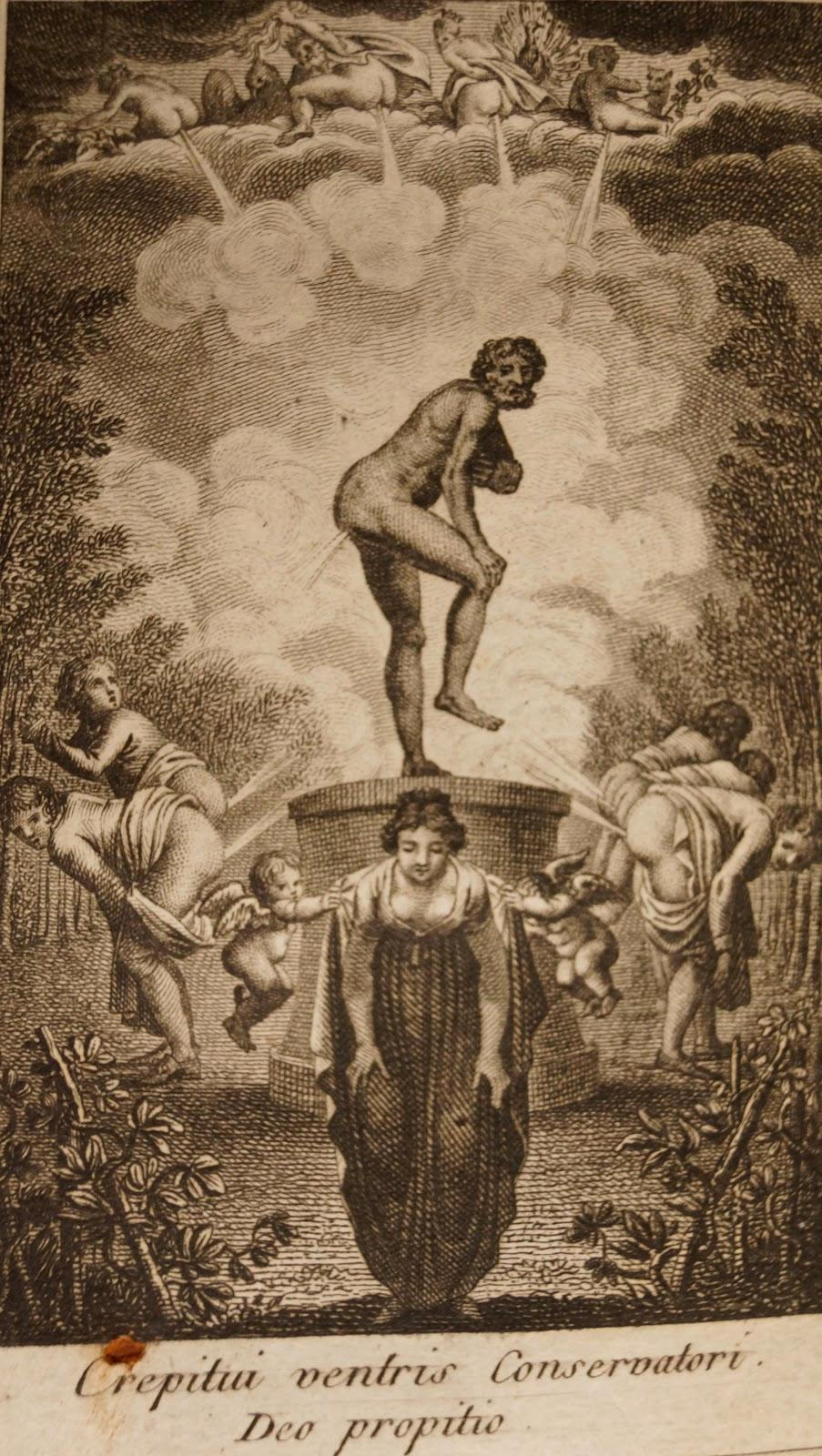
    Of course, the text of Aristophanes is widely quoted in the work of Claude  FX Mercier, Eloge du pet:  dissertation historique, anatomique et philosophique sur son origine, son antiquité, ses vertus, sa figure, les honneurs qu'on lui a rendus chez les peuples anciens et les faceties, auxquelles il a donné lieu (Paris: Favre, 1799), from , which I take this illustration:

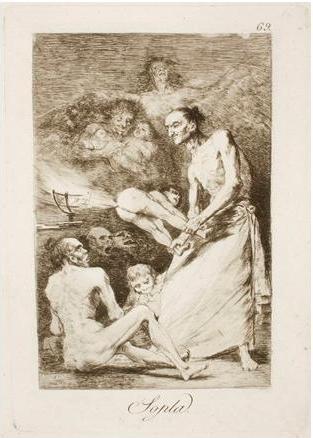
    Such as "scatological"  themes were recurrent on Aristophanes himself and on many other ancient authors. It seems as if the grown man should cost  break this stage so characteristic of child development in which the child discovers and seems to delight in these "scatological" issues and that Sigmund Freud placed  between two and four years old. The issue deserves a more extensive and well documented article, which I will write at time. Meanwhile I will state  once more "Nihil novum sub sole" with this picture, named "Sopla", "blow", of Spanish painter Francisco de Goya:

  • “Ubi bene, ibi patria”. Where it is well with me, there is my country.

    They are numerous classic texts in which the patriotism of citizens is exalted, both in Greece, where they felt very superior to the rest of the world, which they call “barbaric” because they do not speak Greek but babble, as in Rome, where they also knew themselves as the dominators of the world.

    They are numerous maxims, sentences, phrases that condense in a few words that patriotism or that exalt the heroic services of exemplary citizens.

    I will quote and comment on some of these maxims exalting patriotism.

    Cicero, in the first of his famous Catilinariae, speeches against Catiline, who had tried to give a coup and to cause a revolution (a plot), pronounces  the sentence in which the homeland  is presented as a mother, topical and everlasting commonplace playing with the deepest feelings of men who are always children of one mother.

    The homeland is the common parent of all of us

    Patria est communis ómnium parens

    But it should  better read the whole paragraph that contextualizes the sentence, with which Cicero invites Catiline to abandon the city, which would be an admission of guilt on their part of the attempt to subvert the republican order and threatening his own mother.

    Cicero: Catiline Orations,1,7,17:

    If your parents feared and hated you, and if you could by no means pacify them, you would, I think, depart somewhere out of their sight. Now, your country, which is the common parent of all of us, hates and fears you, and has no other opinion of you, than that you are meditating parricide in her case; and will you neither feel awe of her authority, nor deference for her judgment, nor fear of her power?

    And she, O Catiline, thus pleads with you, and after a manner silently speaks to you:… (Translated by C. D. Yonge, B. A. London. Henry G. Bohn, York Street, Covent Garden. 1856.)

    si te parentes timerent atque odissent tui neque eos ratione ulla placare posses, ut opinor, ab eorum oculis aliquo concederes. nunc te patria, quae communis est parens omnium nostrum, odit ac metuit et iam diu nihil te iudicat nisi de parricidio suo cogitare: huius tu neque auctoritatem verebere nec iudicium sequere nec vim pertimesces? [18] quae tecum, Catilina, sic agit et quodam modo tacita loquitur:…

    It continues the text of Cicero in what the homeland personified as a concerned mother, talks to his cruel son Catiline. I invite you to read this famous speech that begins with the words a thousand times quoted and with tem  many students perceived at  first the force of oratory:

    When, O Catiline, do you mean to cease abusing our patience?

    Quo usque tándem abutere, Catilina, patientia nostra?

    In another work Cicero himself presents the love of the fatherland as the conjunction of all loves that a good citizen has:

    Parents are dear; dear are children, relatives, friends; but one native land embraces all our loves

    Cari sunt parentes, cari liberi, pripinqui, familiares; sed omnes ómnium caritates patria una complexa est.  Cicerón,  De officiis, 1,17,57( On Duties or On Obligations )

    So the fatherland  should be above everything, even the children, as Seneca says in his tragedy The Trojan Women, 332:

    A king must precede the homeland to their children

    Praeferre Patriam liberis regem decet:

    You should also read the text of Cicero, now of some length, because it sufficiently illustrates us the concept of "homeland" of a nationalist Roman:

    De officiis, 1,17 (53-58)

    Then, too, there are a great many degrees of closeness or remoteness in human society. To proceed beyond the universal bond of our common humanity, there is the closer one of belonging to the same people, tribe, and tongue, by which men are very closely bound together; it is a still closer relation to be citizens of the same city-state; for fellow-citizens have much in common—forum, temples, colonnades, streets, statutes laws. Courts, rights of suffrage, to say nothing of social and friendly circles and diverse business relations with many.

    But a sill closer social union exists between kindred.  Starting with that infinite bond of union of the human race in general, the conception is now confined to a small and narrow circle.

    For since the reproductive instinct is by Nature's gift the common possession of all living creatures, the first bond of union is that between husband and wife; the next, that between parents and children; then we find one home, with everything in common. And this is the foundation of civil government, the nursery, as it were, of the state. Then follow the bonds between brothers and sisters, and next those of first and then of second cousins; and when they can no longer be sheltered under one roof, they go out into other homes, as into colonies. Then follow between these, in turn, marriages and connections by marriage, and from these again a new stock of relations; and from this propagation and after-growth states have their beginnings. The bonds of common blood hold men fast through good-will and affection; for it means much to share in common the same family traditions, the same forms of domestic worship, and the same ancestral tombs.

    But of all the bonds of fellowship, there is none1 more noble, none more powerful than when good men of congenial character are joined in intimate friendship; for really, if we discover in another that moral goodness on which I dwell so much, it attracts us and makes us friends to the one in whose character it seems to dwell.

    And while every virtue attracts us and makes us love those who seem to possess it, still justice and generosity do so most of all. Nothing, moreover, is more conducive to love and intimacy than compatibility of character in good men; for when two people have the same ideals and the same tastes, it is a natural consequence that each loves the other as himself; and the result is, as Pythagoras requires of ideal friendship, that several are united in one.
    Another strong bond of fellowship is effected by mutual interchange of kind services; and as long as these kindnesses are mutual and acceptable, those between whom they are interchanged are united by the ties of an enduring intimacy.

    But when with a rational spirit you have surveyed1 the whole field, there is no social relation among them all more close, none more dear than that which links each one of us with our country. Parents [p. 61] are dear; dear are children, relatives, friends; but one native land embraces all our loves; and who that is true would hesitate to give his life for her, if by his death he could render her a service? So much the more execrable are those monsters who have torn their fatherland to pieces with every form of outrage and who are2 and have been3 engaged in compassing her utter destruction.

    Now, if a contrast and comparison were to be made to find out where most of our moral obligation is due, country would come first, and parents; for their services have laid us under the heaviest obligation; next come children and the whole family, who look to us alone for support and can have no other protection; finally, our kinsmen, with whom we live on good terms and with whom, for the most part, our lot is one.

    All needful material assistance is, therefore, due first of all to those whom I have named; but intimate relationship of life and living, counsel, conversation, encouragement, comfort, and sometimes even reproof flourish best in friendships. And that friendship is sweetest which is cemented by congeniality of character. (An English Translation  by Walter Miller. Cambridge. Harvard University Press; Cambridge, Mass., London, England. 1913).

    [53] 17. Gradus autem plures sunt societatis hominum. Ut enim ab illa infinita discedatur, propior est eiusdem gentis, nationis, linguae, qua maxime homines coniunguntur; interius etiam est eiusdem esse civitatis; multa enim sunt civibus inter se communia, forum, fana, porticus, viae, leges, iura: iudicia, suffragia, consuetudines praeterea et familiaritates multisque cum multis res rationesque contractae.
    Artior vero colligatio est societatis propinquorum; ab illa enim immensa societate humani generis in exiguum angustumque concluditur.
    [54] Nam cum sit hoc natura commune animantium, ut habeant libidinem procreandi, prima societas in ipso coniugio est, proxima in liberis, deinde una domus, communia omnia; id autem est principium urbis et quasi seminarium rei publicae. Sequuntur fratrum coniunctiones, post consobrinorum sobrinorumque, qui cum una domo iam capi non possint, in alias domos tamquam in colonias exeunt. Sequuntur conubia et affinitates, ex quibus etiam plures propinqui; quae propagatio et suboles origo est rerum publicarum. Sanguinis autem coniunctio et benivolentia devincit homines et caritate;
    [55] magnum est enim eadem habere monumenta maiorum, eisdem uti sacris, sepulcra habere communia.
    Sed omnium societatum nulla praestantior est, nulla firmior, quam cum viri boni moribus similes sunt familiaritate coniuncti; illud enim honestum quod saepe dicimus, etiam si in alio cernimus, tamen nos movet atque illi, in quo id inesse videtur, amicos facit.
    [56] Et quamquam omnis virtus nos ad se allicit facitque, ut eos diligamus, in quibus ipsa inesse videatur, tamen iustitia et liberalitas id maxime efficit. Nihil autem est amabilius nec copulatius quam morum similitudo bonorum; in quibus enim eadem studia sunt, eaedem voluntates, in iis fit ut aeque quisque altero delectetur ac se ipso, efficiturque id, quod Pythagoras vult in amicitia, ut unus fiat ex pluribus.
    Magna etiam illa communitas est, quae conficitur ex beneficiis ultro et citro datis acceptis, quae et mutua et grata dum sunt, inter quos ea sunt, firma devinciuntur societate.
    [57] Sed cum omnia ratione animoque lustraris, omnium societatum nulla est gravior, nulla carior quam ea, quae cum re publica est uni cuique nostrum. Cari sunt parentes, cari liberi, propinqui, familiars, sed omnes omnium caritates patria una complexa est, pro qua quis bonus dubitet mortem oppetere, si ei sit profuturus? Quo est detestabilior istorum immanitas, qui lacerarunt omni scelere patriam et in ea funditus delenda occupati et sunt et fuerunt.
    [58] Sed si contentio quaedam et comparatio fiat, quibus plurimum tribuendum sit officii, principes sint patria et parentes, quorum beneficiis maximis obligati sumus,proximi liberi totaque domus, quae spectat in nos solos neque aliud ullum potest habere perfugium, deinceps bene convenientes propinqui, quibuscum communis etiam fortuna plerumque est.
    Quam ob rem necessaria praesidia vitae debentur iis maxime, quos ante dixi, vita autem victusque communis, consilia, sermones, cohortationes, consolationes, interdum etiam obiurgationes in amicitiis vigent maxime, estque ea iucundissima amicitia, quam similitudo morum coniugavit.

    All the above text is synthesized by Cicero himself in two words that express two feelings that usually turn all nationalisms in his De natura deorum 3.40, (94):

    For God and country" or literally "for our altars and our hearths” or more idiomatically   "for hearth and home;"

    Pro aris et focis.

    The whole paragraph says:

    So saying, Cotta ended. But Lucihus said :

    " You have indeed made a slashing attack upon the most reverently and wisely constructed Stoic doctrine of the divine providence. But as evening is now approaching, you will assign us a day on which to make our answer to your views. For I have to fight against you on behalf of our altars and hearths, of the temples and shrines of the gods, and of the city-walls, which you as pontiffs declare to be sacred and are more careful to hedge the city round with religious ceremonies than even with fortifications ; and my conscience forbids me to abandon their cause so long as I yet can breathe." (Translated by H. Rackman. Loeb Classical Library)

    Quae cum dixisset, Cotta finem. Lucilius autem “Vehementius” inquit “Cotta tu quidem invectus es in eam Stoicorum rationem quae de providentia deorum ab illis sanctissume et prudentissume constituta est. sed quoniam advesperascit, dabis nobis diem aliquem ut contra ista dicamus. est enim mihi tecum pro aris et focis certamen et pro deorum templis atque delubris proque urbis muris, quos vos pontifices sanctos esse dicitis diligentiusque urbem religione quam ipsis moenibus cingitis; quae deseri a me, dum quidem spirare potero, nefas iudico.”

    The previous texts of Cicero are not the result of innovative thinking, but they are the  result of observation and application of basic common sense. This is certainly one of the reasons why the ancient are so near or next to us. Either they have shaped in part our thinking and our identity or the things were and are as they present threm very consistent with the common sense or common feel of men.

    In the read text it appears that this sense of identity is what leads to say "I love my country not because it is big but because it is mine," which explains many of the social and political men behavior, in that it is not reason that is imposed but the sense of identity with the group.

    Seneca  expressed brilliantly this idea. In a context in which he speaks of the value of virtue itself, regardless of the action that consists, he says in Epistles, 66.26:

    Ulysses was in as great haste to reach the rocky barren shore of Ithaca, as Agamemnn was to reach the lofty walls of Mycenae. For, no one loves his country because it is more spacious than another, but because it is his own.  (Translation by Thomas Morell D.D.).

        Vlixes ad Ithacae suae saxa sic properat, quemadmodum Agamemnon ad Mycenarum nobiles muros. Nemo enim patriam quia magna est amat, sed quia sua.

    In the long previous quote Cicero extolled even death for the benefit of the motherland. But undoubtedly the most quoted and known sentence  is that one of the Odes of Horace, 3,2,13:

    "It is sweet and glorious to die for one's country."

    Dulce et decorum est pro patria mori

    Because this Oda, which  sings and extols the virtue, value or condition of the real man, vir, (that's what the word virtue, virtus, means) is not overly long, even at the risk of tiring to some readers less interested, I reproduce it fully in Latin and in translation by John Conington

    To suffer hardness with good cheer,
    In sternest school of warfare bred,
    Our youth should learn; let steed and spear
    Make him one day the Parthian's dread;
    Cold skies, keen perils, brace his life.
    Methinks I see from rampired town
    Some battling tyrant's matron wife,
    Some maiden, look in terror down,—
    “Ah, my dear lord, untrain'd in war!
    O tempt not the infuriate mood
    Of that fell lion I see! from far
    He plunges through a tide of blood!“
    What joy, for fatherland to die!
    Death's darts e'en flying feet o'ertake,
    Nor spare a recreant chivalry,
    A back that cowers, or loins that quake.
    True Virtue never knows defeat:
    Her robes she keeps unsullied still,
    Nor takes, nor quits, her curule seat
    To please a people's veering will.
    True Virtue opens heaven to worth:
    She makes the way she does not find:
    The vulgar crowd, the humid earth,
    Her soaring pinion leaves behind.
    Seal'd lips have blessings sure to come:
    Who drags Eleusis' rite today,
    That man shall never share my home,
    Or join my voyage: roofs give way
    And boats are wreck'd: true men and thieves
    Neglected Justice oft confounds:
    Though Vengeance halt, she seldom leaves
    The wretch whose flying steps she hounds.

    (Translation by John Conington, 1882)

    Angustam amice pauperiem pati
    robustus acri militia puer
    condiscat et Parthos ferocis
    vexet eques metuendus hasta
    vitamque sub divo et trepidis agat
    in rebus. illum ex moenibus hosticis
    matrona bellantis tyranni
    prospiciens et adulta virgo
    suspiret “eheu, ne rudis agminum
    sponsus lacessat regius asperum
    tactu leonem, quem cruenta
    per medias rapit ira caedes.”
    dulce et decorum est pro patria mori:
    mors et fugacem persequitur virum
    nec parcit inbellis iuventae
    poplitibus timidoque tergo.
    Virtus, repulsae nescia sordidae,
    intaminatis fulget honoribus
    nec sumit aut ponit securis
    arbitrio popularis aurae.
    Virtus, recludens inmeritis mori
    caelum, negata temptat iter via
    coetusque volgaris et udam
    spernit humum fugiente penna.
    est et fideli tuta silentio
    merces: vetabo, qui Cereris sacrum
    volgarit arcanae, sub isdem
    sit trabibus fragilemque mecum
    solvat phaselon; saepe Diespiter
    neglectus incesto addidit integrum,
    raro antecedentem scelestum
    deseruit pede Poena claudo.

    Cicero himself again, in one of the Philippicae, speeches he gave against the triumvirate Antony and he called "Philippics" in a clear attempt to  comparison with Demosthenes delivered speeches against Philip of Macedon, father of Alexander, who seized Greece.

    (Note:  these speeches cost very expensive Cicero, but that is a matter for another time).

    Well,  in his invectives, Philippics, 14,11, 31 Cicero says:

    Oh happy death, which, due to nature, has been paid in the cause of one's country!

    O forunata mors, quae natura debita, pro patria est potissimum reddita!

    The debt to nature, which gives us life, is naturally death, debt until today nobody has defaulted.
    I also offer a comprehensive text, which helps us to understand perhaps the warrior and patriotic mystique of this speech been in the Senate on April 21 of the year 43 BC, in which Cicero opposes lifting the "state of emergency" and claims honors for general and legionaries fighting against Marcus Antonius, enemy of the Republic; the rhetoric of these occasions is still today very similar, as the attentive reader will appreciate:

    Cicero, Philippics, 14,11 (31) et seq.

    And I wish more suggestions could occur to me in the way of doing honor to those men. The two ideas which principally do occur to me, I will at all events not pass over; the one of which has reference to the everlasting glory of those bravest of men; the other may tend to mitigate the sorrow and mourning of their relations.

    I therefore give my vote, O conscript fathers, that the most honorable monument possible be erected to the soldiers of the Martial legion, and to those soldiers also who died fighting by their side. Great and incredible are the services done by this legion to the republic. This was the first legion to tear itself from the piratical band of Antonius; this was the legion which encamped at Alba; this was the legion that went over to Caesar; and it was in imitation of the conduct of this legion that the fourth legion has earned almost equal glory for its virtue. The fourth is victorious without having lost a man; some of the Martial legion fell in the very moment of victory. Oh happy death, which, due to nature, has been paid in the cause of one's country!  But I consider you men born for your country; you whose very name is derived from Mars, so that the same god who begot this city for the advantage of the nations, appears to have begotten you for the advantage of this city. Death in flight is infamous; in victory glorious. In truth, Mars himself seems to select all the bravest men from the battle array. Those impious men whom you slew, shall even in the shades below pay the penalty of their parricidal treason. But you, who have poured forth your latest breath in victory, have earned an abode and place among the pious. A brief life has been allotted to us by nature; but the memory of a well-spent life is imperishable. And if that memory were no longer than this life, who would be so senseless as to strive to attain even the highest praise and glory by the most enormous labors and dangers?

    You then have fared most admirably, being the bravest of soldiers while you lived, and now the most holy of warriors, because it will be impossible for your virtue to be buried, either through the forgetfulness of the men of the present age, or the silence of posterity, since the senate and Roman people will have raised to you an imperishable monument, I may almost say with their own hands. Many armies at various times have been great and illustrious in the Punic, and Gallic, and Italian wars; but to none of them have honors been paid of the description which are now conferred on you. And I wish that we could pay you even greater honors, since we have received from you the greatest possible services. You it was who turned aside the furious. Antonius from this city; you it was who repelled him when endeavoring to return. There shall therefore be a vast monument erected with the most sumptuous work and an inscription engraved upon it as the everlasting witness of your godlike virtue And never shall the most grateful language of all who either see or hear of your monument cease to be heard And in this manner you, in exchange for your mortal condition of life, have attained immortality.  (Translated by C. D. Yonge, 1903)

    11 (31) Quorum de honore utinam mihi plura in mentem venirent! Duo certe non praeteribo, quae maxime occurrunt, quorum alterum pertinet ad virorum fortissimorum gloriam sempiternam, alterum ad leniendum maerorem et luctum proximorum.
    12. placet igitur mihi, patres conscripti, legionis Martiae militibus et eis qui una pugnantes occiderint monumentum fieri quam amplissimum. Magna atque incredibilia sunt in rem publicam huius merita legionis. haec se prima latrocinio abrupit Antoni; haec tenuit Albam; haec se ad Caesarem contulit; hanc imitata quarta legio parem virtutis gloriam consecuta est. quarta victrix desiderat neminem: ex Martia non nulli in ipsa victoria conciderunt. O fortunata mors quae naturae debita pro patria est potissimum reddita! [32] vos vero patriae natos iudico; quorum etiam nomen a Marte est, ut idem deus urbem hanc gentibus, vos huic urbi genuisse videatur. in fuga foeda mors est; in victoria gloriosa. etenim Mars ipse ex acie fortissimum quemque pignerari solet. illi igitur impii quos occidistis etiam ad inferos poenas parricidi luent; vos vero qui extremum spiritum in victoria effudistis piorum estis sedem et locum consecuti. brevis a natura vita nobis data est; at memoria bene redditae vitae sempiterna. quae si non esset longior quam haec vita, quis esset tam amens qui maximis laboribus et periculis ad summam laudem gloriamque contenderet? actum igitur praeclare vobiscum, [33] fortissimi, dum vixistis, nunc vero etiam sanctissimi milites, quod vestra virtus neque oblivione eorum qui nunc sunt nec reticentia posterorum sepulta esse poterit, cum vobis immortale monumentum suis paene manibus senatus populusque Romanus exstruxerit. multi saepe exercitus Punicis, Gallicis, Italicis bellis clari et magni fuerunt, nec tamen ullis tale genus honoris tributum est. atque utinam maiora possemus, quando quidem a vobis maxima accepimus! vos ab urbe furentem Antonium avertistis; vos redire molientem reppulistis. erit igitur exstructa moles opere magnifico incisaeque litterae, divinae virtutis testes sempiternae, numquamque de vobis eorum qui aut videbunt vestrum monumentum aut audient gratissimus sermo conticescet. ita pro mortali condicione vitae immortalitatem estis consecuti.

    Undoubtedly one of the best known texts of patriotism until to give the  life for the homeland  is the famous epitaph of the Spartans at Thermopylae, who held the powerful Persian army  while they lived . The  film “300”, directed in 2007 by Zack Snyder, adaptation of the comic of the same name by Frank Miller and Lynn Varley, has undoubtedly contributed to raising awareness the feat of Leonidas and his fellows among a varied public.

    Cicero cites the famous epitaph in his Tusculans, 1,42,101:

    " At Sparta, stranger, tell that here we lie
    in loyal service to our fatherland."

    Dic, hospes, Spartae, nos te hic vidisse iacentes/
    dum sanctis patriae legibus obequimur.

    Cicero praises those who face death with fortitude. In this context he recalls the action of Leonidas and the Spartans, with two terse sentences, which today are repeated, one  at the  epitaph, another one that of the struggle in the shadow of Persian darts:

    Tusculan, 1,42,101:

    But why name commanders and those in high station, when Cato^ writes that whole legions have often gone with alacrity to places whence they had no expectation of returning ? "With like greatness of soul the Lacedaemonians fell at Thermopylae, on whom Simonides wrote :

    " At Sparta, stranger, tell that here we lie
    In loyal service to our fatherland."

    What does their leader Leonidas say ? " Go on,Lacedaemonians, with a brave soul. To-day, perchance, we shall sup in the underworld."

    This was a brave race, while the laws of Lycurgus were in full force. One of them, when a Persian enemy in a boastful strain said, " Our darts and arrows will be so thick that you cannot see the sun," replied, " We shall fight all the better in the shade." (Translated by Andrew P. Peabody)

    sed quid duces et principes nominem, cum legiones scribat Cato saepe alacris in eum locum profectas, unde redituras se non arbitrarentur? pari animo Lacedaemonii in Thermopylis occiderunt, in quos Simonides:
    Dic, hospes, Spartae nos te hic vidisse iacentis,
    Dum sanctis patriae legibus obsequimur.
    quid ille dux Leonidas dicit? “pergite animo forti, Lacedaemonii, hodie apud inferos fortasse cenabimus.” fuit haec gens fortis, dum Lycurgi leges vigebant.  e quibus unus, cum Perses hostis in conloquio dixisset glorians: “solem prae iaculorum multitudine et sagittarum non videbitis”, “in umbra igitur” inquit “pugnabimus.”

    That, according to Cicero, Cato says, reminds me of those documentaries about the last two world wars in which we see marching to the war battalions of unhappy young with a smile that we not know if unconscious or forced. So I imagine the Roman legions; after all the war it has not changed much beyond the destructive capacity of weapons.

    But already in antiquity, as we do today, very people asked what is the homeland ?. The word obviously derives from Latin "pater, -tris" father; therefore it means "fatherland" and according to the Academy designates the native or adopted country to which the human being by legal, historical and emotional ties feels bound. The fatherland is thus the place or country where man was born and by extension the land which adopts you.

    Well, many old men had to leave the area where they were born for several reasons. The Mediterranean was a space or open sea in which ships and citizens of many cities move. Some settled in distant places; for example traders, soldiers who "served the country" away from his people, adventurers or forced citizens by the need to look for where and how best life, convicted or forced into exile citizens … It is the same reality that has not stopped exist to this day, in which the movement and displacement of people is constant.

    Well, these people questioned the concept of homeland, which in its original sense condemned them to be "stateless". At the same time, in the context of world open to all kinds of travelers, some thinkers became aware of the radical equality of all men. Two famous examples are Diogenes the Cynic and Socrates.

    Diogenes Laertius tells us in Lives and Opinions of Eminent Philosophers, Book VI, 38, on the other Diogenes, of Sinope, the Cynic:

    All the curses of tragedy, he used to say, had lighted upon him. At all events he was

    A homeless exile, to his country dead. A wanderer who begs his daily bread
    (translated by Robert Drew Hicks)

    The word used is ἄπολις, a-polis, as homeless.

    Diogenes certainly feel himself uprooted from the circumstances which  give particular identity to the men, no city, no home, away from home …; so it's no wonder the answer given to the frequently asked question: where are you from?

    And so, in Book VI, 63:

    Asked where he came from, he said, "I am a citizen of the world”

    ἐρωτηθεὶς πόθεν εἴη, "κοσμοπολίτης," ἔφη
    (erotezeís pózen eie, “kosmopolítes” éfe)

    If this answer is authentic,  the famous term "cosmopolitan" was originated with Diogenes.

    In a quote from Cicero that I offer below, also the Socrates, when asked which country was he from, he replied that he was "inhabitant of the world", "mundanum incolam".

    But perhaps the best known and quoted phrase is that of Terence in his comedy Heautontimorumenos: Actus I, Escaena I, v. 77:

    I am a man, and nothing that concerns a man do I deem a matter of indifference to me

    Homo sum, humani nihil a me alienum puto

    that is often used to express the feeling of solidarity.

    The Greek name Heautontimorumenos means “who torments himself” and refers to the feeling of a father who regret having been too severe with his son. This is a typical comedy with multiple entanglements complicated plot in which everything just right in the end, as is mandatory in this type of comedy.

    I give a longer appointment to contextualize and see how little does the elementary and humorous meaning given by Terence with the transcendent meaning that is loaded later. It is cited as an expression of the "Humanitas" of Terence

    I quote verses 75-86 (23-34)

    (Cremes worries about excessive work which Menedemus makes  in his field) …

    MENEDEMUS
    Have you so much leisure, Chremes, from your own affairs, that you can attend to those of others-those which don't concern you?
    CHREMES
    I am a man, and nothing that concerns a man do I deem a matter of indifference to me. Suppose that I wish either to advise you in this matter, or to be informed myself: if what you do is right, that I may do the same; if it is not, then that I may dissuade you.
    MENEDEMUS
    It's requisite for me to do so; do you as it is necessary for you to do.
    CHREMES
    Is it requisite for any person to torment himself?
    MENEDEMUS
    It is for me.
    CHREMES
    If you have any affliction, I could wish it otherwise. But prithee, what sorrow is this of yours? How have you deserved so ill of yourself?
    MENEDEMUS
    Alas! alas! He begins to weep.
    CHREMES
    Do not weep, but make me acquainted with it, whatever it is. Do not be reserved; fear nothing; trust me, I tell you. Either by consolation, or by counsel, or by any means, I will aid you.

    (Translatio  by Henry Thomas Riley, 1874)

    Menaedemus.
    Chreme, tantumne est ab re tua oti tibi
    Aliena ut cures, eaque nihil quae ad te attinent?

    Chremes.
    Homo sum: humani nihil a me alienum puto.
    Vel me monere hoc, vel percontari puta.
    Rectum est? ego ut faciam: non est? te ut deterream.

    Menaedemus.
    Mihi sic est usus: tibi ut opus facto est, face.

    Chremes.
    An cuiquam est usus homini se ut cruciet?

    Menaedemus.
    Mihi.

    Chremes.
    Si quid laboris est, nollem: sed quid istuc mali est,
    Quaeso? quid de te tantum meruisti?

    Menaedemus.
    Eheu!

    Chremes.
    Ne lacrima: atque istuc quicquid est fac me ut sciam:
    Ne retice: ne verere: crede, inquam, mihi,
    Aut consolando, aut consilio, aut re iuvero.

    The verse in question has been cited since antiquity:

    Cicero did so in "On Duties, I, 30" (De Officiis) , I, 30, who says it is very difficult to worry about the problems of others as our own.

    Also Seneca, Epistulae, 95, 53, repeats the verse that he said we have in our hearts and mouths to reinforce his idea that men are solidary   and they are made of the same material.

    St. Augustine, Epistyulae, 155,4,14, who also says that  the theater burst into applause when the actor pronounced it  (ferunt etiam theatra tota, plena stultis indoctisque, aplausisse), but the news does not seem to be historical; otherwise the claim to universality of St. Augustine has nothing to do with the intention of Terence:

    Let us therefore try with all our strength that also they reach him  those we love as ourselves, if we love God and we know to love ourselves. Because Christ, that is, the Truth, says that the whole law and the prophets are condensed into two commandments: Love God with all your heart, with all your soul, with all your mind, and love your neighbor as ourselves.

    Here we understand next or neighbor, not the insider by the ties of blood, but by the community of reason in which we live associated all men. If money associates men, how much more  associates them this reason due to the nature that is common, not by business law, but by the law of birth? The splendor of truth is not hidden to clear minds. So comedian puts into the mouth of an old these words addressed to another  old man:

    Have you so much leisure  from your own affairs, that you can attend to those of others-those which don't concern you?

    And the other old responds:

    I am a man, and nothing that concerns a man do I deem a matter of indifference to me.

    It is said that this phrase was applauded in the theater, although it was crowded with foolish and ignorant men. In such a community of human souls so touches the natural affection of all, than a man, who did not feel close or neighbor of all, could not be found in the theatre.

    4. 14. Ad illum ergo quanta opera possumus, etiam illi ut perveniant agamus, quos tamquam nosmetipsos diligimus, si nosmetipsos diligere, illum diligendo iam novimus. Christus namque, id est Veritas, dicit in his duobus praeceptis totam legem Prophetasque pendere, ut diligamus Deum ex toto corde, ex tota anima, ex tota mente, et diligamus proximos tamquam nosmetipsos . Proximus sane hoc loco, non sanguinis propinquitate, sed rationis societate pensandus est, in qua socii sunt omnes homines. Nam si pecuniae ratio socios facit, quanto magis ratio naturae, non negotiandi, sed nascendi lege communis! Hinc et ille comicus (sicut luculentis ingeniis non defit resplendentia veritatis), cum ab uno sene alteri seni dictum componeret:
    Tantumne ab re tua est otii tibi,
    Aliena ut cures ea, quae nihil ad te attinent?
    responsum ab altero reddidit:
    Homo sum, humani nil a me alienum puto .
    Cui sententiae ferunt etiam theatra tota, plena stultis indoctisque, applausisse. Ita quippe omnium affectum naturaliter attigit societas humanorum animorum, ut nullus ibi hominum nisi cuiuslibet hominis proximum se esse sentiret.

    Varro in one of the few fragments of his Menippean Dolium also wrote in:

    Varro, Saturarum Menippearum reliquiae: Dolium aut seria:

      The world is the great house of the little man

    Mundus domus est maxima homulli …

      while indicating the equality of men in their large home and their small individual entity expressed with "homulli", diminutive for "homo".

    So they were finding more open and relevant answers  to the questions: what is my homeland? Where the country is ?, to reach the very  famous and repeated sentence:

    Where it is well with me, there is my country

    Ubi bene, ibi patria

    It is a saying or Latin sentence, result from abbreviation of verse of tragedy “Teucer”, of Pacuvius, which Cicero quotes in Tusculans, 5,37,108.

    Patria est ubicumque est bene (The motherland is anywhere where it is well) seems like a quotation from a verse of Pacuvius, from its tragedy Teucer, which tells the story of Teucer, son of Telamon and Hesione, sister of Priam, who after the fall of Troy wanted to return to their homeland Salamina, but was rejected by Telamon because he could not prevent the death of his brother Ajax. Looking for a place to settle he came to Cyprus and allied with the king of Sidon.

    Then the phrase is found in many authors like Curtius, Ovid, Aulus Gellius etc.

    Cicero, in this passage of his Tusculans questions refers to happiness of the wise, who disdains the seemingly important things that have little value and needs rather modest things. Disdained the honor, money, he refers to the punishment of exile, common in antiquity. But exile hardly differs from the permanent stay abroad; it differs only in that exile is accompanied by the shame of punishment. Then Cicero quotes Socrates, who answers  as he does frequently with a lapidary sentence and then cites numerous Greeks characters, who went abroad and never returned to their homeland.

    It will be better read directly from Cicero, Tusculanae, V, 37,108:

    In the last place, the case of those who refer the objects which they pursue in life to the standard of pleasure presents no difficulty, since wherever these objects can be supplied, they can live happily. Thus to every case Teucer's words are applicable :

    ' Where it is well with me, there is my country." 

    When Socrates was asked to name his city, he said, " The world ; " for he regarded himself as an inhabitant and citizen of the whole world.

    What shall we say of Titus Albucius ?  Did not he with the utmost equanimity pursue the study of philosophy in Athens ? to whom, nevertheless, this would not have happened, if he had obeyed the precepts of Epicurus and taken no interest in public affairs.

    How much happier was Epicurus for living at home than Metrodorus  who also lived in Athens ? Was Plato happier than Xenocrates, or Polemon than Arcesilas ?  Then again, in what esteem should a city be held, from which good and wise men are driven ? Demaratus indeed, the father of our King Tarquin, because he could not bear the tyrant Cypselus, fled from Corinth to Tarquinii, established himself there, and had children born there. Was he foolish in preferring freedom in exile to slavery at home ? (Translated by Andrew P.Peabody)

    [108] postremo ad omnis casus facillima ratio est eorum qui ad voluptatem ea referunt quae secuntur in vita, ut, quocumque haec loco suppeditetur, ibi beate queant vivere. itaque ad omnem rationem Teucri vox accommodari potest:
    Patria est, ubicumque est bene.
    Socrates quidem cum rogaretur, cuiatem se esse diceret, “mundanum” inquit; totius enim mundi se incolam et civem arbitrabatur. quid? T. Albucius  nonne animo aequissimo Athenis exul philosophabatur? cui tamen illud ipsum non accidisset, si in re p. quiescens Epicuri legibus paruisset.
    [109] qui enim beatior Epicurus, quod in patria vivebat, quam, quod Athenis, Metrodorus? aut Plato Xenocratem vincebat aut Polemo Arcesilam, quo esset beatior? quanti vero ista civitas aestimanda est, ex qua boni sapientesque pelluntur? Damaratus quidem, Tarquinii nostri regis pater, tyrannum Cypselum quod ferre non poterat, fugit Tarquinios Corintho et ibi suas fortunas constituit ac liberos procreavit. num stulte anteposuit exilii libertatem domesticae servituti?

    So according the quote of Cicero in which the origin of the phrase"ubi bene, ibi patria est",  is explained that, gave title to this article, also we found out that the incorruptible Socrates had already been presented himself as an inhabitant, as a world citizen, "mundanum incolam".
    Incidentally, the term "mundanum", which uses Cicero, is the translation of the Greek kosmios, which coincides with the translation of the Greek term kosmos to  the Latin mundum

    I will cite several other Latin expressions and sentences whose meaning is very similar, but now without fit them in broader appointments, which the curious reader can easily complete.

    the whole world is a man’s birthplace (Statius,Thebais,8,320)
    Omne homini natale solum

    to the brave, every land is his homeland, like the sea  to fish.  Ovide, Fasti,I,493)
    Omne solum forti patria est ut piscibus aequor:

    Any land is an exile, but another country  (Séneca, De Remediis Fortunae, 8,1)
    Nulla terra exsilium est, sed altera patria;

    I am not born for one corner; the whole world is my native land. (Seneca, Epistolas 28,4)
    Non sum uni angulo natus, patria mea totus hic mundus est

    here our home, this our country (Virgil,Aeneida, 7,122)
    Hic domus, haec patria est:

    But of course, the vision of the country, limited to the land that is born and lives, also have some problems. Remember the phrase curiously cited by four Christian evangelists Lucas, 4.24; Matthew 13,57, Mark 6.14; John 4.44:

    No one is considered a prophet in his hometown/homeland

    Nemo propheta acceptus est in patria sua.

    Even the country can be very unfair to their children, as it said the epitaph which Scipio Africanus wanted  to be recorded in his grave, according to Valerius Maximus, 5,3,2, who devotes a chapter to the ingratitude.

    ungrateful country, you shall not have even my bones

    Ingrata patria, ne ossa quidem mea habes.

    Valerius Maximus spent to the ingratitude the full Chapter 3 of Book V of his work Memorable Deeds and Sayings; he says about Scipio in V,3.2b:

    When it had not yet off the pain for what happened, there was another reason for regret: because after the African  the Old transformed to master of Carthage  the Roman people weakened and broken by the Punic Wars, a people almost lifeless and dying, the  citizens, for compensate with  injustices this heroic action, relegated him to a filthy village and uninhabited swamp.

    But the African did not go to the grave without tell  the harshness of this voluntary exile, because he ordered on his tomb was written: What ungrateful country, you shall not have even my bones.  Is there anything more worthy than this vicissitude, something fairer  than their complaints, or more moderate than this revenge of yours? It refused to receive his  ashes the land that, precisely because of him, did not have been reduced to ashes.

    This was the only revenge with which Scipio answered the ingratitude of Rome, but his revenge is even more painful,  by Hercules !, than the violent attitude of Coriolanus, who attacked the country with the weapons of terror, whereas Scipio he used only shame, because he refused to express any complaints –how strong and sincere they were his good feelings- while the death did not come.

    Priore adhuc querella uibrante alia deinceps exurgit. Africanus superior non solum contusam et confractam belli Punici armis rem publicam, sed paene iam exsanguem atque morientem Karthaginis dominam reddidit. cuius clarissima opera iniuriis pensando ciues ignobilis eum ac desertae paludis accolam fecerunt. eiusque uoluntarii exilii acerbitatem non tacitus ad inferos tulit, sepulcro suo inscribi iubendo 'ingrata patria, ne ossa quidem mea habes'. quid ista aut necessitate indignius aut querella iustius aut ultione moderatius? cineres ei suos negauit, quam in cinerem conlabi passus non fuerat. igitur hanc unam Scipionis uindictam ingrati animi urbs Romana sensit, maiorem me hercule Coriolani uiolentia: ille enim patriam metu pulsauit, hic uerecundia. de qua [re] ne queri quidem++tanta uerae pietatis constantia++nisi post fata sustinuit.

    In these cases, homeland more than a mother is a stepmother, according to the second meaning of the Dictionary of the Royal Spanish Academy.

    Well, trivializing the transcendent tone of "ubi bene, ibi patria", we bring up the Spanish adage:
    You are not from where you born, but from where you spent you life at

    It is the same demystifying meaning as that of this curious souvenir or decorative plate with the figure of a bear whit this sentence:

    Home is where your honey is

    This I call "trivialization" of the item indicates how primal, quasi physiological,is  the concept of "homeland", although it was a lot of demagoguery with which it is used by interested nationalism.

    I want to end this long article with a reference to the present time.

    The movements of man on the whole earth are as old as man himself. For a thousand different reasons and following perhaps instinct of curiosity, many men have not always been in the place where they were born.

    Today  migrations remain millionaire always looking for a better way of life, bene vivere, and probably never as today men have found so difficult to move from one country to another.

    I will  refer to the professional exile or stay abroad of many scientific and professional and Spanish students forced to do their highly qualified work abroad. It forces me to do my stay for a few days, in this case voluntarily, with one of these exiles, highly qualified professional in Munich, the city founded about eight  hundred years ago by  Benedictine monks where the Bavarian Alps become plain.

    Around here (and elsewhere in Europe, including Greece, Anatolia and northern Italy) they moved from the Iron Age, Celtic or Gaul tribes of Gauls, the "Boii", who gave the name to the "Bavarian" region. Julius Cesar documents his last move from the Danube. They ended subsumed and integrated into other peoples.

    Well, at Munich, like at many other German cities, they have reached hundreds of academically well-trained young Spaniards. The better educated Spanish generation that a neoliberal and conservative minister described as nothing short of "adventurers". How ironic that an unpresentable Minister, precisely of work, she classified this national disgrace and tried to camouflage it as an opportunity for some young people to whom she should offer better future!
    She called this massive outflow of young professional "external mobility" to seek job and training opportunities with a euphemism that produces shame.

    One of these young people is precisely my son and that will not let me be indifferent.

    Naturally, scientists have to move in the global village, but because scientists or personal interests, but not because absolute obligation to find a job commensurate with their homework because there is not at home, in his first country, which formed them.

    Perhaps the reflection of the old men helps them   to better withstand the distance: ubi bene, ibi patria.

    Perhaps also it helps them to know the attitude of scholars and intellectuals of Humanism and of the Renaissance, as Ghiberti says in Secondo comment, chap. XV (Vasari, ed.Lemonier I,pagXXIX):

    Only someone who has learned everything is not strange  in any part; although he is deprived of his fortune, even if he is  without friends, in any city where he lives  and can wait without fear the vicissitudes of fate, he will always be a citizen. "

    And Codro Urceo, exiled, in his Vita above his Opera:

    Wherever the wise established its headquarters, there he will find his homeland.

    It was that a time of curiosity and intellectual refinement, in which new worlds and new horizons were discovered. This is now a time of many failures and disappointments in which everything, absolutely everything, is reduced to the economic benefit of the minority.
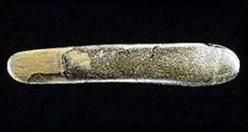
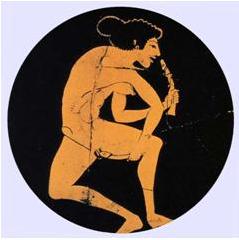
  • Men, women, androgynous

    At this time around the summer solstice, when the days are longer and the nights shorter, they proliferate celebrations and demonstrations of the “gay pride” in which homosexuals, gays, lesbians and transsexuals exhibit the rainbow flag and say the right to have a different sexuality to heterosexual, which until recently was the only canonized and defended by the laws and customs, while others were condemned and persecuted.

    Note: homosexual is a word compound of the Greek ὅμοιος, homoyos,  meaning "same" and the Latin sexualis of sexus, sex. Therefore it refers to the love between people of same  sex. It has nothing to do with its origin with  the Latin word "homo" meaning man. Love between persons of the male gender is often called, specifically "gay", English term which in principle means "happy"; the love between women is called "Sapphic" or "lesbian" from de poetess Sapho of Lesbos (Greek insel). These terms seem began to be used in the eighteenth century in the Illustrated France. Transgender refers to those who have "transformed" its initial or apparent sex to one  with  they really identify.

    Well, how many lessons can be drawn from the ancient Greeks and Romans. Who have some age, we have looked impotent the unbridled persecution of those who did not follow the dominant sexual behavior imposed by religion and social norms, but they acted only as their nature required them.

    We have also seen in recent years  an attitude of society and rules more open, just accepting   what nature has created. This attitude, which is taking shape in rules and laws of social behavior, unfortunately has not been generalized  or in all countries, (they are many which with incomprehensible hardness pursue the homosexual behavior), or all people who because  religious reasons or by cultural inertia manifest an unacceptable rejection that produces only pain and suffering to very many people.

    Maybe you can help us to keep an absolutely open attitude to know  the normality with which the ancients accept what nature engenders.

    It is very known  the presence and importance that  homosexual love, especially the male, has  in ancient Greece. At another time I'll try about it and about the called "paederastia", which has nothing to do with "corruption or sex with minors", then forbidden and harshly persecuted today and punished by the law justly.

    Today I will quote a myth that Plato creates or recreates  in his dialogue “The Symposium”, subtitled “On  love", in which he analyzes what is love ?,; it actually refers almost exclusively to homosexual love.

    Plato uses, as in the past, a myth to explain the existing reality: there are men looking for men, women to other women and men who are seeking complemented by beings of the opposite sex. If things are like this, just we have to find some explanation:

    Plato: Symposium, 188c y ss.

    I will try to describe his power to you, and you shall teach the rest of the world what I am teaching you. In the first place, let me treat of the nature of man and what has happened to it; for the original human nature was not like the present, but different. The sexes were not two as they are now, but originally three in number; there was man, woman, and the union of the two, having a name corresponding to this double nature, which had once a real existence, but is now lost, and the word "Androgynous" is only preserved as a term of reproach. In the second place, the primeval man was round, his back and sides forming a circle; and he had four hands and four feet, one head with two faces, looking opposite ways, set on a round neck and precisely alike; also four ears, two privy members, and the remainder to correspond. He could walk upright as men now do, backwards or forwards as he pleased, and he could also roll over and over at a great pace, turning on his four hands and four feet, eight in all, like tumblers going over and over with their legs in the air; this was when he wanted to run fast. Now the sexes were three, and such as I have described them; because the sun, moon, and earth are three;-and the man was originally the child of the sun, the woman of the earth, and the man-woman of the moon, which is made up of sun and earth, and they were all round and moved round and round: like their parents. Terrible was their might and strength, and the thoughts of their hearts were great, and they made an attack upon the gods; of them is told the tale of Otys and Ephialtes who, as Homer says, dared to scale heaven, and would have laid hands upon the gods. Doubt reigned in the celestial councils. Should they kill them and annihilate the race with thunderbolts, as they had done the giants, then there would be an end of the sacrifices and worship which men offered to them; but, on the other hand, the gods could not suffer their insolence to be unrestrained.

    At last, after a good deal of reflection, Zeus discovered a way. He said: "Methinks I have a plan which will humble their pride and improve their manners; men shall continue to exist, but I will cut them in two and then they will be diminished in strength and increased in numbers; this will have the advantage of making them more profitable to us. They shall walk upright on two legs, and if they continue insolent and will not be quiet, I will split them again and they shall hop about on a single leg." He spoke and cut men in two, like a sorb-apple which is halved for pickling, or as you might divide an egg with a hair; and as he cut them one after another, he bade Apollo give the face and the half of the neck a turn in order that the man might contemplate the section of himself: he would thus learn a lesson of humility. Apollo was also bidden to heal their wounds and compose their forms. So he gave a turn to the face and pulled the skin from the sides all over that which in our language is called the belly, like the purses which draw in, and he made one mouth at the centre, which he fastened in a knot (the same which is called the navel); he also moulded the breast and took out most of the wrinkles, much as a shoemaker might smooth leather upon a last; he left a few, however, in the region of the belly and navel, as a memorial of the primeval state. After the division the two parts of man, each desiring his other half, came together, and throwing their arms about one another, entwined in mutual embraces, longing to grow into one, they were on the point of dying from hunger and self-neglect, because they did not like to do anything apart; and when one of the halves died and the other survived, the survivor sought another mate, man or woman as we call them, being the sections of entire men or women, and clung to that. They were being destroyed, when Zeus in pity of them invented a new plan: he turned the parts of generation round to the front, for this had not been always their position and they sowed the seed no longer as hitherto like grasshoppers in the ground, but in one another; and after the transposition the male generated in the female in order that by the mutual embraces of man and woman they might breed, and the race might continue; or if man came to man they might be satisfied, and rest, and go their ways to the business of life: so ancient is the desire of one another which is implanted in us, reuniting our original nature, making one of two, and healing the state of man.

    Each of us when separated, having one side only, like a flat fish, is but the indenture of a man, and he is always looking for his other half. Men who are a section of that double nature which was once called Androgynous are lovers of women; adulterers are generally of this breed, and also adulterous women who lust after men: the women who are a section of the woman do not care for men, but have female attachments; the female companions are of this sort. But they who are a section of the male follow the male, and while they are young, being slices of the original man, they hang about men and embrace them, and they are themselves the best of boys and youths, because they have the most manly nature. Some indeed assert that they are shameless, but this is not true; for they do not act thus from any want of shame, but because they are valiant and manly, and have a manly countenance, and they embrace that which is like them. And these when they grow up become our statesmen, and these only, which is a great proof of the truth of what I am saving. When they reach manhood they are loves of youth, and are not naturally inclined to marry or beget children,-if at all, they do so only in obedience to the law; but they are satisfied if they may be allowed to live with one another unwedded; and such a nature is prone to love and ready to return love, always embracing that which is akin to him. And when one of them meets with his other half, the actual half of himself, whether he be a lover of youth or a lover of another sort, the pair are lost in an amazement of love and friendship and intimacy, and would not be out of the other's sight, as I may say, even for a moment: these are the people who pass their whole lives together; yet they could not explain what they desire of one another. For the intense yearning which each of them has towards the other does not appear to be the desire of lover's intercourse, but of something else which the soul of either evidently desires and cannot tell, and of which she has only a dark and doubtful presentiment. Suppose Hephaestus, with his instruments, to come to the pair who are lying side, by side and to say to them, "What do you people want of one another?" they would be unable to explain. And suppose further, that when he saw their perplexity he said: "Do you desire to be wholly one; always day and night to be in one another's company? for if this is what you desire, I am ready to melt you into one and let you grow together, so that being two you shall become one, and while you live a common life as if you were a single man, and after your death in the world below still be one departed soul instead of two-I ask whether this is what you lovingly desire, and whether you are satisfied to attain this?"-there is not a man of them who when he heard the proposal would deny or would not acknowledge that this meeting and melting into one another, this becoming one instead of two, was the very expression of his ancient need. And the reason is that human nature was originally one and we were a whole, and the desire and pursuit of the whole is called love. There was a time, I say, when we were one, but now because of the wickedness of mankind God has dispersed us, as the Arcadians were dispersed into villages by the Lacedaemonians. And if we are not obedient to the gods, there is a danger that we shall be split up again and go about in basso-relievo, like the profile figures having only half a nose which are sculptured on monuments, and that we shall be like tallies.

    Wherefore let us exhort all men to piety, that we may avoid evil, and obtain the good, of which Love is to us the lord and minister; and let no one oppose him-he is the enemy of the gods who oppose him. For if we are friends of the God and at peace with him we shall find our own true loves, which rarely happens in this world at present. I am serious, and therefore I must beg Eryximachus not to make fun or to find any allusion in what I am saying to Pausanias and Agathon, who, as I suspect, are both of the manly nature, and belong to the class which I have been describing. But my words have a wider application-they include men and women everywhere; and I believe that if our loves were perfectly accomplished, and each one returning to his primeval nature had his original true love, then our race would be happy. And if this would be best of all, the best in the next degree and under present circumstances must be the nearest approach to such an union; and that will be the attainment of a congenial love. Wherefore, if we would praise him who has given to us the benefit, we must praise the god Love, who is our greatest benefactor, both leading us in this life back to our own nature, and giving us high hopes for the future, for he promises that if we are pious, he will restore us to our original state, and heal us and make us happy and blessed. This, Eryximachus, is my discourse of love, which, although different to yours, I must beg you to leave unassailed by the shafts of your ridicule, in order that each may have his turn; each, or rather either, for Agathon and Socrates are the only ones left. (Translated by Benjamin Jowett)

    Note:
    1. androgynous is a word composed  from two Greek words andros (man) and gyné (woman) ; from it they are  derived another one, such "gynecology", which  according to the dictionary is the part of medicine that deals with the diseases of women.

    2. Parmenides considered the Sun as the male element of the universe, the Moon as the feminine and the Earth as the result of the union of both.

  • Very cruel pupils

    The Christian poet Prudentius wrote a series of singing hymns in the death of many Christian martyrs. He called his work “Peristephanon” or “Crowns of Martyrdom”. Prudentius, connoisseur of classical Latin literature and rhetoric, attempts to integrate the pagan tradition with Christian ideas.

    In the poem number XI Prudentius sings the martyrdom of Hippolytus, who suffered a death similar to mythical Hippolytus,  torn to pieces by horses. Prudentius tells us further that on his poem he is describing the paint on the tomb of Hippolytus that represents his death. It is an example of ekphrasis or description in words, verbally, of a visual work, in this case, a paint.. See https://www.antiquitatem.com/en/hyppolitus-phaedra-martyr-prudentius .

    Well, in the poem number IX also Prudentius tells the death of another martyr, Cassian of Imola,  inspired no doubt on other torture of the mythical-legendary Roman times, the death of the teacher  of Falerias at the hands of his pupils.

    Cassian is a school teacher, specialized in shorthand, martyr suffering a painful death at the hands of his disciples also, punished by refusing to worship pagan gods. The horror of the description of execution binds the distaste they are just the young and tender students who pay in this way  the cares of the teacher.

    And as in the case of Hippolytus, also he tells us now he describes the painting in the tomb which represents the death of the martyr, which incidentally also happened on August 13, as Hippolytus. It is therefore another example of ekphrasis.

    The description of the painting is no less gruesome and baroque in this case than the poem XI on Hippolytus, certainly responding to the literary model of the time and the desire to move a devoted audience but easily impressionalbe by the detailed and prolonged suffering, that here it is imposed on the glorious death of every martyr because of their beliefs. Interestingly, Prudentius entertains in detail, we would say morbid, in describing the torment, but he does not say the attitude and how Cassianus suffer, about  sensations he tells us nothing.

    I offer below the full text of the poem IX of Prudentius.

    Saint Cassian therefore endures  a fanciful penalty, but curiously related to a pagan literary tradition. The Roman historian Livy describes in his Ab urbe condita (History since the founding of the city -Roma-) a mythical legendary episode in which Prudentius certainly is inspired to recreate the Martyrdom of Cassian.

    Livy tells us in 5, 27, how a schoolteacher of Falisci children, simulating go to the field outside the walls, took them to the Romans, with whom they fought, offering them as a tool for achieving the surrender of the Falisci; the Romans of that time, men of honor, did not accept this offer but they  gave the teacher to the Falisci and their  sons for these   were these who will implement the deserved punishment; the Falisci, impressed by the virtue  of the Romans, immediately signed the surrender and peace.

    As I said, Prudentius would have been inspired on this legendary episode from Rome. But this episode, although it is lost in the mist of the legend of the early fourth century BC, seems more credible and believable than the story of Prudentius in the IV-V century AD.

    I also offer below the text of Livy.

    In any case mythical pagan tradition served as repertory and model to shape some stories of Christian martyrs.

    Painting of the early sixteenth century by Innocenzo Francucci

    The Passion of St Cassian of Forum Cornelii.

    Cornelius Sulla « established a Forum, and so the Italians call the town, after its founder's name. Here when I was journeying towards thee, Rome, the world's capital, there sprang up in my heart a hope of Christ's favour.

    I was bowed to the ground before the tomb which the holy martyr Cassian honours with his consecrated body ; and while in tears I was thinking of my sins and all my life's distresses and stinging pains, I lifted my face towards heaven, and there stood confronting me a picture of the martyr painted in colours, bearing a thousand wounds, all his parts torn, and showing his skin broken with tiny pricks. Countless boys round about (a pitiful sight !) were stabbing and piercing his body with the little styles " with which they used to run over their wax tablets, writing down the droning lesson in school.

    I appealed to the verger and he said : " What you are looking at, stranger, is no vain old wife's tale. The picture tells the story of what happened ; it is recorded in books and displays the honest assurance of the olden time. He had been in charge of a school for boys and sat as a teacher of reading and writing with a great throng round him, and he was skilled in putting every word in short signs and following speech quickly with swift pricks on the wax. But at times the young mob, feeling his teaching harsh and stern, were moved with anger and fear, for the teacher is ever distasteful to the youthful learner and childhood never takes kindly to training. Noav there came a cruel tempest battering the faith and pressing hard on the people devoted to the Christian glory. The governor of the flock of pupils was dragged from the midst of his class because he had scornfully refused to worship at the altars, and when the contriver of punishments asked of what profession this man of such high and unruly spirit was, they answered :

    ' He teaches a company of young children, giving them their first lessons in writing down words with signs invented for the purpose.' ' Take him away,' he cried, ' take him
    away a prisoner, and make the children a present of the man who used to flog them. Let them make sport of him as they please, give them leave to mangle him at will, let them give their hands a holiday and dip them in their master's blood. It is a pleasant thought that the strict teacher should himself furnish sport to the pupils he has too much held down.'

    " So he is stripped of his garments and his hands are tied behind his back, and all the band are there, armed with their sharp styles. All the hatred long conceived in silent resentment they each vent now, burning with gall that has at last found freedom.
    Some throw their brittle tablets and break them against his face, the wood flying in fragments when it strikes his brow, the wax-covered box-wood splitting with a loud crack as it is dashed on his blood-stained cheeks, the broken slab wet and red from the blow. Others again launch at him the sharp iron pricks, the end with which by scratching strokes the wax is written upon, and the end with which the letters that have been cut are rubbed out and the roughened surface once more made into a smooth, glossy space. With the one the confessor of Christ is stabbed, with the other he is cut ; the one end enters the soft flesh, the other splits the skin. Two hundred hands together have pierced him all over his body, and from all these wounds at once the blood is dripping.

    A greater torturer was the child who only pricked the surface than he who bored deep into the flesh ; for the light hitter who will not wound to the death has the skill to be cruel with only the piercing pains, but the other, the farther he strikes into the hidden vitals,
    gives more relief by bringing death near. ' Be stout, I beg,' he cries, ' and outdo your years with your strength. What you lack in age let a savage spirit make up.' But the young boys from lack of vigour fail in their efforts and begin to be fatigued; the torments worsen while the tormentors grow faint.

    ' Why do you complain ? ' calls one ; ' you yourself as our teacher gave us this iron and put the weapon in our hands. You see we are giving you back all the thousands of characters which as we stood in tears we took down from your teaching. You cannot be angry with us for writing ; it was you who bade us never let our hand carry an idle style. We are no longer asking for what was so often refused when we were under your instruction, you stingy teacher, — a holiday from school. We like making pricks, twining scratch with scratch and linking curved strokes together. You may examine and correct our lines in long array, in case an erring hand has made any mistake. Use your authority; you have power to punish a fault,if any of your pupils has written carelessly on you.'

    Such sport the boys had on their master's body, and yet the long-drawn suffering was not releasing him from his weariness. At length Christ, taking pity from heaven on his struggles, commands that the bands be loosened from his soul, undoes the irksome hindrances that detain his spirit and hold his life, and opens out its confined seat. The blood follows the open ways from its source in the veins within and leaves the heart, and through the many holes pierced in the body the pulsing warmth of life in the flesh departs.

    " This, stranger, is the story you wonder to see represented in liquid colours, this is the glory of Cassian. Declare now any upright and worthy wish you have, any hope, any desire that burns in your heart. The martyr, you may be sure, hears with all favour every prayer, and fulfils those that he finds acceptable."

    I obeyed, clasping the tomb and shedding tears,warming the altar with my lips, the stone with my breast. Then I reviewed all my private distresses, and murmured my desires and fears, with a prayer for the home I had left behind me in the uncertainty of fortune, and my hope, now faltering, of happiness to come. I was heard. I visited Rome, and found all things issue happily, I returned home and now proclaim the praise of Cassian.  (Translation BY H. J. THOMSON)

    PASSIO SANCTI CASSIANI FOROCORNELIENSISI
    Sylla Forum statuit Cornelius; hoc Itali urbem
    uocant ab ipso conditoris nomine.
    Hic mihi, cum peterem te, rerum maxima Roma,
    spes est oborta prosperum Christum fore.
    Stratus humi tumulo aduoluebar, quem sacer ornat
    martyr dicato Cassianus corpore.
    Dum lacrimans mecum reputo mea uulnera et omnes
    uitae labores ac dolorum acumina,
    erexi ad caelum faciem, stetit obuia contra
    fucis colorum picta imago martyris
    plagas mille gerens, totos lacerata per artus,
    ruptam minutis praeferens punctis cutem.
    Innumeri circum pueri—miserabile uisu—
    confossa paruis membra ligebant stilis,
    unde pugillares soliti percurrere ceras
    scholare murmur adnotantes scripserant.
    Aedituus consultus ait: 'quod prospicis, hospes,
    non est inanis aut anilis fabula;
    historiam pictura refert, quae tradita libris
    ueram uetusti temporis monstrat fidem.
    Praefuerat studiis puerilibus et grege multo
    saeptus magister litterarum sederat,
    uerba notis breuibus conprendere cuncta peritus
    raptimque punctis dicta praepetibus sequi.
    Aspera nonnumquam praecepta et tristia uisa
    inpube uulgus mouerant ira et metu;
    doctor amarus enim discenti semper efybo
    nec dulcis ulli disciplina infantiae est.
    Ecce fidem quatiens tempestas saeua premebat
    plebem dicatam christianae gloriae.
    Extrahitur coetu e medio moderator alumni
    gregis, quod aris supplicare spreuerat.
    Poenarum artifici quaerenti, quod genus artis
    uir nosset alto tam rebellis spiritu,
    respondent: 'agmen tenerum ac puerile gubernat
    fictis notare uerba signis inbuens.'
    'Ducite', conclamat, 'captiuum ducite, et ultro
    donetur ipsis uerberator paruulis.
    Vt libet, inludant, lacerent inpune manusque
    tinguant magistri feriatas sanguine;
    ludum discipulis uolupe est ut praebeat ipse
    doctor seuerus, quos nimis coercuit.'
    Vincitur post terga manus spoliatus amictu,
    adest acutis agmen armatum stilis.
    Quantum quisque odii tacita conceperat ira,
    effundit ardens felle tandem libero.
    Coniciunt alii fragiles inque ora tabellas
    frangunt, relisa fronte lignum dissilit,
    buxa crepant cerata genis inpacta cruentis
    rubetquc ab ictu curta et umens pagina.
    Inde alii stimulos et acumina ferrea uibrant,
    qua parte aratis cera sulcis scribitur,
    et qua secti apices abolentur et aequoris hyrti
    rursus nitescens innouatur area.
    Hinc foditur Christi confessor et inde secatur,
    pars uiscus intrat molle, pars scindit cutem.
    Omnia membra manus pariter fixere ducente
    totidemque guttae uulnerum stillant simul.
    Major tortor erat, qui summa pupugerat infans,
    quam qui profuuda perforarat uiscera,
    ille leuis, quoniam percussor morte negata
    saeuire solis scit dolorum spiculis,
    hic, quanto interius uitalia condita pulsat.
    plus dat medellae, dum necem prope applicat.
    'Este, precor, fortes et uincite uiribus annos,
    quod defit aeuo, suppleat crudelitas!'
    Sed male conatus tener infirmusque laborat,
    tormenta crescunt, dum fatiscit carnifex.
    'Quid gemis?' exclamat quidam, 'tute ipse magister
    istud dedisti ferrum et armasti manus.
    Reddimus ecce tibi tam milia multa notarum,
    quam stando, flendo te docente excepimus.
    Non potes irasci, quod scribimus; ipse iubebas,
    numquam quietum dextera ut ferret stilum.
    Non petimus totiens te praeceptore negatas,
    auare doctor, iam scholarum ferias.
    Pangere puncta libet sulcisque intexere sulcos,
    flexas catenis inpedire uirgulas.
    Emendes licet inspectos longo ordine uersus,
    mendosa forte si quid errauit manus,
    exerce imperium, ius est tibi plectere culpam,
    si quis tuorum te notauit segnius.'
    Talia ludebant pueri per membra magistri
    nec longa fessum poena soluebat uirum.
    Tandem luctantis miseratus ab aethere Christus
    iubet resolui pectoris ligamina
    difficilesque moras animae ac retinacula uitae
    relaxat artas et latebras expedit.
    Sanguis ab interno uenarum fonte patentes
    uias secutus deserit praecordia
    totque foraminibus penetrati corporis exit
    fibrarum anhelans ille uitalis calor.
    'Haec sunt, quae liquidis expressa coloribus, hospes,
    miraris, ista est Cassiani gloria.
    Suggere, si quod habes iustum uel amabile uotum,
    spes si qua tibi est, si quid intus aestuas!
    Audit, crede, preces martyr prosperrimus omnes
    ratasque reddit, quas uidet probabiles.'
    Pareo: conplector tumulum, lacrimas quoque fundo,
    altar tepescit ore, saxum pectore.
    Tunc arcana mei percenseo cuncta laboris,
    tunc, quod petebarn, quod timebam, murmuro:
    et post terga domum dubia sub sorte relictam
    et spem futuri forte nutantem boni.
    Audior, 'urbem adeo, dextris successibus utor,
    domum reuertor, Cassianum praedico.

    Livy, Ab urbe condita, 5, 27

    It was customary amongst the Faliscans to employ the same person as teacher and attendant of their children, and they used to intrust a number of lads at the same time to the care of one man, a practice which still obtains in Greece.  The children of the chief men, as is commonly the case, were under the tuition of one who was regarded as their foremost scholar. This man had in time of peace got into the way of leading the boys out in front of the city for play and exercise, and during the war made no change in his routine, but would draw them sometimes a shorter, sometimes a longer distance from the gate, with this and that game and story, until being farther away one day than usual, he seized the opportunity  to bring them amongst the enemy's outposts, and then into the Roman camp, to the headquarters of Camillus.  He then followed up his villainous act with an even more villainous speech, saying that he had given Falerii into the hands  of the Romans, having delivered up to them the children of those whose fathers were in power there.  On hearing this Camillus answered: “Neither the people nor the captain to whom you are come, you scoundrel, with your scoundrel's gift, is like yourself. Between us and the Faliscans is no fellowship founded on men's covenants; but the fellowship which nature has implanted in both sides is there and will abide.  There are rights of war as well as of peace, and we have learnt to use them justly no less than bravely. We bear no weapons against those tender years which find mercy even in the storming of a city, but against those who are armed themselves, who, without wrong or provocation at our hands, attacked the Roman camp at Veii.  Those people you have done your best to conquer by an unheard-of crime. I shall conquer them, as I conquered Veii, in the Roman way, by dint of courage, toil, and arms.”  He then had the fellow stripped, his hands bound behind his back, and gave him up to the boys to lead back to Falerii, providing them with rods to scourge the traitor as they drove him into town.  To behold this spectacle, there was at first a great gathering together of the people, and presently the magistrates called a meeting of the senate about the strange affair, and men underwent such a revulsion of feeling, that those who a short time before, in the fury of their hate and resentment would almost have preferred the doom of Veii to the peace of Capena, were now calling for peace, with the voice of an entire city.  The honesty of the Romans, and the justice of their general, were praised in market-place and senate-house, and, with the consent of all, envoys proceeded to Camillus in his camp, and thence, by his permission, to the Roman senate, to surrender Falerii. Being introduced into the Curia they are said to have spoken as follows: “Conscript Fathers, you and your general have won a victory over us which no one, whether God or man, could begrudge you, and we give ourselves into your hands, believing (than which nothing can be more honourable to a victor) that we shall be better off under your government than under our own laws.  The outcome of this war has afforded the human race two wholesome precedents: you have set fair-dealing in war above immediate victory; and we, challenged by your fair-dealing, have freely granted you that victory. We are under your sway; send men to receive our arms and hostages, and our city, the gates of which stand open. Neither shall you be disappointed in our fidelity nor we in your rule.” Camillus was thanked both by his enemies and by his fellow citizens. The Faliscans were commanded to pay the soldiers for that year, that the Roman People might be exempted from the war tax. Peace being granted, the Roman army was led home. (Translated by Benjamin Oliver Foster, Ph.D., Ed.)

     mos erat Faliscis eodem magistro liberorum et comite uti, simulque plures pueri, quod hodie quoque in Graecia manet, unius curae demandabantur. principum liberos, sicut fere fit, qui scientia videbatur praecellere erudiebat.  is cum in pace instituisset pueros ante urbem lusus exercendique causa producere, nihil eo more per belli tempus intermisso, modo brevioribus modo longioribus spatiis trahendo eos a porta lusu sermonibusque variatis, longius solito ubi res dedit progressus inter stationes eos hostium castraque inde Romana in praetorium ad Camillum perduxit.  ibi scelesto facinori scelestiorem sermonem addit,  Falerios se in manus Romanis tradidisse, quando eos pueros quorum parentes capita ibi rerum sint in potestatem dediderit.  quae ubi Camillus audivit, “non ad similem” inquit “tui nec populum nec imperatorem scelestus ipse cum scelesto munere venisti.  nobis cum Faliscis  quae pacto fit humano societas non est: quam ingeneravit natura utrisque est eritque. sunt et belli sicut pacis iura, iusteque ea non minus quam fortiter didicimus gerere.  arma habemus non adversus eam aetatem cui etiam captis urbibus parcitur, sed adversus armatos et ipsos, qui nec laesi nec lacessiti a nobis castra Romana ad Veios oppugnarunt.  eos tu quantum in te fuit novo scelere vicisti: ego Romanis artibus, virtute opere armis, sicut Veios vincam.”  denudatum deinde eum manibus post tergum inligatis reducendum Falerios pueris tradidit, virgasque eis quibus proditorem agerent in urbem verberantes dedit.  ad quod spectaculum concursu populi primum facto, deinde a magistratibus de re nova vocato senatu tanta mutatio animis est iniecta ut qui modo efferati odio iraque Veientium exitum paene quam Capenatium pacem mallent, apud eos pacem universa posceret civitas.  fides Romana, iustitia imperatoris in foro et curia celebrantur; consensuque omnium legati ad Camillum in castra, atque inde permissu Camilli Romam ad senatum, qui dederent Falerios proficiscuntur.  introducti ad senatum ita locuti traduntur: “patres conscripti, victoria cui nec deus nec homo quisquam invideat victi a vobis et  imperatore vestro dedimus nos vobis, rati, quo nihil victori4 pulchrius est, melius nos sub imperio vestro quam legibus nostris victuros.  eventu huius belli duo salutaria exempla prodita humano generi sunt: vos fidem in bello quam praesentem victoriam maluistis; nos fide provocati victoriam ultro detulimus.  sub dicione vestra sumus; mittite qui arma, qui obsides, qui urbem patentibus portis accipiant.  nec vos fidei nostrae nec nos imperii vestri paenitebit.” Camillo et ab hostibus et a civibus gratiae actae. Faliscis in stipendium militum eius anni, ut populus Romanus tributo vacaret, pecunia imperata. pace data exercitus Romam reductus.
     

  • Astronomers were the most highly valued scientists in antiquity

    Astronomers, along with medical doctors, were certainly the best scientists valued in antiquity. Largely they are confused with “astrologers” and “healers”, two activities connected with religion and the life of the temples.

    In the Greco-Roman world  astronomy (currently defined as "The science that is as it relates to the stars, and especially to the laws of their movements") and astrology (currently defined as "Study of the position and movement of the stars through whose interpretation and observation it is to know and predict the fate of men and predict terrestrial events. ") are confused, they are the same science. So the myths and beliefs that come from the mists of time are mixed with  it that reason and science is finding out . But gradually astronomy she was expressed in mathematical and geometric language without thereby the "astrology" disappear.

    Today, these scientists professionals who also study the space  are highly valued. Who is not awed by the imaginative theories, impossible to understand for those who are laymen on these issues, the big bang, or by the beautiful received images with waves originated from thousands of light years?

    But gradually the science was more independent from  myth and religion. In the case of astronomy it was becoming mathematics and physical astronomy and geometry astronomy, able to understand and anticipate the movements of the stars. Thus scientists freed or tried to liberate men from fear of the gods, caused by natural phenomena.

    To free  people from fear, that are instilled by natural phenomena which they did not know, was the essential objective of the Epicureans, who already since antiquity were present unjust and selfishly as "hedonistic" greedy pleasures, when the only thing they  were eager was "reason”  and "common sense".

    Lucretius says in his grand treatise on "science" in verse "De Rerum Natura", "On the Nature of Things", praising the great figure of the master Epicurus at the beginning of his work:

    Lucretius, De Rerum Natura, I, 62-79:

    Whilst human kind
    Throughout the lands lay miserably crushed
    Before all eyes beneath Religion- who
    Would show her head along the region skies,
    Glowering on mortals with her hideous face-
    A Greek it was who first opposing dared
    Raise mortal eyes that terror to withstand,
    Whom nor the fame of Gods nor lightning's stroke
    Nor threatening thunder of the ominous sky
    Abashed; but rather chafed to angry zest
    His dauntless heart to be the first to rend
    The crossbars at the gates of Nature old.
    And thus his will and hardy wisdom won;
    And forward thus he fared afar, beyond
    The flaming ramparts of the world, until
    He wandered the unmeasurable All.
    Whence he to us, a conqueror, reports
    What things can rise to being, what cannot,
    And by what law to each its scope prescribed,
    Its boundary stone that clings so deep in Time.
    Wherefore Religion now is under foot,
    And us his victory now exalts to heaven.

    (Translated by William Ellery Leonard, 1916)

    Humana ante oculos foede cum vita iaceret
    in terris oppressa gravi sub religione,
    quae caput a caeli regionibus ostendebat
    horribili super aspectu mortalibus instans,
    primum Graius homo mortalis tollere contra
    est oculos ausus primusque obsistere contra;
    quem neque fama deum nec fulmina nec minitanti
    murmure compressit caelum, sed eo magis acrem
    nritat animi virtutem, effringere ut arta
    naturae primus portarum claustra cupiret.
    ergo vivida vis animi pervicit et extra
    processit longe flammantia moenia mundi
    atque omne immensum peragravit mente animoque,
    unde refert nobis victor quid possit oriri,
    quid nequeat, finita potestas denique cuique
    qua nam sit ratione atque alte terminus haerens.
    quare religio pedibus subiecta vicissim
    opteritur, nos exaequat victoria caelo.

    …………
    Y poco después, afirmando con rotundidad que la ciencia es la salvación,  idea que por lo demás repite en numerosas ocasiones, en los versos: 146-148

    This terror, then, this darkness of the mind,
    Not sunrise with its flaring spokes of light,
    Nor glittering arrows of morning can disperse,
    But only Nature's aspect and her law,

    (Translated by William Ellery Leonard, 1916)

    hunc igitur terrorem animi tenebrasque necessest
    non radii solis neque lucida tela diei
    discutiant, sed naturae species ratioque.

    A good example of this long road towards science is the astronomer Geminus and his "Introduction to the phenomena".We know very few things about him, such as he lived between the first (I)  centuries before and after Christ. Astronomy for centuries was a branch of philosophy. Geminus talks of  physics because everyone who deals with nature (physis) is phisyc, but in I century B.C., astronomy is becoming more specialized and emancipating as "mathematical astronomy", based on mathematics and geometry and moving towards a positive science. Geminus is a professional astronomer seeking demonstrative rigor of mathematics and therefore he despises making weather forecasts based on the rising and setting of the stars.

    Another high exponent is Ptolemy, author, among other works, of the "Almagest", word  which is simply the Arabic transliteration of the Greek title Megisté Sýntxis (The great coordination), based on the understanding of the movements and orbits of the stars.

    Well, another great scientist who could be called "general" and "communicator", Pliny the Elder, who wrote a great encyclopedia, a compendium of scientific knowledge of his time, which read with attention, is not without truly scientific critical thinking, emits a beautiful view on the scientific value of the astronomers in his Natural History, II, 12 (54):

    These were indeed great men, superior to ordinary mortals, who having discovered the laws of these divine bodies, relieved the miserable mind of man from the fear which he had of eclipses, as foretelling some dreadful events or the destruction of the stars. This alarm is freely acknowledged in the sublime strains of Stesichorus and Pindar, as being produced by an eclipse of the sun. And with respect to the eclipse of the moon, mortals impute it to witchcraft, and therefore endeavour to aid her by producing discordant sounds. In consequence of this kind of terror it was that Nicias, the general of the Athenians, being ignorant of the cause, was afraid to lead out the fleet, and brought great distress on his troops .

    Hail to your genius, ye interpreters of heaven! ye who comprehend the nature of things, and who have discovered a mode of reasoning by which ye have conquered both gods and men!

    For who is there, in observing these things and seeing the labours which the stars are compelled to undergo (since we have chosen to apply this term to them), that would not cheerfully submit to his fate, as one born to die?  (The Natural History. Pliny the Elder. John Bostock, M.D., F.R.S. H.T. Riley, Esq., B.A. London. Taylor and Francis, Red Lion Court, Fleet Street. 1855.)

    viri ingentes supraque mortalia, tantorum numinum lege deprehensa et misera hominum mente iam soluta, in defectibus scelera aut mortem aliquam siderum pavente — quo in metu fuisse Stesichori et Pindari vatum sublimia ora palam est deliquio solis — aut in luna veneficia arguente mortalitate et ob id crepitu dissono auxiliante — quo pavore ignarus causae Nicias Atheniensium imperator veritus classem portu educere opes eorum adflixit —: macte ingenio este, caeli interpretes rerumque naturae capaces, argumenti repertores, quo deos hominesque vicistis! quis enim haec cernens et statos siderum (quoniam ita appellare placuit) labores non suae necessitati mortales genitos ignoscat?

    Ovid also  appreciates the extraordinary courage of those who studied the stars, in Fasti, I, 295 et seq .:

    What is to stop me if I should tell also of the stars, their risings and their settings? That was part of my promise. Ah happy souls, who first took thought to know these things and scale the heavenly mansions! Well may we believe they lifted up their heads alike above the frailties and the homes of men. Their lofty natures neither love nor wine did breaks, nor civil business nor the toils of war; no low ambition tempted them, nor glory’s tinsel sheen, nor lust of hoarded pelf. The distant stars they brought within our ken, and heaven itself made subject to their wit. So man may reach the sky: no need that Ossa on Olympus should be piled, and that Pelion’s peak should touch the topmost stars. Under these leaders we, too, will plum the sky and give their own days to the wandering signs. (Translated by Frazer, James George. Loeb Classical Library)

    Quis vetat et stellas, ut quaeque oriturque caditque,
    dicere? promissi pars fuit ista mei.
    felices animae, quibus haec cognoscere primis
    inque domus superas scandere cura fuit!
    credibile est illos pariter vitiisque locisque
    altius humanis exeruisse caput.
    non Venus et vinum sublimia pectora fregit
    officiumque fori militiaeve labor;
    nec levis ambitio perfusaque gloria fuco
    magnarumque fames sollicitavit opum.
    admovere oculis distantia sidera nostris
    aetheraque ingenio supposuere suo.
    sic petitur caelum: non ut ferat Ossan Olympus,
    summaque Peliacus sidera tangat apex.
    nos quoque sub ducibus caelum metabimur illis
    ponemusque suos ad vaga signa dies.

    Attempts to explain the stars and their movements, theoretical and practices speculations that incorporate and develop knowledge of mathematics and geometry, indeed pose a real scientific effort at the start of the path that led to the great current knowledge, that yet so much still unknown, but they want  to know..

    On the background photo obtained by the Hubble  which Stephen Hawking has on the cover of his Facebook page, we will conclude with Manilius:

    Photo credit: ESA/Hubble Rosette nebula

    ...there will always be a matter of debate for the intelligence of men and there will always remain the dark about what is hidden and far above man and God.  (Manilius, Astrologia, I, 145…)

    semper erit genus in pugna, dubiumque manebit
    quod latet et tantum supra est hominemque deumque;

  • The eclipses announce extraordinary events (II)

    In the previous texts we have seen how some people believe that the stars fall as a result of a witch. But there are also who tries a more scientific explanation.

    For example, designed the stars as living beings, we may think they have diseases, they weaken and may even die. Lucretius (99-ca. 55 BC), for example explains it in his poem De Rerum Natura V, vv. 751-770):

      As due to several causes. For, indeed,
    Why should the moon be able to shut out
    Earth from the light of sun, and on the side
    To earthward thrust her high head under sun,
    Opposing dark orb to his glowing beams-
    And yet, at same time, one suppose the effect
    Could not result from some one other body
    Which glides devoid of light forevermore?
    Again, why could not sun, in weakened state,
    At fixed time for-lose his fires, and then,
    When he has passed on along the air
    Beyond the regions, hostile to his flames,
    That quench and kill his fires, why could not he
    Renew his light? And why should earth in turn
    Have power to rob the moon of light, and there,
    Herself on high, keep the sun hid beneath,
    Whilst the moon glideth in her monthly course
    Athrough the rigid shadows of the cone?-
    And yet, at same time, some one other body
    Not have the power to under-pass the moon,
    Or glide along above the orb of sun,
    Breaking his rays and outspread light asunder?
    And still, if moon herself refulgent be
    With her own sheen, why could she not at times
    In some one quarter of the mighty world
    Grow weak and weary, whilst she passeth through
    Regions unfriendly to the beams her own?

    (Translated by William Ellery Leonard. E. P. Dutton. 1916.)

    Solis item quoque defectus lunaeque latebras
    pluribus e causis fieri tibi posse putandumst.
    nam cur luna queat terram secludere solis
    lumine et a terris altum caput obstruere ei,
    obiciens caecum radiis ardentibus orbem,
    tempore eodem aliut facere id non posse putetur
    corpus, quod cassum labatur lumine semper?
    solque suos etiam dimittere languidus ignis
    tempore cur certo nequeat recreareque lumen,
    cum loca praeteriit flammis infesta per auras,
    quae faciunt ignis interstingui atque perire?
    et cur terra queat lunam spoliare vicissim
    lumine et oppressum solem super ipsa tenere,
    menstrua dum rigidas coni perlabitur umbras,
    tempore eodem aliud nequeat succurrere lunae
    corpus vel supra solis perlabier orbem,
    quod radios inter rumpat lumenque profusum?
    et tamen ipsa suo si fulget luna nitore,
    cur nequeat certa mundi languescere parte,
    dum loca luminibus propriis inimica per exit?
    menstrua dum rigidas coni perlabitur umbras.

    A similar idea is that the philosopher Diogenes Laertius assigns to Leucipus  in Lives and Opinions of Eminent Philosophers, IX, 33

    …Eclipses of the sun are rare; eclipses of the moon constantly occur, and this because their orbits are unequal. As the world is born, so, too, it grows, decays and perishes, in virtue of some necessity, the nature of which he does specify.

    It is curious the view of Manilius, astronomical poet, when he says that the stars lose their strength during eclipses, in his Astronomy, IV, verses 841-852:

    The reason is clear because moon, suffering eclipse in some signs and deprived of her brother [Phoebus, the sun] and plunged into the darkness of the night, when the earth comes between and  intercepts the rays of Phoebus and Delia [the moon] does not attract the light wherewith she shines usually,  also those signs [zodiacal, eg. effective] languish along with their planet [the moon] and arching at the same time and losing their customary power, mourn Phoebe as though she was at her burial.  

    The cause itself is reflected in its name: the ancients called them "ecliptic" signs. However, signs suffer while in pairs, and not those who are neighbors, but those who shine in opposite places, like the moon is eclipsed on her circle only when it does not see Phoebus running in the opposite sign .

    causa patet, quod, Luna quibus defecit in astris
    orba sui fratris noctisque immersa tenebris,
    cum medius Phoebi radios intercipit orbis
    nec trahit assuetum quo fulget Delia lumen,
    haec quoque signa suo pariter cum sidere languent               
    incurvata simul solitoque exempta vigori
    et velut elatam Phoeben in funere lugent.
    ipsa docet titulo se causa: ecliptica signa
    dixere antiqui. pariter sed bina laborant,
    nec vicina loco sed quae contraria fulgent,                 
    sicut Luna suo tum tantum deficit orbe
    cum Phoebum adversis currentem non videt astris.

    Of course, some found the scientific explanation, they offer us very clearly: the eclipses are caused by the interposition of the moon or earth between the sun and the star that eclipses. This is the key theory in antiquity and so they are many authors that expose it. We will cite a few:

    Aristotle uses this theory to prove that the stars are spherical, because the shadow cast by the Earth on the moon can be seen that way; in his On the Heavens, (De caelo,) II, 11, 291b24:

    Moreover astronomical arguments give additional confirmation; why no other hypothesis explains the form of increased disk of solar eclipses. Therefore, if any one of the stars is spherical, it is obviously necessary that the rest stars will be spherical also.

    Geminus (I century  BC.), in his Introduction to the phenomena (of Aratus), Chapter X , speaks  of solar eclipses and in XI of lunar eclipses.

    Geminus, Introduction to the Phenomena, X, XI:
    X

    ……….

    The eclipses of the Sun occur because of the interposition of the Moon. Because  the Sun moves higher and the Moon lower,  when the Sun and Moon are at the same degree, the Moon passing under the sun, blocks the sun's rays coming toward our direction. Therefore,  we should not speak of them properly as eclipses, but rather as interposition. Indeed, one part of the sun is never eclipsed; it becomes invisible to us through  the interposition of the Moon.
    ….

    That the sun is eclipsed because the interposition of the Moon  is the greatest proof that eclipses do not occur on another day, but only 30th, when the Moon is in conjunction with the Sun, and since then the magnitude of the eclipse is due to the geographical locations.

    XI
    Eclipses of Moon are caused by the incidence of the Moon on the shadow casted  by the Earth. Just as the other bodies illuminated by the sun cast shadows, so the Earth, illuminated by the sun casts a shadow. In addition it occurs that, because of the size of the Earth, the shadow is evident and profound.

    When the Moon is diametrically opposite to the Sun, then the shadow casted  by the Earth is also diametrically opposed to the Sun; therefore  the moon, when it moves closer than the shadow falls logically in the shadow casted by the Earth.

    The portion of the moon which affects the Earth's shadow is always deprived of sunlight because of the interposition of the earth; therefore at this moment they are at the same line the Sun, the Earth, the shadow of the Earth and the Moon. Therefore eclipses of Moon do not occur on another day, but on the full moon; therefore  the moon is diametrically opposite to the sun.

    The Hispanic Roman Higinus (64 BC-17 AD), who according to Luis Vives was born in Valencia and who has given his  name to one of the lunar craters, also proposes  this theory in his Astronomy, IV, 14, 3:

    You can also understand what happens. As when someone approaches his flat hand to his eyes, if closer it is,  less he can see, and  if farther away it is,  more all things will appear to him. Similarly when the moon reaches the position of the sun, then it seems to be near it and obstructs  its rays, and it  can not eject its  light. However, when the moon is far from that place, then the sun casts its light, and so it comes knocking on our bodies.The lunar eclipse therefore occurs when the moon is near by its size and the sun runs below the earth. Thus, if you drew a straight line down the middle of the earth , the line could touch the sun under the earth and the moon above the earth. When this happens, necessarily sunlight, by the magnitude of the earth, are deflected, so that its light, with which the moon looks, can not get to it, and so it is thought to produce the eclipse of moon.

    Quod evenire sic etiam potest intellegi. Ut si quis alicui manum planam ad oculos admoverit, quanto magis sic fecerit, hoc minus ille videre poterit; et quanto longius ab eo discesserit, hoc magis illi omnia poterunt apparere. Simili ratione cum luna ad solis locum pervenit, tunc proxima eius videtur esse et radios eius obturare, ut lumen eicere non possit. Cum autem luna ab eo loco discesserit, tunc sol lumen eicit, et ita ad corpora nostra adicit.

    Lunae autem eclipsis sic evenit, cum prope dimensione sit luna, cum abierit sol sub terram, dumtaxat hoc modo, ut per mediam terram si quid directum traieceris, contingere possit solem sub terra, lunam autem supra terram; quod cum ita evenit, necesse est solis radios propter magnitudinem terrae ita esse dimissos, ut lumen eius, quo luna lucet, non possit ad eam pervenire, et ita existimatur fieri eclipsis lunae.

    Also Pliny the Elder (AD 62-113) gives this explanation in his Natural History, II, 7, 47:

    For it is evident that the sun is hid by the intervention of the moon, and the moon by the opposition of the earth, and that these changes are mutual, the moon, by her interposition, taking the rays of the sun from the earth, and the earth from the moon. As she advances darkness is suddenly produced, and again the sun is obscured by her shade; for night is nothing more than the shade of the earth. The figure of this shade is like that of a pyramid or an inverted top; and the moon enters it only near its point, and it does not exceed the height of the moon, for there is no other star which is obscured in the same manner, while a figure of this kind always terminates in a point. (Translated by John Bostock, M.D., F.R.S. H.T. Riley, Esq., B.A. London. Taylor and Francis, Red Lion Court, Fleet Street. 1855.)

    Quippe manifestum est solem interuentu lunae occultari lunamque terrae obiectu ac uices reddi, eosdem solis radios luna interpositu suo auferente terrae terraque lunae. Hac subeunte repentinas obduci tenebras rursumque illius umbra sidus hebetari. Neque aliud esse noctem quam terrae umbram, figuram autem umbrae similem metae ac turbini inuerso, quando mucrone tantum ingruat neque lunae excedat altitudinem, quoniam nullum aliud sidus eodem modo obscuretur et talis figura semper mucrone deficiat.

    The ancients were aware of the danger involved directly observing the eclipses of the sun, which can cause irreversible blindness. So Plato (ca. 427-347 BC) in his dialogue Phaedo, 99d tells us:

    SOCRATES: do you wish me, Cebes,” said he, “to give you an account of the way in which I have conducted my second voyage in quest of the cause?”

    “I wish it with all my heart,” he replied.

    “After this, then,” said he, “since I had given up investigating realities, I decided that I must be careful not to suffer the misfortune which happens to people who look at the sun and watch it during an eclipse. For some of them ruin their eyes unless they look at its image in water  or something of the sort. I thought of that danger, and I was afraid my soul would be blinded if I looked at things with my eyes and tried to grasp them with any of my senses.  (Translated by Harold North Fowler)

    Seneca also reminds us how we must observe the eclipse of Sun:

    Whenever we wish to observe an eclipse of the sun, we place on the ground basins filled with oil or pitch. The thick liquid is not easily disturbed, and therefore retains the images it receives.  Images, I may observe, cannot be seen except in a liquid at rest. Then we are in the habit of noting how the moon obstructs the sun, and by the interposition of her body hides his, which is so much larger, sometimes partially, if it so fall out that she only encounter a portion of his orb, sometimes completely. The latter is called a total eclipse : it quite shuts out the light and shows us the stars ; it occurs when the centre of the two bodies lies in the same straight line.  ( Translation by John Clarke, M.A., 1910)

    [12,1] Quotiens defectionem solis uolumus deprehendere, ponimus pelues, quas aut oleo aut pice implemus, quia pinguis umor minus facile turbatur et ideo quas recipit imagines seruat; apparere autem imagines non possunt nisi in liquido et immoto. Tunc solemus notare, quemadmodum luna soli se opponat et illum tanto maiorem obiecto corpore abscondat, modo ex parte, si ita competit, ut in latus eius incurreret, modo totum; haec dicitur perfecta defectio, quae stellas quoque ostendit et intercipit lucem, tunc scilicet cum uterque orbis sub eodem libramento stetit.

    They say that Thales was the first to predict an eclipse that have taken place in 585 BC but he had announced a year earlier. Current astronomers consider this prediction impossible and the news as a result of a somewhat hagiographic view of Thales.

    Herodotus tells us (ca. 639-ca. 547 BC) in Book I of his history:  the kings of Lydia and Media, terrorized by the same eclipse, signed an armistice as soon as their  armies were ready to engage. Both monarchs interpreted the darkness of the sun as a sign from heaven to end hostilities.

    Herodotus, The Stories, I, 74

    After this, since Alyattes would not give up the Scythians to Cyaxares at his demand, there was war between the Lydians and the Medes for five years; each won many victories over the other, and once they fought a battle by night.

    They were still warring with equal success, when it happened, at an encounter which occurred in the sixth year, that during the battle the day was suddenly turned to night. Thales of Miletus had foretold this loss of daylight to the Ionians, fixing it within the year in which the change did indeed happen.

    So when the Lydians and Medes saw the day turned to night, they stopped fighting, and both were the more eager to make peace. Those who reconciled them were Syennesis the Cilician and Labynetus the Babylonian; (Translated by A.D. Godley)

    It was this question of predictability certainly an issue that impassioned ancients.

    At the beginning of the article I commented the discovery of the famous cycle "Saros" that the Greeks took from the Babylonians, and I give  two texts, from Pliny and from Ptolemy, to corroborate his knowledge.

    Pliny referred to Hipparchus (ca.190-120 BC) as the astronomer who understood these cycles. Strabo in his Geography, I, 1, 13  says about Hipparcus:

    Many have testified to the amount of knowledge which this subject requires, and Hipparchus, in his Strictures on Eratosthenes, well observes, ‘that no one can become really proficient in geography, either as a private individual or as a professor, without an acquaintance with astronomy, and a knowledge of eclipses. For instance, no one could tell whether Alexandria in Egypt were north or south of Babylon, nor yet the intervening distance, without observing the latitudes.43 Again, the only means we possess of becoming acquainted with the longitudes of different places is afforded by the eclipses of the sun and moon.’ Such are the very words of Hipparchus.  (H.C. Hamilton, Esq., W. Falconer, M.A., Ed. 1903).

    Cicero (106-43 BC) also says that eclipses (of Moon) were provided in advance by studying the regular motions of the Moon in De divinatione II, 17

     "How can anything be foreseen that has no cause and no distinguishing mark of its coming? Eclipses of the sun and also of the moon are predicted for many years in advance by men who employ mathematics in studying the courses and movements of the heavenly bodies; and the unvarying laws of nature will bring their predictions to pass. Because of the perfectly regular movements of the moon the astronomers calculate when it will be opposite the sun and in the earth's shadow —which is 'the cone of night '1 —and when, necessarily, it will become invisible. For the same reason they know when the moon will be directly between the earth and the sun and thus will hide the light of the sun from our eyes. They know in what sign each planet will be at any given time and at what time each day any constellation will rise and set. You see the course of reasoning followed in arriving at these predictions. (Translated by William Armistead Falconer, 1923)

     Qui potest provideri quicquam futurum esse, quod neque causam habet ullam neque notam, cur futurum sit? Solis defectiones itemque lunae praedicuntur in multos annos ab iis, qui siderum motus numeris persequuntur; ea praedicunt enim, quae naturae necessitas perfectura est. Vident ex constantissimo motu lunae, quando illa e regione solis facta incurrat in umbram terrae, quae est meta noctis, ut eam obscurari necesse sit, quandoque eadem luna subiecta atque opposita soli nostris oculis eius lumen obscuret, quo in signo quaeque errantium stellarum quoque tempore futura sit, qui exortus quoque die signi alicuius aut qui occasus futurus sit. Haec qui ante dicunt, quam rationem sequantur, vides.

    The famous mechanical device known as the Antikythera Mechanism, dating from 87 BC, we will discussed about it on another occasion, is a kind of gear-based calculator to predict the position of the Sun, the Moon and some planets. It allowed to calculate the cycle "saros" I was talking about at the beginning and therefore it helped  to provide for the existence of eclipses.

    The determination of these cycles like  "saros", the millennial observation of the movements, creating instruments to reproduce the movements of the stars, all provided them great experience and made them walk in the right direction and from Mesopotamia, especially  referring to the eclipses of moon; but experts agree in saying that the instruments available at this time were unable to set in advance and accurately the occurrence of an eclipse. Only very recently it has achieved great precision in this regard.
    In any case, astronomy (astrology) enjoyed great recognition in antiquity. Indeed, attempts to explain the stars and their movements, theoretical speculations and practices that incorporate and develop knowledge of mathematics and geometry, are a real scientific endeavor.

    Pliny, whom we have mentioned several times, extols science and courage of the men trying to find out the causes of things. In the passage quoted above in relation to Sulpicius  Galus before the battle of Pydna, he follows commenting:

    Pliny, Natural History II, 9 (12) (54)

    These were indeed great men, superior to ordinary mortals, who having discovered the laws of these divine bodies, relieved the miserable mind of man from the fear which he had of eclipses, as foretelling some dreadful events or the destruction of the stars. This alarm is freely acknowledged in the sublime strains of Stesichorus and Pindar, as being produced by an eclipse of the sun. And with respect to the eclipse of the moon, mortals impute it to witchcraft, and therefore endeavour to aid her by producing discordant sounds. In consequence of this kind of terror it was that Nicias, the general of the Athenians, being ignorant of the cause, was afraid to lead out the fleet, and brought great distress on his troops. Hail to your genius, ye interpreters of heaven! ye who comprehend the nature of things, and who have discovered a mode of reasoning by which ye have conquered both gods and men! For who is there, in observing these things and seeing the labours which the stars are compelled to undergo (since we have chosen to apply this term to them), that would not cheerfully submit to his fate, as one born to die? I shall now, in a brief and summary manner, touch on those points in which we are agreed, giving the reasons where it is necessary to do so; for this is not a work of profound argument, nor is it less wonderful to be able to suggest a probable cause for everything, than to give a complete account of a few of them only. ( John Bostock, M.D., F.R.S. H.T. Riley, Esq., B.A. London.)

     viri ingentes supraque mortalia, tantorum numinum lege deprehensa et misera hominum mente iam soluta, in defectibus scelera aut mortem aliquam siderum pavente — quo in metu fuisse Stesichori et Pindari vatum sublimia ora palam est deliquio solis — aut in luna veneficia arguente mortalitate et ob id crepitu dissono auxiliante — quo pavore ignarus causae Nicias Atheniensium imperator veritus classem portu educere opes eorum adflixit —: macte ingenio este, caeli interpretes rerumque naturae capaces, argumenti repertores,  quo deos hominesque vicistis! quis enim haec cernens et statos siderum (quoniam ita appellare placuit) labores non suae necessitati mortales genitos ignoscat?
    Nunc confessa de iisdem breviter atque capitulatim attingam ratione admodum necessariis locis strictimque reddita, nam neque instituti operis talis argumentatio est neque omnium rerum afferri posse causas minus mirum est quam constare in aliquis.

    Ovid also  appreciates the extraordinary courage of those who studied the stars, in Fasti, I, 295 et seq .:

    What is to stop me if I should tell also of the stars, their risings and their settings? That was part of my promise. Ah happy souls, who first took thought to know these things and scale the heavenly mansions! Well may we believe they lifted up their heads alike above the frailties and the homes of men. Their lofty natures neither love nor wine did breaks, nor civil business nor the toils of war; no low ambition tempted them, nor glory’s tinsel sheen, nor lust of hoarded pelf. The distant stars they brought within our ken, and heaven itself made subject to their wit. So man may reach the sky: no need that Ossa on Olympus should be piled, and that Pelion’s peak should touch the topmost stars. Under these leaders we, too, will plum the sky and give their own days to the wandering signs. (Translated by Frazer, James George. Loeb Classical Library)

    Quis vetat et stellas, ut quaeque oriturque caditque,
    dicere? promissi pars fuit ista mei.
    felices animae, quibus haec cognoscere primis
    inque domus superas scandere cura fuit!
    credibile est illos pariter vitiisque locisque
    altius humanis exeruisse caput.
    non Venus et vinum sublimia pectora fregit
    officiumque fori militiaeve labor;
    nec levis ambitio perfusaque gloria fuco
    magnarumque fames sollicitavit opum.
    admovere oculis distantia sidera nostris
    aetheraque ingenio supposuere suo.
    sic petitur caelum: non ut ferat Ossan Olympus,
    summaque Peliacus sidera tangat apex.
    nos quoque sub ducibus caelum metabimur illis
    ponemusque suos ad vaga signa dies.

    In the classic texts there are numerous references to eclipses actually incurred. I pick up some from article “La explicación de los eclipses en la Antigüedad Grecolatina”("The explanation of eclipses in Greco-Latin antiquity") of the authors Roberto Casazza Alejandro Gangui ,University of Buenos Aires, who in turn cite Couderc, 1969: 128-134. They are considered historic or described by reliable historical sources  the following :: Assyrian eclipse canon (June 15, 763 BC); eclipse of Ashurbanipal  (June 27, 661 BC); eclipse of Archilochus  (April 6, 648 B.C.);  eclipse of Thales (May 28, 585 BC) (-there dense discussions of this eclipse); eclipse of Pindar  (April 30, 463 BC); eclipse of Thucydides (August 3, 431 B.C.); eclipse of Agatocles  (August 15, 310 BC); eclipse of Hipparchus  (November 20 129 BC); eclipse of Phlegon  (November 24, 29 A.D.); eclipse of Plutarch  (March 20, 71 A.D.); eclipse of Theon (June 16, 364 AD Here are also doubtfully). Quoted from Couderc, 1969: 128-134.

  • The eclipses announce extraordinary events (I)

    Man has taken thousands of years, from his appearing on earth, watching the sky, sometimes impressed by the thousands of bright spots, around 1,500 naked eye, moving or standing still, and other times frightened by the influence which the sky can have on their lives.

    The sky itself is a god and those bright points are also divine beings. So any signal that comes from heaven must  be observed, analyzed, countered if its effect is threatening.

    Concerning the stars, one of the aspects that most interested the ancients  was the present position of the stars; some of them, the planets move, but others apparently remain fixed and anchored in heaven. Just the word "planet" πλανήτης, planetes in Greek, means "wanderer, moving"

    From the position and appearance (ortho) and disappearance  (set) of the stars in the sky depend  two fundamental issues: one the determination of the calendar, the ability to organize and understand the cycles of nature; the other one  is related to the belief in the influence the stars have on the lives of men, especially the position of the stars at the time of birth. This question is studying since years  the "astrology" and irrational it may seem us, it has not yet ceased to have a large presence in contemporary life.

    Well, to determine the position of the stars and their appearances and  cycles patient observations were made during thousands of years. The first were the Mesopotamians and Egyptians; from  them learned Greek, who incorporated this knowledge into their mythology and their fledgling science and developed it greatly.

    One sign that most impressed the ancients, and that continues  fascinating us today, are the  eclipses, in our position especially they of the sun, but also of the moon.

    The word eclipse comes from the Greek ἔκλειψις, ékleipsis, which means "disappearance, missing".
    Strabo (ca. 63 BC-AD 19-24) in his Geography, 1, 1, 12 defines eclipses as συγκρίσεις ἡλίου καὶ σελήνης (syncríseis Heliou kay Selenes), ie as combinations, compositions or alignment of the sun and moon [to the earth]. This precise definition remains valid today.

    According to the Dictionary of the Royal Spanish Academy in astronomy eclipse it is "temporary total or partial hiding of a star by the interposition of another celestial body."

    Eclipses can be solar eclipse or lunar eclipse. They are especially striking and dramatic the solar eclipses, which can be partial, total or annular according the  part of sun which is obscured by the interposition of the moon.

    Solar eclipses, especially total eclipses, may cause fear and anxiety for people, even today where the scientific explanation, long ago established, is known worldwide. In this type, night falls in the middle of the day and some stars can see and though they did not last long, they alter the behavior of animals and impress people greatly.

    It can not, therefore, surprise us the interest that eclipses arose in the ancient.

    The Babylonians were remarkable observers of the sky and Egyptians and Greeks learned from then. And Babylonians were those who realized that the planets periodically returned to the same one position and established the so called "Saros cycle", which naturally inherited the Greeks. This cycle is a period of 18 years, 10 or 11 days and 1/3 day (ie, 6585.32 days), time between two solar or lunar eclipses  with similar conditions, when the Moon and Earth they are again in the same approximate position in their orbits: at the same stage, on the same node and at the same distance.

    The name "Saros" (Greek σάρος), which first was used in 1691 by Edmond Halley taking from  encyclopedia or from  Byzantine lexicon of eleventh century "Suda", which says:

    [The saros is] a measure and a number among Chaldeans. For 120 saros-cycles make 2222 years according to the Chaldeans' reckoning, if indeed the saros makes 222 lunar months, which are 18 years and 6 months.

    The Greeks in turn seems that they took  the word "saros" from the Babylonian "Saru", which meant the number 3,600.

    Ptolemy and Pliny refer to this cycle, but they do not call it that. Pliny (23-79 AD) devotes the whole chapter 10 of Book II to the analysis of the recurrence of eclipses, solar and lunar, taking it from Hipparchus:

    Pliny, Naturalis Historia, II, 10 (56-57)

    It is ascertained that the eclipses complete their whole revolution in the space of 223 months, that the eclipse of the sun takes place only at the conclusion or the commencement of a lunation, which is termed conjunction, while an eclipse of the moon takes place only when she is at the full, and is always a little farther advanced than the preceding eclipse. Now there are eclipses of both these stars in every year, which take place below the earth, at stated days and hours; and when they are above it they are not always visible, sometimes on account of the clouds, but more frequently, from the globe of the earth being opposed to the vault of the heavens. It was discovered two hundred years ago, by the sagacity of Hipparchus, that the moon is sometimes eclipsed after an interval of five months, and the sun after an interval of seven; also, that he becomes invisible, while above the horizon, twice in every thirty days, but that this is seen in different places at different times. But the most wonderful circumstance is, that while it is admitted that the moon is darkened by the shadow of the earth, this occurs at one time on its western, and at another time on its eastern side. And farther, that although, after the rising of the sun, that darkening shadow ought to be below the earth, yet it has once happened, that the moon has been eclipsed in the west, while both the luminaries have been above the horizon. And as to their both being invisible in the space of fifteen days, this very thing happened while the Vespasians were emperors, the father being consul for the third time, and the son for the second. (The Natural History. Pliny the Elder. John Bostock, M.D., F.R.S. H.T. Riley, Esq., B.A. London. Taylor and Francis, Red Lion Court, Fleet Street. 1855.)

    defectus ccxxiii mensibus redire in suos orbes certum est, solis defectus non nisi novissima primave fieri luna, quod vocant coitum, lunae autem non nisi plena, semperque citra quam proxime fuerint; omnibus autem annis fieri utriusque sideris defectus statis diebus horisque sub terra nec tamen, cum superne fiant, ubique cerni, aliquando propter nubila, saepius globo terrae obstante convexitatibus mundi.
    intra ducentos annos hipparchi sagacitate compertum est et lunae defectum aliquando quinto mense a priore fieri, solis vero septimo, eundem bis in xxx diebus super terras occultari, sed ab aliis hoc cerni, quaeque sunt in hoc miraculo maxime mira, cum conveniat umbra terrae lunam hebetari, nunc ab occasus parte hoc ei accidere, nunc ab exortus, quanam ratione, cum solis exortu umbra illa hebetatrix sub terra esse debeat, semel iam acciderit ut in occasu luna deficeret utroque super terram conspicuo sidere. nam ut xv diebus utrumque sidus quaereretur, et nostro aevo accidit imperatoribus vespasianis patre iii. filio consulibus.

    Ptolemy tells us something similar in his Almagest, IV, 2 in its Latin version:

    De periodicis lunae temporibus
    The ancient considered that this period was approximately 6585 days and third day, ie 8 hours, because at that time they saw that they ran approximately 223 months (lunar), or 239 revolutions of the anomaly, however 242 around the same latitude, but 241 revolutions in length and 10.40 degrees plus on 18 revolutions at this time

    Prisci ergo admodum tempus hoc esse putabant directum 6585 dies et tertiam unius diei partem utpote horas 8 in tanto enim tempore 223 menses proxime colligi videbant: Revolutiones aut inaequalitatis quidem 239. Latitudinis autem 242, longitudinis vero revolutiones 241 et ad haec gradus 10.40 quoque in 18 revoutionibus in praedicto tempore.

    In the Greco-Roman world the astronomy (currently defined as "The science which is the study of that which is related to the stars, and especially to the laws of their movements") and astrology (currently defined as "Study of the position and movement of the stars through whose interpretation and observation it is to know and predict the fate of men and predict terrestrial events. ") are confused, they are the same science. So the myths and beliefs that come from the mists of time are mixed with that reason and science find out. Gradually the astronomy  was expressed in mathematical and geometric language without thereby the “astrology” disappear.

    I will summarize this long process, in regard to eclipses, on a few  ancient texts, from  hundreds of interesting,  that have been remained.

    Homer in his Odyssey, XX, 350 et seq.  refers to an eclipse, which he presents  as a premonition of the terrible end of the suitors of Penelope at the hands of Odysseus in his palace in Ithaca:

    Then the godlike Theoclymenus spake among them:
    'Ah, wretched men, what woe is this ye suffer?
    Shrouded in night are your heads and your faces and your knees,
    and kindled is the voice of wailing, and all cheeks are wet with tears,
    and the walls and the fair main-beams of the roof are sprinkled with blood.
    And the porch is full, and full is the court,
    of ghosts that hasten hellwards beneath the gloom,
    and the sun has perished out of heaven,
    and an evil mist has overspread the world.'

    (The Odyssey of Homer, done into English prose by S.H.Butcher, M.A. and A.Lang.Ma. Project Gutenberg)

    Archilochus reminded us that eclipses are the work of the gods. Greek poet Archilochus  lived in the seventh century BC and he  refers to an eclipse, probably that of the year 648, as a work of Zeus. He says in the fragment 122 (West):

    Zeus and the  Eclipse (fragment 122 West)

    Nothing is unexpected, nothing can be declared impossible
    or wonderful, since Zeus, father of the Olympians,
    made night at midday keeping back to the light
    even sun was shining; and fear fell upon men.
    From this time men can believe all things, they can wait all things.
    None of you may  be surprised in the future, even when you
    beasts change places with dolphins and go to pasture
    in the deep, when the resonant waves of the sea become
    dearer than the land, and the dolphins love the wooded hills.

    Men do not know what causes eclipses, which as disturbance of the natural order of heaven  produce enormous fear. Sometimes they believe they are caused by the own magic action of men.

    Some authors, like Democritus of Abdera (450a.C. – ca. 370 BC) think the sun or the moon become invisible when they descend from their orbits. The responsible for this descent are witches or wizards, according to popular belief.

    Plato reflects this belief that he puts on the mouth of Socrates in Gorgias, 513a:

    see if this is to your advantage and mine, so that we may not suffer, my distinguished friend, the fate that they say befalls the creatures who would draw down the moon—the hags of Thessaly; that our choice of this power in the city may not cost us all that we hold most dear. (Translated by W.R.M. Lamb. Cambridge, MA, Harvard University Press; London, William Heinemann Ltd. 1967.)

    According to popular belief they turn blind, suffered burns and were left with broken legs for the effort.

    Aristophanes uses the belief on The Clouds, v. 750 ff .:

    Strepsiades. I have got a device for cheating them of the
                 interest.

    Socrates. Exhibit it.

    Strep. Now tell me this, pray; if I were to purchase a
          Thessalian witch, and draw down the moon by night,  and
          then shut it up, as if it were a mirror, in a round
          crest-case, and then carefully keep it—

    Soc. What good, pray, would this do you?

    Strep. What? If the moon were to rise no longer
         anywhere, I should not pay the interest.

    Soc. Why so, pray?

    Strep. Because the money is lent out by the month.
                      (Translated by William James Hickie)

    Pliny also tells us how men believed that eclipses were the result of witchcraft and how they produced them enormous fear, that they tried to ward producing great noise. He says in a text on that he values the great work of the men who liberated the men from fear to these phenomena. He says it in Naturalis Historia, II, 12 (54):

    These were indeed great men, superior to ordinary mortals, who having discovered the laws of these divine bodies, relieved the miserable mind of man from the fear which he had of eclipses, as foretelling some dreadful events or the destruction of the stars. This alarm is freely acknowledged in the sublime strains of Stesichorus and Pindar, as being produced by an eclipse of the sun. And with respect to the eclipse of the moon, mortals impute it to witchcraft, and therefore endeavour to aid her by producing discordant sounds. In consequence of this kind of terror it was that Nicias, the general of the Athenians, being ignorant of the cause, was afraid to lead out the fleet, and brought great distress on his troops. (The Natural History. Pliny the Elder. John Bostock, M.D., F.R.S. H.T. Riley, Esq., B.A. London. Taylor and Francis, Red Lion Court, Fleet Street. 1855.)

    viri ingentes supraque mortalia, tantorum numinum lege deprehensa et misera hominum mente iam soluta, in defectibus scelera aut mortem aliquam siderum pavente – quo in metu fuisse stesichori et pindari vatum sublimia ora palam est deliquio solis – aut in luna veneficia arguente mortalitate et ob id crepitu dissono auxiliante – quo pavore ignarus causae nicias atheniensium imperator veritus classem portu educere opes eorum adflixit

    Livy also, commenting on the site by the Romans in the city of Capua, occupied by the Carthaginians, and describing the noise and clamor of the battle in that also is  involved Anibal, says in (Ab Urbe Condita libri), 26, 5 9,:

    The battle commenced not only with the usual clamour and tumult, but in addition to the din of men, horses, and arms, a multitude of Campanians, unable to bear arms, being distributed along the walls, raised such a shout together with the clangour of brazen vessels, similar to that which is usually made in the dead of night when the moon is eclipsed, that it diverted the attention even of the combatants. (Translated by D. Spillan and Cyrus Edmonds)

    proelium non solito modo clamore ac tumultu est coeptum, sed ad alium virorum, equorum armorumque sonum disposita in muris Campanorum inbellis multitudo tantum cum aeris crepitu, qualis in defectu lunae silenti nocte cieri solet, edidit clamorem, ut averteret etiam pugnantium animos.

    Boethius (480-ca.526), still reminds us of the established practice of beating  bronze objects to ward off the evil spell of the solar eclipse, in his Consolation of Philosophy, Book IV, M (etro) 5, 7, -12

    palleant plenae cornua lunae
    infecta metis noctis opacae,
    quaeque fulgenti texerat ore,
    10 confusa Phoebe detegat astra:
    commouet gentes publicus error
    lassantque crebris pulsibus aera.

    When the full-orbèd moon grows pale
    In the mid course of night,
    And suddenly the stars shine forth
    That languished in her light,
    Th' astonied nations stand at gaze,
    And beat the air in wild amaze.

    (Translated by H.R. James, M.A., CH. )

    The texts that reflect these fears are numerous. Thucydides (460-396) provides an interesting text commenting on the magnitude of the Peloponnesian War. Thucydides puts in relation the disasters of war with the misfortunes of all kinds that occurred then.

    History of the Peloponnesian War, I, 23:

    The Median war, the greatest achievement of past times, yet found a speedy decision in two actions by sea and two by land. The Peloponnesian war was prolonged to an immense length, and long as it was it was short without parallel for the misfortunes that it brought upon Hellas. [2] Never had so many cities been taken and laid desolate, here by the barbarians, here by the parties contending (the old inhabitants being sometimes removed to make room for others); never was there so much banishing and blood-shedding, now on the field of battle, now in the strife of action. [3] Old stories of occurrences handed down by tradition, but scantily confirmed by experience, suddenly ceased to be incredible; there were earthquakes of unparalleled extent and violence; eclipses of the sun occurred with a frequency unrecorded in previous history; there were great droughts in sundry places and consequent famines, and that most calamitous and awfully fatal visitation, the plague. All this came upon them with the late war,… (London, J. M. Dent;)

    Note: Thucydides in his History mentions two solar eclipses, in II, 28 and IV, 52.1; he also refers to one lunar eclipse in VII, 50.4:

    All was at last ready, and they were on the point of sailing away, when an eclipse of the moon, which was then at the full, took place. Most of the Athenians, deeply impressed by this occurrence, now urged the generals to wait; and Nicias, who was somewhat over-addicted to divination and practices of that kind, refused from that moment even to take the question of departure into consideration, until they had waited the thrice nine days prescribed by the soothsayers. (Thucydides. The Peloponnesian War. London, J. M. Dent; New York, E. P. Dutton. 1910.)

    Pindar also uses the same idea and belief that eclipses carry great misfortunes in his Pean 9 (52K Fragment Maehler, A1 Rutherford):

    Beam of the sun ! O thou that seest afar, what
    wilt thou be devising } O mother of mine eyes ! O
    star supreme, reft from us in the daytime. Why
    hast thou perplexed the power of man and the way
    of wisdom, by rushing forth on a darksome track }
    Art thou bringing on us some new and strange
    disaster? Yet, by Zeus, I implore thee, thou swift
    driver divine of steeds ! do thou, O queen I change
    this worldwide portent into some painless blessing
    for Thebes . . .

    [Is it because, in thine anger at the presumptuous
    sons of mortals, thou art unAvilling utterly to blot
    out the pure light of life ?] ^

    But art thou bringing a sign of some war, or wasting
    of produce, or an unspeakably violent snow-storm, or
    fatal faction, or again, some overflowing of the sea
    on the plain, or frost to bind the earth, or heat of
    the south-wind streaming with raging rain ? Or wilt
    thou, by deluging the land, cause the race of men to
    begin anew ? I in no wise lament whate'er I shall
    suffer with all the rest.

    (English translation by  Sir John Sandys, Lttt.D., F.B.A. The Loeb Classical Library)

    Some commentators appreciate precedent of this paean in Egyptian poems to the sun.

    Seneca, in a long and rhetorical choir singing in his tragedy "Thyestes" poetizes on the status of cosmic disorder and panic generated by eclipses:

    At the crime of Atreus who killed the children of Thyestes and had offered as food in a terrible feast, the sun goes back. The choir, stunned, fears that the whole structure of the world comes down and then all returns to the old chaos.

    The choir at the end of his Thyestes, v. 789-884:

    Chorus

    Whither, O father of the lands and skies, before
    whose rising thick night with all her glories flees,
    whither dost turn thy course and why dost blot out
    the day in mid-Olympus? Why, O Phoebus, dost
    snatch away thy face ? Not yet does Vesper,
    twilight's messenger, summon the fires of night ; not
    yet does thy wheel, turning its western goal, bid free
    thy steeds from their completed task; not yet as day
    fades into night has the third trump sounded; the
    ploughman with oxen yet unwearied stands amazed at
    his supper-hour's quick coming. What has driven
    thee from thy heavenly course? What cause from
    their fixed track has turned aside thy horses? Is
    the prison-house of Dis thrown wide and are the
    conquered Giants again essaying war? Doth sorewounded
    Tityos renew in his weary breast his ancient
    wrath ? Has Typhoeus thrown off the mountainous
    mass and set his body free? Is a highway being built
    by the Phlegraean foe, and does Thessalian Pelion
    press on Thracian Ossa?

    Heaven's accustomed alternations are no more;
    no setting, no rising shall there be again. The dewy
    mother of the early dawn, wont to hand o'er to the
    god his morning reins, looks in amaze upon the
    disordered threshold of her kingdom; she is not
    skilled to bathe his weary chariot, nor to plunge his
    steeds, reeking with sweat, beneath the sea. Startled
    himself at such unwonted welcoming, the sinking
    sun beholds Aurora, and bids the shadows arise,
    though night is not yet ready. No stars come out;
    the heavens gleam not with any fires : no moon
    dispels the darkness' heavy pall.

    But whatever this may be, would that night
    were here ! Trembling, trembling are our hearts,
    sore smit with fear, lest all things fall shattered in
    fatal ruin and once more gods and men be o'erwhelmed
    by formless chaos; lest the lands, the encircling sea,
    and the stars that wander in the spangled sky, nature
    blot out once more. No more by the rising of his
    quenchless torch shall the leader of the stars, guiding
    the procession of the years, mark off the summer and
    the winter times; no more shall Luna, reflecting
    Phoebus' rays, dispel night's terrors, and outstrip
    her brother's reins, as in scantier space she speeds
    on her circling path. Into one abyss shall fall the
    heaped-up throng of gods. The Zodiac, which,
    making passage through the sacred stars, crosses the
    zones obliquely, guide and sign-bearer for the slowmoving
    years, falling itself, shall see the fallen
    constellations ; the Ram, who, ere kindly spring has
    come, gives back the sails to the warm West- wind,
    headlong shall plunge into the waves o'er which he
    had borne the trembling Helle ; the Bull, who
    before him on bright horns bears the Hyades, shall
    drag the Twins down with him and the Crab's widecurving claws;
    Alcides’Lion, with burning heat inflamed, once more
    shall fall down from the sky ; the Virgin shall fall to the earth
    she once abandoned, and the Scales of justice with their weights
    shall fall and with them shall drag the fierce Scorpion down;
    old Chiron,who sets the feathered shafts upon
    Haemonian chord, shall lose his shafts from the
    snapped bowstring; the frigid Goat^ who brings
    back sluggish winter, shall fall and break thy urn,
    whoe'er thou art ; with thee shall fall the Fish, last
    of the stars of heaven, and the Wain, which was
    ne'er bathed by the sea, shall be plunged beneath
    the all-engulfing waves ; the slippery Serpent which,
    gliding like a river, separates the Bears, shall fall,
    and icy Cynosura, the Lesser Bear, together with the
    Dragon vast, congealed with cold; and that slow-
    moving driver of his wain, Arctophylax,no longer
    fixed in place, shall fall.
    Have we of all mankind been deemed deserving that heaven,
    its poles  uptorn, should overwhelm us? In our time has the last day come?
    Alas for us, by bitter fate begotten, to misery
    doomed, whether we have lost the sun or banished
    it! Away with lamentations, begone, O fear!
    Greedy indeed for life is he who would not die
    when the world is perishing in his company.

    (Translated by Frank Justus Miller, Ph.D.LL.D., The Loeb Classical Library)

    Chorus
    Quo terrarum superumque parem,
    cuius ad ortus noctis opacae
    decus omne fugit, quo vertis iter
    medioque diem perdis Olympo?
    cur, Phoebe, tuos rapis aspectus?
    nondum serae nuntius horae
    nocturna vocat lumina Vesper;
    nondum Hesperiae flexura rotae
    iubet emeritos solvere currus;
    nondum in noctem vergente die
    tertia misit bucina signum:
    stupet ad subitae tempora cenae
    nondum fessis bubus arator,
    quid te aetherio pepulit cursu?
    quae causa tuos
    limite certo deiecit equos?
    numquid aperto carcere Ditis
    victi temptant bella Gigantes?
    numquid Tityos pectore fesso
    renovat veteres saucius iras?
    num reiecto
    latus explicuit monte Typhoeus?
    numquid struitur via Phlegraeos
    alta per hostes et Thessalicum
    Thressa premitur Pelion Ossa?
    solitae mundi periere vices?
    nihil occasus, nihil ortus erit?
    stupet Eoos
    assueta deo tradere frenos
    genetrix primae roscida lucis
    perversa sui limina regni;
    nescit fessos
    tinguere currus nec fumantes
    sudore iubas mergere ponto.
    ipse insueto novus hospitio
    Sol Auroram videt occiduus,
    tenebrasque iubet surgere nondum
    nocte parata: non succedunt
    astra nec ullo micat igne polus,
    non Luna gravis digerit umbras.
    Sed quicquid id est, utinam nox sit!
    trepidant, trepidant
    pectora magno percussa metu:
    ne fatali cuncta ruina
    quassata labent iterumque, deos
    hominesque premat deforme chaos,
    iterum terras et mare cingens
     et vaga picti sidera mundi
    natura tegat.
    non aeternae facis exortu
    dux astrorum saecula ducens
    dabit aestatis brumaeque notas,
    non Phoebeis obvia flammis
    dement nocti Luna timores
    vincetque sui fratris habenas,
    curro brevius limite currens;
    ibit in unum
    congesta sinum turba deorum,
    hic qui sacris pervius astris
    secat obliquo tramite zonas
    flectens longos signifer annos,
    lapsa videbit sidera labens;
    hic qui nondum vere benigno
    reddit Zephyro- vela tepenti,
    Aries praeceps ibit in undas,
    per quas pavidam vexerat Hellen;
    hic qui nitido Taurus cornu
    praefert Hyadas, secum Geminos
    trahet et curvi bracchia Cancri;
    Leo flammiferis aestibus ardens
    iterum e caelo cadet Herculens,
    cadet in terras Virgo relictas
    iustaeqne cadent pondera Librae
    secumque trahent Scorpion acrem;
    et qui nervo tenet Haemonio
    pinnata senex spicula Chiron,
    rupto perdet spicula nervo;
    pigram referens hiemem gelidus
    cadet Aegoceros frangetque tuam,
    quisquis es, urnam; tecum excedent
    ultima caeli sidera Pisces,
    Plostraque numquam perfusa mari
    merget condens omnia gurges;
    et qui medias dividit Vrsas,
    fluminis instar lubricus Anguis
    magnoque minor iuncta Draconi
    frigida duro. Cynosura gelu,
    custosque sui tardus plaustri
    iam non stabilis ruet Arctophylax.
    Nos e tanto visi populo
    digni premeret quos everso
    cardine mundus?
    in nos aetas ultima venit?
    o nos dura sorte creatos,
    seu perdidimus solem miseri,
    sive expulimus!
    abeant questus, discedo, timor:
    vitae est avidus quisquis non vult
    mundo secum pereunte mori.

    Virgil (70-19 BC), relates sun signals (Phoebus) to the assassination of Caesar and the wars and misfortunes that will befall on Rome in his Georgics I, vv. 464-468:

    He it is who warneth oft
    Of hidden broils at hand and treachery,
    And secret swelling of the waves of war.
    He too it was, when Caesar's light was quenched,
    For Rome had pity, when his bright head he veiled
    In iron-hued darkness, till a godless age
    Trembled for night eternal;

    (Translated by J. B. Greenough. Boston. Ginn & Co. 1900.)

    … Ille etiam caecos instare tumultus
    saepe monet fraudemque et operta tumescere bella;
    ille etiam exstincto miseratus Caesare Romam,
    cum caput obscura nitidum ferrugine texit
    impiaque aeternam timuerunt saecula noctem.

    Virgil also, at the end of Book I of the Aeneid, when Aeneas has been
    taken away by Dido to the palace, presents the court poet singing  the stars and their movements. He does it in verses 736 ff.

    Aeneid, I,736-750

    The goblet then she took, with nectar crown'd
    (Sprinkling the first libations on the ground,)
    And rais'd it to her mouth with sober grace;
    Then, sipping, offer'd to the next in place.
    'T was Bitias whom she call'd, a thirsty soul;
    He took challenge, and embrac'd the bowl,
    With pleasure swill'd the gold, nor ceas'd to draw,
    Till he the bottom of the brimmer saw.
    The goblet goes around: Iopas brought
    His golden lyre, and sung what ancient Atlas taught:
    The various labors of the wand'ring moon,
    And whence proceed th' eclipses of the sun;
    th' original of men and beasts; and whence
    The rains arise, and fires their warmth dispense,
    And fix'd and erring stars dispose their influence;
    What shakes the solid earth; what cause delays
    The summer nights and shortens winter days.
    With peals of shouts the Tyrians praise the song

    Those peals are echo'd by the Trojan throng.
    th' unhappy queen with talk prolong'd the night,
    And drank large draughts of love with vast delight;
    Of Priam much enquir'd, of Hector more;

    (Translated by John Dryden)

    Dixit, et in mensam laticum libavit honorem,
    primaque, libato, summo tenus attigit ore,
    tum Bitiae dedit increpitans; ille impiger hausit
    spumantem pateram, et pleno se proluit auro
    post alii proceres. Cithara crinitus Iopas
    personat aurata, docuit quem maximus Atlas.
    Hic canit errantem lunam solisque labores;
    unde hominum genus et pecudes; unde imber et ignes;
    Arcturum pluviasque Hyadas geminosque Triones;
    quid tantum Oceano properent se tinguere soles
    hiberni, vel quae tardis mora noctibus obstet.
    Ingeminant plausu Tyrii, Troesque sequuntur.
    Nec non et vario noctem sermone trahebat
    infelix Dido, longumque bibebat amorem,
    multa super Priamo rogitans, super Hectore multa;

    Virgil  repeated almost verbatim the same ideas although in another context, now singing the excellence of the old Roman farmer and happy worker of his land; curiously they repeated here two upright lines of the previous text corresponding to the Aeneid, in Georgics, II, v. 475 et seq .:

    Me before all things may the Muses sweet,
    Whose rites I bear with mighty passion pierced,
    Receive, and show the paths and stars of heaven,
    The sun's eclipses and the labouring moons,
    From whence the earthquake, by what power the seas
    Swell from their depths, and, every barrier burst,
    Sink back upon themselves, why winter-suns
    So haste to dip 'neath ocean, or what check
    The lingering night retards. But if to these
    High realms of nature the cold curdling blood
    About my heart bar access, then be fields
    And stream-washed vales my solace, let me love
    Rivers and woods, inglorious.

    (Translated by J. B. Greenough. Boston. Ginn & Co. 1900.)

    Me vero primum dulces ante omnia Musae,
    quarum sacra fero ingenti percussus amore,
    accipiant caelique vias et sidera monstrent,
    defectus solis varios lunaeque labores;
    unde tremor terris, qua vi maria alta tumescant
    480obicibus ruptis rursusque in se ipsa residant,
    quid tantum Oceano properent se tinguere soles
    hiberni, vel quae tardis mora noctibus obstet.
    Sin, has ne possim naturae accedere partis,
    frigidus obstiterit circum praecordia sanguis:
    485rura mihi et rigui placeant in vallibus amnes,
    flumina amem silvasque inglorius.

    Plutarch (50-120d.C.) offers an interesting text on the fear instilled in the army by eclipses, lunar in this case. He says it in the biography of the Roman general Paulus Aemilius (229-160 BC) describing an eclipse that took place on June 21, 168 BC immediately before the battle of Pydna when  the Romans consolidated their dominance in Macedonia:

    Plutarch, Life of Paulus Aemilius, XVII, 3 ff .: (1821, II, 160)

    Now, when night had come, and the soldiers, after supper, were betaking themselves to rest and sleep, on a sudden the moon, which was full and high in the heavens, grew dark, lost its light, took on all sorts of colours in succession, and finally disappeared.
    The Romans, according to their custom, tried to call her light back by the clashing of bronze utensils and by holding up many blazing fire-brands and torches towards the heavens; the Macedonians, however, did nothing of this sort, but amazement and terror possessed their camp, and a rumour quietly spread among many of them that the portent signified an eclipse of a king.

    Now, Aemilius was not altogether without knowledge and experience of the irregularities of eclipses, which, at fixed periods, carry the moon in her course into the shadow of the earth and conceal her from sight, until she passes beyond the region of shadow and reflects again the light of the sun; however, since he was very devout and given to sacrifices and divination, as soon as he saw the moon beginning to emerge from the shadow, he sacrificed eleven heifers to her.

    And as soon as it was day, he sacrificed as many as twenty oxen to Hercules without getting favourable omens; but with the twenty-first victim the propitious signs appeared and indicated victory if they stood on the defensive. Accordingly, having vowed to the god a hecatomb and solemn games, he ordered his officers to put the army in array for battle; but he himself, waiting for the sun to pass to the west and decline, in order that its morning light might not shine in the faces of his men as they fought, passed the time sitting in his tent, which was open towards the plain and the enemy's encampment.

    The story also appears with some variation in Livy XLIV, 37, 4 ff.

    The king, though he was disposed to have given battle that day, was yet satisfied; since his men knew, that, the delay was owing to the enemy: and he led back his troops to their station. When the camp had been thoroughly fortified, Caius Sulpicius Gallus, a military tribune of the second legion, who had been praetor the year before, with the consul’s permission collected the soldiers in assembly, and gave them notice, lest they should any of them consider the matter as a prodigy, that, “on the following night, the moon would be eclipsed, from the second hour to the fourth.” He mentioned that, “as this happened in the course of nature, at stated times, it could be known, and foretold.

    As, therefore, they did not wonder at the regular rising and setting of the sun and moon, or at the moon’s sometimes shining with a full orb, and sometimes in its wane, showing only small horns, so neither ought they to construe as a portent, its being obscured when covered with the shadow of the earth.” When on the night preceding the day before the nones of September, at the hour mentioned, the eclipse took place, the Roman soldiers thought the wisdom of Gallus almost divine; but the Macedonians were shocked, as at a dismal prodigy, foreboding the fall of their kingdom and the ruin of their nation; nor did their soothsayers explain it otherwise. There was shouting and yelling in the camp of the Macedonians, until the moon emerged forth into its full light.

    Both armies had been so eager for an engagement, that, next day, both the king and the consul were censured by many of their respective men for having separated without a battle. The king could readily excuse himself, not only as the enemy had led back his troops into camp, openly declining a battle; but, also, as he had posted his men on ground of such a nature, that the phalanx (which even a small inequality of surface renders useless) could not advance on it.

    The consul, besides appearing to have neglected an opportunity of fighting, and to have given the enemy room to go off in the night, if he were so inclined, was thought to waste time at the present, under pretence of offering sacrifice, though the signal had been displayed, at the first light, for going out to the field.  At last, about the third hour, the sacrifices being duly performed, he summoned a council, and there, too, he was deemed by several to spin out, in talking and unseasonable consultation, the time that ought to be employed in action; after the conversation, however, the consul addressed to them the following speech. (Translated by William A. McDevitte)

    rex quoque, cum sine detractatione paratus pugnare eo die fuisset, contentus eo, quod per hostem moram fuisse scirent, et ipse in castra copias reduxit. castris permunitis C. Sulpicius Gallus, tribunus militum secundae legionis, qui praetor superiore anno fuerat, consulis permissu ad contionem militibus vocatis pronuntiavit, nocte proxima, ne quis id pro portento acciperet, ab hora secunda usque ad quartam horam noctis lunam defecturam esse.  id quia naturali ordine statis temporibus fiat, et sciri ante et praedici posse.
    itaque quem ad modum, quia certi solis lunaeque et ortus et occasus sint, nunc pleno orbe, nunc senescentem exiguo cornu fulgere lunam non mirarentur, ita ne obscurari quidem, cum condatur umbra terrae, trahere in prodigium debere.
    nocte, quam pridie nonas Septembres insecuta est dies, edita hora luna cum defecisset, Romanis militibus Galli sapientia prope divina videri; Macedonas ut triste prodigium, occasum regni perniciemque gentis portendens, movit nec aliter vates. clamor ululatusque in castris Macedonum fuit, donec luna in suam lucem emersit.
    postero die—tantus utrique ardor exercitui ad concurrendum fuerat, ut et regem et consulem suorum quidam, quod sine proelio discessum esset, accusarent— regi prompta defensio erat, non eo solum, quod hostis prior aperte pugnam detractans in castra copias reduxisset, sed etiam quod eo loco signa constituisset, quo phalanx, quam inutilem vel mediocris iniquitas loci efficeret, promoveri non posset.
    consul ad id, quod pridie praetermisisse pugnandi occasionem videbatur et locum dedisse hosti, si nocte abire vellet, tunc quoque per speciem immolandi terere videbatur tempus, cum luce prima ad signum propositum pugnae exeundum in aciem fuisset.
    tertia demum hora sacrificio rite perpetrato ad consilium vocavit; atque ibi, quod rei gerendae tempus esset, loquendo et intempestive consultando videbatur quibusdam extrahere. adversus eos sermones talem consul orationem habuit.

    Pliny also makes reference to episode in his Natural History II, 9 (12) (53)

    The first among the Romans, who explained to the people at large the cause of the two kinds of eclipses, was Sulpicius Gallus, who was consul along with Marcellus; and when he was only a military tribune he relieved the army from great anxiety the day before king Perseus was conquered by Paulus; for he was brought by the general into a public assembly, in order to predict the eclipse, of which he afterwards gave an account in a separate treatise. Among the Greeks, Thales the Milesian first investigated the subject, in the fourth year of the forty-eighth olympiad, predicting the eclipse of the sun which took place in the reign of Alyattes, in the 170th year of the City. After them Hipparchus calculated the course of both these stars for the term of 600 years3, including the months, days, and hours, the situation of the different places and the aspects adapted to each of them; all this has been confirmed by experience, and could only be acquired by partaking, as it were, in the councils of nature. (Translated by John Bostock, M.D., F.R.S. H.T. Riley, Esq., B.A)

    Et rationem quidem defectus utriusque primus Romani generis in vulgum extulit Sulpicius Gallus, qui consul cum M. Marcello fuit, sed tum tribunus militum, sollicitudine exercitu liberato pridie quam Perses rex superatus a Paulo est in concionem ab imperatore productus ad praedicendam eclipsim, mox et composito volumine. apud Graecos autem investigavit primus omnium Thales Milesius Olympiadis XLVIII anno quarto praedicto solis defectu, qui Alyatte rege factus est urbis conditae anno CLXX. post eos utriusque sideris cursum in sexcentos annos praececinit Hipparchus, menses gentium diesque et horas ac situs locorum et visus populorum complexus, aevo teste haut alio modo quam consiliorum naturae particeps.

    Also it appears in Frontinus, Stratagems, I, 12; Zonaras, 9.23., Valerius Maximus, 8, 11.1

    Cicero adds some interesting nuances in Republic I, 15, 23:

    Scipio:
    —I had myself a great affection for this Gallus, and I know he stood very high in the estimation of my father Paulus. I recollect in my early youth, when my father, as consul, commanded in Macedonia, and we were in the camp, our army was seized with a pious terror, because that suddenly, in a clear night, the bright and full moon became eclipsed. Gallus, who was then our lieutenant, the year before that in which he was declared consul, hesitated not, next morning, to state in the camp that it was no prodigy, and that the phenomenon which had then appeared would always appear at certain periods, when the sun was so placed that he could not affect the moon with his light.

    Tubero.
    —Did he succeed in conveying his philosophic doctrine to the rude soldiery? Did he venture to say as much to men so uninstructed, and so fierce?
    Scipio.
    —He did,—and with great credit too; for his opinion was no result of insolent ostentation, nor was his declaration unbecoming the dignity of so learned a man,—indeed, he achieved a very noble action in thus freeing his countrymen from the terrors of an idle superstition.

    (Translated by Francis Barham)

    . … fuit, quod et ipse hominem diligebam et in primis patri meo Paulo probatum et carum fuisse cognoveram. Memini me admodum adulescentulo, cum pater in Macedonia consul esset et essemus in castris, perturbari exercitum nostrum religione et metu, quod serena nocte subito candens et plena luna defecisset. Tum ille, cum legatus noster esset anno fere ante, quam consul est declaratus, haud dubitavit postridie palam in castris docere nullum esse prodigium, idque et tum factum esse et certis temporibus esse semper futurum, cum sol ita locatus fuisset, ut lunam suo lumine non posset attingere. Ain tandem? inquit Tubero; docere hoc poterat ille homines paene agrestes et apud imperitos audebat haec dicere? S. Ille vero et magna quidem cum … …
    [24] neque insolens ostentatio neque oratio  abhorrens a persona hominis gravissimi; rem enim magnam adsecutus est, quod hominibus perturbatis inanem religionem timoremque deiecerat.

    Polybius also includes how astronomical knowledge of Galus served the Romans to beat Macedonia Perseus in Pydna; in XXIX, 16 (6)

    Battle of Pidna

    An eclipse of the moon occurring, the report went abroad, and
    was believed by many, that it signified an eclipse of the king. And
    this circumstance raised the spirits of the Romans and depressed those
    of the Macedonians. So true is the common saying that “war has many a
    groundless scare.”..
    .( Translation by Evelyn Shirley Shuckburgh)

    Tacitus (55-120 AD), also has the reaction much later of Roman legionaries before an eclipse. He tells how Drusus  Julius Caesar used the eclipse to quell a rebellion. He narrates it in his Annals, I, 28:

    The night that followed seemed big with some fatal disaster, when an unexpected phenomenon put an end to the commotion. In a clear and serene sky the moon was suddenly eclipsed. This appearance, in its natural cause not understood by the soldiers, was deemed a prognostic denouncing the fate of the army. The planet, in its languishing state, represented the condition of the legions: if it recovered its former luster, the efforts of the men would be crowned with success. To assist the moon in her labours, the air resounded with the clangour of brazen instruments with the sound of trumpets, and other warlike music. The crowd, in the mean time, stood at gaze : every gleam of light inspired the men with joy; and the sudden gloom depressed their hearts with grief. The clouds condensed, and the moon was supposed to be lost in utter darkness. A melancholy horror seized the multitude ; and melancholy is sure to engender superstition. A religious panic spread through the army. The appearance in the heavens foretold eternal labour  to the legions ; and all lamented that by their crimes they had called down upon themselves the indignation of the gods. Drusus took advantage of the moment. The opportunity was the effect of chance; but, rightly managed, might conduce to the wisest purpose.

    He gave orders that the men who by honest means were most in credit with the malcontents, should go round from tent to tent. Among these was Clemens, the centurion. They visited every part of the camp;
    they applied to the guards on duty; they conversed with the patrole, and mixed with the sentinels at the gates. They allured some by promises, and by terror subdued the spirit of others. "How long shall
    we besiege the son of the emperor? Where will this confusion end? Must we follow Percennius and Vibulenus? And shall we swear fidelity to those new commanders? Will their funds supply the pay of the legions? Have they lands to assign to the veteran soldier? For them shall the Neros and the Drusi be deposed? Are they to mount the vacant throne, the future sovereigns of Rome? Let us, since we were the last to enter into rebellion, be the first to expiate our guilt by well-timed repentance. Demands in favour of all, proceed but slowly ; to individuals, indulgence is more easily granted ; deserve it separately, and the reward will follow."

    This reasoning had its effect: suspicion and mutual distrust began to take place; the new raised soldiers went apart from the veterans ; the legions separated ; a sense of duty revived in the breast of all; the gates were no longer guarded ; and the colours, at first promiscuously crowded together, were restored to their proper station. (Translated by Arthur Murphy, Esq.)

    Noctem minacem et in scelus erupturam fors lenivit: nam luna claro repente caelo visa languescere. id miles rationis ignarus omen praesentium accepit, suis laboribus defectionem sideris adsimulans, prospereque cessura qua pergerent si fulgor et claritudo deae redderetur. igitur aeris sono, tubarum cornuumque concentu strepere; prout splendidior obscuriorve laetari aut maerere; et postquam ortae nubes offecere visui creditumque conditam tenebris, ut sunt mobiles ad superstitionem perculsae semel mentes, sibi aeternum laborem portendi, sua facinora aversari deos lamentantur. utendum inclinatione ea Caesar et quae casus obtulerat in sapientiam vertenda ratus circumiri tentoria iubet; accitur centurio Clemens et si alii bonis artibus grati in vulgus. hi vigiliis, stationibus, custodiis portarum se inserunt, spem offerunt, metum intendunt. 'quo usque filium imperatoris obsidebimus? quis certaminum finis? Percennione et Vibuleno sacramentum dicturi sumus? Percennius et Vibulenus stipendia militibus, agros emeritis largientur? denique pro Neronibus et Drusis imperium populi Romani capessent? quin potius, ut novissimi in culpam, ita primi ad paenitentiam sumus? tarda sunt quae in commune expostulantur: privatam gratiam statim mereare, statim recipias.' commotis per haec mentibus et inter se suspectis, tironem a veterano, legionem a legione dissociant. tum redire paulatim amor obsequii: omittunt portas, signa unum in locum principio seditionis congregata suas in sedes referunt.

    Again Plutarch narrates  a similar episode now referred to an eclipse that took place many years before in 357 BC, time that also has other wonders, in Life of Dion, 24:

    But after the libations and the customary prayers, the moon was eclipsed. Now, to Dion this was nothing astonishing, for he knew that eclipses recurred at regular intervals, and that the shadow projected on the moon was caused by the interposition of the earth between her and the sun. But since the soldiers, who were greatly disturbed, needed some encouragement, Miltas the seer stood up amongst them and bade them be of good cheer, and expect the best results; for the divine powers indicated an eclipse of something that was now resplendent; but nothing was more resplendent than the tyranny of Dionysius, and it was the radiance of this which they would extinguish as soon as they reached Sicily. This interpretation, then, Miltas made public for all to know; but that of the bees, which were seen settling in swarms upon the sterns of Dion's transports, he told privately to him and his friends, expressing a fear that his undertakings would thrive at the outset, but after a short season of flowering would wither away. It is said that Dionysius also had many portentous signs from Heaven. An eagle snatched a lance from one of his body-guards, carried it aloft, and then let it drop into the sea. Furthermore, the water of the sea which washed the base of the acropolis was sweet and potable for a whole day, as all who tasted it could see. Again, pigs were littered for him which were perfect in their other parts, but had no ears. This the seers declared to be a sign of disobedience and rebellion, since, as they said, the citizens would no longer listen to the commands of the tyrant; the sweetness of the sea-water indicated for the Syracusans a change from grievous and oppressive times to comfortable circumstances; an eagle, moreover, was servant of Zeus, and a spear, an emblem of authority and power, wherefore this prodigy showed that the greatest of the gods desired the utter dissolution of the tyranny. Such, at all events, is the account which Theopompus has given. (Translation by. Bernadotte Perrin. Cambridge, MA. Harvard University Press. London. William Heinemann Ltd. 1918. 6.)

  • The abduction of Hylas: a very peculiar mosaic of Italica (Spain)

    In Greek mythology there are numerous episodes in which powerful gods fall in love with beautiful mortals and procreate with them heroes, in their half immortal and in other half mortal. Also the goddesses fall in love sometimes with men, who are mortal. For example Venus is the mother of Aeneas, born from the mortal Anchises, from whom the race of Julius (Julius Caesar, Augustus, etc.) descended.

    An episode often used in art and in ancient literature is the abduction or raptus of Hylas by Nymphs, goddesses of waters:

    Hylas is a member of the expedition of the Argonauts to search  the Golden Fleece; at some point, they have made landfall in the country Cio for the night; Hylax goes to fetch water for dinner; Nymphs of the river, loved by the young warrior,  kidnapped and immersed him in water; his companions, especially his friend Hercules captivated by her beauty, come to look for, but they do not found him; the ship continues its course, leaving Hercules to land, who then walk to Colchis; Later they will know the truth of what happened; Hylas, kidnapped by the Nymphs, had become a divine being.

    This myth of the Nymphs, Ondinas, Naiad, Nereids, dancing in the water where they live or in nearby meadows, and snatching mortals who have the misfortune of seeing them, has even reached our time in beliefs or folklore, such as the Asturian Xanas in Spain..

    The myth already appears in the literature of V century BC and it is popular in the Hellenistic period. They are well known in the versions of Theocritus Idyll XIII and in Apollonius of Rhodes in the Argonautica. Interestingly it does not appear in the paintings of the attics or Sicilian Greek vases.

    I reproduce the version of Theocritus and leave  to the end of the article the very large and interesting version of Apollonius to ease the text.

    Theocritus, Idyl XIII. Hylas

    From what god soever sprung, Nicias, Love was not, as we seem to think, born for us alone; nor first unto us of mortal flesh that cannot see the morrow, look things of beauty beautiful. For Amphitryon’s brazen-heart son that braved the roaring lion, he too once loved a lad, to wit the beauteous Hylas of the curly locks, and even as father his son, had taught him all the lore that made himself a good man and brought him fame; and would never leave him, neither if Day had risen to the noon, nor when Dawn’s white steeds first galloped up in to the home of Zeus, nor yet when the twittering chickens went scurrying at the flapping of their mother’s wings to their bed upon the smoky hen-roost. This did he that he might have the lad fashioned to his mind, and that pulling a straight furrow from the outset the same might come to be a true man.

    Now when Jason son of Aeson was to go to fetch the Golden Fleece with his following of champions that were chosen of the best out of all the cities in the land, then came there with them to the rich Iolcus the great man of toil who was son of the high-born Alcmena of Midea, and went down with Hylas at his side to that good ship Argo, even to her that speeding ungrazed clean through the blue Clappers, ran into Phasis bay as an eagle into a great gulf whereafter those Clappers have stood still, reefs ever more.

    And at the rising of the Pleiads, what time of the waning spring the young lambs find pasture in the uplands, then it was that that divine flower of hero-folk was minded of its voyaging, and taking seat in the Argo’s hull came after two days’ blowing of the Southwind to the Hellespont, and made haven within Propontis at the spot where furrow is broadened and share brightened by the oxen of the Cianians. Being gone forth upon the strand, as for their supper they were making it ready thwart by thwart; but one couch was strown them for all, for they found to their hand a meadow that furnished good store of litter, and thence did cut them taper rushes and tall bedstraw.

    Meanwhile the golden-haired Hylas was gone to bring water against supper for his own Heracles and for the valiant Telamon – for they two did ever eat together at a common board – bone with a brazen ewer. Ere long he espied a spring; in a hollow it lay, whereabout there grew many herbs, as well blue swallow-wort and fresh green maidenhair as blooming parsley and tangled deergrass. Now in the midst of the water there was a dance of the Nymphs afoot, of those Nymphs who, like the water, take no rest, those Nymphs who are the dread Goddesses of the country-folk, Eunica to wit and Malis and Nycheia with the springtime eyes. And there, when the lad put forth the capacious pitcher in haste to dip it in, lo! with one accord they all clung fast to his arm, because love of the young Argive had fluttered all their render breasts. And down he sank into the black water headlong, as when a falling star will sink headlong in the main and a mariner cry to his shipmates ‘Hoist away, my lads; the breeze freshens.’ Then took the Nymphs the weeping lad upon their knees and offered him comfort of gentle speech.

    Meantime the son of Amphitryon was grown troubled for the child, and gone forth with that bow of his that was bent Scythian-wise and the cudgel that was ever in the grasp of his right hand. Thrice cried he on Hylas as loud as his deep throttle could belch sound; thrice likewise did the child make answer, albeit his voice came thin from the water and he that was hard by seemed very far away. When a fawn cries in the hills, some ravening lion will speed from his lair to get him a meal so ready; and even so went Heracles wildly to and fro amid the pathless brake, and covered much country because of his longing for the child. As lovers know no flinching, so endless was the toil of his wandering by wood and wold, and all Jason’s business was but a by-end. And all the while the ship stood tackle aloft, and so far as might be, laden, and the heroes passed thee night a-clearing of the channel, waiting upon Heracles. But he alas! was running whithersoever his feet might carry him, in a frenzy, the god did rend so cruelly the heart within him.

    Thus came fairest Hylas to be numbered of the Blest, and the heroes to gird at Heracles for a deserter because he wandered and left the good ship of the thirty thwarts. Nevertheless he made the inhospitable land of the Colchians afoot.  (Translated by J.M. Edmonds)

    They are numerous texts and ancient references to this myth; I reproduce any of them:

    Apollonius of Rhodes tells us in the Argonautica, I, 1171-1357: I reproduce it at the end of this article. It is a very interesting text that gives a slightly different version.

    Virgil makes a quick reference to it on the Eclogue VI, 40 et seq .:

    Hinc lapides Pyrrhae iactos, Saturnia regna,
    Caucasiasque refert volucres, furtumque Promethei:
    his adiungit, Hylan nautae quo fonte relictum
    clamassent, ut litus “Hyla, Hyla!” omne sonaret.

    Then sang he of the stones by Pyrrha cast,
    of Saturn's reign, and of Prometheus' theft,
    and the Caucasian birds, and told withal
    nigh to what fountain by his comrades left
    the mariners cried on Hylas till the shore
    then re-echoed “Hylas, Hylas!”

    (English (J. B. Greenough, 1895)

    Ovid also on Ars amandi, II,110

    Sis licet antiquo Nireus adamatus Homero,
          Naïadumque tener crimine raptus Hylas,
    Ut dominam teneas, nec te mirere relictum,
         Ingenii dotes corporis adde bonis.

    Though you should be Nireus,be praised by ancient Homer, and the charming Hylas, carried off by the criminality of the Naiads; that you may retain your mistress, and not have to wonder that you are deserted, add the endowments of the mind to the advantages of the person. (Translator: Henry T. Riley)

    Propertius, inspired by Apolonius and Theocritus, writes the poem Elegies, I,20:

    Hoc pro continuo te, Galle, monemus amore,
    quod tibi ne vacuo defluat ex animo:
    saepe imprudenti fortuna occurrit amanti:
    crudelis Minyis sic erat Ascanius.
    est tibi non infra specie, non nomine dispar,
    Theiodamanteo proximus ardor Hylae:
    huic tu, sive leges Umbrae rate flumina silvae,
    sive Aniena tuos tinxerit unda pedes,
    sive Gigantei spatiabere litoris ora,
    sive ubicumque vago fluminis hospitio,
    Nympharum semper cupidas defende rapinas
    (non minor Ausoniis est amor Adryasin);
    ne tibi sit duros montes et frigida saxa,
    Galle, neque expertos semper adire lacus.
    quae miser ignotis error perpessus in oris
    Herculis indomito fleverat Ascanio.
    namque ferunt olim Pagasae navalibus Argo
    egressam longe Phasidos isse viam,
    et iam praeteritis labentem Athamantidos undis
    Mysorum scopulis applicuisse ratem.
    hic manus heroum, placidis ut constitit oris,
    mollia composita litora fronde tegit.
    at comes invicti iuvenis processerat ultra
    raram sepositi quaerere fontis aquam.
    hunc duo sectati fratres, Aquilonia proles
    (nunc superat Zetes, nunc superat Calais),
    oscula suspensis instabant carpere plantis,
    oscula et alterna ferre supina fuga.
    ille sed extrema pendentes ludit in ala
    et volucris ramo summovet insidias.
    iam Pandioniae cessit genus Orithyiae:
    ah dolor! ibat Hylas, ibat Hamadryasin.
    hic erat Arganthi Pege sub vertice montis,
    grata domus Nymphis umida Thyniasin,
    quam supra nulli pendebant debita curae
    roscida desertis poma sub arboribus,
    et circum irriguo surgebant lilia prato
    candida purpureis mixta papaveribus.
    quae modo decerpens tenero pueriliter ungui
    proposito florem praetulit officio,
    et modo formosis incumbens nescius undis
    errorem blandis tardat imaginibus.
    tandem haurire parat demissis flumina palmis
    innixus dextro plena trahens umero.
    cuius ut accensae Dryades candore puellae
    miratae solitos destituere choros
    prolapsum et leviter facili traxere liquore,
    tum sonitum rapto corpore fecit Hylas.
    cui procul Alcides ter 'Hyla!' respondet: at illi
    nomen ab extremis montibus aura refert.
    his, o Galle, tuos monitus servabis amores,
    formosum ni vis perdere rursus Hylan.

    Addressed to Gallus

    I make you this warning, Gallus, in favor of continuous love
    (so that you don't lose your mind and forget):
    Disaster often comes to the unsuspecting lover.
    The cruel Ascanius made that plain to the Argonauts.
    Your boy approximates Theiodamantean Hylas,
    in appearance as much as in name.
    So, whether you choose streams in shady woods,
    or the Anio's wave touches your feet,
    whether you stroll on the Gigantean coast's shore,
    on the wandering welcome of the stream, wherever,
    always be on the lookout for ravenous Nymphs' attacks on him
    (love isn't weaker for Italian Hadryades).
    Don't insist on trekking to hard mounts and
    frigid rock, Gallus, or to unexplored lakes:
    Hercules wept by the untameable Ascanius
    when he came wandering to foreign shores.
    They say the Argo set off from the port at Pagasa
    to make the long journey to Colchis;
    already the gliding raft has crossed the Hellespont's waves
    and has come ashore on Mysian rocks.
    Here, the band of heroes, standing on the calm shore,
    covers a coast decorated in lush foliage.
    But the unconquered youth's companion has gone
    beyond, to seek fresh water from a hidden spring.
    Two brothers follow him, Aquilonian seed,
    Zetes is above him and above him Calais,
    standing with hands poised to snatch kisses,
    to smother him with kisses, one at a time.
    He hangs beneath a high wing, hidden,
    and shoos away the rapid pranksters with his stick.
    Already the race of Pandionian Orithyia has ceased.
    o for shame! Hylas was on his way, on his way to the Hamadryads.
    He was in Pege, the wet abode favored by
    the Thynian Nymphs, beneath the peak of Mount Arganthus.
    Dewy fruit hung from wild trees,
    product of no human labor,
    and shining lilies flourished all over in the damp grass,
    mixed with purple poppies.
    Like a child, he'd pluck them with his delicate nail,
    preferring the flower to his assigned duty.
    And now, lying mindless near the beautiful water,
    he prolongs his dallying with the lovely reflections.
    At last, he prepares to draw water with cupped palms,
    propped on his right arm, drinking his fill.
    The Dryad nymphs are excited by his whiteness,
    they break off their usual chorus and stare.
    Lightly, they draw him, slipping, into the gentle water.
    Then, his body caught, Hylas raises a shout.
    Far off, Hercules sends a response, but the breeze
    returns the name from distant mountains.
    You've been warned, Gallus: protect your love.
    You appear to have trusted your beautiful Hylas to the Nymphs.

    (Vincent Katz. trans. Los Angeles. Sun & Moon Press. 1995.)

    The version of Apollonius, which I reproduce below, inspired several poets of the Flavian period. Valerius Flaccus, III, 545-564; Martial VI, 68.9; VII, 15.1 to 1; IX, 65.14. Statius: Silvae, I, 5.22; III, 4, 42-43.

    Valerius Flaccus Argonautica, III, 545-564:

    So saying she puts up a swift hart through the trackless brushwood, all lofty-antlered, right in the lad’s path. By tardy flight and lengthy halt it challenges his ardour, and provokes him to content in speed of foot. Hylas adventures, and madly afire for so near a quarry, gives chase, while Alcides looking after him urges him on with cheering cry. And now both are out of sight, when as the boy presses on and with weary arm threatens a shot the stag leads him far onward to where a bright fountain gushes forth, and himself with light bound springs clear over the pool. Thus is the lad’s hope baffled nor is he fain to struggle farther; and since sweat had bathed his limbs sand labouring breast, he greedily sinks beside the pleasant stream. Even as the light that shifts and plays upon a lake, when Cynthia looks forth from heaven or the bright wheel of Phoebus in mid course passes by, so doth he shed a gleam upon the waters; he heeds not the shadow of the Nymph or her hair or the sound of her as she rises to embrace him. Greedily casting her arms about him, as he calls, alack! too late for help and utters the name of his mighty friend, she draws him down; for her strength is aided by his falling weight. (TRANSLATED BY J. H. MOZLEY )

    sic ait et celerem frondosa per avia cervum
    suscitat ac iuveni sublimem cornibus offert.
    ille animos tardusque fugae longumque resistens
    sollicitat suadetque pari contendere cursu.
    credit Hylas praedaeque ferox ardore propinquae
    insequitur; simul Alcides hortatibus urget
    prospiciens; iamque ex oculis aufertur uterque,
    cum puerum instantem quadripes fessaque minantem
    tela manu procul ad nitidi spiracula fontis
    ducit et intactas levis ipse superfugit undas.
    hoc pueri spes lusa18 modo est, nec tendere certat
    amplius; utque artus et concita pectora sudor
    diluerat, gratos avidus procumbit ad amnes.19
    stagna vaga sic luce micant, ubi Cynthia caelo
    prospicit aut medii transit rota candida Phoebi:
    tale iubar diffundit aquis; nil umbra comaeque
    turbavitque sonus surgentis ad oscula Nymphae.
    illa avidas iniecta manus heu sera cientem
    auxilia et magni referentem nomen amici
    detrahit; adiutae prono nam pondere vires.

    Martial also makes reference to it on several occasions, for example in VI, 68

    LXVIII. TO CASTRICUS, ON THE DEATH OF THE YOUNG EUTYCHUS.

    Bewail your crime, you Naiads, bewail it through the whole Lucrine lake, and may Thetis herself hear your mourning! Eutychus, your sweet inseparable companion, Castricus, has been snatched away from you, and has perished amid the waters of Bais. He was the partner and kind consoler of all your cares: he was the delight, the Alexis, of our poet. Was it that the amorous nymph saw your charms exposed beneath the crystal waves, and thought that she was sending back Hylas to Hercules? Or has Salmacis at length left her effeminate Hermaphroditus, attracted by the embrace of a tender but vigorous youth? Whatever it may be, whatever the cause of a bereavement so sudden, may the earth and the water, I pray, be propitious to you. (anonymous translation published in the Bohn edition)

    Flete nefas vestrum, sed toto flete Lucrino,
    Naides, et luctus sentiat ipsa Thetis.
    Inter Baianas raptus puer occidit undas
    Eutychos ille, tuum, Castrice, dulce latus.
    5Hic tibi curarum socius blandumque levamen,
    Hic amor, hic nostri vatis Alexis erat.
    Numquid te vitreis nudum lasciva sub undis
    Vidit et Alcidae nympha remisit Hylan?
    An dea femineum iam neglegit Hermaphroditum
    10Amplexu teneri sollicitata viri?
    Quidquid id est, subitae, quaecumque est causa rapinae,
    Sit, precor, et tellus mitis et unda tibi.

    Martial, VII,15

    TO ARGYNNUS.

    What boy is this that retreats from the sparkling waters of Ianthis, and flees from the Naiad their mistress? Is it Hylas? Well is it that Hercules is honoured in this wood, and that he so closely watches these waters. You may minister at these fountains, Argynnus, in security; the Nymphs will do you no harm; beware lest the guardian himself should wish to do so. (anonymous translation published in the Bohn edition)

    Quis puer hic nitidis absistit Ianthidos undis?
    Effugit dominam Naida numquid Hylas?
    O bene, quod silva colitur Tirynthius ista
    Et quod amatrices tam prope servat aquas!
    Securus licet hos fontes, Argynne, ministres:
    Nil facient Nymphae: ne velit ipse, cave.

    Statius, Silvae, I,5,22

    ite. deae virides, liquidosque advertite vultus
    et vitreum teneris crimen redimite corymbis,
    veste nihil tectae, quales emergitis altis
    fontibus et visu Satyros torquetis amantes,
    Non vos, quae culpa decus infamastis aquarum,
    quae culpa decus infamastis aquarum. 3 4 [p. 60]
    20sollicitare iuvat: procul hinc et fonte doloso
    Salmacis et viduae Cebrenidos arida luctu
    flumina et Herculei praedatrix cedat alumni,
    vos mihi, quae Latium septenaque culmina, nymphae,
    incolitis Thybrimque novis attollitis undis,
    25quas praeceps Anien atque exceptura natatus
    Virgo iuvat Marsasque nives et frigora ducens
    Marcia, praecelsis quarum vaga molibus unda
    crescit et innumero pendens transmittitur arcu—:

    You, who with guilt have defamed the honour of the streams, I care not to solicit: far hence remove thou, O Salmacis, with thy deceiving fount, and the river of Cebrenis left forlorn, that grief made dry, and the ravisher of Hercules’ young ward!”But ye Nymphs who dwell in Latium and on the Seven Heights and make Thybris swell with your fresh waters, ye whom headlong Anio delights and the Maiden destined to welcome the swimmer, and Marcia that brings down the Marsian snow and cold, ye whose travelling waves flood through the lofty masonry and are carried high in air over countless arches- (Translated by J.H.Mozley. The Loeb Classical Library)

    Statius  Silvae III, 4, 40 ss.

    …     cedet tibi Latmius ultro 
    Sangariusque puer quemque irrita fontis imago
    et sterilis consumpsit amor. te caerula Nais
    mallet et adprensa traxisset fortius urna.
    tu, puer, ante omnis; solus formosior ille,
    cui daberis.’ sic orsa leves secum ipsa per auras
    tollit olorinaque iubet considere biga.

    …Straightway will the Latmiam yield to thee, and the Sangarian youth,and he whom the fruitless image in the fountain and barren love consumed. The Nymph of the dark-blue water would have preferred thee,and grasped thy urn and drawn thee doen more boldly. Thou, boy,dost surpass them all; only he to whom I shall give thee is more beautiful. (Translated by J.H.Mozley. The Loeb Classical Library)

    Although, as I said, this ground of Hylas does not appear in the paintings of Greek vases of Attica or Sicily, itself stucco reliefs instead it appears profusely in wall paintings, in stucco reliefs, in sculptural reliefs, on works of gold and especially in mosaics, which have been preserved better. All these representations are spread over several sites and appear between  the beginning of the empire and the V century, totaling no less than forty. Of course it was an oft-repeated theme in mosaics adorning the mansions of the rich men at the time. We found it in Italy, Africa, Hispania, Gaul...

    There are more than fifteen in the vicinity of Pompeii and Herculaneum and Stabiae, (where especially  the murals paintings are ). Mosaics appear in Saint Colombe in France, in Thina in Carthage, Constantine and Djemila in Algeria, Volubilis in Morocco, at various points in Rome (Via Appia, Bassus Iunius Basilica, Via Flaminia at the tomb of the Nasoni). They appear sculptural reliefs, coins, etc.

    That it was why the theme of pictures of some painters, we also deduct from Petronius in his Satyricon, 83, where a painting of the Greek painter Apelles with this motive is described, though it may well just be a literary creation without which there had been a painting about we know nothing more:

    Petronius, Satyricon, 83:

    I took a walk through all the public arcades and) entered a picture-gallery, which contained a wonderful collection of pictures in various styles. I beheld works from the hand of Zeuxis, still undimmed by the passage of the years, and contemplated, not without a certain awe, the crude drawings of Protogenes, which equalled the reality of nature herself; but when I stood before the work of Apelles, the kind which the Greeks call "Monochromatic," verily, I almost worshipped, for the outlines of the figures were drawn with such subtlety of touch, and were so life-like in their precision, that you would have thought their very souls were depicted. Here, an eagle was soaring into the sky bearing the shepherd of Mount Ida to heaven; there, the comely Hylas was struggling to escape from the embrace of the lascivious Naiad. Here, too, was Apollo, cursing his murderous hand and adorning his unstrung lyre with the flower just created. Standing among these lovers, which were only painted, "It seems that even the gods are wracked by love," I cried aloud, as if I were in a wilderness. "Jupiter could find none to his taste, even in his own heaven, so he had to sin on earth, but no one was betrayed by him! The nymph who ravished Hylas would have controlled her passion had she thought Hercules was coming to forbid it. Apollo recalled the spirit of a boy in the form of a flower, and all the lovers of Fable enjoyed Love's embraces without a rival, but I took as a comrade a friend more cruel than Lycurgus!" (translation by W. C. Firebaugh)

    In pinacothecam perveni vario genere tabularum mirabilem. Nam et Zeuxidos manus vidi nondum vetustatis iniuria victas, et Protogenis rudimenta cum ipsius naturae veritate certantia non sine quodam horrore tractavi. Jam vero Apellis quam Graeci mon(kthmon appellant, etiam adoravi. Tanta enim subtilitate extremitates imaginum erant ad similitudinem praecisae, ut crederes etiam animorum esse picturam. Hinc aquila ferebat caelo sublimis Idaeum, illinc candidus Hylas repellebat improbam Naida. Damnabat Apollo noxias manus lyramque resolutam modo nato flore honorabat. Inter quos etiam pictorum amantium vultus tanquam in solitudine exclamavi: "Ergo amor etiam deos tangit. Iuppiter in caelo suo non invenit quod diligeret, sed peccaturus in terris nemini tamen iniuriam fecit. Hylan Nympha praedata temperasset amori suo, si venturum ad interdictum Herculem credidisset. Apollo pueri umbram revocavit in florem, et omnes fabulae quoque sine aemulo habuerunt complexus. At ego in societatem recepi hospitem Lycurgo crudeliorem."

    The mosaics usually decorate the rooms according to what they represent. So it is logical that the Muses or Graces adorn spaces dedicated to literary or artistic delight,  that mosaics depicting hunting scenes decorate large salons of rich and idle landowners; that paintings or  referring to love mosaics decorate more intimate spaces, such as bedrooms.

    The abduction of Hylas by the Nymphs has various interpretations. The most obvious, if not the only,  seems certainly the rapture of love; Hylas was abducted by the force of love, by passion. Moreover, on several occasions this theme appears along with other of certain similarity: Artemis and Actaeon, Pyramus and Thisbe, Amymone and Poseidon, Narcissus, nymphs and satyrs, Selene and Endymion, etc. This was a commonplace in antiquity, and the first apologists and church fathers, as I will say later,  criticize and often grouped them. Clearly, if the scene appears in a sarcophagus, it seems more logical to interpret as abduction by the gods after death, as the way of life to the world of the dead.

    In his pictorial or musivarish   representation there are numerous variations, but also some iconographic and compositional unity, quasi fossilized: Hylas with the pitcher at  the banks of the river or lake, a fully bent knee, resting on a rock, while the other leg, stretched, is in the water, anticipating the time of the fall; the nymphs taking his arms, at other times  the legs or torso.                                                 

    In Spain there have been found several mosaics depicting the myth in Los Villares, near the La Bañeza in Leon, in Carranque and in Italica.  I will devote specially my attention to this latter by its special features.

    Mosaic Hylas and the Nymphs. Quintana del Marco (Provincial Archaeological Museum of León).

    Roman Villa of Carranque (Toledo. Spain)

    The  myth appears in Italica as the central emblem of a geometric mosaic of great dimension. It was first interpreted as the god Neptune or Neaereus;  later García Bellido then definitively identified it as the abduction of Hylas. In 1962 it was transferred to the Archaeological Museum of Seville, where it continues beeing.

    Although the plane of the house in which it appears is not clear, it is certainly an area of some privacy, because it is not open to the peristyle, away from the meeting rooms, in the center of a large mosaic geometric meandering form swastikas, perhaps in the entrance area to the bedrooms or cubicula. This would support its erotic-romantic interpretation.

    In this mosaic of Italica the central iconographic motif is the abduction of Hylas. On the left they appear three nymphs, who grip the hero, who appears naked with chlamys, spear and amphora or jar to collect water. On the right the male figure of Heracles appears with raised right arm and mantle and mace on the left. By setting background gloom and dark tones (the myth takes place in a forest at dusk), by the water delicately suggested, the trees stripped of leaves and the arrangement of the characters, this mosaic seems to be the the transposition of a pictorial model that on turn follows a Hellenistic model. The composition is very dramatic: the three nymphs, Hylas about to disappear in the water, on the other side Heracles alarmed when it is  supposed that Hylas is dipping immediately.  Like  some Pompeian paintings and unlike most paintings, the figure of Hylas is not centered. As in almost all tiles, it is represented with a bent knee on a rock and the other leg  over the water. Commentators often noted as the most outstanding feature the appearance of Heracles, who usually does not appear in either, except in Italica, because they focus on the essential motive of the myth: the rapture.

    However there are an exceptional detail that is not highlighted. Generally the Nymphs grab arms, legs and even the chest or torso of Hylas. In this mosaic, exceptionally, one of the nymphs just grabs his penis, which supports the erotic-festive interpretation.

    I do not know another similar representation. If this is a unique case, we should perhaps relate it to the old and extraordinary sense of humor that the southern lands of Hispania had already developed when it was not yet called Andalusia but Baetica.

    So it's incomprehensible the prudery of the Archaeological Museum of Seville which reproduces it in a souvenir postcard or merchanding, but only from the waist up. But putting some doors in Andalusia seems a meaningless and impossible task.

    The myth has obvious erotic sense and that explains that often and as in the case of Italica, these mosaics appear far from the central colonnade of Roman houses and at rather more hidden area, often at the entrances to cubiculum or bedroom. It confirms this erotic sense that also it appears often associated with other myths, both literary texts as pictorial representations or “musivaria” representations, such as the abduction of Ganymede ("the most beautiful of mortals" according Iliad, XX, 231) by Jupiter, Hyacinth, accidentaly  killed by Apollo, Actaeon watching Diana in the bath, Narcissus reflecting his beautiful face in the water, with a similar result as Hylas

    Some Christian writers  found already that Ganymede, Hyacinth and Hylas agreed that they aroused the gay character in the gods (Hylas, although kidnapped by the Nymphs, was loved by Hercules).

    Clement of Alexandria says so in Protrepticus II, 33.5:

    Heracles is the son of Zeus, begotten in this long night. And a true son he is; for long and weary as the time was in which he accomplished his twelve labours, yet in a single night he corrupted the fifty daughters of Thestius, becoming at once bridegroom and adulterer to all these maidens. Not without reason, then, do the poets dub him “abandoned” and “doer of evil deeds.” It would be a long story to relate his varied adulteries and his corruption of boys. For your gods did not abstain from boys. One [Heracles] loved Hylas, another [Apollo] Hyacinthus, another [Poseidon] Chrysippus, another [Zeus] Ganymedes. These are the gods your wives are to worship! Such they must pray for their own husbands to be, similar models of virtue, – that they may be like the gods by aspiring after equally high ideals! Let these be they whom your boys are trained to reverence, in order that they may grow to manhood with the gods ever before them as a manifest pattern of fornication! But perhaps in the case of the gods, it is the males only who rush eagerly after sexual delights while. (Translated by Butterworth, G W. Loeb Classical Library Volume 92. Cambridge, MA. Harvard Universrity Press. 1919.)

    Also Firmicus Maternus says on  De errore profanarum religionum 12,2;

    Adulterio delectatur aliquis: Iovem respicit, et inde cupiditatis suae fomenta conquirit; Probat imitatur et laudat, quod deus sus in cygno fallit, in tauro rapit ludit in satyro, et ut liberalis in flagitiis esse consuescat, quod inclusam regiam virginem auro largiter fluente corruperit. Puerorum aliquis delectatur amplexibus: Ganymedem in sinu Iovis quaerat, Herculem videat Hylam impatiente amore quaerentem, Hyacinthi desiderio captum Apollinem discat, Chrysippum alius, alius  Pelopem videat, ut per deos suos sibi licere dicat quicquid hodie severissime Romanis legibus vindicatur.

    One person is fond of adultery; well, he cats a glance at Jupiter and in that quarter finds encouragement for his passion. He approves, imitates, and glorifies the fact that his god was a deceiver in the shape of a swan, a kidnaper in the of a bull, a hoaxer in the shape of a satyr, and (as if fain to cultivate the habit of generosity –but for debauched purposes) a briber who corrupted with with lavishly flowing gold the princess maiden pent. Another person is fond of the embraces of boys: well,let him look for Ganymede in Jupiter’s bosom, let him see Hercules questing after Hylas with the impatience of love, let him learn how Apollo was overcome with desire for Hyacinthus, let someone else look at the case of Crhysippus,and another at that of Pelops, so that he may declare that his gods authorize him to do whatever is todfay most severely punished by the laws of Rome.  (Firmicus Maternus: The Error of the Pagan Religions Translator Clarence A. Forbes.Edit. Paulister Press, 1970)

    Also Arnobius on Seven Books against the Heathen (Adversus Nationes),  IV,26,10.

    Quid quod non contenti feminei generis adtribuisse diis curas etiam sexus adiungitis adamatos ab his mares? Hylam nescio quis diligit, Hyacintho est alius occupatus, ille Pelopis desideriis flagrat, hic in Chrysippum suspirat ardentius, Catamitus rapitur deliciarum futurus et poculorum custos, et ut Iovis dicatur pullus, in partibus Fabius aduritur mollibus obsignaturque posticis..

    Moreover, not content to have ascribed to the gods love of women, do you also say that they lusted after men? Some one loves Hylas; another is engaged with Hyacinthus; that one burns with desire for Pelops; this one sighs more ardently for Chrysippus; Catamitus is carried off to be a favourite and cup-bearer; and Fabius, that he may be called Jove's darling, is branded on the soft parts, and marked in the hinder. (Trans. Christian Classics Ethereal Library (English ed.). IntraText Digital Library.)

    And Lucian of Samosata, on The true History II,17

    And I saw Socrates son of Sophroniscus in converse with Nestor and Palamedes; clustered round him were Hyacinth the Spartan, Narcissus of Thespiae, Hylas, and many another comely boy. With Hyacinth I suspected that he was in love; at least he was for ever poking questions at him. (ranslated by Fowler, H W and F G. Oxford: The Clarendon Press. 1905).

    Otherwise the myth has had and continues to have a remarkable success to this day. No doubt the beautiful men also occupy the imagination and dreams of women.

    In this blog I do not usually use images, especially in an abusive manner; at this time I reproduce numerous after the text of Apollonius to demonstrate the strength and vigor that this myth has to this day.

    Apollonius of Rhodes, The Argonautica, I, 1200-1357:

    Meantime Hylas with pitcher of bronze in hand had gone apart from the throng, seeking the sacred flow of a fountain, that he might be quick in drawing water for the evening meal and actively make all things ready in due order against his lord's return. For in such ways did Heracles nurture him from his first childhood when he had carried him off from the house of his father, goodly Theiodamas, whom the hero pitilessly slew among the Dryopians because he withstood him about an ox for the plough. Theiodamas was cleaving with his plough the soil of fallow land when he was smitten with the curse; and Heracles bade him give up the ploughing ox against his will. For he desired to find some pretext for war against the Dryopians for their bane, since they dwelt there reckless of right. But these tales would lead me far astray from my song. And quickly Hylas came to the spring which the people who dwell thereabouts call Pegae. And the dances of the nymphs were just now being held there; for it was the care of all the nymphs that haunted that lovely headland ever to hymn Artemis in songs by night. All who held the mountain peaks or glens, all they were ranged far off guarding the woods; but one, a water-nymph was just rising from the fair-flowing spring; and the boy she perceived close at hand with the rosy flush of his beauty and sweet grace. For the full moon beaming from the sky smote him. And Cypris made her heart faint, and in her
    confusion she could scarcely gather her spirit back to her. But as soon as he dipped the pitcher in the stream, leaning to one side, and the brimming water rang loud as it poured against the sounding bronze,
    straightway she laid her left arm above upon his neck yearning to kiss
    his tender mouth; and with her right hand she drew down his elbow, and
    plunged him into the midst of the eddy.

    Alone of his comrades the hero Polyphemus, son of Eilatus, as he went forward on the path, heard the boy's cry, for he expected the return of mighty Heracles. And he rushed after the cry, near Pegae, like some beast of the wild wood whom the bleating of sheep has reached from afar, and burning with hunger he follows, but does not fall in with the flocks; for the shepherds beforehand have penned them in the fold, but he groans and roars vehemently until he is weary.

    Thus vehemently at that time did the son of Eilatus groan and wandered
    shouting round the spot; and his voice rang piteous. Then quickly
    drawing his great sword he started in pursuit, in fear lest the boy
    should be the prey of wild beasts, or men should have lain in ambush for him faring all alone, and be carrying him off, an easy prey. Hereupon as he brandished his bare sword in his hand he met Heracles himself on the path, and well he knew him as he hastened to the ship through the darkness. And straightway he told the wretched calamity while his heart laboured with his panting breath.

    "My poor friend, I shall be the first to bring thee tidings of bitter woe. Hylas has gone to the well and has not returned safe, but robbers have attacked and are carrying him off, or beasts are tearing him to pieces; I heard his cry."

    Thus he spake; and when Heracles heard his words, sweat in abundance poured down from his temples and the black blood boiled beneath his heart. And in wrath he hurled the pine to the ground and hurried along the path whither his feet bore on his impetuous soul. And as when a bull stung by a gadfly tears along, leaving the meadows and the marsh land, and recks not of herdsmen or herd, but presses on, now without cheek, now standing still, and raising his broad neck he bellows
    loudly, stung by the maddening fly; so he in his frenzy now would ply
    his swift knees unresting, now again would cease from toil and shout
    afar with loud pealing cry.

    But straightway the morning star rose above the topmost peaks and the breeze swept down; and quickly did Tiphys urge them to go aboard and avail themselves of the wind. And they embarked eagerly forthwith; and they drew up the ship's anchors and hauled the ropes astern. And the sails were bellied out by the wind, and far from the coast were they joyfully borne past the Posideian headland. But at the hour when gladsome dawn shines from heaven, rising from the east, and the paths stand out clearly, and the dewy plains shine with a bright gleam, then at length they were aware that unwittingly they had abandoned those men. And a fierce quarrel fell upon them, and violent tumult, for that they had sailed and left behind the bravest of their comrades. And Aeson's son, bewildered by their hapless plight, said never a word, good or bad; but sat with his heavy load of grief, eating out his heart. And wrath seized Telamon, and thus he spake:

    "Sit there at thy ease, for it was fitting for thee to leave Heracles behind; from thee the project arose, so that his glory throughout Hellas should not overshadow thee, if so be that heaven grants us a return home. But what pleasure is there in words? For I will go, I only, with none of thy comrades, who have helped thee to plan this
    treachery."

    He spake, and rushed upon Tiphys son of Hagnias; and his eyes sparkled like flashes of ravening flame. And they would quickly have turned back to the land of the Mysians, forcing their way through the deep sea and the unceasing blasts of the wind, had not the two sons of Thracian Boreas held back the son of Aeacus with harsh words. Hapless
    ones, assuredly a bitter vengeance came upon them thereafter at the
    hands of Heracles, because they stayed the search for him. For when they were returning from the games over Pelias dead he slew them in sea-girt Tenos and heaped the earth round them, and placed two columns above, one of which, a great marvel for men to see, moves at the breath of the blustering north wind. These things were thus to be accomplished in after times. But to them appeared Glaucus from the depths of the sea, the wise interpreter of divine Nereus, and raising aloft his shaggy head and chest from his waist below, with sturdy hand he seized the ship's keel, and then cried to the eager crew:

    "Why against the counsel of mighty Zeus do ye purpose to lead bold Heracles to the city of Aeetes? At Argos it is his fate to labour for insolent Eurystheus and to accomplish full twelve toils and dwell with the immortals, if so be that he bring to fulfilment a few more yet; wherefore let there be no vain regret for him. Likewise it is destined for Polyphemus to found a glorious city at the mouth of Cius among the Mysians and to fill up the measure of his fate in the vast land of the Chalybes. But a goddess-nymph through love has made Hylas her husband, on whose account those two wandered and were left behind."

    He spake, and with a plunge wrapped him about with the restless wave; and round him the dark water foamed in seething eddies and dashed against the hollow ship as it moved through the sea. And the heroes rejoiced, and Telamon son of Aeacus came in haste to Jason, and
    grasping his hand in his own embraced him with these words:

    "Son of Aeson, be not wroth with me, if in my folly I have erred, for grief wrought upon me to utter a word arrogant and intolerable. But let me give my fault to the winds and let our hearts be joined as before."

    Him the son of Aeson with prudence addressed: "Good friend, assuredly with an evil word didst thou revile me, saying before them all that I was the wronger of a kindly man. But not for long will I nurse bitter wrath, though indeed before I was grieved. For it was not for flocks of sheep, no, nor for possessions that thou wast angered to fury, but for a man, thy comrade. And I were fain thou wouldst even champion me against another man if a like thing should ever befall me."

    He spake, and they sat down, united as of old. But of those two, by the counsel of Zeus, one, Polyphemus son of Eilatus, was destined to found and build a city among the Mysians bearing the river's name, and the other, Heracles, to return and toil at the labours of Eurystheus. And he threatened to lay waste the Mysian land at once, should they not discover for him the doom of Hylas, whether living or dead. And for him they gave pledges choosing out the noblest sons of the people and took an oath that they would never cease from their labour of
    search. Therefore to this day the people of Cius enquire for Hylas the
    son of Theiodamas, and take thought for the well-built Trachis. For
    there did Heracles settle the youths whom they sent from Cius as pledges.

    And all day long and all night the wind bore the ship on, blowing fresh and strong; but when dawn rose there was not even a breath of air. And they marked a beach jutting forth from a bend of the coast, very broad to behold, and by dint of rowing came to land at sunrise. (Translation by Seaton, R.C.: "Apollonius Rhodius: Argonautica" (Harvard University Press, Cambridge MA, 1912).

    Pompeya VII, 4, 62. Museo Nazionale di Napoli

    In the northern Greek city of Amphipolis

    Saint Colombe (France). Museum of Grenoble.  3rd. century

    Opus sectile. From the Basílica of Iunius Bassus on the Esquiline Hill

    Tor Bella Monaca. Museo Nazionale Romano

    Constantine Museum.

    Djemila (Argelia) Museum of Djemila

    Pietro Santo Bartoli (1635-1700): Hylas A Nymphis Raptus (Hylas Captured by the Nymphs), after Giulio Romano Engraver

    Bertel Thorvaldsen (1770-1844)-Hylas and the Water Nymphs-Thorvaldsens Museum

    Carl Ferdinand Sohn, 1805-1867- Der Raub Des Hylas

    Hylas and the Nymphs (1896) by John William Waterhouse

    Victorian Sculpture


    Duncan Grant (1885-1978

    Hylas and the Nymphs- Karl Bryullov, 1827

    According to the above

    Hylas stolen by the Nymphs, from an antique painting by Santi Bartoli-Giovanni Battista Piranesi.

    Henrietta Rae (1859–1928)

    Hylas And The Water Nymps. by David Neaves

    James Stenhouse

    Hylas and the Water Nymphs by Edouard Theophile Blanchard

    HYLAS RESCUED FROM THE RIVER BY THE NYMPHS' (31), by Joshua Cristall, (1767-1847) in the East Anteroom at Attingham Park

    by doomed-echo

    by RevolverWinds

    ECLECTICLANZ – Artwork

    Atley Loughridge as Dyrope and Justin Blanchard as Hylas in the Shakespeare Theatre Company’s production of Argonautika, written and directed by Mary Zimmerman. Photo by Carol Rosegg.

    Hylas and the Nymphs by KatiaST

    http://antidepresivo.net/wp-content/…ylasNymphs.jpg