Author: admin

  • A very old mentalist tests the love of a father

    There is a television series of American network CBS some success called “The Mentalist” which has some success. The protagonist, recognizes himself as “mentalist”, working with the police to solve all kinds of cases and to identify those guilty of crimes using his insight, his mental agility and analysis and his great capacity for observation human behavior, which react in certain ways to certain stimuli. The mind and its power is the only instrument that is served. Sometimes he is not very orthodox and law-abiding when using certain methods, but the result is always the identification and punishment of criminals.

    Reading Lucian of Samosata, repeatedly discussed in this blog, I find a fact or anecdote in which a doctor, also using his clairvoyance and his powers of observation of the behavior of men, discovers  the nature of the serious illness of a boy, the son of the king, and he is able to solve it.

    The story, well known in antiquity (also it is narrated by Plutarch, Appian, Valerius Maximus and several other appointments), has subsequently enjoyed great success as a reason for all the arts: literature, painting, music, etc. as I will discuss below.

    Although these are not two really like cases, reading Lucian has reminded me to that series because the only tool that the physician uses is his mind and reasoning ability and he also creates the appropriate conditions to resolve the issue positively.

    It will be appropriate to read directly Lucian's dialogue in which he tells it. It's entitled "On the Syrian Goddess", 17, which describes the temples and religious cults of his country, Syria.

    They affirm  that the temple as it exists now is not that which was built originally: the primitive temple fell to pieces in the course of time: the present one they say was the work of Stratonice, the wife of the king of the Assyrians. This I take to be the Stratonice of whom her stepson was enamoured, and the skill of a doctor detected the intrigue: for the lover, overpowered by the malady of his passion, bewildered by the thought of his shameful caprice, lay sick in silence. He lay sick, and though no ache was in any limb, yet his colour was gone, and his frame was growing frailer day by day. The doctor, seeing that he was suffering from no definite disease, perceived that his malady was none other than love. Many are the symptoms of secret love: languor of vision, change in the voice and complexion, and frequent tears. The doctor, aware of this, acted as follows: he laid his hand on the heart of the young man, and summoned all the domestics in the household. The patient remained tranquil and unmoved on the entrance of the rest, but when his stepmother carne in he grew pale and fell to sweating and trembling, and his heart beat violently. These symptoms betrayed his passion to the doctor.

    The doctor proceeded to adopt the following cure: Summoning the young man's father, who was racked by anxiety, he explained to him that the young man's malady was no normal malady, but a wrongful action: "he has no painful symptoms; he is possessed by love and madness. He longs to possess what he will never obtain; he loves my wife, whom I will never give up." This was the trick of the wise physician. The father straightway begged the doctor by his prudence and professional skill not to let his son perish. "His malady depended not on his will; it was involuntary. Pray then do not you let your jealousy bring grief on the whole realm, and do not, dear doctor, draw unpopularity on your profession." Such was the unwitting father's request. The doctor replied: "Your request is scandalous. You would deprive me of my wife and outrage the honour of a medical man. I put it to you, what would be your conduct, since you are deprecating mine, if your wife were the object of his guilty love?" He replied that he would not spare his own wife nor would he begrudge his son his life, even though that son were enamoured of his own stepmother: losing one's wife was a less misfortune than losing one's son. The doctor on hearing this said: "Why then offer me these entreaties? In good truth, your wife is the object of his love. What I said to you was all a made-up story." The father followed this advice, and handed over his wife and his kingdom to his son, and he himself departed into the region of Babylonia and founded a city on the Euphrates which bore his name: and there he died. Thus it was that our wise doctor detected and cured the malady. (Translated by Herbert A. Strong and John Garstang, 1913)

    Although Lucian only gives us the name of Stratonice, most authors who have the same history tell us that the queen was the daughter of Demeter Polorcetes, the king was Seleucus I Nicator, the boy was Antiochus I Soter (324-261) and the doctor was the famous Erasistratus.

    The similarity with the protagonist of the television series  may seem scarce some kind reader. It is true that in the first part, in which the doctor finds cause when he perceives the altered the pulse of the boy, rather it looks like a human "truth machine"  reflecting on a graph physical alterations of people in the presence of certain stimuli. I look more like the television appearance in the sharpness with which the doctor places the mess or white lie to find the solution.

    Plutarch tells it also on Life of Demetrius, 38

    While Demetrius was enjoying a good fortune so illustrious as this, he had tidings concerning his children and his mother, namely, that they had been set free, and that Ptolemy had given them gifts and honours besides; he had tidings also concerning his daughter who was wedded to Seleucus, namely, that she was now the wife of Antiochus the son of Seleucus, and had the title of Queen of Upper Asia.  For it came to pass, as it would seem, that Antiochus fell in love with Stratonicé, who was young, and was already mother of a little boy by Seleucus. Antiochus was distressed, and resorted to many means of fighting down his passion, but at last, condemning himself for his inordinate desires, for his incurable malady, and for the subjugation of his reason, he determined to seek a way of escape from life, and to destroy himself gradually by neglecting his person and abstaining from food, under pretence of having some disease.  But Erasistratus, his physician, perceived quite easily that he was in love, and wishing to discover who was the object of his passion (a matter not so easy to decide), he would spend day after day in the young man's chamber, and if any of the beauties of the court came in, male or female, he would study the countenance of Antiochus, and watch those parts and movements of his person which nature has made to sympathize most with the inclinations of the soul.  Accordingly, when any one else came in, Antiochus showed no change; but whenever Stratonicé came to see him, as she often did, either alone, or with Seleucus, lo, those tell-tale signs of which Sappho sings were all there in him,—stammering speech, fiery flushes, darkened vision, sudden sweats, irregular palpitations of the heart, and finally, as his soul was taken by storm, helplessness, stupor, and pallor.  And besides all this, Erasistratus reasoned further that in all probability the king's son, had he loved any other woman, would not have persisted to the death in refusing to speak about it. He thought it a difficult matter to explain the case fully to Seleucus, but nevertheless, relying on the father's kindly feelings towards his son, he took the risk one day, and told him that love was the young man's trouble, a love that could neither be satisfied nor cured.  The king was amazed, and asked why his son's love could not be satisfied. ‘Because, indeed,’ said Erasistratus, ‘he is in love with my wife.’ ‘Then canst thou not, O Erasistratus,’ said Seleucus, ‘since thou art my son's friend, give him thy wife in addition to thy friendship, especially when thou seest that he is the only anchor of our storm-tossed house?’ ‘Thou art his father,’ said Erasistratus, ‘and yet thou wouldst not have done so if Antiochus had set his affections on Stratonicé.’  ‘My friend,’ said Seleucus, ‘would that someone in heaven or on earth might speedily convert and turn his passion in this direction; since I would gladly let my kingdom also go, if I might keep Antiochus.’ So spake Seleucus with deep emotion and many tears, whereupon Erasistratus clasped him by the hand and told him he had no need of Erasistratus; for as father, husband, and king, he was himself at the same time the best physician also for his household.  Consequently Seleucus called an assembly of the entire people and declared it to be his wish and purpose to make Antiochus king of all Upper Asia, and Stratonicé his queen, the two being husband and wife; he also declared it to be his opinion that his son, accustomed as he was to be submissive and obedient in all things, would not oppose his father in this marriage;  and that if his wife were reluctant to take this extraordinary step, he called upon his friends to teach and persuade her to regard as just and honourable whatever seemed good to the king and conducive to the general welfare. On this wise, then, we are told, Antiochus and Stratonicé became husband and wife.(English Translation by. Bernadotte Perrin. Cambridge, MA. Harvard University Press. London. William Heinemann Ltd. 1920.)

    Note: the reference to Sappho is explained in this blog in  https://www.antiquitatem.com/en/catullus-sapho-lesbian-sapphic-love

    The version of Appian is included at the end of this article if a curious reader wanted to know. It's basically the same story, with some considerations which explain  us the fact of the abdication of the king from a political standpoint. Reading it now could be repetitive.

    Also I reproduce at the end of this article the version of Valerius Maximus, which uses the story as an example of parental love.

    Otherwise, citations and references in the ancient world are numerous. So Lucian himself refers to it twice more in Icaromenippus 15; The Medical Galen (130-200 / 216)  refers to it in XIV 626, 631 <633>, XVIII B 40: 18; Julian Misopogon 60-64; in Souda Encyclopedia under the name Erasistratos (Ἐρασίστρατος)

    In the ancient world there are references to similar stories. In the Life of Hippocrates, by Soranus of Ephesus, a story involving the physician Hippocrates referred to Perdical, son of Alexander I of Macedon, in love with Fila, the concubine of his father's is narrated.

    There is an anonymous poem of 290 hexameters, the V century, called Aegritudo Perdicae, Perdicas disease, which some attribute to Dracontius, where the young Perdicas is in incestuous love for his mother and announced his decision to commit suicide.

    Aristaenetus (Greek author of century V-VI) tells us in one of his Letters of Love (I 13) much like a story, practically the same, referring now to a concubine with no royal name and other characters.  The summary of the letter, which at another time I also will discuss as an example of parental love, reads:

    A son wished his father's concubine. A doctor diagnosed her love with the help of luck rather than science, and with a good plan he convinces the father to give to his son the concubine.

    Some readers may wonder if this story is true or pure literary fiction or folktale story. Of course everything recounted plausible, but neither have any objective evidence to show its historicity. Doubt is reasonable in view of the characteristics of ancient history, often closer to the scientific literature and proven history.

    But the existence of other similar "stories" in the ancient world, as we have seen, strengthens the suspicion that not "true story". In any case it seems reasonable to conclude that, like so many things narrated by ancient historians, it also moves on the border between history and fiction.

    This story, then, was very successful in antiquity and later. It appears, for example, in the Middle Ages in Gesta Romanorum, 40 .

    Boccaccio (1313-1375) includes it in his Decameron, II, 8. Now he is the son of a quaterback of king of England who sick love with the daughter of the Count of Antwerp, whom her parents had collected as beggar, ignoring their true origin. The actors are different, the story is the same.

    Petrarca (1304-1374)) includes it also in his poem, The Triumph of Love, Trionfo d'Amore II, 109 ff:

    He said: "I am Seleucus, and this is
    my son Antiochus, who warred with you
    but right avails not against greater strength.
       And she who is with us was first my wife
    and then was his: for lest he die of love
    to him I gave her, as in our land I might.
       Stratonica she is named; and as thou see'st
    we are not divided: ….

    disse: « Io Seleuco son, questi è Antïoco
    mio figlio, che gran guerra ebbe con voi;
    ma ragion contra forza non ha loco.    
    Questa, mia in prima, sua donna fu poi,
    ché per scamparlo d’amorosa morte
    gliel diedi, e ’l don fu lecito tra noi.   
    Stratonica è ’l suo nome, e nostra sorte,
    come vedi, indivisa;

    and the poem continues…

    With these two Italians its presence and influence in modern literature is assured. It is the plot of a novel by Leonardo Bruni (1369-1444), a play by Camoens (circa 1543); of a novel by Matteo Bandello; William Painter (1540 – 1594?) In his Palace of Pleasure (1566); a novel by Luca Assarino (1635); Brosse (1645) by changing the incident; now is the girl who is in love with the son of the king; what was imitated by Corneille. Philippe Quinault (1657) or Farmian Durosoy Barnabé (1786) had led it to the theater.

    In Spain he is important  Agustín Moreto and Cavana (1645)who in his work Antiochus and Seleucus paints psychological conflicts of the characters that move between his filial duty and her erotic self-interest. This topic  then appears in The Maidens' Consent of Leandro Fernández de Moratino and in Pepita Jiménez  by Juan Valera.

    We can have an idea of extension of history because it  also is a ballad or song that was sung to the tune of the vihuela. That was included as such in the latest edition of work of Esteban Daza entitled "Music book on figures for vihuela, entitled the Parnasso", published in Valladolid in 1576.

    In addition to the above ballad it is also important the presence in music, especially among the operas of Cavalli 1658, Legrenzi, 1681, Hasse, 1721; also musicians, Christoph Graupner (1708), Honoré Langle (1786) and Dmitry Bortniansky (1787), among others, wrote operas about the complicated love of  Estratonice and Antiochus, in which the doctor Erasístratus plays a fundamental role. Although the most famous opera certainly is the Stratonice that Etienne-Nicolas Mehul / Hoffmann released in 1792.

    Equally powerful and repetitive it is its presence in the paint. Since the fifteenth century we have a drawer or chest or cassone of School of Gozzoli. Pietro da Cortona introduced in the Sala di Venere the Palazzo Pitti (1641-1642) the child's bed scene in which there is an inscription that says: "The son loves while it remains silent, the doctor is witty, the father indulgent" "amans et Filius silens. Vafer medicus. Pater indulgens ". Theodoor van Thulden had written in a similar table  "Prudentia Relevant amorem", "they help love with their prudence"

    The Flemish painter Lairesse has two tables on this occasion; Winckelmann commented one of them  enthusiastically in Sendschreiben über die Gedanken von der Nachahmung der griechischen Werke in der Malerei un Bildhauerkunst,, 1756, p. 76-80. Perhaps the mention by Goethe in "Years Learning Wilheml Meister" is also  referred to one of these paintings.

    Many other artists continue this tradition, as Felice Ficherelli (1603-1660), Steen (ca. 1670), Lairesse four times (ca. 1673), Antonio Bellucci (1654-1726), Adriaen van der Werff (1659-1722) Ricci (c.1680), Celesti (late XVII), Pittoni (ca. 1732), Johann Eleazar Schenau (1737-1806), Gaspare Diziani (1689-1767), Pompeo Batoni (1746), West (1772) Jacques-Antoine Vallin (1760-1831) and Alexandre-Charles Guillemot (1786-1831) David (1774), Barry (1774), J.Zick, (ca.1795), Girodet (ca. 1795), Guillenet (1808) Ingres (1840). Even today this reason remains prodeuctive.

     I reproduce this painting of the very famous David, the painter of the French Revolution.
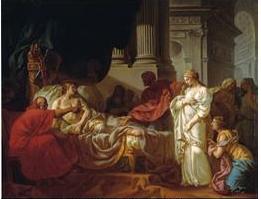
    Antiochus and Stratonice

    Appian, Syrian Wars XI, 59-61

    [59] Seleucus, while still living, appointed his son, Antiochus, king of upper Asia in place of himself. If this seems noble and kingly on his part, even nobler and wiser was his behavior in reference to his son's falling in love, and his self-restraint in suffering; for Antiochus was in love with Stratonice, the wife of Seleucus, his own stepmother, who had already borne a child to Seleucus. Recognizing the wickedness of this passion, Antiochus did nothing wrong, nor did he show his feelings, but he fell sick, took to his bed, and longed for death. Nor could the celebrated physician, Erasistratus, who was serving Seleucus at a very high salary, form any diagnosis of his malady. At length, observing that his body was free from all the symptoms of disease, he conjectured that this was some condition of the mind, through which the body is often strengthened or weakened by sympathy. Grief, anger, and other passions disclose themselves; love only is concealed by the modest. As Antiochus would confess nothing when the physician asked him in confidence, he took a seat by his side and watched the changes of his body to see how he was affected by each person who entered his room. He found that when others came the patient was all the time weakening and wasting away at a uniform pace, but when Stratonice came to visit him his mind was greatly agitated by the struggles of modesty and conscience, and he remained silent. But his body in spite of himself became more vigorous and lively, and when she went away he became weaker again. So the physician told Seleucus that his son had an incurable disease. The king was overwhelmed with grief and cried aloud. Then the physician added, "His disease is love, love for a woman, but a hopeless love."
    [60] Seleucus was astonished that there could be any woman whom he, king of Asia, could not prevail upon to marry such a son as his, by entreaties, by gold, by gifts, by the whole of this great kingdom, the eventual inheritance of the sick prince, which the father would give to him even now, if he wished it, in order to save him. Desiring to learn only one thing more, he asked, "Who is this woman?" Erasistratus replied, "He is in love with my wife." "Well then, my good fellow," rejoined Seleucus, "since you are so bound to us by friendship and favors, and are a model of goodness and wisdom in matters of small moment, will you not save this princely young man for me, the son of your friend and king, unfortunate in love but virtuous, who has concealed his sinful passion and prefers to die rather than confess it? Do you so despise Antiochus? Do you despise his father also?" Then Erasistratus changed his tactics, and, as though he were giving him a knock-down argument, said, "You would not give Antiochus your wife if he were in love with her, although you are his father." Seleucus swore by all the gods of his royal house that he would willingly and cheerfully give her, and make himself an illustrious example of a kind and good father to a chaste son who controlled his passion and did not deserve such suffering. Much more he added of the same sort, and, finally, began to lament that he could not himself be the physician to his unhappy boy, but must needs depend on Erasistratus in this matter also.
    [61] When Erasistratus saw that the king was in earnest and not hypocritical, he told the whole truth. He related how he had discovered the nature of the malady, and how he had detected the secret passion. Seleucus was overjoyed, but it was a difficult matter to persuade his son and not less so to persuade his wife; but he succeeded finally. Then he assembled his army, which was perhaps expecting something of the kind, and told them of his exploits and of the extent of his empire, showing that it surpassed that of any of the other successors of Alexander, and saying that as he was now growing old it was hard for him to govern it on account of its size. "I wish," he said, "to divide it, and so at the same time to provide for your safety in the future and give a part of it now to those who are dearest to me. It is fitting that all of you, who had advanced to such greatness of dominion and power under me since the time of Alexander, should coöperate with me in everything. The dearest to me, and well worthy to reign, are my grownup son and my wife. As they are young, I pray they may soon have children to be an ample guarantee to you of the permanency of the dynasty. I will join them in marriage in your presence and will send them to be sovereigns of the upper provinces now. And I charge you that none of the customs of the Persians and other nations is more worthy of observance than this one law, which is common to all of them, 'That what the king ordains is always right.'" When he had thus spoken the army shouted that he was the greatest king of all the successors of Alexander and the best father. Seleucus laid the same injunctions on Stratonice and his son, then joined them in marriage, and sent them to their kingdom, showing himself even stronger in this famous act than in his deeds of arms.
      (Translation  by Horace White)
                               —-
    Valerius Maximus, Memorable Deeds and Sayings, 5, 7 ext.

    7. ext. 1. But to turn to things that are more pleasant to hear: Antiochus, the son of King Seleucus, fell madly in love with his stepmother, Stratonice. Realizing that he was burning with a wicked passion, he tried to hide this unnatural and traumatic love with a natural discretion. These conflicting feelings contained within the same flesh and bones, and the struggle between his extraordinary desire and his exceptional modesty, reduced his body to a skeleton. He himself was lying in bed, looking like a corpse; his friends were crying; his father was devastated with grief at the approaching death of his only son and was contemplating his future childlessness. The entire dwelling looked more like a funeral home than a palace.
    But Leptines the mathematician (or, as some people say, Erasitratus the doctor) banisched this cloud of sorrow by his foresight. He was sitting beside Antiochus, and he noticed that whenever Stratonice entered, the young man would go red all over and his breathing would slow down again. So he observed the young man more closely and discovered the truth: when Stratonice was entering the room, and again when she was leaving, he surreptitiously held the young man’s arm, and from his pulse rate, which was quicker in the firs case and slower in the second, he discovered what illness the young man was suffering from. He revealed this to Seleucus at once. The king did not hesitate to hand over this wife, whom he loved very much, to his son. He wrote off the fact that the young man had fallen in love as a blow from fortune; but he attributed the fact that he had been prepared to repress this love, even to the point of death, to the young man’s modesty. Let us put before our minds this old king who loved his wife: it will soon become clear how many things and what difficult tihing the kindness of fatherly affection has overcome.
    (Translation by Walker, Henry John) Memorable Deeds and Sayings: One Thousand Tales from Ancient Rome. Hackett Publishing Company, In. 2004)

    VALERI MAXIMI FACTORVM ET DICTORVM MEMORABILIVM LIBER 5.7.ext.1

    Ceterum ut ad iucundiora cognitu ueniamus, Seleuci regis filius Antiochus nouercae Stratonices infinito amore correptus, memor quam inprobis facibus arderet, impium pectoris uulnus pia dissimulatione contegebat. itaque diuersi adfectus isdem uisceribus ac medullis inclusi, summa cupiditas et maxima uerecundia, ad ultimam tabem corpus eius redegerunt. iacebat ipse in lectulo moribundo similis, lamentabantur necessarii, pater maerore prostratus de obitu unici filii deque sua miserrima orbitate cogitabat, totius domus funebris magis quam regius erat uultus. sed hanc tristitiae nubem Leptinis mathematici uel, ut quidam tradunt, Erasistrati medici prouidentia discussit: iuxta enim Antiochum sedens, ut eum ad introitum Stratonices rubore perfundi et spiritu increbrescere eaque egrediente palle<sce>re et ~ excitatiorem anhelitum subinde recuperare animaduertit, curiosiore obseruatione ad ipsam ueritatem penetrauit: intrante enim Stratonice et rursus abeunte brachium adulescentis dissimulanter adprehendendo modo uegetiore modo languidiore pulsu uenarum conperit cuius morbi aeger esset, protinusque id Seleuco exposuit. qui carissima sibi coniuge filio cedere non dubitauit, quod in amorem incidisset, fortunae acceptum referens, quod dissimulare eum ad mortem usque paratus esset, ipsius pudori inputans. subiciatur animis senex, rex, amans: iam patebit quam multa quamque difficilia paterni adfectus indulgentia supera<ue>rit.

  • Some notes on the “Magi” , the three Wise Men

    One of the most deeply rooted festivals in folk and Christian religious life is the “Adoration of the Three Kings other Three Wise Men”. In this event they come together many elements of different religious and cultural backgrounds. We can recall the religious ferment of the Roman Empire, precisely time when Jesus was born, flattering all syncretism. Christian religion have incorporated many elements of Eastern religions of Chaldea, Mesopotamia, Persia, Asia Minor, Egypt, Judea and especially of Greco-Roman and philosophical thought. In all these syncretic religions astral component, highly developed among the Chaldeans in Mesopotamia, is very important.

    I'll try to dig a little deeper on the holiday and iconography of the "Adoration of the Magi", one of the most commonly used scenes by Christianity from the first centuries.
    The Feast of Kings is one of the epiphanies (from Greek  επιφάνεια, epifaneia, "manifestation", composed of ἐπί-, epi, on, over, and φαινεῖν , verb fainein, appear, show), or manifestation of God to men. The other epiphanies are the baptism of Jesus in the Jordan River and the miracle of the wedding at Cana.

    The essential basis text is the reference made in the Gospel of Matthew, only the four canonical Gospels (because it is part of the norm or Christian "canon"); three of them, Matthew, Mark, Luke,  are also called synoptic (from Greek  συν, syn, with, together, and οψις, opsis, view,; ie, we can do a parallel view of them) because they present many coincidences but also significant differences, as this worship of the magi.

    This Gospel of Matthew is preserved in Greek and often it is dated as no earlier than 80, ie 50 or 60 years after the death of Christ. There is a hypothesis that considers the existence of a first version in Aramaic, based on a quote from Eusebius of Caesarea (who lived between approximately 265 and 339), referred to Papias of Hierapolis (who lived between 69 and 150).
    The text of St. Matthew 2: 1-12 says:
    Now when Jesus was born in Bethlehem of Judea in the days of Herod the king, behold, there came wise men from the East to Jerusalem,  saying, “Where is He that is born King of the Jews? For we have seen His star in the East and have come to worship Him.”  When Herod the king had heard these things, he was troubled, and all Jerusalem with him.  And when he had gathered all the chief priests and scribes of the people together, he demanded of them where Christ should be born.  And they said unto him, “In Bethlehem of Judea, for thus it is written by the prophet:
    ‘And thou, Bethlehem, in the land of Judah, art not the least among the princes of Judah; for out of thee shall come a Governor, that shall rule My people Israel.’”
    Then Herod, when he had privily called the wise men, inquired of them diligently what time the star appeared.  And he sent them to Bethlehem and said, “Go and search diligently for the young child, and when ye have found him, bring me word again, that I may come and worship him also.”  When they had heard the king, they departed; and lo, the star which they saw in the East went before them until it came and stood over where the young Child was.  When they saw the star, they rejoiced with exceeding great joy.  And when they had come into the house, they saw the young Child with Mary His mother, and fell down and worshiped Him. And when they had opened their treasures, they presented unto Him gifts: gold and frankincense and myrrh.  And being warned by God in a dream that they should not return to Herod, they departed into their own country another way.
    (21st  Century King James Version)
    The Latin text reads:
    Cum autem natus esset Iesus in Bethlehem Iudaeae in diebus Herodis regis, ecce Magi ab oriente venerunt Hierosolymam dicentes: “ Ubi est, qui natus est, rex Iudaeorum? Vidimus enim stellam eius in oriente et venimus adorare eum ”.  Audiens autem Herodes rex turbatus est et omnis Hierosolyma cum illo;  et congregans omnes principes sacerdotum et scribas populi, sciscitabatur ab eis ubi Christus nasceretur.  At illi dixerunt ei: “ In Bethlehem Iudaeae. Sic enim scriptum est per prophetam:
    "Et tu, Bethlehem terra Iudae,
    nequaquam minima es in principibus Iudae;
    ex te enim exiet dux,
    qui reget populum meum Israel" ”.

    Tunc Herodes, clam vocatis Magis, diligenter didicit ab eis tempus stellae, quae apparuit eis;  et mittens illos in Bethlehem dixit: “ Ite et interrogate diligenter de puero; et cum inveneritis, renuntiate mihi, ut et ego veniens adorem eum ”.  Qui cum audissent regem, abierunt. Et ecce stella, quam viderant in oriente, antecedebat eos, usque dum veniens staret supra, ubi erat puer.  Videntes autem stellam gavisi sunt gaudio magno valde.  Et intrantes domum viderunt puerum cum Maria matre eius, et procidentes adoraverunt eum; et apertis thesauris suis, obtulerunt ei munera, aurum et tus et myrrham. Et responso accepto in somnis, ne redirent ad Herodem, per aliam viam reversi sunt in regionem suam.

    It should be noted that the text speaks simply of  "wise men from the East" and not  of "three kings" magi, numerical and nominal accuracy  subsequently added.
    Second it is a star announcing the birth. As it is known, it has been widely theorized about the characteristics of this star: a comet ?, a supernova ?, a conjunction of several stars? It does a meteor ?.

    Already Origen (186- 185 or 254 or 255), exegete (from Greek ἐξηγητή, exegete, interpreter, and this from ἐξηγεομαι, exegueomai, 'explain',  interpret) thought it was a comet.
    In the eastern society and by its influence in Greco-Roman, stars and atmospheric and celestial phenomena are signs of the gods. Of course, in the ancient world comets were unmistakable signs of a major event; Mithridates births and Augustus were also preceded by the appearance of a comet.
    Justino Frontino, historiador romano del siglo II, nos informa a propósito del rey Mitrídates en sus Historias Filípicas, Historiarum Philippicarum, XXXVII, 2:
    Justin Frontinus, the Roman historian of the second century, tells us about the King Mithridates in his Historiarum Philippicarum, XXXVII, 2:
    The future greatness of this prince even signs from heaven had foretold; for in the year in which he was born, as well as in that in which he began to reign, a comet blazed forth with such splendour, for seventy successive days on each occasion, that the whole sky seemed to be on fire. It covered a fourth part of the firmament4 with its train, and obscured the light of the sun with its effulgence; and in rising and setting it took up the space of four hours. (Translated by  John Selby Watson (London: Henry G. Bohn, 1853)
    II. Huius futuram magnitudinem etiam caelestia ostenta praedixerant. 2 Nam et eo quo genitus est anno et eo quo regnare primum coepit stella cometes per utrumque tempus LXX diebus ita luxit, ut caelum omne conflagrare videretur. 3 Nam et magnitudine sui quartam partem caeli occupaverat et fulgore sui solis nitorem vicerat; et cum oreretur occumberetque, IV horarum spatium consumebat.
    Virgil in his Aeneid, 10, 272 makes a reference to comets:
    it seemed as when in cloudless night a comet's blood-red beam
    makes mournful splendor, or the Dog-star glows,
    which rises to bring drought and pestilence
    to hapless men, and with ill-omened ray saddens the sky.

    (Translated by Theodore C. Williams. Boston. Houghton Mifflin Co. 1910).

    non secus ac liquida siquando nocte cometae
    sanguinei lugubre rubent aut Sirius ardor,
    ille sitim morbosque ferens mortalibus aegris,
    nascitur et laevo contristat lumine caelum.

    Well, the grammarian Servius, commenting on the passage, tells us in his comments to the Aeneid X, 272

    If this looks to the East, it means happy things for that party; if at noon, cheers for Africa and Egypt; if it looks to the West, the land of Italy will  get its favor. It is said that it (the comet) appeared at the time that Augustus got the command; then they were announced to all peoples future joys.

    qui si orientem attenderit, laetas res ipsi parti significat; si meridiem, Africae aut Aegypto gaudia; si occidentem inspexerit, terra Italia voti sui compos erit. hic dicitur apparuisse eo tempore quo est Augustus sortitus imperium; tunc denique gaudia omnibus gentibus futura sunt nuntiata.
    In this context it is easy to understand the text of Origen (184/185 – 253/254) in which he ensures that the star of Bethlehem was a comet and its appearance is quite logical:
    Orígen, Contra Celsum 1, 58-59:
    58…We think that the star which appeared in the east was a new star and not like any of the oridinary ones, neither of those in the fixed sphere nor of those in the lower spheres, but it is to be classed with the comets which occasionally occur, or meteors, or bearded or har-shaped stars,or any other such name by which the Greeks may like to describe their different forms. We establish this point as follows.
    59 It has been observed that at great events and the most far-reaching changes of history stars of this kind appear which are significant of changes of dynasties, or wars, or whatever may happen among men which has the effect of shaking earthly affairs. We have read in the book on comets by Chaeremon the Stoic how comets have sometimes appeared even when good evens were about to happen, and he gives an account of these. If the a comet, as it is called, or some similar star appears at new dynasties or other great events on earth, why is it amazing that a star should have appeared at the birth of a man who was to introduce new ideas among the human race and to bring a doctrine not only to Jews but also to Greeks and to many barbarian nations as well? (Translated by Professor Chadwick. Cambridge University Press)
    Interestingly these beliefs in comets as heralds of positive and negative events are held until today and they are renewed each time the proximity of these stars is announced.

    Many years later, the astronomer Johannes Kepler (1571-1630), related the star of Matthew with the conjunction in 7 BC of Jupiter and Saturn.

    From then to now they have not stopped appear hypotheses that attempt to explain the appearance in the sky of this special light on whose account I do not go because they do   high prestige astronomers.

    In relation to this episode of the Adoration of the Magi it is also necessary at first to define who are the magicians.

    As in another article in this blog I mentioned, the magicians term, magus, magician, μάγοι is not from Greek but Iranian origin. In Greek it has the double meaning of charlatans who dupe with his "magic" but also and especially the priests with a peculiar feature. The primitive religious Persian beliefs and other of Zoroastrianism  conceive the world full of daemons and spirits. The souls of the dead, separated from the body, ascend to heaven, or better, to the heavens, because they are many. In this journey of ascent ritual action and sacrifices of the "magi" is very important. These priests are also experts and scholars of the sky and the astral relations, and therefore astronomers, astrologers (they are similar terms in the ancient world) and mathematicians, whom the Fathers of the Church always regarded as honorable people.

    See: https://www.antiquitatem.com/en/wise-men-tiridates-nero-wizard-epiphany

    The term also had, as I said, the negative connotation of phony and charlatan dealing with demons. Remember what was said in "Acts 3: 9," in which a phony, nicknamed Simon Magus, is repudiated,  whom the apostle Peter, whose power came from the Holy Spirit confronts.
    Even Jesus was himself an extraordinary magician and his power was able to beat the magic of demons, without using spells or incantations, but acting on their own behalf. So in early Christian art Jesus is depicted as thaumaturge  (from Greek θαυματουργός thaumaturgous, skillful, clever, from  θαῦμα, thauma, wonderful thing, and ἔργον, ergon, work), or person performing miracles, with a stick  and the gesture of his hand as magicians do.
    From this point of view, the magicians of Matthew would be true magicians who bowed their heads down and gave his power to the superior power of Jesus. It is evident that the Evangelist intended to show how magicians, then converted into kings of this world, render worship the Son of God, in a world where magic and knowledge of the stars have an important presence.

    On the "social" echo of "wise Men" episode it gives us an idea  the visit of Tiridates, King of Armenia, and magician also, to the emperor Nero. This tour was mentioned by me in the article referenced in above hyperlink. Some people have thought that it was this visit which was the model for the visit of the "magicians" to the child of Bethlehem.
    An essential element is that the gift of the magi is three valuable products in the ancient world: gold, always expensive, incense similar to the value of gold used as perfume and ritual element, and myrrh, whose value was much higher than the other two, used in embalming the bodies of the dead. In Zoroastrianism  also it is offered gold, frankincense and myrrh to Ahura Mazda. We'll see how they are several elements that relate the episode with Zoroastrianism and Mithraism.

    On the relationship between "Mithraism" and "Christianity" I have published a recent article. See:  https://www.antiquitatem.com/en/mithraisme-christianity-winter-solstice. I  comment  how the cult of Mithras is done in caves or underground temples or simulating a cave. Well, in the West is often locate the birth of Jesus in a manger portal but in the East  the place is a cave, probably under the influence of the Mithraic cave.

    Similarly, the episode of the Adoration of the Shepherds is probably a reflection of a similar act of the Shepherds with Mitra.
    However, where the influence is evident, ie, it is seen with the eyes, is in the iconography of the Magi. First it should be specified that there do not were always three; they are represented sometimes two, six, eight and up to twelve, as in the Syriac and Armenian rites. That is, the number three has no support in Scripture.

    In the catacombs of St. Priscilla the oldest painting is preserved and in them are three. The frescoes of this Catumba ranging from mid-second century to the mid-third century.

    In the catacomb of Peter and Marcellinus they are represented two and they are of fourth century.

    In the third century theologian Origen (185-253) indicated that the Magi were three, since there are three gifts that are named in the Gospel of Matthew: gold, frankincense and myrrh, a figure that then Pope St. Leo the Great (Leo I the Great) reaffirms and imposed until today, probably for coincide with the three gifts and probably to symbolize the three then known continents: Europe, Asia and Africa, as expressly the Pseudo Bede (ca. 672-27 May 735) stated in the Middle ages in his In Evangelium Matthaei, chap. II, also relating them to the three sons of Noah:

    Mystically  the three Magi (Wise Men) symbolize the three parts of the world, Asia, Africa and Europe or  the human race, which took its origin in the three sons of Noah.
    Mystice autem tres Magi, tres partes mundi significant,Asiam, Africam, Europam, sive humanum genus, quod a tribus filiis Noe seminarium sumpsit
    Como decía, el papa San León Magno (circa 390 – 461) ratificó la cifra de tres, que es la que con más frecuencia se repite en las representaciones. Dice en su Tratado o Sermón 31, en la Festividad de la Epifanía 1:
    As I said, Pope St. Leo the Great (circa 390-461) confirmed the figure of three, which is the most frequently repeated in the representations. He says in his Sermon 31, on the Feast of the Epiphany 1:
    Sermon XXXI.
    On the Feast of the Epiphany, I.
    To three wise men, therefore, appeared a star of new splendour in the region of the East, which, being brighter and fairer than the other stars, might easily attract the eyes and minds of those that looked on it, so that at once that might be observed not to be meaningless, which had so unusual an appearance.  He therefore who gave the sign, gave to the beholders understanding of it, and caused inquiry to be made about that, of which He had thus caused.
    Sancti Leonis Magni Tractatus XXXI
    Tribus igitur magis in regione orientis stella nouae claritatis apparuit, quae inlustrior ceteris pulchriorque sideribus, facile in se intuentium oculos animosque conuerteret, ut confestim aduerteretur non esse otiosum, quod tam insolitum uidebatur.
    Dedit ergo aspicientibus intellectum, qui praestitit signum, et quod fecit intellegi, fecit inquiri, et se inueniendum obtulit requisitus.
    I reproduce two of the oldest representations of the scene, one of Syracuse in Sicily:

    Sarcophagus of Adelfa. Siracusa. IV century

    And another rough of Boville Ernica in Italy, also of the fourth century and which is postulated to be the oldest.

    The manger under cover of Early Christian sarcophagus of Boville Ernica (Italy) of the fourth century.

    Well, the three wise men are represented from the beginning dressed in Persian costume which is also with always Mitra is represented: short tunic, pants called anaxyrides and the Phrygian cap or pileus (object which I will comment at another time: remember that it is a symbol of freedom that was adopted, for example, by the French revolutionaries and later by many others, including entire countries).

    Mithraeum "Barberini, Rome, mural painting. III century

    In Roman iconography of the East, for example the pedestal of the obelisk of Theodosius in Constantinople, in the late fourth century, in which the barbarians pay tribute to the emperor with his sons Arcadius and Honorius and his wife Gala, the Persians are depicted with this suit and the Thracians with skins.

    This Persian dress of the three Wise Men is displayed in all its definition in the Sarcophagus of Isacio – San Vitale, Ravenna, IV or V century, in which the Virgin Mary has become the living throne of the Child Jesus. The three Magi seem to repeat the same figure, which some experts interpreted as a reflection of some magical formulas in which the elements are repeated three times.

    A similar scene, but rougher, is the sarcophagus of Aurelius, of the catacomb of San Lorenzo Fuori le Mura – Rome, of the fourth century, now in the Vatican Museum.

    Mechanical and perhaps magical repetition of the three kings absolutely equal is seen best in another example

    This dress was maintained for a long time, as evidenced by the various existing representations in the Middle Ages, which is evidence of the persistence of rites and myths.
    There is a tradition or legend referring to the invasion and conquest of Palestine by the Persian Sassanid king Khosrau II in 614. Their  general Shahrbaraz, impressed by the dress of the Wise Men  in the mosaics which that adorn it, ordered not to destroy the famous basilica of the Nativity in Bethlehem and that the building be spared; he interpreted that the figure represented his fellow countrymen, wearing Persian clothing.

    It is no longer as a legend,  but it expresses  the widespread awareness that the Magi came from the East, Persia. What is unacceptable is that in hundreds of internet references, including some books that claim to seriousness endorsed by any college, this anecdote is referred to the Byzantine churches of Ravenna, in Italy,  which I will quote below. How to explain a supposed invasion of Italy by the Sassanid Persians in 614?
    The conversion of the Magi into kings, or better, the syncretism again of wizards and kings, was undoubtedly due to the desire to realize the verses of Psalm 72: 9-11:

    Vor ihm werden sich neigen die in der Wüste, und seine Feinde werden Staub lecken.
    Die Könige zu Tharsis und auf den Inseln werden Geschenke bringen; die Könige aus Reicharabien und Seba werden Gaben zuführen.
    Alle Könige werden ihn anbeten; alle Heiden werden ihm dienen.

    He was Tertullian who found the relationship with Psalm and led to the conversion with "nam et Magos reges habuit fere oriens", " For the East generally regarded the magi as kings" which appears in his work Adversus Marcionem (Contra Marcion) III, 13:

    Tertullian (adv. Marcionem. iii. 13), Contra Marción
    Let those eastern magi wait on the new-born Christ, presenting to Him, (although) in His infancy, their gifts of gold and frankincense; and surely an Infant will have received the riches of Damascus without a battle, and unarmed. For besides the generally known fact, that the riches of the East, that is to say, its strength and resources, usually consist of gold and spices, it is certainly true of the Creator, that He makes gold the riches of the other nations also. Thus He says by Zechariah: "And Judah shall also fight at Jerusalem and shall gather together all the wealth of the nations round about, gold and silver." Moreover, respecting that gift of gold, David also says: "And there shall be given to Him of the gold of Arabia;" and again: "The kings of Arabia and Saba shall offer to Him gifts." For the East generally regarded the magi as kings; and Damascus was anciently deemed to belong to Arabia, before it was transferred to Syrophoenicia on the division of the Syrias (by Rome). Its riches Christ then received, when He received the tokens thereof in the gold and spices; while the spoils of Samaria were the magi themselves. These having discovered Him and honoured Him with their gifts, and on beaded knee adored Him as their God and King, through the witness of the star which led their way and guided them, became the spoils of Samaria, that is to say, of idolatry, because, as it is easy enough to see, they believed in Christ.
    Maneant autem orientales illi Magi in infantia Christum recentem auro et ture munerantes, et acceperit infans virtutem Damasci sine proelio et armis. [7] Nam praeter quod omnibus notum est, orientis virtutem, id est vim et vires, auro et odoribus pollere solitam, certe est creatori virtutem ceterarum quoque gentium aurum constituere, sicut per Zachariam, Et Iudas praetendet apud Hierusalem et congregabit omnem valentiam populorum per circuitum, aurum et argentum. [8] De illo autem tunc auri munere etiam David, Et dabitur illi ex auro Arabiae; et rursus, Reges Arabum et Saba munera offerent illi. Nam et Magos reges habuit fere oriens, et Damascus Arabiae retro deputabatur, antequam transcripta esset in Syrophoenicen ex distinctione Syriarum, cuius tunc virtutem Christus accepit, accipiendo insignia eius, aurum scilicet et odores; spolia autem Samariae ipsos Magos, qui cum illum cognovissent et muneribus honorassent et genu posito adorassent quasi deum et regem sub testimonio indicis et ducis stellae, spolia sunt facti Samariae, id est idololatriae, credentes videlicet in Christum.
    From the interpretation of Tertullian identifying of the Magi and the kings began. Then, much later, the Phrygian caps with which they are originally represented were replaced by crowns on their heads and were even dressed in robes of each period, as is usual in the art.
    The text of Tertullian evidence the apologetic interest of this episode of the Adoration of the Magi to establish recognition of the Messiah by the Magi, by the Gentiles, the pagans of all peoples of the land of the three known continents.
    The names of the three has also been an element of debate and opinion. The Greeks called them Appellicon, Amerín and Damascón. The Jews Magalath, Galgalath and Serafin . The Syrians Larvandad, Hormisdas and Gushnasaph. The Ethiopians Tanisuram, Malik and Sissebd.

    The first time when the name we know today the Magi arises in the West it is in the inscription on the frieze of the Church of San Apollinare Nuovo in Ravenna (Italy). They're mosaics s of mid-sixth century depicting the procession of the Virgin, preceded by three characters dressed in the Persian fashion, with the Phrygian cap,  bearing a gift. Overhead it is read the three names Melchior, Gaspar, Balthasar. The Roman Martyrology mentions St. Gaspar on January 1, San Melchor day 6 and San Baltasar 11 (Acta SS., I, 8, 323, 664). In the manuscripts they appear first in one preserved in Paris VII century the names Bithisarea, Melichior and Guthaspa.

    The etymology of these names is unclear. Some think that Melchor might have Akkadian origin and meaning "king"; Baltasar could derive from Persian and Akkadian Baal hashahr , "Baal is king"; the origin of Gaspar is unknown.

    Then they were related to the sons of Noah: Cam to Baltasar, Shem to Gaspar and Japheth to Melchor or Melkon.

    In the representation of the sarcophagus of Adelfa  in Syracuse and in the Boville Ernica there are two other elements, the ox and the mule or donkey, who have obtained an absolute success in later representations of the "portal of Bethlehem." The presence of these animals refers, as indicated by the holy fathers, the prophecy of Abacud and especially that of Isaiah.
    Abacud: "The Lord will be recognized between two animals"
    Isaiah: "The ox knows its owner, and the ass the manger of his master, but Israel does not know me and my people do not understand me."
    In any case I recognize that details of the names and the presence of the ox and the ass or mule are not issues I've studied enough or that I have extensive knowledge.
    In celebration of the Day of the Kings also there converge other miscellaneous items. So at the end of the Roman Saturnalia, where gifts were made between people (see                https://www.antiquitatem.com/en/christmas-birth-of-jesus- ) then  were celebrated the Sigillaria, festivals in which men gave to children small ceramic figures, which were purchased at a flea market make ready for the purpose. Detail curious this markets, which are still celebrated everywhere on these dates.
    Although the origin of the party may be another, linking these figurines to children is attested by Macrobius in his Saturnalia, 1, 11: "… even now (Praetextatus) intended that Sigillarias, which offer fun for children who still  crawl with  on clay figurines, are related to a religious practice "

    vel nunc Sigillaria, quae lusum reptanti adhuc infantiae oscillis fictilibus praebent, temptat officio religionis ascribere,
    Also Seneca in Letters to Lucilius, 12: 3 says:
    But he said: Do not you know me? I am, Feliciu, your favorite, whom you used to give statuettes; I am the son of your butler Filostius, your little one, your joy.
    " At ille "Non cognoscis me ?" inquit. " Ego sum Felicio, cui solebas sigillaria adferre. Ego sum Philositi vilici filius, deliciolum tuum."
    Also in Rome, on the first day of year were held the festivities of the goddess "Strenia", whom  offerings and gifts were given, which also were extended to the friends. The festival may have a Celtic origin. The name of the goddess derives form the Latin noun "strenia" gift, word which has produced  the Spanish  substantive “estrena” and the verb “estrenar”.
    Moreover from the word "epiphany" comes the Italian "Befana", designating an old woman who on the night of 5 to 6 gives candy and chocolate to children who have been good and coal to those who have behaved wrong. The origin of this agrarian festival is related to the death of the old year and the coming of the new year.
    There is another fact which helps us to better understand the astral environment in which they develop for a long time, even today, religions of all time. As I have repeatedly explained, at around day 25 December the winter solstice occurs. If until that day the sunshine or light each day have been declining, from that moment the process is reversed and the time of sun and light begins to grow. So to this day is called the "dies natalis solis invicit", "birthday of the unconquered sun".
    Well, at that time it occurs in the sky the star Sirius alignment with the three stars of Orion’s  belt, the Pleiades and the sun.

    Image taken from  http://asteromia.net/estrellas/estrellas-sirio.html

    Someone came to consider that the three stars of Orion's belt were the three Magi who announced the birth of Christ and as such are known. But this is not an ancient identification but medieval old; I have not found a single reference in the treaties of ancient astronomy in which these three stars are denominated so. But regardless of age,  that they were named so from the Middle Ages to today is proof of the ease with which humans tend to project into the firmament our beliefs and myths.

    These three stars of Orion's belt are also called the Three Marys.
    This whole episode of the "Three Kings" is thus a very obvious example of syncretism that occurs in the formation of myths, beliefs and rituals and force to survive for thousands of years.

  • Mithra, god of the sun, was born on December 25, day of the winter solstice

    On the night of 24 to 25 December it is celebrated in the West the birth of Christ. But it was not always so and today it is not in the whole Christian world; until the fourth century it was celebrated on January 6 and it continues so in the east, among the Orthodox.

    The winter solstice occurs on December 25th; It is the time when in the northern hemisphere the days are shorter and the nights are longest. But from this  moment the day begins to grow and  "dies natalis solis invicti"  “the birthday of the unconquered sun",  is celebrated on this day .

    That invincible sun is the god Mithra, whose worship and devotion competed with Christianity with which has certain similarities.

    I have dedicated an article to this issue in this blog: https://www.antiquitatem.com/en/christ-was-born-before

    I also spent another comment on some aspects of ritual and celebration of our Christmas, including the episode called "Three Kings".

    https://www.antiquitatem.com/en/christmas-birth-of-jesus-mithras

    https://www.antiquitatem.com/en/wise-men-tiridates-nero-wizard-epiphany

    Mithraism and Christianity have many similarities and many differences. This is demonstrated by some Christian parents and polemicists,  who curiously give us often many details of these secret or semi-secret religions of salvation . Otherwise Christianity also takes elements from  religion and worship of Isis and Osiris, Tammuz, Adonis, Attis, Dionysus.

    To explain the coexistence of similarities and differences we must imagine the spiritual and religious environment of imperial Rome in which there are all religions and rites with which they are encountered in their imperial progress and also the popular atmosphere is very conducive to the development of religions and inimical to atheistic positions.

    Reference may be able  the current environment of some American cities where all kinds of religions and sects, mixture of rites and various ideas, emerge.

    Note: syncretism is called the phenomenon of mixing, assimilation, fusion of diverse elements into one. The word comes from the Greek συγκρητισμός, synkretismos, consisting of συν- prefix syn, with, together, at once, and perhaps the κεραννυμι, kerannymi,  verb, meaning to mix. Or maybe, as Plutarch explains in his Moralia, on Brotherly love ( De amore fraterno), 19,  relates to Crete and its practice of joining all Cretans against the common enemy. This is an interesting etymology I will try in an exclusive article.

    Mithra Is a Persian god  at least 4,000 years old. Its existence has to be before the separation of Hindus and Persians, because this god exists in the Vedic pantheon of India and exists in the Medo-Persian religion, then developing a different evolution. In India he diluted, he was accentuated in Persia and he was prominent in the mysteries of Roman times. His primitive holy book is the Avesta.

    It is characteristic of this religion the existence of an absolute dualism: there were two opposing gods, Ahura-Mazda, the god of good and heaven, and Ahriman, god of darkness and hell. In between there is a mediator, Mithra, benefactor and protector of men.

    The Mithra of Persia is many centuries later spread throughout the Roman Empire, first accompanying the Roman legions, also led by officials and merchants, among whose members will quickly settled.
    But to get here it underwent many changes and contamination. First the original Persian religion and primitive rites were reformed by Zarathustra, whom the Greeks called Zoroaster, leading to Zoroastrianism. It was very also affected by the religion of Babylon and the various peoples of Mesopotamia, and impregnated with astrology, it is also spread throughout Asia Minor, it came into contact with Jews and other Semitic peoples, it influenced and in turn it was affected by Greek philosophy, taking helena form, etc.

    In many cases their gods were identified with Asian or Greek gods: Ormazd or Ahuramazda with Zeus, Hades with Ahriman, etc. Mithra remains as such because he has no equivalent in the Greek pantheon. That is, Mazdeism  is also an example of  syncretimus.

    Mithraism spread throughout the empire in the early centuries of the Empire accompanying especially the soldiers. Precisely the religious life of the devotee of Mithras is conceived as a militia and way of perfection. It is no wonder that it had remarkable success among the legionaries. An essential factor, of course, was the favor of the emperors, whose tendencies to deification and justification of power by divinity, grew stronger the Oriental Mithraic beliefs.

    Testing the extension and development of this cult it is for example the existence of many kings of the area called Mithridates: Pontus, Parthia, Cappadocia, Armenia.

    The  mithraea or temples of Mitra appear throughout the empire, particularly associated with Roman legions camps. In Rome there were several, perhaps the greatest it is under the church of San Clemente near the Colosseum.

    Mithraism disappeared, but their beliefs into two antagonistic powers that dominate the universe, good and evil, light and darkness, remained in Manichaeism and other beliefs as bogomilism, in the Cathars or Albigensians.

    Even the Zoroastrianism  still occurs in the small community of Parsis, ancient Persians who migrated to the India. See you: https://www.antiquitatem.com/en/exposure-of-corpses-burial-cremation-

    Between Mithraism and Christianity there are great similarities in the doctrinal aspect and in the ritual and consequently there was a strong rivalry, which triumphantly came out Christianity from the fourth century, but as at the time the French philologist, philosopher and writer Renan (1823-1892) said in his book "Marcus Aurelius", 579,:

    If Christianity had been checked in its growth by some deadly disease, the world would have become Mithraic.”

    It is impossible to make a detailed study of the multiple similarities and therefore I will only to point out the most important.

    In the doctrinal aspect, both are religions of salvation and  mystery because they promise an eternal life of happiness after death to believer; only initiates participate of the rites, which are secret. Mithra is the intermediary between heaven and hell, between the realms of good and evil. He is the representative of Ahura-Mazda on earth who protects us men from demonic forces of Ahriman. Mithra is the "light of the world", symbol of truth, justice, loyalty. He is also called the "judge of souls" which purified ascend to heaven. Mithra is the heavenly father who receive them in their heavenly mansion. They firmly believe in heaven and hell, survival and resurrection of the body after death, punishment and reward; benevolent God will do justice to the righteous who will grant eternal salvation day of reckoning, when the triumph of light over darkness will definitely occur.

    It is also a religion with great moral content, self-control, resistance to sensuality, in which the devotee has to travel a path of purification of seven degrees, until the Father, which is perfect as Mithra, and must to fight the forces of evil. In this struggle he will have the help of Mithra.

    This type of religion in which there are no one god but several, though only one of them is superior to the other and the only worthy of worship, it is technically called henotheism them, from the Greek εἷς, ἕν, heis, hen one, and θεός, god, theos, and –ism, one god.

    The similarities of the rites of both religions are very striking.

    The cult of Mithras is made in natural or manufactured caves but with some element to remember the cave origin, called mithraea,  indicating that its origin is very primitive. In Latin it it is called spelaeum, specus, spelunca (Speleology or study of caves derives from this word), antrum. Precisely the birth of Christ, which the popular devotion placed in a "portal" in the West, in the East it is often presented in a cave. In them the image of Mithra taurocton  or “slaughtering bulls”  ( after the Greek word tauroktonos (ταυροκτόνος; from Latin taurus, bull and Greek κτείνω, kteino, slaughter, kill) appears as the central iconographic motif.

    The great feast of the birth of Mithra is celebrated, of course, the day of the winter solstice, December 25.
    The centerpiece is the sacrifice, without that implies  that a bull was sacrificed really. Alfred Loisy in his book “The pagan Mysteries and the Christian mystery” tells us: "What is shown is the sacrifice of the bull as the beginning of the blessed life promised to initiate and of virtue that is in the sacred banquet for obtaining that immortality "

    Within Mithraic iconography, the image certainly the best known is the taurocton Mitra who presided certainly the sacred space of mithraeum.

    I take the exact words of Alfred Loisy to describe it, in a good example of ekphrasis.

    Note: écfrasis or ekphrasis, from Greek  ἔκφρασις, 'to explain to the end. An ekphrasis, according to  rhetoric and classical tradition, is a verbal description, in words, of a work of visual art, a painting or a sculpture):

     "… The bull is in a cave, brought down, lying on the ground, the front legs bent over the body, the rear extended; Mithra is on the animal, left knee bent, right leg extended on the right hind leg of the bull; with the left hand lifts the snout of the animal, whose head turns toward the sky, and with his right hand a large knife stabs at birth neck. Mitra himself has his head turned, as if looking behind him, and often with a singular expression of sadness. Generally a crow, left, leans toward him; often in the left corner there is the figure of the sun, to the right of the moon; Below there is a dog which sheds on the blood gushing from the wound, and also a serpent; a scorpion takes the testicles of the expiring beast with its claws and it bites them with its tail; sometimes an ant I also involved; or below the bull  there is a crater with a lion which  seems to look or drink in it, while on the other side, the snake seems to do the same. On each side there is a young, one, Cautes, with a raised torch; and the other, Cautopatés, with a given torch back, both dresses and hairstyles as Mithra. One last thing that should not be the least important: the bull's tail, raised, ends in a bunch of spikes; There are also monuments in which from wound of bull ears instead of blood spring. These ears  are what give meaning to the scene, or it is superfluous look for it.  (Alfred Loisy: Los misterios paganos y el misterio cristiano, pág. 139. Ed.Paidos. Barcelona, 1990)

    Tout le monde connaît le type de Cette représentation : dans une caverne, le taureau dompté, tombé à terre, les jambes de devant pliées sous lui, celles de derrière étôndiies; Mithra sur la bête, lé genou gauche plié, la jambe droite allongée sut la cuisse droite du taureau; de la main gâuche il soulevé les
    naseaux de l'animal, dont la tête se tourne vers le ciel, et de la main droite il lui enfonce, au défaut de l'épaule, un long Coutelas; Mithra lui-même a la tête tournée, comme regardant derrière lui, et souvent avec une singulière expression de tristesse; ordinairement un corbeau, à gauche. Se penche dé sôft côté; souvent, dans l'angle à gauéhe est la flgute du Soléil, a droite celle de la Lune; en bas, se jetant vers le sang qui jaillît de la blessure, est un chien, aussi un  serpent; un scorpion pince les testicules de la bêté expifànte et les pique dé sa queue; une fourmi quelquefois se met aussi de la fête; ou bien, au-dessous du laureau, un cratère est représenté, un lion a l'air de le garder ou d'y boire, tandis que d'autre part, lé serpent a mine d'en faire autant; de chaque côté, un Jéune homme, l'un, Caulès, avec une torche levée, l'autré, Càutopatès, avec une torche renversée, tous deux vêtus et coiffés comme Mithra; dernier détail, qui ne doit pas être le moins important, la queue du taureau, relevée, se terminé en toufle d'épis ; on signale même dés monuments où ce sont des épis qui jaillissent, au lieu de sang, dé là blèsssure du taureau’. Ce sont ces épis-là qui donnent le mot de la scène, ou bien il est superflu de le chercher.
    (Alfred Loisy: Les mystères paíens et le mystère chrétien)

    In this iconographic ensemble there is represented the Avestan myth of the slain at the origin bull, from  whose wound  the plants emerged and from their offspring  the species of farm animals born; Mithra killed the bull.

    The representation of the sacrifice of the bull is a symbol and  remembrance of the sacrifice of the primeval animal (it was the first living creature that was created by Ahura-Mazda) and cosmic animal that gave rise to life to men. The death of the bull is a symbol of the new year and salvation in the hereafter. So on the mithraeum of Aventine in Rome man reads " You saved men by the shedding of eternal blood."

    Another essential element of Mithraic ritual is the celebration of the banquet or Eucharist, where they ate the bread and drank the holy water, which at one point was wine, substitute of the original drink fruit of the poisonous plant of homa, equivalent to "soma "or Hindu sacred drink.

    Also an essential element in the rite is baptism or purification by water that the devotee must  to perform in one of the seven steps, and the signal (signatio) in front in the so-called  step "Soldier".

    There are many other similarities in theology and ritual we can not comment on this article, such as the clothing of the priests, the initiation ceremony called "sacramentum" because it is a similar sort of oath to the military oath soldiers, the touch of chimes at some point of religious service and so on.

    These similarities drew wide attention of the early church fathers, who polemicise sharply with the Mithraists. Indeed most of the details of these rituals we know from the description which   the Christian parents make .

    Tertullian is the son of a centurion and he is connoisseur of the Mithraists rites. Certainly he, impressed by the similarities,  only finds an explanation for the many coincidences: these rites and this religion is the work of the devil who is interested in discrediting and extinguish the Christian religion.

    Read what he says in his work:

    TERTULLIAN's PRESCRIPTION AGAINST HERETICKS, 40

    But lastly, from whence (I pray) comes that Interpretation which is the immediate cause of Heresies ? From the devil most certainly, whose grand affair it is to corrupt the truth; and who in his idolatrous mysteries pretends to imitate the sacred rites of the true Religion. He in his turn too baptizes some, namely his own disciples and followers; by washing he promises a purgation from sin, and if I yet remember, Mithra signs his soldiers in their foreheads; he makes an oblation of bread, puts on the form of the resurrection, and withal he crowns them with a mimick martyrdom. To this also may be added, that his chief priest is the husband of one wife, that he hath his virgins and his  continentes. But if we look back upon the superstitions of  Numa Pompilius; if we take a view of the  sacerdotal offices, the marks of honour, and the privileges; if we reflect upon the sacrifical performances, the Instruments and vessels for sacrifices, the variety of vows, and the numerous expiations, we shall manifestly see, that the devil hath had in his eye throughout the whole Institution the scrupulous nicety of imitating the Jewish Law. It is he who hath affected so exactly to express the rites wherewith the Christian sacraments are administered; It is he (I say) that makes use of the same artifice in corrupting the instruments of divine truth and of Christianity, by drawing one sense from another, taking words from words, parables from parables, and adapting all to a profane faith, which bears some faint, some languid resemblance to the true. And therefore no one has any reason to doubt, but that these spiritual wickednesses, from whence Heresies proceed, have sprung from the devil, and that they differ not from idolatry, feeing they both have their rise from the same author, and are both of a like nature. For either heretics feign another od in opposition to the Creator, or if they confess and acknowledge one Creator, they do not allow him these perfections which are truly and properly his; and therefore every lye they tell of god is a species of idolatry. (Translated by Joseph Betty. 1722)

    De praescriptione haereticorum, 40

    XL. [1] Sed quaeritur, a quo intellectus interuertatur eorum quae ad haereses faciant? [2]  A diabolo scilicet, cuius sunt partes interuertendi ueritatem qui ipsas quoque res sacramentorum diuinorum idolorum mysteriis aemulatur. [3]  Tingit et ipse quosdam utique credentes et fideles suos;
    expositionem delictorum de lauacro repromittit, [4]  et si adhuc memini Mithrae, signat illic in frontibus milites suos. Celebrat et panis oblationem et imaginem resurrectionis inducit et sub gladio redimit coronam. [5] Quid, quod et summum pontificem in unis nuptiis statuit? Habet et uirgines, habet et continentes. [6] Ceterum si Numae Pompilii superstitiones reuoluamus, si sacerdotalia officia et insignia et priuilegia, si sacrificantium ministeria et instrumenta et uasa,
    ipsorum sacrificiorum
    ac piaculorum et uotorum curiositates consideremus, nonne manifeste diabolus morositatem illam Iudaicae legis imitatus est? [7]  Qui ergo ipsas res de quibus sacramenta Christi administrantur, tam aemulanter adfectauit exprimere in negotiis idololatriae, utique et idem et eodem ingenio gestiit et potuit instrumenta quoque diuinarum rerum et sanctorum christianorum, sensum de sensibus, uerba
    de uerbis, parabolas de parabolis, profanae et aemulae fidei attemperare. [8]  Et ideo neque a diabolo inmissa esse spiritalia nequitiae, ex quibus etiam haereses ueniunt, dubitare quis debet, neque ab idololatria distare haereses cum et auctoris et operis eiusdem sint, cuius et idololatria.
    [9] Deum aut fingunt alium aduersus creatorem aut si unicum creatorem confitentur, aliter eum disserunt quam
    in uero est. [10]  Itaque omne mendacium quod de Deo dicunt, quoddammodo genus est idololatriae.

    Similarly Justin  expressed himself , also impressed by the similarities of the Christian Eucharist with the Mithraic, including the formulas of consecration, for which, as Tertullian, no other explanation is that the intervention of the devil. So after explaining what the Eucharist is, tells us in Apologia, 1. 66:

    CHAP. LXVI.—Of the Eucharist.

    For the apostles, in the memoirs composed by them, which are called Gospels, have thus delivered unto us what was enjoined upon them; that Jesus took bread, and when He had given thanks, said, "This do ye in remembrance of me,[136] this is my body;" and that, after the same manner, having taken the cup and given thanks, He said, "This is my blood;" and gave it to them alone. Which the wicked devils have imitated in the mysteries of Mithras, commanding the same thing to be done. For, that bread and a cup of water are placed with certain incantations in the mystic rites of one who is being initiated, you either know or can learn. (Translated by Marcus Dods)

    In short, as Loisy says: "The Mysteries of Mithra were a great religion"

    All these historical issues have been extensively studied since the late nineteenth century and they are known, but generally they do not reach the public because the authorities and the responsible religious or not know or do not want to know, and much less to transmit to the faithful, whom they  should consider not ready to know the historical truth.

    So it causes so much commotion and distress the statements of  hierarchy as simple as that performed by Pope John Paul II on December 21, 1993, when he acknowledged that Christmas Day replaced the pagan festival of the Invincible Sun, which coincided with the solstice Winter. The media news were echo of that and we can  easily locate it in anywhere hemeroteca.

    Note: hemeroteca, from Greek hemera (Ἡμέρα), day and theke (θήκη), wardrobe, safe deposit, in which news data and magazines are stored.

    The declaration of the successor of John Paul II, Pope Benedict XVI caused no less surprise and dismay among the faithful devotees, when in November of 2012 he published the book “The childhood of Jesus”, which he recognizes the error of the calendar to set the date of birth of Jesus or he claims that the iconographic elements of birth of Jesus, as the accompaniment of the mule and ox,  are mere ornaments of tradition and they  have nothing to do with historical reality. This suppression of these animals disoriented many citizens practicing religion with apparent naivete.

    Well, back to the topic of Mithraism, I will say that Franz Cumont (1868-1947), historian and philologist Belgian, put the basis of historical studies about this religion.  He published a huge documentary work about  that. He, having been a teacher university for several years, was rejected as a professor at the University of Ghent by Catholic education minister. The fact caused a huge media and student campaign  to reject the interference of religion in college.

    Another great specialist in the study of the history of the mystery religions was Alfred Loisy (1857-1940), theologian and French priest, contemporary of Cumont. He is considered the founder of modern biblical studies.  He soon came into conflict with the Vatican, which excommunicated him in 1908 and his books were being included each year in the index. The Second Vatican Council rehabilitated him implicitly and partially . His work “Les  païens Mystères and the chrétien Mystère” was published in 1919, but in Spanish it was not until 1967, outside of Spain, of course, entitled The pagan mysteries and the Christian mystery; in Spain was reprinted in 1990. In 1909 he was appointed professor at the prestigious French College (Collège de France) where he taught and researched for many years.

    They are really exciting few paragraphs of the preface to the first edition in which we can discover  the consciousness of a man who using the method of history has discovered what he believes to be the truth, but whose publication must certainly cause novelty; he, fearing an unexpected death, believes it is his duty to publish the historical truth that he has found, but it is aware of the need to keep expanding and showing that information.

    I transcribe these paragraphs as an example of the difficulties that not long ago and even today, the  historians find, but they  they should only serve historical truth  that the texts transmitted to them:

    Life is short, and when man  feels the yours as eminently fragile, man  has, perhaps, the right to say without much delay what he has been believed grasp of truth. An in-depth and thorough of all testimony concerning the pagan mysteries and Christian origins discussion could absorb many stocks, and man is not required at all, no doubt, to be silent about it, waiting for a generation of scholars have thoroughly scrutinized all details.

    It is also possible to ask whether it is absolutely essential to have exhausted the question to know what to expect on essential points. Moreover, as it relates to Christian origins, knowledge of the texts is not all  and the total independence of judgment is important. The texts are known and studied from a long time, but criticism hardly differs from the faith, whose oldest documents are those texts. Addressing them without  theological or polemical interest is undoubtedly condition to understand them well from the standpoint of the history. Well, this condition can still to be, at present, a great novelty.

    La vie est courte, et, lorsqu'on sent la sienne éminemment fragile, on a peut-être le droit de dire sans trop de retard ce que Von a cru saisir de vérité. Une discussion approfondie et minutieuse de tous les témoignages concernant les mystères païens et les origines chrétiennes pourrait absorber plusieurs existences, et Von n'est point sans doute obligé de se taire sur le sujet en attendant qu'une génération d'érudits en ait minutieusement scruté tous les détails . Il est permis aussi de se demander s'il
    est absolument indispensable d'avoir épuisé la question pour savoir à quoi s'en tenir sur les points essentiels. D'ailleurs, en ce qui regarde les origines chrétiennes, la connaissance des textes
    n'est pas tout, et tindépendance entière du jugement a son importance. Les textes sont connus et étudiés depuis longtemps, mais la critique est à peine dégagée de la foi dont ces textes sont les plus anciens documents. Les aborder sans aucun intérêt théologique ou polémiqua est sans doute une condition indispensable pour les bien entendre au point de vue de l'histoire. Or cette condition peut encore, à t heure actuelle, passer pour une grande nouveauté.

  • A room with mirrors

    I think that Horace is the best Latin poet. I know that there will be someone who questions me and tell me that he is Virgil. Well, epic and lyric are two different genres of poetry.

    Horace is the author of famous lines that have become  always said judgments: aurea mediocritas, Carpe diem, Beatus ille …  I have mentioned him several times in this blog, as it can be found in it using the space next to the magnifying glass symbol. See for example:

     https://www.antiquitatem.com/en/the-most-beautiful-latin-poem-horace

    http://es.antiquitatem.com/carpe-diem-horacio-oda-poesia-latina

    In his poems he left us some information about his life and also we have a short biography that about him Suetonius left us  in his book De poetis, "Lives Of The Poets", corresponding to his De viris illustribus, “On famous Men”.

    Suetonius wrote numerous works, he seems to have specialized in the biography, always rife with anecdotes that could be described as "historical gossip", to which at bottom we are so fond today as yesterday.

    I tell you a couple of anecdotes of “historical gossip” concerning his dealings with Augustus or his peculiar sexual tastes.

    Octavius enjoyed the friendship of the great Maecenas and of the emperor Augustus, but knew always keep some distance, jealous of their independence and aware of their personal reality. So it seems that he rejected the post of personal secretary which  the emperor offered him. But  Augustus got not angry, and he maintains a full of irony and trusting relationship with the poet, reciprocated in the same direction by Horace. Augustus jokes about the short stature and obesity of the poet (brevis atque obesus, says Suetonius), whom also jokingly he calls  "chaste penis" or "funny guy".

    Horace remained unmarried all her life, but that does not mean he  does not had a wide sexual experience, as it is clear from his verses. For example there are several girls with Greek names on his works  cited as Cinara, Glícera, Lalage, Inaquia, like many courtesans, with whom perhaps he had relations. Also he is mentioned young boys as Lyciscus and Ligurinus. Perhaps the "most chaste penis" was as a mischievous irony of Augustus.

    Moreover, Suetonius says he was "somewhat rampant in matters of love", "ad res venereas  intemperatior ". And to complete this data he tells us how he placed mirrors in your room (speculato cubiculo) to be seen from every angle himself in lovemaking.

    I reproduce some fragments from the brief  Vita that Suetonius offers us, referring to these stories:

    Besides this, among other drolleries, he often called him, "his most immaculate penis," and "his charming little man," and loaded him from time to time with proofs of his munificence.
    …….
    In person, Horace was short and fat, as he is described by himself in his Satires, and by Augustus in the following letter: "Dionysius has brought me your small volume, which, little as it is, not to blame you for that, I shall judge favourably. You seem to me, however, to be afraid lest your volumes should be bigger than yourself. But if you are short in stature, you are corpulent enough. You may, therefore, if you will, write in a quart, when the size of your volume is as large round as your paunch."
    It is reported that he was immoderately addicted to venery. [For he is said to have had obscene pictures so disposed in a bedchamber lined with mirrors, that, whichever way he looked, lascivious images might present themselves to his view.] (
    The Translation of Alexander Thomson, M.D.)

    Praeterea saepe eum inter alios iocos «purissimum pene» et «homuncionem lepidissimum» appellat, unaque et altera liberalitate locupletavit.
    ……
    Habitu corporis fuit brevis atque obesus, qualis et a semetipso in saturis describitur et ab Augusto hac epistula: «Pertulit ad me Dionysius libellum tuum, quem ego ut accusantem quantuluscumque est, boni consulo. Vereri autem mihi videris ne maiores libelli tui sint, quam ipse es. Sed tibi statura deest, corpusculum non deest. Itaque licebit in sextariolo scribas, quo circuitus voluminis tui sit ὀγκωδέστατος, sicut est ventriculi tui».

    Ad res venereas intemperantior traditur; nam speculato cubiculo scorta dicitur habuisse disposita, ut, quocumque respexisset, ibi ei imago coitus referretur.

    The multiplication by mirrors, it seems to be a remarkable aphrodisiac (word derived from Greek goddess of love Aphrodite, as the Latin Venus) yesterday and today, especially for voyeurs because there are many palaces, castles, hotels where there is "the room of mirrors". Famous it is the Palace of Versailles, although the great room of mirrors was not huge stage for special amorous but to feed the ego of the courtiers, which is another form of voyeurism. Maybe it was the room of the Castle of Belmonte, built by the famous and powerful Marquis of Villena. The ceiling of this room is adorned with lots of little mirrors. Clear relationship between eros and mirror they have different  Venus of Mirror painted by such notable artists as Velázquez and Rubens; in both an eros or cherub holds a mirror in which Venus, treated as a mortal and not a goddess, sees her face reflected.

    Finally, cinephiles will  recall the first scenes of steamy movie, mixture of thriller  (police investigation) and aggressive sex, Basic Instinct, (19929, directed by Paul Verhoeven and starring by Sharon Stone and Michael Douglas.

    Probably in no other field like love on its various forms, it is really the theme of this blog: nihil novum sub sole.


  • They are names of lovers

    Ever since man invented a system to let recorded his thoughts, ie, the writing, he used all useful supports he found at your fingertips: clay, stone, bronze, lead, cloth, ivory, animal skin or parchment and even human skin (tattoos for example), papyrus, paper, glass, the latest plasma technology and what future holds.

    Certainly the most romantic and very old support, although today it may be considered insufficiently respectful of nature, has been and it is now the bark of trees.

    Who does not know the poem by Antonio Machado, the famous Spanish poet,  belonging to his work “Campos de Castilla”, 1912, which he called "Campos de Soria"?

    I’ve seen once more the golden poplars,
    roadside poplars of the Duero,
    between San Polo and San Saturio,
    beyond the ancient walls
    of Soria – watchtower towards
    Aragon, on Castilian soil.

    The riverside poplars that blend
    the rustling of dry leaves
    with water’s sound when the wind rises
    have initials carved
    in their bark, lovers’ names
    those symbols that are years.
    Poplars of love whose branches yesterday
    were filled with nightingales:
    poplars that tomorrow will be
    lyres of the fragrant spring wind:
    poplars of love by the water that flows
    and passes by and dreams,
    You go with me, I carry you in my heart!

    ( from http://spanishpoems.blogspot.com.es/2005/07/antonio-machado-campos-de-soria.html )

    He vuelto a ver los álamos dorados,
    álamos del camino en la ribera
    del Duero, entre San Polo y San Saturio,
    tras las murallas viejas
    de Soria —barbacana
    hacia Aragón, en castellana tierra—.

    Estos chopos del río, que acompañan
    con el sonido de sus hojas secas
    el son del agua, cuando el viento sopla,
    tienen en sus cortezas
    grabadas iniciales que son nombres
    de enamorados, cifras que son fechas.

    ¡Álamos del amor que ayer tuvisteis
    de ruiseñores vuestras ramas llenas;
    álamos que seréis mañana liras
    del viento perfumado en primavera;
    álamos del amor cerca del agua
    que corre y pasa y sueña,
    álamos de las márgenes del Duero,
    conmigo vais, mi corazón os lleva!

    This loving practice, more typical of teenagers, but regardless of age, is very old. Frequently and modern the text is accompanied by a heart, sometimes even to more passionate emphasis is crossed by an arrow or dart of blind Cupid or Eros, the god proper  to this meaning. This detail of the well-arrow or involves a good knowledge of the ancient world or simply it is an unnecessary kitsch.

    In any case, the support may seem accidental but in no way it is, because the tree is a living thing that grows and  with  its development it grows that is written on him, as we shall see in a quote from the Latin poet Ovid. Thus, the poet or the lover considers the tree as a living being, and he apostrophizes often this  as if it were a person.

    Otherwise it remains curious that the Latin word "liber" has a double meaning here curiously related each other: it means "book" and "bark"; more precisely, it means the inside of the bark, consisted by several fibrous layers. To be more exact, "liber" also means "free" and even the name of an important Roman god, although they have different Indo-European roots and they are therefore different words.

    It is evident that  "liber",  meaning "inside of the bark of a tree" and meaning the "book", are related, by the same reason that the Greek word "Biblos" means "papyrus" and book. But this issue deserves further development, which I will make at another time. So in the creation of the language, the tree has become into material and linguistically books.

    Well, we have news of the use of this romantic support 2200 years before Machado; for example by Callimachus, Hellenistic poet who lived from 310-240 BC, responsible for directing the famous Library of Alexandria, who wrote the catalog Pinakes inventing a system of classification of books that still it exists  (see https://www.antiquitatem.com/en/libary-of-alexandria-philology-bibliothe  ; he is the author of a poem to "Coma Berenices" famous constellation, only one that is a catasterism (or becomes a star, which is what the word means) of a human character, Queen Berenice, about that on another occasion I will try .

    Callimachus, in fragment 73 of his work Aitia ("causes" signfica the word that entitled explanations of various religious, cultural, etc.  events ) tells us:

    But graven on your bark may ye bear such writing as shall declare “Cydippe beautiful” (Translated by A.W. Mair, D.Litt., 1921)

    The verse refers to the famous and popular love story or love fable "Acontius and Cydippe", about that I will discuss in more detail on another occasion. It suffices now know that Acontius did get an apple to the girl Cydippe with the registration and the formula " I swear by Artemis to take by husband Acontius ". The reading, though unintended, of this oath  joined her them  forever in love. We can remember the important  "apple" plays in love affairs: the judgment of Paris, Helena, Atalanta and Hippomenes .

    Many years later, in the V or VI century AD, the Greek Aristaenetus, who includes love poems by various authors, including Callimachus, for which we serve as an informative complement and testimony splendid view of the few fragments of poet which left us, says:

    "Hopefully, trees, you had understanding and voice, so that only ye should say 'beautiful Cydippe'; or you had such many letters written on your bark. "

    The  lyrical Theocritus, who lived in Syracuse (Sicily), Cos and Alexandria in the third century BC, in his Idyll XVIII, 48 (titled Epithalamium of Helena)  witness us the perhaps ancient practice of Laconia and Sparta to write on trees:

    For you afore all shall a coronal of the gray groundling trefoíl
    Hang to a shady platan-tree, and a vial of running oil
    His offering drip from a silver lip beneath the same platan-tree,
    And a Doric rede be writ i' the bark for him that passeth by to mark,
    ‘I am Helen’s; worship me.’

    (Translated by Edmonds, J M. Loeb Classical Library Volume 28. Cambridge, MA. Harvard Univserity Press. 1912)

    The word “epithalamium” ( Latin form of Greek ἐπιθαλάμιον, epithalamion, from ἐπί epi "upon," and θάλαμος thalamus, nuptial chamber, nuptial bed), designates the wedding song that in the wedding of a girl the friends of a girl do her in front of  the room of the newly betrothed.

    Idyll in turn is a Greek word, εἰδύλλιον, transferred into Latin as Idyllium, which in principle means short poem. It is a lyric poem of love theme in which the characters are idealized shepherds in an ideal nature. Virgil practiced this literary genre or subgenre in his Eclogues or Bucolics. On extension a “idyllium', romance', can also refer to the certain intensity loving  relationship itself.

    The Greek poet of the III-II century before Christ Glaucus of Nicopolis also uses the action of writing in the bark, which is reflected in Palatine Anthology IX 341

    A. Nymphs answer me truly, if Daphnis on his road rested here his white goats.
    B. Yes, yes, piper Pan, and on the back of that poplar tree he cut a message for thee: “Pan, Pan, go tu Malea; to the mountain of Psophis. I shall come there.”
    A. Farewell  Nymphs, I go

    (Translated by W.R. Paton)

    Also Virgil in his Eclogues 5 tand 10  uses this topic.

    In Eclogue V, 10-18, (dialogue between Menalcas and Mopsus pastors)
    ….
    MENALCAS

    Do you first begin,
    good Mopsus, whether minded to sing aught
    of Phyllis and her loves, or Alcon's praise,
    or to fling taunts at Codrus. Come, begin,
    while Tityrus watches o'er the grazing kids.

    MOPSUS

    Nay, then, I will essay what late I carved
    on a green beech-tree's rind, playing by turns,
    and marking down the notes; then afterward
    bid you Amyntas match them if he can.

    MENALCAS

    As limber willow to pale olive yields,
    as lowly Celtic nard to rose-buds bright,
    so, to my mind, Amyntas yields to you.
    But hold awhile, for to the cave we come.

    (Translated by J. B. Greenough, 1895)


    Menalcas

    Incipe, Mopse, prior, si quos aut Phyllidis ignes,
    aut Alconis habes laudes, aut iurgia Codri:
    incipe, pascentis servabit Tityrus haedos.

    Mopsus

    Immo haec, in viridi nuper quae cortice fagi
    carmina descripsi et modulans alterna notavi,
    experiar, tu deinde iubeto ut certet Amyntas.

    Menalcas

    Lenta salix quantum pallenti cedit olivae,
    puniceis humilis quantum saliunca rosetis,
    iudicio nostro tantum tibi cedit Amyntas.

    And in the Eclogue X Virgil sings his friend, the poet Cornelius Gallus, in love with a whimsical actress named Cytheris (what story often repeated) who in  the poem is called Lycoris; retired to the solitude of an idealized pastoral nature, he writes on the trees the story of his unhappy love:

    Eclogue X, 52 et seq.

    Resolved am I
    in the woods, rather, with wild beasts to couch,
    and bear my doom, and character my love
    upon the tender tree-trunks: they will grow,
    and you, my love, grow with them

    (Translated by J. B. Greenough, 1900)

    certum est in silvis, inter spelaea ferarum
    malle pati, tenerisque meos incidere amores
    arboribus; crescent illae, crescetis, amores.

    Also the melancholy Propertius in his Elegies, I, XVIII, 19-22:

    You'll be witnesses, if a tree has loves,
    beech and pine dear to the Arcadian god,
    how often my words resound under your delicate shade
    and is written in your bark the name, Cynthia!

    (Transalate byVincent Katz. Los Angeles. Sun & Moon Press. 1995)

    Vos eritis testes, si quos haber arbor amores,
    fagus et Arcadio pinus amica deo.
    A quotiens teneras resonant mea verba sub umbras,
    Scribitur et vestris Cynthia corticibus!

    Ovid also uses the "topos" or the poetic "place" in their Heroida V 21-30 (letter of old love heroines to her lovers), which conveys the letter that the nymph Oenone writes to her husband, the Trojan Paris, who later does not hesitate to go to Greece and generate with its abduction of Helen, wife of Menelaus, the leiv-motiv, (what irony!), of the great Trojan War:

    The beech trees still preserve my name cut there by your hand;  and Oenone, written by your knife, is read upon their bark;  and, as the trunk increases, may name still grows:
    Grow on, and rise straight as testimonies of my name!
    There grows, I remember, a poplar, rooted by  the river’s side, on which are carved the letters, testament of our love.
    Live, thou poplar, I pray, fed on the bordering stream, that holds this inscription
    In your furrowed bark:

    If Paris is able to live without Oenone, than Xanthus shall would flow back to his source.

    Xanthus, rush backwards; turn backward your streams around.
    Paris still allows Oenone to be deserted.

    Incisae servant a te mea nomina fagi
    Et legor Oenone falce notata tua;
    Et quantum trunci, tantum mea nomina crescunt.
    Crescite et in títulos surgite recta meos.
    Populus est, memini, fluvialis consita  rivo,
    Est in qua nostri littera scripta memor;
    Popule,vive, precor, quae consita margine ripae
    Hoc in rugosa cortice Carmen habes:
    “Cum Paris Oenone poterit spirare relicta,
    Ad fontemXanthi versa recurret aqua”
    Xanthe, retro propera, versaeque recurrite limphae.
    Sustinet Oenonen deseruisse Paris.

    (Note that  poplar is the tree that supports the scripture about that Ovid tells us, like Machado. It's the most logical if we talk about trees "planted on the banks of the river,"  Xanthos and  Duero.

    This combination of  inscribed on the bark of trees love and impossible actions, called “adynata” (Greek word which means “impossible actions” will be repeated frequently in the later  bucolic poetry of the Renaissance. The “Adynata”, return the river to its sources, the darkening of the sun, the immobility of the sky, are an expression of the world upside down:

    We can still quote Calpurnius Siculus from old , author of the mid-first century BC, Latin poet born in Sicily, who wrote (now being questioned authorship of his plays) the Ecloges inspired by Theocritus and Virgil, and he also repeated this “topos” in Bucolic I, 19 ff .:

    ( Corydon and Ornitus brothers take shelter from the heat in the shade of a beech, whose bark are engraved with a poem with the prediction of Faun announces the return of the golden age …)

    ORNITUS.  Now we have both come beneath the shade we sought. But what legend is this inscribed upon the hallowed beech, which someone of late has scored with hasty knife? Do you notice how the letters still preserve the fresh greenness of their cutting and do not as yet gape with sapless slit?

    CORYDON.  Ornytus, look closer. You can more quickly scan the lines inscribed on the bark high up. You have length enough of limb by the bounty of your father, and tall stature ungrudgingly transmitted by your mother.

    ORNITUS.  These be no verses in wayside style by shepherd or by traveller: 'tis a very god who sings. No ring here of cattle-stall; nor do alpine yodellings make refrains for the sacred lay.

    CORYDON.  You tell of miracles! Away with dallying; and at once with eager eye read me through the inspired poem.

    ORNITUS.  "I, Faunus of celestial birth, guardian of hill and forest, foretell to the nations that these things shall come. Upon the sacred tree I please to carve the joyous lay in which destiny is revealed. Rejoice above all, ye denizens of the woods; rejoice, ye peoples who are mine! …
    (Translated by J. Wight Duff and Arnold M. Duff)

    ORNITUS:      et iam captatae pariter successimus umbrae.
                            sed quaenam sacra descripta est pagina fago,
                           quam modo nescio quis properanti falce notavit?
                           aspicis ut virides etiam nunc littera rimas
                           servet et arenti nondum se laxet hiatu?
    CORYDON: Ornyte, fer propius tua lumina: tu potes alto
                          cortice  descriptos citius percurrere versus;
                          nam tibi longa satis pater internodia largus
                          procerumque dedit mater non invida corpus.
    ORNITUS:   non pastor, non haec triviali more viator,
                           sed deus ipse canit: nihil armentale resultat,
                           nec montana sacros distinguunt iubila versus.
    CORYDON :  mira refers; sed rumpe moras oculoque sequaci
                           quamprimum nobis divinum perlege carmen.
    ORNITUS:    "qui iuga, qui silvas tueor, satus aethere Faunus,
                          haec populis ventura cano: iuvat arbore sacra
                          laeta patefactis incidere carmina fatis.
                          vos o praecipue nemorum gaudete coloni,
                          vos populi gaudete mei:

    Note: disclosed fates  seem to refer to the advent of Emperor Nero, whom sings Calpurnius.

    And again he uses on the Bucolic III in verses 43 and then 91:

    v. III, 43:   

    I.  Come, speak — for I will carve your words upon the bark of the cherry-tree and then cut away the lines on the red rind and take them to her.
    (Translated by J. Wight Duff and Arnold M. Duff)

    Dic age; nam cerasi tua cortice verba notabo
    Et decisa feram rutilanti carmina libro.

    .
    v. III,91

    LYCIDAS: …Yet, ere all is o'er, these lines shall be affixed upon the accursed tree:

    'Shepherds, put not your trust in fickle maids.

    Phyllis is loved by Mopsus; the end of all claims Lycidas.' "
    (Translated by J. Wight Duff and Arnold M. Duff)

    Hi tamen ante mala  figentur in arbore versus
    “Credere pastores, levibus nolite puellis
    Phyllida Mopsus habet, Lycidam habet ultima rerum”.

    Also Nemesianus,  in his Eclogue I, v. 28-29 writes the praises of Meliboeus on a tree trunk:

    But since you ask but the praise my pipe can give, hear now what the cherry-tree you see beside the river keeps upon this theme; it preserves my lay in the carving on its bark.
    (Translated by J. Wight Duff and Arnold M. Duff)

    Accipe quae super haec cerasus,quam cernis ad amnem,
    Continent, inciso servans mea carmina libro.

    This love-poetic topic continued to be used extensively in the Middle Ages and in the Renaissance naturally to this day with the "rebirth" of bucolic poetry. Serve as paradigmatic examples Garcilaso de la Vega and the immortal Cervantes, who uses it at least three times in his immortal Life of Don Quixote .

    Garcilaso, Eclogue III, vv. 237 et seq.

    One of those fair goddesses, whose beauty
    seemed to exceed that of all the rest,
    her countenance expressing the great pity
    aroused by such a sorrowful event.
    standing a little to one side, was busy
    carving on the bark of a tree a text,
    which was to be the fair nymph’s epitaph,
    delivering these word on her behalf.

    (Translated by John Dent-Young, The University of Chicago Press, 2009)

    Una de aquellas diosas, que en belleza,
    al parecer, a todas excedía,
    mostrando en el semblante la tristeza
    que del funesto y triste caso había
    apartado algún tanto, en la corteza
    de un álamo estas letras escribía
    como epitafio de la ninfa bella,
    que hablaban así por parte de ella.

    This verse of Garcilaso seems to remind to Sannazaro, Arcadia, VI, 1:

    While Ergasto sang devotional song, Fronimo, wittier than any other pastor, wrote it on a green beech bark "

    Mentre Ergasto cantò la pietosa canzone, Fronimo, sovra tutti pastori ingegnosissimo, la scrise in una verde corteccia de faggio”

    or the sonnet by Ludovico Dolce:

    "So for me the logs in which I carved and wrote
    my name with  high and beautiful  notes".

    “Così a me i tronchi dove intagli e scrivi
    Il nome mio con note altere e belle”.

    Cervantes uses it on the story of Marcela and Chrysostom:

    Don Quixote, Part One, chap. XII:

    We have a place not far off, where there are some two dozen  of beech trees, and on them all you may find I do not know how many Marcellas cut in the smooth bark. On some of them is a crown carved over the name; as much as to say that Marcella bears away the crown, and deserves the garland of beauty. Here sighs one shepherd, there another whines; here is one singing doleful ditties, there another is wringing his hands and making woeful complaints. (Wordsworth Classics)


    No está muy lejos de aquí un sitio donde hay casi dos docenas de altas hayas, y no hay ninguna que su lisa corteza no tenga grabado y escrito el nombre de Marcela, y encima de alguna, una corona grabada en el mismo árbol, como si más claramente dijera su amante que Marcela la lleva y la merece de toda la hermosura humana. Aquí sospira un pastor, allí se queja otro; acullá se oyen amorosas canciones, acá desesperadas endechas.

    Also in chap. XXVI:

    However, he entertained himself with his amorous contemplation, walking up and down the meadow, and writing some poetical conceptions in the smooth sand, and upon the barks of trees, all of them expressive of his sorrows, and the praises of Dulcinea; …(Wordsworth Classics)

    Y, así, se entretenía paseándose por el pradecillo, escribiendo y grabando por las cortezas de los  árboles y por la menuda arena muchos versos, todos acomodados a su tristeza, y algunos en alabanza de Dulcinea., .

    And again in Part II, Chapter 73, which is the last of the work:

    …said Samson Carrasco; “for, as everybody knows I am a most celebrated  poet, I will write pastorals in abundance. Sometimes too I may raise my strain, as occasion offers, to divert us, as we range the groves and plains. But one thing, gentlemen, we must not forget, it is absolutely necessary that each of us choose a name for the shepherdess he means to celebrate in his lays; nor must we forget the ceremony used by the amorous shepherds, of writing, carving, notching or engraving on every tree the names of such snepherdesses, though the bark be ever  so hard” (Wordsworth Classics)

    -Y más- dijo Sansón Carrasco- que como ya todo el mundo sabe, yo soy celebérrimo poeta y a cada paso compondré versos pastoriles o cortesanos o como más me viniere a cuento, para que nos entretengamos por esos andurriales donde habemos de andar; y lo que más es menester, señores míos, es que cada uno escoja el nombre de la pastora que piensa celebrar en sus versos, y que no dejemos árbol, por duro que sea, donde no la retule y grabe su nombre, como es uso y costumbre de los enamorados pastores.

    Since then today or poets do not have ceased to sing of love nor lovers have stopped recording their names on the trees, now, it is true, in competition with the horrible habit, and globalized, knotting ferrous padlocks on the railings of the bridges, as false  often as proclaimed loves, ready to disappear in the river on which hang.

  • Philosophy for life

    Unfortunately Philosophy does not enjoy the prestige it has enjoyed in the past. It is true that with some frequency, philosophers, some philosophers, have taken refuge in their university faculties or cultural cliques and they have abstracted themselves from society to which they belonged.

    Lucian of Samosata is a Greek thinker and writer who lived in Roman times, in the years 125 – 181. It is a great satirical, considered cynical by some people, but he did not belong to any philosophical school. Often the acid and "cynical" Lucian mercilessly whips philosophers, especially the "Platonic" and those of his time, whom he considered mere charlatans. It is another  different view of the consideration that the "philosophers"  enjoyed in their society and perhaps it shocks the student of academic and scholastic philosophy.

    A brief example of the acid criticism with which he castigates philosophers, is for example this excerpt from his dialogue “Icaromenippus, an Aerial Expedition”. Zeus summoned an assembly of gods, concerned about the attitude of some men who question their existence or worship.

    Lucian of Samosata, Icaromenippus, 28  et seq.

    28 … And in the morning Zeus arose, and bade summon an assembly.

    29 When all were gathered, he thus commenced:—‘The immediate occasion of my summoning you is the arrival of this stranger yesterday. But I have long intended to take counsel with you regarding the philosophers, and now, urged by Selene and her complaints, I have determined to defer the consideration of the question no longer. There is a class which has recently become conspicuous among men; they are idle, quarrelsome, vain, irritable, lickerish, silly, puffed up, arrogant, and, in Homeric phrase, vain cumberers of the earth. These men have divided themselves into bands, each dwelling in a separate word-maze of its own construction, and call themselves Stoics, Epicureans, Peripatetics, and more farcical names yet. Then they take to themselves the holy name of Virtue, and with uplifted brows and flowing beards exhibit the deceitful semblance that hides immoral lives; their model is the tragic actor, from whom if you strip off the mask and the gold-spangled robe, there is nothing left but a paltry fellow hired for a few shillings to play a part.

    30 ‘Nevertheless, quite undeterred by their own characters, they scorn the human and travesty the divine; they gather a company of guileless youths, and feed them with solemn chatter upon Virtue and quibbling verbal puzzles; in their pupils’ presence they are all for fortitude and temperance, and have no words bad enough for wealth and pleasure: when they are by themselves, there is no limit to their gluttony, their lechery, their licking of dirty pence. But the head and front of their offending is this: they neither work themselves nor help others’ work; they are useless drones,
    Of no avail in council nor in war;
    which notwithstanding, they censure others; they store up poisoned words, they con invectives, they heap their neighbours with reproaches; their highest honours are for him who shall be loudest and most overbearing and boldest in abuse.

    31‘Ask one of these brawling bawling censors, And what do you do? in God’s name, what shall we call your contribution to progress? and he would reply, if conscience and truth were anything to him: I consider it superfluous to sail the sea or till the earth or fight for my country or follow a trade; but I have a loud voice and a dirty body; I eschew warm water and go barefoot through the winter; I am a Momus who can always pick holes in other people’s coats; if a rich man keeps a costly table or a mistress, I make it my business to be properly horrified; but if my familiar friend is lying sick, in need of help and care, I am not aware of it. Such, your Godheads, is the nature of this vermin.

    32 ‘There is a special insolence in those who call themselves Epicureans; these go so far as to lay their hands on our character; we take no interest in human affairs, they say, and in fact have nothing to do with the course of events. And this is a serious question for you; if once they infect their generation with this view, you will learn what hunger means. Who will sacrifice to you, if he does not expect to profit by it? As to Selene’s complaints, you all heard them yesterday from this stranger’s lips. And now decide upon such measures as shall advantage mankind and secure your own safety.’

    33 Zeus had no sooner closed his speech than clamour prevailed, all crying at once…

    (Translated by Fowler, H W and F G. Oxford: The Clarendon Press. 1905.)

    In his numerous dialogues they are very common this kind of criticism, but also he wrote some not ironic, but serious works on a pair of philosophers who influenced  him personally.

    I will reproduce in full a small work (rather it is not too long) in which Lucian of Samosata offers the only data we have about a philosopher who should not have been first class but that he hit him as a teacher, Demonax . Interestingly Lucian lived in the time of philosopher Emperor Marcus Aurelius or of Stoic philosopher Epictetus (55 -135) but he did not write his biography.

    Demonax  was not a  creator of great system of thought, nor he belonged to any school although some consider him "cynical" and indeed their lifestyle resembled not a little to the "doggy", that's what the word  "cynical"(from κυνικός, Greek word formed from κύων κυνός , dog)  means.

    Demonax was an honest thinker, with simple  and poor life,  consistent with his preaching, close to their fellow citizens whom he helped always he could. It is such, then, philosopher not taken off and away from society but rather the opposite. Often the "thinkers" are abstracted, depart, (that  is what the word  abstraction, from abs-trahere, means)  from his countrymen, lost in the cloud of his speculation. But the "thinker", the intellectual in general must offer its reflection to the social whole. Unfortunately, often the only ones offering their “knowlegde”  are the talkative, known today as ubiquitous charlatans in all media.

    Otherwise the text on Demonax Life is also a good document of witticisms and humor that entertained the social life of people with  a certain culture.

    Lucian of Samosata : Life of Demonax .

    1 It was in the book of Fate that even this age of ours should not be destitute entirely of noteworthy and memorable men, but produce a body of extraordinary power, and a mind of surpassing wisdom. My allusions are to Sostratus the Boeotian, whom the Greeks called, and believed to be, Heracles; and more particularly to the philosopher Demonax. I saw and marvelled at both of them, and with the latter I long consorted. I have written of Sostratus elsewhere [Footnote: The life of Sostratus is not extant.], and described his stature and enormous strength, his open-air life on Parnassus, sleeping on the grass and eating what the mountain afforded, the exploits that bore out his surname — robbers exterminated, rough places made smooth, and deep waters bridged.

    2 This time I am to write of Demonax, with two sufficient ends in view: first, to keep his memory green among good men, as far as in me lies; and secondly, to provide the most earnest of our rising generation, who aspire to philosophy, with a contemporary pattern, that they may not be forced back upon the ancients for worthy models, but imitate this best — if I am any judge — of all philosophers.

    3 He came of a Cyprian family which enjoyed considerable property and political influence. But his views soared above such things as these; he claimed nothing less than the highest, and devoted himself to philosophy. This was not due to any exhortations of Agathobulus, his predecessor Demetrius, or Epictetus. He did indeed enjoy the converse of all these, as well as of Timocrates of Heraclea, that wise man whose gifts of expression and of understanding were equal. It was not, however, to the exhortations of any of these, but to a natural impulse towards the good, an innate yearning for philosophy which manifested itself in childish years, that he owed his superiority to all the things that ordinary men pursue. He took independence and candour for his guiding principles, lived himself an upright, wholesome, irreproachable life, and exhibited to all who saw or heard him the model of his own disposition and philosophic sincerity.

    4 He was no half-baked enthusiast either; he had lived with the poets, and knew most of them by heart; he was a practised speaker; he had a knowledge of philosophic principles not of the superficial skin-deep order; he had developed and hardened his body by exercise and toil, and, in short, had been at the pains to make himself every man’s equal at every point. He was consistent enough, when he found that he could no longer suffice to himself, to depart voluntarily from life, leaving a great reputation behind him among the true nobility of Greece.

    5 Instead of confining himself to a single philosophic school, he laid them all under contribution, without showing clearly which of them he preferred; but perhaps he was nearest akin to Socrates; for, though he had leanings as regards externals and plain living to Diogenes, he never studied effect or lived for the applause and admiration of the multitude; his ways were like other people’s; he mounted no high horse; he was just a man and a citizen.

    6 He indulged in no Socratic irony; but his discourse was full of Attic grace; those who heard it went away neither disgusted by servility nor repelled by ill-tempered censure, but on the contrary lifted out of themselves by charity, and encouraged to more orderly, contented, hopeful lives.

    7 He was never known to shout or be over vehement or angry, even when he had to correct; he touched offences, but pardoned offenders, saying that the doctors’ was the right model, who treat sickness but are not angry with the sick. It is human, he thought, to err, but divine (whether in God or man) to put the error right.

    8 A life of this sort left him without wants of his own; but he was always ready to render any proper service to his friends — including reminders to those among them who passed for fortunate, how brief was their tenure of what they so prided themselves upon. To all, on the other hand, who repined at poverty, resented exile, or complained of old age or bad health, he administered laughing consolation, and bade them not forget how soon their troubles would be over, the distinction between good and bad be obsolete, and long freedom succeed to short-lived distress.

    9 He was fond of playing peace-maker between brothers at variance, or presiding over the restoration of marital harmony. He could say a word in season, too, before an agitated political assembly, which would turn the scale in favour of patriotic duty. Such was the temper that philosophy produced in him, kindly, mild, and cheerful.

    10 Nothing ever grieved him except the illness or death of a friend, friendship being the one among blessings that he put highest; and indeed he was every man’s friend, counting among his kindred whatever had human shape. Not that there were no degrees in the pleasure different people’s society gave him; but he avoided none, except those who seemed so far astray that they could get no good from him. And every word or act in which these principles took shape might have been dictated by the Graces and Aphrodite; for ‘on his lips Persuasion sat,’ as the play has it.

    11 Accordingly he was regarded with reverence at Athens, both by the collective assembly and by the officials; he always continued to be a person of great consequence in their eyes. And this though most of them had been at first offended with him, and hated him as heartily as their ancestors had Socrates. Besides his candour and independence, there had been found Anytuses and Meletuses to repeat the historic charges: he had never been known to sacrifice, and he made himself singular by avoiding initiation at Eleusis. On this occasion he showed his courage by appearing in a garland and festal attire, and then pleading his cause before the people with a dash of unwonted asperity infused into his ordinary moderate tone. On the count of never having sacrificed to Athene, ‘Men of Athens,’ he said, ‘there is nothing wonderful in this; it was only that I gave the Goddess credit for being able to do very well without sacrifices from me.’ And in the matter of the Mysteries, his reason for not following the usual practice was this: if the Mysteries turned out to be bad, he would never be able to keep quiet about it to the uninitiated, but must dissuade them from the ceremony; while, if they were good, humanity would tempt him to divulge them. The Athenians, stone in hand already, were at once disarmed, and from that time onwards paid him honour and respect, which ultimately rose to reverence. Yet he had opened his case with a bitter enough reproof: ‘Men of Athens, you see me ready garlanded; proceed to sacrifice me, then; your former offering was deficient in this formality.’

    12 I will now give some specimens of his pointed and witty sayings, which may begin with his answers to Favorinus. The latter had heard that he made fun of his lectures, and in particular of the sentimental verses with which they were garnished, and which Demonax thought contemptible, womanish, and quite unsuited to philosophy. So he came and asked him: ‘Who, pray, are you, that you should pour scorn upon me?’ ‘I am the possessor of a critical pair of ears,’ was the answer. The sophist had not had enough; ‘You are no infant,’ he went on, ‘but a philosopher, it seems; may one ask what marks the transformation?’ ‘The marks of manhood,’ said Demonax.

    13 Another time the same person came up and asked him what school of philosophy he belonged to. ‘Who told you I was a philosopher?’ was all he said. But as he left him, he had a good laugh to himself, which Favorinus observing, demanded what he was laughing at; ‘I was only amused by your taking a man for a philosopher because he wears a beard, when you have none yourself.’

    14 When Sidonius, who had a great reputation at Athens as a teacher, was boasting that he was conversant with all the philosophic systems — but I had better quote his words. ‘Let Aristotle call, and I follow to the Lyceum; Plato, and I hurry to the Academy; Zeno, and I make my home in the Porch; Pythagoras, and I keep the rule of silence.’ Then rose Demonax from among the audience: ‘Sidonius, Pythagoras calls.’

    15 A pretty girlish young man called Python, son of some Macedonian grandee, once by way of quizzing him asked a riddling question and invited him to show his acumen over it. ‘I only see one thing, dear child,’ he said, ‘and that is, that you are a fair logician.’ The other lost his temper at this equivoque, and threatened him: ‘You shall see in a minute what a man can do.’ ‘Oh, you keep a man, do you?’ was Demonax’s smiling retort.

    16 He once, for daring to laugh at an athlete who displayed himself in gay clothes because he had won an Olympic victory, received a blow on the head with a stone, which drew blood. The bystanders were all as angry as if they had themselves been the victims, and set up a shout —‘The Proconsul! the Proconsul!’ ‘Thank you, gentlemen,’ said Demonax, ‘but I should prefer the doctor.’

    17 He once picked up a little gold charm in the road as he walked, and posted a notice in the market-place stating that the loser could recover his property, if he would call upon Demonax and give particulars of the weight, material, and workmanship. A handsome young exquisite came, professing to have lost it. The philosopher soon saw that it was a got-up story; ‘Ah, my boy,’ he said, ‘you will do very well, if you lose your other charms as little as you have lost this one.’

    18 A Roman senator at Athens once presented his son, who had great beauty of a soft womanish type. ‘My son salutes you, sir,’ he said. To which Demonax answered, ‘A pretty lad, worthy of his father, and extremely like his mother.’

    19 A cynic who emphasized his principles by wearing a bear’s skin he insisted on addressing not by his name of Honoratus, but as Bruin.

    20 Asked for a definition of Happiness, he said that only the free was happy. ‘Well,’ said the questioner, ‘there is no lack of free men.’—‘I count no man free who is subject to hopes and fears.’— ‘You ask impossibilities; of these two we are all very much the slaves.’ ‘Once grasp the nature of human affairs,’ said Demonax, ‘and you will find that they justify neither hope nor fear, since both pain and pleasure are to have an end.’

    21 Peregrine Proteus was shocked at his taking things so lightly, and treating mankind as a subject for humour: ‘You have no teeth, Demonax.’ ‘And you, Peregrine, have no bowels.’

    22 A physical philosopher was discoursing about the antipodes; Demonax took his hand, and led him to a well, in which he showed him his own reflection: ‘Do you want us to believe that the antipodes are like that?’

    23 A man once boasted that he was a wizard, and possessed of mighty charms whereby he could get what he chose out of anybody. ‘Will it surprise you to learn that I am a fellow-craftsman?’ asked Demonax; ‘pray come with me to the baker’s, and you shall see a single charm, just one wave of my magic wand, induce him to bestow several loaves upon me.’ Current coin, he meant, is as good a magician as most.

    24 The great Herodes, mourning the untimely death of Pollux, used to have the carriage and horses got ready, and the place laid at table, as though the dead were going to drive and eat. To him came Demonax, saying that he brought a message from Pollux. Herodes, delighted with the idea that Demonax was humouring his whim like other people, asked what it was that Pollux required of him. ‘He cannot think why you are so long coming to him.’

    25 When another person kept himself shut up in the dark, mourning his son, Demonax represented himself to him as a magician: he would call up the son’s ghost, the only condition being that he should be given the names of three people who had never had to mourn. The father hum’d and ha’d, unable, doubtless, to produce any such person, till Demonax broke in: ‘And have you, then, a monopoly of the unendurable, when you cannot name a man who has not some grief to endure?’

    26 He often ridiculed the people who use obsolete and uncommon words in their lectures. One of these produced a bit of Attic purism in answer to some question he had put. ‘My dear sir,’ he said, ‘the date of my question is today; that of your answer is temp. Bell. Troj.’

    27 A friend asking him to come to the temple of Asclepius, there to make prayer for his son, ‘Poor deaf Asclepius!’ he exclaimed; ‘can he not hear at this distance?’

    28 He once saw two philosophers engaged in a very unedifying game of cross questions and crooked answers. ‘Gentlemen,’ said he, ‘here is one man milking a billy-goat, and another catching the proceeds in a sieve.’

    29 When Agathocles the Peripatetic vaunted himself as the first and only dialectician, he asked him how he could be the first, if he was the only, or the only, if he was the first.

    30 The consular Cethegus, on his way to serve under his father in Asia, said and did many foolish things. A friend describing him as a great ass, ‘Not even a great ass,’ said Demonax.

    31 When Apollonius was appointed professor of philosophy in the Imperial household, Demonax witnessed his departure, attended by a great number of his pupils. ‘Why, here is Apollonius with all his Argonauts,’ he cried.

    32 Asked whether he held the soul to be immortal, ‘Dear me, yes,’ he said; ‘everything is.’

    33 He remarked a propos of Herodes that Plato was quite right about our having more than one soul; the same soul could not possibly compose those splendid declamations, and have places laid for Regilla and Pollux after their death.

    34 He was once bold enough to ask the assembled people, when he heard the sacred proclamation, why they excluded barbarians from the Mysteries, seeing that Eumolpus, the founder of them, was a barbarian from Thrace.

    35 When he once had a winter voyage to make, a friend asked how he liked the thought of being capsized and becoming food for fishes. ‘I should be very unreasonable to mind giving them a meal, considering how many they have given me.’

    36 To a rhetorician who had given a very poor declamation he recommended constant practice. ‘Why, I am always practising to myself,’ says the man. ‘Ah, that accounts for it; you are accustomed to such a foolish audience.’

    37 Observing a soothsayer one day officiating for pay, he said: ‘I cannot see how you can ask pay. If it is because you can change the course of Fate, you cannot possibly put the figure high enough: if everything is settled by Heaven, and not by you, what is the good of your soothsaying?’

    38 A hale old Roman once gave him a little exhibition of his skill in fence, taking a clothes-peg for his mark. ‘What do you think of my play, Demonax?’ he said. ‘Excellent, so long as you have a wooden man to play with.’

    39 Even for questions meant to be insoluble he generally had a shrewd answer at command. Some one tried to make a fool of him by asking, If I burn a hundred pounds of wood, how many pounds of smoke shall I get? ‘Weigh the ashes; the difference is all smoke.’

    40 One Polybius, an uneducated man whose grammar was very defective, once informed him that he had received Roman citizenship from the Emperor. ‘Why did he not make you a Greek instead?’ asked Demonax.

    41 Seeing a decorated person very proud of his broad stripe, he whispered in his ear, while he took hold of and drew attention to the cloth, ‘This attire did not make its original wearer anything but a sheep.’

    42 Once at the bath the water was at boiling point, and some one called him a coward for hesitating to get in. ‘What,’ said he, ‘is my country expecting me to do my duty?’

    43 Some one asked him what he took the next world to be like. ‘Wait a bit, and I will send you the information.’

    44 A minor poet called Admetus told him he had inserted a clause in his will for the inscribing on his tomb of a monostich, which I will give:
    Admetus’ husk earth holds, and Heaven himself.
    ‘What a beautiful epitaph, Admetus!’ said Demonax, ‘and what a pity it is not up yet!’

    45 The shrunk shanks of old age are a commonplace; but when his reached this state, some one asked him what was the matter with them. ‘Ah,’ he said with a smile, ‘Charon has been having a bite at them.’

    46 He interrupted a Spartan who was scourging his servant with, ‘Why confer on your slave the privilege of Spartans [Footnote: See Spartans in Notes.] like yourself?’

    47 He observed to one Danae, who was bringing a suit against her brother, ‘Have the law of him by all means; it was another Danae whose father was called the Lawless. [Footnote: See Danae in Notes.]

    48 He waged constant warfare against all whose philosophy was not practical, but for show. So when he saw a cynic, with threadbare cloak and wallet, but a braying-pestle instead of a staff, proclaiming himself loudly as a follower of Antisthenes, Crates, and Diogenes, he said: ‘Tell us no lies; your master is the professor of braying.’

    49 Noticing how foul play was growing among the athletes, who often supplemented the resources of boxing and wrestling with their teeth, he said it was no wonder that the champions’ partisans had taken to describing them as lions.

    50 There was both wit and sting in what he said to the proconsul. The latter was one of the people who take all the hair off their bodies with pitch-plaster. A cynic mounted a block of stone and cast this practice in his teeth, suggesting that it was for immoral purposes. The proconsul in a rage had the man pulled down, and was on the point of condemning him to be beaten or banished, when Demonax, who was present, pleaded for him on the ground that he was only exercising the traditional cynic licence. ‘Well,’ said the proconsul, ‘I pardon him this time at your request; but if he offends again, what shall I do to him?’ ‘Have him depilated,’ said Demonax.

    51 Another person, entrusted by the Emperor with the command of legions and the charge of a great province, asked him what was the way to govern well. ‘Keep your temper, say little, and hear much.’

    52 Asked whether he ate honey-cakes, ‘Do you suppose,’ he said, ‘that bees only make honey for fools?’

    53 Noticing near the Poecile a statue minus a hand, he said it had taken Athens a long time to get up a bronze to Cynaegirus.

    54 Alluding to the lame Cyprian Rufinus, who was a Peripatetic and spent much time in the Lyceum walks, ‘What presumption,’ he exclaimed, ‘for a cripple to call himself a Walking Philosopher!’
    55 Epictetus once urged him, with a touch of reproof, to take a wife and raise a family — for it beseemed a philosopher to leave some one to represent him after the flesh. But he received the home thrust: ‘Very well, Epictetus; give me one of your daughters.’

    56 His remark to Herminus the Aristotelian is equally worth recording. He was aware that this man’s character was vile and his misdeeds innumerable, and yet his mouth was always full of Aristotle and his ten predicaments. ‘Certainly, Herminus,’ he said, ‘no predicament is too bad for you.’

    57 When the Athenians were thinking, in their rivalry with Corinth, of starting gladiatorial shows, he came forward and said: ‘Men of Athens, before you pass this motion, do not forget to destroy the altar of Pity.’

    58 On the occasion of his visiting Olympia, the Eleans voted a bronze statue to him. But he remonstrated: ‘It will imply a reproach to your ancestors, men of Elis, who set up no statue to Socrates or Diogenes.’

    59 I once heard him observe to a learned lawyer that laws were not of much use, whether meant for the good or for the bad; the first do not need them, and upon the second they have no effect.

    60 There was one line of Homer always on his tongue:
    Idle or busy, death takes all alike.

    61He had a good word for Thersites, as a cynic and a leveller.

    62 Asked which of the philosophers was most to his taste, he said: ‘I admire them all; Socrates I revere, Diogenes I admire, Aristippus I love.’

    63 He lived to nearly a hundred, free from disease and pain, burdening no man, asking no man’s favour, serving his friends, and having no enemies. Not Athens only, but all Greece was so in love with him that as he passed the great would give him place and there would be a general hush. Towards the end of his long life he would go uninvited into the first house that offered, and there get his dinner and his bed, the household regarding it as the visit of some heavenly being which brought them a blessing. When they saw him go by, the baker-wives would contend for the honour of supplying him, and a happy woman was the actual donor. Children too used to call him father, and bring him offerings of fruit.

    64 Party spirit was once running high at Athens; he came into the assembly, and his mere appearance was enough to still the storm. When he saw that they were ashamed, he departed again without having uttered a word.

    65 When he found that he was no longer able to take care of himself, he repeated to his friends the tag with which the heralds close the festival:
    The games are done, The crowns all won; No more delay, But haste away,
    and from that moment abstaining from food, left life as cheerfully as he had lived it.

    66 When the end was near, he was asked his wishes about burial. ‘Oh, do not trouble; scent will summon my undertakers.’ Well, but it would be indecent for the body of so great a man to feed birds and dogs. ‘Oh, no harm in making oneself useful in death to anything that lives.’

    67 However, the Athenians gave him a magnificent public funeral, long lamented him, worshipped and garlanded the stone seat on which he had been wont to rest when tired, accounting the mere stone sanctified by him who had sat upon it. No one would miss the funeral ceremony, least of all any of the philosophers. It was these who bore him to the grave.

    I have made but a small selection of the material available; but it may serve to give readers some idea of this great man’s character.

    (Translated by Fowler, H W and F G. Oxford: The Clarendon Press. 1905.)

  • Philosophy provides great services to human life (Cicero, Tusculan Disputations V, 2)

    The General Conference of the United Nations Educational, Scientific and Cultural Organization (UNESCO), established as World Philosophy Day the third Thursday of November. We just celebrated it therefore last Thursday. Unfortunately few people have learned of it.

    Naturally man "thinks" from the beginning of its existence. This is precisely the characteristic of humans, but philosophy as science, art, systematic approach is a creation of the Greeks, undoubtedly the most important.

    The special historical and cultural conditions of the continental, insular and Asiatic Greece, its also open to all roads and winds of east and west, north and south, geographical location made it possible: that man, the subject was faced systematically to what was in front,  the object, with the only instrument of his powerful reason.

    Hence the term philosophy, which means "love of wisdom", "desire to know" was coined. It is a word composed of φιλος, filos, friend, and σοφία, sophia, wisdom. Who has  love of wisdom, he  is a φιλο-σοφóς, a philosopher.

    From that moment, that habit of thinking underlies all social and individual life. His enormous importance has been recognized until recently, when  unfortunately it seems to be disappearing from some university faculties and from the interest of the people.

    Cicero excelled as a speaker and many speeches are retained from him. Also he intervened actively in politics; he became consul, the first in his family and so he was considered a "homo novus", a "new man" in politics. In civil disputes between Caesar and Pompey he chose the loser,  Pompey. In the last three years of his life, separated by force from political and forensic life, he had time to write some treaties of Philosophy. In one of them, in Tusculans Disputations, (five days of reflection on his estate at Tusculum), he explains the origin of the word "philosophy" and "philosopher", that  Pythagoras used the first. Also he makes a great compliment on the "Philosophy" which hardly was shared by today's society, including people today considered literate.

    I offer two passages from the Book V of the Tusculans. In this book, the focus is the discussion about whether a virtuous life, exercise of virtue, is alone capable of providing happiness.

    On Cicero, Tusculans Disputations, V, 3.7 to 5.11 tells us the origin of the word "philosophy" and makes a small historical summary:

    3(7)-5 (11)

    3. While the thing itself is of the greatest antiquity, we yet confess that philosophy, as its name, is recent. For who indeed can deny that wisdom itself is ancient, not only in fact, but also in name ?  It attained this most illustrious name among the men of early time by the knowledge of things divine and human and of the beginnings and causes of things. Therefore we have learned that the seven who were deemed and called by the Greeks  by our people " wise,"  and many centuries earlier, Lycurgus, in whose time Homer is said to have lived, before this city was built, and already in the heroic age, Ulysses and Nestor were, and were esteemed to be, wise. Nor would Atlas have been said in tradition to support the sky, or Prometheus to have been nailed to Caucasus, nor Cepheus, with his wife, son-in-law and daughter, to have been placed among the stars, unless their superhuman knowledge of things heavenly had given over their names to fabulous story. With these as leaders, thenceforth all who had for their pursuit the contemplation of nature were esteemed and called wise, and that designation of them came down even to Pythagoras, who — as Heraclides of Pontus, distinguished as a learned man and a disciple of Plato, writes — was said to have come to Phlius, and to have discussed certain subjects learnedly and copiously with Leon, king of the Phliasians. Leon, admiring his genius and eloquence, asked him what art he regarded as specially his own. He replied that he knew no art, but that he was a philosopher. Leon, surprised by the novelty of the name, asked him who the philosophers were, and what was the difference between them and other men. Pythagoras answered, that human life seemed to him like the concourse that brought all Greece together with the greatest array of games. There, some, with bodies specially trained, contended for the glory and eminence of the crown ; others were induced to come by the purpose and expected gain of buying or selling ; while there was a certain class of those present, and they of the highest quality, who sought neither applause nor money, but came to look on, and who studiously and thoroughly saw what was done, and how. Thus of us men, as if from some
    city into a great public concourse, coming into this life from another life and nature, some are subservient to fame, some to money, while there are some few who, holding everything else in no esteem, look studiously into the nature of things. These call themselves studious of wisdom, for that is what "philosopher" means; and as at the games it is most respectable to look on without getting anything for one's self, so in life the contemplation and knowledge of things stand far before all other pursuits.

    Nor was Pythagoras merely the inventor of the name ; he enlarged the range of subjects embraced in philosophy. When after the conversation at Phlius he came into Italy, he made what was called Magna Graecia illustrious by the most excellent institutions and arts both in private and in public. Of his system I may perhaps find some other opportunity of speaking. But down to the time of Socrates, who had heard the lectures of Archelaus, a disciple of Anaxagoras, ancient philosophy treated of numbers and motions, and the beginning and end of everything, and its adepts inquired into the magnitudes, distances and courses of the stars and into whatever appertained to the heavens. Socrates first called philosophy down from heaven, and gave it a place in cities, and introduced it even into men's homes, and forced it to make inquiry into life and morals, and things good and evil His manifold method of discussion, the variety of his subjects, and the greatness of his genius, consecrated by the memory and the writings of Plato, gave rise to many schools of mutually dissenting philosophers, among which I have attached myself chiefly to the method which I think that Socrates pursued, concealing my own opinion, relieving others of their errors, and on every question seeking to ascertain what is most probable. Carneades having employed this method with great acuteness and copiousness of argument and illustration, I have attempted to reason in the same way, often on other occasions, and of late at Tusculum. (Translated by Andrew P. Peabody, 1886).

    Note: According to Plato, Protagoras 342 a-b, the seven sages, who lived between the seventh and sixth centuries, were Tales of Mieto, Bias of Priene, Pittacus of Mytilene Solon of Athens, Cleobulus, Myson of Chenae and Chilon of Sparta. In other lists Misón a farmer of Quene, replaces Periander, tyrant of Corinth.

    Note: See the Latin text below

    Cicero thinks that often we blame our misfortunes to nature and not to their own mistakes; and then he continues on and doing a great praise of the "Philosophy".

    CICERO, Tusculans Disputations, V, 2: 5-6

    2. But the correction both of this offence and of our other faults and sins is to be sought from Philosophy, to whose bosom I had recourse in my earliest years of my own free and earnest choice, and now, tossed by the severest disasters, as by a heavy storm, I flee to the same port whence I took sail. O Philosophy, guide of life ! searcher out of virtue, expeller of faults  What would not only my own life, but that of the whole race of man, have been without thee ? Thou gavest birth to cities. Thou didst call together scattered men to live in society. Thou didst unite them with one another, first by homes, then by marriages, then by intercourse in writing and in speech. Thou art the inventor of laws ; thou, the mistress of morals and discipline. I flee to thee. I seek thine aid. As formerly in great part, so now with my inmost soul and entirely, I yield myself up to thee. A single day well spent and conformed to thy precepts is to be preferred to a sinful immortality. Whose help then may I use rather than that which comes from thee, who hast in thy bounty given me tranquility of life, and hast taken away the fear of death ? Yet Philosophy is so far from being praised as she deserves for what she has done for human life, that, neglected by most men, by some she is even spoken of reproachfully. Yet who dares to reproach the parent of life, to defile himself with this parricide, and to be so impiously ungrateful as to accuse her whom he ought to revere, even if unable fully to
    understand her? But, as I think, this error and this darkness are brought upon the minds of the
    unlearned, because they cannot look so far back, and do not imagine that those by whom the life of men was first ordered were philosophers.
    (Translated by Andrew P. Peabody, 1886)

    Note: See the Latin text below

    Today's society, including people of culture, will share hardly this power and some rhetorical praise of philosophy.

    Cicero, Tusculans Disputations, V, 3.7 to 5.11

    [7] Quam rem antiquissimam cum videamus, nomen tamen esse confitemur recens. nam sapientiam quidem ipsam quis negare potest non1 modo re esse antiquam, verum etiam nomine? quae divinarum humanarumque rerum, tum initiorum causarumque cuiusque rei cognitione hoc pulcherrimum nomen apud antiquos adsequebatur. itaque et illos septem, qui a Graecis σοφοί, sapientes a nostris et habebantur et nominabantur, et multis ante saeculis Lycurgum, cuius temporibus Homerus etiam fuisse ante hanc urbem conditam traditur, et iam heroicis aetatibus Ulixem et Nestorem accepimus et fuisse et habitos esse sapientis.

    [8] nec vero Atlans sustinere caelum nec Prometheus adfixus Caucaso nec stellatus Cepheus cum uxore genero filia traderetur, nisi caelestium divina cognitio nomen eorum ad errorem fabulae traduxisset. a quibus ducti deinceps omnes, qui in rerum contemplatione studia ponebant, sapientes et habebantur et nominabantur, idque eorum nomen usque ad Pythagorae manavit aetatem. quem, ut scribit auditor Platonis Ponticus Heraclides, vir doctus in primis, Phliuntem ferunt venisse, eumque cum Leonte, principe Phliasiorum, docte et copiose disseruisse quaedam. cuius ingenium et eloquentiam cum admiratus esset Leon, quaesivisse ex eo, qua maxime arte confideret; at illum: artem quidem se scire nullam, sed esse philosophum. admiratum Leontem novitatem nominis quaesivisse, quinam essent philosophi, et quid inter eos et reliquos interesset;

    [9] Pythagoram autem respondisse similem sibi videri vitam hominum et mercatum eum, qui haberetur maxumo ludorum apparatu totius Graeciae celebritate; nam ut illic alii corporibus exercitatis gloriam et nobilitatem coronae peterent, alii emendi aut vendendi quaestu et lucro ducerentur, esset autem quoddam genus eorum, idque vel maxime ingenuum, qui nec plausum nec lucrum quaererent, sed visendi causa venirent studioseque perspicerent, quid ageretur et quo modo, item nos quasi in mercatus quandam celebritatem ex urbe aliqua sic in hanc vitam ex alia vita et natura profectos alios gloriae servire, alios pecuniae, raros esse quosdam, qui ceteris omnibus pro nihilo habitis rerum naturam studiose intuerentur; hos se appellare sapientiae studiosos—id est enim philosophos—; et ut illic liberalissimum esset spectare nihil sibi adquirentem, sic in vita longe omnibus studiis contemplationem rerum cognitionemque praestare.

    [10] Nec vero Pythagoras nominis solum inventor, sed rerum etiam ipsarum amplificator fuit. qui cum post hunc Phliasium sermonem in Italiam venisset, exornavit eam Graeciam, quae magna dicta est, et privatim et publice praestantissumis et institutis et artibus. cuius de disciplina aliud tempus fuerit fortasse dicendi. sed ab antiqua philosophia usque ad Socratem, qui Archelaum, Anaxagorae discipulum, audierat, numeri motusque tractabantur, et unde omnia orerentur quove reciderent, studioseque ab is siderum magnitudines intervalla cursus anquirebantur et cuncta caelestia. Socrates autem primus philosophiam devocavit e caelo et in urbibus conlocavit et in domus etiam introduxit et coëgit de vita et moribus rebusque bonis et malis quaerere.

    [11] cuius multiplex ratio disputandi rerumque varietas et ingenii magnitudo Platonis memoria et litteris consecrata plura genera effecit dissentientium philosophorum, e quibus nos id potissimum consecuti sumus, quo Socratem usum arbitrabamur, ut nostram ipsi sententiam tegeremus, errore alios levaremus et in omni disputatione, quid esset simillimum veri, quaereremus. quem morem cum Carneades acutissime copiosissimeque tenuisset, fecimus et alias saepe et nuper in Tusculano, ut ad eam6 consuetudinem disputaremus.
            …………….
    CICERO, Tusculans Disputations, V, 2: 5-6

    [5] Sed et huius culpae et ceterorum vitiorum peccatorumque nostrorum omnis a philosophia petenda correctio est. cuius in sinum cum a primis temporibus aetatis nostra voluntas studiumque nos compulisset,  his gravissimis casibus in eundem portum, ex quo eramus egressi, magna iactati tempestate confugimus. o vitae philosophia dux, o virtutis indagatrix expultrixque vitiorum! quid non modo nos, sed omnino vita hominum sine te esse potuisset? tu urbis peperisti, tu dissipatos homines in societatem vitae convocasti, tu eos inter se primo domiciliis, deinde coniugiis, tum litterarum et vocum communione iunxisti, tu inventrix legum, tu magistra morum et disciplinae fuisti; ad te confugimus, a te opem petimus, tibi nos, ut antea magna ex parte, sic nunc penitus totosque tradimus. est autem unus dies bene et ex praeceptis tuis actus peccanti inmortalitati anteponendus.


    [6] cuius igitur potius opibus utamur quam tuis, quae et vitae tranquillitatem largita nobis es et terrorem mortis sustulisti? Ac philosophia quidem tantum abest ut proinde ac de hominum est vita merita laudetur, ut a plerisque neglecta a multis etiam vituperetur. vituperare quisquam vitae parentem et hoc parricidio se inquinare audet et tam impie ingratus esse, ut eam accuset, quam vereri deberet, etiamsi minus percipere potuisset? sed, ut opinor, hic error et haec indoctorum animis offusa caligo est, quod tam longe retro respicere non possunt nec eos, a quibus vita hominum instructa primis sit, fuisse philosophos  arbitrantur.

  • Mythical Hippolytus and martyr Hippolytus: disturbing coincidences

    The hero Theseus escaped the labyrinth of Crete with the help of Ariadne, who he promised marriage to, but he abandoned her on Naxos. Theseus is the father of Hippolytus, whom he had from an Amazon, by some calle Antiope or Hippolyta or Melanippe or just the Amazon. Then Theseus married Phaedra, the sister of Ariadne. Many centuries after the mythical time, there was another Hippolytus, a Christian martyr.

    Hyppolitus eventually became a beautiful and chaste young man whose only occupation was hunting wild animals in the company of virgin huntress goddess Artemis or Diana. As a follower of the virgin goddess, he also remains chaste and disdains the feminine love. This spurned love offended Aphrodite, who inspired his stepmother Phaedra a passionate and unrestrained love for her stepson. Hippolytus resisted the requirements of Phaedra, who falsely accused him to Theseus, his father, of to try  to rape her. Theseus, naive, believed Phaedra and prayed to Poseidon to help him to avenge his son's offense.

    So when one day  Hippolytus walked in his chariot along to the sea, a fighting bull came from the waters and scared the horses, which bolted, dismembered and dragged Hippolytus. Then Diana  persuaded Asclepius  to give him back the life and this angered Jupiter. Diana changed the figure of Hippolytus making him old and hid him in Italy, in the woods of Nemi or of Aricia, where he lived under the name Virbius.

    Note: the name itself "Hippolytus" is the synthesis of the myth, since it comes to mean  "the runaway horses" or "stampede of horses"; it comes from Ιππός, horse and, lithos λυτος, from verb λύω ,  meaning "to loose, untie"

    This is, as seen, another version of the famous theme of Potiphar, a myth that is found in various Eastern cultures.

    Well, the Italian forest Nemi or Aricia, was sacred to Diana and Virbius, later identified on mythology with Hippolitus, as we have seen. The horses could not entry in this forest of Aricia because the had been the cause of death of Hippolytus. The feast of Diana and Hippolytus held on August 13. Virbius and Diana were worshiped in many places in Italy, as in Campania.

    Centuries later there was another Hippolytus, the martyr.

    News of Hippolytus are very confusing and they have continued to generate controversy among scholars since antiquity itself. We do not know the date of his birth and  we know about his death that he died about the year 236. He is  presented as a Roman officer who arrested kept Saint Lawrence, an episode that led to his conversion to Christianity. It seems he  followed  the Novatianist heresy when he was as a priest, but later he reconciled himself with the Church. He opposed  Calixtus, Urban and Pontian popes and he was  considered the first "antipope". It is said that he was  "bishop", but we do not know of what diocese. He is one of the most prolific writers of ancient patristic, but only there were preserved a few fragments.

    There were other several Hippolitus, who  often have been confused, as Hippolytus of Porto, whose feast is celebrated on August 22.

    He was buried on the Via Tiburcina. His feast day is August 13. Your death and martyrdom must have taken place about the year 236.

    Prudentius (348 AD -.. C 410), the famous Christian poet of Calahorra or less likely of Saragossa , in Spain, (he self  generates this confusion), sang the heroic death of some martyrs, among others that of Hippolytus in his work Hymn XI of Liber Peristephanon — ("Crowns of Martyrdom"). It is a long poem of 246 verses, of which I will quote some particularly significant verses.

    Prudentius reveals in his work the relationship of Christian worship with pagan mythology and he, as a connoisseur of the pagan world, had the bright idea of applying to the martyr Hippolytus the brutal dismemberment by horses of the mythical Hippolytus, son of Theseus . In this connection, it is considered the patron saint of horses.

    Prudentius says he is based on a fresco mural painting of the tomb of Hippolytus, which logically describes  the death of legendary Hippolitus. The tomb seems to have been found, but without trace of the fresco.

    So the holy Prudentius is a mixture of mythical Greek hero and Christian martyr. Moreover, the poem raises numerous historical problems using various sources, it seems to refer, mixing, to several Hippolitus.

    Prudentius take  inspiration for his poem on the tragedy of Seneca, Phaedra. Actually he is not only inspired, but he goes further: at times it is almost a transcript of the text of Seneca.


    "Martyrdom of St. Hippolytus" (1468, Museum of Sint Salvator Kathedral, Bruges), originally made to decorate the altar of the Cathedral of Bruges.

    Liber Peristephanon — ("Crowns of Martyrdom"

    In verses 83-122 he describes the conviction and punishment of Hippolytus. In verses 123-132 he describes the fresco in which he is inspired. I will bring these two long pieces:

    They called for some unusual kind of
    death, some newly devised penalty to make an
    example for the terror of others. The judge, sitting
    with head thrown back, asked : " What is he called ? "
    and they stated that he was called Hippolytus.
    " Hippolytus let him be, then. Let him get a team
    frightened and agitated and be torn to death by
    wild horses." His words were hardly spoken when
    they forced two animals that had never known the
    bridle to submit their necks to the strange yoke. They
    were not brought from the stable nor ever had been
    stroked by a caressing trainer's hand and broken in
    to suffer a rider's government, but were beasts of the
    field lately caught out of a wandering herd, their
    untamed spirits excited by a wild creature's nervous-
    ness. Already the struggling pair were harnessed
    together, their heads joined in discordant partner-
    ship. Instead of a pole there was a rope separating
    the bodies of the two, running between them and
    touching the flanks of both ; and from the yoke it
    stretched out a long way back, trailing behind their
    tracks, reaching beyond their hooves. To the end
    of it, where the rut it made on the surface of the
    dusty ground followed the changing course of the
    runaway horses, a noose fastened Hippolytus' legs,
    binding his feet tight with a gripping knot and tying
    them to the rope.

    Now that all was got ready and the needful whips
    and harness and wild horses provided for the martyr's
    suffering, they set them on with sudden shouts and
    lashes, and violently dug the pricks into their sides.
    These were the last words heard from the venerable
    old man : " Let these ravish my body, but do Thou,
    O Christ, ravish my soul." Off go the horses head-
    long, rushing about blindly wherever the din and
    their quivering nerves and frantic excitement drive
    them, spurred by their wild spirit, carried on by their
    dash, impelled by the noise, and in their swift career
    unconscious of the burden that goes with them.
    Through woods and over rocks they rush, no river-
    bank keeps them back, no torrent in their way checks
    them. They lay fences low and break through every
    obstacle ; down slopes and over broken ground
    they go, and bound over the steep places. The body
    is shattered, the thorny shrubs which bristle on the
    ground cut and tear it to little bits. Some of it
    hangs from the top of rocks, some sticks to bushes,
    with some the branches are reddened, with some the
    earth is wet. 
    (TRANSLATION BY H. J. THOMSON)

    Note: See below the Latin text.

    And speaking of cool in which he is inspired, he says, abusing the most baroque and bloody description in verses 132-152:

    There is a picture of the outrage painted on a wall,
    showing in many colours the wicked deed in all its
    details ; above the tomb is depicted a lively likeness,
    portraying in clear semblance Hippolytus' bleeding
    body as he was dragged along. I saw the tips of
    rocks dripping, most excellent Father, and scarlet
    stains imprinted on the briers, where a hand that
    was skilled in portraying green bushes had also
    figured the red blood in vermilion. One could see
    the parts torn asunder and lying scattered in dis-
    order up and down at random. The artist had
    painted too his loving people walking after him in
    tears wherever the inconstant track showed his zig-
    zag course. Stunned with grief, they were searching
    with their eyes as they went, and gathering the
    mangled flesh in their bosoms. One clasps the snowy
    head, cherishing the venerable white hair on his
    loving breast, while another picks up the shoulders,
    the severed hands, arms, elbows, knees, bare frag-
    ments of legs. With their garments also they wipe
    dry the soaking sand, so that no drop shall remain to
    dye the dust; and wherever blood adheres to the
    spikes on which its warm spray fell, they press a
    sponge on it and carry it all away.

    Now the thick wood held no longer any part of
    the sacred body, nor cheated it of a full burial. The
    parts were reviewed and found to make the number
    belonging to the unmutilated body ; the pathless
    ground being cleared, and the boughs and rocks
    wiped dry, had nothing of the whole man still to
    give up ; and now a site was chosen on which to set a
    tomb. They left the river-mouth," for Rome found
    favour with them as the place to keep the holy
    remains.

    Note: See below the Latin text

    About the feast day of the saint he also says in 231-234

    If I remember aright, beauteous Rome honours
    this martyr on the Ides * of August, as she herself
    names the day in the old fashion, and I should like
    you too, holy teacher, to count it among your yearly
    festivals.
    (TRANSLATION BY H. J. THOMSON)

    Note: See below the Latin text

    Prudentius  is directly inspired by the tragedy of Seneca's "Phaedra" as a comparative study should demonstrate it . For fragment exposed I offer  the corresponding text of lines 1050-1114. But what this text shows is that not only Prudentius applies  the torture of myth to the martyr,  but he ascribes to him  all the details of the torture that Seneca applied to the mythical hero.

    We can think that if Prudentius is describing a fresh and his description agrees almost went really  with the text of Seneca, what he sees in his ekphrasis was the representation of the execution of the mythical Hippolytus and not this of the martyr.

    Seneca, Phaedra, 1050-1114

    The lands quaked with fear; herds fled in frenzy in all directions through the fields, and the herdsman forgot to follow his cattle. All beasts fled from their wooded haunts; all hunters stood trembling, pale with chilling fear. Hippolytus alone, quite unafraid, with tight reins holds fast his horses and, terror-stricken though they are, urges them on with the encouragement of his familiar voice.

    [1057] There is a deep passage towards the fields through the broken hills, hard by the neighbouring stretches of the sea below. Here that huge creature sharpens his anger and prepares his wrath. When he has gained his spirit, and with full trail rehearsed his wrath, he darts forth, running swiftly, scarce touching the surface of the ground with flying feet, and stands, in grim menace, before the trembling steeds. Thy son, rising up, confronts him with fierce, threatening look, nor does he change countenance, but loudly thunders: “This empty terror cannot break my spirit, for ‘twas my father’s task to conquer bulls.” But straightway his horses, disobedient to the reins, seized the chariot and, roaming from the road, wherever frenzied terror carried them in their mad flight, there they plunged along and dashed amid the rocks.

    [1072] But he, as a helmsman holds his ship steady on the boisterous sea, lest it give its side to the waves, and skilfully cheats the floods, in like manner guides his swift-moving steeds. Now he drags on their mouths checked by the tight-drawn reins, and now, oft plying the twisted lash, he forces them to his will. His companion holds doggedly in pursuit, now racing alongside the horses, now making detour to face them, form every side filling them with fear.

    [1080] But now they could flee no further; for he charged full front upon them, that bristling, horned monster of the deep. Then, truly, the plunging horses, driven by mad fear, broke form control, struggled to wrench their necks from the yoke, and, rearing up, hurled their burden to the ground. Headlong on his face he plunged and, as he fell, entangled his body in the clinging reins; and the more he struggled, the tighter he drew those firm-holding coils. The horses felt their deed, and now, with the light chariot, since none controlled, wherever fear bade on they dashed. Just so, not recognizing their wonted burden, and indignant that the day had been entrusted to a pretended Sun, the horses  flung Phaëthon far from his heavenly track. Far and wide the fields are stained with blood, and his head, dashed on the rocks, bounds back from them. The brambles pluck away his hair; the hard stones ravage that lovely face, and his ill-fated beauty is ruined by many a wound. The swift wheels drag his dying limbs; and at last, as he is whirled along, a tree, its trunk charred into a stake, stays him with its stock driven right through the groin and holds him fast, and for a little while the car stands still, held by its impaled master. Awhile that wound stays the team – then equally delay and their master, too, they break.  Thereafter the thickets slash his half-dead body, the rough brambles with their sharp thorns tear him and every tree-trunk has taken its toll of him.

    [1105] Now bands of his mourning servants are scouring the fields through the places where Hippolytus was dragged, marked in a long trail by bloody traces, and his whimpering dogs are tracking their master’s limbs. But not yet has the painstaking toil of his grieving friends availed to fill out his body. Has his glorious beauty come to this? He who but now as the illustrious partner of his father’s throne, who but now, his acknowledged heir, shone like the stars, he is being gathered from every hand for his last burning, and collected for his funeral pyre. (TRANSLATED BY FRANK JUSTUS MILLER)

    Note: see below the Latin text.

    Moreover, his description of the fresco that Prudentius  said he saw at the tomb of Hippolytus is a clear example of ekphrasis  (from the Greek  ἔκφρασις Greek, 'to explain to the end"). An ekphrasis, as rhetoric and classical tradition, is a verbal description , in words, of a work of visual art, of a painting or sculpture, for example.

    Another example of ekphrasis is offered by the same Prudentius  in poem IX.

    A hypotyposis (Greek: úποτúπωσις), would be an especially emotional and animated description to excite the imagination of the listening public. The ekphrasis might be a kind of hypotyposis.

    In this issue of the two Hippolitus, such a mixture and confusion of data, such coincidence in such important aspects as the way to die, the millimeter match with the text of Seneca and the date of its celebration, the August 13, are still worry and wonder about relationships and syncretism in the early centuries occurred between the traditional pagan religion and Christianity and that often endures to this day.

    This allowed  to Sir James George Frazer (1854-1941) to state in the opening pages of his famous and important work "The Golden Bough"

    Here it is worth observing that in his long and chequered career this mythical personage has displayed a rema rkable tenacity of life. For we can hardly doubt that the Saint Hippolytus of
    the Roman calendar, who was dragged by horses to death on the thirteenth of August, Diana’s own day, is no other than the Greek hero of the same name, who, after dying twice over as a heathen sinner, has been happily resuscitated as a Christian saint”. 

    Hymn XI of Liber Peristephanon — ("Crowns of Martyrdom") v. 83-132:

    Insolitum leti poscunt genus et noua poenæ
    inuenta, exemplo quo trepident alii.
    Ille supinata residens ceruice : " Quis ", inquit,
    " dicitur ? " adfirmant dicier Hippolytum.
    " Ergo sit Hippolytus, quatiat turbetque iugales
    intereatque feris dilaceratus equis. "
    Vix hæc ille, duo cogunt animalia freni
    ignara insueto subdere colla iugo,
    non stabulis blandiue manu palpata magistri
    imperiumque equitis ante subacta pati,
    sed campestre uago nuper pecus e grege captum,
    quod pauor indomito corde ferinus agit.
    Iamque reluctantes sociarant uincula bigas
    oraque discordi foedere nexuerant :
    temonis uice funis inest, qui terga duorum
    diuidit et medius tangit utrumque latus,
    deque iugo in longum se post uestigia retro
    protendens trahitur transit et ima pedum.
    Huius ad extremum, sequitur qua puluere summo
    cornipedum refugas orbita trita uias,
    crura uiri innectit laqueus nodoque tenaci
    adstringit plantas cumque rudente ligat.
    Postquam composito satis instruxere paratu
    martyris ad poenam uerbera, uincla, feras,
    instigant subitis clamoribus atque flagellis
    iliaque infestis perfodiunt stimulis.
    Vltima uox audita senis uenerabilis hæc est :
    " Hi rapiant artus, tu rape, Christe, animam ! "
    Prorumpunt alacres cæcoque errore feruntur,
    qua sonus atque tremor, qua furor exagitant.
    Incendit feritas, rapit impetus et fragor urget,
    nec cursus uolucer mobile sentit onus.

    Per siluas, per saxa ruunt, non ripa retardat
    fluminis aut torrens oppositus cohibet ;
    prosternunt sæpes et cuncta obstacula rumpunt,
    prona fragosa petunt, ardua transiliunt.
    Scissa minutatim labefacto corpore frusta
    carpit spinigeris stirpibus hirtus ager.
    Pars summis pendet scopulis, pars sentibus hæret,
    parte rubent frondes, parte madescit humus.

    v. 132-152

    Exemplar sceleris paries habet illitus, in quo
    multicolor fucus digerit omne nefas ;
    picta super tumulum species liquidis uiget umbris,
    effigians tracti membra cruenta uiri.
    Rorantes saxorum apices uidi, optime papa,
    purpureasque notas uepribus impositas.
    Docta manus uirides imitando effingere dumos
    luserat et minio russeolam saniem.
    Cernere erat, ruptis compagibus, ordine nullo,
    membra per incertos sparsa iacere situs.
    Addiderat caros gressu lacrimisque sequentes,
    deuia quo fractum semita monstrat iter.
    Mærore adtoniti atque oculis rimantibus ibant
    implebantque sinus uisceribus laceris.
    Ille caput niueum complectitur ac reuerendam
    canitiem molli confouet in gremio ;
    hic humeros truncasque manus et brachia et ulnas
    et genua et crurum fragmina nuda legit.
    Palliolis etiam bibulæ siccantur harenæ,
    ne quis in infecto puluere ros maneat.
    Si quis et in sudibus recalenti aspergine sanguis
    insidet, hunc omnem spongia pressa rapit.
    Nec iam densa sacro quidquam de corpore silua
    obtinet aut plenis fraudat ab exsequiis.
    Cumque recensitis constaret partibus ille
    corporis integri qui fuerat numerus,
    nec purgata aliquid deberent auia, toto
    ex homine extersis frondibus et scopulis,
    metando eligitur tumulo locus, ostia linquunt,
    Roma placet, sanctos quæ teneat cineres.

    v. 231-234

    Si bene commemini, colit hunc pulcherrima Roma
    Idibus Augusti mensis, ut ipsa uocat
    prisco more diem, quem te quoque, sancte magister,
    annua festa inter dinumerare uelim. 
    (v.231-234)

    Seneca, Phaedra, 1050-1114

    tremuere terrae, fugit attonitum pecus
    passim per agros nec suos pastor sequi
    meminit iuvencos; omnis e saltu fera
    diffugit, omnis frigido exsanguis metu
    venator horret, solus immunis metu
    Hippolytus artis continet frenis equos
    pavidosque notae vocis hortatu ciet.
    est alta ad agros collibus ruptis via,
    vicina tangens spatia suppositi maris;
    hic se illa moles acuit atque iras parat.
    ut cepit animos seque praetemptans satis
    prolusit irae, praepeti cursu evolat,
    summam citato vix gradu tangens humum,
    et torva currus ante trepidantes stetit.
    contra feroci gustus insurgens minax
    vultu nec ora mutat et magnum intonat:
    'haud frangit animum vanus hic terror meum:
    nam mihi paternus vincere est tauros labor.'
    inobsequentes protinus frenis equi
    rapuere currum iamque derrantes via,
    quacumque rabidos pavidus evexit furor,
    hac ire pergunt seque per scopulos agunt.
    at ille, qualis turbido rector mari
    ratem retentat, ne det obliquum latus,
    et arte fluctum fallit, haud aliter citos
    currus gubernat: ora nunc pressis trahit
    constricti frenis, terga nunc torto frequens
    verbere cohercet. sequitur adsiduus comes,
    nunc aequa carpens spatia, nunc contra obvius
    oberrat, omni parte terrorem movens.
    non-licuit ultra fugere: nam toto obvius
    incurrit ore corniger ponti horridus.
    tum vero pavida sonipedes mente exciti
    imperia solvunt seque luctantur iugo
    eripere rectique in pedes iactant onus.
    praeceps in ora fusus implicuit cadens
    laqueo tenaci corpus et quanto magis
    pugnat, sequaces hoc magis nodos ligat.
    sensere pecudes facinus— et curru levi,
    dominante nullo, qua timor iussit ruunt.
    talis per auras non suum agnoscens onus
    Solique falso creditum indignans diem
    Phaethonta currus devio excussit polo.
    late cruentat arva et inrisum caput
    scopulis resultat; auferant dumi comas,
    et ora duras pulchra populatur lapis
    peritque multo vulnere infelix decor.
    moribunda celeres membra pervolvunt rotae:
    tandemque raptum truncus ambusta sude
    medium per inguen stipite ingesto tenet,
    paulumque domino currus affixo stetit.
    haesere biiuges vulnere— et pariter moram
    dominumque rumpunt, inde semanimem secant
    virgulta, acutis asperi vepres rubis
    omnisque truncus corporis partem tulit.
    errant per agros funebris famuli manus,
    per illa qua distinctus Hippolytus loca
    longum cruenta tramitem signat nota,
    maestaeque domini membra vestigant canes.
    necdum dolentum sedulus potuit labor
    explere corpus, hocine est formae decus?
    qui modo paterni clarus imperii comes
    et certus heres siderum fulsit modo,
    passim ad supremos ille colligitur rogos
    et funeri confertur.


  • Eratosthenes did not become

    Alpha (Α α) is the first letter of the Greek alphabet. Beta (Β, β) was the second. To be an “alpha” means to be the first of the group; to be a “beta” means to be the second.

    In the animal world and zoo world, that  is the same but  in Greek cultism, being an "alpha" male means being the roughest and strongest of the group, accumulate a greater quantity of testosterone and have the fastest and most aggressive sperm and consequently have the  exclusivity of  junction  with the females.

    In the "homo" gender it is not irrelevant and value to be an "alpha male" in the zoo sense, but the sapiens has many and varied areas of interest in addition to the primary desire of junction.

    Eratóstener was  a curious and wise character in Greek Antiquity. He was born in Cyrene circa  276 B.C. and he died in Alexandria in 194 B.C. He lived in Alexandria, where he was director of the famous Library, about which I have dealt extensively in this blog.

    He  was a wise mathematician, geographer, astronomer, philosopher, historian, poet, musician, etc. According to Suetonius, he was the first who called himself as “filologus", a philologist".  Among its achievements, which have been left  to posterity, it is the famous "Sieve of Eratosthenes" or  mode and stencil to find prime number and especially the measuring of the circumference of the Earth with minimal error.

    It is allocated to him the famous work Catasterisms, which explains 44 constellations of the  visible from Greece sky. The work, as it has been transmitted quite schematic, it is not yours, but he must well have been the author of a larger work  which is today  a mere relic summary for students.

    He wrote three books on Geography, in which he exposed his measurement of the circumference of the earth, explained below. He is also author of a Chronography from the Trojan War to Alexander the Great, on  reference to the celebration of the Olympic Games in honor of Zeus. He wrote the "Platonic" dialogue relating the music to mathematics; also he wrote an essay on the cub duplication; an epic poem called Hermes, the elegiac poem Erigone; an extensive work on Old Comedy and the famous  mentioned above treatise  “Catasterisms”.

    Well, Eratosthenes was not for his contemporaries an "alpha" but a "beta" and with these  nickname he was called and this not because he was a scholar and second category scientist, but because it was "the second" in all categories and topics of in question.

    By this reason he is also called "pentatlos", pentathlete, the best in the whole five sports. (compound Greek word from penta = five and ahtlos = competition). Others called him "the second Plato." All this is told in the Suda (Greek encyclopedia of X century), in  Ἐρατοσθένης, ε 2898 according to the numbering of Adler

    Anyway, just  the gentle reader may compile clearly a long list of men "beta", of second men, whom  mankind is indebted for their  many positive contributions. They had the wisdom and intelligence to leave the first place, the "alpha" place ,for absolutely expendable people.

    As I stated,  in the Suda (tenth century Greek encyclopedia) in entry Ἐρατοσθένης, ε 2898 according to the numbering of Adler, we are informed of it:

    Son of Aglaus (others say Ambrosius); of Cyrene. A pupil of the philosopher Ariston of Chios, the grammarian Lysanias of Cyrene, and Callimachus the poet. Ptolemy III summoned him from Athens, and he lived until Ptolemy V. Because he came second in every branch of learning to those who had reached the highest level, he was nicknamed 'platforms', βήματα [1] Others called him a second or new Plato, or the 'pentathlete'. He was born in the 126th Olympiad,[276-273 B.C] and died aged 80, giving up food because of his declining eye-sight. He left a distinguished pupil, Aristophanes of Byzantium, whose pupil Aristarchus was in turn.His pupils were Mnaseas, Menander and Aristis. He wrote philosophical works, poems and histories; Astronomy, or Catasterisms; On the Philosophical Sects; On Freedom from Pain; many dialogues; and numerous grammatical works.

    [1] βήματα , a mistake for βῆτα (the second letter  in the alphabet).

    His measurement of length of the diameter of the Earth with minimal error, without  satellites, radar, telescopes and other modern props, is the result of an intelligence which continues to fascinate us. Definitely it deserves a little explanation.

    It is told that reviewing one day a papyrus of Library, he found that it said that on June 21, in the spring solstice, in Siena, near the first cataract of the Nile Egyptian city, at noon you could see the water in fund of the wells and vertical poles did not shaded because the sun was at its zenith. Eratosthenes recalled that this day in Alexandria obelisks shaded shadow forming an angle of 1/50 of a circle, ie, 7.2 ° (degrees). As the sun was far from the earth, the sun's rays impinged parallel sites.  Knowing the distance between Alexandria and Syene was 5,000 stadia, about 800 kms, it was concluded that the share of 7.2 ° (degrees) away; inasmuch as the earth's circumference is 360 degrees, he concluded that the length was 252,000 stadia, equivalent to about 41 142 kms. He was wrong on a percentage laughable. The length in ecuador with today's precision is 40,076 kms.
     

    If two parallel straight lines are transected by a third line, the alternate interior angles are equal. Angle B equals angle A; so the length from Alexandria to Syene was 7,2º, about 800 kms.

  • Do you think that I have acted my part on the stage of life well? Death and Testament of Augustus

    Caesar Augustus died on 19 August of the year 14 AD, at about four in the
    afternoon . It’s been two thousand years since then. Caesar Augustus had a long reign and he had a peaceful death, smooth, unlike a number of his successors who suffered a violent death.

    had a peaceful death, smooth, unlike a number of his successors who suffered a violent death.

    According to Suetonius, whose story I reproduce, Augustus used to say goodbye to their loved on famous entence, precisely that with which theater actors submitted themselves to the judgment of the spectator, pronouncing in Greek and Latin:

    "Do you think that I have acted my part on the stage of life well?"

    And he immediately subjoined,.

    If all be right, with joy your voices raise,
    In loud applauses to the actor's praise.

    Note: Lucianus of Samosata attributed to the Cynic philosopher Demonax a similar phrase in his Life of Demonax 65:

    The games are done, The crowns all won; No more delay. But haste away”and left to die by refusing all food"

    . Another similar expression is  attributed to Rabelais without sufficient reason: "Draw the curtain, the farce is ended" (in French, le rideau Tirez, the farce is jouée).

    The phrase of Augustus is not without rhetoric, but also with stoicism and conformism maturity of whom  from an immature youth became the most powerful person of the time. The story of his death and testament is full of anecdotes and details to which  the historian Suetonius, a kind of drafter of the gossip of the moment was so fond.

    Suetonius, Lives of the Twelve Caesars, Life of Augustus, XICIX et seq

    Upon the day of his death, he now and then enquired, if there was any disturbance in the town on his account; and calling for a mirror, he ordered his hair to be combed, and his shrunk cheeks to be adjusted. Then asking his friends who were admitted into the room, "Do you think that I have acted my part on the stage of life well?" he immediately subjoined,

    “εἰ δὲ πᾶν ἔχει καλῶς, τῷ παιθνίῳ,
    δότε κρότον, καὶ πάντες ὑμεῖς μετὰ χαρᾶς κτυπήσατε.”

    “If all be right, with joy your voices raise,
    In loud applauses to the actor's praise.

    ” After which, having dismissed them all, whilst he was inquiring of some persons who were just arrived from Rome, concerning Drusus's daughter, who was in a bad state of health, he expired suddenly, amidst the kisses of Livia, and with these words: "Livia! live mindful of our union; and now, farewell!" dying a very easy death, and such as he himself had always wished for. For as often as he heard that any person had died quickly and without pain, he wished for himself and his friends the like εὐθανασίαν (an easy death), for that was the word he made use of. He betrayed but one symptom, before he breathed his last, of being delirious, which was this: he was all on a sudden much frightened, and complained that he was carried away by forty men. But this was rather a presage, than any delirium: for precisely that number of soldiers belonging to the praetorian cohort, carried out his corpse.

    He expired in the same room in which his father Octavius had died, when the two Sextus's, Pompey and Apuleius, were consuls, upon the fourteenth of the calends of September [the 19th August], at the ninth hour of the day, being seventy-six years of age, wanting only thirty-five days.  His remains were carried by the magistrates of the municipal  towns and colonies, from Nola to Bovillae, and in the night-time, because of the season of the year. During the intervals, the body lay in some basilica, or great temple, of each town. At Bovillae it was met by the Equestrian Order, who carried it to the city, and deposited it in the vestibule of his own house. The senate proceeded with so much zeal in the arrangement of his funeral, and paying honour to his memory, that amongst several other proposals, some were for having the funeral procession made through the triumphal gate, preceded by the image of Victory which is in the senate-house, and the children of highest rank of both sexes singing the funeral dirge. Others proposed, that on the day of the funeral, they should lay aside their gold rings, and wear rings of iron; and others, that his bones should be collected by the priests of the principal colleges. One likewise proposed to transfer the name of August to September, because he was born in the latter, but died in the former. Another moved, that the whole period of time, from his birth to his death, should be called the Augustan age, and be inserted in the calendar under that title. But at last it was judged proper to be moderate in the honours paid to his memory. Two funeral orations were pronounced in his praise, one before the temple of Julius, by Tiberius; and the other before the rostra, under the old shops, by Drusus, Tiberius's son. The body was then carried upon the shoulders of senators into the Campus Martius, and there burnt. A man of pretorian rank affirmed upon oath, that he saw his spirit ascend from the funeral pile to heaven. The most distinguished persons of the equestrian order, bare-footed, and with their tunics loose, gathered up his relics, and deposited them in the mausoleum, which had been built in the sixth consulship between the Flaminian Way and the bank of the Tiber; at which time likewise he gave the groves and walks about it for the use of the people.

    He made a will a year and four months before his death, upon the third of the nones of April [the 11th of April], in the consulship of Lucius Plancus, and Caius Silius. It consisted of two skins of parchment, written partly in his own hand, and partly by his freedmen Polybius and Hilarian; and had been committed to the custody of the Vestal Virgins, by whom it was now produced, with three codicils under seal, as well as the will: all these were opened and read in the senate. He appointed as his direct heirs, Tiberius for two-thirds of his estate, and Livia for the other third, both of whom he desired to assume his name. The heirs in remainder were Drusus, Tiberius's son, for one third, and Germanicus with his three sons for the residue. In the third place, failing them, were his relations, and several of his friends. He. left in legacies to the Roman people forty millions of sesterces; to the tribes  three millions five hundred thousand; to the praetorian troops a thousand each man; to the city cohorts five hundred; and to the legions and soldiers three hundred each; which several sums he ordered to be paid immediately after his death, having taken due care that the money should be ready in his exchequer. For the rest he ordered different times of payment. In some of his bequests he went as far as twenty thousand sesterces, for the payment of which he allowed a twelvemonth; alleging for this procrastination the scantiness of his estate; and declaring that not more than a hundred and fifty millions of sesterces would come to his heirs: notwithstanding that during the twenty preceding years, he had received, in legacies from his friends, the sum of fourteen hundred millions; almost the whole of which, with his two paternal estates, and others which had been left him, he had spent in the service of the state. He left orders that the two Julias, his daughter and granddaughter, if any thing happened to them, should not be buried in his tomb. With regard to the three codicils before mentioned, in one of them he gave orders about his funeral; another contained a summary of his acts, which he intended should be inscribed on brazen plates, and placed in front of his mausoleum; in the third he had drawn up a concise account of the state of the empire; the number of troops enrolled, what money there was in the treasury, the revenue, and arrears of taxes; to which were added the names of the freedmen and slaves from whom the several accounts might be taken. (Translation by Alexander Thomson).

    Supremo die identidem exquirens, an iam de se tumultus foris esset, petito speculo capillum sibi comi ac malas labantes corrigi praecepit et admissos amicos percontatus, ecquid iis uideretur mimum uitae commode transegisse, adiecit et clausulam:

    ἐπεὶ δὲ πάνυ καλῶς πέπαισται, δότε κρότον
    καὶ πάντες ἡμᾶς μετὰ χαρᾶς προπέμψατε.

    omnibus deinde dimissis, dum aduenientes ab urbe de Drusi filia aegra interrogat, repente in osculis Liuiae et in hac uoce defecit: 'Liuia, nostri coniugii memor uiue, ac uale!' sortitus exitum facilem et qualem semper optauerat. nam fere quotiens audisset cito ac nullo cruciatu defunctum quempiam, sibi et suis εὐθανασίαν similem—hoc enim et uerbo uti solebat —precabatur. unum omnino ante efflatam animam signum alienatae mentis ostendit, quod subito pauefactus a quadraginta se iuuenibus abripi questus est. id quoque magis praesagium quam mentis deminutio fuit, siquidem totidem milites praetoriani extulerunt eum in publicum.

     obiit in cubiculo eodem, quo pater Octauius, duobus Sextis, Pompeio et Appuleio, cons. XIIII. Kal. Septemb. hora diei nona, septuagesimo et sexto aetatis anno, diebus V et XXX minus.
    Corpus decuriones municipiorum et coloniarum a Nola Bouillas usque deportarunt noctibus propter anni tempus, cum interdiu in basilica cuiusque oppidi uel in aedium sacrarum maxima reponeretur. a Bouillis equester ordo suscepit urbique intulit atque in uestibulo domus conlocauit. senatus et in funere ornando et in memoria honoranda eo studio certatim progressus est, ut inter alia complura censuerint quidam, funus triumphali porta ducendum, praecedente Victoria quae est in curia, canentibus neniam principum liberis utriusque sexus; alii, exequiarum die ponendos anulos aureos ferreosque sumendos; nonnulli, ossa legenda per sacerdotes summorum collegiorum.

    fuit et qui suaderet, appellationem mensis Augusti in Septembrem transferendam, quod hoc genitus Augustus, illo defunctus esset; alius, ut omne tempus a primo die natali ad exitum eius saeculum Augustum appellaretur et ita in fastos referretur. uerum adhibito honoribus modo bifariam laudatus est: pro aede Diui Iuli a Tiberio et pro rostris ueteribus a Druso Tiberi filio, ac senatorum umeris delatus in Campum crematusque.

    nec defuit uir praetorius, qui se effigiem cremati euntem in caelum uidisse iuraret. reliquias legerunt primores equestris ordinis tunicati et discincti pedibusque nudis ac Mausoleo condiderunt. id opus inter Flaminiam uiam ripamque Tiberis sexto suo consulatu extruxerat circumiectasque siluas et ambulationes in usum populi iam tum publicarat.

    CI Testamentum L. Planco C. Silio cons. III. Non. Apriles, ante annum et quattuor menses quam decederet, factum ab eo ac duobus codicibus partim ipsius partim libertorum Polybi et Hilarionis manu scriptum depositumque apud se uirgines Vestales cum tribus signatis aeque uoluminibus protulerunt. quae omnia in senatu aperta atque recitata sunt.

    heredes instituit primos: Tiberium ex parte dimidia et sextante, Liuiam ex parte tertia, quos et ferre nomen suum iussit; secundos: Drusum Tiberi filium ex triente, ex partibus reliquis Germanicum liberosque eius tres sexus uirilis; tertio gradu propinquos amicosque compluris. legauit populo R. quadringenties, tribubus tricies quinquies sestertium, praetorianis militibus singula milia nummorum, cohortibus urbanis quingenos, legionaris trecenos nummos; quam summam repraesentari iussit, nam et confiscatam semper repositamque habuerat.

    reliqua legata uarie dedit perduxitque quaedam ad uicena sestertia, quibus soluendis annuum diem finiit, excusata rei familiaris mediocritate nec plus peruenturum ad heredes suos quam milies et quingenties professus, quamuis uiginti proximis annis quaterdecies milies ex testamentis amicorum percepisset, quod paene omne cum duobus paternis patrimoniis ceterisque hereditatibus in rem p. absumpsisset. Iulias filiam neptemque, si quid iis accidisset, uetuit sepulcro suo inferri.
    tribus uoluminibus, uno mandata de funere suo complexus est, altero indicem rerum a se gestarum, quem uellet incidi in aeneis tabulis, quae ante Mausoleum statuerentur, tertio breuiarium totius imperii, quantum militum sub signis ubique esset, quantum pecuniae in aerario et fiscis et uectigaliorum residuis. adiecit et libertorum seruorumque nomina, a quibus ratio exigi posset.

    About his long reign it have existed since ancient times  a number of assessments: for some it was the great leader who ended the civil war, reached peace and saved the republican institutions; for others however he was a cruel and ambitious person who ended the republican "democracy" and established an authoritarian "monarchical" regime.

    Augustus himself had left a paper that he recorded and distributed throughout the Empire which reflects the memory of his reign. It is a document, of course, of advertising in which there is no space  negative criticism. It's called "Res gestae divi Augusti" "Acts of the Divine Augustus." The copy of the mausoleum was destroyed in the eventful history of Rome, but it is preserved in an inscription at Ankara known as "Monumentum Ancyranum".

    We find the general assessment that Augustus  makes about  himself in chapter 34 of this document :

    A golden shield was placed in the Curia Julia whose inscription testified that the senate and the Roman people gave me this in recognition of my valour, my clemency, my justice, and my piety.

    Clupeus aureus in Curia Iulia positus quem mihi Senatum populumque Romanum dare virtutis clementiaeque iustitiae et pietatis causa testatum est per eius clupei inscriptionem.

    The official historian Velleius Patérculu, moving by the court of Tiberius, has no qualms in repeating exact expressions of this document to praise the work of Augustus as a restorer of democratic freedoms, repeating the official version:

    The civil wars were ended after twenty years, foreign wars suppressed, peace restored, the frenzy of arms everywhere lulled to rest; validity was restored to the laws, authority to the courts, and dignity to the senate; the power of the magistrates was reduced to its former limits,…. The old traditional form of the republic was restored.  Agriculture returned to the fields, respect to religion, to mankind freedom from anxiety, and to each citizen his property rights were now assured. (VELLEIUS PATERCULUS, Roman History, II,89) (translation by Frederick W. Shipley)

    Finita vicesimo anno bella civilia, sepulta externa, revocata pax, sopitus ubique armorum furor, restituta vis legibus, iudiciis auctoritas, senatui maiestas, imperium magistratuum ad pristinum redactum modum, … Prisca illa et antiqua rei publicae forma revocata. Rediit cultus agris, sacris honos, securitas hominibus, certa cuique rerum suarum possessio;

    Seneca was not a historian but a philosopher and moralist and repeatedly refers to Augustus, whom he considers "princeps bonus", "good prince" who is generous and self-monitoring in power. …

    Tacitus is a later historian of the early second century and represents the senatorial class , defender of republican liberty and primitive ideals. He does not deal directly about the Augustan age, but he refers to him on several occasions and even he considers this  government as a monarchy, he justifies its actions by the need of the time: Augustus restored peace, even at the cost of freedom

    After the conflict at Actium, and when it became essential to peace, that all power should be centered in one man (Historiae, I,1) (English (Alfred John Church, William Jackson Brodribb, 1873)

    postquam bellatum apud Actium atque omnem potentiam ad unum conferri pacis interfuit,

    In fact Tacitus presents the various contrary opinions of the authors without yours is clear. It seems to be closer to the enemies of Augustus, to them who think  that he established peace but at the cost of much blood and losing the freedoms that will never be as before and he has a rather negative judgment about August.

    Suetonius is a historian who does not have an analytical conception of history, but rather he collects all document, gossip, hearsay, anecdote which are at  the court. He gives  a Solomonic judgment on Augustus: before overcoming his adversaries in his early days he was cruel and overbearing, treacherous, lying, corrupt; in its second stage he was  generous, just, merciful, modest “princeps” …

    The best historian of these matters is the Greek Dion Cassius, with his Roman History, who lived from 155 to 235 at least. For him the regime of Augustus was an autocracy in which the Senate had a great influence. Precisely this was the right system he advocated in his time. Cassius  tell in 53, 12:

    But as he wished even so to be thought democratic, while he accepted all the care and oversight of the public business,… (Translation by Earnest Cary.)

    In any case, the regime established by Augustus became later  to  tyranny, arbitrariness, illegality.

    Anyway, at this point we can use the Roman ritual expression, repeated throughout the empire in thousands of tombstones,:

    may the earth rest lightly on you

       S(it) T(ibi) T(erra) L(evis)